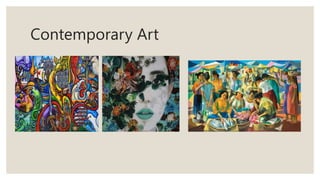
Contemporary
Philippine Arts from the
Regions
Quarter 1 - Module 1 - Arts in the Philippines
You are expected to:
1. define contemporary arts;
2. describe the art forms from the various regions
through the development of Philippine arts; and
3. describe various contemporary art forms from
the regions based on the elements and
principles of arts.
What Contemporary Arts
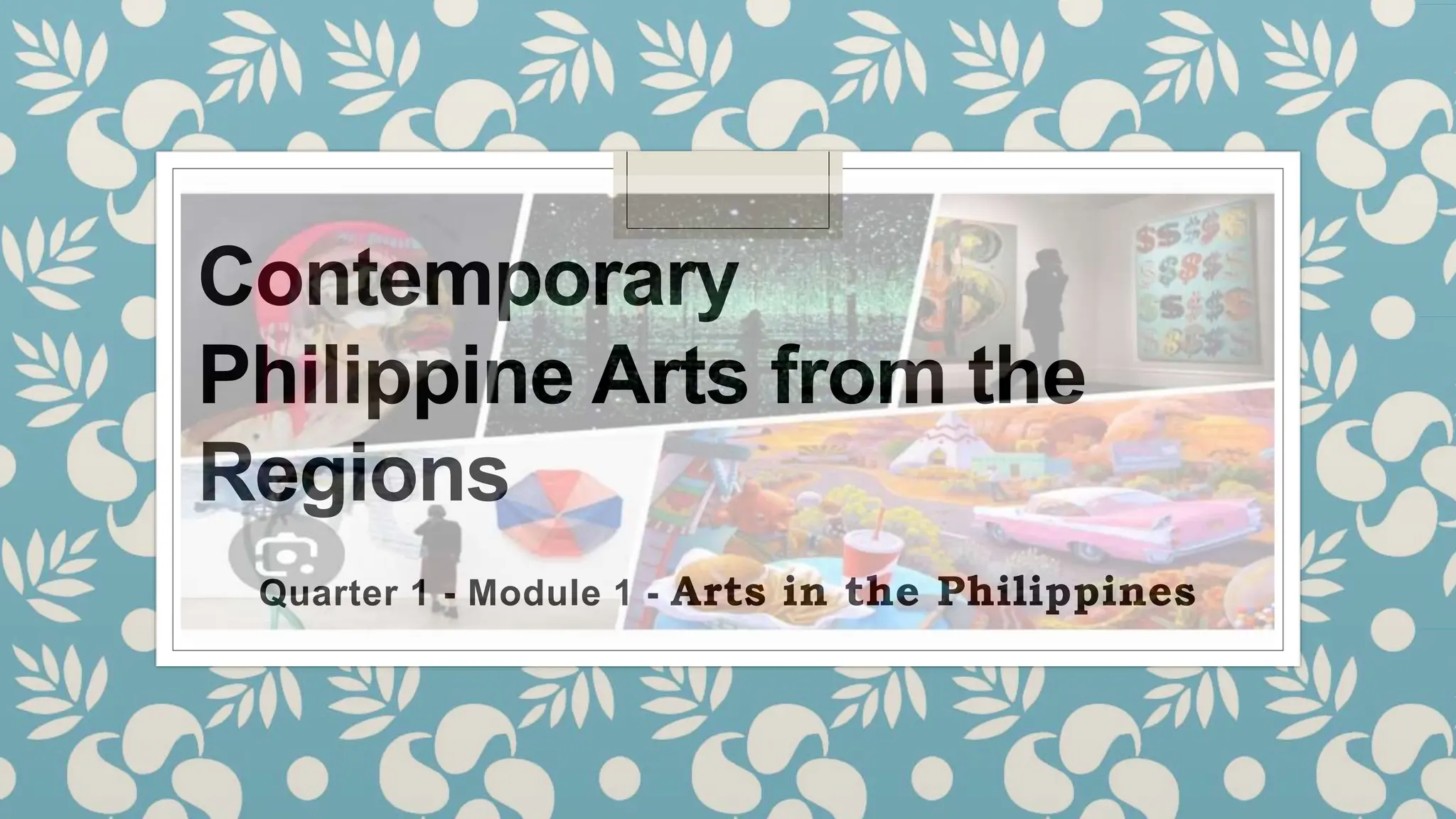
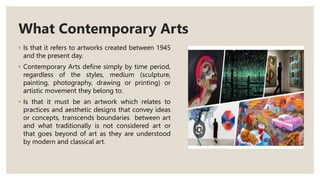
◦ Is that it refers to artworks created between 1945
and the present day.
◦ Contemporary Arts define simply by time period,
regardless of the styles, medium (sculpture,
painting, photography, drawing or printing) or
artistic movement they belong to.
◦ Is that it must be an artwork which relates to
practices and aesthetic designs that convey ideas
or concepts, transcends boundaries between art
and what traditionally is not considered art or
that goes beyond of art as they are understood
by modern and classical art.
Arts in the Philippines
◦ Art or “Sining” is defined as the different manners of
expressing human skills and imagination in the
creation of aesthetic conditions, objects and
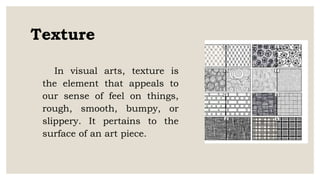
presentations. Art is not confined only to what is seen.
Art involves the use of all the physical senses in order to
appreciate it.
◦ Arts play a significant role in the abundant cultural identity of
the Philippines. It reflects the people, history, and traditions of the
Philippines as a whole.
◦Directions: Complete the graphic organizer by supplying five words that you think
relates Philippine Arts. Then, write three sentences that explain why you think those
words are associated with the given main idea.
Explanation:
PHILLIPINE
ARTS
◦ Philippines has diverse art forms from its different regions.
◦ These diverse art forms, when integrated, give a clear picture
of how abundant the culture and tradition of the Philippines is.
◦ It continues to evolve up to the present and progress to
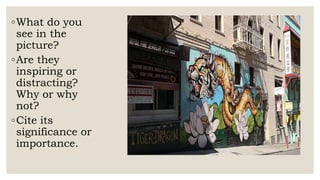
contemporary art tradition.
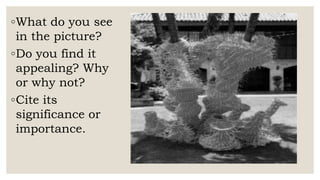
◦ As a Filipino, we should have the knowledge about the
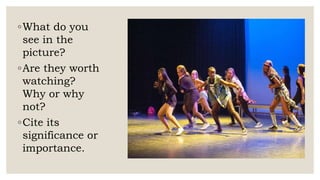
different art forms in the Philippines to fully understand the
culture, tradition, and nation’s identity.
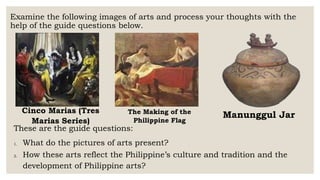
Examine the following images of arts and process your thoughts with the
help of the guide questions below.
Manunggul Jar
The Making of the
Philippine Flag
Cinco Marias (Tres
Marias Series)
These are the guide questions:
1. What do the pictures of arts present?
2. How these arts reflect the Philippine’s culture and tradition and the
development of Philippine arts?
The development of the Philippine arts comes in three
major traditions:
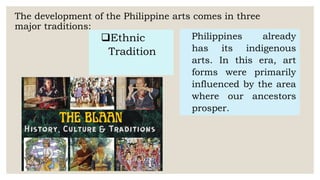
Ethnic
Tradition
Philippines already
has its indigenous
arts. In this era, art
forms were primarily
influenced by the area
where our ancestors
prosper.
The development of the Philippine arts comes in three
major traditions:
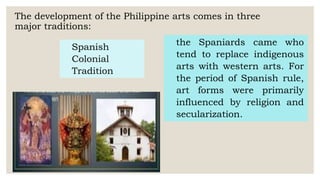
Spanish
Colonial
Tradition
the Spaniards came who
tend to replace indigenous
arts with western arts. For
the period of Spanish rule,
art forms were primarily
influenced by religion and
secularization.
The development of the Philippine arts comes in three
major traditions:
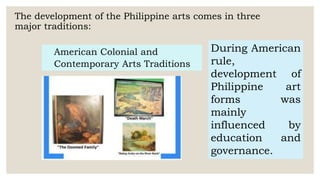
American Colonial and
Contemporary Arts Traditions
During American
rule,
development of
Philippine art
forms was
mainly
influenced by
education and
governance.
Contemporary Art
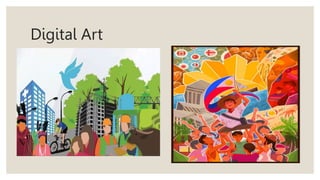
Digital Art
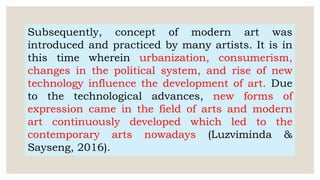
Subsequently, concept of modern art was
introduced and practiced by many artists. It is in
this time wherein urbanization, consumerism,
changes in the political system, and rise of new
technology influence the development of art. Due
to the technological advances, new forms of
expression came in the field of arts and modern
art continuously developed which led to the
contemporary arts nowadays (Luzviminda &
Sayseng, 2016).
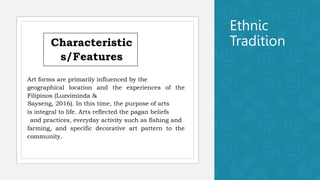
Ethnic
Tradition
Characteristic
s/Features
Art forms are primarily influenced by the
geographical location and the experiences of the
Filipinos (Luzviminda &
Sayseng, 2016). In this time, the purpose of arts
is integral to life. Arts reflected the pagan beliefs
and practices, everyday activity such as fishing and
farming, and specific decorative art pattern to the
community.
Ethnic
Tradition
https://upload.wikimedia.org
/wikipedia/commons/7/7b/
Angono-Petroglyphs-1.jpg
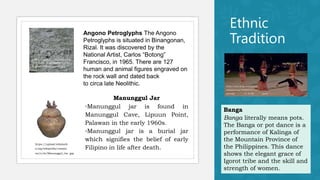
Angono Petroglyphs The Angono
Petroglyphs is situated in Binangonan,
Rizal. It was discovered by the
National Artist, Carlos “Botong”
Francisco, in 1965. There are 127
human and animal figures engraved on
the rock wall and dated back
to circa late Neolithic.
https://upload.wikimedi
a.org/wikipedia/commo
ns/e/eb/Manunggul_Jar .jpg
Manunggul Jar
◦Manunggul jar is found in
Manunggul Cave, Lipuun Point,
Palawan in the early 1960s.
◦Manunggul jar is a burial jar
which signifies the belief of early
Filipino in life after death.
Banga
Banga literally means pots.
The Banga or pot dance is a
performance of Kalinga of
the Mountain Province of
the Philippines. This dance
shows the elegant grace of
Igorot tribe and the skill and
strength of women.
https://www.flickr.com/photos
/kostastrovas/5586665289/in/
photolist - 9 vF7Xk - aqxtt6
Spanish
Colonial
Tradition
Characteristic
s/Features
Art forms were primarily influenced by religion and
secularization. In this time, Spaniards used
arts to propagate the Catholic faith
Spanish
Colonial
Tradition
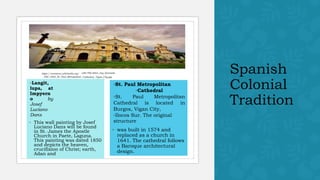
◦Langit,
lupa, at
Impyern
o by
Josef
Luciano
Dans
◦ This wall painting by Josef
Luciano Dans will be found
in St. James the Apostle
Church in Paete, Laguna.
This painting was dated 1850
and depicts the heaven,
crucifixion of Christ; earth,
Adan and
◦St. Paul Metropolitan
◦Cathedral
◦St. Paul Metropolitan
Cathedral is located in
Burgos, Vigan City,
◦Ilocos Sur. The original
structure
◦ was built in 1574 and
replaced as a church in
1641. The cathedral follows
a Baroque architectural
design.
https://commons.wikimedia.org/ wiki/File:Allan_Jay_Quesada
-
_DSC_0465_St._Paul_Metropolitan _Cathedral,_Vigan_City.jpg
American
Colonial and
Contemporary Arts
Traditions
Characteristic
s/Features
Modern Art
Modern art refers to the practice of art from 1860s to
1960s. the main theme of art works in this time is
national identity.
Contemporary Arts
Contemporary art refers to the practice of art from
1970s to the present. Contemporary arts mirror
contemporary culture and society. Diverse and
emerging art practices were being introduced in this
era.
American
Colonial
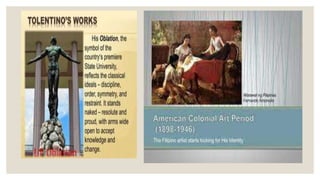
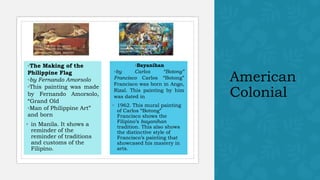
◦The Making of the
Philippine Flag
◦by Fernando Amorsolo
◦This painting was made
by Fernando Amorsolo,
“Grand Old
◦Man of Philippine Art”
and born
◦ in Manila. It shows a
reminder of the
reminder of traditions
and customs of the
Filipino.
◦Bayanihan
◦by Carlos “Botong”
Francisco Carlos “Botong”
Francisco was born in Ango,
Rizal. This painting by him
was dated in
◦ 1962. This mural painting
of Carlos “Botong”
Francisco shows the
Filipino’s bayanihan
tradition. This also shows
the distinctive style of
Francisco’s painting that
showcased his mastery in
arts.
https://www.flickr.com/photos
/192509194@N08/5102723041
2/in/photolist -tqrprj -2kK6TQG
https://www.flickr.com/photos/
nccaofficial/18250521149/in/p
hotolist-tNJG6K-2hVaF4W
Contemporary
Arts
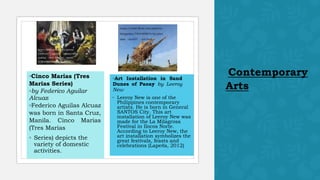
◦Cinco Marias (Tres
Marias Series)
◦by Federico Aguilar
Alcuaz
◦Federico Aguilas Alcuaz
was born in Santa Cruz,
Manila. Cinco Marias
(Tres Marias
◦ Series) depicts the
variety of domestic
activities.
◦Art Installation in Sand
Dunes of Paoay by Leeroy
New
◦ Leeroy New is one of the
Philippines contemporary
artists. He is born in General
SANTOS City. This art
installation of Leeroy New was
made for the La Milagrosa
Festival in Ilocos Norte.
According to Leeroy New, the
art installation symbolizes the
great festivals, feasts and
celebrations (Lape𝑛̃a, 2012)
http://www.artnet.com/artists
/federico -aguilar -alcuaz/cinco -
marias -tres -marias -series -
t13EdcO9e9IDJjcXRsyM5A2
https://www.flickr.com/photos/
blrapadas/7401469674/in/phot
olist -ch3t57 -bX1hu6
◦ These art forms from various regions or from various artists
contributed to the picture of Philippine’s identity as a country.
◦ And as a Filipino, it’s important that we have knowledge to
describe these art forms based on its details and elements, in
relation to our country’s culture and tradition, that makes it an
artistic piece.
◦ In the field of arts, knowing the elements and principles of arts
is important, not just to the artist but also to the viewer, to have
a deeper understanding of an artwork.
Elements of Art
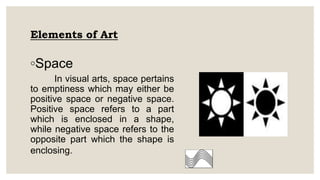
◦Space
In visual arts, space pertains
to emptiness which may either be
positive space or negative space.
Positive space refers to a part
which is enclosed in a shape,
while negative space refers to the
opposite part which the shape is
enclosing.
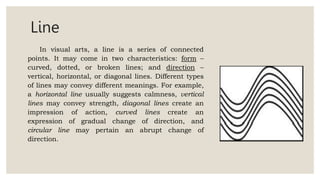
Line
In visual arts, a line is a series of connected
points. It may come in two characteristics: form –
curved, dotted, or broken lines; and direction –
vertical, horizontal, or diagonal lines. Different types
of lines may convey different meanings. For example,
a horizontal line usually suggests calmness, vertical
lines may convey strength, diagonal lines create an
impression of action, curved lines create an
expression of gradual change of direction, and
circular line may pertain an abrupt change of
direction.
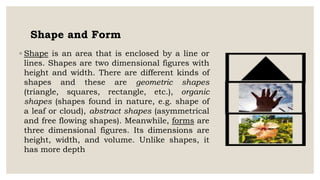
Shape and Form
◦ Shape is an area that is enclosed by a line or
lines. Shapes are two dimensional figures with
height and width. There are different kinds of
shapes and these are geometric shapes
(triangle, squares, rectangle, etc.), organic
shapes (shapes found in nature, e.g. shape of
a leaf or cloud), abstract shapes (asymmetrical
and free flowing shapes). Meanwhile, forms are
three dimensional figures. Its dimensions are
height, width, and volume. Unlike shapes, it
has more depth
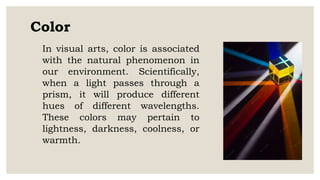
Color
In visual arts, color is associated
with the natural phenomenon in
our environment. Scientifically,
when a light passes through a
prism, it will produce different
hues of different wavelengths.
These colors may pertain to
lightness, darkness, coolness, or
warmth.
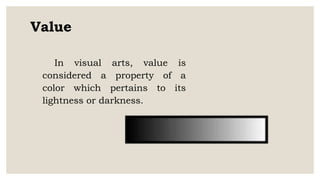
Value
In visual arts, value is
considered a property of a
color which pertains to its
lightness or darkness.
Texture
In visual arts, texture is
the element that appeals to
our sense of feel on things,
rough, smooth, bumpy, or
slippery. It pertains to the
surface of an art piece.
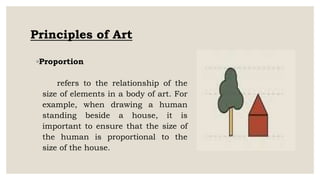
Principles of Art
◦Proportion
refers to the relationship of the
size of elements in a body of art. For
example, when drawing a human
standing beside a house, it is
important to ensure that the size of
the human is proportional to the
size of the house.
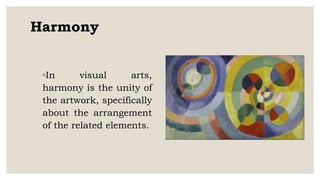
Harmony
◦In visual arts,
harmony is the unity of
the artwork, specifically
about the arrangement
of the related elements.
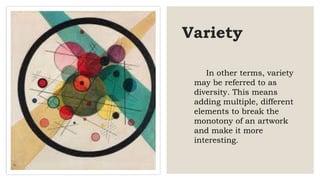
Variety
In other terms, variety
may be referred to as
diversity. This means
adding multiple, different
elements to break the
monotony of an artwork
and make it more
interesting.
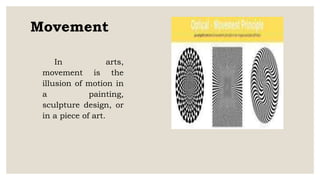
Movement
In arts,
movement is the
illusion of motion in
a painting,
sculpture design, or
in a piece of art.
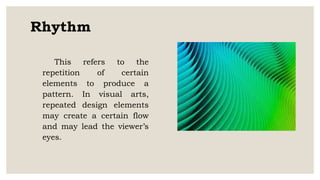
Rhythm
This refers to the
repetition of certain
elements to produce a
pattern. In visual arts,
repeated design elements
may create a certain flow
and may lead the viewer’s
eyes.
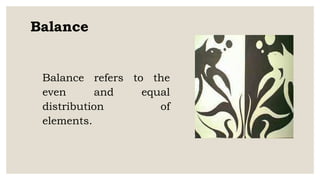
Balance
Balance refers to the
even and equal
distribution of
elements.
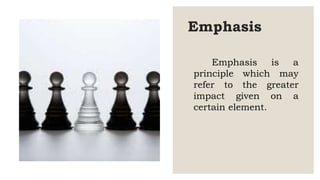
Emphasis
Emphasis is a
principle which may
refer to the greater
impact given on a
certain element.
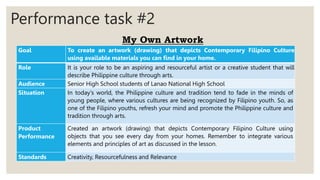
Performance task #2
My Own Artwork
Goal To create an artwork (drawing) that depicts Contemporary Filipino Culture
using available materials you can find in your home.
Role It is your role to be an aspiring and resourceful artist or a creative student that will
describe Philippine culture through arts.
Audience Senior High School students of Lanao National High School
Situation In today's world, the Philippine culture and tradition tend to fade in the minds of
young people, where various cultures are being recognized by Filipino youth. So, as
one of the Filipino youths, refresh your mind and promote the Philippine culture and
tradition through arts.
Product
Performance
Created an artwork (drawing) that depicts Contemporary Filipino Culture using
objects that you see every day from your homes. Remember to integrate various
elements and principles of art as discussed in the lesson.
Standards Creativity, Resourcefulness and Relevance
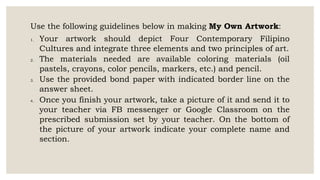
Use the following guidelines below in making My Own Artwork:
1. Your artwork should depict Four Contemporary Filipino
Cultures and integrate three elements and two principles of art.
2. The materials needed are available coloring materials (oil
pastels, crayons, color pencils, markers, etc.) and pencil.
3. Use the provided bond paper with indicated border line on the
answer sheet.
4. Once you finish your artwork, take a picture of it and send it to
your teacher via FB messenger or Google Classroom on the
prescribed submission set by your teacher. On the bottom of
the picture of your artwork indicate your complete name and
section.
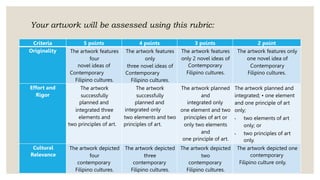
Your artwork will be assessed using this rubric:
Criteria 5 points 4 points 3 points 2 point
Originality The artwork features
four
novel ideas of
Contemporary
Filipino cultures.
The artwork features
only
three novel ideas of
Contemporary
Filipino cultures.
The artwork features
only 2 novel ideas of
Contemporary
Filipino cultures.
The artwork features only
one novel idea of
Contemporary
Filipino cultures.
Effort and
Rigor
The artwork
successfully
planned and
integrated three
elements and
two principles of art.
The artwork
successfully
planned and
integrated only
two elements and two
principles of art.
The artwork planned
and
integrated only
one element and two
principles of art or
only two elements
and
one principle of art.
The artwork planned and
integrated; • one element
and one principle of art
only;
• two elements of art
only; or
• two principles of art
only.
Cultural
Relevance
The artwork depicted
four
contemporary
Filipino cultures.
The artwork depicted
three
contemporary
Filipino cultures.
The artwork depicted
two
contemporary
Filipino cultures.
The artwork depicted one
contemporary
Filipino culture only.
END.
LESSON 2:ART:
MEANING AND
FORMS
LESSON 2:Art: Meaning and Forms
◦ Modern Philippine Arts from Contemporary Philippine Arts.
◦ It would be easy to misunderstand the two by treating them as
interchangeably the same. The recent years revealed a
conglomeration or mix of different art forms and art media that
are expressions of the times where we live in. Many art forms
are integrated to create artworks that are quite different from
Classical and Modern Arts. Integrative Art has become part of
Contemporary Art. Contemporary Art is evident when we go to
the different regions and provinces of our country. Each
artwork exhibiting its own uniqueness and meaning.
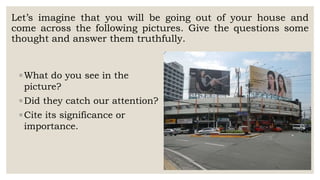
Let’s imagine that you will be going out of your house and
come across the following pictures. Give the questions some
thought and answer them truthfully.
◦ What do you see in the
picture?
◦ Did they catch our attention?
◦ Cite its significance or
importance.
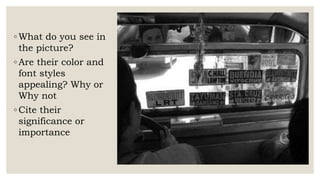
◦ What do you see in
the picture?
◦ Are their color and
font styles
appealing? Why or
Why not
◦ Cite their
significance or
importance
◦What do you
see in the
picture?
◦Are they
inspiring or
distracting?
Why or why
not?
◦Cite its
significance or
importance.
◦What do you see
in the picture?
◦Do you find it
appealing? Why
or why not?
◦Cite its
significance or
importance.
◦What do you
see in the
picture?
◦Are they worth
watching?
Why or why
not?
◦Cite its
significance or
importance.
◦The artworks and styles of the past have
evolved and have adapted to a dynamic
changing world, a world immersed in the
latest technology and emerging ideologies.
These artworks and styles are created,
witnessed and experienced in our lifetime by
artists and style experts catering to
Millennial and Gen Z viewers, and techy
clientele. These artworks are collectively
known as Contemporary Art.
◦The term contemporary has been defined as
something “happening, existing, living, or
coming into being during the same period of
time” (Merriam-Webster).
◦Assuming this definition, Contemporary Art
refers to art of any form and genre that
produced in our contemporary time, simply
put as “art created today.”
Contemporary Art
◦ Contemporary Art is influenced by the economic, social, political
and environmental context where the artist is immersed in.
◦ It can be said that Contemporary Art is the artist’s expression of
his perception and comprehension of these contexts.
◦ Contemporary Arts in the Philippines is as diverse as our people.
◦ Contemporary Philippine Art is not confined to the usual genres of
the four main art forms, namely, visual, literary, applied and
performing arts.
◦ Genres are categories of artistic creation and are characterized by
similarities in form, style, or subject matter.
◦ Many other genres came up which include pure are forms as well
as mixed art forms.
The following are examples from each art form:
Visual Arts Performance Arts Applied Arts Literary Arts
• Pop Art
• Word Art
• Conceptual Art
• Installation Art
• Photorealism
• Contemporary
Realism
• Graffiti Art
• Music: blues,
electronic,
experimental, funk,
hip-hop, jazz, metal,
pop, rock, roots
• Theater Art: stage,
film, street play
• Dance: flash mob,
Street Dances
comprising hiphop,
funk, house and rave
• Video Art
• Photography
• Computer Art
• Film and
Broadcasting Art
• Architecture, Design
and
Allied Art
• Illustrated Novel
• Digi-Fiction
• Graphic Novels
• Manga
• Doodle Fiction
• Text-Talk Novels
• Chick Literature
• Flash Fiction
• Hyper Poetry
• Blog
Elements of Contemporary Art
1. Appropriation, this relates to the modifications made by the
artist.
2. Hybridity, this refers in the use of different art mediums that
are put together.
3. Technology, its application highlights the creativity of the
artist.
4. Performance, carried out for viewers to experience.
5. Space, intricate use of space.
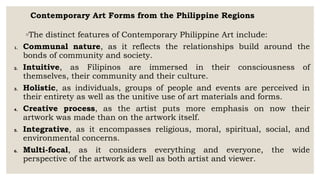
Contemporary Art Forms from the Philippine Regions
◦The distinct features of Contemporary Philippine Art include:
1. Communal nature, as it reflects the relationships build around the
bonds of community and society.
2. Intuitive, as Filipinos are immersed in their consciousness of
themselves, their community and their culture.
3. Holistic, as individuals, groups of people and events are perceived in
their entirety as well as the unitive use of art materials and forms.
4. Creative process, as the artist puts more emphasis on now their
artwork was made than on the artwork itself.
5. Integrative, as it encompasses religious, moral, spiritual, social, and
environmental concerns.
6. Multi-focal, as it considers everything and everyone, the wide
perspective of the artwork as well as both artist and viewer.

contemporary arts from the region module 1

  • 1.
    Contemporary Philippine Arts fromthe Regions Quarter 1 - Module 1 - Arts in the Philippines
  • 2.
    You are expectedto: 1. define contemporary arts; 2. describe the art forms from the various regions through the development of Philippine arts; and 3. describe various contemporary art forms from the regions based on the elements and principles of arts.
  • 3.
    What Contemporary Arts ◦Is that it refers to artworks created between 1945 and the present day. ◦ Contemporary Arts define simply by time period, regardless of the styles, medium (sculpture, painting, photography, drawing or printing) or artistic movement they belong to. ◦ Is that it must be an artwork which relates to practices and aesthetic designs that convey ideas or concepts, transcends boundaries between art and what traditionally is not considered art or that goes beyond of art as they are understood by modern and classical art.
  • 4.
    Arts in thePhilippines ◦ Art or “Sining” is defined as the different manners of expressing human skills and imagination in the creation of aesthetic conditions, objects and presentations. Art is not confined only to what is seen. Art involves the use of all the physical senses in order to appreciate it. ◦ Arts play a significant role in the abundant cultural identity of the Philippines. It reflects the people, history, and traditions of the Philippines as a whole.
  • 5.
    ◦Directions: Complete thegraphic organizer by supplying five words that you think relates Philippine Arts. Then, write three sentences that explain why you think those words are associated with the given main idea. Explanation: PHILLIPINE ARTS
  • 6.
    ◦ Philippines hasdiverse art forms from its different regions. ◦ These diverse art forms, when integrated, give a clear picture of how abundant the culture and tradition of the Philippines is. ◦ It continues to evolve up to the present and progress to contemporary art tradition. ◦ As a Filipino, we should have the knowledge about the different art forms in the Philippines to fully understand the culture, tradition, and nation’s identity.
  • 7.
    Examine the followingimages of arts and process your thoughts with the help of the guide questions below. Manunggul Jar The Making of the Philippine Flag Cinco Marias (Tres Marias Series) These are the guide questions: 1. What do the pictures of arts present? 2. How these arts reflect the Philippine’s culture and tradition and the development of Philippine arts?
  • 8.
    The development ofthe Philippine arts comes in three major traditions: Ethnic Tradition Philippines already has its indigenous arts. In this era, art forms were primarily influenced by the area where our ancestors prosper.
  • 9.
    The development ofthe Philippine arts comes in three major traditions: Spanish Colonial Tradition the Spaniards came who tend to replace indigenous arts with western arts. For the period of Spanish rule, art forms were primarily influenced by religion and secularization.
  • 10.
    The development ofthe Philippine arts comes in three major traditions: American Colonial and Contemporary Arts Traditions During American rule, development of Philippine art forms was mainly influenced by education and governance.
  • 12.
  • 13.
  • 14.
    Subsequently, concept ofmodern art was introduced and practiced by many artists. It is in this time wherein urbanization, consumerism, changes in the political system, and rise of new technology influence the development of art. Due to the technological advances, new forms of expression came in the field of arts and modern art continuously developed which led to the contemporary arts nowadays (Luzviminda & Sayseng, 2016).
  • 15.
    Ethnic Tradition Characteristic s/Features Art forms areprimarily influenced by the geographical location and the experiences of the Filipinos (Luzviminda & Sayseng, 2016). In this time, the purpose of arts is integral to life. Arts reflected the pagan beliefs and practices, everyday activity such as fishing and farming, and specific decorative art pattern to the community.
  • 16.
    Ethnic Tradition https://upload.wikimedia.org /wikipedia/commons/7/7b/ Angono-Petroglyphs-1.jpg Angono Petroglyphs TheAngono Petroglyphs is situated in Binangonan, Rizal. It was discovered by the National Artist, Carlos “Botong” Francisco, in 1965. There are 127 human and animal figures engraved on the rock wall and dated back to circa late Neolithic. https://upload.wikimedi a.org/wikipedia/commo ns/e/eb/Manunggul_Jar .jpg Manunggul Jar ◦Manunggul jar is found in Manunggul Cave, Lipuun Point, Palawan in the early 1960s. ◦Manunggul jar is a burial jar which signifies the belief of early Filipino in life after death. Banga Banga literally means pots. The Banga or pot dance is a performance of Kalinga of the Mountain Province of the Philippines. This dance shows the elegant grace of Igorot tribe and the skill and strength of women. https://www.flickr.com/photos /kostastrovas/5586665289/in/ photolist - 9 vF7Xk - aqxtt6
  • 17.
    Spanish Colonial Tradition Characteristic s/Features Art forms wereprimarily influenced by religion and secularization. In this time, Spaniards used arts to propagate the Catholic faith
  • 18.
    Spanish Colonial Tradition ◦Langit, lupa, at Impyern o by Josef Luciano Dans ◦This wall painting by Josef Luciano Dans will be found in St. James the Apostle Church in Paete, Laguna. This painting was dated 1850 and depicts the heaven, crucifixion of Christ; earth, Adan and ◦St. Paul Metropolitan ◦Cathedral ◦St. Paul Metropolitan Cathedral is located in Burgos, Vigan City, ◦Ilocos Sur. The original structure ◦ was built in 1574 and replaced as a church in 1641. The cathedral follows a Baroque architectural design. https://commons.wikimedia.org/ wiki/File:Allan_Jay_Quesada - _DSC_0465_St._Paul_Metropolitan _Cathedral,_Vigan_City.jpg
  • 19.
    American Colonial and Contemporary Arts Traditions Characteristic s/Features ModernArt Modern art refers to the practice of art from 1860s to 1960s. the main theme of art works in this time is national identity. Contemporary Arts Contemporary art refers to the practice of art from 1970s to the present. Contemporary arts mirror contemporary culture and society. Diverse and emerging art practices were being introduced in this era.
  • 20.
    American Colonial ◦The Making ofthe Philippine Flag ◦by Fernando Amorsolo ◦This painting was made by Fernando Amorsolo, “Grand Old ◦Man of Philippine Art” and born ◦ in Manila. It shows a reminder of the reminder of traditions and customs of the Filipino. ◦Bayanihan ◦by Carlos “Botong” Francisco Carlos “Botong” Francisco was born in Ango, Rizal. This painting by him was dated in ◦ 1962. This mural painting of Carlos “Botong” Francisco shows the Filipino’s bayanihan tradition. This also shows the distinctive style of Francisco’s painting that showcased his mastery in arts. https://www.flickr.com/photos /192509194@N08/5102723041 2/in/photolist -tqrprj -2kK6TQG https://www.flickr.com/photos/ nccaofficial/18250521149/in/p hotolist-tNJG6K-2hVaF4W
  • 21.
    Contemporary Arts ◦Cinco Marias (Tres MariasSeries) ◦by Federico Aguilar Alcuaz ◦Federico Aguilas Alcuaz was born in Santa Cruz, Manila. Cinco Marias (Tres Marias ◦ Series) depicts the variety of domestic activities. ◦Art Installation in Sand Dunes of Paoay by Leeroy New ◦ Leeroy New is one of the Philippines contemporary artists. He is born in General SANTOS City. This art installation of Leeroy New was made for the La Milagrosa Festival in Ilocos Norte. According to Leeroy New, the art installation symbolizes the great festivals, feasts and celebrations (Lape𝑛̃a, 2012) http://www.artnet.com/artists /federico -aguilar -alcuaz/cinco - marias -tres -marias -series - t13EdcO9e9IDJjcXRsyM5A2 https://www.flickr.com/photos/ blrapadas/7401469674/in/phot olist -ch3t57 -bX1hu6
  • 22.
    ◦ These artforms from various regions or from various artists contributed to the picture of Philippine’s identity as a country. ◦ And as a Filipino, it’s important that we have knowledge to describe these art forms based on its details and elements, in relation to our country’s culture and tradition, that makes it an artistic piece. ◦ In the field of arts, knowing the elements and principles of arts is important, not just to the artist but also to the viewer, to have a deeper understanding of an artwork.
  • 23.
    Elements of Art ◦Space Invisual arts, space pertains to emptiness which may either be positive space or negative space. Positive space refers to a part which is enclosed in a shape, while negative space refers to the opposite part which the shape is enclosing.
  • 24.
    Line In visual arts,a line is a series of connected points. It may come in two characteristics: form – curved, dotted, or broken lines; and direction – vertical, horizontal, or diagonal lines. Different types of lines may convey different meanings. For example, a horizontal line usually suggests calmness, vertical lines may convey strength, diagonal lines create an impression of action, curved lines create an expression of gradual change of direction, and circular line may pertain an abrupt change of direction.
  • 25.
    Shape and Form ◦Shape is an area that is enclosed by a line or lines. Shapes are two dimensional figures with height and width. There are different kinds of shapes and these are geometric shapes (triangle, squares, rectangle, etc.), organic shapes (shapes found in nature, e.g. shape of a leaf or cloud), abstract shapes (asymmetrical and free flowing shapes). Meanwhile, forms are three dimensional figures. Its dimensions are height, width, and volume. Unlike shapes, it has more depth
  • 26.
    Color In visual arts,color is associated with the natural phenomenon in our environment. Scientifically, when a light passes through a prism, it will produce different hues of different wavelengths. These colors may pertain to lightness, darkness, coolness, or warmth.
  • 27.
    Value In visual arts,value is considered a property of a color which pertains to its lightness or darkness.
  • 28.
    Texture In visual arts,texture is the element that appeals to our sense of feel on things, rough, smooth, bumpy, or slippery. It pertains to the surface of an art piece.
  • 29.
    Principles of Art ◦Proportion refersto the relationship of the size of elements in a body of art. For example, when drawing a human standing beside a house, it is important to ensure that the size of the human is proportional to the size of the house.
  • 30.
    Harmony ◦In visual arts, harmonyis the unity of the artwork, specifically about the arrangement of the related elements.
  • 31.
    Variety In other terms,variety may be referred to as diversity. This means adding multiple, different elements to break the monotony of an artwork and make it more interesting.
  • 32.
    Movement In arts, movement isthe illusion of motion in a painting, sculpture design, or in a piece of art.
  • 33.
    Rhythm This refers tothe repetition of certain elements to produce a pattern. In visual arts, repeated design elements may create a certain flow and may lead the viewer’s eyes.
  • 34.
    Balance Balance refers tothe even and equal distribution of elements.
  • 35.
    Emphasis Emphasis is a principlewhich may refer to the greater impact given on a certain element.
  • 36.
    Performance task #2 MyOwn Artwork Goal To create an artwork (drawing) that depicts Contemporary Filipino Culture using available materials you can find in your home. Role It is your role to be an aspiring and resourceful artist or a creative student that will describe Philippine culture through arts. Audience Senior High School students of Lanao National High School Situation In today's world, the Philippine culture and tradition tend to fade in the minds of young people, where various cultures are being recognized by Filipino youth. So, as one of the Filipino youths, refresh your mind and promote the Philippine culture and tradition through arts. Product Performance Created an artwork (drawing) that depicts Contemporary Filipino Culture using objects that you see every day from your homes. Remember to integrate various elements and principles of art as discussed in the lesson. Standards Creativity, Resourcefulness and Relevance
  • 37.
    Use the followingguidelines below in making My Own Artwork: 1. Your artwork should depict Four Contemporary Filipino Cultures and integrate three elements and two principles of art. 2. The materials needed are available coloring materials (oil pastels, crayons, color pencils, markers, etc.) and pencil. 3. Use the provided bond paper with indicated border line on the answer sheet. 4. Once you finish your artwork, take a picture of it and send it to your teacher via FB messenger or Google Classroom on the prescribed submission set by your teacher. On the bottom of the picture of your artwork indicate your complete name and section.
  • 38.
    Your artwork willbe assessed using this rubric: Criteria 5 points 4 points 3 points 2 point Originality The artwork features four novel ideas of Contemporary Filipino cultures. The artwork features only three novel ideas of Contemporary Filipino cultures. The artwork features only 2 novel ideas of Contemporary Filipino cultures. The artwork features only one novel idea of Contemporary Filipino cultures. Effort and Rigor The artwork successfully planned and integrated three elements and two principles of art. The artwork successfully planned and integrated only two elements and two principles of art. The artwork planned and integrated only one element and two principles of art or only two elements and one principle of art. The artwork planned and integrated; • one element and one principle of art only; • two elements of art only; or • two principles of art only. Cultural Relevance The artwork depicted four contemporary Filipino cultures. The artwork depicted three contemporary Filipino cultures. The artwork depicted two contemporary Filipino cultures. The artwork depicted one contemporary Filipino culture only.
  • 39.
  • 40.
  • 41.
    LESSON 2:Art: Meaningand Forms ◦ Modern Philippine Arts from Contemporary Philippine Arts. ◦ It would be easy to misunderstand the two by treating them as interchangeably the same. The recent years revealed a conglomeration or mix of different art forms and art media that are expressions of the times where we live in. Many art forms are integrated to create artworks that are quite different from Classical and Modern Arts. Integrative Art has become part of Contemporary Art. Contemporary Art is evident when we go to the different regions and provinces of our country. Each artwork exhibiting its own uniqueness and meaning.
  • 42.
    Let’s imagine thatyou will be going out of your house and come across the following pictures. Give the questions some thought and answer them truthfully. ◦ What do you see in the picture? ◦ Did they catch our attention? ◦ Cite its significance or importance.
  • 43.
    ◦ What doyou see in the picture? ◦ Are their color and font styles appealing? Why or Why not ◦ Cite their significance or importance
  • 44.
    ◦What do you seein the picture? ◦Are they inspiring or distracting? Why or why not? ◦Cite its significance or importance.
  • 45.
    ◦What do yousee in the picture? ◦Do you find it appealing? Why or why not? ◦Cite its significance or importance.
  • 46.
    ◦What do you seein the picture? ◦Are they worth watching? Why or why not? ◦Cite its significance or importance.
  • 47.
    ◦The artworks andstyles of the past have evolved and have adapted to a dynamic changing world, a world immersed in the latest technology and emerging ideologies. These artworks and styles are created, witnessed and experienced in our lifetime by artists and style experts catering to Millennial and Gen Z viewers, and techy clientele. These artworks are collectively known as Contemporary Art.
  • 48.
    ◦The term contemporaryhas been defined as something “happening, existing, living, or coming into being during the same period of time” (Merriam-Webster). ◦Assuming this definition, Contemporary Art refers to art of any form and genre that produced in our contemporary time, simply put as “art created today.”
  • 49.
    Contemporary Art ◦ ContemporaryArt is influenced by the economic, social, political and environmental context where the artist is immersed in. ◦ It can be said that Contemporary Art is the artist’s expression of his perception and comprehension of these contexts. ◦ Contemporary Arts in the Philippines is as diverse as our people. ◦ Contemporary Philippine Art is not confined to the usual genres of the four main art forms, namely, visual, literary, applied and performing arts. ◦ Genres are categories of artistic creation and are characterized by similarities in form, style, or subject matter. ◦ Many other genres came up which include pure are forms as well as mixed art forms.
  • 50.
    The following areexamples from each art form: Visual Arts Performance Arts Applied Arts Literary Arts • Pop Art • Word Art • Conceptual Art • Installation Art • Photorealism • Contemporary Realism • Graffiti Art • Music: blues, electronic, experimental, funk, hip-hop, jazz, metal, pop, rock, roots • Theater Art: stage, film, street play • Dance: flash mob, Street Dances comprising hiphop, funk, house and rave • Video Art • Photography • Computer Art • Film and Broadcasting Art • Architecture, Design and Allied Art • Illustrated Novel • Digi-Fiction • Graphic Novels • Manga • Doodle Fiction • Text-Talk Novels • Chick Literature • Flash Fiction • Hyper Poetry • Blog
  • 51.
    Elements of ContemporaryArt 1. Appropriation, this relates to the modifications made by the artist. 2. Hybridity, this refers in the use of different art mediums that are put together. 3. Technology, its application highlights the creativity of the artist. 4. Performance, carried out for viewers to experience. 5. Space, intricate use of space.
  • 52.
    Contemporary Art Formsfrom the Philippine Regions ◦The distinct features of Contemporary Philippine Art include: 1. Communal nature, as it reflects the relationships build around the bonds of community and society. 2. Intuitive, as Filipinos are immersed in their consciousness of themselves, their community and their culture. 3. Holistic, as individuals, groups of people and events are perceived in their entirety as well as the unitive use of art materials and forms. 4. Creative process, as the artist puts more emphasis on now their artwork was made than on the artwork itself. 5. Integrative, as it encompasses religious, moral, spiritual, social, and environmental concerns. 6. Multi-focal, as it considers everything and everyone, the wide perspective of the artwork as well as both artist and viewer.

Editor's Notes

  • #6 With that, let us check your ideas about Philippine arts.
  • #7 In this module, you will have an understanding and appreciation of the Philippine Arts specifically the Contemporary Philippine Arts. To start your learning of the different art forms in the Philippines
  • #9 The development of the Philippine arts comes in three major traditions. These are the Ethnic Tradition, Spanish Colonial Tradition, and American Colonial and Contemporary Arts Traditions. Even before the colonization, the Philippines already has its indigenous arts-. In this era, art forms were primarily influenced by the area where our ancestors prosper. ethnic tra the Spaniards came who tend to replace indigenous arts with western arts. For the period of Spanish rule, art forms were primarily influenced by religion and secularization – Spanish tra , after more than three centuries of Spanish colonization, Americans came. American rule, development of Philippine art forms was mainly influenced by education and governance.
  • #10 The development of the Philippine arts comes in three major traditions. These are the Ethnic Tradition, Spanish Colonial Tradition, and American Colonial and Contemporary Arts Traditions. Even before the colonization, the Philippines already has its indigenous arts-. In this era, art forms were primarily influenced by the area where our ancestors prosper. ethnic tra the Spaniards came who tend to replace indigenous arts with western arts. For the period of Spanish rule, art forms were primarily influenced by religion and secularization – Spanish tra , after more than three centuries of Spanish colonization, Americans came. American rule, development of Philippine art forms was mainly influenced by education and governance.
  • #36 These elements and principles of arts are essential to understand the meaning of a piece of art clearly and deeply. In relation to that, diverse art forms in the Philippines convey its meanings through the elements and principles present to them. So, as we described some art forms from the various regions through the development of Philippine arts, let’s use the elements and principles of arts to understand it.
  • #42 Different kinds of local artworks have sprung not only in the urban centers of the country and in schools of arts of different educational institutions but also a lot more of never before seen or heard art forms from the countryside have made known and have become renowned. The seeming isolation and distance of many communities in far flung regions have kept the beauty and significance of countless forms of Philippine art. It is real good news that they have been exposed and have been expressed. It is essential to know and understand the meaning of the term contemporary when used in defining Contemporary Philippine Arts. Understanding it would pave the way for better appreciation of the arts in the Philippine context. Understanding Philippine Arts would provide a better perception of the details, context, meaning and significance of the artworks placed in a cultural, political and historical context.
  • #43 People get out of their houses to go to school, to work or to buy something. Almost all of them are unmindful of their surroundings as they seldom pay attention to the daily usual sights and sounds. They all come back home with same circumstances. The signages, billboards, music, pictures and other similar visual and auditory presentations have become a conglomeration of perceived mundane elements of daily life. Thus, the beauty, relevance, significance and implications of these otherwise monotonous external stimuli are seldom comprehended and appreciated.
  • #48 The pictures presented in the previous activity are depictions of the artworks that are seen today. Present day art has a lot of variety. There are various expressions Philippine art that can be found right inside our homes and are found everywhere. The arrangement of furniture, home décor, the way a mother cooks a particular kind of food to the jeepney designs and signages, architecture of buildings, billboard designs and other unnoticed works of art, comprise the “art of today.”
  • #49 It should not be confused with Modern Art which ranges from the end of the 19th Century until the 1970’s or 1980’s or the late 20th Century. It will put Contemporary Art from the late 20th Century to the present. Modern Art differs from Contemporary Art historically and contextually.