Methods of Philosophizing
Pre Activity. What is an Infographics?
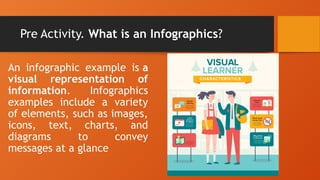
An infographic example is a
visual representation of
information. Infographics
examples include a variety
of elements, such as images,
icons, text, charts, and
diagrams to convey
messages at a glance
Activity Proper. Infographics for Truth
Instructions:
• You will be divided into five groups.
• Each group will be given a topic that deals on different methods of
philosophizing.
• Brainstorm on the contents of each method. Focus on how it deals with
knowledge and search for truth. Know also the different philosophers on each
method and their contributions to philosophy.
• Make an inforgraphics that will show your understanding of each method.
Make sure that all the questions on instruction 3 are answered. Be creative
enough. It should be informative and easy to understand.
• Discuss it with your class.
Methods of Philosophizing
1. The Dialectic method
2. The Pragmatic Method
3. The Phenomonological Method
4. The Primary and Secondary Reflections
5. The Analytic Method
Post Activity. Reflection
• What have you learned from the activity?
• With these methods can we easily distinguish truth from not?
• From the five methods, which is most suitable in todays era?
I learned that Truth is _____________________________________.
I feel that Truth is important because ________________________.
I commit to uphold the truth by _____________________________.
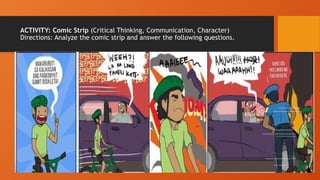
ACTIVITY: Comic Strip (Critical Thinking, Communication, Character)
Directions: Analyze the comic strip and answer the following questions.
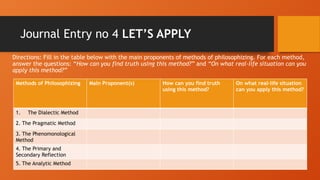
Journal Entry no 4 LET’S APPLY
Directions: Fill in the table below with the main proponents of methods of philosophizing. For each method,
answer the questions: “How can you find truth using this method?” and “On what real-life situation can you
apply this method?”
Methods of Philosophizing Main Proponent(s) How can you find truth
using this method?
On what real-life situation
can you apply this method?
1. The Dialectic Method
2. The Pragmatic Method
3. The Phenomonological
Method
4. The Primary and
Secondary Reflection
5. The Analytic Method
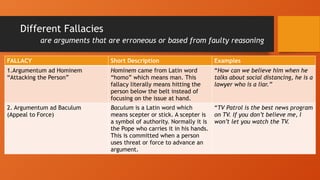
Different Fallacies
are arguments that are erroneous or based from faulty reasoning
FALLACY Short Description Examples
1.Argumentum ad Hominem
“Attacking the Person”
Hominem came from Latin word
“homo” which means man. This
fallacy literally means hitting the
person below the belt instead of
focusing on the issue at hand.
“How can we believe him when he
talks about social distancing, he is a
lawyer who is a liar.”
2. Argumentum ad Baculum
(Appeal to Force)
Baculum is a Latin word which
means scepter or stick. A scepter is
a symbol of authority. Normally it is
the Pope who carries it in his hands.
This is committed when a person
uses threat or force to advance an
argument.
“TV Patrol is the best news program
on TV. If you don’t believe me, I
won’t let you watch the TV.
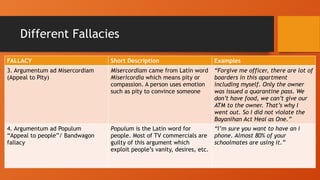
Different Fallacies
FALLACY Short Description Examples
3. Argumentum ad Misercordiam
(Appeal to Pity)
Misercordiam came from Latin word
Misericordia which means pity or
compassion. A person uses emotion
such as pity to convince someone
“Forgive me officer, there are lot of
boarders in this apartment
including myself. Only the owner
was issued a quarantine pass. We
don’t have food, we can’t give our
ATM to the owner. That’s why I
went out. So I did not violate the
Bayanihan Act Heal as One.”
4. Argumentum ad Populum
“Appeal to people”/ Bandwagon
fallacy
Populum is the Latin word for
people. Most of TV commercials are
guilty of this argument which
exploit people’s vanity, desires, etc.
“I’m sure you want to have an i
phone. Almost 80% of your
schoolmates are using it.”
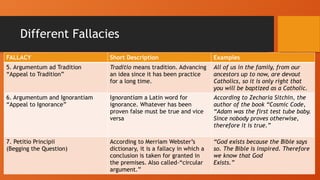
Different Fallacies
FALLACY Short Description Examples
5. Argumentum ad Tradition
“Appeal to Tradition”
Traditio means tradition. Advancing
an idea since it has been practice
for a long time.
All of us in the family, from our
ancestors up to now, are devout
Catholics, so it is only right that
you will be baptized as a Catholic.
6. Argumentum and Ignorantiam
“Appeal to Ignorance”
Ignorantiam a Latin word for
ignorance. Whatever has been
proven false must be true and vice
versa
According to Zecharia Sitchin, the
author of the book “Cosmic Code,
“Adam was the first test tube baby.
Since nobody proves otherwise,
therefore it is true.”
7. Petitio Principii
(Begging the Question)
According to Merriam Webster’s
dictionary, it is a fallacy in which a
conclusion is taken for granted in
the premises. Also called-“circular
argument.”
“God exists because the Bible says
so. The Bible is inspired. Therefore
we know that God
Exists.”
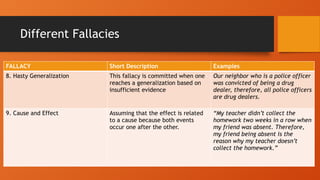
Different Fallacies
FALLACY Short Description Examples
8. Hasty Generalization This fallacy is committed when one
reaches a generalization based on
insufficient evidence
Our neighbor who is a police officer
was convicted of being a drug
dealer, therefore, all police officers
are drug dealers.
9. Cause and Effect Assuming that the effect is related
to a cause because both events
occur one after the other.
“My teacher didn’t collect the
homework two weeks in a row when
my friend was absent. Therefore,
my friend being absent is the
reason why my teacher doesn’t
collect the homework.”
Different Fallacies
FALLACY Short Description Examples
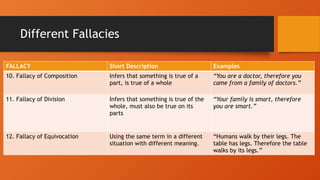
10. Fallacy of Composition Infers that something is true of a
part, is true of a whole
“You are a doctor, therefore you
came from a family of doctors.”
11. Fallacy of Division Infers that something is true of the
whole, must also be true on its
parts
“Your family is smart, therefore
you are smart.”
12. Fallacy of Equivocation Using the same term in a different
situation with different meaning.
“Humans walk by their legs. The
table has legs. Therefore the table
walks by its legs.”
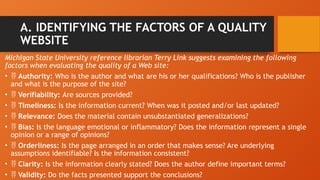
A. IDENTIFYING THE FACTORS OF A QUALITY
WEBSITE
Michigan State University reference librarian Terry Link suggests examining the following
factors when evaluating the quality of a Web site:
•  Authority: Who is the author and what are his or her qualifications? Who is the publisher
and what is the purpose of the site?
•  Verifiability: Are sources provided?
•  Timeliness: Is the information current? When was it posted and/or last updated?
•  Relevance: Does the material contain unsubstantiated generalizations?
•  Bias: Is the language emotional or inflammatory? Does the information represent a single
opinion or a range of opinions?
•  Orderliness: Is the page arranged in an order that makes sense? Are underlying
assumptions identifiable? Is the information consistent?
•  Clarity: Is the information clearly stated? Does the author define important terms?
•  Validity: Do the facts presented support the conclusions?
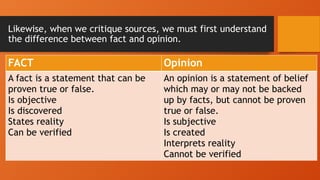
Likewise, when we critique sources, we must first understand
the difference between fact and opinion.
FACT Opinion
A fact is a statement that can be
proven true or false.
Is objective
Is discovered
States reality
Can be verified
An opinion is a statement of belief
which may or may not be backed
up by facts, but cannot be proven
true or false.
Is subjective
Is created
Interprets reality
Cannot be verified
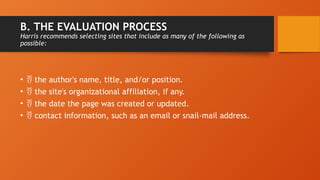
B. THE EVALUATION PROCESS
Harris recommends selecting sites that include as many of the following as
possible:
•  the author's name, title, and/or position.
•  the site's organizational affiliation, if any.
•  the date the page was created or updated.
•  contact information, such as an email or snail-mail address.
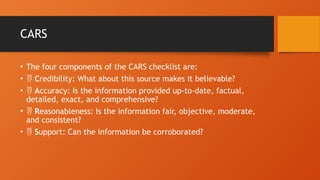
CARS
• The four components of the CARS checklist are:
•  Credibility: What about this source makes it believable?
•  Accuracy: Is the information provided up-to-date, factual,
detailed, exact, and comprehensive?
•  Reasonableness: Is the information fair, objective, moderate,
and consistent?
•  Support: Can the information be corroborated?
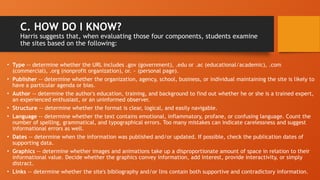
C. HOW DO I KNOW?
Harris suggests that, when evaluating those four components, students examine
the sites based on the following:
• Type -- determine whether the URL includes .gov (government), .edu or .ac (educational/academic), .com
(commercial), .org (nonprofit organization), or. ~ (personal page).
• Publisher -- determine whether the organization, agency, school, business, or individual maintaining the site is likely to
have a particular agenda or bias.
• Author -- determine the author's education, training, and background to find out whether he or she is a trained expert,
an experienced enthusiast, or an uninformed observer.
• Structure -- determine whether the format is clear, logical, and easily navigable.
• Language -- determine whether the text contains emotional, inflammatory, profane, or confusing language. Count the
number of spelling, grammatical, and typographical errors. Too many mistakes can indicate carelessness and suggest
informational errors as well.
• Dates -- determine when the information was published and/or updated. If possible, check the publication dates of
supporting data.
• Graphics -- determine whether images and animations take up a disproportionate amount of space in relation to their
informational value. Decide whether the graphics convey information, add interest, provide interactivity, or simply
distract.
• Links -- determine whether the site's bibliography and/or lins contain both supportive and contradictory information.
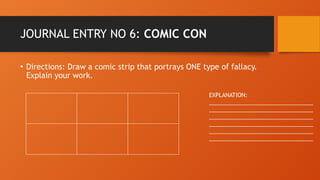
JOURNAL ENTRY NO 6: COMIC CON
• Directions: Draw a comic strip that portrays ONE type of fallacy.
Explain your work.
EXPLANATION:
_________________________________
_________________________________
_________________________________
_________________________________
_________________________________
_________________________________

METHODS-OF-PHILOSOPHIZING [Autosaved].pptx

  • 1.
  • 2.
    Pre Activity. Whatis an Infographics? An infographic example is a visual representation of information. Infographics examples include a variety of elements, such as images, icons, text, charts, and diagrams to convey messages at a glance
  • 3.
    Activity Proper. Infographicsfor Truth Instructions: • You will be divided into five groups. • Each group will be given a topic that deals on different methods of philosophizing. • Brainstorm on the contents of each method. Focus on how it deals with knowledge and search for truth. Know also the different philosophers on each method and their contributions to philosophy. • Make an inforgraphics that will show your understanding of each method. Make sure that all the questions on instruction 3 are answered. Be creative enough. It should be informative and easy to understand. • Discuss it with your class.
  • 4.
    Methods of Philosophizing 1.The Dialectic method 2. The Pragmatic Method 3. The Phenomonological Method 4. The Primary and Secondary Reflections 5. The Analytic Method
  • 5.
    Post Activity. Reflection •What have you learned from the activity? • With these methods can we easily distinguish truth from not? • From the five methods, which is most suitable in todays era? I learned that Truth is _____________________________________. I feel that Truth is important because ________________________. I commit to uphold the truth by _____________________________.
  • 6.
    ACTIVITY: Comic Strip(Critical Thinking, Communication, Character) Directions: Analyze the comic strip and answer the following questions.
  • 7.
    Journal Entry no4 LET’S APPLY Directions: Fill in the table below with the main proponents of methods of philosophizing. For each method, answer the questions: “How can you find truth using this method?” and “On what real-life situation can you apply this method?” Methods of Philosophizing Main Proponent(s) How can you find truth using this method? On what real-life situation can you apply this method? 1. The Dialectic Method 2. The Pragmatic Method 3. The Phenomonological Method 4. The Primary and Secondary Reflection 5. The Analytic Method
  • 8.
    Different Fallacies are argumentsthat are erroneous or based from faulty reasoning FALLACY Short Description Examples 1.Argumentum ad Hominem “Attacking the Person” Hominem came from Latin word “homo” which means man. This fallacy literally means hitting the person below the belt instead of focusing on the issue at hand. “How can we believe him when he talks about social distancing, he is a lawyer who is a liar.” 2. Argumentum ad Baculum (Appeal to Force) Baculum is a Latin word which means scepter or stick. A scepter is a symbol of authority. Normally it is the Pope who carries it in his hands. This is committed when a person uses threat or force to advance an argument. “TV Patrol is the best news program on TV. If you don’t believe me, I won’t let you watch the TV.
  • 9.
    Different Fallacies FALLACY ShortDescription Examples 3. Argumentum ad Misercordiam (Appeal to Pity) Misercordiam came from Latin word Misericordia which means pity or compassion. A person uses emotion such as pity to convince someone “Forgive me officer, there are lot of boarders in this apartment including myself. Only the owner was issued a quarantine pass. We don’t have food, we can’t give our ATM to the owner. That’s why I went out. So I did not violate the Bayanihan Act Heal as One.” 4. Argumentum ad Populum “Appeal to people”/ Bandwagon fallacy Populum is the Latin word for people. Most of TV commercials are guilty of this argument which exploit people’s vanity, desires, etc. “I’m sure you want to have an i phone. Almost 80% of your schoolmates are using it.”
  • 10.
    Different Fallacies FALLACY ShortDescription Examples 5. Argumentum ad Tradition “Appeal to Tradition” Traditio means tradition. Advancing an idea since it has been practice for a long time. All of us in the family, from our ancestors up to now, are devout Catholics, so it is only right that you will be baptized as a Catholic. 6. Argumentum and Ignorantiam “Appeal to Ignorance” Ignorantiam a Latin word for ignorance. Whatever has been proven false must be true and vice versa According to Zecharia Sitchin, the author of the book “Cosmic Code, “Adam was the first test tube baby. Since nobody proves otherwise, therefore it is true.” 7. Petitio Principii (Begging the Question) According to Merriam Webster’s dictionary, it is a fallacy in which a conclusion is taken for granted in the premises. Also called-“circular argument.” “God exists because the Bible says so. The Bible is inspired. Therefore we know that God Exists.”
  • 11.
    Different Fallacies FALLACY ShortDescription Examples 8. Hasty Generalization This fallacy is committed when one reaches a generalization based on insufficient evidence Our neighbor who is a police officer was convicted of being a drug dealer, therefore, all police officers are drug dealers. 9. Cause and Effect Assuming that the effect is related to a cause because both events occur one after the other. “My teacher didn’t collect the homework two weeks in a row when my friend was absent. Therefore, my friend being absent is the reason why my teacher doesn’t collect the homework.”
  • 12.
    Different Fallacies FALLACY ShortDescription Examples 10. Fallacy of Composition Infers that something is true of a part, is true of a whole “You are a doctor, therefore you came from a family of doctors.” 11. Fallacy of Division Infers that something is true of the whole, must also be true on its parts “Your family is smart, therefore you are smart.” 12. Fallacy of Equivocation Using the same term in a different situation with different meaning. “Humans walk by their legs. The table has legs. Therefore the table walks by its legs.”
  • 13.
    A. IDENTIFYING THEFACTORS OF A QUALITY WEBSITE Michigan State University reference librarian Terry Link suggests examining the following factors when evaluating the quality of a Web site: •  Authority: Who is the author and what are his or her qualifications? Who is the publisher and what is the purpose of the site? •  Verifiability: Are sources provided? •  Timeliness: Is the information current? When was it posted and/or last updated? •  Relevance: Does the material contain unsubstantiated generalizations? •  Bias: Is the language emotional or inflammatory? Does the information represent a single opinion or a range of opinions? •  Orderliness: Is the page arranged in an order that makes sense? Are underlying assumptions identifiable? Is the information consistent? •  Clarity: Is the information clearly stated? Does the author define important terms? •  Validity: Do the facts presented support the conclusions?
  • 14.
    Likewise, when wecritique sources, we must first understand the difference between fact and opinion. FACT Opinion A fact is a statement that can be proven true or false. Is objective Is discovered States reality Can be verified An opinion is a statement of belief which may or may not be backed up by facts, but cannot be proven true or false. Is subjective Is created Interprets reality Cannot be verified
  • 15.
    B. THE EVALUATIONPROCESS Harris recommends selecting sites that include as many of the following as possible: •  the author's name, title, and/or position. •  the site's organizational affiliation, if any. •  the date the page was created or updated. •  contact information, such as an email or snail-mail address.
  • 16.
    CARS • The fourcomponents of the CARS checklist are: •  Credibility: What about this source makes it believable? •  Accuracy: Is the information provided up-to-date, factual, detailed, exact, and comprehensive? •  Reasonableness: Is the information fair, objective, moderate, and consistent? •  Support: Can the information be corroborated?
  • 17.
    C. HOW DOI KNOW? Harris suggests that, when evaluating those four components, students examine the sites based on the following: • Type -- determine whether the URL includes .gov (government), .edu or .ac (educational/academic), .com (commercial), .org (nonprofit organization), or. ~ (personal page). • Publisher -- determine whether the organization, agency, school, business, or individual maintaining the site is likely to have a particular agenda or bias. • Author -- determine the author's education, training, and background to find out whether he or she is a trained expert, an experienced enthusiast, or an uninformed observer. • Structure -- determine whether the format is clear, logical, and easily navigable. • Language -- determine whether the text contains emotional, inflammatory, profane, or confusing language. Count the number of spelling, grammatical, and typographical errors. Too many mistakes can indicate carelessness and suggest informational errors as well. • Dates -- determine when the information was published and/or updated. If possible, check the publication dates of supporting data. • Graphics -- determine whether images and animations take up a disproportionate amount of space in relation to their informational value. Decide whether the graphics convey information, add interest, provide interactivity, or simply distract. • Links -- determine whether the site's bibliography and/or lins contain both supportive and contradictory information.
  • 18.
    JOURNAL ENTRY NO6: COMIC CON • Directions: Draw a comic strip that portrays ONE type of fallacy. Explain your work. EXPLANATION: _________________________________ _________________________________ _________________________________ _________________________________ _________________________________ _________________________________

Editor's Notes

  • #4 The infographics made by the students can be used in our discussion of the 5 methods of philosophizing.
  • #6  1. Look at the comic strip. Do you agree with the reasoning of the person inside the car? Why or why ? 2. If you are the biker, how would you react to the remarks of the person inside the car?
  • #8 Philosophizing involves the gift of speech and the gift of intelligence that enable us to reason out and detect the falsity or truthfulness of a statement. When one reasons out, he/she expresses his opinion and when others disagree, then argument begins. In philosophical parlance argument is not an emotional reptilian word war or a territorial show of force between persons but a philosophical method in knowing the truth of a certain phenomenon or reality. It is a set of statements which includes the premises and conclusion (the latter is the one that claims the truth of the premises) (Cornejo & Ebia, 2017). Unconsciously, we are culprits of this in our daily interaction with people including our families and friends. Even TV commercials intentionally employ some faulty reasoning to convince their target market to purchase their products. Lawyers outwit each other by employing some fallacies to defend their clients. I am sure you are familiar with the famous “Flip Top Battles” group in today’s digital world. Shall we say a modern dialectical approach which appeal not only to the mind but also to our aesthetic sense? They entertain audience and it is awesome how they display their wit to outsmart each other in a poetic manner. It becomes an art and aesthetically superb, but if you go beyond entertainment and analyze their statements there are a lot of faulty reasoning going on. Below are some of the Fallacies which we believe you need to be aware of.
  • #12 FACTS VERSUS OPINION: FOCUS ON INFORMATION LITERACY Today's students, many of whom do most of their research online, are able to access a nearly limitless supply of information -- much of it came from unknown sources. In fact, the very nature of the medium allows anyone with an Internet provider and a small amount of skill to disseminate whatever information he or she chooses. The result is a World Wide Web of overflowing information, on the other hand, it also contains inadvertent ignorance and blatant biases.
  • #15 In considering the kinds of sources or sites, Robert Harris, a professor of English at Southern California College suggests that students should ask themselves, "Which sources are likely to be fair, objective, lacking hidden motives, showing quality control?"
  • #16 Once students have located sources that appear appropriate and credible, Harris advises students to subject the sites to the CARS checklist for informational quality.