Case Study – Maersk Line and
the Future of Container Shipping
       ME 7366 Global Manufacturing
       Graduate School of Engineering


            A. Lee Mulkey
               October 29, 2012
Lee Mulkey Bio
     Founder and President ALM Company
     President and CEO Wenaas USA, Inc.
     President and CEO Purchased Parts Group, Inc.
     Senior Associate Indian River Consulting Group
     President and CEO Briggs – Weaver, Inc.
     Executive VP and CFO Sammons Distribution, Inc.
     VP and CFO Vinson Supply Company and Continental
      Emsco Company
     Started or Managed Over a Dozen Companies In Europe,
      Mexico, Canada and Asia
     MBA – International, University of Dallas
ALM Company – What We Do
   Advisory and Project Services for Manufacturers,
   Marketing Companies and Value Added Distributors

    Supply Chain Mgt. & Global    Global IT Systems,
    Sourcing                        Performance Optimization
                                    and Security
    Building Private Brands
                                   Global Expansion
    Restructuring / Interim /
    Crisis Mgt.                    Export Compliance &
                                    Training
    Capital Sourcing
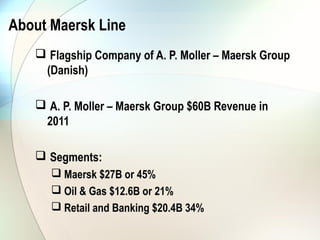
About Maersk Line
    Flagship Company of A. P. Moller – Maersk Group
    (Danish)

    A. P. Moller – Maersk Group $60B Revenue in
    2011

    Segments:
       Maersk $27B or 45%
       Oil & Gas $12.6B or 21%
       Retail and Banking $20.4B 34%
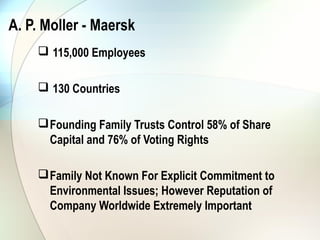
A. P. Moller - Maersk
     115,000 Employees

     130 Countries

     Founding Family Trusts Control 58% of Share
      Capital and 76% of Voting Rights

     Family Not Known For Explicit Commitment to
      Environmental Issues; However Reputation of
      Company Worldwide Extremely Important
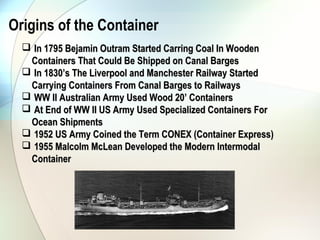
Origins of the Container
   In 1795 Bejamin Outram Started Carring Coal In Wooden
   Containers That Could Be Shipped on Canal Barges
   In 1830’s The Liverpool and Manchester Railway Started
   Carrying Containers From Canal Barges to Railways
   WW II Australian Army Used Wood 20’ Containers
   At End of WW II US Army Used Specialized Containers For
   Ocean Shipments
   1952 US Army Coined the Term CONEX (Container Express)
   1955 Malcolm McLean Developed the Modern Intermodal
   Container
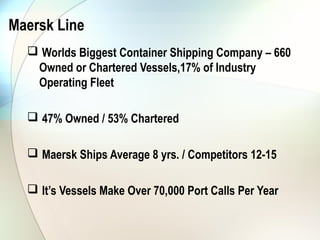
Maersk Line
   Worlds Biggest Container Shipping Company – 660
   Owned or Chartered Vessels,17% of Industry
   Operating Fleet

   47% Owned / 53% Chartered

   Maersk Ships Average 8 yrs. / Competitors 12-15

   It’s Vessels Make Over 70,000 Port Calls Per Year
Maersk Line
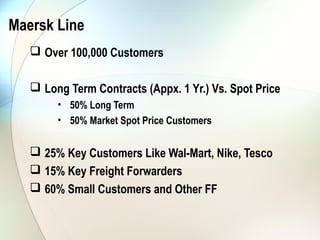
    Over 100,000 Customers

    Long Term Contracts (Appx. 1 Yr.) Vs. Spot Price
        • 50% Long Term
        • 50% Market Spot Price Customers


    25% Key Customers Like Wal-Mart, Nike, Tesco
    15% Key Freight Forwarders
    60% Small Customers and Other FF
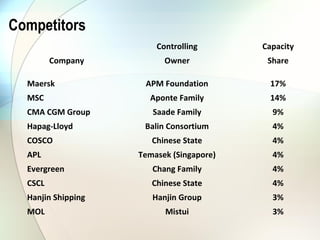
Competitors
                        Controlling       Capacity
         Company          Owner            Share

  Maersk             APM Foundation         17%
  MSC                 Aponte Family         14%
  CMA CGM Group        Saade Family         9%
  Hapag-Lloyd        Balin Consortium       4%
  COSCO                Chinese State        4%
  APL               Temasek (Singapore)     4%
  Evergreen            Chang Family         4%
  CSCL                 Chinese State        4%
  Hanjin Shipping      Hanjin Group         3%
  MOL                     Mistui            3%
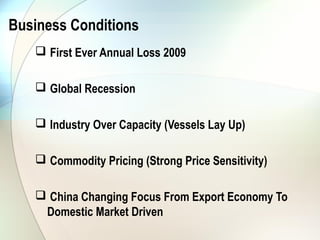
Business Conditions
    First Ever Annual Loss 2009

    Global Recession

    Industry Over Capacity (Vessels Lay Up)

    Commodity Pricing (Strong Price Sensitivity)

    China Changing Focus From Export Economy To
    Domestic Market Driven
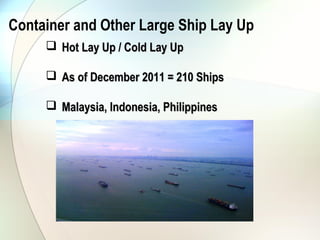
Container and Other Large Ship Lay Up
      Hot Lay Up / Cold Lay Up

      As of December 2011 = 210 Ships

      Malaysia, Indonesia, Philippines
Cost and Security Issues of Lay Up

    Cold Lay Up $1,000/day | Hot Lay Up Much More

    $450B In Shipping Company Debt For Laid Up
    Container, Bulk and Tanker Vessels Worldwide

    Security Issues:
      Environmental
       Personnel & Crew
       Physical Factors (Terrorist, Theft, Fire, Other)
Maersk’s Strategy

     Three Fundamental Challenges to Differentiate
     Itself From the Industry:

        Unreliability


        Complexity (Hard To Do Business)


        Environmental Impact
Reliability
     Goal To Become Industry Leader
     Already Leader in On-time Delivery at Appx. 80%
     New Goal Is Further Improvement … Reduce
      Customer’s “Just In Case Inventory”
     “Daily Maersk” Asia – Europe Route 95% On-time
      Goal … Requires 70 New Vessels
     All Service Ports Operate Entirely As Planned
     On Other Routes Work With Terminal Partners To
      Reduce Time In Port by 30%. Already Achieved
      10% Reduction
Simplicity
     Immense Paperwork Flow To Move Goods

     Streamline and Digitize Much Of The Paperwork
        Order and Follow Cargo Online
        Simplified Documentation Process
        Track Cargo
        Automatic Notification

     IT System Interface

     Improved Customer Service
Environment … “Sustainability Strategy”
     Industry Environmental Impact:
        Ship Exhaust Emissions From Bunker Fuel
        Considered a Large Source Of Greenhouse Gas
        Emissions
        Thought That Climate Change Occurring Because
        Of Greenhouse Gas Emissions From Human
        Activity
        Maritime Shipping Accounts For 3.3% of Global
        Emissions
        Bunker Fuel Releases 2,000x More Sulfur Than
        Diesel Fuel
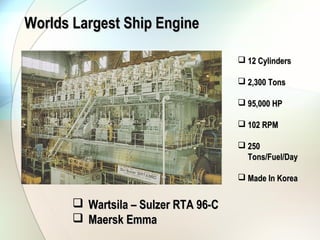
Worlds Largest Ship Engine

                                       12 Cylinders

                                       2,300 Tons

                                       95,000 HP

                                       102 RPM

                                       250
                                        Tons/Fuel/Day

                                       Made In Korea


        Wartsila – Sulzer RTA 96-C
        Maersk Emma
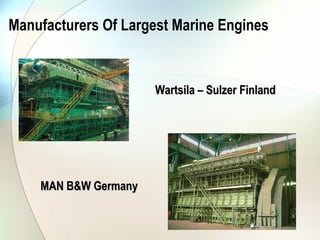
Manufacturers Of Largest Marine Engines


                      Wartsila – Sulzer Finland


    MAN B&W Germany
Other Shipping Environmental Issues

      Ballast and Waste Water

      Garbage

      Scrapping Old Ships
A. P. Moller – Maersk Group Strategy ...
“Sustainability”
     Four Key Themes:

        Environment and Climate Change

        Health and Safety (Includes Piracy)

        Social Responsibility

        Responsible Business Practices (Similar To SOX,
        FCPA and Dodd-Frank)
Maersk Line Environment Goals

    Maersk To Become Global Leader In Low-Carbon
    Shipping

    Lead The Industry Toward Zero SOx Emissions

    Reduce It’s Impact On Marine Environment

     Achieving These Goals Would Meet the Group’s Environmental
      Sustainability Initiative.
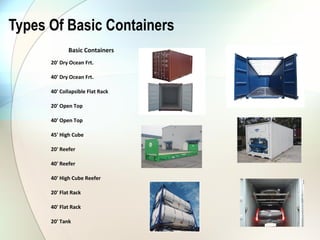
Types Of Basic Containers
             Basic Containers
      20' Dry Ocean Frt.

      40' Dry Ocean Frt.

      40' Collapsible Flat Rack

      20' Open Top

      40' Open Top

      45' High Cube

      20' Reefer

      40' Reefer

      40' High Cube Reefer

      20' Flat Rack

      40' Flat Rack

      20' Tank
Actions To Date

     Slow Steaming (Save Fuel & Less Emissions)
    Speed Reduced By 27% … What was impact on
    customers supply chain?

    Sulphur Emissions Reduced, But Fuel Costs
    Increased From Using Diesel Fuel While At Berth.
    Diesel Fuel $250/Ton Higher.

    Developing Scrubber Technology To Clean
    Exhaust Gases For Future Vessels
Actions To Date

     Protecting Marine Environment:
        Chemical-free Ballast Water Technology On 100%
        Of Owned Fleet
        All Waste From Owned or Chartered Vessels
        Disposed of In Ports
        Strategic Partnerships with Research Institutions
        and Customers to Provide Research on State of
        Worlds Oceans
Actions To Date
     Technical Changes:
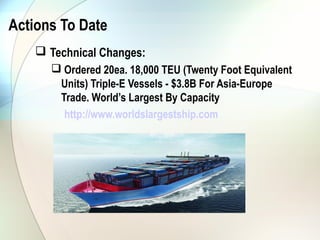
       Ordered 20ea. 18,000 TEU (Twenty Foot Equivalent
       Units) Triple-E Vessels - $3.8B For Asia-Europe
       Trade. World’s Largest By Capacity
        http://www.worldslargestship.com
Triple-E Vessels Advantages / Disadvantages

     Designed To Run At Slower Speeds
     59% Lower Unit Cost & 50% Lower CO2 Emissions
      / Container Than Industry Average
     “Cradle-to-Cradle Passport” End of Life
      Decommissioning

     So Large Only Select Ports Can Handle
     Risk of Industry Overcapacity if Everyone Orders
     Bigger Ships (Competitors Are Ordering Bigger
     Ships)
New WAFMAX and SAMMAX Fleet

    West Africa Max (WAFMAX)
      $2.0B, 22 Ships, 4,500 TEU’s
      Largest Vessels Deployed On West Africa Routes

    South America MAX (SAMMAX)
      $2.2B, 16 Ships, 7,450 TEU’s
      Shallow Draft … 39 Feet
      Largest Vessels Deployed In South America
More Action Taken

     Existing Vessels:
        $10Mea. Waste-heat Recovery Systems For Many
        Vessels
        New Hull Coatings
        Environment Certified Shipyards to Scrap Ships
        … Increased Cost $20M on 10 Vessels.

     New Fuels … Biofuels
Selling Sustainability

    Maersk Wanted To Be Industry Leader In
    Providing Transparency and Environmental
    Information To Customers
       Provided Monthly Customer Scorecards
       Educate Customers On Environmental Impacts Of
       Transportation Industry

    Customer’s Reaction Was Environmental
    Concerns Are Good, But Price Is Most Important
Conclusion

     Soren Skou, CEO Maersk Line:
       Concerned Sustainability Approach Not Working
       With Customers
       Concerned It Would Not Allow Differentiation
       Between Maersk and Competitors
       CMA CGM, Hapag-Lloyd had CO2 Calculators To
       Measure Carbon Footprint Of A Shipments Journey
       APL Named Sustainable Shipping Operator Of The
       Year For 2010
Current Update
    Shipping Cost of 20’ Container From West China To
    Port of LA in 2009 = $700; Today = $2,000 / 286%
    Increase

    May 2012 Increased Rates 30% (Price Fixing With
    Competitors?)

    Global Recession Continues, European Volumes
    Continue To Decrease, Current Estimate 4% Global
    Increase In Volume For 2012

    Lost Record $599M 1st. Qtr., $227M Profit 2nd. Qtr.
Choice Of Assignment Questions

    Should Maersk Line Change or Create A New
    Strategic Plan? Accuracy Of Strategic Forecast?

    Should A. P. Moller – Maersk Group Consider A
     Strategic Redeployment (Sale) Of Maersk Line?
Big Picture Issues

    Can A Commodity Item or Service Command A
    Premium Price?

    The Cost to the World Economy Caused By the
    Dogma of “Human Activity Causing Global
    Warming and That Global Warming Is Bad”?
       Impact On Continued European and US Recession
       Impact of Cap and Trade (Tax)
More information about Lee Mulkey can be
found at his corporate website:
www.ALMCompany.com or
www.Linkedin.com/in/LeeMulkey
See his blogs on Marketing Channel
Management, Global Supply Chains,
Keeping Mistakes Above the Waterline and
The CEO, The Supply Chain and the Zone
of Indifference. “Golden Chains Means Big
Gains” Texas CEO Magazine:
http://bit.ly/LH7OBn

Maersk Line and the Future of Container Shipping.SMU.10.29.12

  • 1.
    Case Study –Maersk Line and the Future of Container Shipping ME 7366 Global Manufacturing Graduate School of Engineering A. Lee Mulkey October 29, 2012
  • 2.
    Lee Mulkey Bio  Founder and President ALM Company  President and CEO Wenaas USA, Inc.  President and CEO Purchased Parts Group, Inc.  Senior Associate Indian River Consulting Group  President and CEO Briggs – Weaver, Inc.  Executive VP and CFO Sammons Distribution, Inc.  VP and CFO Vinson Supply Company and Continental Emsco Company  Started or Managed Over a Dozen Companies In Europe, Mexico, Canada and Asia  MBA – International, University of Dallas
  • 3.
    ALM Company –What We Do Advisory and Project Services for Manufacturers, Marketing Companies and Value Added Distributors Supply Chain Mgt. & Global  Global IT Systems, Sourcing Performance Optimization and Security Building Private Brands  Global Expansion Restructuring / Interim / Crisis Mgt.  Export Compliance & Training Capital Sourcing
  • 4.
    About Maersk Line  Flagship Company of A. P. Moller – Maersk Group (Danish)  A. P. Moller – Maersk Group $60B Revenue in 2011  Segments:  Maersk $27B or 45%  Oil & Gas $12.6B or 21%  Retail and Banking $20.4B 34%
  • 5.
    A. P. Moller- Maersk  115,000 Employees  130 Countries  Founding Family Trusts Control 58% of Share Capital and 76% of Voting Rights  Family Not Known For Explicit Commitment to Environmental Issues; However Reputation of Company Worldwide Extremely Important
  • 6.
    Origins of theContainer  In 1795 Bejamin Outram Started Carring Coal In Wooden Containers That Could Be Shipped on Canal Barges  In 1830’s The Liverpool and Manchester Railway Started Carrying Containers From Canal Barges to Railways  WW II Australian Army Used Wood 20’ Containers  At End of WW II US Army Used Specialized Containers For Ocean Shipments  1952 US Army Coined the Term CONEX (Container Express)  1955 Malcolm McLean Developed the Modern Intermodal Container
  • 7.
    Maersk Line  Worlds Biggest Container Shipping Company – 660 Owned or Chartered Vessels,17% of Industry Operating Fleet  47% Owned / 53% Chartered  Maersk Ships Average 8 yrs. / Competitors 12-15  It’s Vessels Make Over 70,000 Port Calls Per Year
  • 8.
    Maersk Line  Over 100,000 Customers  Long Term Contracts (Appx. 1 Yr.) Vs. Spot Price • 50% Long Term • 50% Market Spot Price Customers  25% Key Customers Like Wal-Mart, Nike, Tesco  15% Key Freight Forwarders  60% Small Customers and Other FF
  • 9.
    Competitors Controlling Capacity Company Owner Share Maersk APM Foundation 17% MSC Aponte Family 14% CMA CGM Group Saade Family 9% Hapag-Lloyd Balin Consortium 4% COSCO Chinese State 4% APL Temasek (Singapore) 4% Evergreen Chang Family 4% CSCL Chinese State 4% Hanjin Shipping Hanjin Group 3% MOL Mistui 3%
  • 10.
    Business Conditions  First Ever Annual Loss 2009  Global Recession  Industry Over Capacity (Vessels Lay Up)  Commodity Pricing (Strong Price Sensitivity)  China Changing Focus From Export Economy To Domestic Market Driven
  • 11.
    Container and OtherLarge Ship Lay Up  Hot Lay Up / Cold Lay Up  As of December 2011 = 210 Ships  Malaysia, Indonesia, Philippines
  • 12.
    Cost and SecurityIssues of Lay Up  Cold Lay Up $1,000/day | Hot Lay Up Much More  $450B In Shipping Company Debt For Laid Up Container, Bulk and Tanker Vessels Worldwide  Security Issues: Environmental  Personnel & Crew  Physical Factors (Terrorist, Theft, Fire, Other)
  • 13.
    Maersk’s Strategy  Three Fundamental Challenges to Differentiate Itself From the Industry:  Unreliability  Complexity (Hard To Do Business)  Environmental Impact
  • 14.
    Reliability  Goal To Become Industry Leader  Already Leader in On-time Delivery at Appx. 80%  New Goal Is Further Improvement … Reduce Customer’s “Just In Case Inventory”  “Daily Maersk” Asia – Europe Route 95% On-time Goal … Requires 70 New Vessels  All Service Ports Operate Entirely As Planned  On Other Routes Work With Terminal Partners To Reduce Time In Port by 30%. Already Achieved 10% Reduction
  • 15.
    Simplicity  Immense Paperwork Flow To Move Goods  Streamline and Digitize Much Of The Paperwork  Order and Follow Cargo Online  Simplified Documentation Process  Track Cargo  Automatic Notification  IT System Interface  Improved Customer Service
  • 16.
    Environment … “SustainabilityStrategy”  Industry Environmental Impact:  Ship Exhaust Emissions From Bunker Fuel Considered a Large Source Of Greenhouse Gas Emissions  Thought That Climate Change Occurring Because Of Greenhouse Gas Emissions From Human Activity  Maritime Shipping Accounts For 3.3% of Global Emissions  Bunker Fuel Releases 2,000x More Sulfur Than Diesel Fuel
  • 17.
    Worlds Largest ShipEngine  12 Cylinders  2,300 Tons  95,000 HP  102 RPM  250 Tons/Fuel/Day  Made In Korea  Wartsila – Sulzer RTA 96-C  Maersk Emma
  • 18.
    Manufacturers Of LargestMarine Engines Wartsila – Sulzer Finland MAN B&W Germany
  • 19.
    Other Shipping EnvironmentalIssues  Ballast and Waste Water  Garbage  Scrapping Old Ships
  • 20.
    A. P. Moller– Maersk Group Strategy ... “Sustainability”  Four Key Themes:  Environment and Climate Change  Health and Safety (Includes Piracy)  Social Responsibility  Responsible Business Practices (Similar To SOX, FCPA and Dodd-Frank)
  • 21.
    Maersk Line EnvironmentGoals  Maersk To Become Global Leader In Low-Carbon Shipping  Lead The Industry Toward Zero SOx Emissions  Reduce It’s Impact On Marine Environment Achieving These Goals Would Meet the Group’s Environmental Sustainability Initiative.
  • 22.
    Types Of BasicContainers Basic Containers 20' Dry Ocean Frt. 40' Dry Ocean Frt. 40' Collapsible Flat Rack 20' Open Top 40' Open Top 45' High Cube 20' Reefer 40' Reefer 40' High Cube Reefer 20' Flat Rack 40' Flat Rack 20' Tank
  • 23.
    Actions To Date  Slow Steaming (Save Fuel & Less Emissions) Speed Reduced By 27% … What was impact on customers supply chain? Sulphur Emissions Reduced, But Fuel Costs Increased From Using Diesel Fuel While At Berth. Diesel Fuel $250/Ton Higher. Developing Scrubber Technology To Clean Exhaust Gases For Future Vessels
  • 24.
    Actions To Date  Protecting Marine Environment:  Chemical-free Ballast Water Technology On 100% Of Owned Fleet  All Waste From Owned or Chartered Vessels Disposed of In Ports  Strategic Partnerships with Research Institutions and Customers to Provide Research on State of Worlds Oceans
  • 25.
    Actions To Date  Technical Changes:  Ordered 20ea. 18,000 TEU (Twenty Foot Equivalent Units) Triple-E Vessels - $3.8B For Asia-Europe Trade. World’s Largest By Capacity http://www.worldslargestship.com
  • 26.
    Triple-E Vessels Advantages/ Disadvantages  Designed To Run At Slower Speeds  59% Lower Unit Cost & 50% Lower CO2 Emissions / Container Than Industry Average  “Cradle-to-Cradle Passport” End of Life Decommissioning  So Large Only Select Ports Can Handle  Risk of Industry Overcapacity if Everyone Orders Bigger Ships (Competitors Are Ordering Bigger Ships)
  • 27.
    New WAFMAX andSAMMAX Fleet  West Africa Max (WAFMAX)  $2.0B, 22 Ships, 4,500 TEU’s  Largest Vessels Deployed On West Africa Routes  South America MAX (SAMMAX)  $2.2B, 16 Ships, 7,450 TEU’s  Shallow Draft … 39 Feet  Largest Vessels Deployed In South America
  • 28.
    More Action Taken  Existing Vessels:  $10Mea. Waste-heat Recovery Systems For Many Vessels  New Hull Coatings  Environment Certified Shipyards to Scrap Ships … Increased Cost $20M on 10 Vessels.  New Fuels … Biofuels
  • 29.
    Selling Sustainability  Maersk Wanted To Be Industry Leader In Providing Transparency and Environmental Information To Customers  Provided Monthly Customer Scorecards  Educate Customers On Environmental Impacts Of Transportation Industry  Customer’s Reaction Was Environmental Concerns Are Good, But Price Is Most Important
  • 30.
    Conclusion  Soren Skou, CEO Maersk Line:  Concerned Sustainability Approach Not Working With Customers  Concerned It Would Not Allow Differentiation Between Maersk and Competitors  CMA CGM, Hapag-Lloyd had CO2 Calculators To Measure Carbon Footprint Of A Shipments Journey  APL Named Sustainable Shipping Operator Of The Year For 2010
  • 31.
    Current Update  Shipping Cost of 20’ Container From West China To Port of LA in 2009 = $700; Today = $2,000 / 286% Increase  May 2012 Increased Rates 30% (Price Fixing With Competitors?)  Global Recession Continues, European Volumes Continue To Decrease, Current Estimate 4% Global Increase In Volume For 2012  Lost Record $599M 1st. Qtr., $227M Profit 2nd. Qtr.
  • 32.
    Choice Of AssignmentQuestions  Should Maersk Line Change or Create A New Strategic Plan? Accuracy Of Strategic Forecast?  Should A. P. Moller – Maersk Group Consider A Strategic Redeployment (Sale) Of Maersk Line?
  • 33.
    Big Picture Issues  Can A Commodity Item or Service Command A Premium Price?  The Cost to the World Economy Caused By the Dogma of “Human Activity Causing Global Warming and That Global Warming Is Bad”?  Impact On Continued European and US Recession  Impact of Cap and Trade (Tax)
  • 34.
    More information aboutLee Mulkey can be found at his corporate website: www.ALMCompany.com or www.Linkedin.com/in/LeeMulkey See his blogs on Marketing Channel Management, Global Supply Chains, Keeping Mistakes Above the Waterline and The CEO, The Supply Chain and the Zone of Indifference. “Golden Chains Means Big Gains” Texas CEO Magazine: http://bit.ly/LH7OBn