CONSUMER
AWARENESS
ACKNOWLEDGMENT
•I would like to thank my teacher Mrs. Nidhi Nigam,
who gave me the opportunity to do this project.
This project helped me to learn about Consumer
Awareness, and their rights. I would also like to
thanks my parents who helped me correcting my
grammatical mistakes.
I N D E X
• Objectives of Consumer Awareness
• Who is a CONSUMER?
• Rights of a Consumer
• Consumer Responsibilities
• Case Studies
• Consumer Protection Act 1986
• Product Standardization Logos
OBJECTIVES
The objectives of consumer awareness is to:
• Achieve maximum satisfaction of the consumer.
• Protection against exploitation of the consumer.
• Control over consumption of harmful goods.
WHO IS A CONSUMER?
• A person who shows his/her willingness in consuming goods and
services from a supplier with the intention of paying for them is called a
Consumer.
• Someone who has purchased goods and services for personal
consumption.
RIGHTS OF A CONSUMER
• Right to Safety: Means right to be protected against the marketing of goods
and services, which are hazardous to life and property. The purchased goods
should not only meet their immediate needs, but also fulfil long term
interests. They should preferably purchase quality marked products such as
ISI, AGMARK etc.
• Right to be Informed: Means right to be informed about the quality, quantity,
potency, purity, standard and price of goods so as to protect the consumer
against unfair trade practices and misleading labels and advertisements.
• Right to Choose: Means right to be assured, wherever possible, about
access to variety of goods and services at competitive price. It also includes
right to basic goods and services. This is because unrestricted right of the
minority to choose can mean a denial for the majority of its fair share.
• Right to be Heard: Means that consumer's interests will receive due
consideration at appropriate forums. One can complain the retailer if he or
she is dissatisfied about the product or service.
• Right to Seek Redressal: Means right to seek redressal against unfair trade
practices or unscrupulous exploitation of consumers. It also includes right to
fair settlement of the genuine grievances of the consumer and the right to
receive compensations for misrepresentations or dissatisfactory goods. One
can also take the help of Consumer Organisations in seeking redressal of
their grievances.
• Right to Consumer Education: Means the right to acquire the knowledge and
skill to be an informed consumer throughout life. Ignorance of consumers,
particularly of rural consumers, is mainly responsible for their exploitation.
They should know their rights and must exercise them. Only then real
consumer protection can be achieved with success.
CONSUMER RESPONSIBILITIES
• The Responsibility to be aware about the quality and safety of goods and services
before buying them and gather all information and facts about a product or service.
The buyer should keep an update of changes and innovations in the marketplace.
• The Responsibility to Think Independently and make choices about one’s needs
and demands.
• The Responsibility to Speak Out and inform manufacturers and governments of
needs and wants and about any kind of dissatisfaction with a product or service in a
fair and honest manner.
• The Responsibility to be an Ethical Consumer and to be fair by not engaging in
dishonest practices which cost all consumers money and use the product or service
in line with the terms and conditions, avoiding all kind of risk.
• The Responsibility to Respect the Environment and avoid waste, littering and
contribution to pollution.
CASE STUDY
In April 2019, one of my friend bought a branded Air Conditioner worth of 25,000 INR.
One month hence, the A.C. Started malfunctioning, the ducts were leaking and the
refrigerant was also low. Despite all this when he went back to the shop from where
he purchased the A.C., the shopkeeper denied to repair it although it was in the
Warranty period.
Being a consumer and knowing about the consumer rights, my friend went to the
Consumer Court with an appeal for a replacement and compensation for harassment.
Apparently he won the case and his A.C. was replaced and got a compensation of
rupees 25,000.
CASE STUDY-2
Ms. Chadha visited a beauty salon for an eyelash extensions service. She was
informed by the beautician that if she purchased 30 facial sessions at $1,600, the
eyelash extensions would be complimentary. She would also be given another two
free sessions of eyelash extensions valued at $100 each. Two months later, she
visited the salon for the complimentary eyelash extensions. The beautician
accidentally glued her right eye shut causing her much pain. Ms. Chadha visited a
doctor and was diagnosed with cornea inflammation. She lost confidence in the salon
and requested for a refund of the facial package and reimbursement for her medical
bills.
But the Salon refused that she came to their salon and they did any kind of extension,
they had even deleted all the payment details and Ms. Chadha was not as careful to
take the payment bill, thus she didn’t get any evidence.
CONSUMER PROTECTION ACT 1986
• The Consumer Protection Act, 1986 (COPRA) was passed in October 1986 and
came into force on December 24, 1986. This Act is regarded as the 'Magna Carta'
in the field of consumer protection for checking unfair trade practices. The main
objectives of the Act are to provide better and all round protection to consumers and
effective safeguards against different types of exploitation such as defective goods,
deficient services etc. It applies to all goods, services and unfair trade practices
unless specifically exempted by the Central Government and covers all sectors-
private, public or co-operative. It has led to the establishment of a widespread
network of consumer forums and appellate courts all over India. Various Consumer
Protection Councils are established at the national, state and district level to
increase consumer awareness in India. It was later replaced by The Consumer
Protection Act, 2019.
PRODUCTS STANDARDIZATION LOGOS
Food Safety and Standards
Authority of India
International Organization for
Standardization Indian Standards Institution
And many more…
INTERVIEW
• Q1. Are you careful enough to take the bills for any transactions?
Ans1. Yes, I always take the bills for even the smallest transactions ever done by me.
• Q2. Do you know all your Responsibilities and Rights as a consumer?
Ans2. Yes, all my Responsibilities and Rights as a consumer are well known to me.
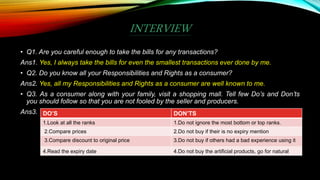
• Q3. As a consumer along with your family, visit a shopping mall. Tell few Do’s and Don’ts
you should follow so that you are not fooled by the seller and producers.
Ans3. DO’S DON’TS
1.Look at all the ranks 1.Do not ignore the most bottom or top ranks.
2.Compare prices 2.Do not buy if their is no expiry mention
3.Compare discount to original price 3.Do not buy if others had a bad experience using it
4.Read the expiry date 4.Do not buy the artificial products, go for natural
• Q4. Do you check the price of goods you buy, from alternative sources?
Ans4. Yes.
• Q5. What kind of shopping do you prefer? Online or Offline and Why?
Ans5. I prefer Offline shopping because:
1. We get personalized attention and recommendations.
2. We get product experience.
• Q6. Have you ever faced any kind of irrespective act by the shopkeeper or
the supplier?
Ans6. No, not yet.
ANALYSIS AND CONCLUSION
Through this presentation I analyzed and concluded that:
• A consumer is the most integral part of an Economy. Without consumer demands,
producers would lack one of the key motivations to produce goods.
• A consumer should be given all due respects, attention and should never be
Exploited.
• Consumers must also know all his rights and be aware about their responsibilities
and who can fight for their rights.
• A consumer must follow the instructions given by the government, check the
standardized logo of any product and be cautious while shopping each time.
BIBLIOGRAPHY
• Consumer Rights: https://consumeraffairs.nic.in/organisation-and-
units/division/consumer-protection-unit/consumer-rights
• Consumer Responsibility:
https://www.consumeraffairsjamaica.gov.jm/portal/index.php/consumer-laws/106-
consumer-rights-responsibilities
• Consumer awareness Act:
https://en.wikipedia.org/wiki/Consumer_Protection_Act,_1986
GLOSSARY
• Unscrupulous: Having or showing no moral principles; not honest or fair.
• Grievances: A real or imagined cause for complaint, especially unfair treatment.
• Redressal: Remedy or compensation for a wrong or grievance.
• Litter: Waste products that have been discarded incorrectly, without consent, at an
unsuitable location.
• Warranty period: A warranty period is the period of time that warrant free repair and
adjustment services in case of a malfunction occurred under normal use that has
followed instruction manuals.
• Reimbursement: The act of compensating someone for an out-of-pocket expense
by giving them an amount of money equal to what was spent.
THANK YOU

SST CONSUMER AWARNESS

  • 1.
  • 2.
    ACKNOWLEDGMENT •I would liketo thank my teacher Mrs. Nidhi Nigam, who gave me the opportunity to do this project. This project helped me to learn about Consumer Awareness, and their rights. I would also like to thanks my parents who helped me correcting my grammatical mistakes.
  • 3.
    I N DE X • Objectives of Consumer Awareness • Who is a CONSUMER? • Rights of a Consumer • Consumer Responsibilities • Case Studies • Consumer Protection Act 1986 • Product Standardization Logos
  • 4.
    OBJECTIVES The objectives ofconsumer awareness is to: • Achieve maximum satisfaction of the consumer. • Protection against exploitation of the consumer. • Control over consumption of harmful goods.
  • 5.
    WHO IS ACONSUMER? • A person who shows his/her willingness in consuming goods and services from a supplier with the intention of paying for them is called a Consumer. • Someone who has purchased goods and services for personal consumption.
  • 6.
    RIGHTS OF ACONSUMER • Right to Safety: Means right to be protected against the marketing of goods and services, which are hazardous to life and property. The purchased goods should not only meet their immediate needs, but also fulfil long term interests. They should preferably purchase quality marked products such as ISI, AGMARK etc. • Right to be Informed: Means right to be informed about the quality, quantity, potency, purity, standard and price of goods so as to protect the consumer against unfair trade practices and misleading labels and advertisements. • Right to Choose: Means right to be assured, wherever possible, about access to variety of goods and services at competitive price. It also includes right to basic goods and services. This is because unrestricted right of the minority to choose can mean a denial for the majority of its fair share.
  • 7.
    • Right tobe Heard: Means that consumer's interests will receive due consideration at appropriate forums. One can complain the retailer if he or she is dissatisfied about the product or service. • Right to Seek Redressal: Means right to seek redressal against unfair trade practices or unscrupulous exploitation of consumers. It also includes right to fair settlement of the genuine grievances of the consumer and the right to receive compensations for misrepresentations or dissatisfactory goods. One can also take the help of Consumer Organisations in seeking redressal of their grievances. • Right to Consumer Education: Means the right to acquire the knowledge and skill to be an informed consumer throughout life. Ignorance of consumers, particularly of rural consumers, is mainly responsible for their exploitation. They should know their rights and must exercise them. Only then real consumer protection can be achieved with success.
  • 8.
    CONSUMER RESPONSIBILITIES • TheResponsibility to be aware about the quality and safety of goods and services before buying them and gather all information and facts about a product or service. The buyer should keep an update of changes and innovations in the marketplace. • The Responsibility to Think Independently and make choices about one’s needs and demands. • The Responsibility to Speak Out and inform manufacturers and governments of needs and wants and about any kind of dissatisfaction with a product or service in a fair and honest manner. • The Responsibility to be an Ethical Consumer and to be fair by not engaging in dishonest practices which cost all consumers money and use the product or service in line with the terms and conditions, avoiding all kind of risk. • The Responsibility to Respect the Environment and avoid waste, littering and contribution to pollution.
  • 9.
    CASE STUDY In April2019, one of my friend bought a branded Air Conditioner worth of 25,000 INR. One month hence, the A.C. Started malfunctioning, the ducts were leaking and the refrigerant was also low. Despite all this when he went back to the shop from where he purchased the A.C., the shopkeeper denied to repair it although it was in the Warranty period. Being a consumer and knowing about the consumer rights, my friend went to the Consumer Court with an appeal for a replacement and compensation for harassment. Apparently he won the case and his A.C. was replaced and got a compensation of rupees 25,000.
  • 10.
    CASE STUDY-2 Ms. Chadhavisited a beauty salon for an eyelash extensions service. She was informed by the beautician that if she purchased 30 facial sessions at $1,600, the eyelash extensions would be complimentary. She would also be given another two free sessions of eyelash extensions valued at $100 each. Two months later, she visited the salon for the complimentary eyelash extensions. The beautician accidentally glued her right eye shut causing her much pain. Ms. Chadha visited a doctor and was diagnosed with cornea inflammation. She lost confidence in the salon and requested for a refund of the facial package and reimbursement for her medical bills. But the Salon refused that she came to their salon and they did any kind of extension, they had even deleted all the payment details and Ms. Chadha was not as careful to take the payment bill, thus she didn’t get any evidence.
  • 11.
    CONSUMER PROTECTION ACT1986 • The Consumer Protection Act, 1986 (COPRA) was passed in October 1986 and came into force on December 24, 1986. This Act is regarded as the 'Magna Carta' in the field of consumer protection for checking unfair trade practices. The main objectives of the Act are to provide better and all round protection to consumers and effective safeguards against different types of exploitation such as defective goods, deficient services etc. It applies to all goods, services and unfair trade practices unless specifically exempted by the Central Government and covers all sectors- private, public or co-operative. It has led to the establishment of a widespread network of consumer forums and appellate courts all over India. Various Consumer Protection Councils are established at the national, state and district level to increase consumer awareness in India. It was later replaced by The Consumer Protection Act, 2019.
  • 12.
    PRODUCTS STANDARDIZATION LOGOS FoodSafety and Standards Authority of India International Organization for Standardization Indian Standards Institution And many more…
  • 13.
    INTERVIEW • Q1. Areyou careful enough to take the bills for any transactions? Ans1. Yes, I always take the bills for even the smallest transactions ever done by me. • Q2. Do you know all your Responsibilities and Rights as a consumer? Ans2. Yes, all my Responsibilities and Rights as a consumer are well known to me. • Q3. As a consumer along with your family, visit a shopping mall. Tell few Do’s and Don’ts you should follow so that you are not fooled by the seller and producers. Ans3. DO’S DON’TS 1.Look at all the ranks 1.Do not ignore the most bottom or top ranks. 2.Compare prices 2.Do not buy if their is no expiry mention 3.Compare discount to original price 3.Do not buy if others had a bad experience using it 4.Read the expiry date 4.Do not buy the artificial products, go for natural
  • 14.
    • Q4. Doyou check the price of goods you buy, from alternative sources? Ans4. Yes. • Q5. What kind of shopping do you prefer? Online or Offline and Why? Ans5. I prefer Offline shopping because: 1. We get personalized attention and recommendations. 2. We get product experience. • Q6. Have you ever faced any kind of irrespective act by the shopkeeper or the supplier? Ans6. No, not yet.
  • 15.
    ANALYSIS AND CONCLUSION Throughthis presentation I analyzed and concluded that: • A consumer is the most integral part of an Economy. Without consumer demands, producers would lack one of the key motivations to produce goods. • A consumer should be given all due respects, attention and should never be Exploited. • Consumers must also know all his rights and be aware about their responsibilities and who can fight for their rights. • A consumer must follow the instructions given by the government, check the standardized logo of any product and be cautious while shopping each time.
  • 16.
    BIBLIOGRAPHY • Consumer Rights:https://consumeraffairs.nic.in/organisation-and- units/division/consumer-protection-unit/consumer-rights • Consumer Responsibility: https://www.consumeraffairsjamaica.gov.jm/portal/index.php/consumer-laws/106- consumer-rights-responsibilities • Consumer awareness Act: https://en.wikipedia.org/wiki/Consumer_Protection_Act,_1986
  • 17.
    GLOSSARY • Unscrupulous: Havingor showing no moral principles; not honest or fair. • Grievances: A real or imagined cause for complaint, especially unfair treatment. • Redressal: Remedy or compensation for a wrong or grievance. • Litter: Waste products that have been discarded incorrectly, without consent, at an unsuitable location. • Warranty period: A warranty period is the period of time that warrant free repair and adjustment services in case of a malfunction occurred under normal use that has followed instruction manuals. • Reimbursement: The act of compensating someone for an out-of-pocket expense by giving them an amount of money equal to what was spent.
  • 18.