CONSUMER BUYING
BEHAVIOUR
Page  2
WHAT IS CONSUMER BEHAVIOUR?
 Consumer Behaviour can be defined as the sum total of how
individuals and groups recognize and determine their needs
and how they purchase and experience goods and services to
meet those needs.
 It includes:-
 What
 Where
 Why
 When
 How
Page  3
Marketing Strategy
 Marketing Strategy is basically the answer to the question,
How will we provide superior customer value to our target
customer?
 Product
 Price
 Communication
 Distribution
 Service
Page  4
Role of Consumer Behaviour in Marketing Strategy
 Marketing strategy
 Design, implementation, and control of a plan to influence
exchanges to achieve organizational objectives
Design
 In consumer markets, these are designed to
 Increase chances of favorable thoughts and feelings of particular
products, services and brands among consumers
 Increase chances of trial and purchase
 Developed by manufacturers, retail stores, and other direct
marketers to
 Increase chances of favorable thoughts and feelings among
consumers about purchasing from them
 Increase chances of actual purchase
 Developed by companies that make funds available for purchase
to
 Increase chances of usage of services offered by consumers
5
Implementation
 Marketing strategies involve developing and presenting
marketing stimuli directed at selected target markets to
influence
 What they think
 How they feel
 What they do
 Essence of marketing strategy is to understand markets,
develop and implement superior strategies to attract and hold
them profitably
6
 Powerful force on consumers and society at large
 The power of marketing and the ability of consumer research and
analysis to yield insight into consumer behavior should not be
discounted or misused
7
Consumer Perception
 According to S.P. Robbins: Perception may be defined as a process by
which individuals organise and interpret their sensory impressions in order
to give meaning to their environment.
 According to Joseph Reitz, “Perception includes all those processes by
which an individual receives information about his environment- seeing,
hearing, feeling, tasting and smelling”
8
FACTORS IFLUENCING PERCEPTION
 Factors in Perceiver (Internal Factors)
a. Needs and Motives
b. Self-concepts
c. Beliefs
d. Past Experience
e. Current Psychological State
f. Expectations
9
 Factors in the Target or Perceived (External Factors)
a. Size
b. Intensity
c. Frequency
d. Status
e. Contrast
 Factors in The Situation
a. Physical Setting
b. Social Setting
c. Organizational Setting
10
Elements of Perception
 Sensation
When a person is exposed to any of the marketing stimuli or an ad, the first reflex is
initiate in him is known as sensation.
Example: when a person come across a beautiful ad of a Mercedes Benz on the
centre spread of a magazine.
 Absolute Threshold
the absolute threshold is the amount of intensity needed to detect a difference
between something and nothing.
Example: Suppose you are driving on the highway and a billboard is in the
distance. A billboard might have the most entertaining copy ever written, but this
genius is wasted if the print is too small for passing motorists to see it from the
highway.
11
 Differential Threshold/ JND
The minimal difference that can be detected between two similar stimuli is called
the differential threshold or the Just Noticeable Difference.
Example: Hindustan Unilever increases the price of a 1.5kg package of Surf Excel
Blue Detergent from Rs. 110 to Rs. 120.
 Subliminal Perception
Suppose a person sitting at a movie and is exposed to messages like Eat popcorn
and Drink Coke. However, each message is shown on the screen for only a fraction
of a second, so short a time that you are not consciously aware of them.
12
Influence of Perception on CBB
 Selective Distortion:
It is changing or twisting currently received information. It occurs when a person
receives information inconsistent with personal feelings or beliefs.
 Selective Retention:
In this, a person remembers information inputs that support personal feelings and
beliefs and forgets inputs that do not.
13
CONSUMER LEARNING
 According to E. R. Hilgard, Learning is a relatively permanent change in behaviour
that occurs as a result of prior experience.
 The process of acquiring the ability to respond adequately to a situation which may
or may not have been previously encountered.
14
COMPONENTS OF LEARNING
 Motivation
 Cues
 Response
 Reinforcement
15
THEORIES OF CONSUMER LEARNING
 Behavioural/ Connectionist learning Theory
Classical Conditioning: Ivan Pavlov A Russian Physiologist Experiment
Operant Conditioning: In which desired voluntary behaviour leads to a reward or
prevents puishments
 Cognitive Learning Theory
The importance of perception, problem solving and insight
 Social Learning Theory
Learning comes from watching models- presents, teachers, peers, motion pictures,
television performers, bosses. An extension of operant consequences
 Involvement Theory
importance of sort of things in his or her life.
16
INFLUENCE OF LEARNING ON CB
 Recognition and Recall
 Cognitive Responses to Advertising
 Attitudinal and Behaviuoral Measures Brand Loyalty
 Brand Equity
17
INFORMATION PROCESSING
 Just as a computer processes information received as input, so too does the
human mind process the information it receives as input.
18
INFORMATION PROCESSING AND MEMORY STORES
 Sensory Store
 Short-Term Store
 Long-Term Store
 Rehearsal and Encoding
 Retention
 Retrieval
 Interferences
19
CONSUMER MOTIVATION
According to Dalton E. Mcfarland, Motivation refers to the way in which urges,
drives, desires, aspirations, and striving or needs direct, control or explain the
behaviour of human beings.
Key elements:
Intensity
Direction
persistance
20
Motives
 According to William J. Stanton, A motive may be defined as a drive or an urge for
which an individual seeks satisfaction.
 According to Berelson and Steiner, A motive is the inner state that energizes
activities or moves and that directs or channels behaviour to work goals.
21
MASLOW’S NEED PRIORITY MODEL/
MASLOW’S HIERARCHY OF NEEDS THEORY
 There are two types of needs – Basic and Secondary or acquired.
 Basic needs are important for survival where as secondary needs are not so
important.
22
23
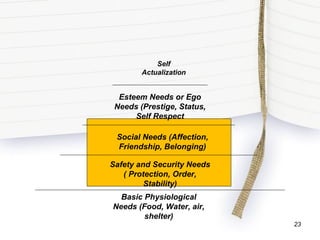
Self
Actualization
Esteem Needs or Ego
Needs (Prestige, Status,
Self Respect
Social Needs (Affection,
Friendship, Belonging)
Safety and Security Needs
( Protection, Order,
Stability)
Basic Physiological
Needs (Food, Water, air,
shelter)
 Maslow has further classified the needs as lower order needs and higher order
needs.
 First two needs in the hierarchical order are lower needs and rests three are higher
order needs.
24
INFLUENCE OF MOTIVATION ON CONSUMER BEHAVIOUR
 Functional Motives
 Aesthetics/ Emotional Motives
 Social Motives
 Situational Motives
 Curiosity Motives
25
INVOLVEMENT
 Consumer involvement refers to the degree of information processing or extent of
importance that consumer attaches to a product. The degree of involvement has a
very significant effect on consumer behaviour. When more expensive products are
to be purchased, the consumer gets more involvement in purchase process but he
may not be equally involved in a product which is less expensive.
 High Involvement
 Low Involvement
26
Factors Influencing Consumer Involvement
 Previous Experience
 Interest
 Perceived Risk of Negative Consequences
 Situation
 Social Visibility
27
CONSUMER ATTITUDE
 According to Bem, Attitudes are likes and dislikes.
 According to Allport, Attitude is learned predispositions to respond to an object or
class of object in a consistently favourable or unfavourable way.
28
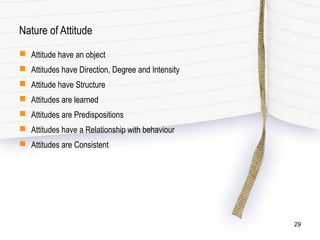
Nature of Attitude
 Attitude have an object
 Attitudes have Direction, Degree and Intensity
 Attitude have Structure
 Attitudes are learned
 Attitudes are Predispositions
 Attitudes have a Relationship with behaviour
 Attitudes are Consistent
29
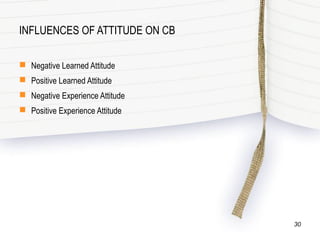
INFLUENCES OF ATTITUDE ON CB
 Negative Learned Attitude
 Positive Learned Attitude
 Negative Experience Attitude
 Positive Experience Attitude
30
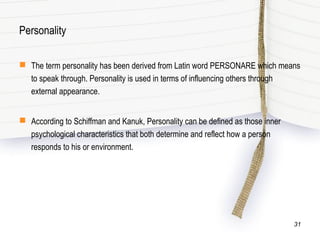
Personality
 The term personality has been derived from Latin word PERSONARE which means
to speak through. Personality is used in terms of influencing others through
external appearance.
 According to Schiffman and Kanuk, Personality can be defined as those inner
psychological characteristics that both determine and reflect how a person
responds to his or environment.
31
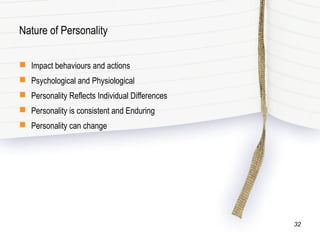
Nature of Personality
 Impact behaviours and actions
 Psychological and Physiological
 Personality Reflects Individual Differences
 Personality is consistent and Enduring
 Personality can change
32
EXTERNAL INFLUENCES
 Group Behaviour
 Social Class
 Opinion Leaders
 Reference Groups
 Family
33
Group Behaviour
 According to David H. Smith, “A group is a set of two or more individuals who are
jointly characterised by a network of relevant communications, shared sense of
collective identity and one or more shared dispositions with associated normative
strength”.
34
Nature of Groups
 Two or More Persons
 Collective Identity
 Interaction
 Shared Goal Interest
35
Social Group Influencing on Consumer Behaviour
 Family
 Reference Groups
 Opinion Leaders
 Roles and Status
36
Social Class
 Social Class is defined as the division of members of a society into a hierarchy of
distinct status classes, so that members of each class have relatively the same
status and members of all other classes have either more or less status
37
Social Class Categories
 Upper- Upper Class
 Lower-Upper Class
 Upper-Middle Class
 Lower-Middle Class
 Upper-Lower Class
 Lower-Lower Class
38
Social Class Influence on CB
 According to the types of social classes
39
Applications of Social Class Influences
 Advertising
 Market Segment
 Distribution
 Product Development
40
Opinion Leaders
 Opinion leaders are individuals whose ideas and behaviour serve as a model to
others. Opinion leaders communicate messages to a primary group, influencing the
attitudes and behaviour change of their followers.
 Opinion Leader is a process by which the opinion leader informally influences the
actions or attitude of others, who may be opinion seekers of opinion recipients.
41
Characteristics of Opinion Leadership
 Higher Social Status:
Opinion leaders have approximately the same social class position as non-leaders,
although they have higher social status within the class.
 Media Exposure:
 Knowledge
 Social/ Gregarious
 Innovator
 Familiar
 Individuated
42
Types of Opinion Leaders
 Generalized Opinion Leaders
 Market Mavens
 Surrogate Buyers
 Purchase Pals
43
Influence of Opinion Leadership
 Product-Involvement
 Self-Involvement
a. Gaining Attentions
b. Showing Connoisseurship
c. Having Inside Information
d. Suggesting Status
e. Spreading the Gossips
f. Seeking Confirmation
g. Asserting Supiority
 Other Involvement
 Message Involvement
44
Reference Group
 Reference group can be defined as actual or imaginary, institutions, individuals or
groups having significant relevance on the target individual’s evaluations,
aspirations or behaviour.
 A reference groups is an individual(s) or group(s) that influences the shaping of an
individual’s opinion, belief, attitude and/or behaviour.
 Some of them are Normative Reference Group and Comparative Reference
Group.
45
Types of Reference Group
 Friendship Group
 Shopping Group
 Work Groups
 Virtual Groups or Communities
 Brand Communities
 Consumer Action Groups
46
Influence of Reference Groups
 Compliance: Necessity of the beliefs and values considered
 Identification: Group beliefs and values followed while living in group
 Internationalization: Group Beliefs and Value can be the same at individual level
47
Culture
 Culture is everything that is socially learned and shaped by the members of a
society.
 Culture is a society’s personality.
 Culture is the sum total of learned beliefs, values and customs that serve to direct
the consumer behaviour of members of a particular society.
 Beliefs consists of the very large number of mental or verbal statements (i.e. I
believe…) that reflect a person’s particular knowledge and assessment of
something (another person, a store, a product, a brand)
 Values also are beliefs. Values differ from other beliefs.
 Customs are covert modes of behaviour that constitute culturally approved or
acceptable ways of behaving in a specific situations. Customs consist of everyday
or routine behaviour. Thus, while beliefs and values are guides for behaviour,
customs are usual and acceptable ways of behaving.
48
Factors Affecting Culture
 Social Factors:
a. Reference Groups
b. Family
C. Roles and Status
 Personal Factors:
a. Age and stage in the lifecycle
b. Occupation and Economic Circumstances
c. Personality and Self-concept
d. Lifestyle and Values
49
Role of Culture in Influencing Consumer Behaviour
 The impact of culture is so natural and automatic that influence on behaviour is
usually taken for granted.
 Culture can exist and sometimes reveal itself at different perceived or subjective
levels. There are three levels of subjective culture are as follow:
Level1. Supranational
Level2. National
Level3. Group
50
SUBCULTURE
 Subculture is defined as broad groups of consumers within a society’s culture
having similar values which distinguish them from the rest of society
 Subculture can be distinctive because of the age, ethnicity, class, location and/or
gender of the members.
 The qualities that determine a subculture as distinct may be linguistic, aesthetic,
religious, political, sexual, geographical or combination of factors.
51
Types of Subculture
 Nationality Subculture
 Religious Subculture
 Geographic and Regional Subculture
 Racial Subculture
 Age Subculture
 Gender as a Subculture
52
Role of Subculture in Influencing CB
53
FAMILY
 Family is defined as two or more persons related by blood, marriage, or adoption
who reside together.
 Although families sometimes are referred to as households, not all households are
families.
 Example: a household might include individuals who are not related by blood,
marriage or adoption. Such as unmarried couples, family friends, roommates.
54
Family Specific Characteristics
 Mobility
 Geographical Location
 Children
 Marriage
55
Types of Family
 Married Couple
 Nuclear Couple
 Extended Family
56
Functions of Family
 Economic Well-being
 Emotional Support
 Suitable Family Lifestyle
57
Family Life Cycle & Marketing Strategy
 Bachelorhood
 Honeymooners
 Parenthood
 Post Parenthood
 Dissolution
58
CONSUMER DECISION-MAKING
 Introduction:
 The key to influencing the purchase process are understanding purchase
intention and the situational influences.
59
Buying Role of Consumers
 Initiator
 Influencer
 Decider
 Gatekeeper
 Buyer
 User
60
Consumer Decision Making Process
 Problem/ Need Recognition
 Information Search
 Evaluation of Alternatives
 Purchase Decision
 Post Purchase Behaviour
61
Diffusion Of Innovation
 According to Rogers, Diffusion is a process by which an innovation is
communicated through certain channels over time among the members of a social
system.
62
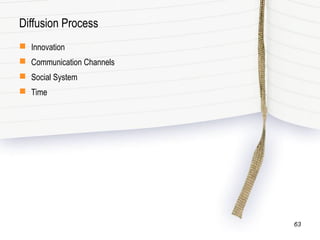
Diffusion Process
 Innovation
 Communication Channels
 Social System
 Time
63
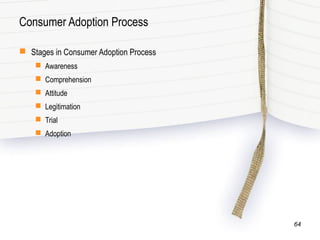
Consumer Adoption Process
 Stages in Consumer Adoption Process
 Awareness
 Comprehension
 Attitude
 Legitimation
 Trial
 Adoption
64
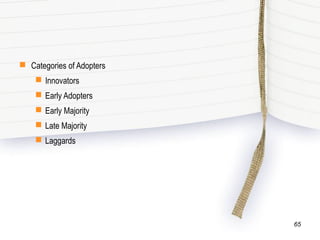
 Categories of Adopters
 Innovators
 Early Adopters
 Early Majority
 Late Majority
 Laggards
65
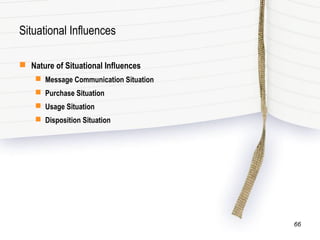
Situational Influences
 Nature of Situational Influences
 Message Communication Situation
 Purchase Situation
 Usage Situation
 Disposition Situation
66
ORGANIZATIONAL BUYING
 Organizational/industrial/businessOrganizational/industrial/business
buying can be defined as the decision-buying can be defined as the decision-
making process by which formalmaking process by which formal
organizations establish the need fororganizations establish the need for
purchase products and services andpurchase products and services and
identify, evaluate and choose amongidentify, evaluate and choose among
alternative brands and suppliers.alternative brands and suppliers.
67
Objectives of Organizational Buying
 Non-Task Objectives
 Task Oriented Objectives
 Cost
 Quality
 Service
68
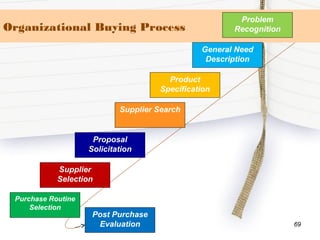
Organizational Buying Process
69
Post Purchase
Evaluation
Purchase Routine
Selection
Supplier
Selection
Proposal
Solicitation
Supplier Search
Product
Specification
General Need
Description
Problem
Recognition
Buying Centre/Decision Making Units
A buying centre includes all those persons in an
organization who become involved in the purchase
decision.
Identifying Key Members of Buying Centre:
1. Top Management Persons
2. Technical Persons (functions)
3. Buyers/Purchasers (Purchase or Materials
Department)
4. Accounts/Finance Persons
5. Marketing Function 70
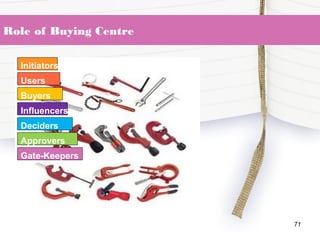
Role of Buying Centre
Initiators
Users
Buyers
Influencers
Deciders
Approvers
Gate-Keepers
71
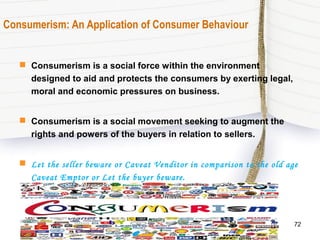
Consumerism: An Application of Consumer Behaviour
 Consumerism is a social force within the environment
designed to aid and protects the consumers by exerting legal,
moral and economic pressures on business.
 Consumerism is a social movement seeking to augment the
rights and powers of the buyers in relation to sellers.
 Let the seller beware or Caveat Venditor in comparison to the old age
Caveat Emptor or Let the buyer beware.
72
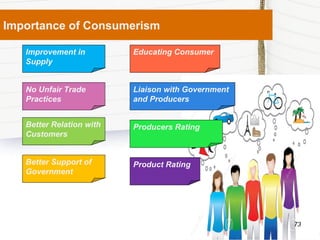
Importance of Consumerism
73
Improvement in
Supply
Educating Consumer
Better Relation with
Customers
No Unfair Trade
Practices
Better Support of
Government
Producers Rating
Product Rating
Liaison with Government
and Producers
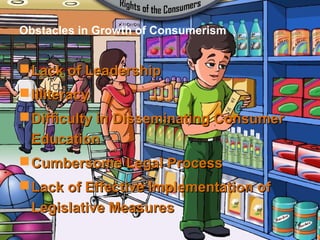
Obstacles in Growth of Consumerism
Lack of LeadershipLack of Leadership
IlliteracyIlliteracy
Difficulty in Disseminating ConsumerDifficulty in Disseminating Consumer
EducationEducation
Cumbersome Legal ProcessCumbersome Legal Process
Lack of Effective Implementation ofLack of Effective Implementation of
Legislative MeasuresLegislative Measures
74
Factors Contributing to Consumerism
 Globalization
 New Organizational Technologies
 Unprecedented Market Competition
 Misleading and Deceptive Advertising
 Unfair Trade Practices
75
Thank You
Kingsoft Office
published by www.Kingsoftstore.com @Kingsoft_Office
kingsoftstore

Cbb MARKETNG STRATEGY

  • 1.
  • 2.
    Page  2 WHATIS CONSUMER BEHAVIOUR?  Consumer Behaviour can be defined as the sum total of how individuals and groups recognize and determine their needs and how they purchase and experience goods and services to meet those needs.  It includes:-  What  Where  Why  When  How
  • 3.
    Page  3 MarketingStrategy  Marketing Strategy is basically the answer to the question, How will we provide superior customer value to our target customer?  Product  Price  Communication  Distribution  Service
  • 4.
    Page  4 Roleof Consumer Behaviour in Marketing Strategy  Marketing strategy  Design, implementation, and control of a plan to influence exchanges to achieve organizational objectives
  • 5.
    Design  In consumermarkets, these are designed to  Increase chances of favorable thoughts and feelings of particular products, services and brands among consumers  Increase chances of trial and purchase  Developed by manufacturers, retail stores, and other direct marketers to  Increase chances of favorable thoughts and feelings among consumers about purchasing from them  Increase chances of actual purchase  Developed by companies that make funds available for purchase to  Increase chances of usage of services offered by consumers 5
  • 6.
    Implementation  Marketing strategiesinvolve developing and presenting marketing stimuli directed at selected target markets to influence  What they think  How they feel  What they do  Essence of marketing strategy is to understand markets, develop and implement superior strategies to attract and hold them profitably 6
  • 7.
     Powerful forceon consumers and society at large  The power of marketing and the ability of consumer research and analysis to yield insight into consumer behavior should not be discounted or misused 7
  • 8.
    Consumer Perception  Accordingto S.P. Robbins: Perception may be defined as a process by which individuals organise and interpret their sensory impressions in order to give meaning to their environment.  According to Joseph Reitz, “Perception includes all those processes by which an individual receives information about his environment- seeing, hearing, feeling, tasting and smelling” 8
  • 9.
    FACTORS IFLUENCING PERCEPTION Factors in Perceiver (Internal Factors) a. Needs and Motives b. Self-concepts c. Beliefs d. Past Experience e. Current Psychological State f. Expectations 9
  • 10.
     Factors inthe Target or Perceived (External Factors) a. Size b. Intensity c. Frequency d. Status e. Contrast  Factors in The Situation a. Physical Setting b. Social Setting c. Organizational Setting 10
  • 11.
    Elements of Perception Sensation When a person is exposed to any of the marketing stimuli or an ad, the first reflex is initiate in him is known as sensation. Example: when a person come across a beautiful ad of a Mercedes Benz on the centre spread of a magazine.  Absolute Threshold the absolute threshold is the amount of intensity needed to detect a difference between something and nothing. Example: Suppose you are driving on the highway and a billboard is in the distance. A billboard might have the most entertaining copy ever written, but this genius is wasted if the print is too small for passing motorists to see it from the highway. 11
  • 12.
     Differential Threshold/JND The minimal difference that can be detected between two similar stimuli is called the differential threshold or the Just Noticeable Difference. Example: Hindustan Unilever increases the price of a 1.5kg package of Surf Excel Blue Detergent from Rs. 110 to Rs. 120.  Subliminal Perception Suppose a person sitting at a movie and is exposed to messages like Eat popcorn and Drink Coke. However, each message is shown on the screen for only a fraction of a second, so short a time that you are not consciously aware of them. 12
  • 13.
    Influence of Perceptionon CBB  Selective Distortion: It is changing or twisting currently received information. It occurs when a person receives information inconsistent with personal feelings or beliefs.  Selective Retention: In this, a person remembers information inputs that support personal feelings and beliefs and forgets inputs that do not. 13
  • 14.
    CONSUMER LEARNING  Accordingto E. R. Hilgard, Learning is a relatively permanent change in behaviour that occurs as a result of prior experience.  The process of acquiring the ability to respond adequately to a situation which may or may not have been previously encountered. 14
  • 15.
    COMPONENTS OF LEARNING Motivation  Cues  Response  Reinforcement 15
  • 16.
    THEORIES OF CONSUMERLEARNING  Behavioural/ Connectionist learning Theory Classical Conditioning: Ivan Pavlov A Russian Physiologist Experiment Operant Conditioning: In which desired voluntary behaviour leads to a reward or prevents puishments  Cognitive Learning Theory The importance of perception, problem solving and insight  Social Learning Theory Learning comes from watching models- presents, teachers, peers, motion pictures, television performers, bosses. An extension of operant consequences  Involvement Theory importance of sort of things in his or her life. 16
  • 17.
    INFLUENCE OF LEARNINGON CB  Recognition and Recall  Cognitive Responses to Advertising  Attitudinal and Behaviuoral Measures Brand Loyalty  Brand Equity 17
  • 18.
    INFORMATION PROCESSING  Justas a computer processes information received as input, so too does the human mind process the information it receives as input. 18
  • 19.
    INFORMATION PROCESSING ANDMEMORY STORES  Sensory Store  Short-Term Store  Long-Term Store  Rehearsal and Encoding  Retention  Retrieval  Interferences 19
  • 20.
    CONSUMER MOTIVATION According toDalton E. Mcfarland, Motivation refers to the way in which urges, drives, desires, aspirations, and striving or needs direct, control or explain the behaviour of human beings. Key elements: Intensity Direction persistance 20
  • 21.
    Motives  According toWilliam J. Stanton, A motive may be defined as a drive or an urge for which an individual seeks satisfaction.  According to Berelson and Steiner, A motive is the inner state that energizes activities or moves and that directs or channels behaviour to work goals. 21
  • 22.
    MASLOW’S NEED PRIORITYMODEL/ MASLOW’S HIERARCHY OF NEEDS THEORY  There are two types of needs – Basic and Secondary or acquired.  Basic needs are important for survival where as secondary needs are not so important. 22
  • 23.
    23 Self Actualization Esteem Needs orEgo Needs (Prestige, Status, Self Respect Social Needs (Affection, Friendship, Belonging) Safety and Security Needs ( Protection, Order, Stability) Basic Physiological Needs (Food, Water, air, shelter)
  • 24.
     Maslow hasfurther classified the needs as lower order needs and higher order needs.  First two needs in the hierarchical order are lower needs and rests three are higher order needs. 24
  • 25.
    INFLUENCE OF MOTIVATIONON CONSUMER BEHAVIOUR  Functional Motives  Aesthetics/ Emotional Motives  Social Motives  Situational Motives  Curiosity Motives 25
  • 26.
    INVOLVEMENT  Consumer involvementrefers to the degree of information processing or extent of importance that consumer attaches to a product. The degree of involvement has a very significant effect on consumer behaviour. When more expensive products are to be purchased, the consumer gets more involvement in purchase process but he may not be equally involved in a product which is less expensive.  High Involvement  Low Involvement 26
  • 27.
    Factors Influencing ConsumerInvolvement  Previous Experience  Interest  Perceived Risk of Negative Consequences  Situation  Social Visibility 27
  • 28.
    CONSUMER ATTITUDE  Accordingto Bem, Attitudes are likes and dislikes.  According to Allport, Attitude is learned predispositions to respond to an object or class of object in a consistently favourable or unfavourable way. 28
  • 29.
    Nature of Attitude Attitude have an object  Attitudes have Direction, Degree and Intensity  Attitude have Structure  Attitudes are learned  Attitudes are Predispositions  Attitudes have a Relationship with behaviour  Attitudes are Consistent 29
  • 30.
    INFLUENCES OF ATTITUDEON CB  Negative Learned Attitude  Positive Learned Attitude  Negative Experience Attitude  Positive Experience Attitude 30
  • 31.
    Personality  The termpersonality has been derived from Latin word PERSONARE which means to speak through. Personality is used in terms of influencing others through external appearance.  According to Schiffman and Kanuk, Personality can be defined as those inner psychological characteristics that both determine and reflect how a person responds to his or environment. 31
  • 32.
    Nature of Personality Impact behaviours and actions  Psychological and Physiological  Personality Reflects Individual Differences  Personality is consistent and Enduring  Personality can change 32
  • 33.
    EXTERNAL INFLUENCES  GroupBehaviour  Social Class  Opinion Leaders  Reference Groups  Family 33
  • 34.
    Group Behaviour  Accordingto David H. Smith, “A group is a set of two or more individuals who are jointly characterised by a network of relevant communications, shared sense of collective identity and one or more shared dispositions with associated normative strength”. 34
  • 35.
    Nature of Groups Two or More Persons  Collective Identity  Interaction  Shared Goal Interest 35
  • 36.
    Social Group Influencingon Consumer Behaviour  Family  Reference Groups  Opinion Leaders  Roles and Status 36
  • 37.
    Social Class  SocialClass is defined as the division of members of a society into a hierarchy of distinct status classes, so that members of each class have relatively the same status and members of all other classes have either more or less status 37
  • 38.
    Social Class Categories Upper- Upper Class  Lower-Upper Class  Upper-Middle Class  Lower-Middle Class  Upper-Lower Class  Lower-Lower Class 38
  • 39.
    Social Class Influenceon CB  According to the types of social classes 39
  • 40.
    Applications of SocialClass Influences  Advertising  Market Segment  Distribution  Product Development 40
  • 41.
    Opinion Leaders  Opinionleaders are individuals whose ideas and behaviour serve as a model to others. Opinion leaders communicate messages to a primary group, influencing the attitudes and behaviour change of their followers.  Opinion Leader is a process by which the opinion leader informally influences the actions or attitude of others, who may be opinion seekers of opinion recipients. 41
  • 42.
    Characteristics of OpinionLeadership  Higher Social Status: Opinion leaders have approximately the same social class position as non-leaders, although they have higher social status within the class.  Media Exposure:  Knowledge  Social/ Gregarious  Innovator  Familiar  Individuated 42
  • 43.
    Types of OpinionLeaders  Generalized Opinion Leaders  Market Mavens  Surrogate Buyers  Purchase Pals 43
  • 44.
    Influence of OpinionLeadership  Product-Involvement  Self-Involvement a. Gaining Attentions b. Showing Connoisseurship c. Having Inside Information d. Suggesting Status e. Spreading the Gossips f. Seeking Confirmation g. Asserting Supiority  Other Involvement  Message Involvement 44
  • 45.
    Reference Group  Referencegroup can be defined as actual or imaginary, institutions, individuals or groups having significant relevance on the target individual’s evaluations, aspirations or behaviour.  A reference groups is an individual(s) or group(s) that influences the shaping of an individual’s opinion, belief, attitude and/or behaviour.  Some of them are Normative Reference Group and Comparative Reference Group. 45
  • 46.
    Types of ReferenceGroup  Friendship Group  Shopping Group  Work Groups  Virtual Groups or Communities  Brand Communities  Consumer Action Groups 46
  • 47.
    Influence of ReferenceGroups  Compliance: Necessity of the beliefs and values considered  Identification: Group beliefs and values followed while living in group  Internationalization: Group Beliefs and Value can be the same at individual level 47
  • 48.
    Culture  Culture iseverything that is socially learned and shaped by the members of a society.  Culture is a society’s personality.  Culture is the sum total of learned beliefs, values and customs that serve to direct the consumer behaviour of members of a particular society.  Beliefs consists of the very large number of mental or verbal statements (i.e. I believe…) that reflect a person’s particular knowledge and assessment of something (another person, a store, a product, a brand)  Values also are beliefs. Values differ from other beliefs.  Customs are covert modes of behaviour that constitute culturally approved or acceptable ways of behaving in a specific situations. Customs consist of everyday or routine behaviour. Thus, while beliefs and values are guides for behaviour, customs are usual and acceptable ways of behaving. 48
  • 49.
    Factors Affecting Culture Social Factors: a. Reference Groups b. Family C. Roles and Status  Personal Factors: a. Age and stage in the lifecycle b. Occupation and Economic Circumstances c. Personality and Self-concept d. Lifestyle and Values 49
  • 50.
    Role of Culturein Influencing Consumer Behaviour  The impact of culture is so natural and automatic that influence on behaviour is usually taken for granted.  Culture can exist and sometimes reveal itself at different perceived or subjective levels. There are three levels of subjective culture are as follow: Level1. Supranational Level2. National Level3. Group 50
  • 51.
    SUBCULTURE  Subculture isdefined as broad groups of consumers within a society’s culture having similar values which distinguish them from the rest of society  Subculture can be distinctive because of the age, ethnicity, class, location and/or gender of the members.  The qualities that determine a subculture as distinct may be linguistic, aesthetic, religious, political, sexual, geographical or combination of factors. 51
  • 52.
    Types of Subculture Nationality Subculture  Religious Subculture  Geographic and Regional Subculture  Racial Subculture  Age Subculture  Gender as a Subculture 52
  • 53.
    Role of Subculturein Influencing CB 53
  • 54.
    FAMILY  Family isdefined as two or more persons related by blood, marriage, or adoption who reside together.  Although families sometimes are referred to as households, not all households are families.  Example: a household might include individuals who are not related by blood, marriage or adoption. Such as unmarried couples, family friends, roommates. 54
  • 55.
    Family Specific Characteristics Mobility  Geographical Location  Children  Marriage 55
  • 56.
    Types of Family Married Couple  Nuclear Couple  Extended Family 56
  • 57.
    Functions of Family Economic Well-being  Emotional Support  Suitable Family Lifestyle 57
  • 58.
    Family Life Cycle& Marketing Strategy  Bachelorhood  Honeymooners  Parenthood  Post Parenthood  Dissolution 58
  • 59.
    CONSUMER DECISION-MAKING  Introduction: The key to influencing the purchase process are understanding purchase intention and the situational influences. 59
  • 60.
    Buying Role ofConsumers  Initiator  Influencer  Decider  Gatekeeper  Buyer  User 60
  • 61.
    Consumer Decision MakingProcess  Problem/ Need Recognition  Information Search  Evaluation of Alternatives  Purchase Decision  Post Purchase Behaviour 61
  • 62.
    Diffusion Of Innovation According to Rogers, Diffusion is a process by which an innovation is communicated through certain channels over time among the members of a social system. 62
  • 63.
    Diffusion Process  Innovation Communication Channels  Social System  Time 63
  • 64.
    Consumer Adoption Process Stages in Consumer Adoption Process  Awareness  Comprehension  Attitude  Legitimation  Trial  Adoption 64
  • 65.
     Categories ofAdopters  Innovators  Early Adopters  Early Majority  Late Majority  Laggards 65
  • 66.
    Situational Influences  Natureof Situational Influences  Message Communication Situation  Purchase Situation  Usage Situation  Disposition Situation 66
  • 67.
    ORGANIZATIONAL BUYING  Organizational/industrial/businessOrganizational/industrial/business buyingcan be defined as the decision-buying can be defined as the decision- making process by which formalmaking process by which formal organizations establish the need fororganizations establish the need for purchase products and services andpurchase products and services and identify, evaluate and choose amongidentify, evaluate and choose among alternative brands and suppliers.alternative brands and suppliers. 67
  • 68.
    Objectives of OrganizationalBuying  Non-Task Objectives  Task Oriented Objectives  Cost  Quality  Service 68
  • 69.
    Organizational Buying Process 69 PostPurchase Evaluation Purchase Routine Selection Supplier Selection Proposal Solicitation Supplier Search Product Specification General Need Description Problem Recognition
  • 70.
    Buying Centre/Decision MakingUnits A buying centre includes all those persons in an organization who become involved in the purchase decision. Identifying Key Members of Buying Centre: 1. Top Management Persons 2. Technical Persons (functions) 3. Buyers/Purchasers (Purchase or Materials Department) 4. Accounts/Finance Persons 5. Marketing Function 70
  • 71.
    Role of BuyingCentre Initiators Users Buyers Influencers Deciders Approvers Gate-Keepers 71
  • 72.
    Consumerism: An Applicationof Consumer Behaviour  Consumerism is a social force within the environment designed to aid and protects the consumers by exerting legal, moral and economic pressures on business.  Consumerism is a social movement seeking to augment the rights and powers of the buyers in relation to sellers.  Let the seller beware or Caveat Venditor in comparison to the old age Caveat Emptor or Let the buyer beware. 72
  • 73.
    Importance of Consumerism 73 Improvementin Supply Educating Consumer Better Relation with Customers No Unfair Trade Practices Better Support of Government Producers Rating Product Rating Liaison with Government and Producers
  • 74.
    Obstacles in Growthof Consumerism Lack of LeadershipLack of Leadership IlliteracyIlliteracy Difficulty in Disseminating ConsumerDifficulty in Disseminating Consumer EducationEducation Cumbersome Legal ProcessCumbersome Legal Process Lack of Effective Implementation ofLack of Effective Implementation of Legislative MeasuresLegislative Measures 74
  • 75.
    Factors Contributing toConsumerism  Globalization  New Organizational Technologies  Unprecedented Market Competition  Misleading and Deceptive Advertising  Unfair Trade Practices 75
  • 76.
    Thank You Kingsoft Office publishedby www.Kingsoftstore.com @Kingsoft_Office kingsoftstore