Unit 2
DR. Nidhi Raj Gupta
Consumer Behaviour
Consumer behaviour refers to the study of
individuals' decision-making processes and
behaviours when purchasing, using, or disposing
of goods and services.
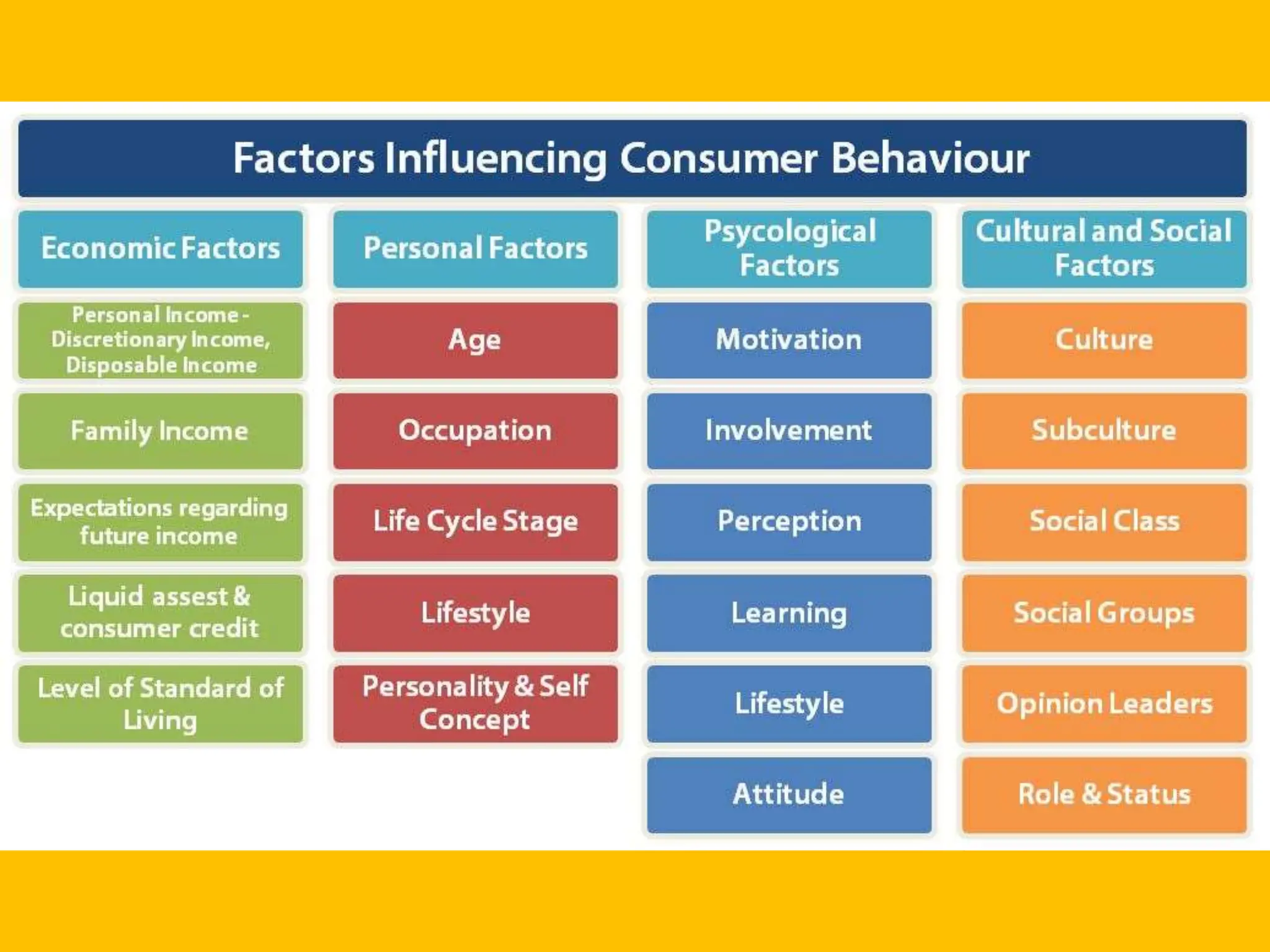
It involves understanding the psychological,
social, and cultural factors influencing these
decisions.
Nature
• Multidimensional Aspect: Consumer behavior is a complex, multifaceted
phenomenon combining elements of psychology, sociology, anthropology, and
economics. It encompasses a wide range of factors, from individual mental
processes to broader cultural and social norms.
• Dynamic Nature: Consumer preferences and behaviors are not static; they evolve
over time due to various factors such as technological advancements, social
trends, economic changes, and personal experiences.
• Variability: Different consumers have unique needs, perceptions, and behaviors.
Even the same consumer may exhibit different behaviors in different situations.
• Influenced by Various Factors: Consumer behavior is influenced by internal factors
like beliefs, attitudes, and motivation, as well as external factors like family,
culture, and social groups.
• Decision-Making Process: It involves a series of steps that consumers go through,
including problem recognition, information search, evaluation of alternatives,
purchase decision, and post-purchase behavior.
• Goal-Oriented: Consumers engage in buying behavior to satisfy specific needs and
desires, which can range from basic physiological needs to complex psychological
motivations.
Importance
• Marketing Strategy Development: Understanding consumer behavior is crucial for
marketers to design and implement effective marketing strategies. It helps in segmenting the
market, targeting the right audience, and positioning products/services accordingly.
• Product Development and Innovation: Insights into consumer behavior guide businesses in
developing products that meet the evolving needs and preferences of consumers, leading to
innovation and improved product offerings.
• Enhancing Customer Experience: By understanding the needs and behaviors of consumers,
companies can enhance customer experiences, leading to increased customer satisfaction
and loyalty.
• Effective Communication: Knowledge of consumer behavior aids in crafting appropriate
communication strategies that resonate with the target audience, thereby increasing the
effectiveness of advertising and promotional activities.
• Competitive Advantage: Businesses that thoroughly understand and anticipate the behavior
of their consumers are more likely to gain a competitive edge in the marketplace.
• Risk Reduction: By predicting consumer responses and trends, companies can reduce the risk
associated with new product launches or market entry.
• Societal Impact: Understanding consumer behavior also has societal implications, as it can
help in promoting sustainable consumption patterns and influencing public policy for
consumer welfare.
Consumer Buying Behavior
Consumer Buying Behavior refers to the
BUYING BEHAVIOR of
final consumers (individuals & households)
who buy goods and services
For
Personal Consumption.
Problem
Types Of Problem
Routine Problem
Emergency Problem
Planning Problem
Evolving Problem
Activating Problem Recognition
Desired State
Actual State
Actual State
Information Search
The Buyer Decision Process
Step 2. Information Search
•Family, friends, neighbors
•Most influential source of
information
•Advertising, salespeople
•Receives most information
from these sources
•Mass Media
•Consumer-rating groups
•Handling the product
•Examining the product
•Using the product
Personal Sources
Commercial Sources
Public Sources
Experiential Sources
Alternate
Evaluation
The Buyer Decision Process
Step 3. Evaluation of Alternatives
Product Attributes
Evaluation of Quality, Price, & Features
Degree of Importance
Which attributes matter most to me?
Brand Beliefs
What do I believe about each available brand?
Total Product Satisfaction
Based on what I’m looking for, how satisfied
would I be with each product?
Evaluation Procedures
Choosing a product (and brand) based on one
or more attributes.
The Buyer Decision Process
Step 4. Purchase Decision
Purchase Intention
Desire to buy the most preferred brand
Purchase Decision
Attitudes
of others
Unexpected
situational
factors
The Buyer Decision Process
Step 5. Post Purchase Behavior
Consumer’s Expectations of
Product’s Performance
Dissatisfied
Customer
Satisfied
Customer!
Product’s Perceived
Performance
Cognitive Dissonance
Market Segmentation
Meaning
Market
Segmentation is the
sub-dividing of market
into homogeneous
subsets of customers,
where any subset may
conceivably be selected
as a market target to
be reached with a
distinct marketing
mix.” – Philip Kotler
Need &
Requisite
• Identify
Opportunities
• Optimize
Resources
• Minimize Risk
• Enhance
Customer
Satisfaction
Levels Of Market Segmentation
Local Marketing
Niche Marketing
Individual Marketing
Segmentation
HLL VS NIRMA
Bases for Segmentation (Consumer Goods)
Geographical
Demographical
Age
Income
Gender
Occupation
Education
Marital Status
Family Size & Structure
Psychographic
Meaning
Psychographic segmentation is a method used to
divide a market or customer group into segments
based on :
• Beliefs,
• Values,
• Lifestyle,
• Social Status,
• Activities, Interests
Psychographic
Personality Life Style
Behavioral
• Occasions
• Benefits
• User Status: nonuser, ex user,
Potential user, first time user,
regular user
• Usage Rate: light, medium, heavy
• Loyalty : Hard core, Split,
Shifting, Switchers
• Buyer readiness Stage: aware,
unaware, interested
• Attitude: Enthusiastic, Positive,
indifferent, Negative and hostile
Occasion
Benefit
Benefit
Benefit
Benefit
Benefit
Attitude
Target Meaning
Target
Targeting Strategies
• Standardization: Coke, Pepsi
• Differentiation: Economy
Class/ Business class
• Focus: Standardization +
Differentiation
Focus
Positioning
It Is A Marketing Strategy Focused
On Distinguishing A Brand From Its
Competitors.
Positioning
Positioning Types
Attribute/Benefit/ Value Differentiation
Competitive
POP & POD

Consumer Behaviour and Segmentation.pptx

  • 1.
  • 2.
    Consumer Behaviour Consumer behaviourrefers to the study of individuals' decision-making processes and behaviours when purchasing, using, or disposing of goods and services. It involves understanding the psychological, social, and cultural factors influencing these decisions.
  • 3.
    Nature • Multidimensional Aspect:Consumer behavior is a complex, multifaceted phenomenon combining elements of psychology, sociology, anthropology, and economics. It encompasses a wide range of factors, from individual mental processes to broader cultural and social norms. • Dynamic Nature: Consumer preferences and behaviors are not static; they evolve over time due to various factors such as technological advancements, social trends, economic changes, and personal experiences. • Variability: Different consumers have unique needs, perceptions, and behaviors. Even the same consumer may exhibit different behaviors in different situations. • Influenced by Various Factors: Consumer behavior is influenced by internal factors like beliefs, attitudes, and motivation, as well as external factors like family, culture, and social groups. • Decision-Making Process: It involves a series of steps that consumers go through, including problem recognition, information search, evaluation of alternatives, purchase decision, and post-purchase behavior. • Goal-Oriented: Consumers engage in buying behavior to satisfy specific needs and desires, which can range from basic physiological needs to complex psychological motivations.
  • 4.
    Importance • Marketing StrategyDevelopment: Understanding consumer behavior is crucial for marketers to design and implement effective marketing strategies. It helps in segmenting the market, targeting the right audience, and positioning products/services accordingly. • Product Development and Innovation: Insights into consumer behavior guide businesses in developing products that meet the evolving needs and preferences of consumers, leading to innovation and improved product offerings. • Enhancing Customer Experience: By understanding the needs and behaviors of consumers, companies can enhance customer experiences, leading to increased customer satisfaction and loyalty. • Effective Communication: Knowledge of consumer behavior aids in crafting appropriate communication strategies that resonate with the target audience, thereby increasing the effectiveness of advertising and promotional activities. • Competitive Advantage: Businesses that thoroughly understand and anticipate the behavior of their consumers are more likely to gain a competitive edge in the marketplace. • Risk Reduction: By predicting consumer responses and trends, companies can reduce the risk associated with new product launches or market entry. • Societal Impact: Understanding consumer behavior also has societal implications, as it can help in promoting sustainable consumption patterns and influencing public policy for consumer welfare.
  • 5.
    Consumer Buying Behavior ConsumerBuying Behavior refers to the BUYING BEHAVIOR of final consumers (individuals & households) who buy goods and services For Personal Consumption.
  • 8.
  • 10.
  • 11.
  • 12.
  • 13.
  • 14.
  • 16.
  • 18.
  • 19.
    The Buyer DecisionProcess Step 2. Information Search •Family, friends, neighbors •Most influential source of information •Advertising, salespeople •Receives most information from these sources •Mass Media •Consumer-rating groups •Handling the product •Examining the product •Using the product Personal Sources Commercial Sources Public Sources Experiential Sources
  • 20.
  • 21.
    The Buyer DecisionProcess Step 3. Evaluation of Alternatives Product Attributes Evaluation of Quality, Price, & Features Degree of Importance Which attributes matter most to me? Brand Beliefs What do I believe about each available brand? Total Product Satisfaction Based on what I’m looking for, how satisfied would I be with each product? Evaluation Procedures Choosing a product (and brand) based on one or more attributes.
  • 22.
    The Buyer DecisionProcess Step 4. Purchase Decision Purchase Intention Desire to buy the most preferred brand Purchase Decision Attitudes of others Unexpected situational factors
  • 23.
    The Buyer DecisionProcess Step 5. Post Purchase Behavior Consumer’s Expectations of Product’s Performance Dissatisfied Customer Satisfied Customer! Product’s Perceived Performance Cognitive Dissonance
  • 24.
  • 25.
    Meaning Market Segmentation is the sub-dividingof market into homogeneous subsets of customers, where any subset may conceivably be selected as a market target to be reached with a distinct marketing mix.” – Philip Kotler
  • 26.
    Need & Requisite • Identify Opportunities •Optimize Resources • Minimize Risk • Enhance Customer Satisfaction
  • 27.
    Levels Of MarketSegmentation
  • 28.
  • 29.
  • 30.
  • 33.
  • 34.
  • 37.
    Bases for Segmentation(Consumer Goods)
  • 38.
  • 39.
  • 43.
  • 44.
    Meaning Psychographic segmentation isa method used to divide a market or customer group into segments based on : • Beliefs, • Values, • Lifestyle, • Social Status, • Activities, Interests
  • 45.
  • 47.
    Behavioral • Occasions • Benefits •User Status: nonuser, ex user, Potential user, first time user, regular user • Usage Rate: light, medium, heavy • Loyalty : Hard core, Split, Shifting, Switchers • Buyer readiness Stage: aware, unaware, interested • Attitude: Enthusiastic, Positive, indifferent, Negative and hostile
  • 48.
  • 49.
  • 50.
  • 51.
  • 52.
  • 53.
  • 54.
  • 61.
  • 62.
  • 63.
    Targeting Strategies • Standardization:Coke, Pepsi • Differentiation: Economy Class/ Business class • Focus: Standardization + Differentiation
  • 64.
  • 65.
    Positioning It Is AMarketing Strategy Focused On Distinguishing A Brand From Its Competitors.
  • 66.
  • 67.
    Positioning Types Attribute/Benefit/ ValueDifferentiation Competitive
  • 68.