Vouching
UNIT 3
Content
• Vouching:Meaning, Definition, Importance
• Routine Checking And Vouching,
• Voucher And Types Of Voucher
• Vouching of receipts-cash sales,
• Receipt from debtors,
• Proceeds From The Sale Of Investments,
• Vouching Of Payments,
• Cash Purchase,
• Payment To Creditors,
• Deferred Revenue Expenditure.
Vouching:Meaning, Definition
“Vouching is the examination
by the auditor of all documentary evidence,
which is available to support the authenticity of transactions
entered in the client’s records”.
Spicer and Pegler
It is popularly known as the acid test of an audit because it tests the truth
of a transaction recorded in the client’s books
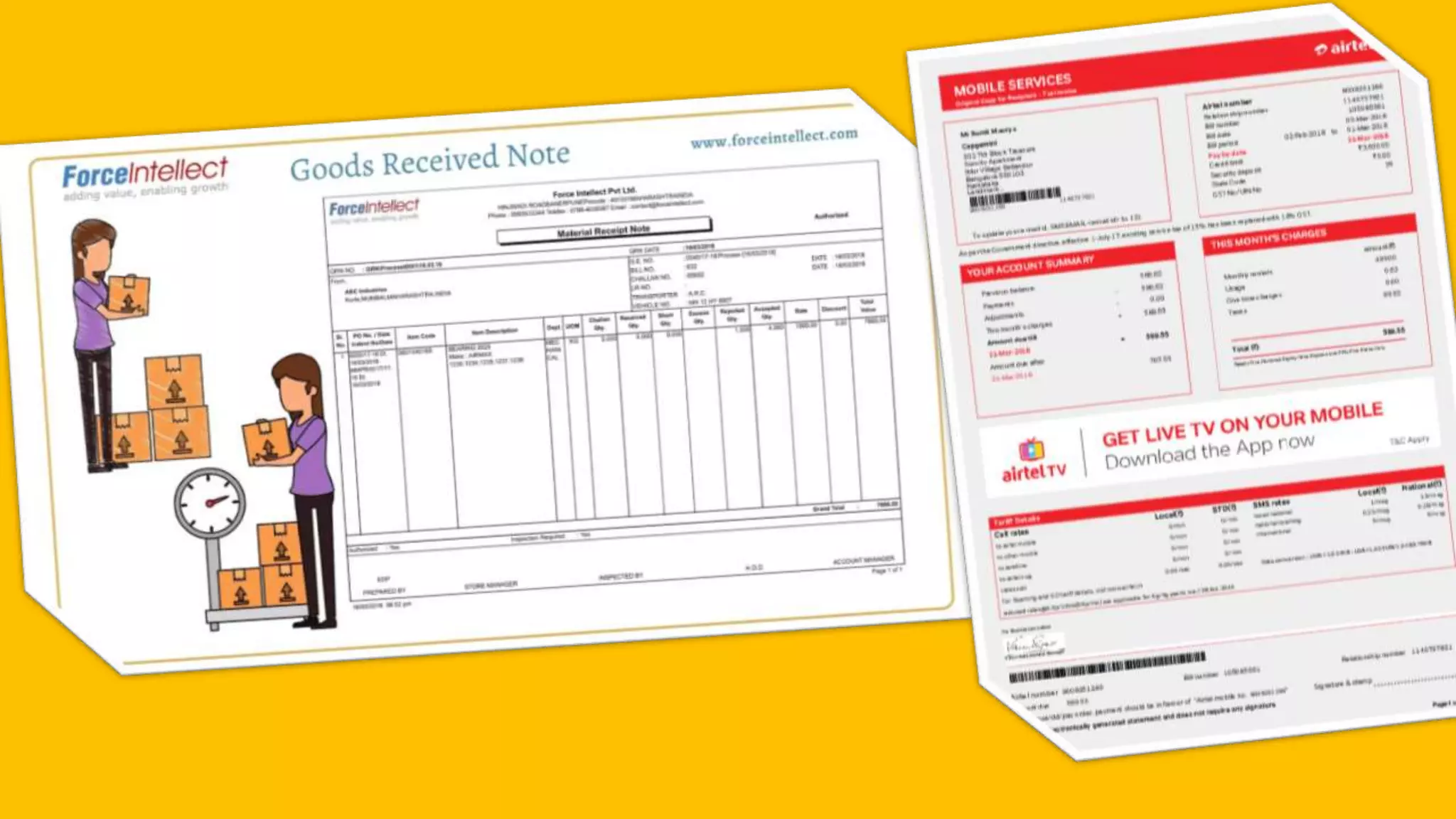
What is a Voucher?
Eg:- When you are given money to pay the Fee of your college, Parents ask
us for the Fee receipt, for they barely have faith on us. Hence to Confirm the
Amount and payment of fee, the Fee receipt acts as a Voucher.
Importance
Objectives
1.To Detect Errors and Frauds
2. To Know the Truth of Account
3. To Find the Unrecorded Transactions
4. To Know That All the Transactions Are
Authorized
5. To Know That Only the Business Transactions
Are Recorded
Principles or Techniques of Vouching
1. Arranged Vouchers: All vouchers should be serially numbered
and arranged in sequential order
2. Checking Of Date: Date recorded in the cash book.
3. Compare the Words and figures:
4. Checking Of Authority: Passed by the authorized officer.
5. Cutting or Change:. Missing vouchers and receipts, get duplicate
copies from the client. If there is any cutting or change on the receipts
and vouchers figures it should be signed by the authorized officer.
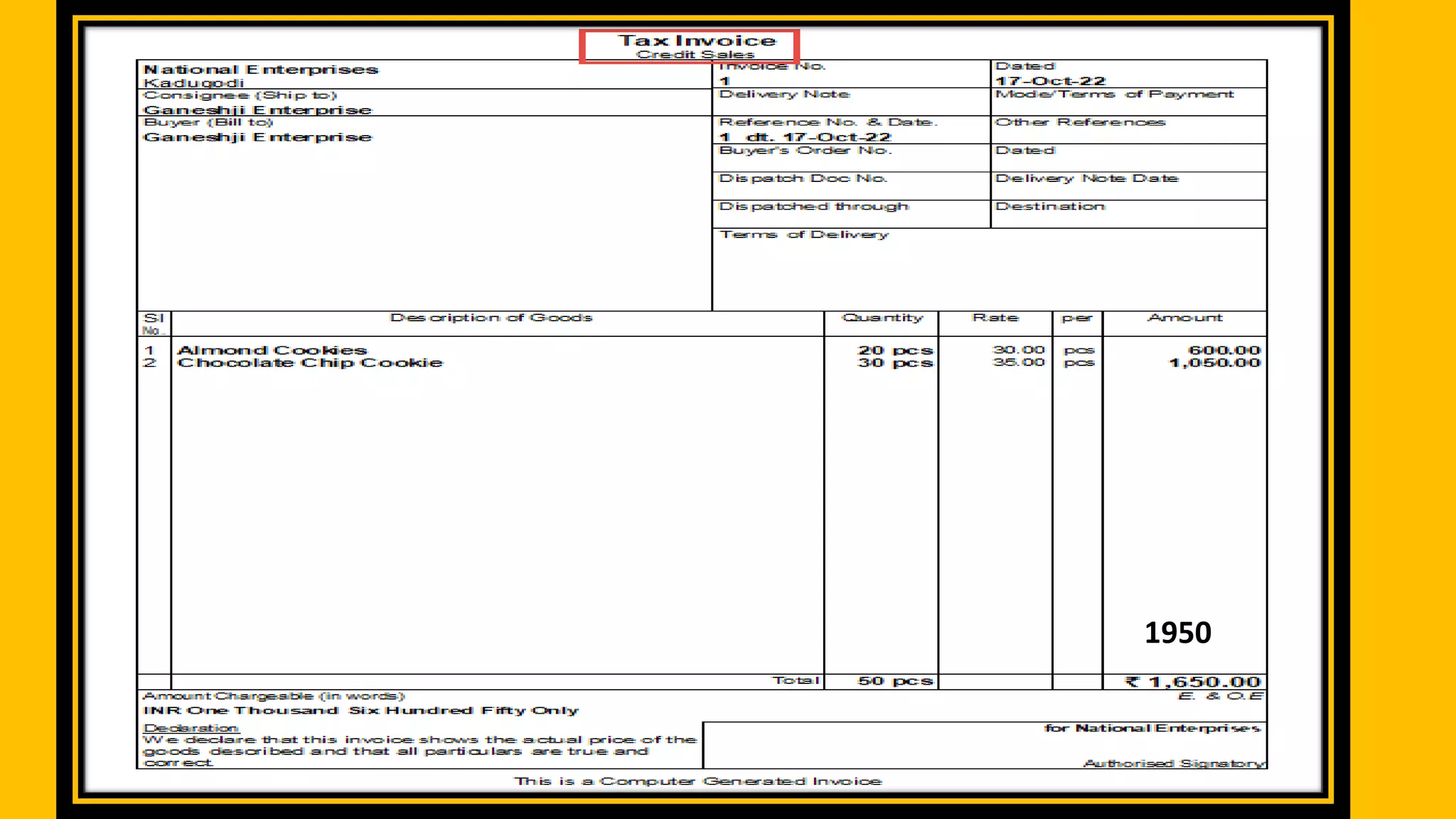
1950
Principles or Techniques
of Vouching
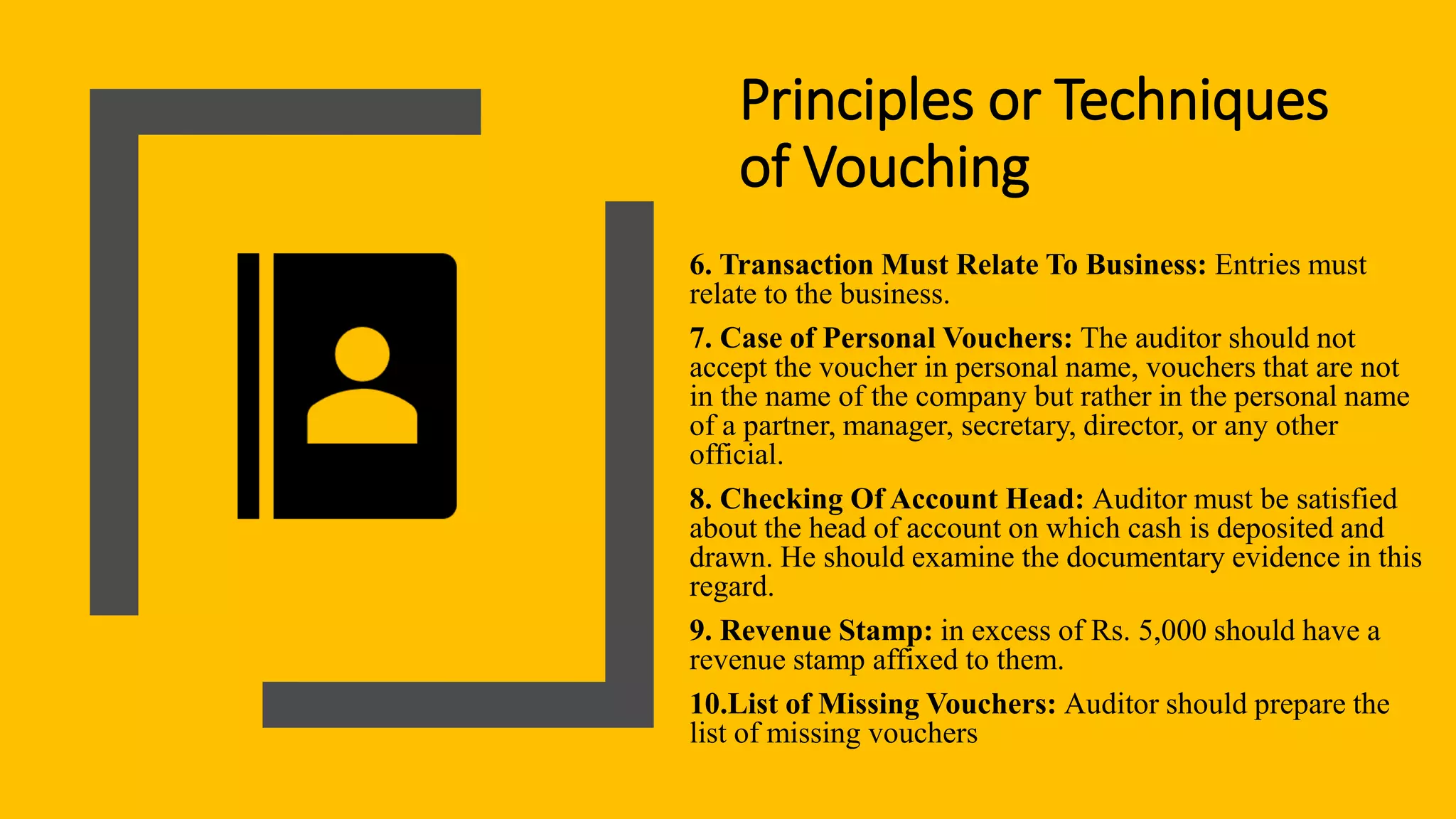
6. Transaction Must Relate To Business: Entries must
relate to the business.
7. Case of Personal Vouchers: The auditor should not
accept the voucher in personal name, vouchers that are not
in the name of the company but rather in the personal name
of a partner, manager, secretary, director, or any other
official.
8. Checking Of Account Head: Auditor must be satisfied
about the head of account on which cash is deposited and
drawn. He should examine the documentary evidence in this
regard.
9. Revenue Stamp: in excess of Rs. 5,000 should have a
revenue stamp affixed to them.
10.List of Missing Vouchers: Auditor should prepare the
list of missing vouchers
NOT REQUIRED FOR
EXAMS
To collect fees or revenue for maintaining courts. There was a law called Indian Stamp Act 1899.
This law was amended for 51 times since 1899 to 2004. Under section 30, if you make a payment of more than Rs. 5000/-
to any other, then you can insist on getting a stamped receipt with Re 1/- revenue stamp.
In this case, if the payee refuses to give a receipt with a revenue stamp, then he can be punished with a fine of Rs. 100/-
under section 65.
Revenue Stamps
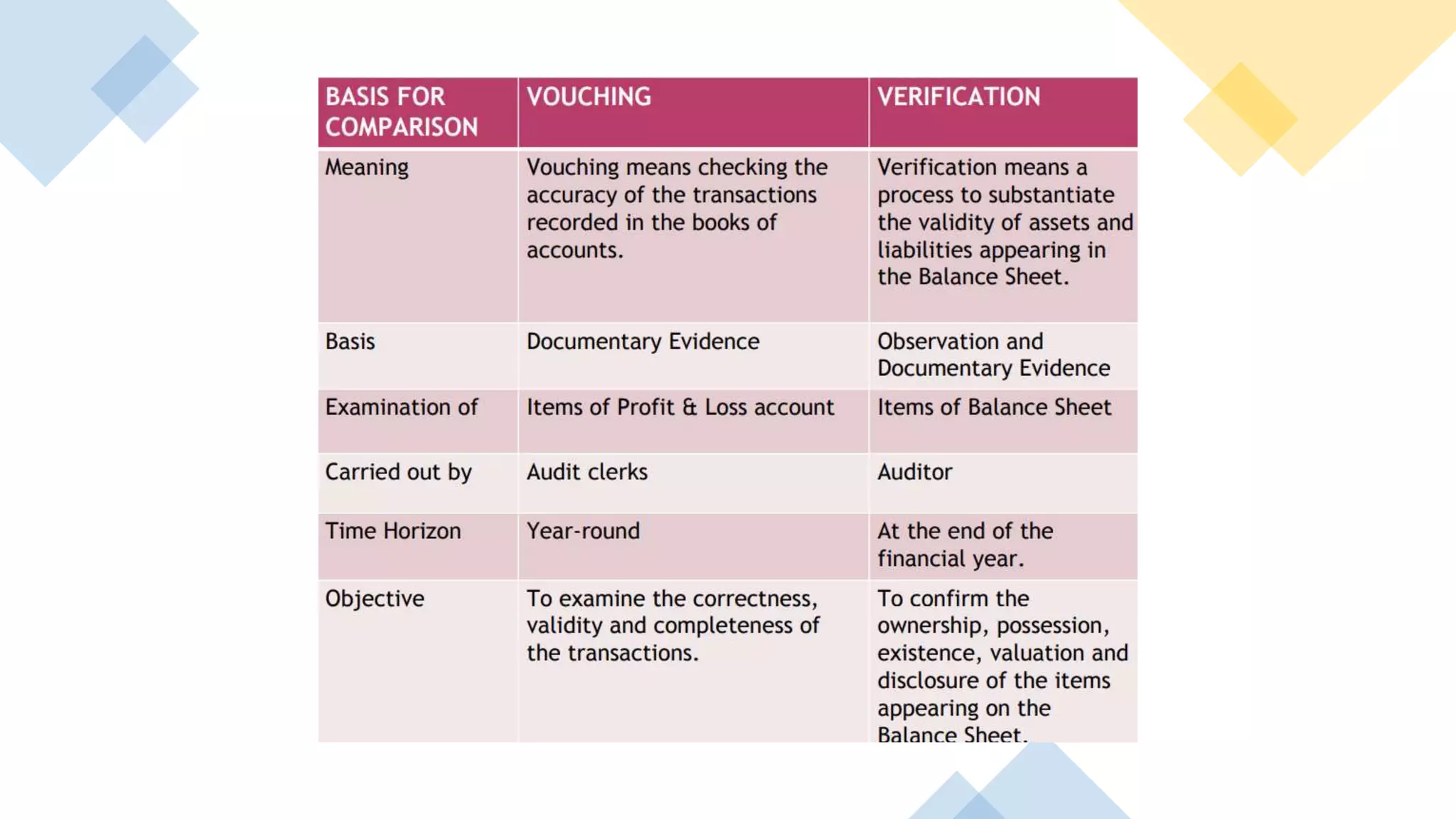
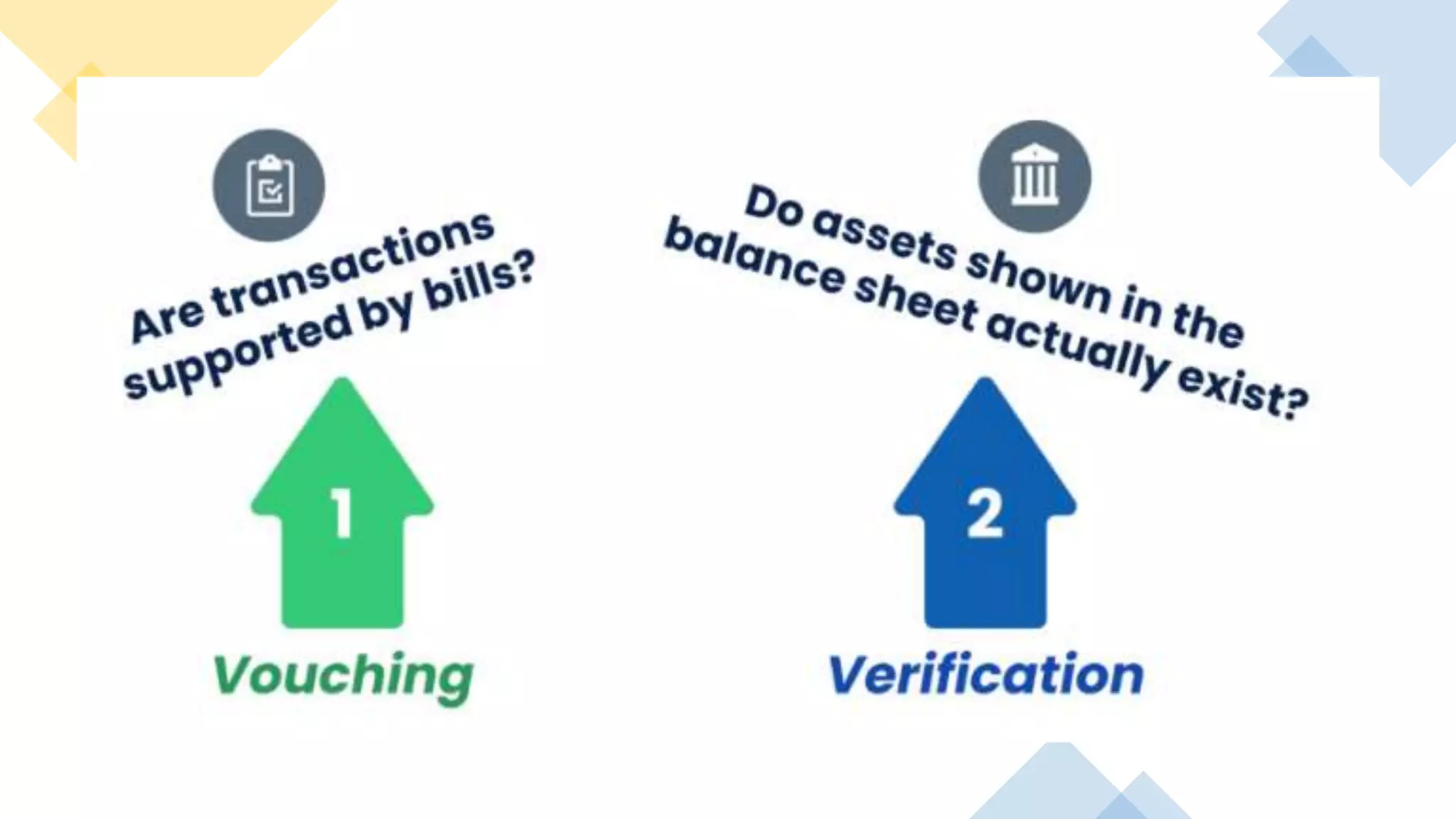
Vouching vs Verification
Vouching is concerned with the
checking of records with the help of
supporting documents.
Verification is a process to check the title,
possession, existence, and valuation of
assets.
Types of Voucher
1. Primary vouchers: when
written evidence is
available in original, it is
known as primary voucher.
Ex: sales invoice, cash
memo, purchase invoice,
minutes book of board
meeting etc
2. Collateral vouchers: when
there is no written evidence, but
copies are made available for the
purpose of audit
Ex: carbon copies of sales
invoice. Copies of
resolutions passed in a
meeting
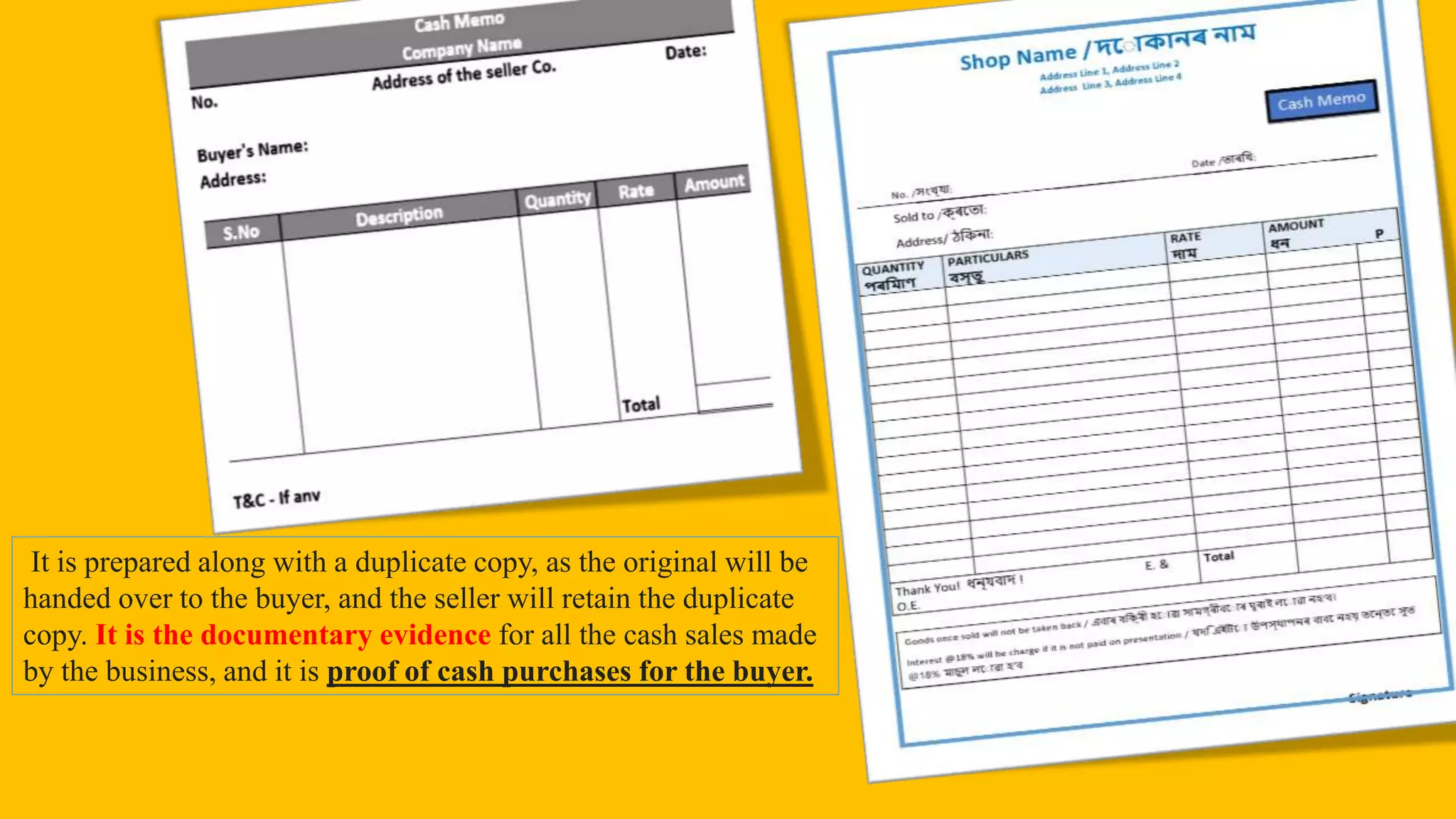
It is prepared along with a duplicate copy, as the original will be
handed over to the buyer, and the seller will retain the duplicate
copy. It is the documentary evidence for all the cash sales made
by the business, and it is proof of cash purchases for the buyer.
Sources
Any document based upon which a financial transaction is recorded In Books of accounts (BoA) is
known as source documents.
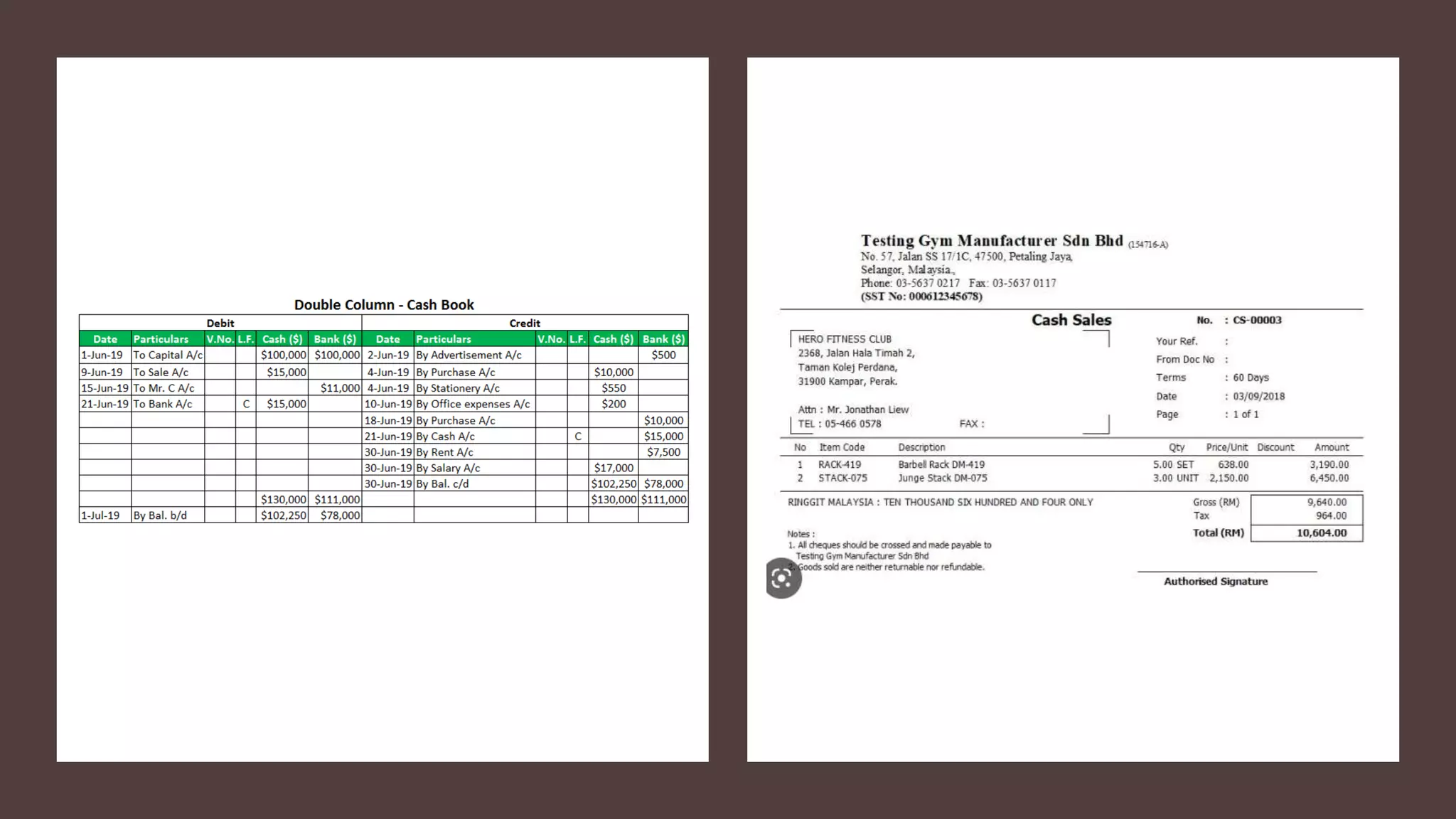
. Cash memo: on which the details of amount, date of cash sales and cash purchases of a company
are given. Cash memos issued on cash sales and cash memos received on cash purchases. It is based
on cash payment. Cash sales and cash purchases are recorded in the accounting books.
2. Cheques: if withdrawn, notes should be given on counterfoils and for deposit, use pay in slips 3.
Invoice & bills: are used for credit sales & purchases. 3 copies are made- 1 for BoA as source
document, and other sent along with goods.
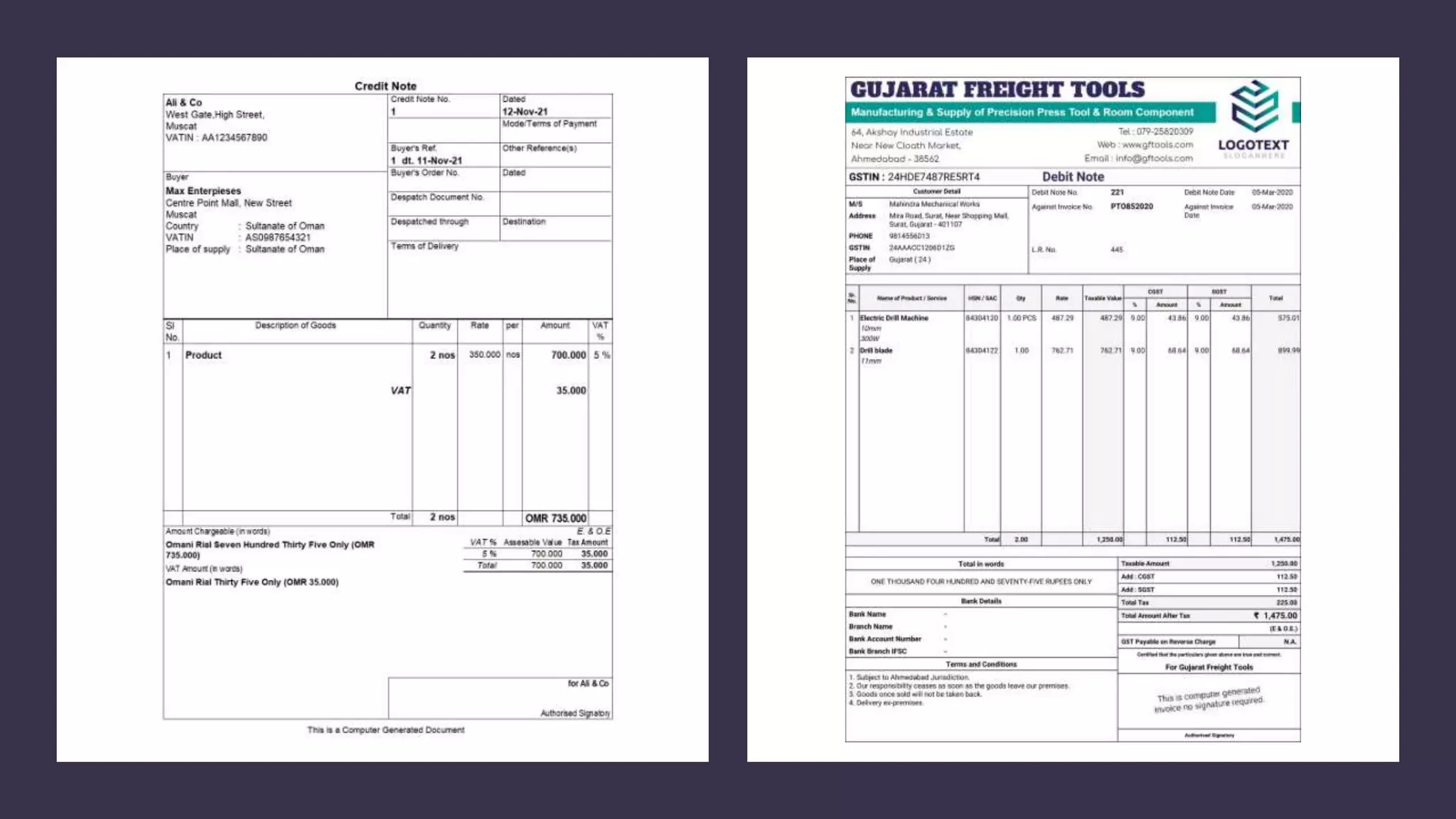
4. Credit note: are issued during sales return. Customers’ accounts are credited with S. R. amount
and further used as a source document.
5. Debit note: are issued during purchase return. The sellers account is debited with the amount of
purchase return and the debit note is used as a source document.
6. Pay in slip: used to deposit either cheque or cash in bank. While main body is kept with the bank,
duly stamped counterfoil is given to the customer.
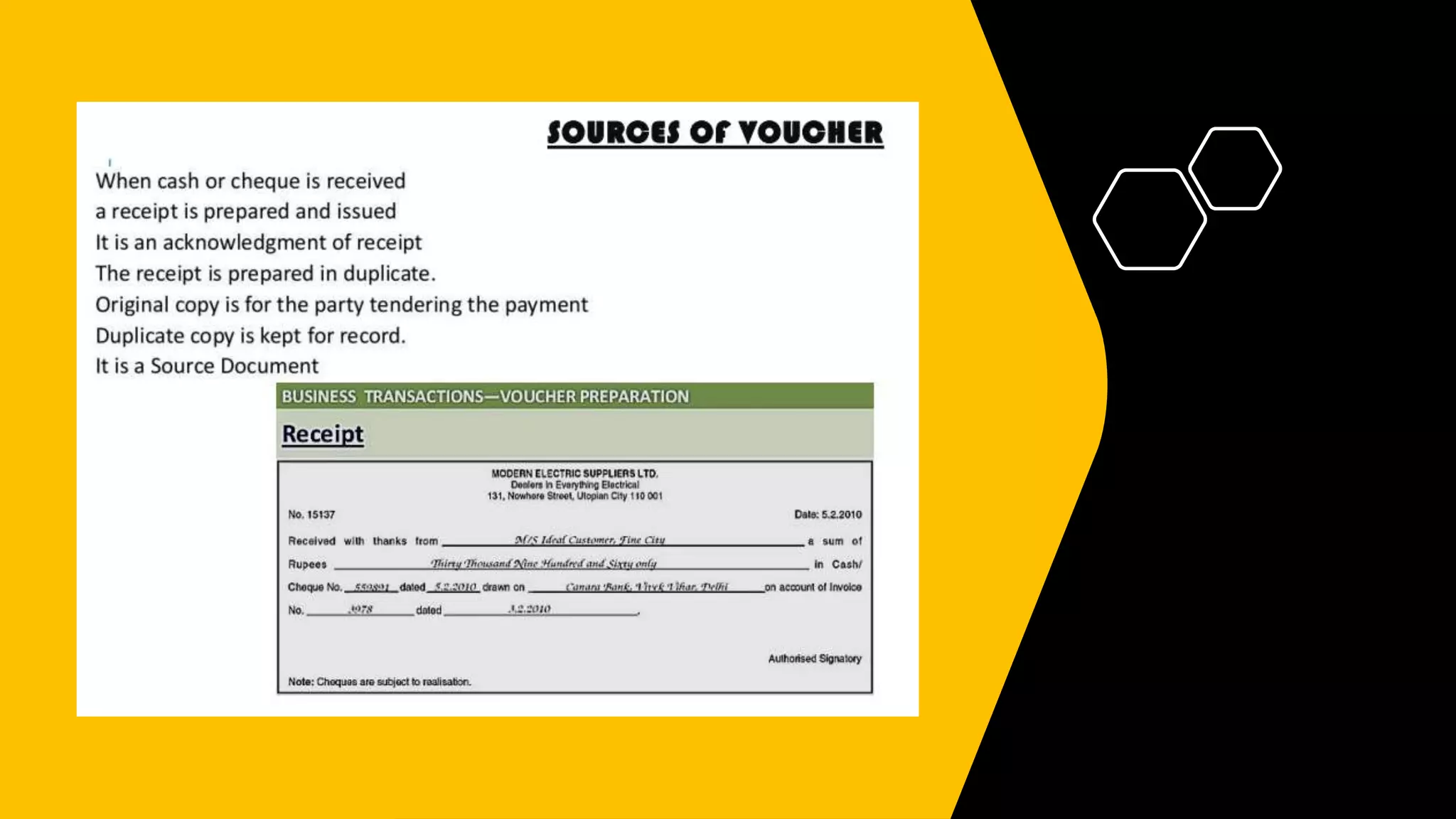
7. Receipt
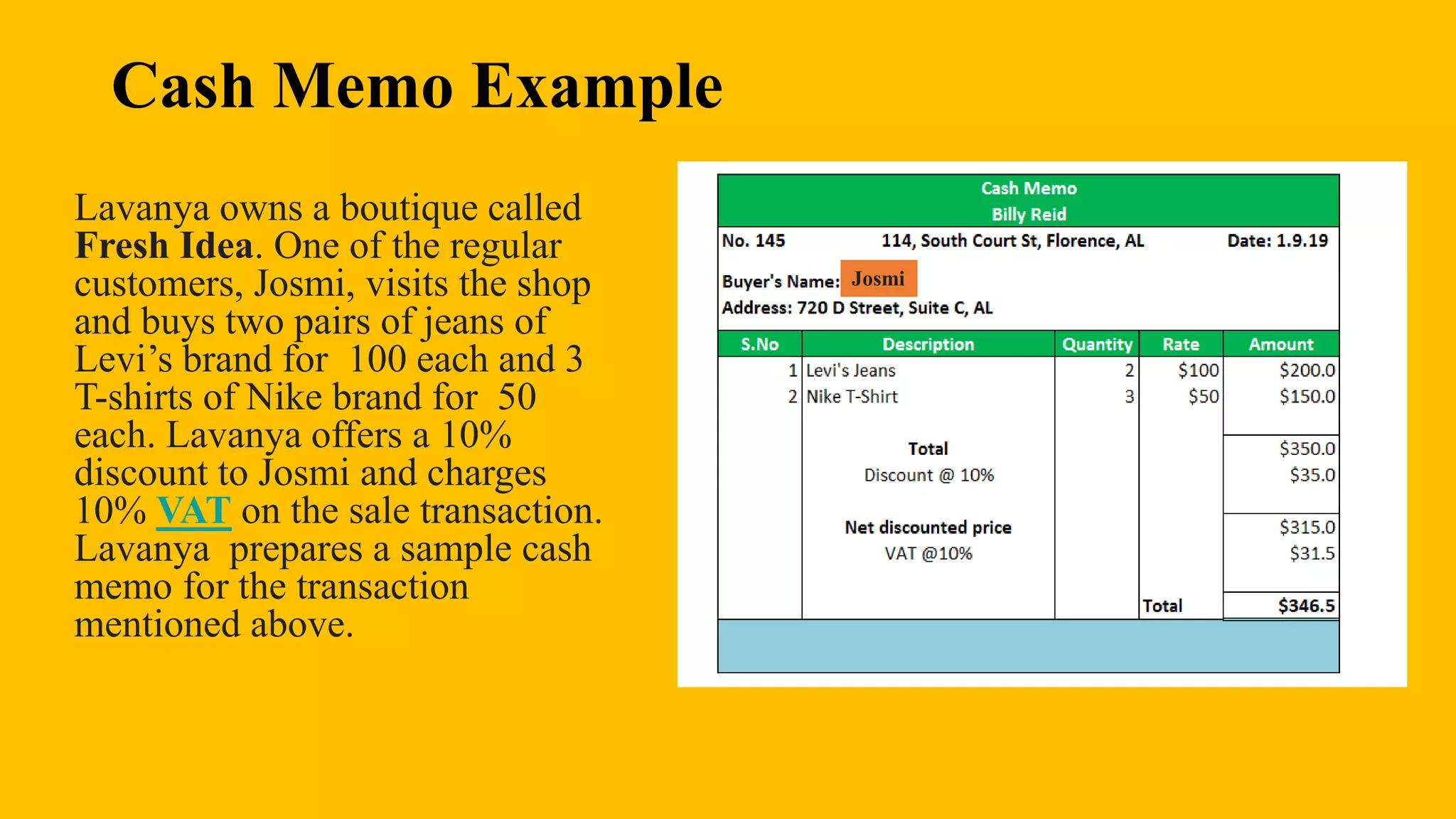
Josmi
Cash Memo Example
Lavanya owns a boutique called
Fresh Idea. One of the regular
customers, Josmi, visits the shop
and buys two pairs of jeans of
Levi’s brand for 100 each and 3
T-shirts of Nike brand for 50
each. Lavanya offers a 10%
discount to Josmi and charges
10% VAT on the sale transaction.
Lavanya prepares a sample cash
memo for the transaction
mentioned above.
Examining
Vouchers
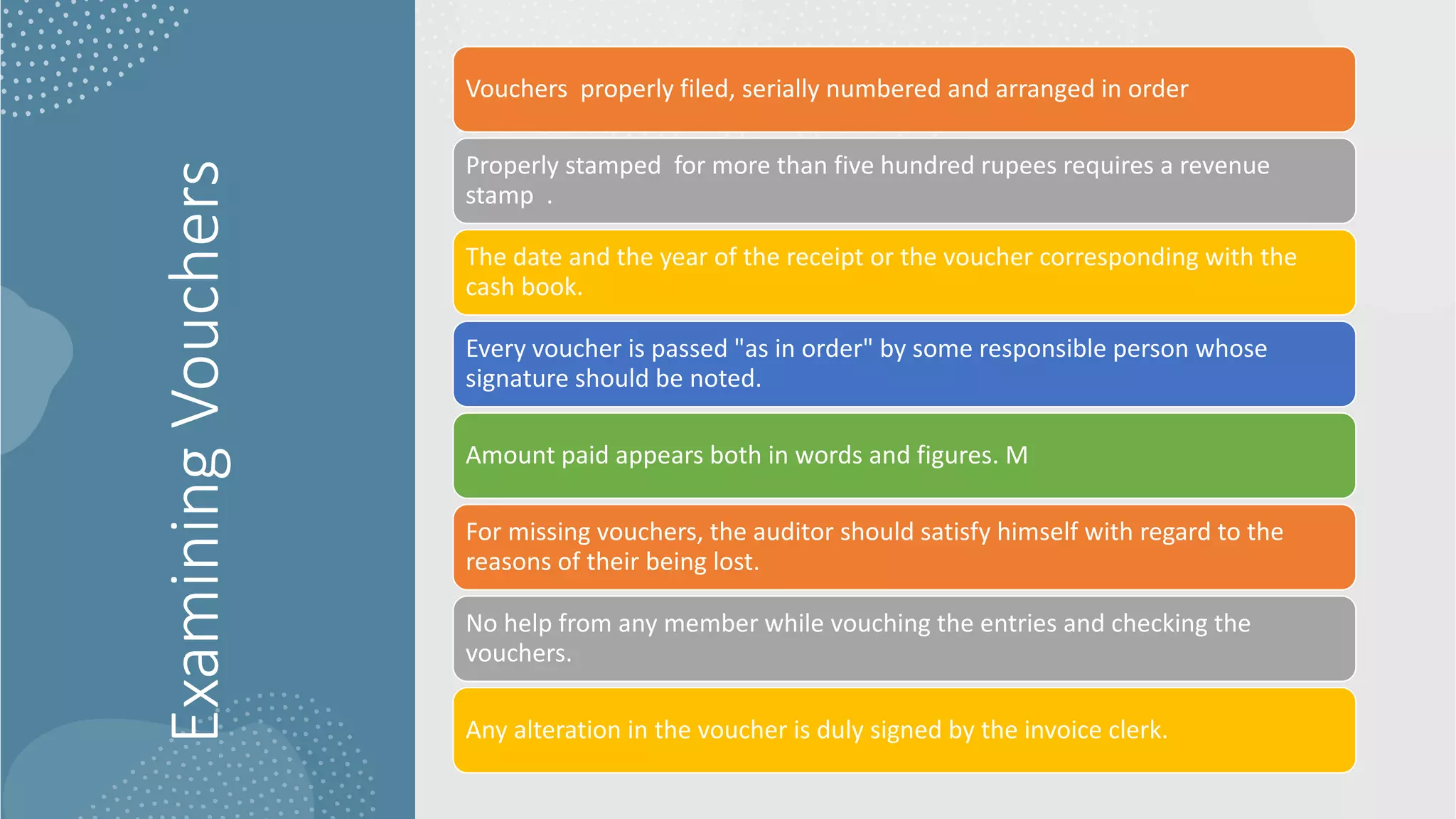
Vouchers properly filed, serially numbered and arranged in order
Properly stamped for more than five hundred rupees requires a revenue
stamp .
The date and the year of the receipt or the voucher corresponding with the
cash book.
Every voucher is passed "as in order" by some responsible person whose
signature should be noted.
Amount paid appears both in words and figures. M
For missing vouchers, the auditor should satisfy himself with regard to the
reasons of their being lost.
No help from any member while vouching the entries and checking the
vouchers.
Any alteration in the voucher is duly signed by the invoice clerk.
• Minutes means a formal written record, in
physical or electronic form, of the proceedings of a
Meeting and Minutes Book means a Book
maintained in physical or in electronic form for the
purpose of recording of Minutes.
• A distinct minute book shall be maintained for
each type of meeting namely
• 1. General Meetings of the Members
• 2. Board Meeting of the Directors
• 3. Meetings of each Committee of the Board
• 4. Meetings of the Creditors
• Resolutions passed by postal ballot shall be
recorded in the minute book of general meetings as
if it has been deemed to be passed in the general
meeting.
• Sources:
• Any document based upon which a financial transaction is recorded In Books of accounts (BoA) is
• known as source documents.
• In case of accountancy, the first step is identifying the foundation of a financial transaction based on documentary proof
known as source documents.
1.Cash memo: on which the details of amount, date of cash sales and cash purchases of a company are given. Cash memos
issued on cash sales and cash memos received on cash purchases. It is based on cash payment. Cash sales and cash purchases
are recorded in the accounting books.
• 2. Cheques: if withdrawn, notes should be given on counterfoils and for deposit, use pay in slips 3. Invoice & bills: are used for
credit sales & purchases. 3 copies are made- 1 for BoA as source document, and other sent along with goods.
• 4. Credit note: are issued during sales return. Customers’ accounts are credited with S. R. amount and further used as a
source document.
• 5. Debit note: are issued during purchase return. The sellers account is debited with the amount of purchase return and the
debit note is used as a source document.
• 6. Pay in slip: used to deposit either cheque or cash in bank. While main body is kept with the bank, duly stamped counterfoil
is given to the customer.
• 7. Receipt
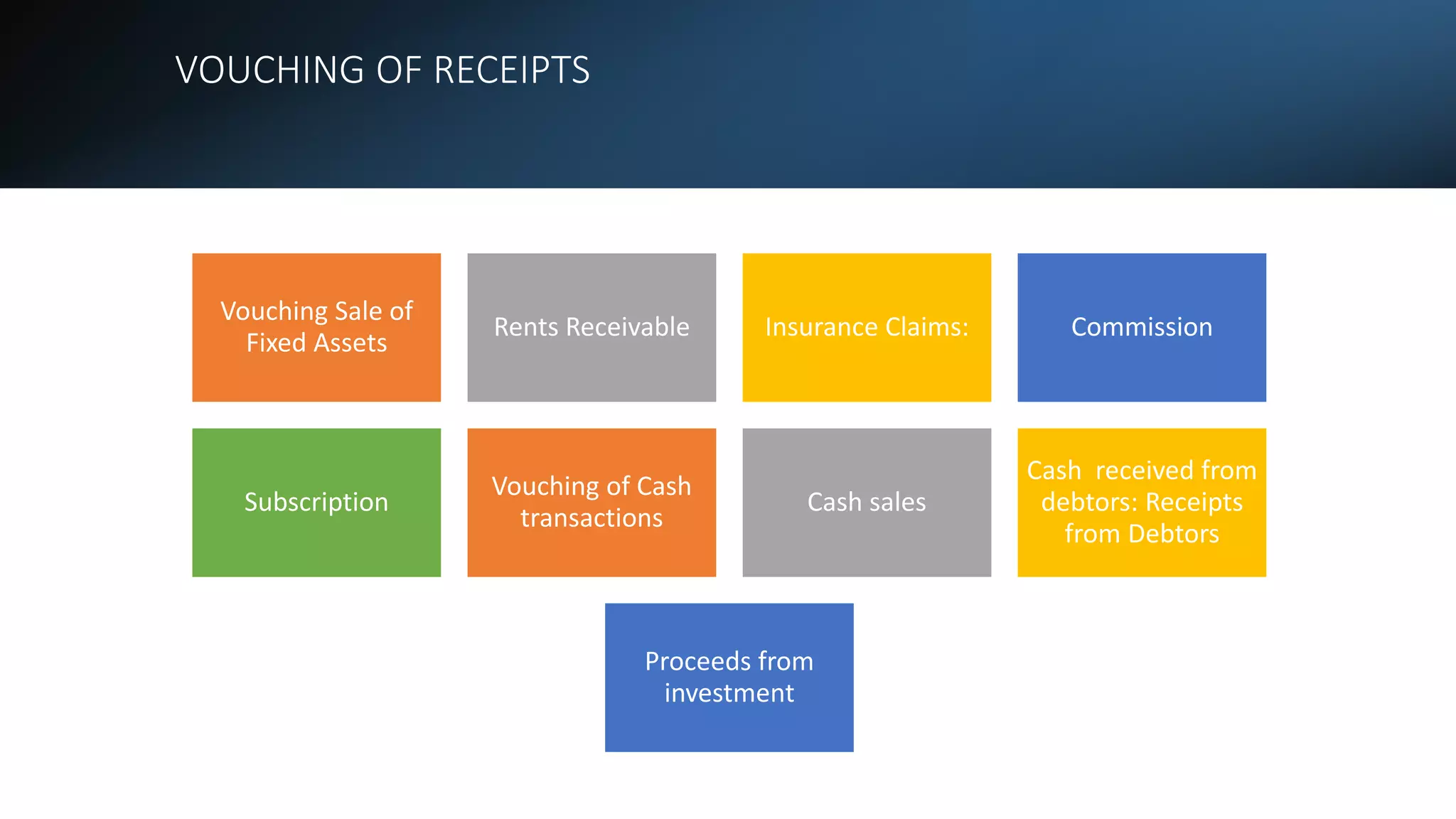
VOUCHING OF RECEIPTS
Vouching Sale of
Fixed Assets
Rents Receivable Insurance Claims: Commission
Subscription
Vouching of Cash
transactions
Cash sales
Cash received from
debtors: Receipts
from Debtors
Proceeds from
investment
Vouching Sale
of Fixed Assets
An auditor has to verify the following documents while
auditing Sale of fixed assets
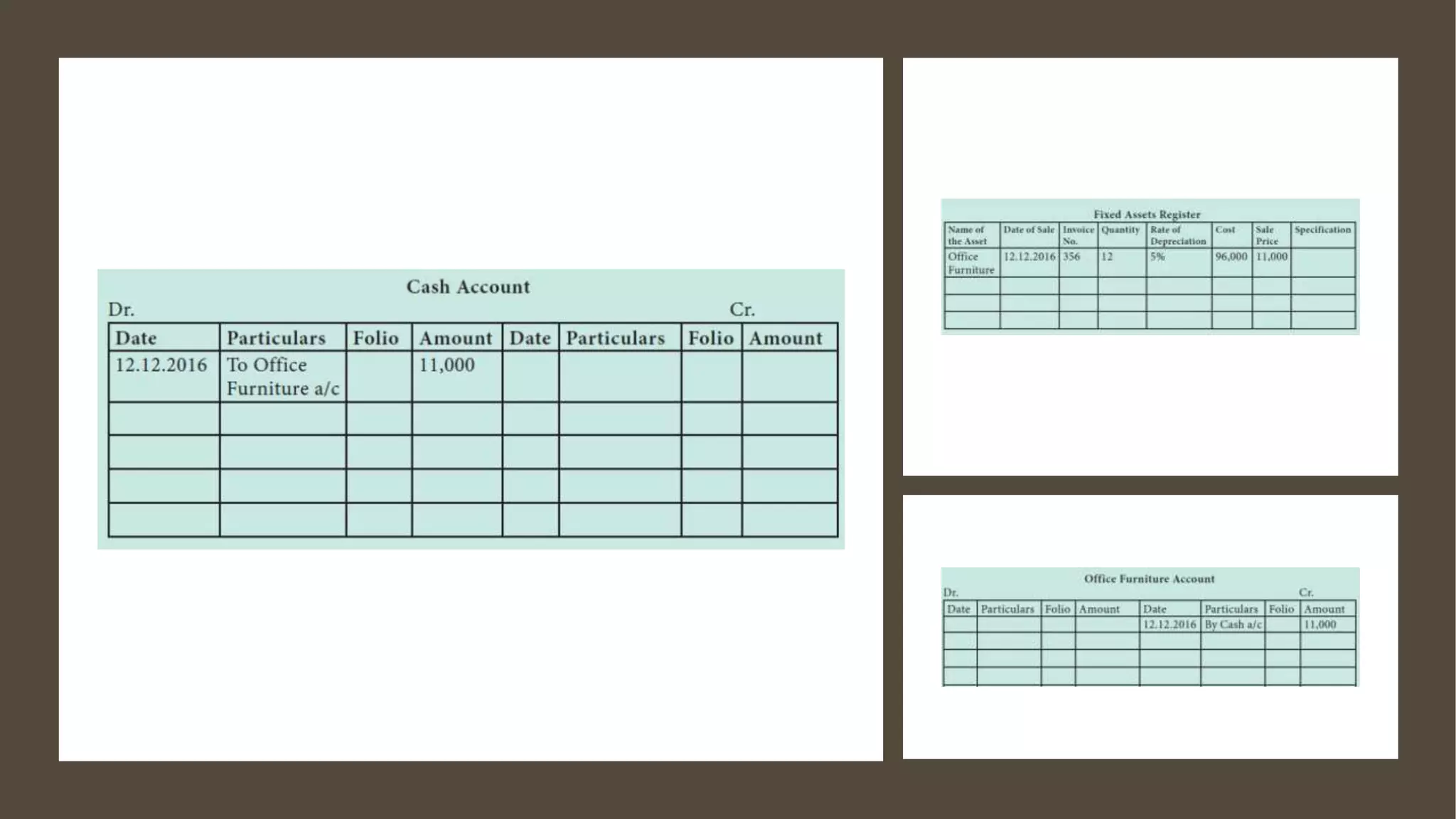
1. Fixed asset register.
2. Sale Agreement.
3. Statement of accounts from Auctioneers.
4. Brokers’ sold note.
5. Correspondence (if any)
6. Directors’ minutes book in the case of a company.
Role of an Auditor
in vouching sale of
fixed assets
Sale of fixed assets should be approved by the board of directors.
Auditors should
1. verify the minutes of meeting of the Board of Directors.
2. verify the cash book, the entries relating to sale of fixed assets
3. bank book to ensure that the amount received on the sale of fixed assets is immediately
deposited in bank on the next day.
4. verify the calculation of profit/loss in sale of assets
5. ensure that the profit on sale is transferred to capital reserve and not to the general
profit & loss account
• It is possible in case of sale of fixed assets, the sale deed is not executed for the full
purchase consideration. To detect such a fraud, the auditor should examine the
correspondence made with the parties willing to purchase them.
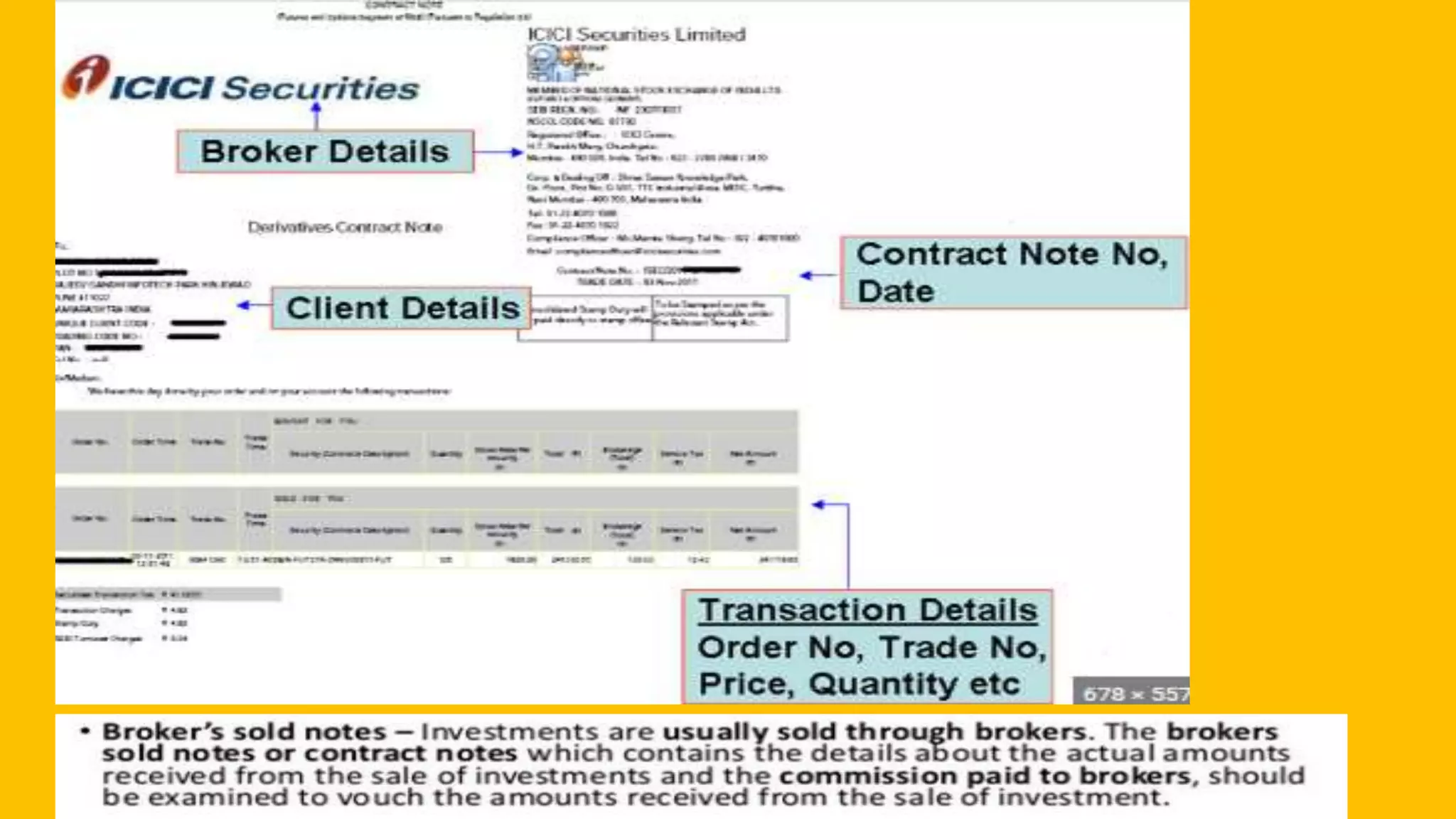
• In case, sale has been made through a broker, the broker's sold note should be examined.
Rents Receivable
(I) examine the leases agreement with the tenants
and ascertain the exact amount receivable.
(ii) Check the amounts due with the rent-foil.
(iii) Compare the amounts as per rent roll with the cash book.
(iv) Check the counterfoils of rent receipt issued to tenants.
If agents are appointed to collect rent, the accounts or statements submitted by
them should be carefully checked.
Insurance Claims
Amounts received under an
insurance policy should be verified
by means of the correspondence
with and accounts rendered by the
insurance companies
Subscriptions
Subscriptions received by a club or
society should be checked with
counter-foils of receipt books and
with the published list of
subscribers
Commission received
Vouching of
Cash
transactions
• Vouching of cash transactions is by far the most
important job in every business irrespective of its
size and type of business etc. Before setting the
programmer for vouching the cash book, an auditor
should examine carefully the whole system of
internal check in operation in respect of cash
transactions.
Vouching of receipts of the debit side of the
cash book
1. Opening balance: This can be vouched by
comparing it with the balance shown in the duly
audited balance sheet of the previous year.
By doing this, it is verified that the actual balance has
been brought down.
Cash sales
Under this head, the chances of fraud
are comparatively greater, for
example the salesman may sell goods
but may not record the same in the
cash book thus misappropriating the
money.
Therefore the auditor should examine
the effectiveness of the internal
control system in operation in regard
to cash sales. Assuming an effective
internal check system in operation,
the auditor should take the following
steps to verify the correctness of the
amount of cash sales.
Cash sales
Cash ledger should be fully checked with carbon copies of cash memos
To check the daily deposits of cash received in the bank.
Dates of cash memos and date on which the receipts are recorded in cash book must be same.
Where the company has a discount policy, if more discount is allowed in a transaction, it must be approved by a
responsible officer.
Where the cash memos are cancelled, all copies including original copy duly cancelled should be kept in the books.
(Vouchers, duplicate cash memo, salesman abstract, cash summaries)
Cash received from debtors
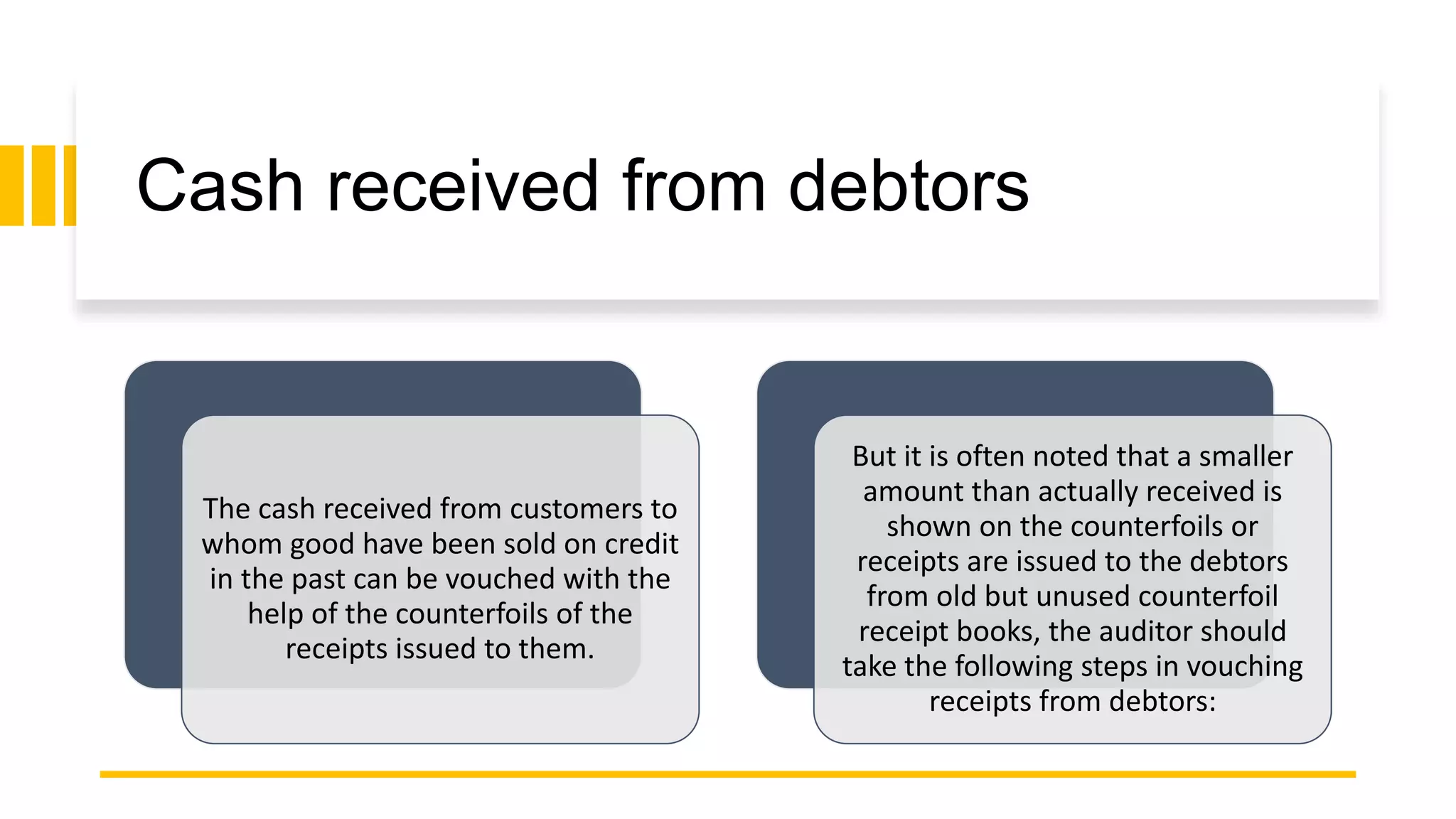
The cash received from customers to
whom good have been sold on credit
in the past can be vouched with the
help of the counterfoils of the
receipts issued to them.
But it is often noted that a smaller
amount than actually received is
shown on the counterfoils or
receipts are issued to the debtors
from old but unused counterfoil
receipt books, the auditor should
take the following steps in vouching
receipts from debtors:
Cash received from debtors
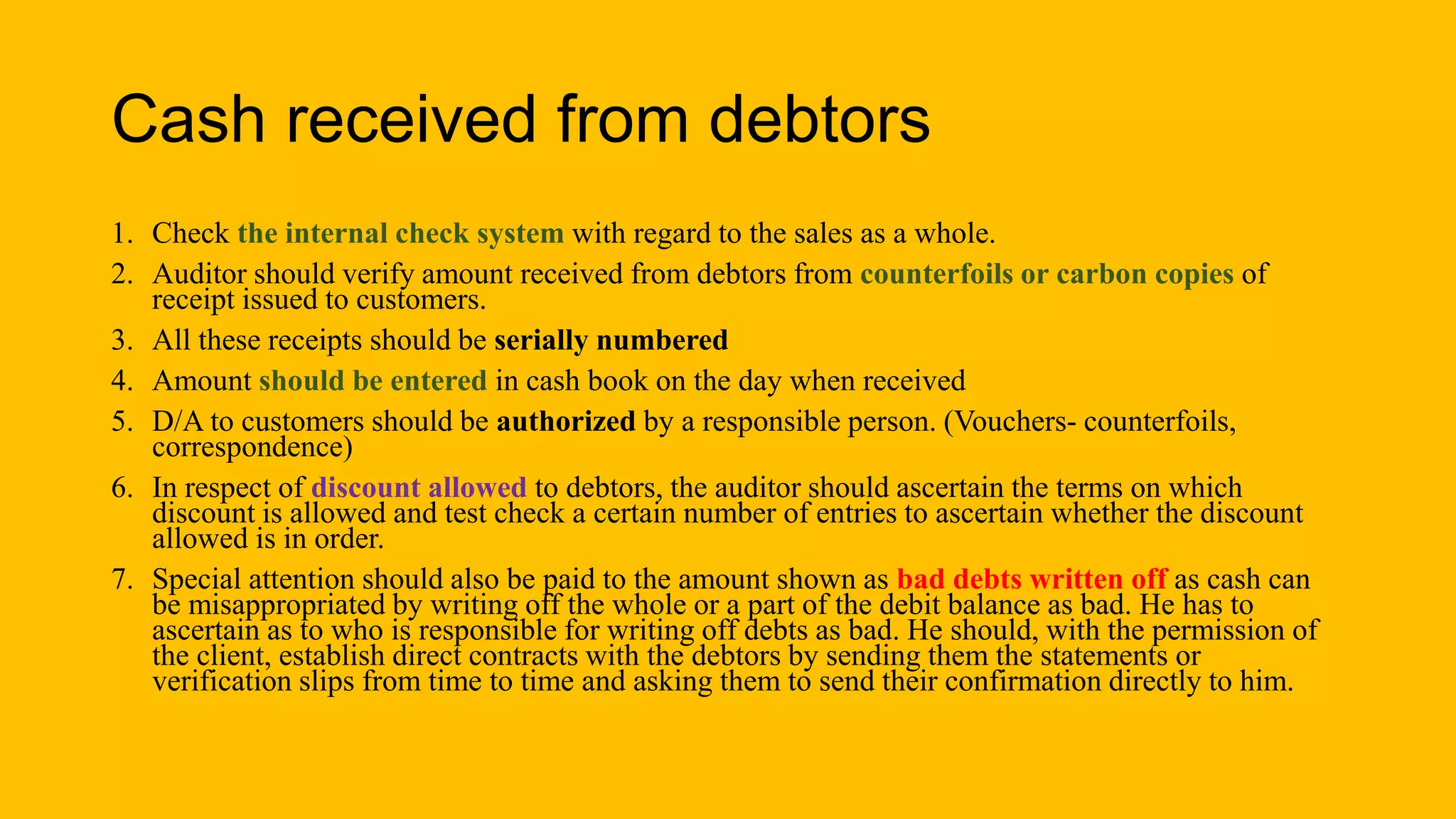
1. Check the internal check system with regard to the sales as a whole.
2. Auditor should verify amount received from debtors from counterfoils or carbon copies of
receipt issued to customers.
3. All these receipts should be serially numbered
4. Amount should be entered in cash book on the day when received
5. D/A to customers should be authorized by a responsible person. (Vouchers- counterfoils,
correspondence)
6. In respect of discount allowed to debtors, the auditor should ascertain the terms on which
discount is allowed and test check a certain number of entries to ascertain whether the discount
allowed is in order.
7. Special attention should also be paid to the amount shown as bad debts written off as cash can
be misappropriated by writing off the whole or a part of the debit balance as bad. He has to
ascertain as to who is responsible for writing off debts as bad. He should, with the permission of
the client, establish direct contracts with the debtors by sending them the statements or
verification slips from time to time and asking them to send their confirmation directly to him.
Teeming And Lading
• When cash is received from customers, a cash
memo is issued to the customer and a carbon
copy of cash memo is retained by the clerk.
• Fraud can take place by accounting lesser
amount than what is actually received.
Sometimes, fraud may occur when payment
received from a customer is misappropriated
without making entry in the account and later on
when cash is received from another customer.
• This practice is called as “Teeming and Lading
of Fraud.”
To detect
such a fraud
the auditor
should
• 1. Examine the accounts of those debtors
which show part payments from time to
time.
• 2. Check the amount and date on the
counterfoil receipts to compare it with the
date and amount deposited in the bank.
• 3. Should send verification slips to the
debtor requesting them to send the
confirmation directly to him.
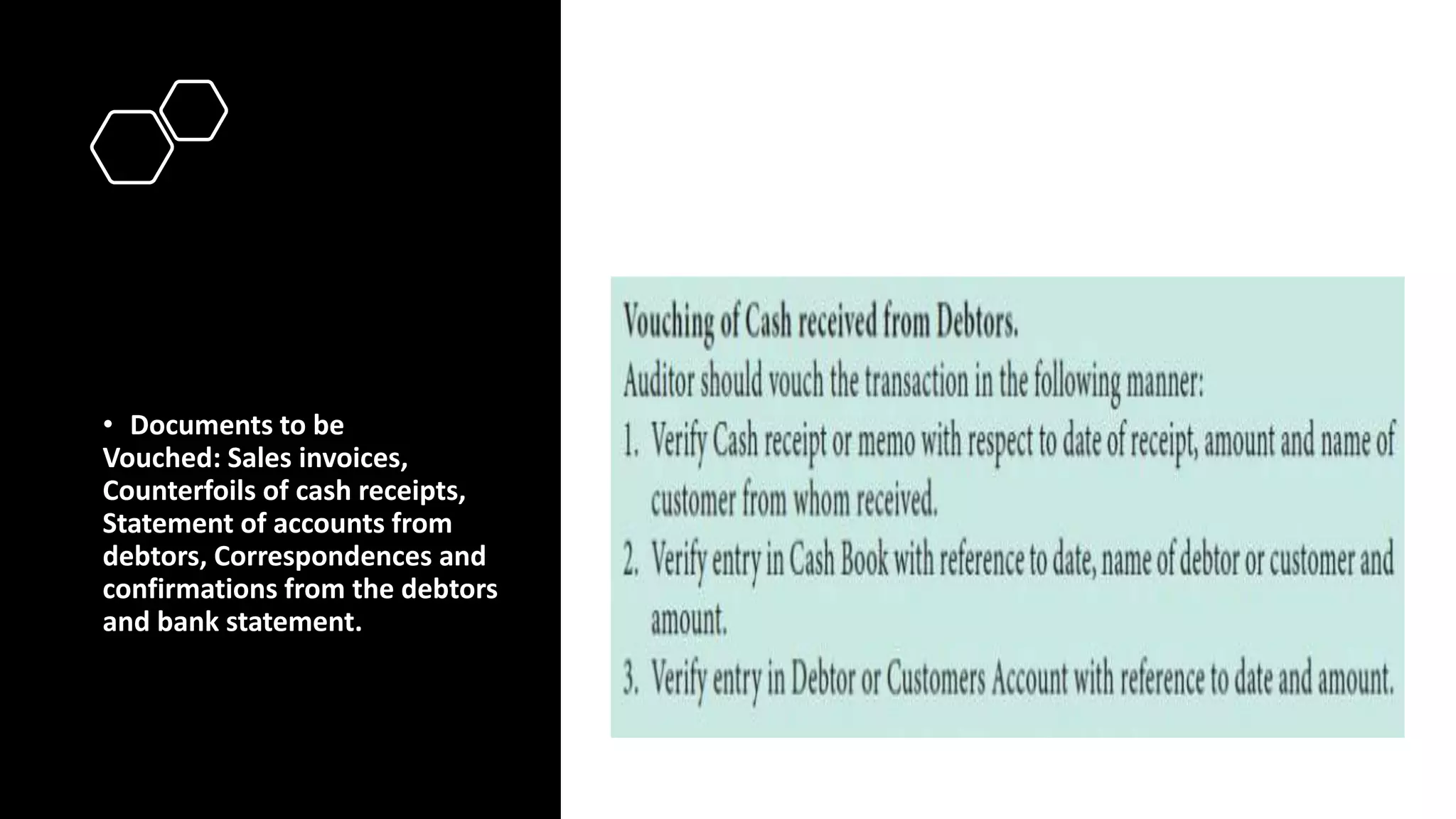
Auditor should vouch the transaction in the
following manner ?
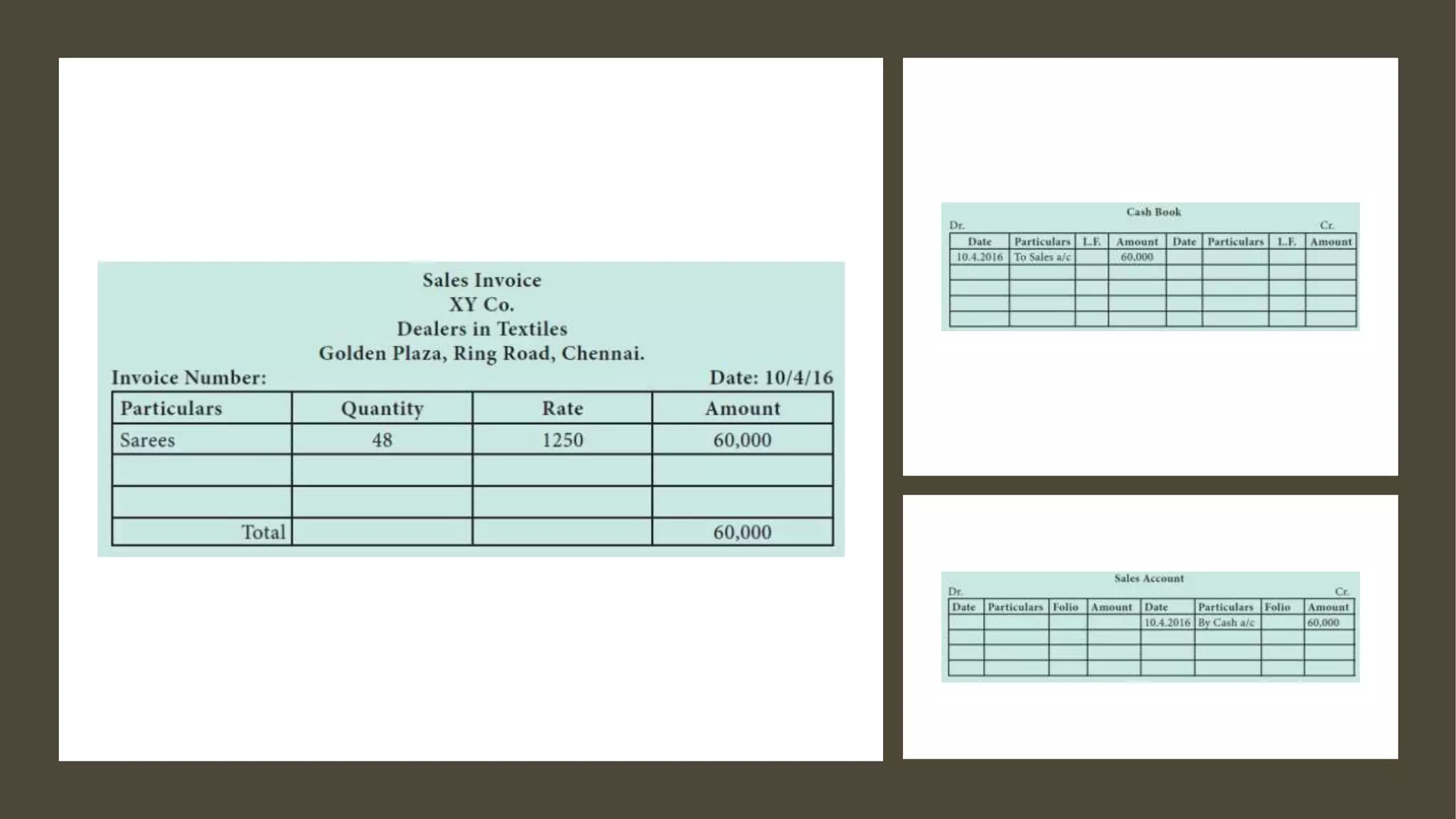
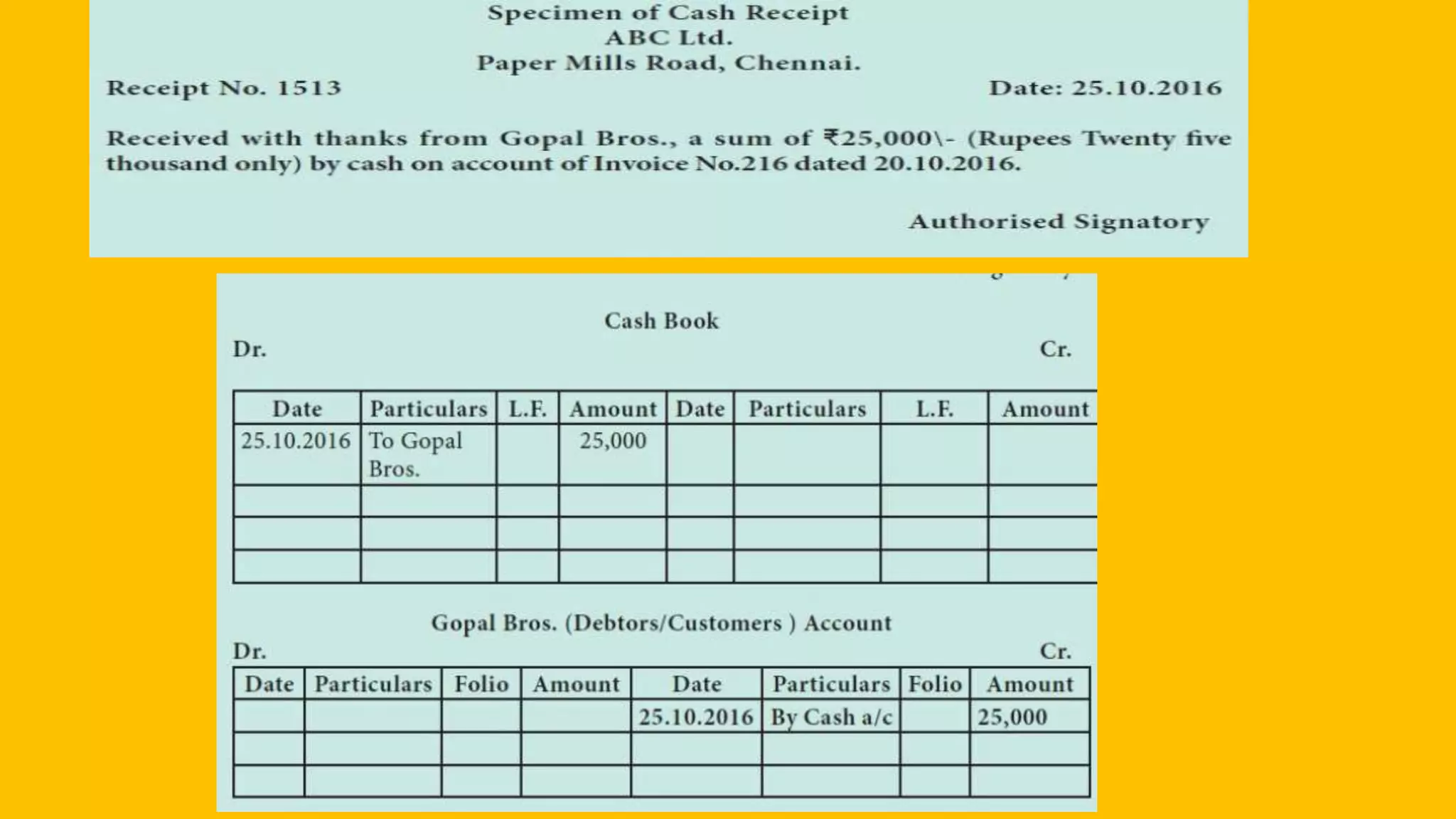
Example:
On 25.10.2016, Received cash
from Gopal Bros. for Rs. 25,000
towards sale made on
20.10.2016.
• Documents to be
Vouched: Sales invoices,
Counterfoils of cash receipts,
Statement of accounts from
debtors, Correspondences and
confirmations from the debtors
and bank statement.
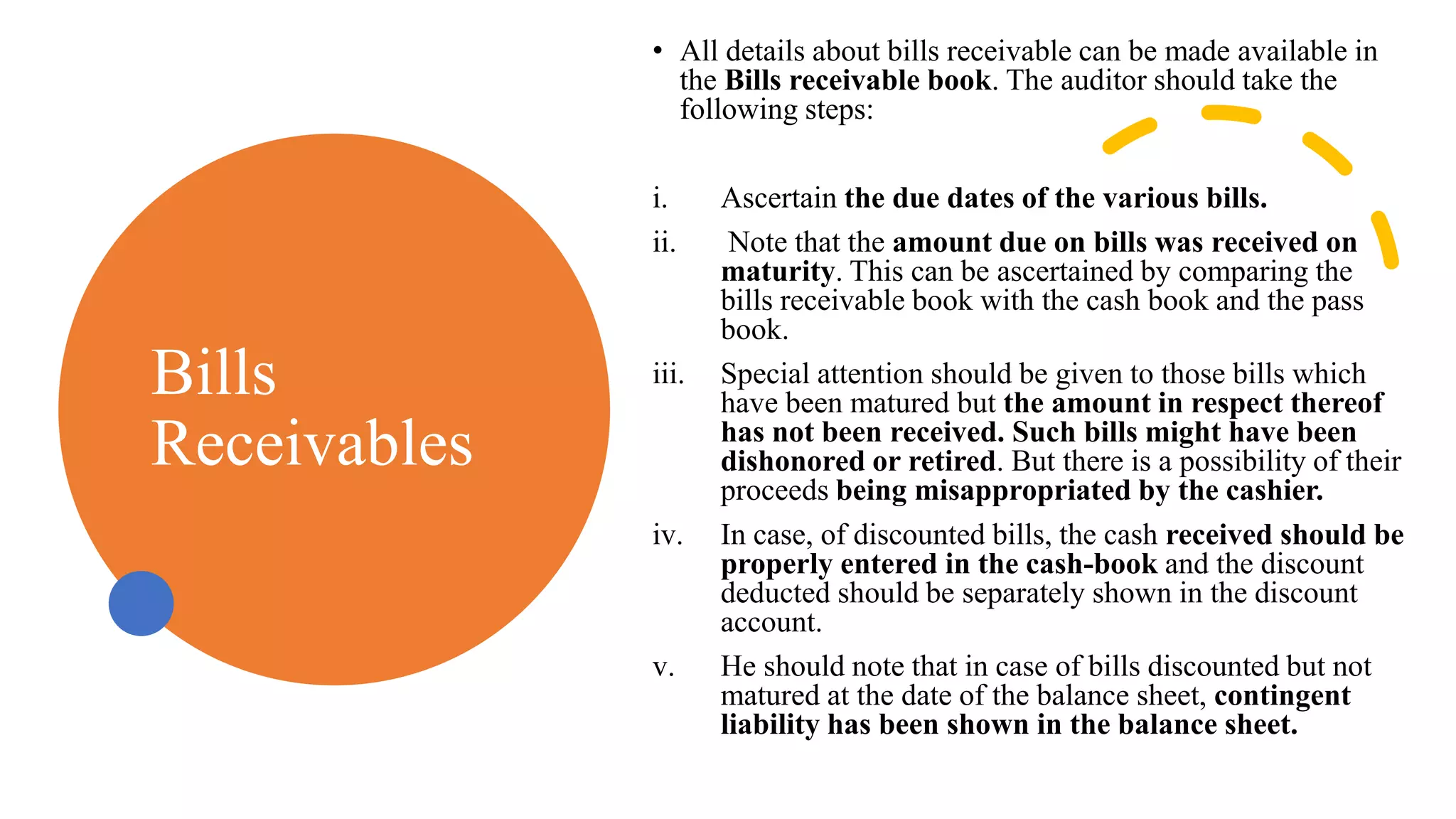
Bills
Receivables
• All details about bills receivable can be made available in
the Bills receivable book. The auditor should take the
following steps:
i. Ascertain the due dates of the various bills.
ii. Note that the amount due on bills was received on
maturity. This can be ascertained by comparing the
bills receivable book with the cash book and the pass
book.
iii. Special attention should be given to those bills which
have been matured but the amount in respect thereof
has not been received. Such bills might have been
dishonored or retired. But there is a possibility of their
proceeds being misappropriated by the cashier.
iv. In case, of discounted bills, the cash received should be
properly entered in the cash-book and the discount
deducted should be separately shown in the discount
account.
v. He should note that in case of bills discounted but not
matured at the date of the balance sheet, contingent
liability has been shown in the balance sheet.
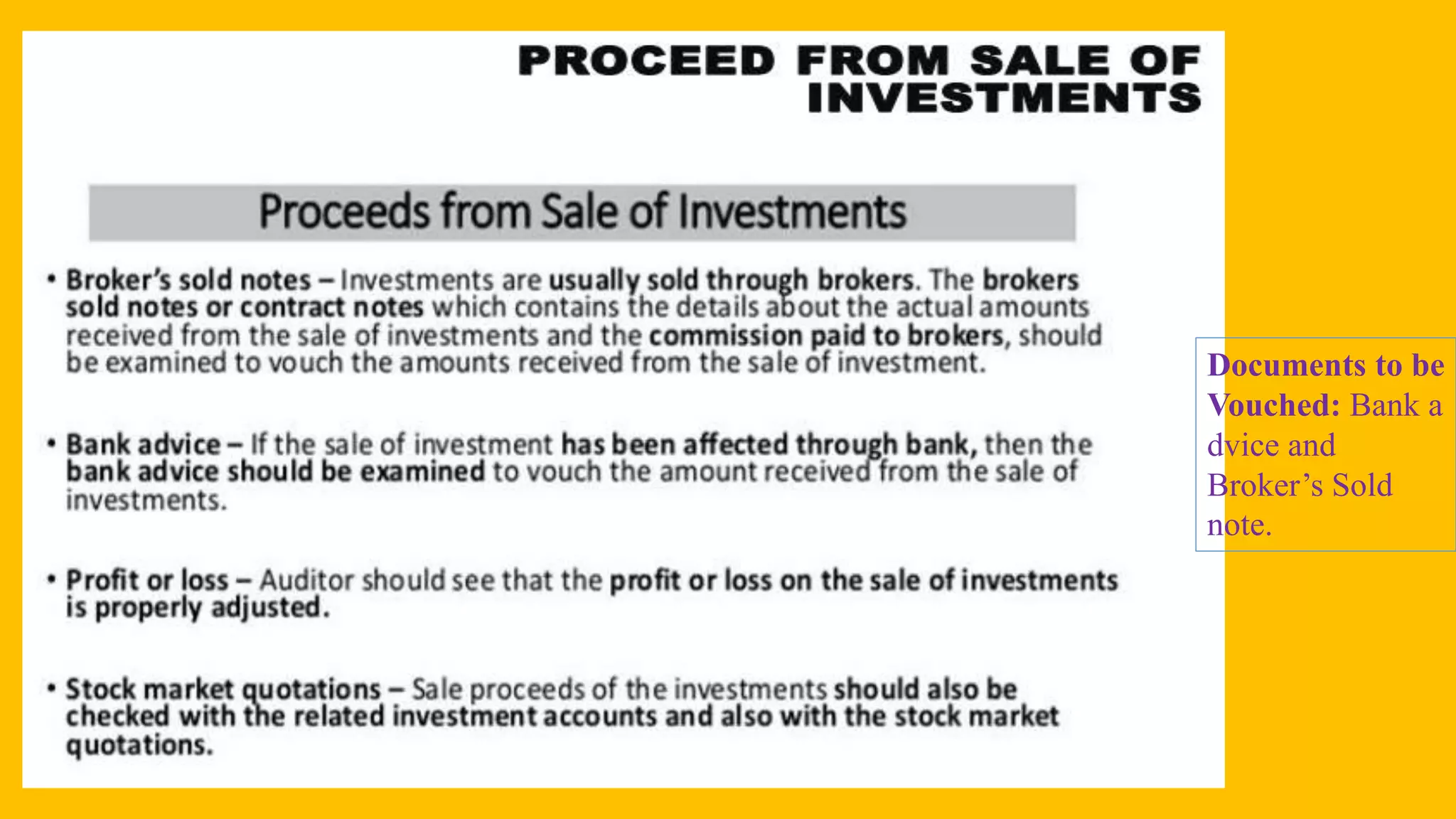
Documents to be
Vouched: Bank a
dvice and
Broker’s Sold
note.
Sale Of
Investments
• In this connection, the auditor should consider the following
points:
(i) As investments are usually sold through brokers, so the
broker's sold note should be examined to note the date of
sale, the amount received and the commission changed.
• (ii) In case the sale has been made through the bank, the bank
advice should be examined.
• (iii) He should note as to whether the sale has been cum-
dividend and if so, the dividend has subsequently been
received and the sale proceeds have been proportioned
between capital and revenue.
• If investments are sold ex-dividend, he has to see that the
dividend has been received if declared.
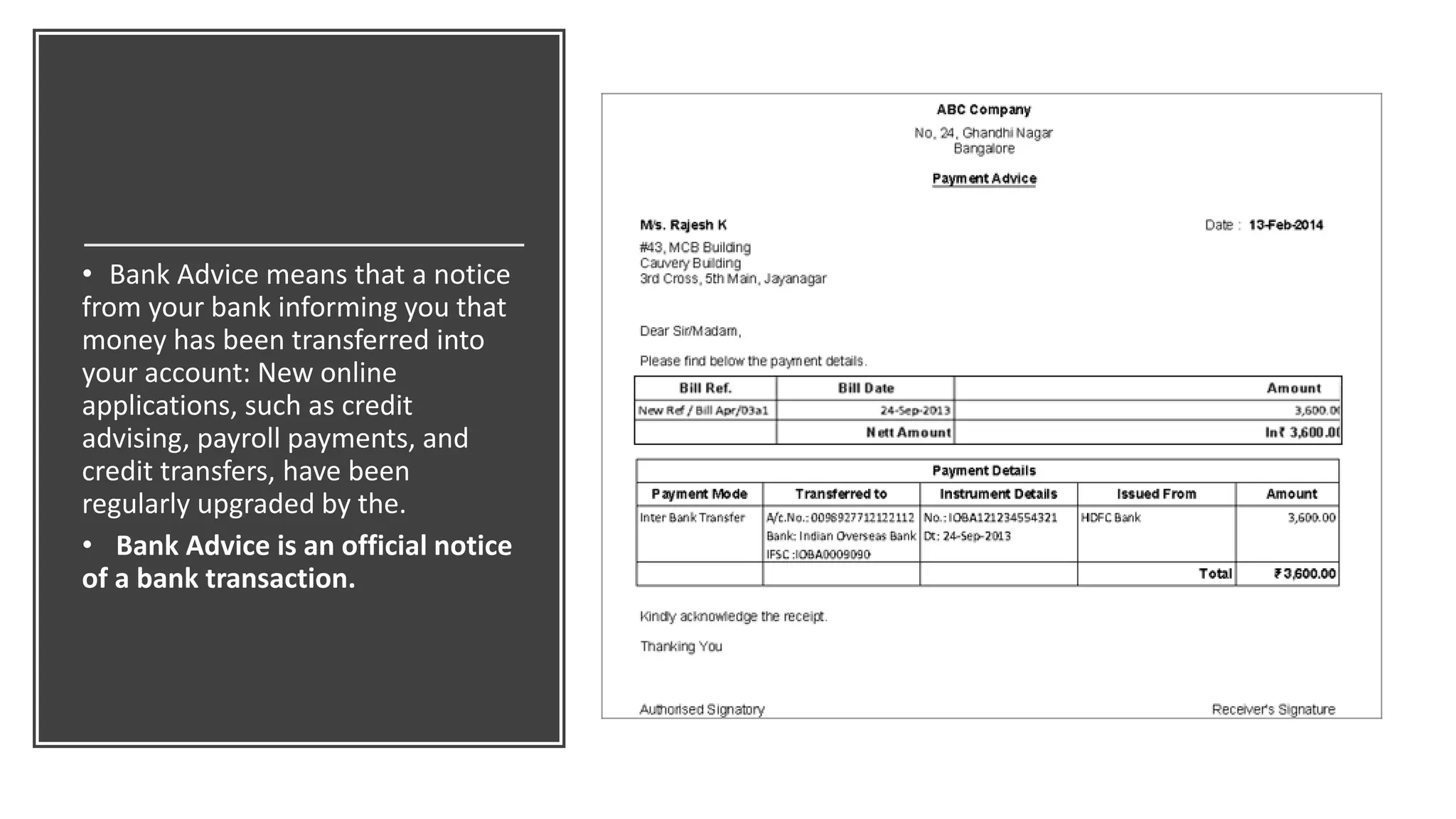
• Bank Advice means that a notice
from your bank informing you that
money has been transferred into
your account: New online
applications, such as credit
advising, payroll payments, and
credit transfers, have been
regularly upgraded by the.
• Bank Advice is an official notice
of a bank transaction.
What is
Deferred
Revenue
Expenditure?
This term refers to money spent during one
accounting period with the intention of
creating revenue in a future accounting
period. You pay the initial expense upfront
to see benefits earned in the future.
Deferred revenue expenditure refers to
those expenses which will be incurred in
the current accounting period but the
benefits of the expenses will be applicable
over several accounting periods.
It’s important to recognise deferred
revenue expenditure because a portion of
it can be written off each year in relation to
the benefits earned.
Let us take an example. In the case of a startup company, the firm invests heavily in
marketing and advertising initially.
They do this to capture some position in the market and amongst competitors. This expense,
done initially, reaps the benefits over several years.
Although this money is paid upfront, the results of the campaign won’t be immediately seen.
Advertisements attract new leads who move through the marketing funnel to eventually make
a sale, at which point revenue is earned.
This isn’t a one-time process; it’s ongoing, as more potential customers view advertisements
and make a purchase. As a result, the benefit of the initial expense could be seen spread out
over several accounting years.
Vouching Unit 3 DR.NRG.pptx

Vouching Unit 3 DR.NRG.pptx

  • 1.
  • 2.
    Content • Vouching:Meaning, Definition,Importance • Routine Checking And Vouching, • Voucher And Types Of Voucher • Vouching of receipts-cash sales, • Receipt from debtors, • Proceeds From The Sale Of Investments, • Vouching Of Payments, • Cash Purchase, • Payment To Creditors, • Deferred Revenue Expenditure.
  • 3.
    Vouching:Meaning, Definition “Vouching isthe examination by the auditor of all documentary evidence, which is available to support the authenticity of transactions entered in the client’s records”. Spicer and Pegler It is popularly known as the acid test of an audit because it tests the truth of a transaction recorded in the client’s books
  • 4.
    What is aVoucher? Eg:- When you are given money to pay the Fee of your college, Parents ask us for the Fee receipt, for they barely have faith on us. Hence to Confirm the Amount and payment of fee, the Fee receipt acts as a Voucher.
  • 6.
  • 7.
    Objectives 1.To Detect Errorsand Frauds 2. To Know the Truth of Account 3. To Find the Unrecorded Transactions 4. To Know That All the Transactions Are Authorized 5. To Know That Only the Business Transactions Are Recorded
  • 8.
    Principles or Techniquesof Vouching 1. Arranged Vouchers: All vouchers should be serially numbered and arranged in sequential order 2. Checking Of Date: Date recorded in the cash book. 3. Compare the Words and figures: 4. Checking Of Authority: Passed by the authorized officer. 5. Cutting or Change:. Missing vouchers and receipts, get duplicate copies from the client. If there is any cutting or change on the receipts and vouchers figures it should be signed by the authorized officer.
  • 9.
  • 10.
    Principles or Techniques ofVouching 6. Transaction Must Relate To Business: Entries must relate to the business. 7. Case of Personal Vouchers: The auditor should not accept the voucher in personal name, vouchers that are not in the name of the company but rather in the personal name of a partner, manager, secretary, director, or any other official. 8. Checking Of Account Head: Auditor must be satisfied about the head of account on which cash is deposited and drawn. He should examine the documentary evidence in this regard. 9. Revenue Stamp: in excess of Rs. 5,000 should have a revenue stamp affixed to them. 10.List of Missing Vouchers: Auditor should prepare the list of missing vouchers
  • 11.
    NOT REQUIRED FOR EXAMS Tocollect fees or revenue for maintaining courts. There was a law called Indian Stamp Act 1899. This law was amended for 51 times since 1899 to 2004. Under section 30, if you make a payment of more than Rs. 5000/- to any other, then you can insist on getting a stamped receipt with Re 1/- revenue stamp. In this case, if the payee refuses to give a receipt with a revenue stamp, then he can be punished with a fine of Rs. 100/- under section 65. Revenue Stamps
  • 12.
    Vouching vs Verification Vouchingis concerned with the checking of records with the help of supporting documents. Verification is a process to check the title, possession, existence, and valuation of assets.
  • 15.
    Types of Voucher 1.Primary vouchers: when written evidence is available in original, it is known as primary voucher. Ex: sales invoice, cash memo, purchase invoice, minutes book of board meeting etc 2. Collateral vouchers: when there is no written evidence, but copies are made available for the purpose of audit Ex: carbon copies of sales invoice. Copies of resolutions passed in a meeting
  • 17.
    It is preparedalong with a duplicate copy, as the original will be handed over to the buyer, and the seller will retain the duplicate copy. It is the documentary evidence for all the cash sales made by the business, and it is proof of cash purchases for the buyer.
  • 18.
    Sources Any document basedupon which a financial transaction is recorded In Books of accounts (BoA) is known as source documents. . Cash memo: on which the details of amount, date of cash sales and cash purchases of a company are given. Cash memos issued on cash sales and cash memos received on cash purchases. It is based on cash payment. Cash sales and cash purchases are recorded in the accounting books. 2. Cheques: if withdrawn, notes should be given on counterfoils and for deposit, use pay in slips 3. Invoice & bills: are used for credit sales & purchases. 3 copies are made- 1 for BoA as source document, and other sent along with goods. 4. Credit note: are issued during sales return. Customers’ accounts are credited with S. R. amount and further used as a source document. 5. Debit note: are issued during purchase return. The sellers account is debited with the amount of purchase return and the debit note is used as a source document. 6. Pay in slip: used to deposit either cheque or cash in bank. While main body is kept with the bank, duly stamped counterfoil is given to the customer. 7. Receipt
  • 19.
    Josmi Cash Memo Example Lavanyaowns a boutique called Fresh Idea. One of the regular customers, Josmi, visits the shop and buys two pairs of jeans of Levi’s brand for 100 each and 3 T-shirts of Nike brand for 50 each. Lavanya offers a 10% discount to Josmi and charges 10% VAT on the sale transaction. Lavanya prepares a sample cash memo for the transaction mentioned above.
  • 27.
    Examining Vouchers Vouchers properly filed,serially numbered and arranged in order Properly stamped for more than five hundred rupees requires a revenue stamp . The date and the year of the receipt or the voucher corresponding with the cash book. Every voucher is passed "as in order" by some responsible person whose signature should be noted. Amount paid appears both in words and figures. M For missing vouchers, the auditor should satisfy himself with regard to the reasons of their being lost. No help from any member while vouching the entries and checking the vouchers. Any alteration in the voucher is duly signed by the invoice clerk.
  • 28.
    • Minutes meansa formal written record, in physical or electronic form, of the proceedings of a Meeting and Minutes Book means a Book maintained in physical or in electronic form for the purpose of recording of Minutes. • A distinct minute book shall be maintained for each type of meeting namely • 1. General Meetings of the Members • 2. Board Meeting of the Directors • 3. Meetings of each Committee of the Board • 4. Meetings of the Creditors • Resolutions passed by postal ballot shall be recorded in the minute book of general meetings as if it has been deemed to be passed in the general meeting.
  • 29.
    • Sources: • Anydocument based upon which a financial transaction is recorded In Books of accounts (BoA) is • known as source documents. • In case of accountancy, the first step is identifying the foundation of a financial transaction based on documentary proof known as source documents. 1.Cash memo: on which the details of amount, date of cash sales and cash purchases of a company are given. Cash memos issued on cash sales and cash memos received on cash purchases. It is based on cash payment. Cash sales and cash purchases are recorded in the accounting books. • 2. Cheques: if withdrawn, notes should be given on counterfoils and for deposit, use pay in slips 3. Invoice & bills: are used for credit sales & purchases. 3 copies are made- 1 for BoA as source document, and other sent along with goods. • 4. Credit note: are issued during sales return. Customers’ accounts are credited with S. R. amount and further used as a source document. • 5. Debit note: are issued during purchase return. The sellers account is debited with the amount of purchase return and the debit note is used as a source document. • 6. Pay in slip: used to deposit either cheque or cash in bank. While main body is kept with the bank, duly stamped counterfoil is given to the customer. • 7. Receipt
  • 31.
    VOUCHING OF RECEIPTS VouchingSale of Fixed Assets Rents Receivable Insurance Claims: Commission Subscription Vouching of Cash transactions Cash sales Cash received from debtors: Receipts from Debtors Proceeds from investment
  • 34.
  • 35.
    An auditor hasto verify the following documents while auditing Sale of fixed assets 1. Fixed asset register. 2. Sale Agreement. 3. Statement of accounts from Auctioneers. 4. Brokers’ sold note. 5. Correspondence (if any) 6. Directors’ minutes book in the case of a company.
  • 36.
    Role of anAuditor in vouching sale of fixed assets Sale of fixed assets should be approved by the board of directors. Auditors should 1. verify the minutes of meeting of the Board of Directors. 2. verify the cash book, the entries relating to sale of fixed assets 3. bank book to ensure that the amount received on the sale of fixed assets is immediately deposited in bank on the next day. 4. verify the calculation of profit/loss in sale of assets 5. ensure that the profit on sale is transferred to capital reserve and not to the general profit & loss account • It is possible in case of sale of fixed assets, the sale deed is not executed for the full purchase consideration. To detect such a fraud, the auditor should examine the correspondence made with the parties willing to purchase them. • In case, sale has been made through a broker, the broker's sold note should be examined.
  • 41.
    Rents Receivable (I) examinethe leases agreement with the tenants and ascertain the exact amount receivable. (ii) Check the amounts due with the rent-foil. (iii) Compare the amounts as per rent roll with the cash book. (iv) Check the counterfoils of rent receipt issued to tenants. If agents are appointed to collect rent, the accounts or statements submitted by them should be carefully checked.
  • 42.
    Insurance Claims Amounts receivedunder an insurance policy should be verified by means of the correspondence with and accounts rendered by the insurance companies Subscriptions Subscriptions received by a club or society should be checked with counter-foils of receipt books and with the published list of subscribers Commission received
  • 43.
    Vouching of Cash transactions • Vouchingof cash transactions is by far the most important job in every business irrespective of its size and type of business etc. Before setting the programmer for vouching the cash book, an auditor should examine carefully the whole system of internal check in operation in respect of cash transactions. Vouching of receipts of the debit side of the cash book 1. Opening balance: This can be vouched by comparing it with the balance shown in the duly audited balance sheet of the previous year. By doing this, it is verified that the actual balance has been brought down.
  • 46.
    Cash sales Under thishead, the chances of fraud are comparatively greater, for example the salesman may sell goods but may not record the same in the cash book thus misappropriating the money. Therefore the auditor should examine the effectiveness of the internal control system in operation in regard to cash sales. Assuming an effective internal check system in operation, the auditor should take the following steps to verify the correctness of the amount of cash sales.
  • 47.
    Cash sales Cash ledgershould be fully checked with carbon copies of cash memos To check the daily deposits of cash received in the bank. Dates of cash memos and date on which the receipts are recorded in cash book must be same. Where the company has a discount policy, if more discount is allowed in a transaction, it must be approved by a responsible officer. Where the cash memos are cancelled, all copies including original copy duly cancelled should be kept in the books. (Vouchers, duplicate cash memo, salesman abstract, cash summaries)
  • 49.
    Cash received fromdebtors The cash received from customers to whom good have been sold on credit in the past can be vouched with the help of the counterfoils of the receipts issued to them. But it is often noted that a smaller amount than actually received is shown on the counterfoils or receipts are issued to the debtors from old but unused counterfoil receipt books, the auditor should take the following steps in vouching receipts from debtors:
  • 50.
    Cash received fromdebtors 1. Check the internal check system with regard to the sales as a whole. 2. Auditor should verify amount received from debtors from counterfoils or carbon copies of receipt issued to customers. 3. All these receipts should be serially numbered 4. Amount should be entered in cash book on the day when received 5. D/A to customers should be authorized by a responsible person. (Vouchers- counterfoils, correspondence) 6. In respect of discount allowed to debtors, the auditor should ascertain the terms on which discount is allowed and test check a certain number of entries to ascertain whether the discount allowed is in order. 7. Special attention should also be paid to the amount shown as bad debts written off as cash can be misappropriated by writing off the whole or a part of the debit balance as bad. He has to ascertain as to who is responsible for writing off debts as bad. He should, with the permission of the client, establish direct contracts with the debtors by sending them the statements or verification slips from time to time and asking them to send their confirmation directly to him.
  • 52.
    Teeming And Lading •When cash is received from customers, a cash memo is issued to the customer and a carbon copy of cash memo is retained by the clerk. • Fraud can take place by accounting lesser amount than what is actually received. Sometimes, fraud may occur when payment received from a customer is misappropriated without making entry in the account and later on when cash is received from another customer. • This practice is called as “Teeming and Lading of Fraud.”
  • 53.
    To detect such afraud the auditor should • 1. Examine the accounts of those debtors which show part payments from time to time. • 2. Check the amount and date on the counterfoil receipts to compare it with the date and amount deposited in the bank. • 3. Should send verification slips to the debtor requesting them to send the confirmation directly to him.
  • 54.
    Auditor should vouchthe transaction in the following manner ? Example: On 25.10.2016, Received cash from Gopal Bros. for Rs. 25,000 towards sale made on 20.10.2016.
  • 55.
    • Documents tobe Vouched: Sales invoices, Counterfoils of cash receipts, Statement of accounts from debtors, Correspondences and confirmations from the debtors and bank statement.
  • 57.
    Bills Receivables • All detailsabout bills receivable can be made available in the Bills receivable book. The auditor should take the following steps: i. Ascertain the due dates of the various bills. ii. Note that the amount due on bills was received on maturity. This can be ascertained by comparing the bills receivable book with the cash book and the pass book. iii. Special attention should be given to those bills which have been matured but the amount in respect thereof has not been received. Such bills might have been dishonored or retired. But there is a possibility of their proceeds being misappropriated by the cashier. iv. In case, of discounted bills, the cash received should be properly entered in the cash-book and the discount deducted should be separately shown in the discount account. v. He should note that in case of bills discounted but not matured at the date of the balance sheet, contingent liability has been shown in the balance sheet.
  • 58.
    Documents to be Vouched:Bank a dvice and Broker’s Sold note.
  • 59.
    Sale Of Investments • Inthis connection, the auditor should consider the following points: (i) As investments are usually sold through brokers, so the broker's sold note should be examined to note the date of sale, the amount received and the commission changed. • (ii) In case the sale has been made through the bank, the bank advice should be examined. • (iii) He should note as to whether the sale has been cum- dividend and if so, the dividend has subsequently been received and the sale proceeds have been proportioned between capital and revenue. • If investments are sold ex-dividend, he has to see that the dividend has been received if declared.
  • 60.
    • Bank Advicemeans that a notice from your bank informing you that money has been transferred into your account: New online applications, such as credit advising, payroll payments, and credit transfers, have been regularly upgraded by the. • Bank Advice is an official notice of a bank transaction.
  • 62.
    What is Deferred Revenue Expenditure? This termrefers to money spent during one accounting period with the intention of creating revenue in a future accounting period. You pay the initial expense upfront to see benefits earned in the future. Deferred revenue expenditure refers to those expenses which will be incurred in the current accounting period but the benefits of the expenses will be applicable over several accounting periods. It’s important to recognise deferred revenue expenditure because a portion of it can be written off each year in relation to the benefits earned.
  • 63.
    Let us takean example. In the case of a startup company, the firm invests heavily in marketing and advertising initially. They do this to capture some position in the market and amongst competitors. This expense, done initially, reaps the benefits over several years. Although this money is paid upfront, the results of the campaign won’t be immediately seen. Advertisements attract new leads who move through the marketing funnel to eventually make a sale, at which point revenue is earned. This isn’t a one-time process; it’s ongoing, as more potential customers view advertisements and make a purchase. As a result, the benefit of the initial expense could be seen spread out over several accounting years.