
Paper Presentation
Submitted By:- Anu Kaushik
Ankit Verma
Contents
CONCLUSION
FINDINGS AND DISCUSSIONS
DATA ANALYSIS
RESEARCH METHODOLOGY
OBJECTIVES
LIMITATIONS
INTRODUCTION
SUGGESTIONS
Determinants of consumer’ purchasing behavior
for Ready to Eat Food in Delhi
• India is the world’s second largest producer of food next to
China and has the potential of being biggest industry with
food and agricultural sector.
• “Ready-to-eat food is food offered or exposed for sale
without additional cooking or preparation, which is packed
on the premises where sold and is ready for consumption”
• The paper aimed to examine the “Determinants of
consumer’ purchasing behavior for Ready to Eat Food in
Delhi”.
• RTE will grow around 22% during 2014-19
•
RTE Packets
Determinants of consumer’ purchasing behavior for Ready
to Eat Food in Delhi
FACTOR AFFECTING
CONSUMER
PURCHASING
BEHAVIOR
To identify the factors
affecting the
consumers purchasing
behaviour for ready to
eat
DEMOGRAPHICS ON
PURCHASING
BEHAVIOR
To find the impact of
demographics on the
purchasing behaviour
for ready to eat
.
OBJECTIVES
COMSUMPTION
PATTERN
To explore
consumption patterns
of ready to eat
Determinants of consumer’ purchasing behavior for Ready
to Eat Food in Delhi
Questionnaire
was formed
(8 Demographic, 6
Consumption
Information, 18
statements on
Consumers
Purchasing Behavior
Questions)
How?
why?
Where?
Who?
Determinants of consumer’ purchasing behavior for Ready
to Eat Food in Delhi
Research
Methodology
DESCRIPTIVE RESEARCH
1. STATEMENT
OF
THE PURPOSE
2. JUDGEMENTAL
SAMPLING
3. SAMPLE
SIZE - 302
4. DATA SOURCE
5. PRIMARY SOURCE
OF DATA
6. SECONDARY SOURCE
OF DATA
Determinants of consumer’ purchasing behavior for Ready
to Eat Food in Delhi
ANOVA Test (Educational Qualification, occupation,
income, family size, no of children)
Chi square test on RTE brands and Demography factors
(family size, income, gender, age of respondent)
Chi square test on how often customer consume RTE
(Family size, Annual household income)
DATA
ANALYSIS
T- Test (Gender and Marital Status)
Chi square test on How often customer purchase RTE
(family size, occupation, age, gender, education, marital status)
Chi square test on the number of RTE packets purchase each
month (family. size occupation, education, marital status)
1
The respondents
in this survey
consisted of 86
MALES and 216
FEMALES
2
About 4.32% are not
formally educated,
12.92% had secondary
school degree, 42.72%
completed graduation
and 26.15% are post
graduate 5.96% had
professional
qualification, 5.62%
were educated till 10th
and 2.31% in category
of others.
3
32.1 percent
responded ate
pasta, followed by
Others (23.5%), and
Shahi paneer
(17.2%). Pasta
became the most
preferred meals
eaten by
respondents.
Determinants of consumer’ purchasing behavior for Ready
to Eat Food in Delhi
Findings & Discussions
RTE RTERTERTE
4.3% 28.8% 33.1% 33.8%
Age group of respondent who filled the survey
Findings & Discussions
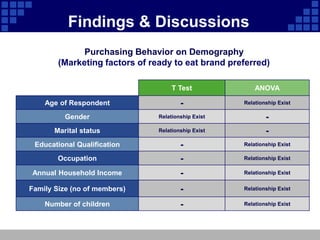
T Test ANOVA
Age of Respondent - Relationship Exist
Gender Relationship Exist -
Marital status Relationship Exist -
Educational Qualification - Relationship Exist
Occupation - Relationship Exist
Annual Household Income - Relationship Exist
Family Size (no of members) - Relationship Exist
Number of children - Relationship Exist
Purchasing Behavior on Demography
(Marketing factors of ready to eat brand preferred)
Findings & Discussions
RTE brands
influence on
Demography
factors
customer
purchase RTE
influence on
demography
customer
consume RTE
influence
Demography
Number of RTE
packets purchase
each month
influence
demography
Age of Respondent Relationship Exist NO Relationship Exist - -
Gender Relationship Exist - - -
Marital status - NO Relationship Exist -
NO Relationship
Exist
Educational
Qualification - Relationship Exist -
NO Relationship
Exist
Occupation - NO Relationship Exist - Relationship Exist
Annual Household
Income
Relationship Exist - Relationship Exist -
Family Size (no of
members)
NO Relationship Exist NO Relationship Exist
NO Relationship
Exist
No Relationship
Exist
Number of children - - - -
Chi Square Tests
Purchasing behavior of consumers on
ready to eat
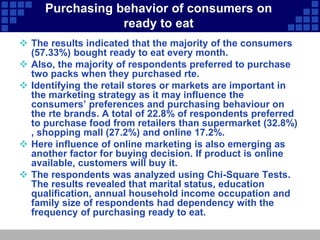
 The results indicated that the majority of the consumers
(57.33%) bought ready to eat every month.
 Also, the majority of respondents preferred to purchase
two packs when they purchased rte.
 Identifying the retail stores or markets are important in
the marketing strategy as it may influence the
consumers’ preferences and purchasing behaviour on
the rte brands. A total of 22.8% of respondents preferred
to purchase food from retailers than supermarket (32.8%)
, shopping mall (27.2%) and online 17.2%.
 Here influence of online marketing is also emerging as
another factor for buying decision. If product is online
available, customers will buy it.
 The respondents was analyzed using Chi-Square Tests.
The results revealed that marital status, education
qualification, annual household income occupation and
family size of respondents had dependency with the
frequency of purchasing ready to eat.
Findings & Discussions
RESULT FROM T - TEST
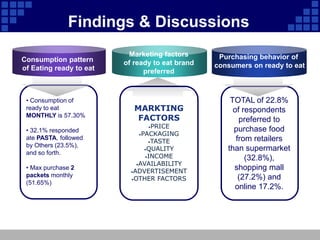
Consumption pattern
of Eating ready to eat
• Consumption of
ready to eat
MONTHLY is 57.30%
• 32.1% responded
ate PASTA, followed
by Others (23.5%),
and so forth.
• Max purchase 2
packets monthly
(51.65%)
TOTAL of 22.8%
of respondents
preferred to
purchase food
from retailers
than supermarket
(32.8%),
shopping mall
(27.2%) and
online 17.2%.
Text
Text
MARKTING
FACTORS
•PRICE
•PACKAGING
•TASTE
•QUALITY
•INCOME
•AVAILABILITY
•ADVERTISEMENT
•OTHER FACTORS
Marketing factors
of ready to eat brand
preferred
Purchasing behavior of
consumers on ready to eat
Marketing factors of rte brand preferred
 Consumers were asked 18 opinion questions regarding ready to eat
marketing. The questionnaire comprised of five point- Likert scale
(closer to 1 is Strongly disagree, closer to 5 is strongly agree).
 T-test and ANOVA test were applied on demographics and Likert Scale
questions when it is examined, It was observed Annual household
income, occupation ,family size, education qualification have
significance relationship with marketing activities.
 The marketing activities apparently had impacted on consumers
buying decision making
 More than half of the respondents remarked that price was the most
important factor in choosing which brand to purchase.
 On the question whether the brand name was important or not, the
majority of the respondents gave positive answers showing that
customer could be brand loyal if company timely update them about
benefits and offers and provide them with better quality of food also
the past experience of the brand do play a crucial role while taking
purchasing decisions
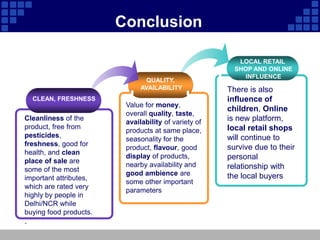
Conclusion
QUALITY,
AVAILABILITY
LOCAL RETAIL
SHOP AND ONLINE
INFLUENCE
CLEAN, FRESHNESS
Cleanliness of the
product, free from
pesticides,
freshness, good for
health, and clean
place of sale are
some of the most
important attributes,
which are rated very
highly by people in
Delhi/NCR while
buying food products.
.
Value for money,
overall quality, taste,
availability of variety of
products at same place,
seasonality for the
product, flavour, good
display of products,
nearby availability and
good ambience are
some other important
parameters
There is also
influence of
children, Online
is new platform,
local retail shops
will continue to
survive due to their
personal
relationship with
the local buyers
BEST
FOODS (7.60%)
Heinz kitchen
(1.7%)
Haldiram
(24.2%)
MTR (35.4%)
ITC (31.1%)
kitchen of India 11.9%
Aashirvaad 19.2%
Conclusion
RTE Brand Preferred by Respondents
SUGGESTIONS
 SUGGESTIONS 1:- The determinants of purchasing behaviour of consumer of
ready to eat at national level.
 SUGGESTIONS 2:- The role of salesperson at retail stores in influencing the
purchasing behaviour of consumer ready to eat In India
 SUGGESTIONS 3:- The impact of nature and location of stores on purchasing
behaviour of consumer of ready to eat at national level
 SUGGESTIONS 4:- The role of social media and influenced advertisement will
persuade the purchasing decision include an online purchase interest of
customers at national level.
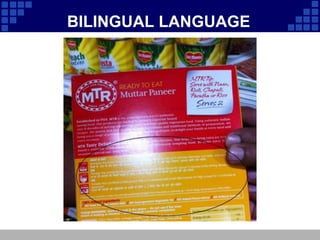
 SUGGESTIONS 5:- The role of language whether to use bilingual or multilingual on
packets to create more connection with customer as by increase in distribution at
national level will tend to reach RTE to every customer of different culture.
 SUGGESTIONS 6:- The role of innovation with the product and more variety
needed according to the customer of different culture at national level.
•
BILINGUAL LANGUAGE
LIMITATIONS
 There are certain limitations for this study. Firstly and major
limitation was the time constraint since the study was to be
evaluated along with our MBA course and that might had the
effect on the quality. Secondly the study involved limited
resources hence it acted as an constraint as well. Less
corporation from respondent. The sample size was of 302 which
was small too and was decided keeping the same since time
constraint has effected the data collection.

Determinants of consumer’ purchasing behaviour for Ready to Eat Food in Delhi (CONSUMER BEHAVIOUR)

  • 1.
    Paper Presentation Submitted By:-Anu Kaushik Ankit Verma
  • 2.
    Contents CONCLUSION FINDINGS AND DISCUSSIONS DATAANALYSIS RESEARCH METHODOLOGY OBJECTIVES LIMITATIONS INTRODUCTION SUGGESTIONS
  • 3.
    Determinants of consumer’purchasing behavior for Ready to Eat Food in Delhi • India is the world’s second largest producer of food next to China and has the potential of being biggest industry with food and agricultural sector. • “Ready-to-eat food is food offered or exposed for sale without additional cooking or preparation, which is packed on the premises where sold and is ready for consumption” • The paper aimed to examine the “Determinants of consumer’ purchasing behavior for Ready to Eat Food in Delhi”. • RTE will grow around 22% during 2014-19 •
  • 4.
  • 5.
    Determinants of consumer’purchasing behavior for Ready to Eat Food in Delhi FACTOR AFFECTING CONSUMER PURCHASING BEHAVIOR To identify the factors affecting the consumers purchasing behaviour for ready to eat DEMOGRAPHICS ON PURCHASING BEHAVIOR To find the impact of demographics on the purchasing behaviour for ready to eat . OBJECTIVES COMSUMPTION PATTERN To explore consumption patterns of ready to eat
  • 6.
    Determinants of consumer’purchasing behavior for Ready to Eat Food in Delhi Questionnaire was formed (8 Demographic, 6 Consumption Information, 18 statements on Consumers Purchasing Behavior Questions) How? why? Where? Who?
  • 7.
    Determinants of consumer’purchasing behavior for Ready to Eat Food in Delhi Research Methodology DESCRIPTIVE RESEARCH 1. STATEMENT OF THE PURPOSE 2. JUDGEMENTAL SAMPLING 3. SAMPLE SIZE - 302 4. DATA SOURCE 5. PRIMARY SOURCE OF DATA 6. SECONDARY SOURCE OF DATA
  • 8.
    Determinants of consumer’purchasing behavior for Ready to Eat Food in Delhi ANOVA Test (Educational Qualification, occupation, income, family size, no of children) Chi square test on RTE brands and Demography factors (family size, income, gender, age of respondent) Chi square test on how often customer consume RTE (Family size, Annual household income) DATA ANALYSIS T- Test (Gender and Marital Status) Chi square test on How often customer purchase RTE (family size, occupation, age, gender, education, marital status) Chi square test on the number of RTE packets purchase each month (family. size occupation, education, marital status)
  • 9.
    1 The respondents in thissurvey consisted of 86 MALES and 216 FEMALES 2 About 4.32% are not formally educated, 12.92% had secondary school degree, 42.72% completed graduation and 26.15% are post graduate 5.96% had professional qualification, 5.62% were educated till 10th and 2.31% in category of others. 3 32.1 percent responded ate pasta, followed by Others (23.5%), and Shahi paneer (17.2%). Pasta became the most preferred meals eaten by respondents. Determinants of consumer’ purchasing behavior for Ready to Eat Food in Delhi Findings & Discussions
  • 10.
    Findings & Discussions RTERTERTERTE 4.3% 28.8% 33.1% 33.8% Age group of respondent who filled the survey
  • 11.
    Findings & Discussions TTest ANOVA Age of Respondent - Relationship Exist Gender Relationship Exist - Marital status Relationship Exist - Educational Qualification - Relationship Exist Occupation - Relationship Exist Annual Household Income - Relationship Exist Family Size (no of members) - Relationship Exist Number of children - Relationship Exist Purchasing Behavior on Demography (Marketing factors of ready to eat brand preferred)
  • 12.
    Findings & Discussions RTEbrands influence on Demography factors customer purchase RTE influence on demography customer consume RTE influence Demography Number of RTE packets purchase each month influence demography Age of Respondent Relationship Exist NO Relationship Exist - - Gender Relationship Exist - - - Marital status - NO Relationship Exist - NO Relationship Exist Educational Qualification - Relationship Exist - NO Relationship Exist Occupation - NO Relationship Exist - Relationship Exist Annual Household Income Relationship Exist - Relationship Exist - Family Size (no of members) NO Relationship Exist NO Relationship Exist NO Relationship Exist No Relationship Exist Number of children - - - - Chi Square Tests
  • 13.
    Purchasing behavior ofconsumers on ready to eat  The results indicated that the majority of the consumers (57.33%) bought ready to eat every month.  Also, the majority of respondents preferred to purchase two packs when they purchased rte.  Identifying the retail stores or markets are important in the marketing strategy as it may influence the consumers’ preferences and purchasing behaviour on the rte brands. A total of 22.8% of respondents preferred to purchase food from retailers than supermarket (32.8%) , shopping mall (27.2%) and online 17.2%.  Here influence of online marketing is also emerging as another factor for buying decision. If product is online available, customers will buy it.  The respondents was analyzed using Chi-Square Tests. The results revealed that marital status, education qualification, annual household income occupation and family size of respondents had dependency with the frequency of purchasing ready to eat.
  • 14.
    Findings & Discussions RESULTFROM T - TEST Consumption pattern of Eating ready to eat • Consumption of ready to eat MONTHLY is 57.30% • 32.1% responded ate PASTA, followed by Others (23.5%), and so forth. • Max purchase 2 packets monthly (51.65%) TOTAL of 22.8% of respondents preferred to purchase food from retailers than supermarket (32.8%), shopping mall (27.2%) and online 17.2%. Text Text MARKTING FACTORS •PRICE •PACKAGING •TASTE •QUALITY •INCOME •AVAILABILITY •ADVERTISEMENT •OTHER FACTORS Marketing factors of ready to eat brand preferred Purchasing behavior of consumers on ready to eat
  • 15.
    Marketing factors ofrte brand preferred  Consumers were asked 18 opinion questions regarding ready to eat marketing. The questionnaire comprised of five point- Likert scale (closer to 1 is Strongly disagree, closer to 5 is strongly agree).  T-test and ANOVA test were applied on demographics and Likert Scale questions when it is examined, It was observed Annual household income, occupation ,family size, education qualification have significance relationship with marketing activities.  The marketing activities apparently had impacted on consumers buying decision making  More than half of the respondents remarked that price was the most important factor in choosing which brand to purchase.  On the question whether the brand name was important or not, the majority of the respondents gave positive answers showing that customer could be brand loyal if company timely update them about benefits and offers and provide them with better quality of food also the past experience of the brand do play a crucial role while taking purchasing decisions
  • 16.
    Conclusion QUALITY, AVAILABILITY LOCAL RETAIL SHOP ANDONLINE INFLUENCE CLEAN, FRESHNESS Cleanliness of the product, free from pesticides, freshness, good for health, and clean place of sale are some of the most important attributes, which are rated very highly by people in Delhi/NCR while buying food products. . Value for money, overall quality, taste, availability of variety of products at same place, seasonality for the product, flavour, good display of products, nearby availability and good ambience are some other important parameters There is also influence of children, Online is new platform, local retail shops will continue to survive due to their personal relationship with the local buyers
  • 17.
    BEST FOODS (7.60%) Heinz kitchen (1.7%) Haldiram (24.2%) MTR(35.4%) ITC (31.1%) kitchen of India 11.9% Aashirvaad 19.2% Conclusion RTE Brand Preferred by Respondents
  • 18.
    SUGGESTIONS  SUGGESTIONS 1:-The determinants of purchasing behaviour of consumer of ready to eat at national level.  SUGGESTIONS 2:- The role of salesperson at retail stores in influencing the purchasing behaviour of consumer ready to eat In India  SUGGESTIONS 3:- The impact of nature and location of stores on purchasing behaviour of consumer of ready to eat at national level  SUGGESTIONS 4:- The role of social media and influenced advertisement will persuade the purchasing decision include an online purchase interest of customers at national level.  SUGGESTIONS 5:- The role of language whether to use bilingual or multilingual on packets to create more connection with customer as by increase in distribution at national level will tend to reach RTE to every customer of different culture.  SUGGESTIONS 6:- The role of innovation with the product and more variety needed according to the customer of different culture at national level. •
  • 19.
  • 20.
    LIMITATIONS  There arecertain limitations for this study. Firstly and major limitation was the time constraint since the study was to be evaluated along with our MBA course and that might had the effect on the quality. Secondly the study involved limited resources hence it acted as an constraint as well. Less corporation from respondent. The sample size was of 302 which was small too and was decided keeping the same since time constraint has effected the data collection.