Consultations Models
Dr Faisal Al Hadad
Consultant of Family Medicine &
Occupational Health
PSMMC
Stott and Davis 1979
”The exceptional potential in each primary care consultation”
suggests that four areas can be systematically explored
each time a patient consults.
A Management of presenting problems
B Modification of help-seeking behaviours
C Management of continuing problems
D Opportunistic health promotion
Byrne and Long 1976
“Doctors Talking to Patients”
Six phases which form a logical structure to the consultation:


Phase I: The doctor establishes a relationship with the patient



Phase II: The doctor either attempts to discover or actually discovers the
reason for the patient’s attendance



Phase III: The doctor conducts a verbal or physical examination or both



Phase IV: The doctor, or the doctor and the patient , or the patient (in that
order of probability) consider the condition



Phase V: The doctor, and occasionally the patient, detail further treatment or
further investigation



Phase VI:The consultation is terminated usually by the doctor.
Pendleton et. al. 1984

“ The Consultation as Approach to Learning and Teaching”
The authors (Pendleton, Schofield, Tate and Harvelock) describe seven tasks
.which form comprehensive and coherent aims for any consultation
1 To define the reason for the patient’s attendance, including:
i
the nature and history of the problems
ii
their aetiology
iii
the patient’s ideas, concerns and expectations
iv
the effects of the problems
2 To consider other problems:
i
continuing problems
ii
at-risk factors
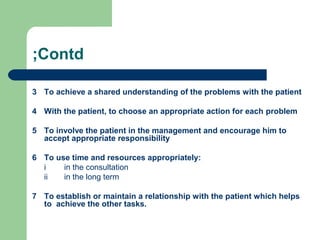
;Contd
3 To achieve a shared understanding of the problems with the patient
4 With the patient, to choose an appropriate action for each problem
5 To involve the patient in the management and encourage him to
accept appropriate responsibility
6 To use time and resources appropriately:
i
in the consultation
ii
in the long term
7 To establish or maintain a relationship with the patient which helps
to achieve the other tasks.
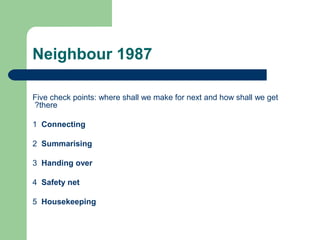
Neighbour 1987
Five check points: where shall we make for next and how shall we get
?there
1 Connecting
2 Summarising
3 Handing over
4 Safety net
5 Housekeeping
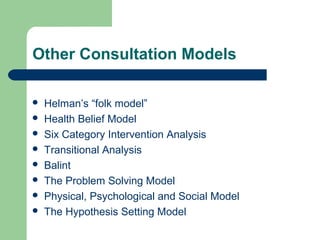
Other Consultation Models









Helman’s “folk model”
Health Belief Model
Six Category Intervention Analysis
Transitional Analysis
Balint
The Problem Solving Model
Physical, Psychological and Social Model
The Hypothesis Setting Model
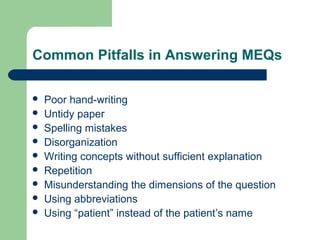
Common Pitfalls in Answering MEQs










Poor hand-writing
Untidy paper
Spelling mistakes
Disorganization
Writing concepts without sufficient explanation
Repetition
Misunderstanding the dimensions of the question
Using abbreviations
Using “patient” instead of the patient’s name
?How to answer MEQ

Write down what you
would actually do in the
real world
?How to answer MEQ

Write down what you
would actually do in the
real world

Consultation models

  • 1.
    Consultations Models Dr FaisalAl Hadad Consultant of Family Medicine & Occupational Health PSMMC
  • 2.
    Stott and Davis1979 ”The exceptional potential in each primary care consultation” suggests that four areas can be systematically explored each time a patient consults. A Management of presenting problems B Modification of help-seeking behaviours C Management of continuing problems D Opportunistic health promotion
  • 3.
    Byrne and Long1976 “Doctors Talking to Patients” Six phases which form a logical structure to the consultation:  Phase I: The doctor establishes a relationship with the patient  Phase II: The doctor either attempts to discover or actually discovers the reason for the patient’s attendance  Phase III: The doctor conducts a verbal or physical examination or both  Phase IV: The doctor, or the doctor and the patient , or the patient (in that order of probability) consider the condition  Phase V: The doctor, and occasionally the patient, detail further treatment or further investigation  Phase VI:The consultation is terminated usually by the doctor.
  • 4.
    Pendleton et. al.1984 “ The Consultation as Approach to Learning and Teaching” The authors (Pendleton, Schofield, Tate and Harvelock) describe seven tasks .which form comprehensive and coherent aims for any consultation 1 To define the reason for the patient’s attendance, including: i the nature and history of the problems ii their aetiology iii the patient’s ideas, concerns and expectations iv the effects of the problems 2 To consider other problems: i continuing problems ii at-risk factors
  • 5.
    ;Contd 3 To achievea shared understanding of the problems with the patient 4 With the patient, to choose an appropriate action for each problem 5 To involve the patient in the management and encourage him to accept appropriate responsibility 6 To use time and resources appropriately: i in the consultation ii in the long term 7 To establish or maintain a relationship with the patient which helps to achieve the other tasks.
  • 6.
    Neighbour 1987 Five checkpoints: where shall we make for next and how shall we get ?there 1 Connecting 2 Summarising 3 Handing over 4 Safety net 5 Housekeeping
  • 7.
    Other Consultation Models         Helman’s“folk model” Health Belief Model Six Category Intervention Analysis Transitional Analysis Balint The Problem Solving Model Physical, Psychological and Social Model The Hypothesis Setting Model
  • 8.
    Common Pitfalls inAnswering MEQs          Poor hand-writing Untidy paper Spelling mistakes Disorganization Writing concepts without sufficient explanation Repetition Misunderstanding the dimensions of the question Using abbreviations Using “patient” instead of the patient’s name
  • 9.
    ?How to answerMEQ Write down what you would actually do in the real world
  • 10.
    ?How to answerMEQ Write down what you would actually do in the real world