THE CONSULTATION
A Presentation by Team D
Dr Ahmed Yakubu & Dr Kemi Usanga
Department of Family Medicine
University of Uyo Teaching Hospital
Delivered on 30th July, 2021.
OUTLINE:
• Introduction
• Definition
• Components of the Consultation
• Aims of Studying Consultation
• Consultation Models
• Communication Skills in Consultation
• Barriers to Consultation Process
• Factors that Influence Consultation
• Conclusion
• References
INTRODUCTION:
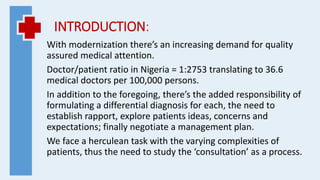
With modernization there’s an increasing demand for quality
assured medical attention.
Doctor/patient ratio in Nigeria = 1:2753 translating to 36.6
medical doctors per 100,000 persons.
In addition to the foregoing, there’s the added responsibility of
formulating a differential diagnosis for each, the need to
establish rapport, explore patients ideas, concerns and
expectations; finally negotiate a management plan.
We face a herculean task with the varying complexities of
patients, thus the need to study the ‘consultation’ as a process.
INTRODUCTION CONT’D:
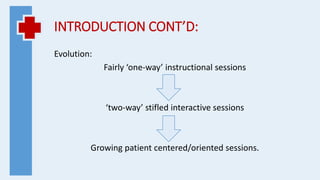
Evolution:
Fairly ‘one-way’ instructional sessions
‘two-way’ stifled interactive sessions
Growing patient centered/oriented sessions.
INTRODUCTION CONT’D:
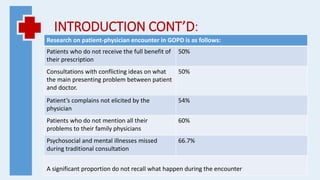
Research on patient-physician encounter in GOPD is as follows:
Patients who do not receive the full benefit of
their prescription
50%
Consultations with conflicting ideas on what
the main presenting problem between patient
and doctor.
50%
Patient’s complains not elicited by the
physician
54%
Patients who do not mention all their
problems to their family physicians
60%
Psychosocial and mental illnesses missed
during traditional consultation
66.7%
A significant proportion do not recall what happen during the encounter
DEFINITION:
The Consultation is the occasion, when in the intimacy of the
consulting room, clinic or a given safe environment, an ill
patient or a person who believes he is ill, seeks the attention
or advice of the doctor whom he trusts.
OR
An interactive session where in a healthy or sick
individual/individual who feels unwell seeks explanation
and/or cure, or advice from a physician within the confines of
an ideal setting.
COMPONENTS OF CONSULTATION:
a. The patient: The one who assumes the sick role, who must be
considered as a biopsychosocial being not neglecting their sense of
spirituality.
b. The doctor: Compliments the role of the patient, must be
objective, emotionally detached from the patient but empathetic.
Adhering to the medical ethics.
c.The enviroment: The ideal setting, which guarantees privacy and
comfort, is well equipped, organized and quiet.
d. Interaction (Communication skill)
AIM OF STUDYING ‘THE CONSULTATION’:
1. Understand the common models of the
consultation that have been proposed and how
we can use these models to reflect on
previous consultations in order to improve
future consultation behaviour.
2. Use the skills typically associated with good
doctor/patient communication.
AIM OF STUDYING ‘THE CONSULTATION’
CONT’D:
3. Show a holistic approach, and understand that
consultations have a clinical, psychological and
social component, with the relevance of each
component varying from consultation to
consultation.
4. Recognise, manage and monitor your personal
emotions arising from the consultation.
5. For the purpose of self appraisal and
educational development.
CONSULTATION MODELS
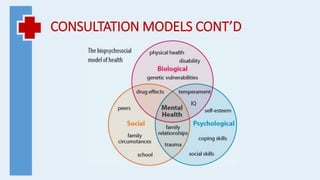
1. The Physical, Psychological and Social Model
This was first developed in 1972.
The Model encourages the Doctor to extend his
thinking beyond the purely organic approach to
patients i. e. to include the patient’s emotional,
family, social and environmental circumstances.
CONSULTATION MODELS CONT’D
2. Six Category Analysis:
Developed in 1975 by John Heron for doctors, counselors or
therapists.
The doctor’s interventions fall into one of six categories:
1. Prescriptive – Giving advice or instructions, being critical or
directive.
2. Informative – Imparting new knowledge, instructing or
interpreting.
3. Confronting – Challenging a restrictive attitude or behaviour,
giving direct feed-back within a caring context.
CONSULTATION MODELS CONT’D
Six Category Analysis Continued:
4. Cathartic – Seeking to release emotion in the
form of weeping, laughter, trembling or anger.
5. Catalytic – Encouraging the patient to discover
and explore his own latent thoughts and feelings.
6. Supportive – Offering comfort and approval,
affirming the patient’s intrinsic value.
CONSULTATION MODELS CONT’D:
3. Doctors Talking to patient model:
It was developed in 1978 by Byrne and Long. It has six
phases which formed a logical structure to the
consultation:
• Phase I – The doctor establishes a relationship with
the patient
• Phase II- The doctor either attempts to or actually
discovers the reasons for the patient’s attendance
• Phase III- The doctor conducts a verbal or physical
examination or both.
CONSULTATION MODELS CONT’D
Doctors Talking to patient model continued:
Phase IV- The doctor or the doctor and the patient, or
the patient (in this order of probability) consider the
condition.
• Phase V- The doctor and occasionally the patient
detail further treatment or investigation.
• Phase VI- The consultation is usually terminated by
the doctor.
CONSULTATION MODELS CONT’D
4. The Exceptional Potential in Each Primary Care
Consultation Model –
First developed by Stott and Davies in 1979.
It suggests four areas which can be systematically
explored, each time a patient consults to include:
A. Management of presenting problems
B. Modification of help seeking behaviour
C. Management of continuing problems
D. Opportunistic health promotion
CONSULTATION MODELS CONT’D
OBJECTIVES of The Exceptional Potential in Each Primary Care
Consultation Model:
1. To provide a theoretical base from which a practitioner can
develop the full potential in any primary care consultation.
2. To highlight some unique features of good primary care
3. To provide a simple and valid structure in training and
practice.
4. To o allow the philosophy, principles, and research
achievements in comprehensive care to be discussed
within a simple patient-centered framework,
CONSULTATION MODELS CONT’D
5. Hellman’s Folk Model:
Developed by Cecil Hellman (a medical anthropologist) in 1981.
He opined that a patient with a problem comes to the doctor
seeking answers to six questions:-
I. What has happened?
II. Why has it happened?
III. Why to me?
IV. Why now?
V. What would happen if nothing was done about it.
VI. What should i do about it and who should I consult for
further help?
CONSULTATION MODELS CONT’D
6. Neighbour Model:
Developed in 1987, with five main points
•Connecting – Establishing a rapport with patient.
•Summarizing – Getting to what concern brought
him to you, using skills to discover their ideas,
concerns, expectations and summarizing the points
for the patient.
CONSULTATION MODELS CONT’D
Neighbour Model Continued:
•Handing over- Following negotiations the doctor
and patient’s agenda are agreed upon.
•Safety-netting: what if? – Consider your proposed
actions for each case.
•Housekeeping – Reassess yourself to see if you are
in good enough shape for the next patient .
CONSULTATION MODELS CONT’D
7. The Three Functions Approach:
Developed by Cohen-Cole and Bird. 1989
It has three major components:
•Gathering data to understand the patient’s problem
•Developing Rapport
•Education and motivation
CONSULTATION MODELS CONT’D
8. The Calgary-Cambridge Approach:
Developed by Suzanne Kurtz and Jonathan
Silverman in 1998. The structure of the
consultation proposed is as follows:
1. Initiating the session
2. Gathering information
3. Building the relationship
CONSULTATION MODELS CONT’D
The Calgary-Cambridge Approach Continued:
4. Explanation and planning
5. Close the Session
CONSULTATION MODELS CONT’D
9. THE TRADITIONAL MODEL:
• Presenting complaints
• History of presenting complaints
• Past medical history
• Drug history
• Social and family history
• Review of systems
• Examination
CONSULTATION MODELS CONT’D
Traditional Model cont’d:
• Biological diagnosis
• Investigation
• Treatment and follow up
In the traditional model areas of challenges may include
responding to cues, exploring a patient’s health
understanding and developing a shared management plan
with the patient.
CONSULTATION MODELS CONT’D
10. The Patient-centered Model:
This Model was developed in 1995 by McWhiney
and colleagues at University of Western Ontario.
Components of PCCM:
1. Exploring the disease and the illness experience
2. Understanding the whole person
3. Finding common ground regarding
management
CONSULTATION MODELS CONT’D
Components of PCCM cont’d:
4. Incorporating prevention and health promotion
5. Enhancing the doctor-patient relationship
6. ‘Being realistic’ about personal limitations and
resources.
BENEFITS OF THE PATIENT CENTERED
CONSULTATION:
1. Many studies have shown that adherence and patient
satisfaction both increase when patients are given
information by their doctors about their management.
2. Patient-centred consultation reduces costs. It is less
expensive, for instance, to promote adherence than to
hospitalize people for not taking their drugs as prescribed.
3. Patient-centred consultation maximizes time. It
certainly reduces the number of visits by the patient.
BENEFITS OF THE PATIENT CENTERED
CONSULTATION CONT’D:
4. The diagnosis is more likely to be accurate and
management of the condition is better tailored to meet
patients needs.
5. Less resources are used because only the needful are
involved.
6. Reduces litigation because it meets patients’
satisfaction.
7. Doctor’s satisfaction is also improved.
PCCM ASSESSMENT:
In using this patient-centred approach a 3-stage
assessment is advocated:
1. Assess the clinical Component
2. Identifying disease: Understanding the
illness experience (FIFE)
3. Assess the contextual component:
COMMUNICATION SKILLS IN CONSULTATION
For acquaintance and familliarization with skills in
communication during consultation the acronym P. R.
A. C. T. I. C. A. L. may be come in handy:
P - Prior to the consultation review the patient’s
folder. Pull your attention span together and
concentrate on what is coming. Switch off your phone
if possible.
COMMUNICATION SKILLS IN CONSULTATION
CONT’D
R – Relationship. Greet the patient. Offer him/her a
seat. Politely introduce yourself.
Make a proper opening statement with a question,
such as: ‘How can I help you?’ This is a good
question if the client does not look ill, but: ‘What
illness brought you to the hospital? ‘- is a better
question for an ill-looking patient.
COMMUNICATION SKILLS IN CONSULTATION
CONT’D
A – Anxieties. Address the patient’s fears. Use open ended
questions. Ask about his ideas of the illness, his concern,
the feelings that the illness has evoked and his
expectations. Watch for non-verbal clues.
C – Common language should be used. Clarify the patients
statements. Summarize what you think he has said. A
summary tells the patient that you have been listening and
it demonstrates your interest.
COMMUNICATION SKILLS IN CONSULTATION
CONT’D
T – Translating. Use simple words to communicate
your findings along with the diagnosis to the patient.
I – Interaction. In formulating a management plan,
explain everything in simple language to your
patient. Give the information in small bits, checking
for his understanding, aiming for a shared
understanding of the problem.
COMMUNICATION SKILLS IN CONSULTATION
CONT’D
C- Convert insight into action. Discuss the
implementation of your management plan and how
it will be achieved.
A – Agreement. Check to make sure that you and the
patient are in agreement about his clinical
assessment and overall management plan
COMMUNICATION SKILLS IN CONSULTATION
CONT’D
L – Leave. End of consultation. With the patient out
of the room, reflect on the consultation. If anything
was missed, it may still be possible to gather the
loose ends now and plan to make good at the
review/check-up visit.
BARRIERS TO CONSULTATION PROCESS
Barriers could be: Physical, Psychological or social and they
need to be recognized and overcome. They include:
Physical Barriers:
• Deafness
• Intoxication
• Aphasia
• Dementia
• Delirium
BARRIERS TO CONSULTATION PROCESS
CONT’D
Psychological Barriers:
• Depression
• Anxiety
• Psychosis
• Paranoia
• Personality disorders
BARRIERS TO CONSULTATION PROCESS
CONT’D
Social Barriers:
• Language/Interpreter
• Illiteracy
• Cultural barriers
• Immigration status
• Legal problems.
FACTORS THAT INFLUENCE THE
CONSULTATION:
• Recording the consultation can be an impediment if care
is not taken.
• Sometimes the urge to finish quickly may present while
prescription is being written and so adversely influence
the consultation.
• Age – Younger persons are more likely to expect a
relationship of mutual participation than elderly ones.
FACTORS THAT INFLUENCE THE
CONSULTATION CONT’D:
• Gender – Women are more likely to take more time at the
consultation than men while doctors are more likely to
discuss more with men.
• Education – Patients with high social and educational
background tend to participate more in the consultation.
• Duration of illness – A patient’s desire to participate in the
consultation increases in the course of an illness as they
gain more knowledge and understanding of the illness.
FACTORS THAT INFLUENCE THE
CONSULTATION CONT’D:
•Finance – Consultations on fee for service basis
tend to take more time than where doctors are
government paid.
•Patients presenting with medically unexplained
symptoms (MUS), tend not to be satisfied with
their consultation.
•The physicians appearance (dressing)
CONCLUSION:
Consultation models provide a potential structure for
the complex interactions that occur between patients
and doctors.
They help doctors process the vast amount of
information that is conveyed to them during the
consultation.
They help Family physicians communicate more
effectively with their patients, which in turn can
improve their job satisfaction, patient satisfaction and
patient outcomes.
CONCLUSION:
They can help FPs to understand where their
consultations are going wrong, and may help them find
ways to correct this problem.
There will never be a model that covers every
eventuality in the exceptional and unique world of
primary care.
If consultation models are used, they should not be
followed rigidly, but adapted to one’s innate consulting
skills and personality traits, allowing our natural warmth
and empathy to show through.
What is the role of referral in the
consultation process ?
REFERENCES
Okokon, I. B. The Consultation in Primary Care. A Presentation at
the 2014 Revision Course in Family Medicine.
Denness, C. What are Consultation Models for? SAGE Journals.
2013. Available from www.journals.sagepub.com Accessed on
28/07/2021.
Mehay, R. Ram’s top tips for the CSA-part
one. 2012. Available from www.bradfordvts.co.uk/mrcgp/csa.
accessed on 28/7/2021.
THANK YOU FOR LISTENING

The consultation team d

  • 1.
    THE CONSULTATION A Presentationby Team D Dr Ahmed Yakubu & Dr Kemi Usanga Department of Family Medicine University of Uyo Teaching Hospital Delivered on 30th July, 2021.
  • 2.
    OUTLINE: • Introduction • Definition •Components of the Consultation • Aims of Studying Consultation • Consultation Models • Communication Skills in Consultation • Barriers to Consultation Process • Factors that Influence Consultation • Conclusion • References
  • 3.
    INTRODUCTION: With modernization there’san increasing demand for quality assured medical attention. Doctor/patient ratio in Nigeria = 1:2753 translating to 36.6 medical doctors per 100,000 persons. In addition to the foregoing, there’s the added responsibility of formulating a differential diagnosis for each, the need to establish rapport, explore patients ideas, concerns and expectations; finally negotiate a management plan. We face a herculean task with the varying complexities of patients, thus the need to study the ‘consultation’ as a process.
  • 4.
    INTRODUCTION CONT’D: Evolution: Fairly ‘one-way’instructional sessions ‘two-way’ stifled interactive sessions Growing patient centered/oriented sessions.
  • 5.
    INTRODUCTION CONT’D: Research onpatient-physician encounter in GOPD is as follows: Patients who do not receive the full benefit of their prescription 50% Consultations with conflicting ideas on what the main presenting problem between patient and doctor. 50% Patient’s complains not elicited by the physician 54% Patients who do not mention all their problems to their family physicians 60% Psychosocial and mental illnesses missed during traditional consultation 66.7% A significant proportion do not recall what happen during the encounter
  • 6.
    DEFINITION: The Consultation isthe occasion, when in the intimacy of the consulting room, clinic or a given safe environment, an ill patient or a person who believes he is ill, seeks the attention or advice of the doctor whom he trusts. OR An interactive session where in a healthy or sick individual/individual who feels unwell seeks explanation and/or cure, or advice from a physician within the confines of an ideal setting.
  • 7.
    COMPONENTS OF CONSULTATION: a.The patient: The one who assumes the sick role, who must be considered as a biopsychosocial being not neglecting their sense of spirituality. b. The doctor: Compliments the role of the patient, must be objective, emotionally detached from the patient but empathetic. Adhering to the medical ethics. c.The enviroment: The ideal setting, which guarantees privacy and comfort, is well equipped, organized and quiet. d. Interaction (Communication skill)
  • 8.
    AIM OF STUDYING‘THE CONSULTATION’: 1. Understand the common models of the consultation that have been proposed and how we can use these models to reflect on previous consultations in order to improve future consultation behaviour. 2. Use the skills typically associated with good doctor/patient communication.
  • 9.
    AIM OF STUDYING‘THE CONSULTATION’ CONT’D: 3. Show a holistic approach, and understand that consultations have a clinical, psychological and social component, with the relevance of each component varying from consultation to consultation. 4. Recognise, manage and monitor your personal emotions arising from the consultation. 5. For the purpose of self appraisal and educational development.
  • 10.
    CONSULTATION MODELS 1. ThePhysical, Psychological and Social Model This was first developed in 1972. The Model encourages the Doctor to extend his thinking beyond the purely organic approach to patients i. e. to include the patient’s emotional, family, social and environmental circumstances.
  • 11.
  • 12.
    CONSULTATION MODELS CONT’D 2.Six Category Analysis: Developed in 1975 by John Heron for doctors, counselors or therapists. The doctor’s interventions fall into one of six categories: 1. Prescriptive – Giving advice or instructions, being critical or directive. 2. Informative – Imparting new knowledge, instructing or interpreting. 3. Confronting – Challenging a restrictive attitude or behaviour, giving direct feed-back within a caring context.
  • 13.
    CONSULTATION MODELS CONT’D SixCategory Analysis Continued: 4. Cathartic – Seeking to release emotion in the form of weeping, laughter, trembling or anger. 5. Catalytic – Encouraging the patient to discover and explore his own latent thoughts and feelings. 6. Supportive – Offering comfort and approval, affirming the patient’s intrinsic value.
  • 14.
    CONSULTATION MODELS CONT’D: 3.Doctors Talking to patient model: It was developed in 1978 by Byrne and Long. It has six phases which formed a logical structure to the consultation: • Phase I – The doctor establishes a relationship with the patient • Phase II- The doctor either attempts to or actually discovers the reasons for the patient’s attendance • Phase III- The doctor conducts a verbal or physical examination or both.
  • 15.
    CONSULTATION MODELS CONT’D DoctorsTalking to patient model continued: Phase IV- The doctor or the doctor and the patient, or the patient (in this order of probability) consider the condition. • Phase V- The doctor and occasionally the patient detail further treatment or investigation. • Phase VI- The consultation is usually terminated by the doctor.
  • 16.
    CONSULTATION MODELS CONT’D 4.The Exceptional Potential in Each Primary Care Consultation Model – First developed by Stott and Davies in 1979. It suggests four areas which can be systematically explored, each time a patient consults to include: A. Management of presenting problems B. Modification of help seeking behaviour C. Management of continuing problems D. Opportunistic health promotion
  • 17.
    CONSULTATION MODELS CONT’D OBJECTIVESof The Exceptional Potential in Each Primary Care Consultation Model: 1. To provide a theoretical base from which a practitioner can develop the full potential in any primary care consultation. 2. To highlight some unique features of good primary care 3. To provide a simple and valid structure in training and practice. 4. To o allow the philosophy, principles, and research achievements in comprehensive care to be discussed within a simple patient-centered framework,
  • 18.
    CONSULTATION MODELS CONT’D 5.Hellman’s Folk Model: Developed by Cecil Hellman (a medical anthropologist) in 1981. He opined that a patient with a problem comes to the doctor seeking answers to six questions:- I. What has happened? II. Why has it happened? III. Why to me? IV. Why now? V. What would happen if nothing was done about it. VI. What should i do about it and who should I consult for further help?
  • 19.
    CONSULTATION MODELS CONT’D 6.Neighbour Model: Developed in 1987, with five main points •Connecting – Establishing a rapport with patient. •Summarizing – Getting to what concern brought him to you, using skills to discover their ideas, concerns, expectations and summarizing the points for the patient.
  • 20.
    CONSULTATION MODELS CONT’D NeighbourModel Continued: •Handing over- Following negotiations the doctor and patient’s agenda are agreed upon. •Safety-netting: what if? – Consider your proposed actions for each case. •Housekeeping – Reassess yourself to see if you are in good enough shape for the next patient .
  • 21.
    CONSULTATION MODELS CONT’D 7.The Three Functions Approach: Developed by Cohen-Cole and Bird. 1989 It has three major components: •Gathering data to understand the patient’s problem •Developing Rapport •Education and motivation
  • 22.
    CONSULTATION MODELS CONT’D 8.The Calgary-Cambridge Approach: Developed by Suzanne Kurtz and Jonathan Silverman in 1998. The structure of the consultation proposed is as follows: 1. Initiating the session 2. Gathering information 3. Building the relationship
  • 23.
    CONSULTATION MODELS CONT’D TheCalgary-Cambridge Approach Continued: 4. Explanation and planning 5. Close the Session
  • 24.
    CONSULTATION MODELS CONT’D 9.THE TRADITIONAL MODEL: • Presenting complaints • History of presenting complaints • Past medical history • Drug history • Social and family history • Review of systems • Examination
  • 25.
    CONSULTATION MODELS CONT’D TraditionalModel cont’d: • Biological diagnosis • Investigation • Treatment and follow up In the traditional model areas of challenges may include responding to cues, exploring a patient’s health understanding and developing a shared management plan with the patient.
  • 26.
    CONSULTATION MODELS CONT’D 10.The Patient-centered Model: This Model was developed in 1995 by McWhiney and colleagues at University of Western Ontario. Components of PCCM: 1. Exploring the disease and the illness experience 2. Understanding the whole person 3. Finding common ground regarding management
  • 27.
    CONSULTATION MODELS CONT’D Componentsof PCCM cont’d: 4. Incorporating prevention and health promotion 5. Enhancing the doctor-patient relationship 6. ‘Being realistic’ about personal limitations and resources.
  • 28.
    BENEFITS OF THEPATIENT CENTERED CONSULTATION: 1. Many studies have shown that adherence and patient satisfaction both increase when patients are given information by their doctors about their management. 2. Patient-centred consultation reduces costs. It is less expensive, for instance, to promote adherence than to hospitalize people for not taking their drugs as prescribed. 3. Patient-centred consultation maximizes time. It certainly reduces the number of visits by the patient.
  • 29.
    BENEFITS OF THEPATIENT CENTERED CONSULTATION CONT’D: 4. The diagnosis is more likely to be accurate and management of the condition is better tailored to meet patients needs. 5. Less resources are used because only the needful are involved. 6. Reduces litigation because it meets patients’ satisfaction. 7. Doctor’s satisfaction is also improved.
  • 30.
    PCCM ASSESSMENT: In usingthis patient-centred approach a 3-stage assessment is advocated: 1. Assess the clinical Component 2. Identifying disease: Understanding the illness experience (FIFE) 3. Assess the contextual component:
  • 31.
    COMMUNICATION SKILLS INCONSULTATION For acquaintance and familliarization with skills in communication during consultation the acronym P. R. A. C. T. I. C. A. L. may be come in handy: P - Prior to the consultation review the patient’s folder. Pull your attention span together and concentrate on what is coming. Switch off your phone if possible.
  • 32.
    COMMUNICATION SKILLS INCONSULTATION CONT’D R – Relationship. Greet the patient. Offer him/her a seat. Politely introduce yourself. Make a proper opening statement with a question, such as: ‘How can I help you?’ This is a good question if the client does not look ill, but: ‘What illness brought you to the hospital? ‘- is a better question for an ill-looking patient.
  • 33.
    COMMUNICATION SKILLS INCONSULTATION CONT’D A – Anxieties. Address the patient’s fears. Use open ended questions. Ask about his ideas of the illness, his concern, the feelings that the illness has evoked and his expectations. Watch for non-verbal clues. C – Common language should be used. Clarify the patients statements. Summarize what you think he has said. A summary tells the patient that you have been listening and it demonstrates your interest.
  • 34.
    COMMUNICATION SKILLS INCONSULTATION CONT’D T – Translating. Use simple words to communicate your findings along with the diagnosis to the patient. I – Interaction. In formulating a management plan, explain everything in simple language to your patient. Give the information in small bits, checking for his understanding, aiming for a shared understanding of the problem.
  • 35.
    COMMUNICATION SKILLS INCONSULTATION CONT’D C- Convert insight into action. Discuss the implementation of your management plan and how it will be achieved. A – Agreement. Check to make sure that you and the patient are in agreement about his clinical assessment and overall management plan
  • 36.
    COMMUNICATION SKILLS INCONSULTATION CONT’D L – Leave. End of consultation. With the patient out of the room, reflect on the consultation. If anything was missed, it may still be possible to gather the loose ends now and plan to make good at the review/check-up visit.
  • 37.
    BARRIERS TO CONSULTATIONPROCESS Barriers could be: Physical, Psychological or social and they need to be recognized and overcome. They include: Physical Barriers: • Deafness • Intoxication • Aphasia • Dementia • Delirium
  • 38.
    BARRIERS TO CONSULTATIONPROCESS CONT’D Psychological Barriers: • Depression • Anxiety • Psychosis • Paranoia • Personality disorders
  • 39.
    BARRIERS TO CONSULTATIONPROCESS CONT’D Social Barriers: • Language/Interpreter • Illiteracy • Cultural barriers • Immigration status • Legal problems.
  • 40.
    FACTORS THAT INFLUENCETHE CONSULTATION: • Recording the consultation can be an impediment if care is not taken. • Sometimes the urge to finish quickly may present while prescription is being written and so adversely influence the consultation. • Age – Younger persons are more likely to expect a relationship of mutual participation than elderly ones.
  • 41.
    FACTORS THAT INFLUENCETHE CONSULTATION CONT’D: • Gender – Women are more likely to take more time at the consultation than men while doctors are more likely to discuss more with men. • Education – Patients with high social and educational background tend to participate more in the consultation. • Duration of illness – A patient’s desire to participate in the consultation increases in the course of an illness as they gain more knowledge and understanding of the illness.
  • 42.
    FACTORS THAT INFLUENCETHE CONSULTATION CONT’D: •Finance – Consultations on fee for service basis tend to take more time than where doctors are government paid. •Patients presenting with medically unexplained symptoms (MUS), tend not to be satisfied with their consultation. •The physicians appearance (dressing)
  • 43.
    CONCLUSION: Consultation models providea potential structure for the complex interactions that occur between patients and doctors. They help doctors process the vast amount of information that is conveyed to them during the consultation. They help Family physicians communicate more effectively with their patients, which in turn can improve their job satisfaction, patient satisfaction and patient outcomes.
  • 44.
    CONCLUSION: They can helpFPs to understand where their consultations are going wrong, and may help them find ways to correct this problem. There will never be a model that covers every eventuality in the exceptional and unique world of primary care. If consultation models are used, they should not be followed rigidly, but adapted to one’s innate consulting skills and personality traits, allowing our natural warmth and empathy to show through.
  • 45.
    What is therole of referral in the consultation process ?
  • 46.
    REFERENCES Okokon, I. B.The Consultation in Primary Care. A Presentation at the 2014 Revision Course in Family Medicine. Denness, C. What are Consultation Models for? SAGE Journals. 2013. Available from www.journals.sagepub.com Accessed on 28/07/2021. Mehay, R. Ram’s top tips for the CSA-part one. 2012. Available from www.bradfordvts.co.uk/mrcgp/csa. accessed on 28/7/2021.
  • 47.
    THANK YOU FORLISTENING