PATIENT CONSULTANCY
Dr. A.U.Sheikh
Pharm.D| M.Phil | MD (A.M) | C.R.C.P
Diabetes Management Specialist
The ability of a pharmacist to
consult effectively is
fundamental to
pharmaceutical care and this
includes establishing a
platform for achieving
adherence/concordance.
Little bit of history..
Pioneering pharmacists provided
comprehensive pharmacy services to nursing
facilities as early as the 1950s.
The term ‘consultant pharmacist’ was coined
by George F. Archambault.
Who sometimes is referred as ‘founding father
of consultant pharmacy’
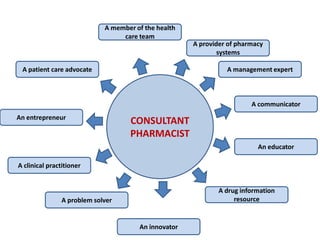
CONSULTANT
PHARMACIST
CONSULTANT
PHARMACIST
A provider of pharmacy
systems
A management expert
A member of the health
care team
A communicator
An educator
A patient care advocate
An entrepreneur
A clinical practitioner
A problem solver
An innovator
A drug information
resource
PATIENT CONSULTANCY
PROCESS
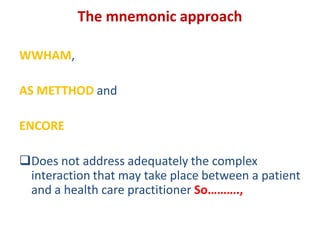
The mnemonic approach
WWHAM,
AS METTHOD and
ENCORE
Does not address adequately the complex
interaction that may take place between a patient
and a health care practitioner So……….,
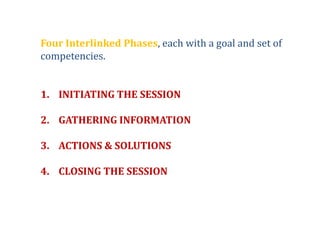
Four Interlinked Phases, each with a goal and set of
competencies.
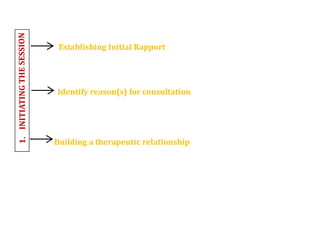
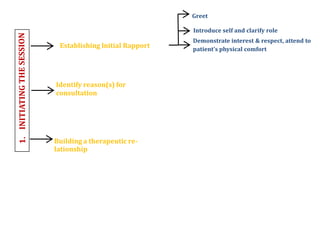
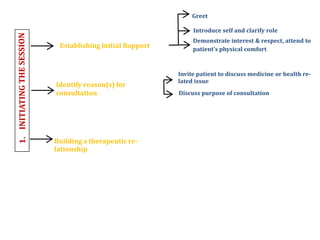
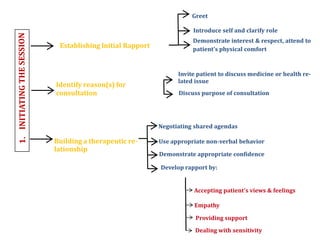
1. INITIATING THE SESSION
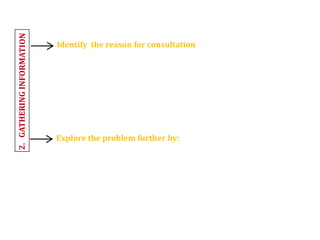
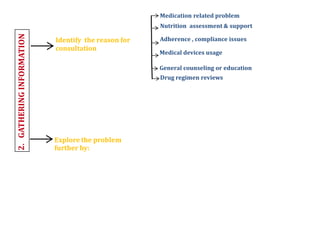
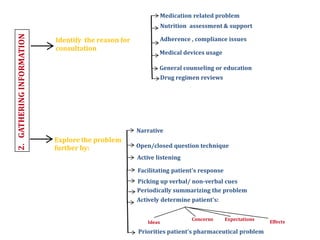
2. GATHERING INFORMATION
3. ACTIONS & SOLUTIONS
4. CLOSING THE SESSION
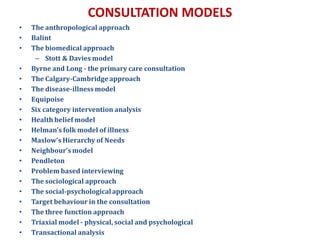
CONSULTATION MODELS
• The anthropological approach
• Balint
• The biomedical approach
– Stott & Davies model
• Byrne and Long - the primary care consultation
• The Calgary-Cambridge approach
• The disease-illness model
• Equipoise
• Six category intervention analysis
• Health belief model
• Helman's folk model of illness
• Maslow’s Hierarchy of Needs
• Neighbour’s model
• Pendleton
• Problem based interviewing
• The sociological approach
• The social-psychological approach
• Target behaviour in the consultation
• The three function approach
• Triaxial model - physical, social and psychological
• Transactional analysis
Identify reason(s) for consultation
Building a therapeutic relationship
Establishing Initial Rapport
Identify reason(s) for
consultation
Building a therapeutic re-
lationship
Greet
Introduce self and clarify role
Demonstrate interest & respect, attend to
patient’s physical comfort
Establishing Initial Rapport
Identify reason(s) for
consultation
Building a therapeutic re-
lationship
Greet
Introduce self and clarify role
Demonstrate interest & respect, attend to
patient’s physical comfort
Invite patient to discuss medicine or health re-
lated issue
Discuss purpose of consultation
Establishing Initial Rapport
Identify reason(s) for
consultation
Building a therapeutic re-
lationship
Greet
Introduce self and clarify role
Demonstrate interest & respect, attend to
patient’s physical comfort
Invite patient to discuss medicine or health re-
lated issue
Discuss purpose of consultation
Negotiating shared agendas
Use appropriate non-verbal behavior
Demonstrate appropriate confidence
Develop rapport by:
Accepting patient’s views & feelings
Empathy
Providing support
Dealing with sensitivity
Identify the reason for consultation
Explore the problem further by:
Identify the reason for
consultation
Explore the problem
further by:
Medication related problem
Nutrition assessment & support
Adherence , compliance issues
Medical devices usage
General counseling or education
Drug regimen reviews
Identify the reason for
consultation
Explore the problem
further by:
Medication related problem
Nutrition assessment & support
Adherence , compliance issues
Medical devices usage
General counseling or education
Drug regimen reviews
Narrative
Open/closed question technique
Active listening
Facilitating patient's response
Picking up verbal/ non-verbal cues
Periodically summarizing the problem
Actively determine patient’s:
Ideas
Concerns Expectations
Effects
Priorities patient’s pharmaceutical problem
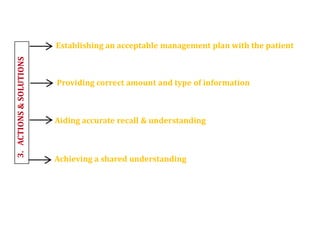
Establishing an acceptable management plan with the patient
Providing correct amount and type of information
Aiding accurate recall & understanding
Achieving a shared understanding
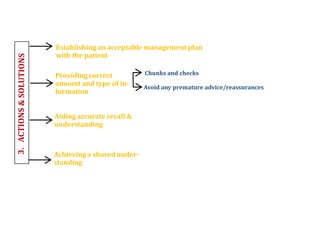
Establishing an acceptable management plan
with the patient
Providing correct
amount and type of in-
formation
Aiding accurate recall &
understanding
Achieving a shared under-
standing
Chunks and checks
Avoid any premature advice/reassurances
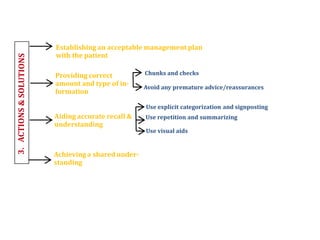
Establishing an acceptable management plan
with the patient
Providing correct
amount and type of in-
formation
Aiding accurate recall &
understanding
Achieving a shared under-
standing
Chunks and checks
Avoid any premature advice/reassurances
Use explicit categorization and signposting
Use repetition and summarizing
Use visual aids
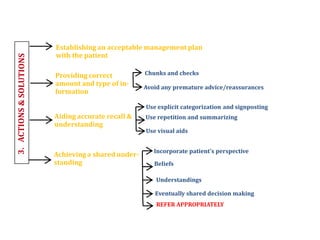
Establishing an acceptable management plan
with the patient
Providing correct
amount and type of in-
formation
Aiding accurate recall &
understanding
Achieving a shared under-
standing
Chunks and checks
Avoid any premature advice/reassurances
Use explicit categorization and signposting
Use repetition and summarizing
Use visual aids
Incorporate patient’s perspective
Beliefs
Understandings
Eventually shared decision making
REFER APPROPRIATELY
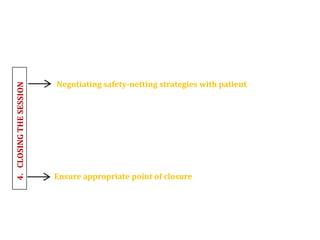
Negotiating safety-netting strategies with patient
Ensure appropriate point of closure
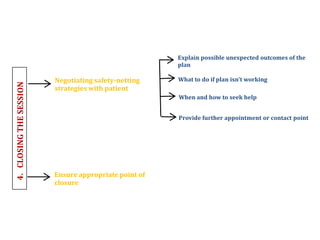
Negotiating safety-netting
strategies with patient
Ensure appropriate point of
closure
Explain possible unexpected outcomes of the
plan
What to do if plan isn’t working
When and how to seek help
Provide further appointment or contact point
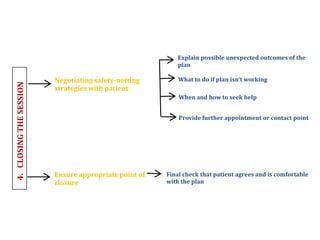
Negotiating safety-netting
strategies with patient
Ensure appropriate point of
closure
Explain possible unexpected outcomes of the
plan
What to do if plan isn’t working
When and how to seek help
Provide further appointment or contact point
Final check that patient agrees and is comfortable
with the plan
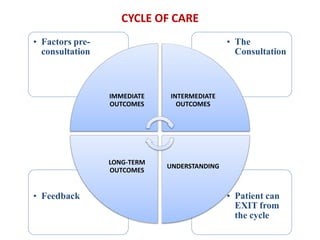
CYCLE OF CARE
• Patient can
EXIT from
the cycle
• Feedback
• The
Consultation
• Factors pre-
consultation
IMMEDIATE
OUTCOMES
INTERMEDIATE
OUTCOMES
UNDERSTANDING
LONG-TERM
OUTCOMES
Barriers to effective consultation
Consultant factors
• Lack of time (real or perceived)
• Inadequate clinical information.
• Inadequate clinical skills.
• Inadequate communication skills.
• Attitudinal problems.
• Poor recovery from previous stressful
consultation or life events.
• Artificial stimulants.
Patient factors
•Lack of time (real or perceived)
•Fear (of consultant, pain and dying)
•Lack of understanding of basic biology and
probability.
•Unscientific health beliefs.
•Unrealistic expectations of the health service.
•Unrealistic expectations of medical science.
•Aggressive attitude.
•Mental illness.
•Artificial stimulants.
CONSULTATION BEHAVIORS
For effective consultation, the health
care professional also needs to draw
upon a range of communication
behaviors.
1. QUESTIONING STYLE
Appropriate use of open, leading and
closed questions.
Open question: ‘Tell me more
about’……’What is the pain like?’
Closed question: ‘Have you lost weight?’
2. Empathy, Empowerment and Enablement
An empathetic consultant can empower the
patient and enable them to ‘move on’ from
their problem productively.
3. REFLECTION
Reflect back a phrase or symptom that the
patient has mentioned in order to explore it
further.
Patient: ‘I have been feeling a bit out of
sorts....’
Consultant: ‘Out of sorts….tell me what you
mean by this.’
4. RESPONDING TO CUES
‘You seem very upset/anxious…’
is an example of responding to non-verbal cue.
5. NARRATIVE
Patients invariably present their problems as a
story:
‘This happened..
and then happened….
and then I felt something.. .
I talked to a few people about it. . .
Now I want to know what to do. . . . ’
Patients want to go away with a better story:
‘My problem seems less ….
I understand it better……
now I know what to do…..’
6. MOTIVATIONAL INTERVIEWING
A negotiating style for helping people to
change behavior by helping patients to
explore and resolve ambivalence, increasing
motivation to change
Persuasion and coercion are not appropriate
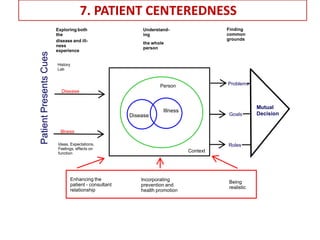
Exploring both
the
disease and ill-
ness
experience
Understand-
ing
the whole
person
Finding
common
grounds
Problems
Goals
Roles
Person
Disease
Illness
Context
History
Lab
Disease
Illness
Ideas, Expectations,
Feelings, effects on
function
Mutual
Decision
Enhancing the
patient - consultant
relationship
Incorporating
prevention and
health promotion
Being
realistic
7. PATIENT CENTEREDNESS
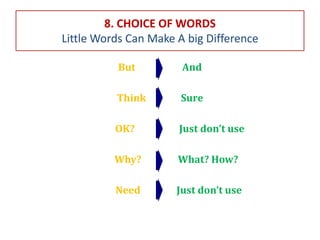
8. CHOICE OF WORDS
Little Words Can Make A big Difference
But And
Think Sure
OK? Just don’t use
Why? What? How?
Need Just don’t use
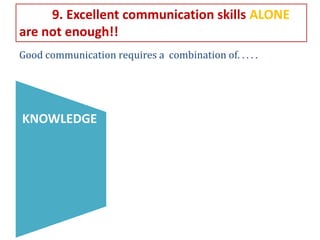
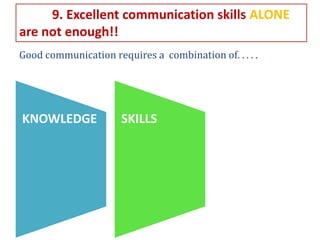
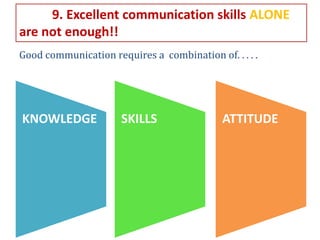
9. Excellent communication skills ALONE
are not enough!!
Good communication requires a combination of. . . . .
KNOWLEDGE
9. Excellent communication skills ALONE
are not enough!!
Good communication requires a combination of. . . . .
KNOWLEDGE SKILLS
9. Excellent communication skills ALONE
are not enough!!
Good communication requires a combination of. . . . .
ATTITUDEKNOWLEDGE SKILLS
9. Excellent communication skills ALONE
are not enough!!
Good communication requires a combination of. . . . .
That would be all. . .
THANK YOU

Patient consultancy 23082016

  • 1.
    PATIENT CONSULTANCY Dr. A.U.Sheikh Pharm.D|M.Phil | MD (A.M) | C.R.C.P Diabetes Management Specialist
  • 2.
    The ability ofa pharmacist to consult effectively is fundamental to pharmaceutical care and this includes establishing a platform for achieving adherence/concordance.
  • 3.
    Little bit ofhistory.. Pioneering pharmacists provided comprehensive pharmacy services to nursing facilities as early as the 1950s. The term ‘consultant pharmacist’ was coined by George F. Archambault. Who sometimes is referred as ‘founding father of consultant pharmacy’
  • 4.
  • 5.
    CONSULTANT PHARMACIST A provider ofpharmacy systems A management expert A member of the health care team A communicator An educator A patient care advocate An entrepreneur A clinical practitioner A problem solver An innovator A drug information resource
  • 6.
  • 7.
    The mnemonic approach WWHAM, ASMETTHOD and ENCORE Does not address adequately the complex interaction that may take place between a patient and a health care practitioner So……….,
  • 8.
    Four Interlinked Phases,each with a goal and set of competencies. 1. INITIATING THE SESSION 2. GATHERING INFORMATION 3. ACTIONS & SOLUTIONS 4. CLOSING THE SESSION
  • 9.
    CONSULTATION MODELS • Theanthropological approach • Balint • The biomedical approach – Stott & Davies model • Byrne and Long - the primary care consultation • The Calgary-Cambridge approach • The disease-illness model • Equipoise • Six category intervention analysis • Health belief model • Helman's folk model of illness • Maslow’s Hierarchy of Needs • Neighbour’s model • Pendleton • Problem based interviewing • The sociological approach • The social-psychological approach • Target behaviour in the consultation • The three function approach • Triaxial model - physical, social and psychological • Transactional analysis
  • 10.
    Identify reason(s) forconsultation Building a therapeutic relationship Establishing Initial Rapport
  • 11.
    Establishing Initial Rapport Identifyreason(s) for consultation Building a therapeutic re- lationship Greet Introduce self and clarify role Demonstrate interest & respect, attend to patient’s physical comfort
  • 12.
    Establishing Initial Rapport Identifyreason(s) for consultation Building a therapeutic re- lationship Greet Introduce self and clarify role Demonstrate interest & respect, attend to patient’s physical comfort Invite patient to discuss medicine or health re- lated issue Discuss purpose of consultation
  • 13.
    Establishing Initial Rapport Identifyreason(s) for consultation Building a therapeutic re- lationship Greet Introduce self and clarify role Demonstrate interest & respect, attend to patient’s physical comfort Invite patient to discuss medicine or health re- lated issue Discuss purpose of consultation Negotiating shared agendas Use appropriate non-verbal behavior Demonstrate appropriate confidence Develop rapport by: Accepting patient’s views & feelings Empathy Providing support Dealing with sensitivity
  • 14.
    Identify the reasonfor consultation Explore the problem further by:
  • 15.
    Identify the reasonfor consultation Explore the problem further by: Medication related problem Nutrition assessment & support Adherence , compliance issues Medical devices usage General counseling or education Drug regimen reviews
  • 16.
    Identify the reasonfor consultation Explore the problem further by: Medication related problem Nutrition assessment & support Adherence , compliance issues Medical devices usage General counseling or education Drug regimen reviews Narrative Open/closed question technique Active listening Facilitating patient's response Picking up verbal/ non-verbal cues Periodically summarizing the problem Actively determine patient’s: Ideas Concerns Expectations Effects Priorities patient’s pharmaceutical problem
  • 17.
    Establishing an acceptablemanagement plan with the patient Providing correct amount and type of information Aiding accurate recall & understanding Achieving a shared understanding
  • 18.
    Establishing an acceptablemanagement plan with the patient Providing correct amount and type of in- formation Aiding accurate recall & understanding Achieving a shared under- standing Chunks and checks Avoid any premature advice/reassurances
  • 19.
    Establishing an acceptablemanagement plan with the patient Providing correct amount and type of in- formation Aiding accurate recall & understanding Achieving a shared under- standing Chunks and checks Avoid any premature advice/reassurances Use explicit categorization and signposting Use repetition and summarizing Use visual aids
  • 20.
    Establishing an acceptablemanagement plan with the patient Providing correct amount and type of in- formation Aiding accurate recall & understanding Achieving a shared under- standing Chunks and checks Avoid any premature advice/reassurances Use explicit categorization and signposting Use repetition and summarizing Use visual aids Incorporate patient’s perspective Beliefs Understandings Eventually shared decision making REFER APPROPRIATELY
  • 21.
    Negotiating safety-netting strategieswith patient Ensure appropriate point of closure
  • 22.
    Negotiating safety-netting strategies withpatient Ensure appropriate point of closure Explain possible unexpected outcomes of the plan What to do if plan isn’t working When and how to seek help Provide further appointment or contact point
  • 23.
    Negotiating safety-netting strategies withpatient Ensure appropriate point of closure Explain possible unexpected outcomes of the plan What to do if plan isn’t working When and how to seek help Provide further appointment or contact point Final check that patient agrees and is comfortable with the plan
  • 24.
    CYCLE OF CARE •Patient can EXIT from the cycle • Feedback • The Consultation • Factors pre- consultation IMMEDIATE OUTCOMES INTERMEDIATE OUTCOMES UNDERSTANDING LONG-TERM OUTCOMES
  • 25.
    Barriers to effectiveconsultation Consultant factors • Lack of time (real or perceived) • Inadequate clinical information. • Inadequate clinical skills. • Inadequate communication skills. • Attitudinal problems. • Poor recovery from previous stressful consultation or life events. • Artificial stimulants.
  • 26.
    Patient factors •Lack oftime (real or perceived) •Fear (of consultant, pain and dying) •Lack of understanding of basic biology and probability. •Unscientific health beliefs. •Unrealistic expectations of the health service. •Unrealistic expectations of medical science. •Aggressive attitude. •Mental illness. •Artificial stimulants.
  • 27.
    CONSULTATION BEHAVIORS For effectiveconsultation, the health care professional also needs to draw upon a range of communication behaviors.
  • 28.
    1. QUESTIONING STYLE Appropriateuse of open, leading and closed questions. Open question: ‘Tell me more about’……’What is the pain like?’ Closed question: ‘Have you lost weight?’
  • 29.
    2. Empathy, Empowermentand Enablement An empathetic consultant can empower the patient and enable them to ‘move on’ from their problem productively.
  • 30.
    3. REFLECTION Reflect backa phrase or symptom that the patient has mentioned in order to explore it further. Patient: ‘I have been feeling a bit out of sorts....’ Consultant: ‘Out of sorts….tell me what you mean by this.’
  • 31.
    4. RESPONDING TOCUES ‘You seem very upset/anxious…’ is an example of responding to non-verbal cue.
  • 32.
    5. NARRATIVE Patients invariablypresent their problems as a story: ‘This happened.. and then happened…. and then I felt something.. . I talked to a few people about it. . . Now I want to know what to do. . . . ’ Patients want to go away with a better story: ‘My problem seems less …. I understand it better…… now I know what to do…..’
  • 33.
    6. MOTIVATIONAL INTERVIEWING Anegotiating style for helping people to change behavior by helping patients to explore and resolve ambivalence, increasing motivation to change Persuasion and coercion are not appropriate
  • 34.
    Exploring both the disease andill- ness experience Understand- ing the whole person Finding common grounds Problems Goals Roles Person Disease Illness Context History Lab Disease Illness Ideas, Expectations, Feelings, effects on function Mutual Decision Enhancing the patient - consultant relationship Incorporating prevention and health promotion Being realistic 7. PATIENT CENTEREDNESS
  • 35.
    8. CHOICE OFWORDS Little Words Can Make A big Difference But And Think Sure OK? Just don’t use Why? What? How? Need Just don’t use
  • 36.
    9. Excellent communicationskills ALONE are not enough!! Good communication requires a combination of. . . . .
  • 37.
    KNOWLEDGE 9. Excellent communicationskills ALONE are not enough!! Good communication requires a combination of. . . . .
  • 38.
    KNOWLEDGE SKILLS 9. Excellentcommunication skills ALONE are not enough!! Good communication requires a combination of. . . . .
  • 39.
    ATTITUDEKNOWLEDGE SKILLS 9. Excellentcommunication skills ALONE are not enough!! Good communication requires a combination of. . . . .
  • 40.
    That would beall. . . THANK YOU