Criticism is part of our lives because
everybody has an opinion, some are
jealous of you, some want to drag
you down, and some want to help
you. Criticism does hurt!
You will certainly never have the
ability to silence each of your
doubters, so it is better you develop
a strategy to handle criticism.
Constant self-criticism makes it
difficult for you to handle
criticism from others.
Perfectionism and inner fears
about outside criticism can stop
you from progressing on your
aims.
Criticism is the practice
of judging the qualities
and faults of something
or someone.
Criticism can be
categorized as
constructive criticism
and destructive criticism.
Hold for a moment and ask yourself below questions when you hear a
criticism:
Is this feedback irrational or helpful?
Does it have only hurtful comments pointing out your mistake?
What is the tone of your critic’s voice?
Are you in a good relationship with the critic?
Identify Criticism is Constructive or Destructive
How to handle constructive Criticism?
1. Never react immediately
By delaying your response, you
prevent yourself from
responding emotionally.
How to handle constructive Criticism?
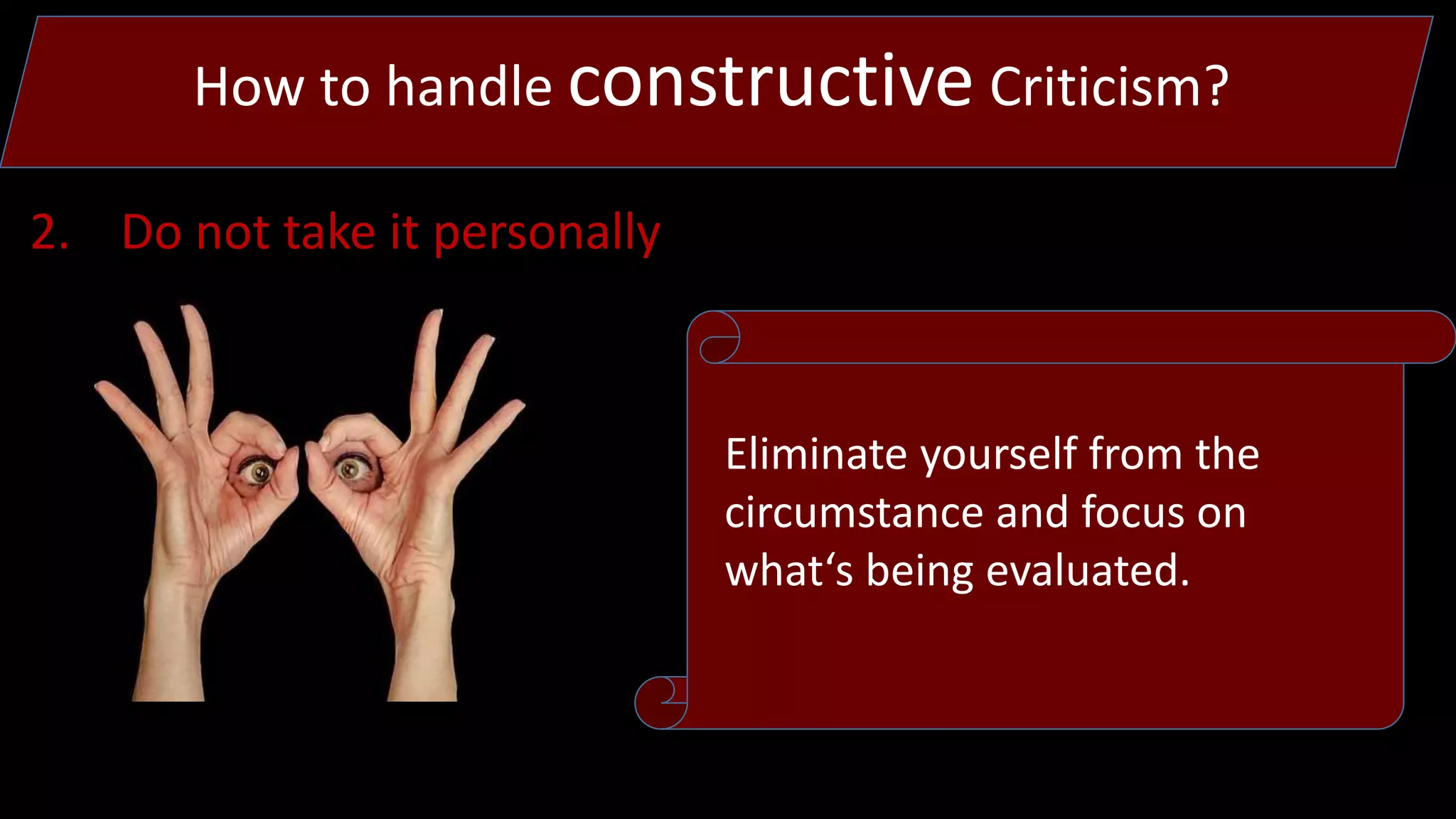
2. Do not take it personally
Eliminate yourself from the
circumstance and focus on
what‘s being evaluated.
How to handle constructive Criticism?
Do not allow criticism to define
your self-worth, however,
instead concentrate on your
strengths.
3. Know your self-worth
How to handle constructive Criticism?
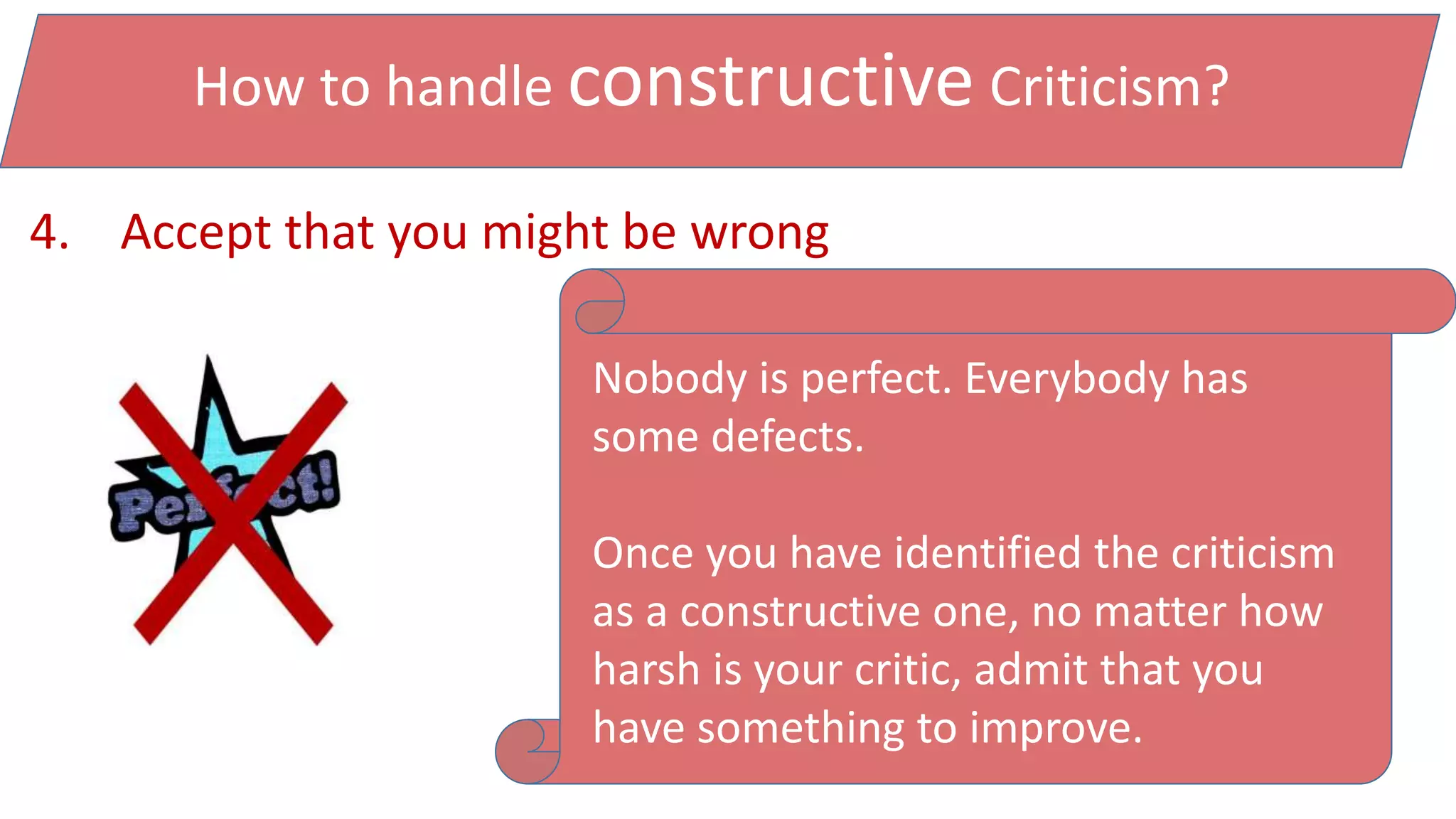
4. Accept that you might be wrong
Nobody is perfect. Everybody has
some defects.
Once you have identified the criticism
as a constructive one, no matter how
harsh is your critic, admit that you
have something to improve.
How to handle constructive Criticism?
5. Understand that you can’t please everybody
You can never please
everybody.
No matter how well you do
your job. Somebody is going
to criticize you.
How to handle constructive Criticism?
6. Always value Criticism
When people share
appreciation, we feel happy.
But when they criticize us, we
feel dejected.
Appreciate the people who
share valuable suggestions.
How to handle constructive Criticism?
7. Remind yourself the benefits of getting constructive
criticism
Constructive Criticism :
• Boosts your humility
• Opportunity to improve yourself
• Opens you up to new perspectives
• Improves your rational thinking
• Opportunity to choose peace over conflict
How to handle constructive Criticism?
8. Understand it carefully
• When a person provides
feedback to you, listen
carefully.
• Do not scrutinize or question
the person’s evaluation
• Focus on exactly what you can
gain from the experience.
How to handle constructive Criticism?
9. Thank your Critic!
Appreciate the fact that the
person has taken the time
to talk to you something
that can make you an even
better person.
How to handle constructive Criticism?
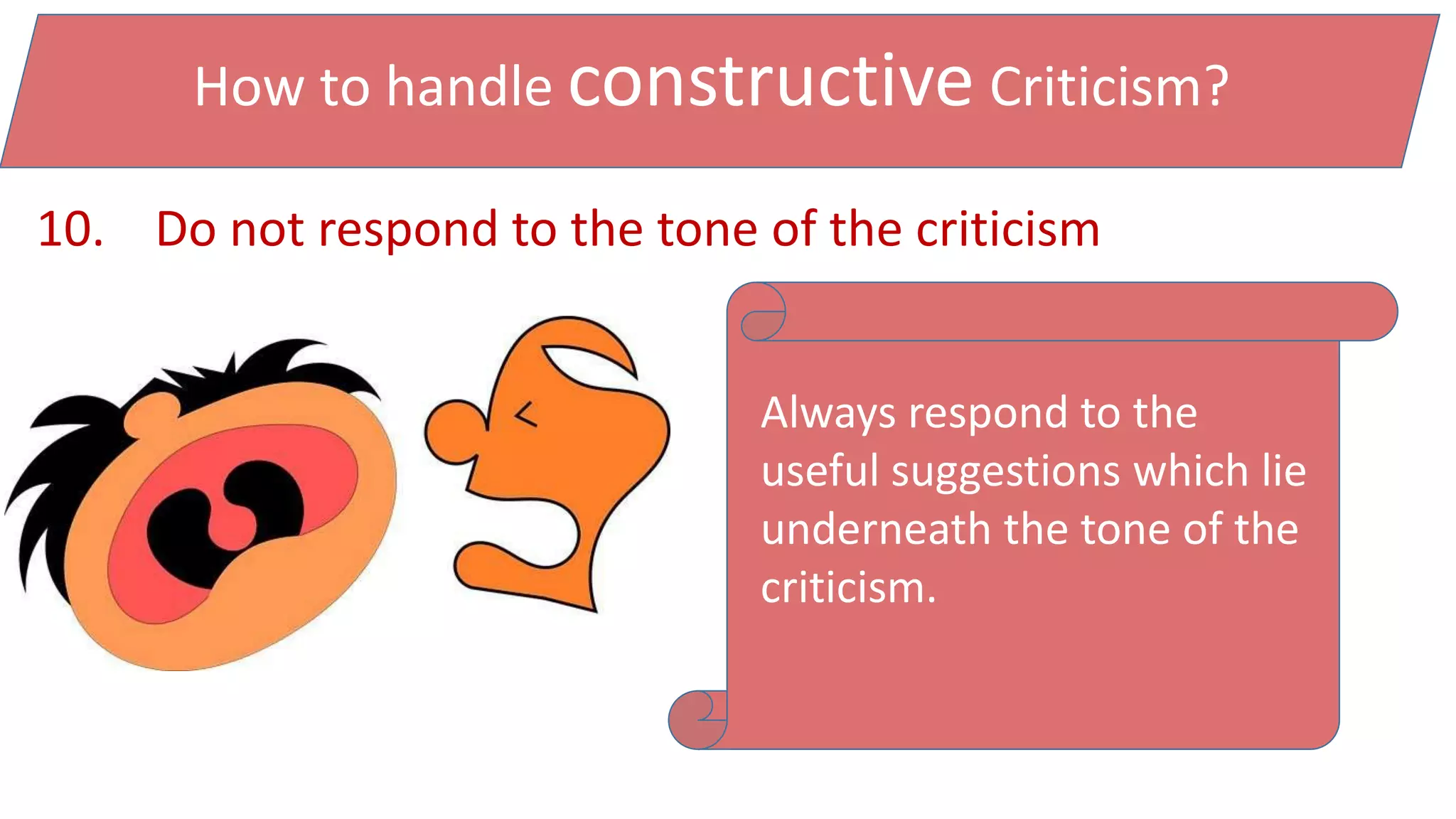
10. Do not respond to the tone of the criticism
Always respond to the
useful suggestions which lie
underneath the tone of the
criticism.
How to handle constructive Criticism?
11. Ask questions to get more clarity
• Respond calmly with questions to get to the
root of the problem.
• Break down the feedback to understand
what to do next.
• You can share your perspective.
• Ask for specific instances that help you
understand the problem.
How to handle constructive Criticism?
12. Take care of stress
Take a deep breath to
reduce your stress levels
How to handle constructive Criticism?
13. Ignore the incorrect criticism
Some people are critical
of everything!
Never take seriously such
criticism.
“Criticism may not be agreeable, but it
is necessary. It fulfills the same
function as pain in the human body. It
calls attention to an unhealthy state of
things.”
- Winston Churchill
Nisha A Sahadevan is the Founder of Learn2LiveFully , a
Certified NLP Practitioner and Passionate about Human
Potential Development.

Constructive criticism

  • 2.
    Criticism is partof our lives because everybody has an opinion, some are jealous of you, some want to drag you down, and some want to help you. Criticism does hurt! You will certainly never have the ability to silence each of your doubters, so it is better you develop a strategy to handle criticism.
  • 3.
    Constant self-criticism makesit difficult for you to handle criticism from others. Perfectionism and inner fears about outside criticism can stop you from progressing on your aims.
  • 4.
    Criticism is thepractice of judging the qualities and faults of something or someone. Criticism can be categorized as constructive criticism and destructive criticism.
  • 5.
    Hold for amoment and ask yourself below questions when you hear a criticism: Is this feedback irrational or helpful? Does it have only hurtful comments pointing out your mistake? What is the tone of your critic’s voice? Are you in a good relationship with the critic? Identify Criticism is Constructive or Destructive
  • 6.
    How to handleconstructive Criticism? 1. Never react immediately By delaying your response, you prevent yourself from responding emotionally.
  • 7.
    How to handleconstructive Criticism? 2. Do not take it personally Eliminate yourself from the circumstance and focus on what‘s being evaluated.
  • 8.
    How to handleconstructive Criticism? Do not allow criticism to define your self-worth, however, instead concentrate on your strengths. 3. Know your self-worth
  • 9.
    How to handleconstructive Criticism? 4. Accept that you might be wrong Nobody is perfect. Everybody has some defects. Once you have identified the criticism as a constructive one, no matter how harsh is your critic, admit that you have something to improve.
  • 10.
    How to handleconstructive Criticism? 5. Understand that you can’t please everybody You can never please everybody. No matter how well you do your job. Somebody is going to criticize you.
  • 11.
    How to handleconstructive Criticism? 6. Always value Criticism When people share appreciation, we feel happy. But when they criticize us, we feel dejected. Appreciate the people who share valuable suggestions.
  • 12.
    How to handleconstructive Criticism? 7. Remind yourself the benefits of getting constructive criticism Constructive Criticism : • Boosts your humility • Opportunity to improve yourself • Opens you up to new perspectives • Improves your rational thinking • Opportunity to choose peace over conflict
  • 13.
    How to handleconstructive Criticism? 8. Understand it carefully • When a person provides feedback to you, listen carefully. • Do not scrutinize or question the person’s evaluation • Focus on exactly what you can gain from the experience.
  • 14.
    How to handleconstructive Criticism? 9. Thank your Critic! Appreciate the fact that the person has taken the time to talk to you something that can make you an even better person.
  • 15.
    How to handleconstructive Criticism? 10. Do not respond to the tone of the criticism Always respond to the useful suggestions which lie underneath the tone of the criticism.
  • 16.
    How to handleconstructive Criticism? 11. Ask questions to get more clarity • Respond calmly with questions to get to the root of the problem. • Break down the feedback to understand what to do next. • You can share your perspective. • Ask for specific instances that help you understand the problem.
  • 17.
    How to handleconstructive Criticism? 12. Take care of stress Take a deep breath to reduce your stress levels
  • 18.
    How to handleconstructive Criticism? 13. Ignore the incorrect criticism Some people are critical of everything! Never take seriously such criticism.
  • 19.
    “Criticism may notbe agreeable, but it is necessary. It fulfills the same function as pain in the human body. It calls attention to an unhealthy state of things.” - Winston Churchill
  • 20.
    Nisha A Sahadevanis the Founder of Learn2LiveFully , a Certified NLP Practitioner and Passionate about Human Potential Development.