Proceedings of the International Conference on Emerging Trends in Engineering and Management (ICETEM14)
30 – 31, December 2014, Ernakulam, India
93
CONSTRUCTION OF PHYLOGENETIC TREE FROM
MULTIPLE GENE TREES USING PRINCIPAL
COMPONENT ANALYSIS
Anu Sabarish R, Tessamma Thomas
Department of Electronics, Cochin University of Science and Technology, Cochin, India
ABSTRACT
A wide range of methods have been used to study molecular phylogeny to discover the appropriate degree of
relationship within a group of organisms. An approach to construct the phylogenetic tree from multiple gene trees is
presented here. Multiple gene trees corresponding to different proteins, obtained from 15 placental mammals are created.
A principal component analysis based method of inferring a phylogenetic tree from these multiple gene trees is
described. The information thus gathered provide meaningful insights into the pattern and process of evolution which
will show the recency of common ancestry. The result clearly indicates that the species tree generated using the proposed
method is more accurate and consistent compared to the trees that are inferred from a single gene.
Keywords: Correlation, Dendrogram, Distance Matrix, Electron Ion Interaction Potential, Gene Tree, Genomic Signal
Processing, Principal Component Analysis, Phylogenetic Tree, SVD.
1. INTRODUCTION
Genomic signal processing is an interdisciplinary field of representing, analyzing and understanding biological
sequences and images using improved computational techniques that are commonly applied to areas of voice, image and
video processing. It is becoming increasingly important to process the vast amount of data generated by the wide range of
new sequencing techniques. Compared to the conventional approaches, traditional as well as new signal processing
methods can play a significant role in processing this large volume of data. Various pattern recognition, data mining and
machine learning algorithms are developed for processing and understanding the genomic data.
Genome contains the biological information needed to construct and maintain every organism. In most of the
organisms, except a few viruses, the genome is made of deoxyribonucleic acid (DNA) having a double helix structure [1]
with two strands. Each strand consists of a linked chain of nucleotides or nitrogenated bases which are of 4 types-
adenine(A), thymine(T), cytosine(C) and guanine(G). Three adjacent bases in a DNA sequence form a triplet called codon,
each one representing an amino acid. A linear chain of amino acids, starting with the codon ATG, corresponding to the
amino acid methionine, followed by a sequence of amino acids and ending with a stop codon, constitutes a protein. Protein
sequences belonging to the same functional class from different organisms have some sort of sequence similarity that
allows them to perform their common function. This similarity in structure and sequence can be attributed to the fact that
they are derived phylogenetically from a common precursor and evolution process appears to have exerted a considerable
degree of conservatism towards functionally critical residues [2].
Phylogenetics is the study of evolutionary relationship among the different forms of life, both existing and
extinct. In the past, different methods were used for phylogenetic analysis including Paleontological, Morphological and
Embryological studies. Recently, owing to the development of advanced sequencing techniques, molecular phylogenetics
INTERNATIONAL JOURNAL OF ELECTRONICS AND
COMMUNICATION ENGINEERING & TECHNOLOGY (IJECET)
ISSN 0976 – 6464(Print)
ISSN 0976 – 6472(Online)
Volume 5, Issue 12, December (2014), pp. 93-98
© IAEME: http://www.iaeme.com/IJECET.asp
Journal Impact Factor (2014): 7.2836 (Calculated by GISI)
www.jifactor.com
IJECET
© I A E M E
Proceedings of the International Conference on Emerging Trends in Engineering and Management (ICETEM14)
30 – 31, December 2014, Ernakulam, India
94
is widely used which involves the analysis of hereditary molecular differences, mainly in DNA sequences and amino acid
sequences. The pattern of evolutionary relationship among different species is best illustrated by phylogenetic trees. A
relationship topology based on the observation of divergence within a single homologous gene is called a gene tree. An
internal node in a gene tree represents the divergence of an ancestral gene into alleles with different DNA sequences by
mutation. A gene tree represents the evolutionary history of that gene, while the tree based on data from multiple genes is a
species tree. An internal node in a species tree represents a speciation event. The species trees are not exactly same as the
gene trees, as the mutations and speciation events do not occur strictly at the same time, but gene trees are generally an
accurate representation of species trees.
A Molecular Clock Hypothesis was proposed in [3] where, the accumulation of amino acid changes was
compared to steady ticking of a clock and the substitution rates were expected to remain constant within homologous
protein over a large period of time. Thus the number of differences between two homologous proteins can be well
correlated to the amount of time since speciation caused them to diverge independently. And this will facilitate to
decipher the phylogenetic relationship between different species and also the time of their divergence. As the genomes
evolve by gradual accumulation of mutations, the amount of difference in nucleotide sequence between a pair of
genomes indicates the recency of common ancestor. In [2] it is demonstrated that the number of variant residues gives an
approximation of the evolutionary distance between two species and their time of divergence. The evolutionary distance
between all pairs of sequences, obtained from the corresponding nucleotide difference is represented as the distance
matrix. Then a representation in the form of a tree is generated from this distance matrix using Unweighted Pair Group
Method with Arithmetic average (UPGMA) algorithm.
In this work, a computational technique based on direct protein sequence correlation described in [4] is used to
analyse the phylogenetic relationship between different species. From a group of organisms, a sample set of proteins are
selected. For processing, the alphabetical amino acid sequence has to be converted into a numerical form. Individual
gene trees are constructed based on each of these sequences. Then a method based on principal component analysis for
combining the information gained from the individual gene trees to infer a phylogenetic tree is proposed. Using the
method, phylogenetic tree for two set of organisms are constructed and compared.
The paper is organized as follows. The method for representing protein sequence data in numerical form is
mentioned in section 2. Section 3 describes a method of constructing phylogenetic tree using sequence correlation, the
theory of principal component analysis and its application in inferring phylogenetic tree from gene trees. Section 4
describes the details of implementation and finally the results are discussed in section 5.
2. NUMERICAL REPRESENTATION OF AMINO ACID SEQUENCES
Most of the identified protein sequence data is available freely over the web at various online databases, one of
which is the Entrez search and retrieval system of the National Center for Biotechnology Information [5]. The protein
sequences obtained from these sources are often in the form of a sequence of characters, each representing a distinct
amino acid, which has to be converted into numerical form for further processing. Various methods have been used in
literature for numerical mapping [6] [7] [8] [9] [10] [11] [12].
A comparison of the informational capacity of various physicochemical, thermodynamic, structural and
statistical parameters of amino acids are performed in [9] and it is shown that Electron Ion Interaction Potential (EIIP) is
the most suitable known amino acid property that can be used in structure-function analysis of proteins. The EIIP values
for amino acids and nucleotides are calculated using the general model of pseudo potential described in [13]:
πµ
µπβα
2
)2sin()( 0 ZZZ
kwqk
−
=+
rrr
(1)
where, q is the change in momentum of delocalized electron in the interaction with the potential w, Z is the atomic
number, Z0 is the atomic number of the inert element that begins the period which includes the actual Z in the standard
periodic table, and
FK
q
2
=µ (2)
where, q is a wave number and KF the corresponding Fermi momentum.
)(
)(
3
2
0ZZ
E ZF
Z
−
=
α
β (3)
where ZFE )( is the corresponding Fermi energy.
Proceedings of the International Conference on Emerging Trends in Engineering and Management (ICETEM14)
30 – 31, December 2014, Ernakulam, India
95
The EIIP values of the 20 amino acids that form the linear polypeptide chain of each protein sequence are
obtained from [14]. We can obtain a numerical sequence by substituting the EIIP value of each amino acid for the
corresponding alphabetic letter in protein sequence. In this work EIIP value is used for the transformation of protein
sequences into numerical form.
3. METHODOLOGY
3.1 Phylogenetic analysis using sequence correlation
In this method, the numerical form of amino acid sequence is subjected to cross correlation with other
homologous sequences. The correlation function is a measure of similarity between two functions which is normalized
such that its magnitude is always less than 1. The correlation coefficient R(i) is calculated as follows,
∑ ∑
∑
− −
−
×
−
=
1
0
1
0
22
1
0
)()(
)()(
)(
N N
N
nYnX
inXnY
iR (4)
where, X[n] and Y[n] are the two sequences and i represents the shift. The maximum value of R(i), denoted by Cxy, is
taken as the measure of similarity between the two sequences X and Y. The correlation Cxy thus obtained is then converted
to the corresponding distance parameter (Dxy) using the relation given below.
Dxy = 1- Cxy (5)
where 0 ≤ Dxy ≤ 1. All the pair wise sequence correlation is found and pair wise distance is calculated. A distance matrix
is thus formed which is used for gene tree construction using UPGMA method.
3.2 Principal component analysis
Principal component analysis (PCA) is a dimensionality reduction technique which transforms high dimensional
data to a lower dimensional subspace. PCA is an orthogonal transformation that transforms a data set with correlated
variables into a smaller uncorrelated set of variables with less redundancy while retaining most of the useful information.
The first principal component (PC) represents the direction of highest variance; the second PC represents the direction
that maximises the remaining variance in the orthogonal subspace to the first component. This can be extended up to the
adequate number of PC’s required to represent the system in an optimal way.
The PCA can be considered as a linear transformation, P that transforms X into Y. Here X represents the original
data set and Y represents the new data set which is the projection of X on principal components. Both X and Y are p x q
matrices where p is the number of variables and q is the number of observations or samples. In order to quantify the
redundancy in the variable a covariance function Cx is defined as,
‫ܥ‬௫ =
ଵ
௡ିଵ
்ܺܺ
(6)
where Cx is an p x p matrix with diagonal elements representing the variance of each variables and the off diagonal
elements represent the covariance between the variables. The optimized data set without redundancy must have a
covariance matrix with all off diagonal elements as zero. Hence the transformation matrix P should be selected such that
Cy is diagonalized. One method is to calculate the eigen vectors of Cx and forming a transformation matrix P with the
eigen vectors as its rows. The eigen vectors also represent the PC’s of the original data set X where the significance of
PC’s is given by the corresponding eigen values. The first PC is the eigen vector with the largest eigen value and so on.
The principal components can also be obtained by using singular value decomposition (SVD). The SVD of an p x
q matrix X is represented by,
்ܺ
≝ ்ܷܸܵ
(7)
Here the columns of V are equivalent to the eigen vectors obtained from the covariance matrix Cx and are the
principal components of X. The number of PC’s extracted is same as the number of variables in original data. To achieve
dimensionality reduction the first few meaningful components are retained.
3.3 Inferring phylogenetic tree from multiple gene trees using PCA
Multiple gene trees are generated using the method described above. Using the correlation method separate
distance matrices (Di) having all pair wise distance are obtained for each of the N genes.
Proceedings of the International Conference on Emerging Trends in Engineering and Management (ICETEM14)
30 – 31, December 2014, Ernakulam, India
96
‫ܦ‬௜ = ൥
‫ܦ‬ଵଵ … ‫ܦ‬ଵ௞
: : :
‫ܦ‬௞ଵ … ‫ܦ‬௞௞
൩ (8)
where i=1,2,3,…N.
Here Di is the distance matrix for the ith
gene, N is the number of genes taken for analysis, k is the number of species
under consideration, Dxy is the distance between species x and y.
The distance matrix obtained is converted into a one dimensional distance vector (di) of length M.
݀௜ = ሾ݀௜ଵ	, ݀௜ଶ, … , ݀௜ெሿ (9)
where i=1,2,3,…N.
There will be N such vectors where N is the number of genes selected for analysis. Then a joint data matrix (X) of size N x
M is formed with each distance vector of size M occupying the rows.
ܺ = ൦
݀ଵଵ ݀ଵଶ … ݀ଵெ
݀ଶଵ ݀ଶଶ … ݀ଶெ
: : : :
݀ேଵ ݀ேଶ … ݀ேெ
൪ (10)
A principal component analysis of the data set X is performed using singular value decomposition to obtain the eigen
vector of X. The eigen vector with the highest eigen value is taken as the first principal component, PC1. Here we are
interested only in PC1 and the remaining ones are not considered. Then a projection of the data X onto PC1 gives the
distance vector Y which can be taken as the consensus vector of all the genes selected for the population under
consideration.
ܻଵ×ெ = ܲ‫ܥ‬ଵ×ேܺே×ெ (11)
ܻଵ×ெ = ሾ‫ݕ‬ଵଵ ‫ݕ‬ଵଶ … ‫ݕ‬ଵெሿ
ܻଵ×ெ = ሾ‫ܿ݌‬ଵଵ ‫ܿ݌‬ଵଶ … ‫ܿ݌‬ଵேሿ ൦
‫ݔ‬ଵଵ ‫ݔ‬ଵଶ … ‫ݔ‬ଵெ
‫ݔ‬ଶଵ ‫ݔ‬ଶଶ … ‫ݔ‬ଶெ
: : : :
‫ݔ‬ேଵ ‫ݔ‬ேଶ … ‫ݔ‬ேெ
൪
Y is a one dimensional distance vector of the form, di, of length M which is converted back to distance matrix in
the form Di. Finally the phylogenetic tree based on the N different genes of the k populations is generated using UPGMA
method.
4. IMPLEMENTATION AND RESULTS
4.1 Database
The amino acid sequences of proteins are obtained from the National Center for Biotechnology Information
(NCBI) website. In the first example, amino acid sequences of testin, myoglobin, lysozyme, caveolin-1 and cytochrome b
from 11 primates namely Papio anubis (Baboon), Pan troglodytes (Chimpanzee), Hylobates agilis (Gibbon), Gorilla
beringei (Gorilla), Homo sapiens (Human), Lepilemur mustelinus (Lemur), Callithrix jacchus (Marmoset), Aotus
trivirgatus (Night monkey), Saimiri sciureus (Squirrel monkey), Macaca mulatta (Rhesus monkey) and Pongo abelii
(Urangutan) are considered. In the second example, amino acid sequences of 10 proteins, testin, myoglobin, lysozyme,
caveolin-1, caveolin-2, caveolin-3, cytochrome-b, somatotropin, prolactin and flotillin, from 15 organisms under
Eutheria are considered. The 15 species selected are Papio anubis (Baboon), Pan troglodytes (Chimpanzee), Gorilla
beringei (Gorilla), Homo sapiens (Human), Callithrix jacchus (Marmoset), Saimiri sciureus (Squirrel monkey), Macaca
mulatta (Rhesus monkey), Pongo abelii (Urangutan), Mus musculus (Mouse), Rattus norvegicus (Rat), Ovis aries
(Sheep), Bos Taurus (Cattle), Canis lupus familiaris (Dog), Felis catus (Cat) and Oryctolagus cuniculus (Rabbit).
4.2 Construction of phylogenetic tree from multiple gene trees
In this method phylogenies are inferred separately for each gene and the resulting gene trees are used to generate
a consensus phylogeny. In the first example, 11 primates, as mentioned above, are considered. 5 different protein
sequences, testin, myoglobin, lysozyme, caveolin-1 and cytochrome b of these organisms in the form a character string
are obtained and are converted into numerical form using EIIP method. Using the steps described in section 3.1, five
distance matrices, Di (i=1,2,..5) for each of the five genes are generated. Separate gene trees are then constructed by
UPGMA method using the distance matrices. It can be observed that the structure of these gene trees obtained for the
same set of organisms varied considerably from one another. Hence a consensus structure to represent the evolutionary
Proceedings of the International Conference on Emerging Trends in Engineering and Management (ICETEM14)
30 – 31, December 2014, Ernakulam, India
97
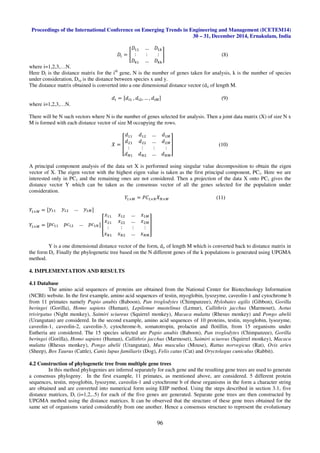
pattern is needed. The consensus phylogenetic tree is then obtained using the method described in section 3.3. By
applying principal component analysis on the concatenated distance matrix, a variable reduction is achieved and the
obtained phylogenetic tree is shown in Fig. 1. The resulting phylogenetic tree matches very well with the taxonomic
classification of the set of organisms involved and is more consistent.
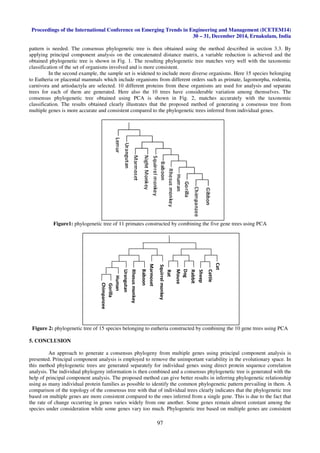
In the second example, the sample set is widened to include more diverse organisms. Here 15 species belonging
to Eutheria or placental mammals which include organisms from different orders such as primate, lagomorpha, rodentia,
carnivora and artiodactyla are selected. 10 different proteins from these organisms are used for analysis and separate
trees for each of them are generated. Here also the 10 trees have considerable variation among themselves. The
consensus phylogenetic tree obtained using PCA is shown in Fig. 2, matches accurately with the taxonomic
classification. The results obtained clearly illustrates that the proposed method of generating a consensus tree from
multiple genes is more accurate and consistent compared to the phylogenetic trees inferred from individual genes.
Figure1: phylogenetic tree of 11 primates constructed by combining the five gene trees using PCA
Figure 2: phylogenetic tree of 15 species belonging to eutheria constructed by combining the 10 gene trees using PCA
5. CONCLUSION
An approach to generate a consensus phylogeny from multiple genes using principal component analysis is
presented. Principal component analysis is employed to remove the unimportant variability in the evolutionary space. In
this method phylogenetic trees are generated separately for individual genes using direct protein sequence correlation
analysis. The individual phylogeny information is then combined and a consensus phylogenetic tree is generated with the
help of principal component analysis. The proposed method can give better results in inferring phylogenetic relationship
using as many individual protein families as possible to identify the common phylogenetic pattern prevailing in them. A
comparison of the topology of the consensus tree with that of individual trees clearly indicates that the phylogenetic tree
based on multiple genes are more consistent compared to the ones inferred from a single gene. This is due to the fact that
the rate of change occurring in genes varies widely from one another. Some genes remain almost constant among the
species under consideration while some genes vary too much. Phylogenetic tree based on multiple genes are consistent
Rabbit
Urangutan
Gorilla
Rhesusmonkey
Baboon
Mouse
Human
Squirrelmonkey
Cattle
Marmoset
Rat
Chimpanzee
Sheep
Cat
Dog
Proceedings of the International Conference on Emerging Trends in Engineering and Management (ICETEM14)
30 – 31, December 2014, Ernakulam, India
98
compared to the ones inferred from a single gene, as different rate of changes of sequences of different genes can lead to
inconsistent topology of relationship. The proposed approach can also be used to generate a consensus phylogenetic tree
from a group of phylogenetic trees generated using different approaches.
REFERENCES
[1] J.D. Watson and F.H.C. Crick, A structure for DNA, Nature, Vol. 171, 737-738, 1953.
[2] E. Margoliash, Primary structure and evolution of cytochrome c, Proceedings of the National academy of
sciences of the USA, Vol. 50, 672-679, 1963.
[3] E. Zuckerkandl, and L.B. Pauling, Molecular disease, evolution and genetic heterogeneity, Horizons in
Biochemistry, Academic Press, New York, 189–225, 1962.
[4] A.R. Sabarish, and T. Thomas, Molecular phylogeny analysis using correlation distance and spectral distance,
Int. J. Data Mining and Bioinformatics, Vol. 10, No. 4, 391-406, 2014.
[5] National Center for Biotechnology Information. [online] Available at http://www.ncbi.nlm.nih.gov/ (Accessed
15 October 2013).
[6] K.H. Chu, J. Qi, Z.G. Yu, and V.Anh, Origin and phylogeny of chloroplasts revealed by a simple correlation
analysis of complete genomes, Molecular Biology and Evolution, Vol. 21, No. 1, 200–206, 2004.
[7] I. Cosic, and E. Pirogova, Application of ionization constant of amino acids for protein signal analysis within
the resonant recognition model, Proceedings of the 20th Annual International Conference of the IEEE
Engineering in Medicine and Biology Society, Vol. 20, No 2, 1072-1075, 1998.
[8] J.A. Glazier, S. Raghavachari, C.L. Berthelsen, and M.H. Skolnick, Reconstructing phylogeny from the
multifractal spectrum of mitochondrial DNA, Physical Review Letters, Vol. 51, No. 3, 2665-2668, 1995.
[9] L. Lazovic, Selection of amino acid parameters for fourier transform-based analysis of proteins, CABIOS
Communication, Vol. 12, No. 6, 553-562, 1996.
[10] L. Marsella, F. Sirocco, A. Trovato, F. Seno, and S.C.E. Tosatto, REPETITA: detection and discrimination of
the periodicity of protein solenoid repeats by discrete Fourier transform, Bioinformatics, Vol.25, 285-295, 2009.
[11] A.R. Sabarish, and T. Thomas, A Frequency domain approach to protein sequence similarity analysis and
functional classification, Signal & Image processing : An International Journal, Vol.2, No.1, 36-49, 2011.
[12] P.P. Vaidyanathan, Genomics and proteomics: A signal processor’s tour, IEEE Circuits and Systems Magazine,
Vol. 4, 6-29, 2005.
[13] V. Veljkovic, and I. Slavic, Simple General-Model Pseudopotential, Physical Review Letters, Vol. 29, No.2,
105-107, 1972.
[14] I. Cosic, Macromolecular Bioactivity: Is it resonant interaction between macromolecules?- Theory and
applications, IEEE Transactions on biomedical engineering, Vol. 41, No. 12, 1101-1114, 1994.
[15] Shashikant S. Patil, Sachin A Sonawane, Nischay Upadhyay and Aanchal Srivastava, “Compressive Assessment
of Bioinformatics in Biomedical Imaging and Image Processing”, International Journal of Computer
Engineering & Technology (IJCET), Volume 5, Issue 4, 2014, pp. 175 - 185, ISSN Print: 0976 – 6367,
ISSN Online: 0976 – 6375.

Construction of phylogenetic tree from multiple gene trees using principal component analysis

  • 1.
    Proceedings of theInternational Conference on Emerging Trends in Engineering and Management (ICETEM14) 30 – 31, December 2014, Ernakulam, India 93 CONSTRUCTION OF PHYLOGENETIC TREE FROM MULTIPLE GENE TREES USING PRINCIPAL COMPONENT ANALYSIS Anu Sabarish R, Tessamma Thomas Department of Electronics, Cochin University of Science and Technology, Cochin, India ABSTRACT A wide range of methods have been used to study molecular phylogeny to discover the appropriate degree of relationship within a group of organisms. An approach to construct the phylogenetic tree from multiple gene trees is presented here. Multiple gene trees corresponding to different proteins, obtained from 15 placental mammals are created. A principal component analysis based method of inferring a phylogenetic tree from these multiple gene trees is described. The information thus gathered provide meaningful insights into the pattern and process of evolution which will show the recency of common ancestry. The result clearly indicates that the species tree generated using the proposed method is more accurate and consistent compared to the trees that are inferred from a single gene. Keywords: Correlation, Dendrogram, Distance Matrix, Electron Ion Interaction Potential, Gene Tree, Genomic Signal Processing, Principal Component Analysis, Phylogenetic Tree, SVD. 1. INTRODUCTION Genomic signal processing is an interdisciplinary field of representing, analyzing and understanding biological sequences and images using improved computational techniques that are commonly applied to areas of voice, image and video processing. It is becoming increasingly important to process the vast amount of data generated by the wide range of new sequencing techniques. Compared to the conventional approaches, traditional as well as new signal processing methods can play a significant role in processing this large volume of data. Various pattern recognition, data mining and machine learning algorithms are developed for processing and understanding the genomic data. Genome contains the biological information needed to construct and maintain every organism. In most of the organisms, except a few viruses, the genome is made of deoxyribonucleic acid (DNA) having a double helix structure [1] with two strands. Each strand consists of a linked chain of nucleotides or nitrogenated bases which are of 4 types- adenine(A), thymine(T), cytosine(C) and guanine(G). Three adjacent bases in a DNA sequence form a triplet called codon, each one representing an amino acid. A linear chain of amino acids, starting with the codon ATG, corresponding to the amino acid methionine, followed by a sequence of amino acids and ending with a stop codon, constitutes a protein. Protein sequences belonging to the same functional class from different organisms have some sort of sequence similarity that allows them to perform their common function. This similarity in structure and sequence can be attributed to the fact that they are derived phylogenetically from a common precursor and evolution process appears to have exerted a considerable degree of conservatism towards functionally critical residues [2]. Phylogenetics is the study of evolutionary relationship among the different forms of life, both existing and extinct. In the past, different methods were used for phylogenetic analysis including Paleontological, Morphological and Embryological studies. Recently, owing to the development of advanced sequencing techniques, molecular phylogenetics INTERNATIONAL JOURNAL OF ELECTRONICS AND COMMUNICATION ENGINEERING & TECHNOLOGY (IJECET) ISSN 0976 – 6464(Print) ISSN 0976 – 6472(Online) Volume 5, Issue 12, December (2014), pp. 93-98 © IAEME: http://www.iaeme.com/IJECET.asp Journal Impact Factor (2014): 7.2836 (Calculated by GISI) www.jifactor.com IJECET © I A E M E
  • 2.
    Proceedings of theInternational Conference on Emerging Trends in Engineering and Management (ICETEM14) 30 – 31, December 2014, Ernakulam, India 94 is widely used which involves the analysis of hereditary molecular differences, mainly in DNA sequences and amino acid sequences. The pattern of evolutionary relationship among different species is best illustrated by phylogenetic trees. A relationship topology based on the observation of divergence within a single homologous gene is called a gene tree. An internal node in a gene tree represents the divergence of an ancestral gene into alleles with different DNA sequences by mutation. A gene tree represents the evolutionary history of that gene, while the tree based on data from multiple genes is a species tree. An internal node in a species tree represents a speciation event. The species trees are not exactly same as the gene trees, as the mutations and speciation events do not occur strictly at the same time, but gene trees are generally an accurate representation of species trees. A Molecular Clock Hypothesis was proposed in [3] where, the accumulation of amino acid changes was compared to steady ticking of a clock and the substitution rates were expected to remain constant within homologous protein over a large period of time. Thus the number of differences between two homologous proteins can be well correlated to the amount of time since speciation caused them to diverge independently. And this will facilitate to decipher the phylogenetic relationship between different species and also the time of their divergence. As the genomes evolve by gradual accumulation of mutations, the amount of difference in nucleotide sequence between a pair of genomes indicates the recency of common ancestor. In [2] it is demonstrated that the number of variant residues gives an approximation of the evolutionary distance between two species and their time of divergence. The evolutionary distance between all pairs of sequences, obtained from the corresponding nucleotide difference is represented as the distance matrix. Then a representation in the form of a tree is generated from this distance matrix using Unweighted Pair Group Method with Arithmetic average (UPGMA) algorithm. In this work, a computational technique based on direct protein sequence correlation described in [4] is used to analyse the phylogenetic relationship between different species. From a group of organisms, a sample set of proteins are selected. For processing, the alphabetical amino acid sequence has to be converted into a numerical form. Individual gene trees are constructed based on each of these sequences. Then a method based on principal component analysis for combining the information gained from the individual gene trees to infer a phylogenetic tree is proposed. Using the method, phylogenetic tree for two set of organisms are constructed and compared. The paper is organized as follows. The method for representing protein sequence data in numerical form is mentioned in section 2. Section 3 describes a method of constructing phylogenetic tree using sequence correlation, the theory of principal component analysis and its application in inferring phylogenetic tree from gene trees. Section 4 describes the details of implementation and finally the results are discussed in section 5. 2. NUMERICAL REPRESENTATION OF AMINO ACID SEQUENCES Most of the identified protein sequence data is available freely over the web at various online databases, one of which is the Entrez search and retrieval system of the National Center for Biotechnology Information [5]. The protein sequences obtained from these sources are often in the form of a sequence of characters, each representing a distinct amino acid, which has to be converted into numerical form for further processing. Various methods have been used in literature for numerical mapping [6] [7] [8] [9] [10] [11] [12]. A comparison of the informational capacity of various physicochemical, thermodynamic, structural and statistical parameters of amino acids are performed in [9] and it is shown that Electron Ion Interaction Potential (EIIP) is the most suitable known amino acid property that can be used in structure-function analysis of proteins. The EIIP values for amino acids and nucleotides are calculated using the general model of pseudo potential described in [13]: πµ µπβα 2 )2sin()( 0 ZZZ kwqk − =+ rrr (1) where, q is the change in momentum of delocalized electron in the interaction with the potential w, Z is the atomic number, Z0 is the atomic number of the inert element that begins the period which includes the actual Z in the standard periodic table, and FK q 2 =µ (2) where, q is a wave number and KF the corresponding Fermi momentum. )( )( 3 2 0ZZ E ZF Z − = α β (3) where ZFE )( is the corresponding Fermi energy.
  • 3.
    Proceedings of theInternational Conference on Emerging Trends in Engineering and Management (ICETEM14) 30 – 31, December 2014, Ernakulam, India 95 The EIIP values of the 20 amino acids that form the linear polypeptide chain of each protein sequence are obtained from [14]. We can obtain a numerical sequence by substituting the EIIP value of each amino acid for the corresponding alphabetic letter in protein sequence. In this work EIIP value is used for the transformation of protein sequences into numerical form. 3. METHODOLOGY 3.1 Phylogenetic analysis using sequence correlation In this method, the numerical form of amino acid sequence is subjected to cross correlation with other homologous sequences. The correlation function is a measure of similarity between two functions which is normalized such that its magnitude is always less than 1. The correlation coefficient R(i) is calculated as follows, ∑ ∑ ∑ − − − × − = 1 0 1 0 22 1 0 )()( )()( )( N N N nYnX inXnY iR (4) where, X[n] and Y[n] are the two sequences and i represents the shift. The maximum value of R(i), denoted by Cxy, is taken as the measure of similarity between the two sequences X and Y. The correlation Cxy thus obtained is then converted to the corresponding distance parameter (Dxy) using the relation given below. Dxy = 1- Cxy (5) where 0 ≤ Dxy ≤ 1. All the pair wise sequence correlation is found and pair wise distance is calculated. A distance matrix is thus formed which is used for gene tree construction using UPGMA method. 3.2 Principal component analysis Principal component analysis (PCA) is a dimensionality reduction technique which transforms high dimensional data to a lower dimensional subspace. PCA is an orthogonal transformation that transforms a data set with correlated variables into a smaller uncorrelated set of variables with less redundancy while retaining most of the useful information. The first principal component (PC) represents the direction of highest variance; the second PC represents the direction that maximises the remaining variance in the orthogonal subspace to the first component. This can be extended up to the adequate number of PC’s required to represent the system in an optimal way. The PCA can be considered as a linear transformation, P that transforms X into Y. Here X represents the original data set and Y represents the new data set which is the projection of X on principal components. Both X and Y are p x q matrices where p is the number of variables and q is the number of observations or samples. In order to quantify the redundancy in the variable a covariance function Cx is defined as, ‫ܥ‬௫ = ଵ ௡ିଵ ்ܺܺ (6) where Cx is an p x p matrix with diagonal elements representing the variance of each variables and the off diagonal elements represent the covariance between the variables. The optimized data set without redundancy must have a covariance matrix with all off diagonal elements as zero. Hence the transformation matrix P should be selected such that Cy is diagonalized. One method is to calculate the eigen vectors of Cx and forming a transformation matrix P with the eigen vectors as its rows. The eigen vectors also represent the PC’s of the original data set X where the significance of PC’s is given by the corresponding eigen values. The first PC is the eigen vector with the largest eigen value and so on. The principal components can also be obtained by using singular value decomposition (SVD). The SVD of an p x q matrix X is represented by, ்ܺ ≝ ்ܷܸܵ (7) Here the columns of V are equivalent to the eigen vectors obtained from the covariance matrix Cx and are the principal components of X. The number of PC’s extracted is same as the number of variables in original data. To achieve dimensionality reduction the first few meaningful components are retained. 3.3 Inferring phylogenetic tree from multiple gene trees using PCA Multiple gene trees are generated using the method described above. Using the correlation method separate distance matrices (Di) having all pair wise distance are obtained for each of the N genes.
  • 4.
    Proceedings of theInternational Conference on Emerging Trends in Engineering and Management (ICETEM14) 30 – 31, December 2014, Ernakulam, India 96 ‫ܦ‬௜ = ൥ ‫ܦ‬ଵଵ … ‫ܦ‬ଵ௞ : : : ‫ܦ‬௞ଵ … ‫ܦ‬௞௞ ൩ (8) where i=1,2,3,…N. Here Di is the distance matrix for the ith gene, N is the number of genes taken for analysis, k is the number of species under consideration, Dxy is the distance between species x and y. The distance matrix obtained is converted into a one dimensional distance vector (di) of length M. ݀௜ = ሾ݀௜ଵ , ݀௜ଶ, … , ݀௜ெሿ (9) where i=1,2,3,…N. There will be N such vectors where N is the number of genes selected for analysis. Then a joint data matrix (X) of size N x M is formed with each distance vector of size M occupying the rows. ܺ = ൦ ݀ଵଵ ݀ଵଶ … ݀ଵெ ݀ଶଵ ݀ଶଶ … ݀ଶெ : : : : ݀ேଵ ݀ேଶ … ݀ேெ ൪ (10) A principal component analysis of the data set X is performed using singular value decomposition to obtain the eigen vector of X. The eigen vector with the highest eigen value is taken as the first principal component, PC1. Here we are interested only in PC1 and the remaining ones are not considered. Then a projection of the data X onto PC1 gives the distance vector Y which can be taken as the consensus vector of all the genes selected for the population under consideration. ܻଵ×ெ = ܲ‫ܥ‬ଵ×ேܺே×ெ (11) ܻଵ×ெ = ሾ‫ݕ‬ଵଵ ‫ݕ‬ଵଶ … ‫ݕ‬ଵெሿ ܻଵ×ெ = ሾ‫ܿ݌‬ଵଵ ‫ܿ݌‬ଵଶ … ‫ܿ݌‬ଵேሿ ൦ ‫ݔ‬ଵଵ ‫ݔ‬ଵଶ … ‫ݔ‬ଵெ ‫ݔ‬ଶଵ ‫ݔ‬ଶଶ … ‫ݔ‬ଶெ : : : : ‫ݔ‬ேଵ ‫ݔ‬ேଶ … ‫ݔ‬ேெ ൪ Y is a one dimensional distance vector of the form, di, of length M which is converted back to distance matrix in the form Di. Finally the phylogenetic tree based on the N different genes of the k populations is generated using UPGMA method. 4. IMPLEMENTATION AND RESULTS 4.1 Database The amino acid sequences of proteins are obtained from the National Center for Biotechnology Information (NCBI) website. In the first example, amino acid sequences of testin, myoglobin, lysozyme, caveolin-1 and cytochrome b from 11 primates namely Papio anubis (Baboon), Pan troglodytes (Chimpanzee), Hylobates agilis (Gibbon), Gorilla beringei (Gorilla), Homo sapiens (Human), Lepilemur mustelinus (Lemur), Callithrix jacchus (Marmoset), Aotus trivirgatus (Night monkey), Saimiri sciureus (Squirrel monkey), Macaca mulatta (Rhesus monkey) and Pongo abelii (Urangutan) are considered. In the second example, amino acid sequences of 10 proteins, testin, myoglobin, lysozyme, caveolin-1, caveolin-2, caveolin-3, cytochrome-b, somatotropin, prolactin and flotillin, from 15 organisms under Eutheria are considered. The 15 species selected are Papio anubis (Baboon), Pan troglodytes (Chimpanzee), Gorilla beringei (Gorilla), Homo sapiens (Human), Callithrix jacchus (Marmoset), Saimiri sciureus (Squirrel monkey), Macaca mulatta (Rhesus monkey), Pongo abelii (Urangutan), Mus musculus (Mouse), Rattus norvegicus (Rat), Ovis aries (Sheep), Bos Taurus (Cattle), Canis lupus familiaris (Dog), Felis catus (Cat) and Oryctolagus cuniculus (Rabbit). 4.2 Construction of phylogenetic tree from multiple gene trees In this method phylogenies are inferred separately for each gene and the resulting gene trees are used to generate a consensus phylogeny. In the first example, 11 primates, as mentioned above, are considered. 5 different protein sequences, testin, myoglobin, lysozyme, caveolin-1 and cytochrome b of these organisms in the form a character string are obtained and are converted into numerical form using EIIP method. Using the steps described in section 3.1, five distance matrices, Di (i=1,2,..5) for each of the five genes are generated. Separate gene trees are then constructed by UPGMA method using the distance matrices. It can be observed that the structure of these gene trees obtained for the same set of organisms varied considerably from one another. Hence a consensus structure to represent the evolutionary
  • 5.
    Proceedings of theInternational Conference on Emerging Trends in Engineering and Management (ICETEM14) 30 – 31, December 2014, Ernakulam, India 97 pattern is needed. The consensus phylogenetic tree is then obtained using the method described in section 3.3. By applying principal component analysis on the concatenated distance matrix, a variable reduction is achieved and the obtained phylogenetic tree is shown in Fig. 1. The resulting phylogenetic tree matches very well with the taxonomic classification of the set of organisms involved and is more consistent. In the second example, the sample set is widened to include more diverse organisms. Here 15 species belonging to Eutheria or placental mammals which include organisms from different orders such as primate, lagomorpha, rodentia, carnivora and artiodactyla are selected. 10 different proteins from these organisms are used for analysis and separate trees for each of them are generated. Here also the 10 trees have considerable variation among themselves. The consensus phylogenetic tree obtained using PCA is shown in Fig. 2, matches accurately with the taxonomic classification. The results obtained clearly illustrates that the proposed method of generating a consensus tree from multiple genes is more accurate and consistent compared to the phylogenetic trees inferred from individual genes. Figure1: phylogenetic tree of 11 primates constructed by combining the five gene trees using PCA Figure 2: phylogenetic tree of 15 species belonging to eutheria constructed by combining the 10 gene trees using PCA 5. CONCLUSION An approach to generate a consensus phylogeny from multiple genes using principal component analysis is presented. Principal component analysis is employed to remove the unimportant variability in the evolutionary space. In this method phylogenetic trees are generated separately for individual genes using direct protein sequence correlation analysis. The individual phylogeny information is then combined and a consensus phylogenetic tree is generated with the help of principal component analysis. The proposed method can give better results in inferring phylogenetic relationship using as many individual protein families as possible to identify the common phylogenetic pattern prevailing in them. A comparison of the topology of the consensus tree with that of individual trees clearly indicates that the phylogenetic tree based on multiple genes are more consistent compared to the ones inferred from a single gene. This is due to the fact that the rate of change occurring in genes varies widely from one another. Some genes remain almost constant among the species under consideration while some genes vary too much. Phylogenetic tree based on multiple genes are consistent Rabbit Urangutan Gorilla Rhesusmonkey Baboon Mouse Human Squirrelmonkey Cattle Marmoset Rat Chimpanzee Sheep Cat Dog
  • 6.
    Proceedings of theInternational Conference on Emerging Trends in Engineering and Management (ICETEM14) 30 – 31, December 2014, Ernakulam, India 98 compared to the ones inferred from a single gene, as different rate of changes of sequences of different genes can lead to inconsistent topology of relationship. The proposed approach can also be used to generate a consensus phylogenetic tree from a group of phylogenetic trees generated using different approaches. REFERENCES [1] J.D. Watson and F.H.C. Crick, A structure for DNA, Nature, Vol. 171, 737-738, 1953. [2] E. Margoliash, Primary structure and evolution of cytochrome c, Proceedings of the National academy of sciences of the USA, Vol. 50, 672-679, 1963. [3] E. Zuckerkandl, and L.B. Pauling, Molecular disease, evolution and genetic heterogeneity, Horizons in Biochemistry, Academic Press, New York, 189–225, 1962. [4] A.R. Sabarish, and T. Thomas, Molecular phylogeny analysis using correlation distance and spectral distance, Int. J. Data Mining and Bioinformatics, Vol. 10, No. 4, 391-406, 2014. [5] National Center for Biotechnology Information. [online] Available at http://www.ncbi.nlm.nih.gov/ (Accessed 15 October 2013). [6] K.H. Chu, J. Qi, Z.G. Yu, and V.Anh, Origin and phylogeny of chloroplasts revealed by a simple correlation analysis of complete genomes, Molecular Biology and Evolution, Vol. 21, No. 1, 200–206, 2004. [7] I. Cosic, and E. Pirogova, Application of ionization constant of amino acids for protein signal analysis within the resonant recognition model, Proceedings of the 20th Annual International Conference of the IEEE Engineering in Medicine and Biology Society, Vol. 20, No 2, 1072-1075, 1998. [8] J.A. Glazier, S. Raghavachari, C.L. Berthelsen, and M.H. Skolnick, Reconstructing phylogeny from the multifractal spectrum of mitochondrial DNA, Physical Review Letters, Vol. 51, No. 3, 2665-2668, 1995. [9] L. Lazovic, Selection of amino acid parameters for fourier transform-based analysis of proteins, CABIOS Communication, Vol. 12, No. 6, 553-562, 1996. [10] L. Marsella, F. Sirocco, A. Trovato, F. Seno, and S.C.E. Tosatto, REPETITA: detection and discrimination of the periodicity of protein solenoid repeats by discrete Fourier transform, Bioinformatics, Vol.25, 285-295, 2009. [11] A.R. Sabarish, and T. Thomas, A Frequency domain approach to protein sequence similarity analysis and functional classification, Signal & Image processing : An International Journal, Vol.2, No.1, 36-49, 2011. [12] P.P. Vaidyanathan, Genomics and proteomics: A signal processor’s tour, IEEE Circuits and Systems Magazine, Vol. 4, 6-29, 2005. [13] V. Veljkovic, and I. Slavic, Simple General-Model Pseudopotential, Physical Review Letters, Vol. 29, No.2, 105-107, 1972. [14] I. Cosic, Macromolecular Bioactivity: Is it resonant interaction between macromolecules?- Theory and applications, IEEE Transactions on biomedical engineering, Vol. 41, No. 12, 1101-1114, 1994. [15] Shashikant S. Patil, Sachin A Sonawane, Nischay Upadhyay and Aanchal Srivastava, “Compressive Assessment of Bioinformatics in Biomedical Imaging and Image Processing”, International Journal of Computer Engineering & Technology (IJCET), Volume 5, Issue 4, 2014, pp. 175 - 185, ISSN Print: 0976 – 6367, ISSN Online: 0976 – 6375.