ATLANTIC TESTING LABORATORIES


               Construction Materials
               Engineering & Testing


              New York State County Highway
               Superintendents Association

                     August 30, 2011
Construction Materials
Engineering & Testing

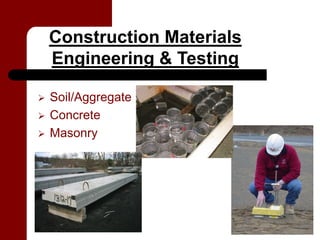
Soil/Aggregate
Concrete
Masonry
QA/QC Program


Materials Testing

Special
Inspection
Construction Materials
Engineering & Testing

Quality Control-Verify materials in
accordance with contract documents
Tests performed in accordance with
applicable standards (e.g. ASTM,ACI,
AASHTO, NYSDOT)
Correlation between quality materials and
quality project
Options
Soil Properties


Shear Strength
Compressibility/Consolidation
Permeability
Soil - Laboratory

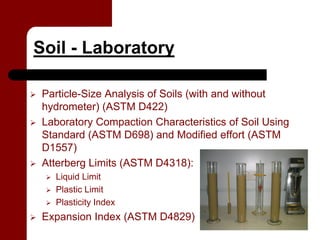
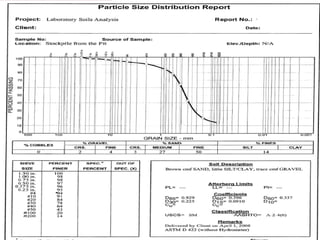
 Particle-Size Analysis of Soils (with and without
 hydrometer) (ASTM D422)
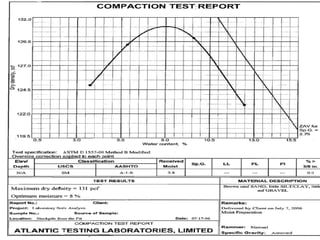
 Laboratory Compaction Characteristics of Soil Using
 Standard (ASTM D698) and Modified effort (ASTM
 D1557)
 Atterberg Limits (ASTM D4318):
   Liquid Limit
   Plastic Limit
   Plasticity Index
 Expansion Index (ASTM D4829)
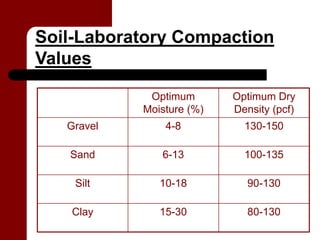
Soil-Laboratory Compaction
Values

             Optimum       Optimum Dry
            Moisture (%)   Density (pcf)
   Gravel       4-8          130-150

   Sand        6-13          100-135

    Silt       10-18          90-130

    Clay       15-30          80-130
Soil - Laboratory


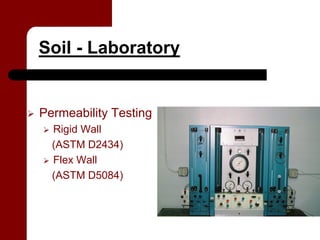
Permeability Testing
  Rigid Wall
  (ASTM D2434)
  Flex Wall
  (ASTM D5084)
Aggregate-Laboratory


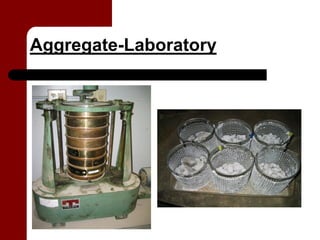
 Pre-qualification testing to identify quality
aggregates for subsequent approval and production


   Evaluate aggregate properties against federal,
state, or private standards
Aggregate-Laboratory

  Aggregate Soundness (ASTM C88, NYSDOT)
  Specific gravity and absorption of aggregate (ASTM
 C127/128)
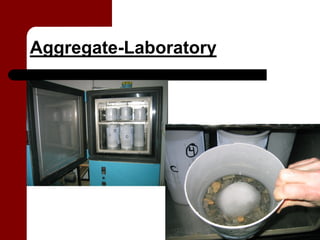
   Resistance of coarse aggregates to freezing & thawing
 (NYSDOT)
  Unit weight and voids in aggregate (ASTM C29)
  Flat and Elongated Particles (ASTM D4791)
Aggregate-Laboratory
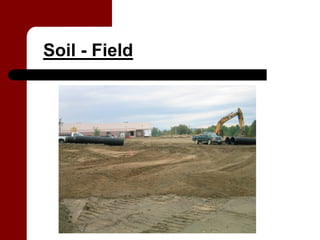
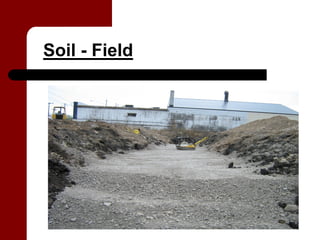
Soil - Field


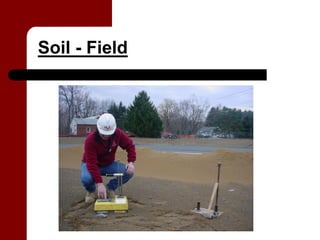
 Aggregate Sampling (ASTM D75)

 Density of Soil and Soil-Aggregate In-place
 by:
   Nuclear Method (ASTM D2922)
   Other: Sand Cone (ASTM D1556) and Rubber
   Balloon Method (ASTM D2167)
Soil - Field
Soil - Field


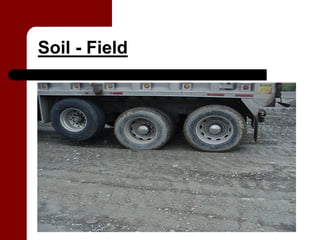
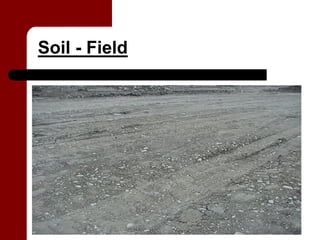
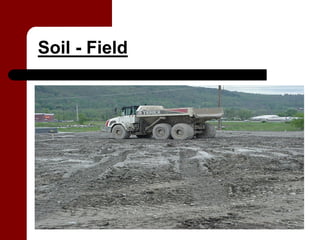
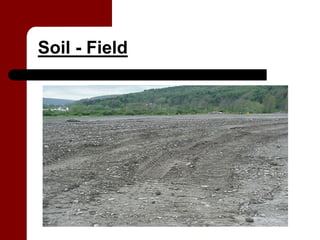
 Field Compaction
   Soil Type, Material Gradation, Water Content, Lift
   Thickness, Compactive Effort
   % = Field Dry Density/Laboratory Dry Density
   Compaction Issues
   Problem Soils
      Oversize Particles
      Degradation
      Gap-Graded
Soil Properties
Soil - Field
Soil - Field
Soil - Field
Soil - Field
Soil - Field
Soil - Field
Concrete Properties


 Strength
 Durability
 Permeability
Concrete-Mix Design

 Starts in the Laboratory-Develop Economical, Workable
 Mix to Meet Project Requirements
 Proportioning
    Strength, Environment, Unit Weight
    W/C Ratio, Entrained Air
    Aggregates
    Other Admixtures
 Performed Under Controlled Laboratory Conditions
 Compressive Strength Based on 28-Day Curing Time
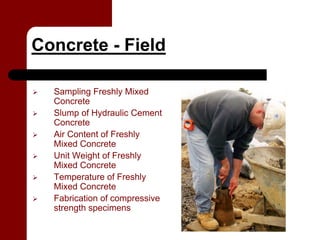
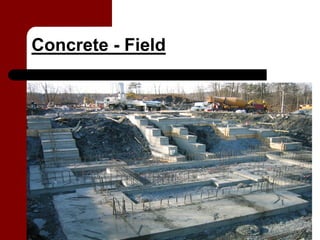
Concrete - Field

  Sampling Freshly Mixed
  Concrete
  Slump of Hydraulic Cement
  Concrete
  Air Content of Freshly
  Mixed Concrete
  Unit Weight of Freshly
  Mixed Concrete
  Temperature of Freshly
  Mixed Concrete
  Fabrication of compressive
  strength specimens
Concrete - Field

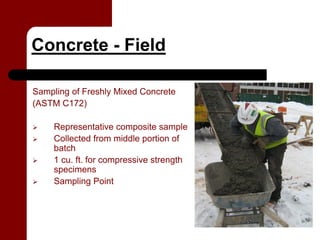
Sampling of Freshly Mixed Concrete
(ASTM C172)

     Representative composite sample
     Collected from middle portion of
     batch
     1 cu. ft. for compressive strength
     specimens
     Sampling Point
Concrete - Field
Concrete - Field

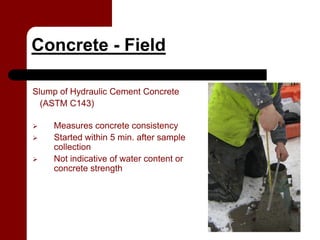
Slump of Hydraulic Cement Concrete
  (ASTM C143)

    Measures concrete consistency
    Started within 5 min. after sample
    collection
    Not indicative of water content or
    concrete strength
Concrete - Field


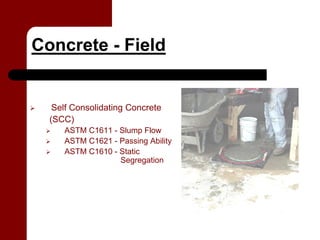
   Self Consolidating Concrete
  (SCC)
     ASTM C1611 - Slump Flow
     ASTM C1621 - Passing Ability
     ASTM C1610 - Static
                  Segregation
Concrete - Field

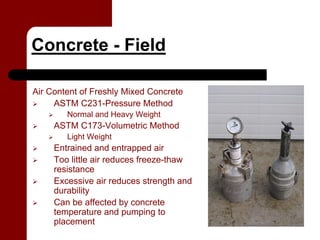
Air Content of Freshly Mixed Concrete
     ASTM C231-Pressure Method
        Normal and Heavy Weight
     ASTM C173-Volumetric Method
        Light Weight
     Entrained and entrapped air
     Too little air reduces freeze-thaw
     resistance
     Excessive air reduces strength and
     durability
     Can be affected by concrete
     temperature and pumping to
     placement
Concrete - Field

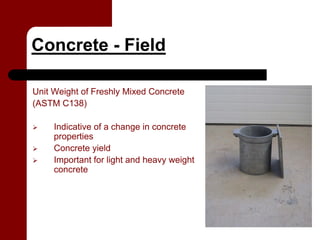
Unit Weight of Freshly Mixed Concrete
(ASTM C138)

     Indicative of a change in concrete
     properties
     Concrete yield
     Important for light and heavy weight
     concrete
Concrete - Field

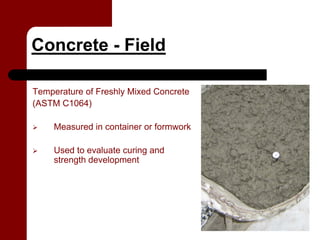
Temperature of Freshly Mixed Concrete
(ASTM C1064)

     Measured in container or formwork

     Used to evaluate curing and
     strength development
Concrete - Field

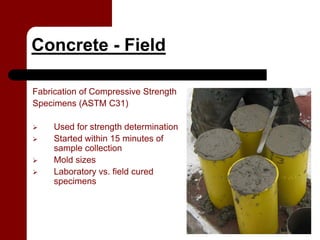
Fabrication of Compressive Strength
Specimens (ASTM C31)

     Used for strength determination
     Started within 15 minutes of
     sample collection
     Mold sizes
     Laboratory vs. field cured
     specimens
Concrete - Field
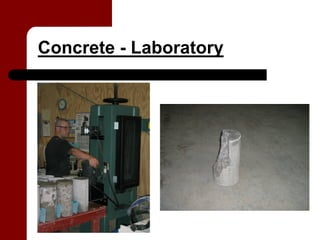
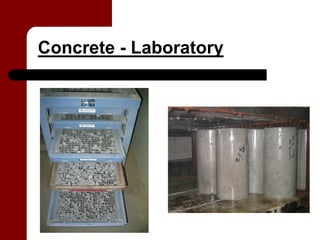
Concrete - Laboratory


 Material finer than 75 microns (ASTM C117)
 Dry Sieve Analysis of Fine and Coarse
 Aggregates (ASTM C136)
 Compressive Strength of Cylindrical Concrete
 Specimens (ASTM C39)
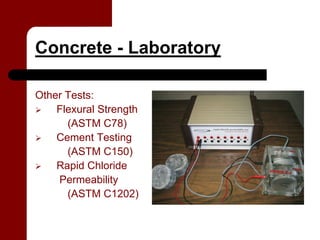
Concrete - Laboratory

Other Tests:
    Flexural Strength
      (ASTM C78)
    Cement Testing
      (ASTM C150)
    Rapid Chloride
    Permeability
      (ASTM C1202)
Concrete-In-Place Evaluation


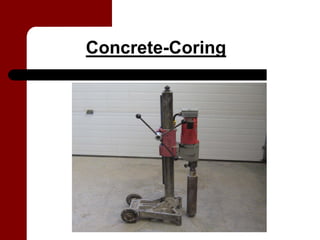
Coring (ASTM C42)
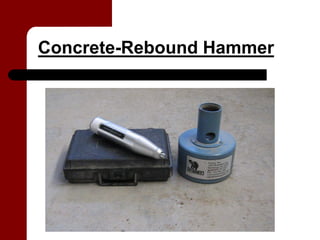
Rebound hammer (ASTM C805)
Windsor probe (ASTM C803)
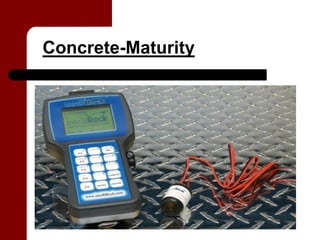
Maturity method (ASTM C1074)
Concrete-Coring
Concrete-Rebound Hammer
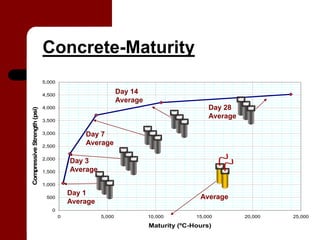
Concrete-Maturity
Concrete-Maturity
                             5,000

                             4,500
                                                           Day 14
                                                           Average
                             4,000                                                     Day 28
Compressive Strength (psi)


                                                                                       Average
                             3,500

                             3,000           Day 7
                             2,500
                                             Average

                             2,000
                                         Day 3
                             1,500       Average

                             1,000

                                         Day 1
                              500                                                   Average
                                         Average
                                0
                                     0             5,000             10,000        15,000        20,000   25,000

                                                                     Maturity (ºC-Hours)
Masonry - Laboratory

 Water Retention and Air Content Determination (ASTM
 C91)
 Compressive Strength of Hydraulic Mortars (ASTM C109)
 Sampling and Testing CMUs and Related Units (ASTM
 C140)
 Mortar Water Content (ASTM C140)
 Mortar Aggregate Ratio (ASTM C780)
 Compressive Strength of Molded Masonry Mortar
 Cylinders and Cubes (ASTM C780)
 Compressive Strength of Masonry Prisms (ASTM C1314)
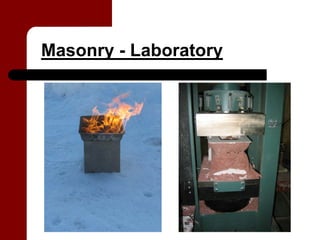
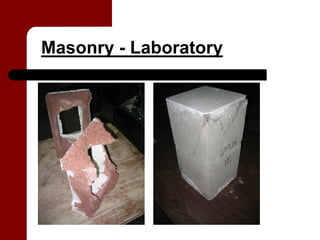
Masonry - Laboratory
Masonry - Field

 Sampling and Testing of Grout (ASTM C1019)
 Slump of Freshly Mixed Grout
 Air Content of Freshly Mixed Concrete by the Volumetric
 Method
 Air Content of Freshly Mixed Concrete by the Pressure Method
 Compressive Strength of Molded Masonry Cylinders and
 Cubes (ASTM C780)
 Fabricate mortar and grout compressive strength cubes,
 cylinders, or specimens
 Collect samples of concrete masonry units, field mixed mortar,
 or mortar batch materials for laboratory testing
Final Comments

  Properly trained, certified, and approved testing
  personnel
  Performed in accordance with the appropriate test
  procedures
  Timely reporting of test results
Question & Answer
Question and Answer

What organization publishes standards for the
 sampling, testing, and evaluation of
 soil/aggregate, concrete, and masonry
 construction materials?


  Answer: ASTM
Question and Answer

What are two of the most common laboratory
 tests performed on soils for use as fill in
 building construction?


 Answer: Particle Size Analysis and Laboratory
 Compaction
Question and Answer

What is the most common test method for
 evaluating the in-place density of fill materials?


  Answer: Nuclear Density
Question and Answer

What are three of the most common tests
 performed on fresh, plastic concrete?


  Answer: Slump, Air, and Temperature
Question and Answer

True or False: Non-Destructive Test methods,
  such as the rebound hammer, may be used
  as the sole basis for the acceptance or
  rejection of suspect hardened concrete?


  Answer: False
Question and Answer

True or False: Clay soils typically have a
  higher optimum dry density than gravel soils.


  Answer: False
Question and Answer

True or False: Air-entraining admixtures are
  added to plastic concrete to provide
  freeze/thaw protection.


  Answer: True
Question and Answer

What are two methods for evaluating masonry
 materials during construction?


  Answer: Individual components and Prisms
Question and Answer

The design compressive strength of concrete is
  based on a cure time of ______ days?


  Answer: 28 days
Question and Answer

True or False: An increase in the air content of
  concrete will increase the concrete’s
  compressive strength?


  Answer: False

Construction Materials Engineering and Testing

  • 1.
    ATLANTIC TESTING LABORATORIES Construction Materials Engineering & Testing New York State County Highway Superintendents Association August 30, 2011
  • 2.
    Construction Materials Engineering &Testing Soil/Aggregate Concrete Masonry
  • 3.
  • 4.
    Construction Materials Engineering &Testing Quality Control-Verify materials in accordance with contract documents Tests performed in accordance with applicable standards (e.g. ASTM,ACI, AASHTO, NYSDOT) Correlation between quality materials and quality project Options
  • 5.
  • 6.
    Soil - Laboratory Particle-Size Analysis of Soils (with and without hydrometer) (ASTM D422) Laboratory Compaction Characteristics of Soil Using Standard (ASTM D698) and Modified effort (ASTM D1557) Atterberg Limits (ASTM D4318): Liquid Limit Plastic Limit Plasticity Index Expansion Index (ASTM D4829)
  • 9.
    Soil-Laboratory Compaction Values Optimum Optimum Dry Moisture (%) Density (pcf) Gravel 4-8 130-150 Sand 6-13 100-135 Silt 10-18 90-130 Clay 15-30 80-130
  • 10.
    Soil - Laboratory PermeabilityTesting Rigid Wall (ASTM D2434) Flex Wall (ASTM D5084)
  • 11.
    Aggregate-Laboratory Pre-qualification testingto identify quality aggregates for subsequent approval and production Evaluate aggregate properties against federal, state, or private standards
  • 12.
    Aggregate-Laboratory AggregateSoundness (ASTM C88, NYSDOT) Specific gravity and absorption of aggregate (ASTM C127/128) Resistance of coarse aggregates to freezing & thawing (NYSDOT) Unit weight and voids in aggregate (ASTM C29) Flat and Elongated Particles (ASTM D4791)
  • 13.
  • 14.
  • 15.
    Soil - Field Aggregate Sampling (ASTM D75) Density of Soil and Soil-Aggregate In-place by: Nuclear Method (ASTM D2922) Other: Sand Cone (ASTM D1556) and Rubber Balloon Method (ASTM D2167)
  • 16.
  • 17.
    Soil - Field Field Compaction Soil Type, Material Gradation, Water Content, Lift Thickness, Compactive Effort % = Field Dry Density/Laboratory Dry Density Compaction Issues Problem Soils Oversize Particles Degradation Gap-Graded
  • 18.
  • 19.
  • 20.
  • 21.
  • 22.
  • 23.
  • 24.
  • 25.
    Concrete Properties Strength Durability Permeability
  • 26.
    Concrete-Mix Design Startsin the Laboratory-Develop Economical, Workable Mix to Meet Project Requirements Proportioning Strength, Environment, Unit Weight W/C Ratio, Entrained Air Aggregates Other Admixtures Performed Under Controlled Laboratory Conditions Compressive Strength Based on 28-Day Curing Time
  • 27.
    Concrete - Field Sampling Freshly Mixed Concrete Slump of Hydraulic Cement Concrete Air Content of Freshly Mixed Concrete Unit Weight of Freshly Mixed Concrete Temperature of Freshly Mixed Concrete Fabrication of compressive strength specimens
  • 28.
    Concrete - Field Samplingof Freshly Mixed Concrete (ASTM C172) Representative composite sample Collected from middle portion of batch 1 cu. ft. for compressive strength specimens Sampling Point
  • 29.
  • 30.
    Concrete - Field Slumpof Hydraulic Cement Concrete (ASTM C143) Measures concrete consistency Started within 5 min. after sample collection Not indicative of water content or concrete strength
  • 31.
    Concrete - Field Self Consolidating Concrete (SCC) ASTM C1611 - Slump Flow ASTM C1621 - Passing Ability ASTM C1610 - Static Segregation
  • 32.
    Concrete - Field AirContent of Freshly Mixed Concrete ASTM C231-Pressure Method Normal and Heavy Weight ASTM C173-Volumetric Method Light Weight Entrained and entrapped air Too little air reduces freeze-thaw resistance Excessive air reduces strength and durability Can be affected by concrete temperature and pumping to placement
  • 33.
    Concrete - Field UnitWeight of Freshly Mixed Concrete (ASTM C138) Indicative of a change in concrete properties Concrete yield Important for light and heavy weight concrete
  • 34.
    Concrete - Field Temperatureof Freshly Mixed Concrete (ASTM C1064) Measured in container or formwork Used to evaluate curing and strength development
  • 35.
    Concrete - Field Fabricationof Compressive Strength Specimens (ASTM C31) Used for strength determination Started within 15 minutes of sample collection Mold sizes Laboratory vs. field cured specimens
  • 36.
  • 37.
    Concrete - Laboratory Material finer than 75 microns (ASTM C117) Dry Sieve Analysis of Fine and Coarse Aggregates (ASTM C136) Compressive Strength of Cylindrical Concrete Specimens (ASTM C39)
  • 38.
  • 39.
  • 40.
    Concrete - Laboratory OtherTests: Flexural Strength (ASTM C78) Cement Testing (ASTM C150) Rapid Chloride Permeability (ASTM C1202)
  • 41.
    Concrete-In-Place Evaluation Coring (ASTMC42) Rebound hammer (ASTM C805) Windsor probe (ASTM C803) Maturity method (ASTM C1074)
  • 42.
  • 43.
  • 44.
  • 45.
    Concrete-Maturity 5,000 4,500 Day 14 Average 4,000 Day 28 Compressive Strength (psi) Average 3,500 3,000 Day 7 2,500 Average 2,000 Day 3 1,500 Average 1,000 Day 1 500 Average Average 0 0 5,000 10,000 15,000 20,000 25,000 Maturity (ºC-Hours)
  • 46.
    Masonry - Laboratory Water Retention and Air Content Determination (ASTM C91) Compressive Strength of Hydraulic Mortars (ASTM C109) Sampling and Testing CMUs and Related Units (ASTM C140) Mortar Water Content (ASTM C140) Mortar Aggregate Ratio (ASTM C780) Compressive Strength of Molded Masonry Mortar Cylinders and Cubes (ASTM C780) Compressive Strength of Masonry Prisms (ASTM C1314)
  • 47.
  • 48.
  • 49.
    Masonry - Field Sampling and Testing of Grout (ASTM C1019) Slump of Freshly Mixed Grout Air Content of Freshly Mixed Concrete by the Volumetric Method Air Content of Freshly Mixed Concrete by the Pressure Method Compressive Strength of Molded Masonry Cylinders and Cubes (ASTM C780) Fabricate mortar and grout compressive strength cubes, cylinders, or specimens Collect samples of concrete masonry units, field mixed mortar, or mortar batch materials for laboratory testing
  • 50.
    Final Comments Properly trained, certified, and approved testing personnel Performed in accordance with the appropriate test procedures Timely reporting of test results
  • 51.
  • 52.
    Question and Answer Whatorganization publishes standards for the sampling, testing, and evaluation of soil/aggregate, concrete, and masonry construction materials? Answer: ASTM
  • 53.
    Question and Answer Whatare two of the most common laboratory tests performed on soils for use as fill in building construction? Answer: Particle Size Analysis and Laboratory Compaction
  • 54.
    Question and Answer Whatis the most common test method for evaluating the in-place density of fill materials? Answer: Nuclear Density
  • 55.
    Question and Answer Whatare three of the most common tests performed on fresh, plastic concrete? Answer: Slump, Air, and Temperature
  • 56.
    Question and Answer Trueor False: Non-Destructive Test methods, such as the rebound hammer, may be used as the sole basis for the acceptance or rejection of suspect hardened concrete? Answer: False
  • 57.
    Question and Answer Trueor False: Clay soils typically have a higher optimum dry density than gravel soils. Answer: False
  • 58.
    Question and Answer Trueor False: Air-entraining admixtures are added to plastic concrete to provide freeze/thaw protection. Answer: True
  • 59.
    Question and Answer Whatare two methods for evaluating masonry materials during construction? Answer: Individual components and Prisms
  • 60.
    Question and Answer Thedesign compressive strength of concrete is based on a cure time of ______ days? Answer: 28 days
  • 61.
    Question and Answer Trueor False: An increase in the air content of concrete will increase the concrete’s compressive strength? Answer: False