Quality Control &
Material Testing
• (QC) is a procedure or set of procedures
intended to ensure that a manufactured product
or performed service adheres to a defined set
of quality criteria or meets the requirements of
the client or customer.
• Controls include product inspection
emphasizes testing of products to uncover defects
and reporting to management who make the
decision to allow or deny product release
Quality Control
• The basic goal of this process is to ensure that
the products or services that are provided meet
specific requirements and characteristics, such
as being dependable, satisfactory, safe and
fiscally sound
Objective
• Materials testing is the process of pulling bending,
twisting, turning, hitting, and squeezing materials
or components to make sure they withstand the
intense stresses, strains and impact forces they
are likely to experience in use and application. In
other words, materials’ testing examines the
overall strength, toughness, flexibility, suitability
and fitness for purpose.
Materials Testing
Cement Test
tests on cements are
carried to know the quality
of cement supplied at site.
It gives some idea about
cement quality based on
color, touch and feel and
other tests.
Cement Test
Physical Test
Fineness Test
Initial setting time and Final setting time
Soundness test
Consistency test
Compressive strength
Chemical Analysis
SiO2, Al2O3, Fe2O3, CaO, and MgO
Loss on Ignition
Insoluble Residue
Sulphur Trioxide
Cement Test
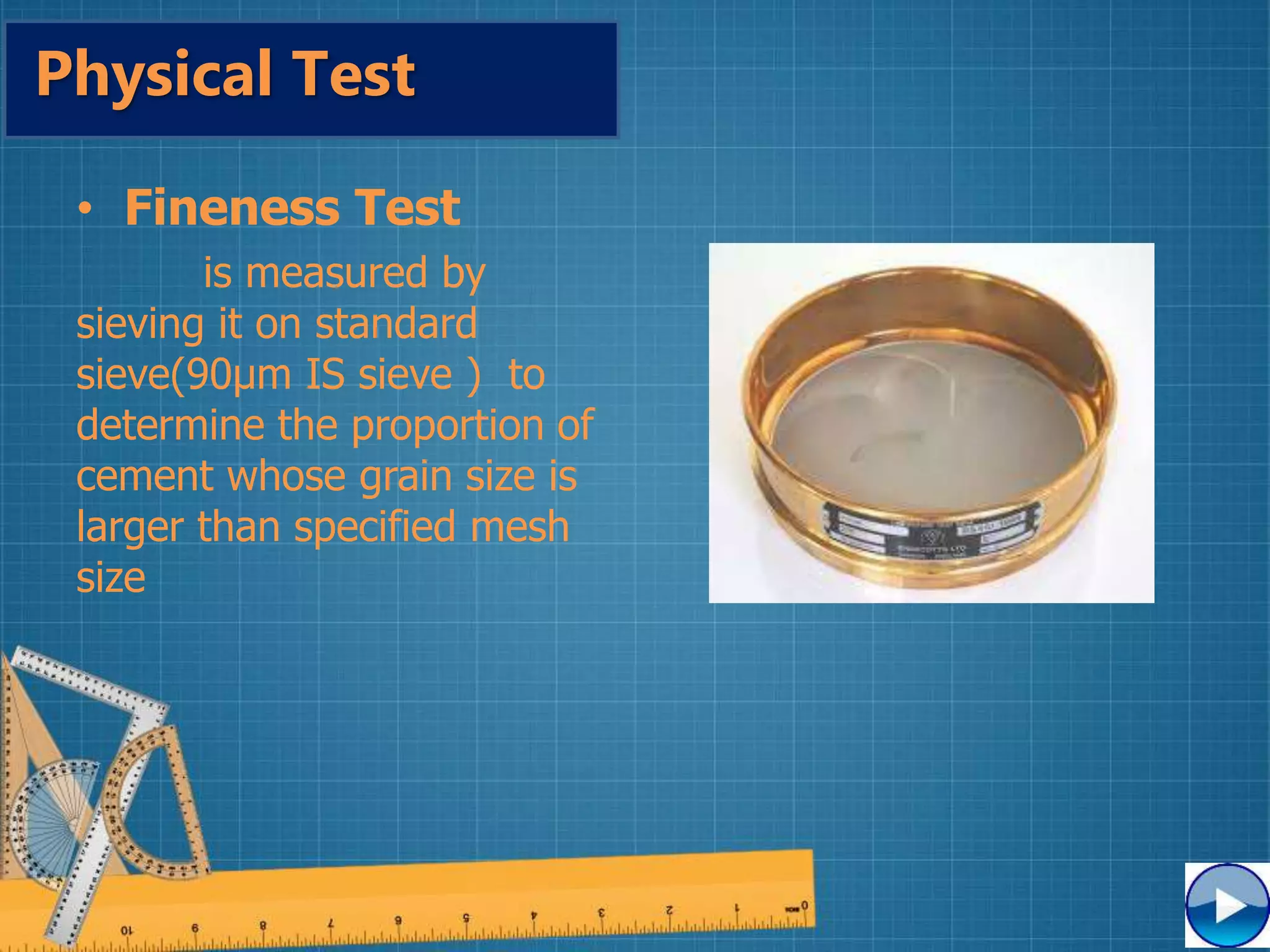
• Fineness Test
is measured by
sieving it on standard
sieve(90µm IS sieve ) to
determine the proportion of
cement whose grain size is
larger than specified mesh
size
Physical Test
• Initial Setting Time
Place the test block
under the rod bearing the
needle. Lower the needle
gently in order to make
contact with the surface
of the cement paste and
release quickly, allowing it
to penetrate the test
block
Physical Test
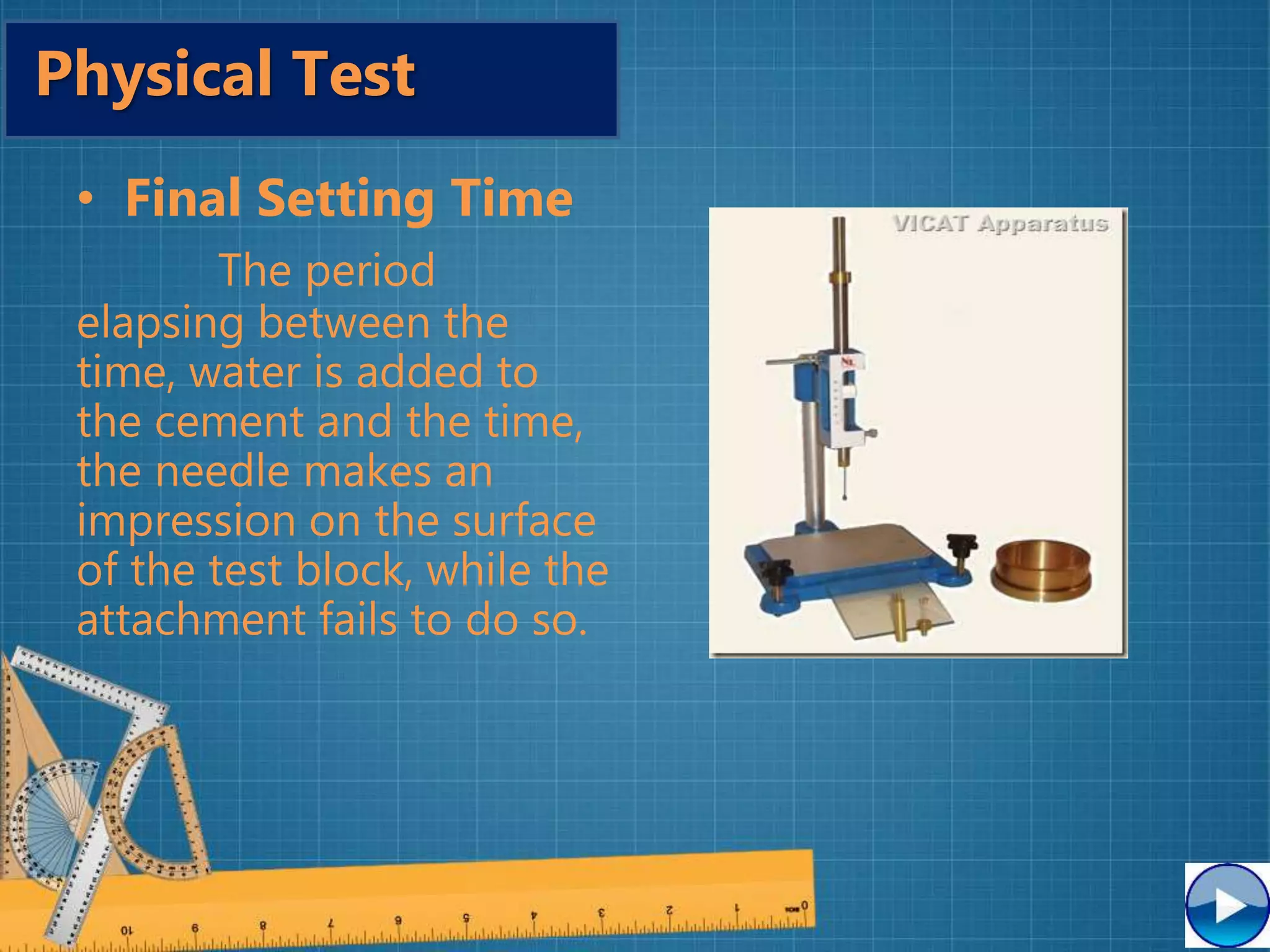
• Final Setting Time
The period
elapsing between the
time, water is added to
the cement and the time,
the needle makes an
impression on the surface
of the test block, while the
attachment fails to do so.
Physical Test
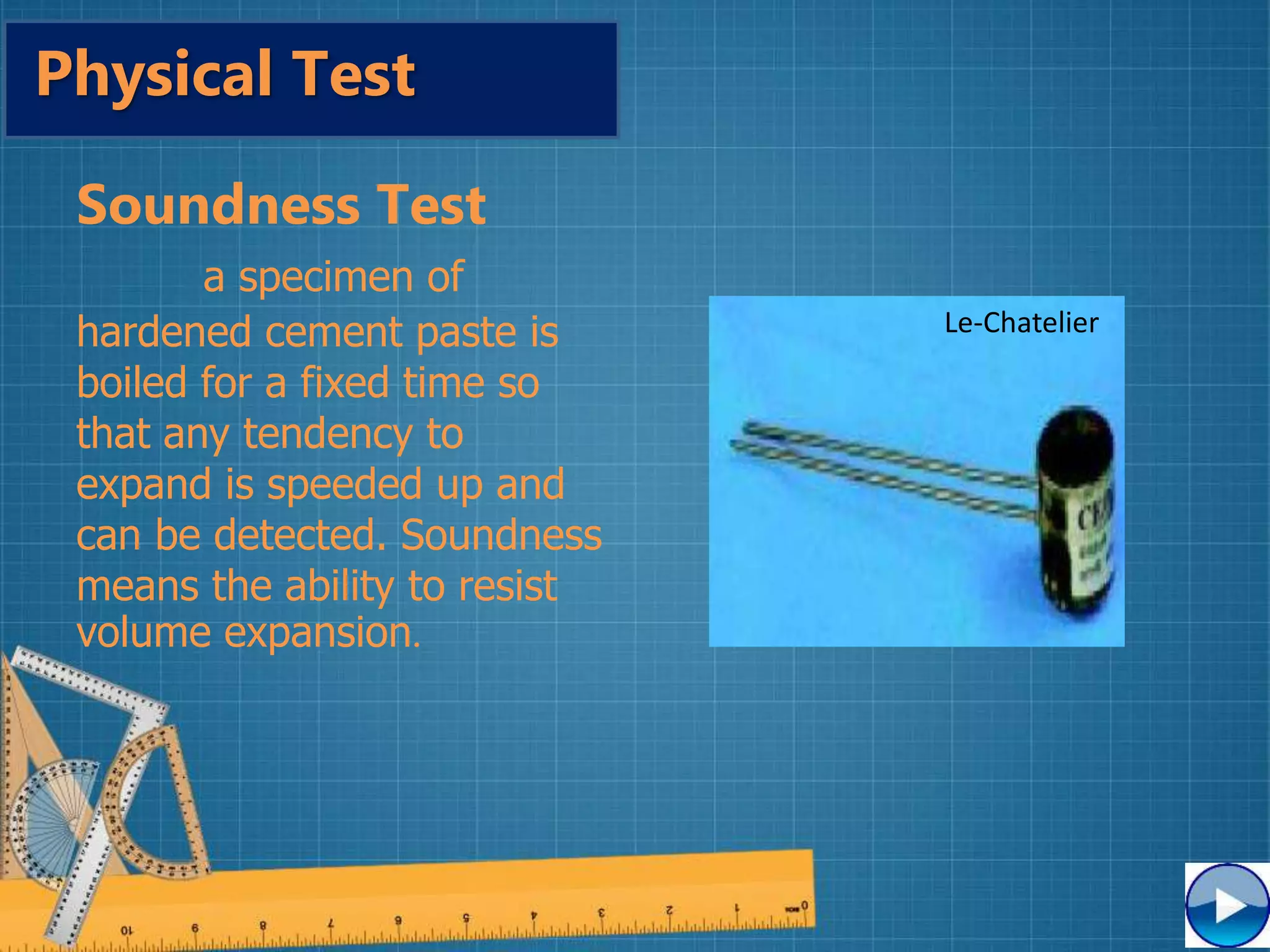
Soundness Test
a specimen of
hardened cement paste is
boiled for a fixed time so
that any tendency to
expand is speeded up and
can be detected. Soundness
means the ability to resist
volume expansion.
Le-Chatelier
Physical Test
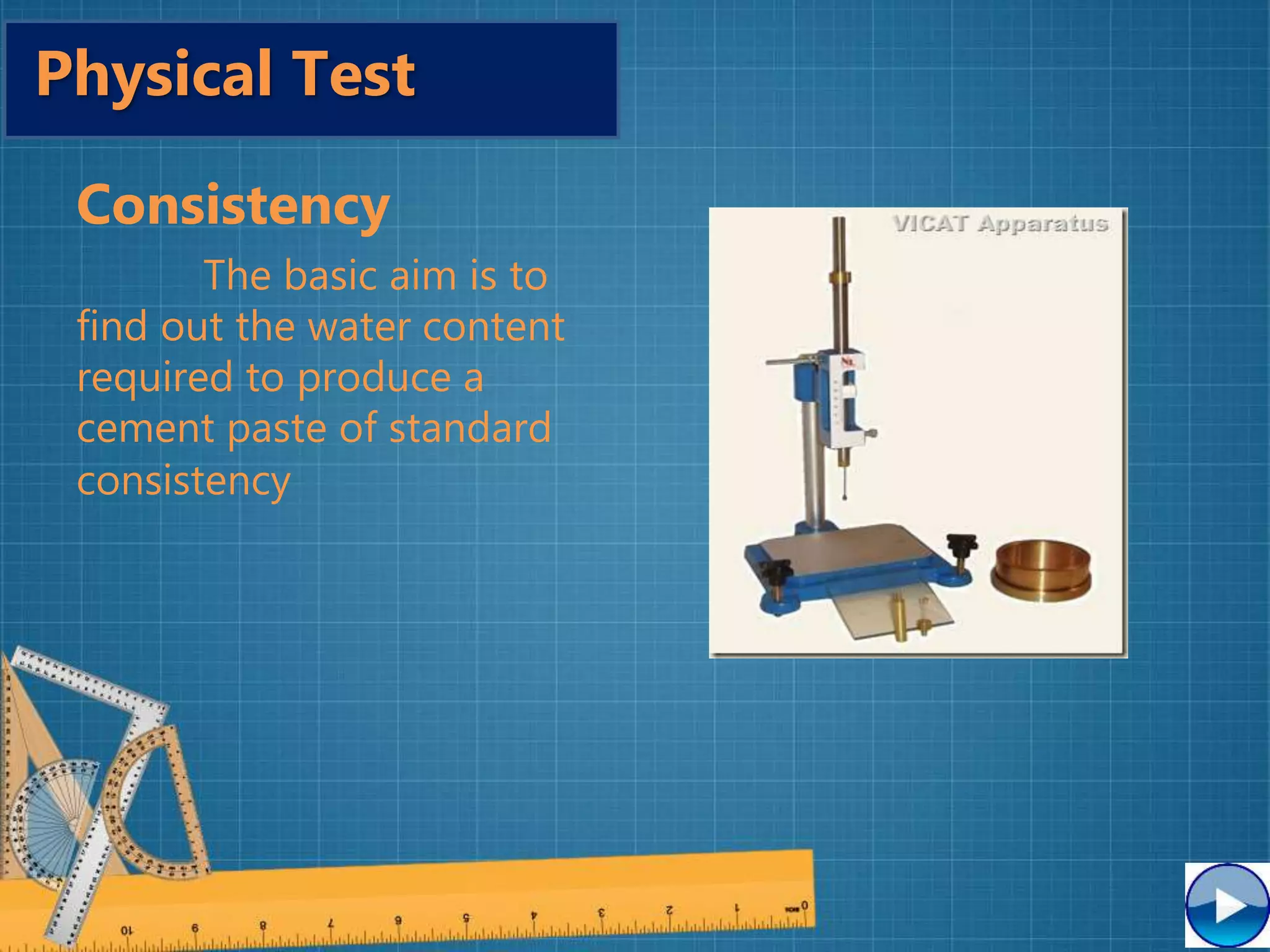
Consistency
The basic aim is to
find out the water content
required to produce a
cement paste of standard
consistency
Le-Chatelier
Physical Test
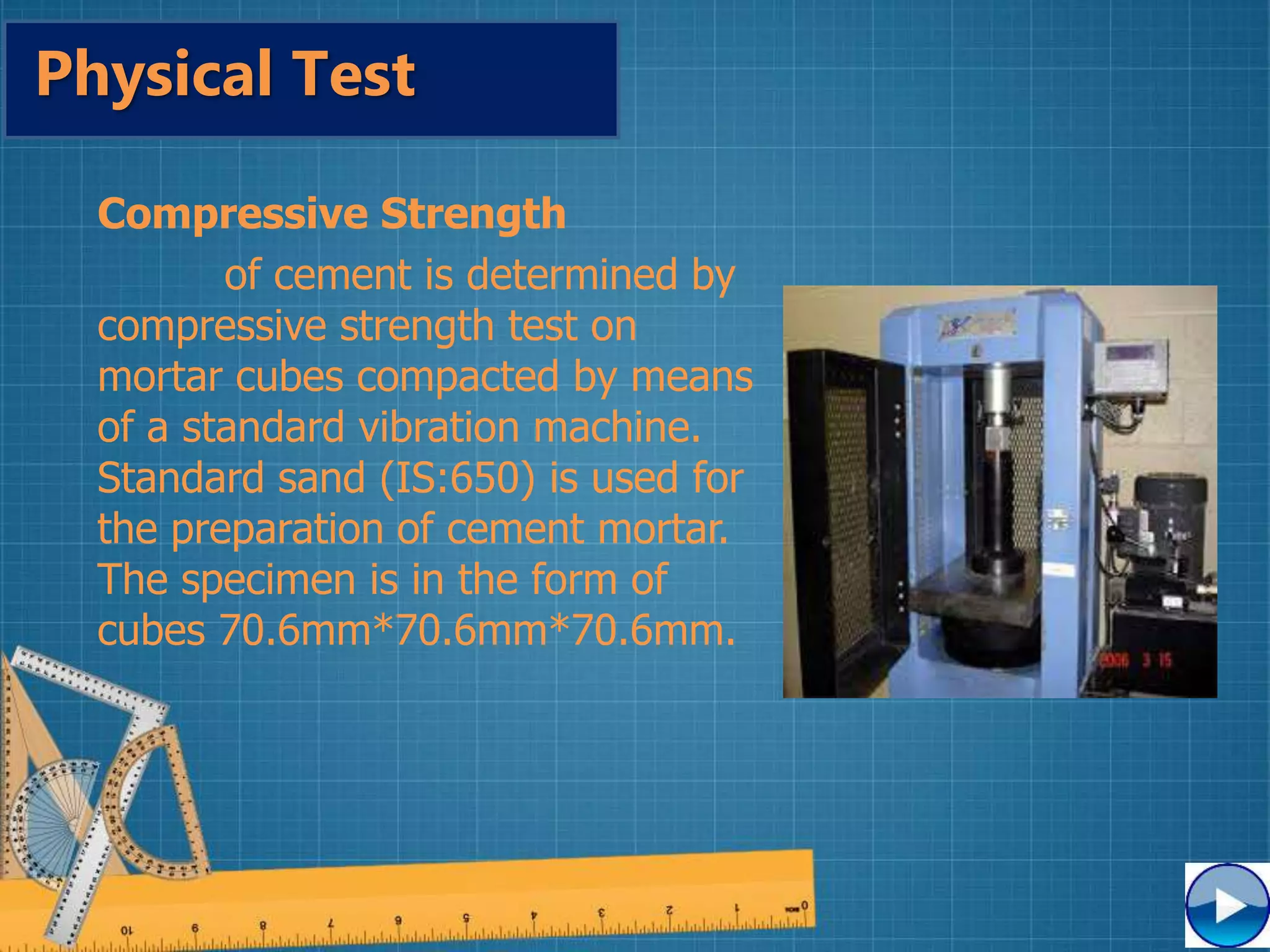
Compressive Strength
of cement is determined by
compressive strength test on
mortar cubes compacted by means
of a standard vibration machine.
Standard sand (IS:650) is used for
the preparation of cement mortar.
The specimen is in the form of
cubes 70.6mm*70.6mm*70.6mm.
Physical Test
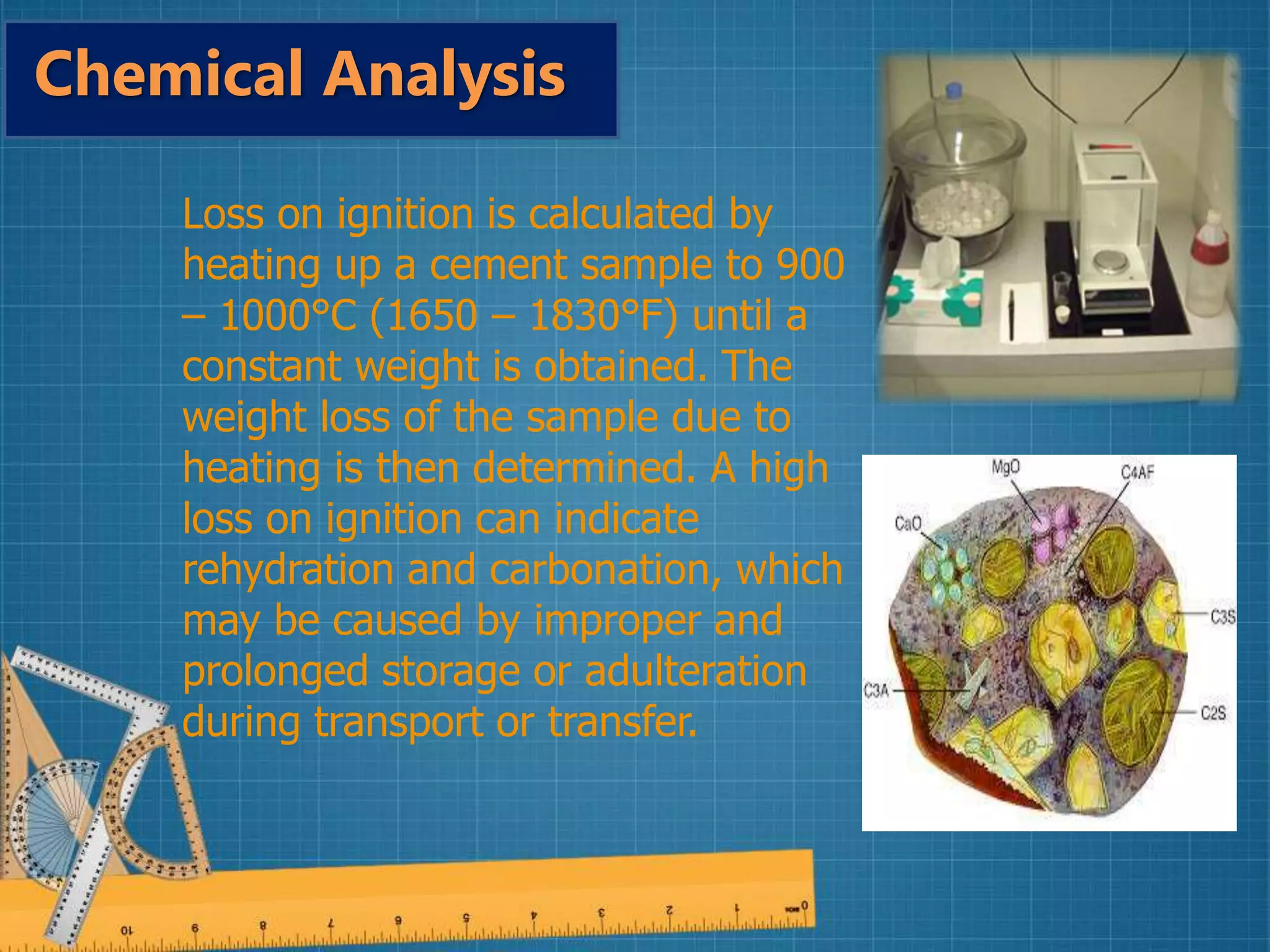
Loss on ignition is calculated by
heating up a cement sample to 900
– 1000°C (1650 – 1830°F) until a
constant weight is obtained. The
weight loss of the sample due to
heating is then determined. A high
loss on ignition can indicate
rehydration and carbonation, which
may be caused by improper and
prolonged storage or adulteration
during transport or transfer.
Chemical Analysis
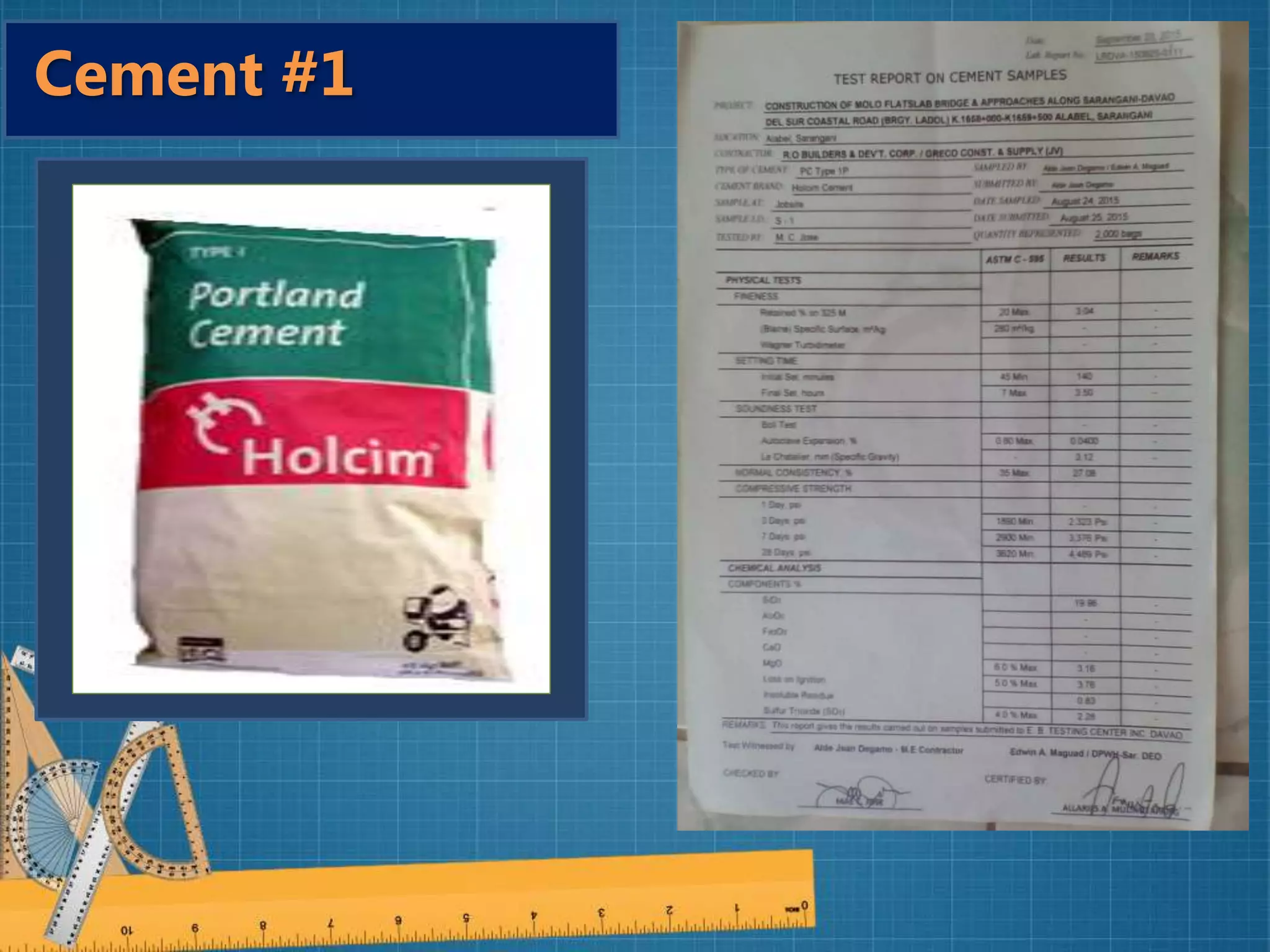
Cement #1
Cement #2
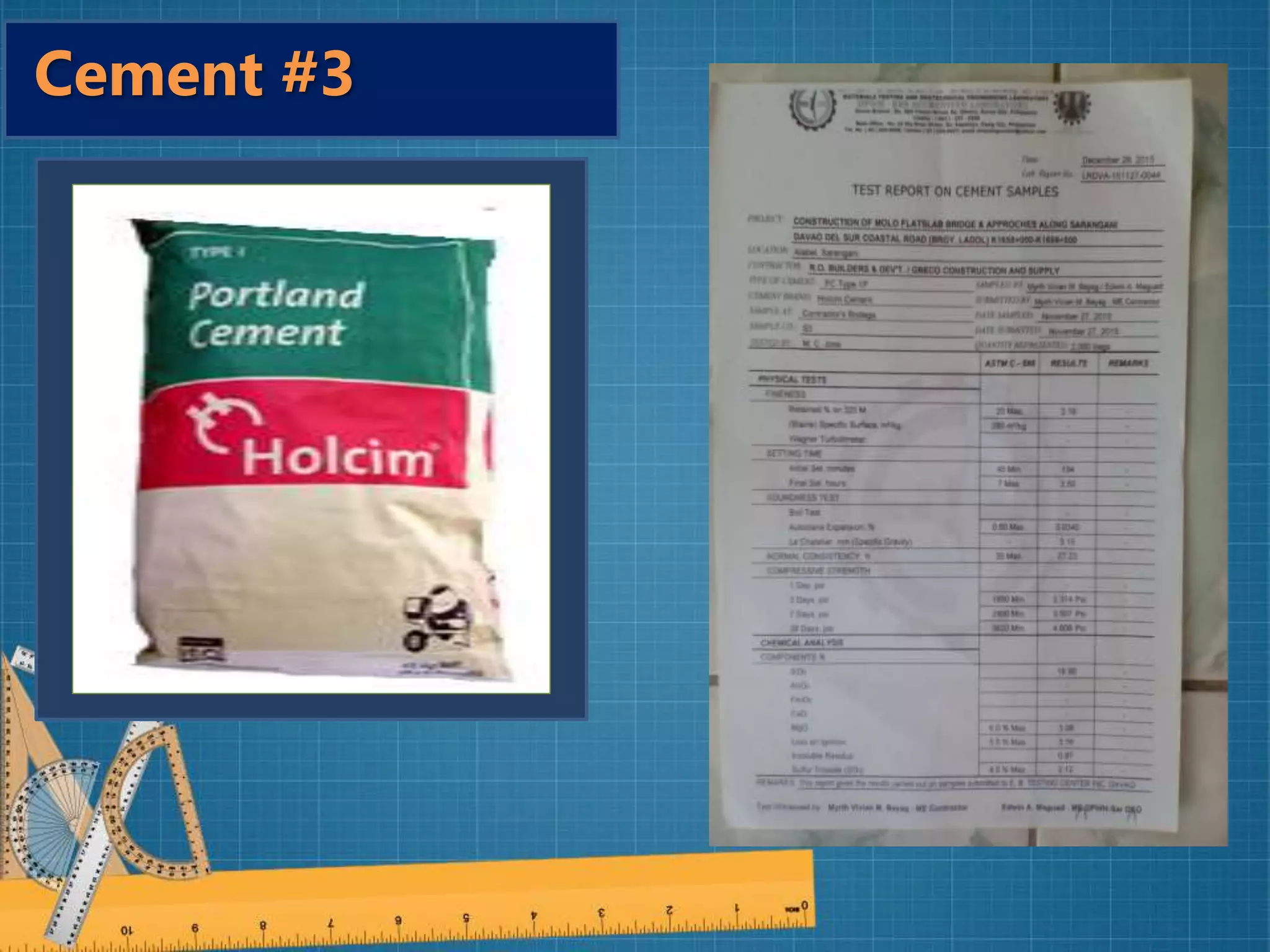
Cement #3
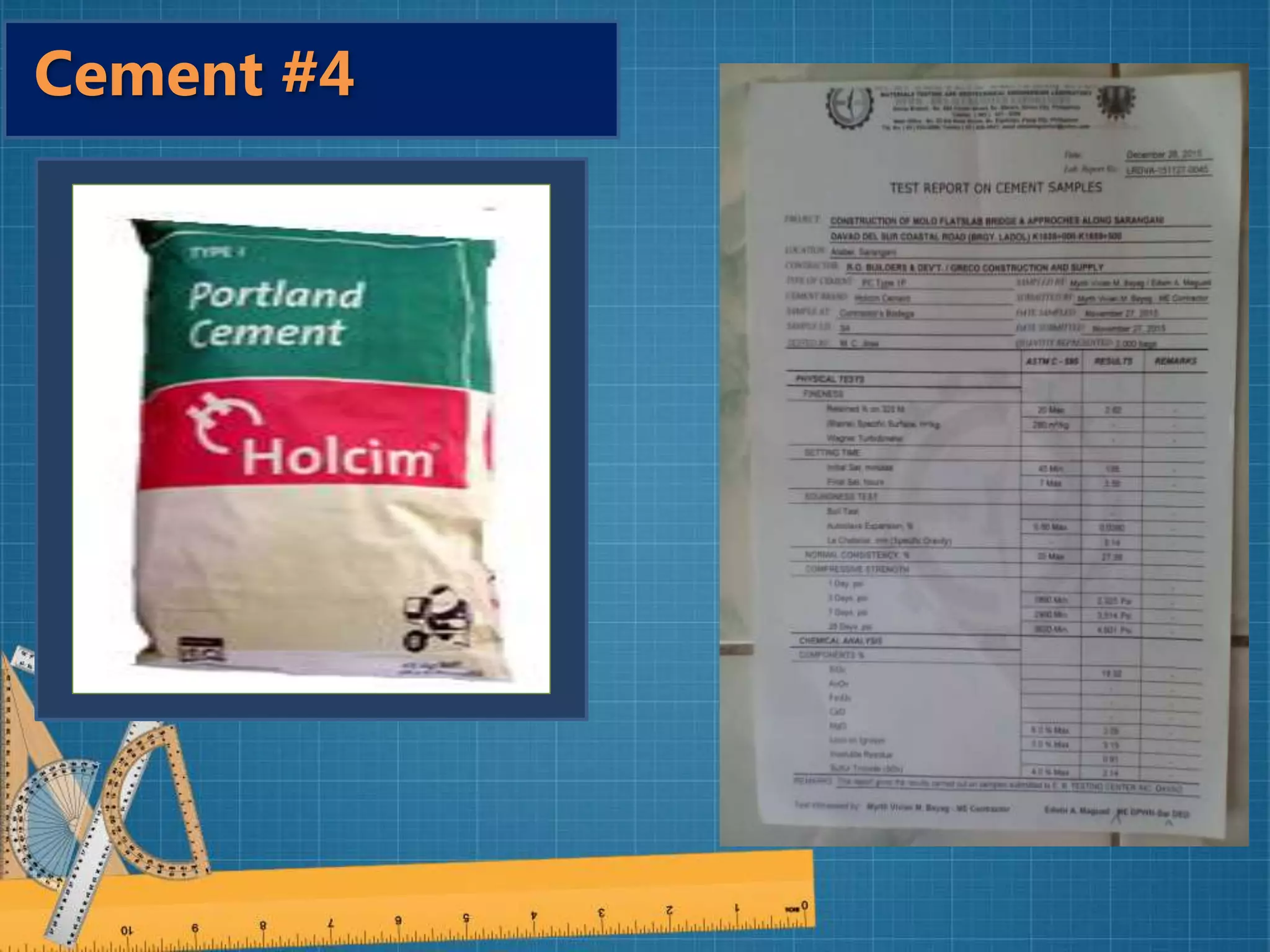
Cement #4
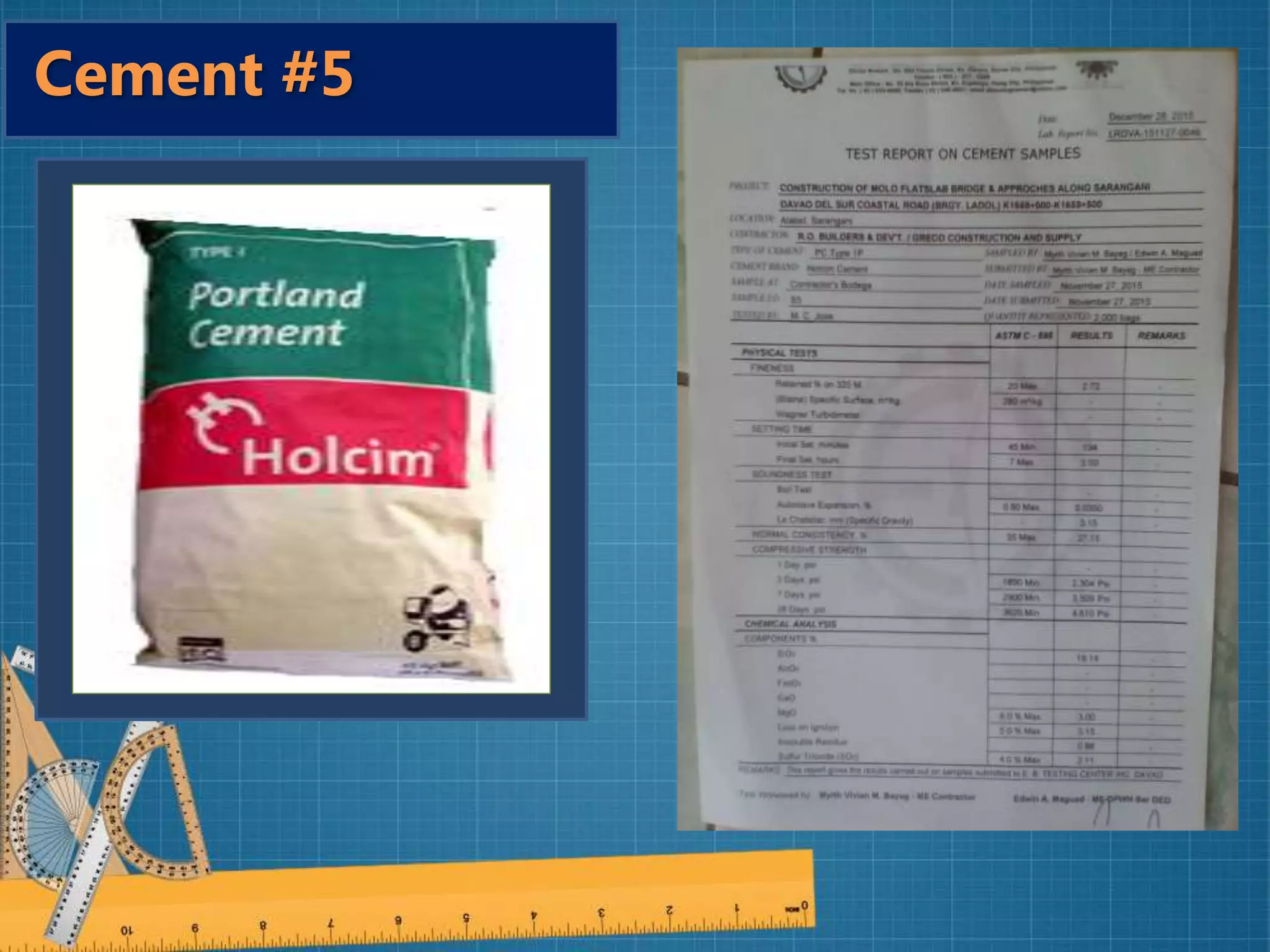
Cement #5
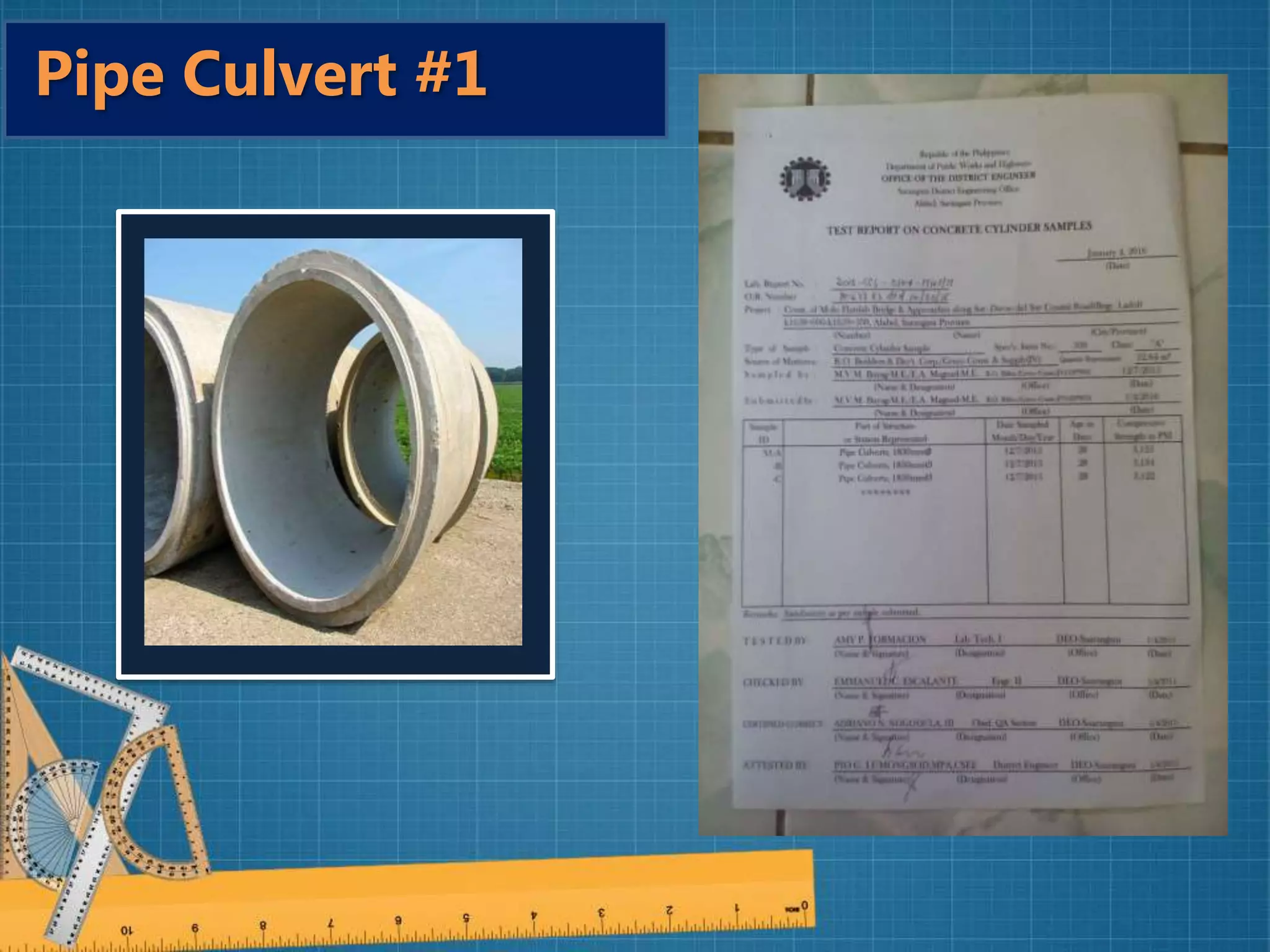
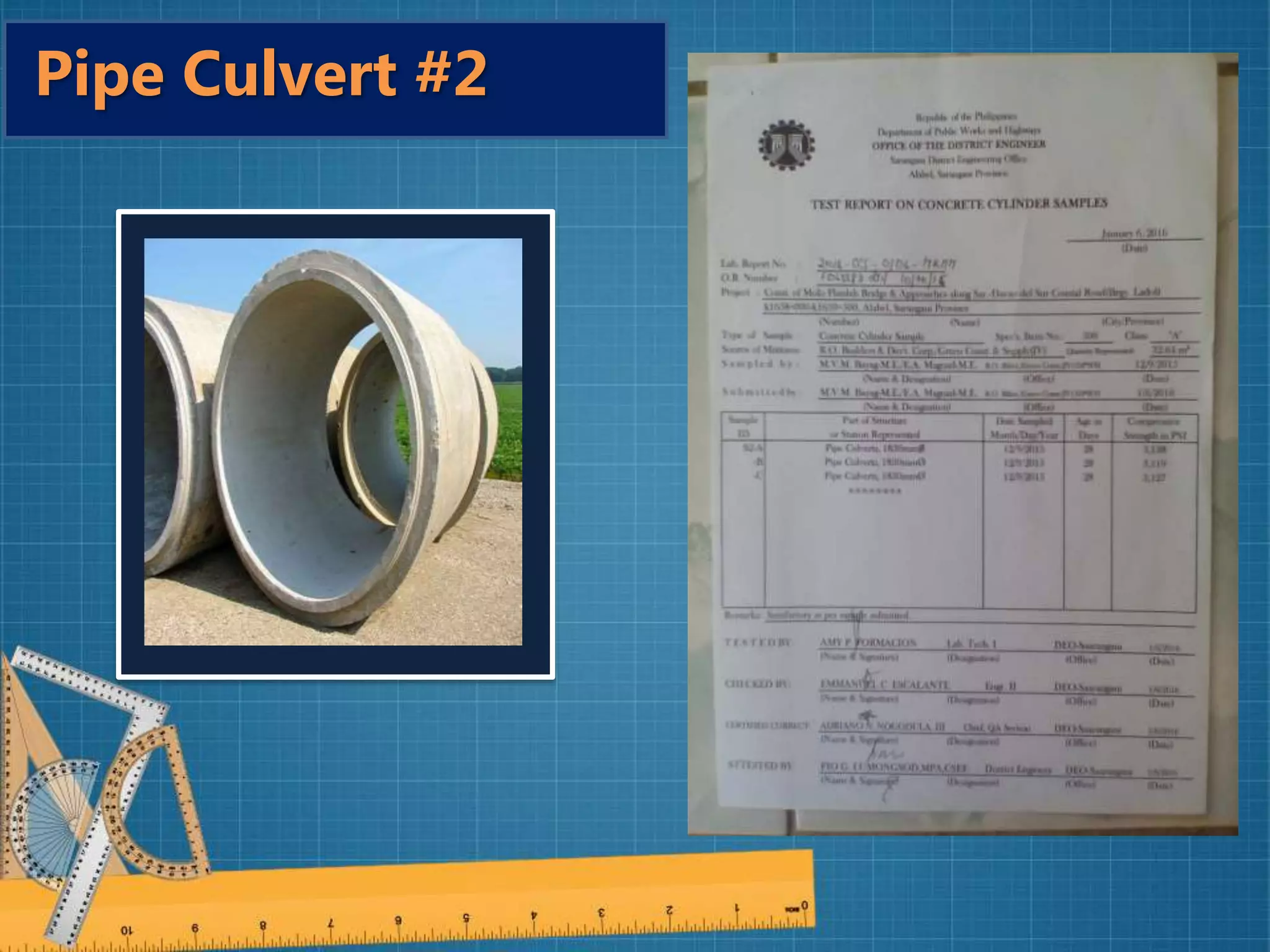
Pipe Culvert #1
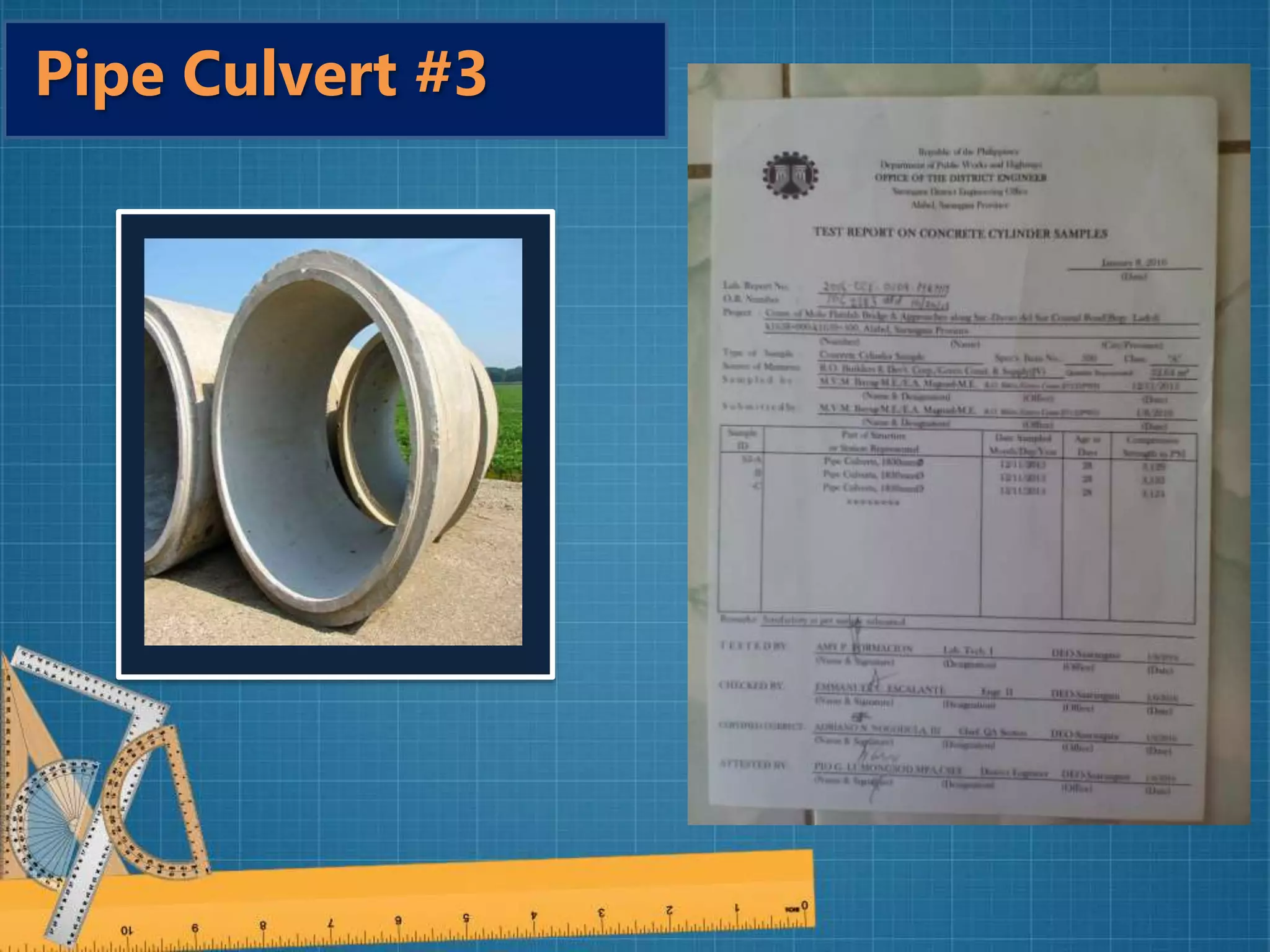
Pipe Culvert #2
Pipe Culvert #3
Lined Canal Cover
Retaining Wall
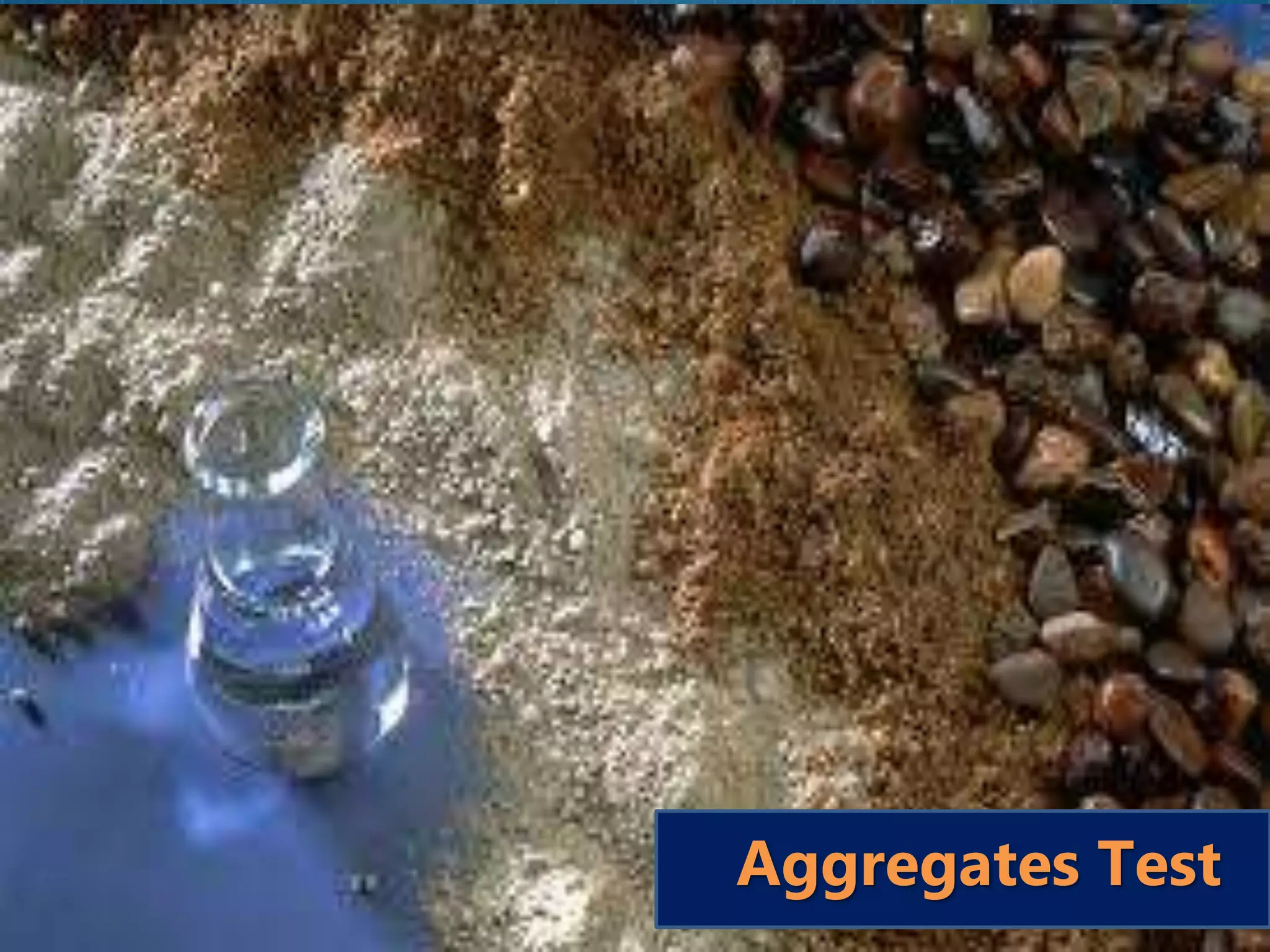
Aggregates Test
This test method is used to determine
the grading of aggregates extracted from
bituminous mixtures. The results are used to
determine compliance of the particle size
distribution with applicable specifications
requirements, and to provide necessary data
for control of the production of various
aggregates to be used in bituminous
mixtures.
Aggregates Test
Aggregates Test
Specific Gravity
Absorption
Unit Weight
Fineness Modulus
Soundness
 Organic Impurities
 Abrasion Loss
 % Wash Loss
 Mortar Strength
 Clay Lumps
Physical Properties
Mechanical Analysis
Sieve Analysis
Physical Properties
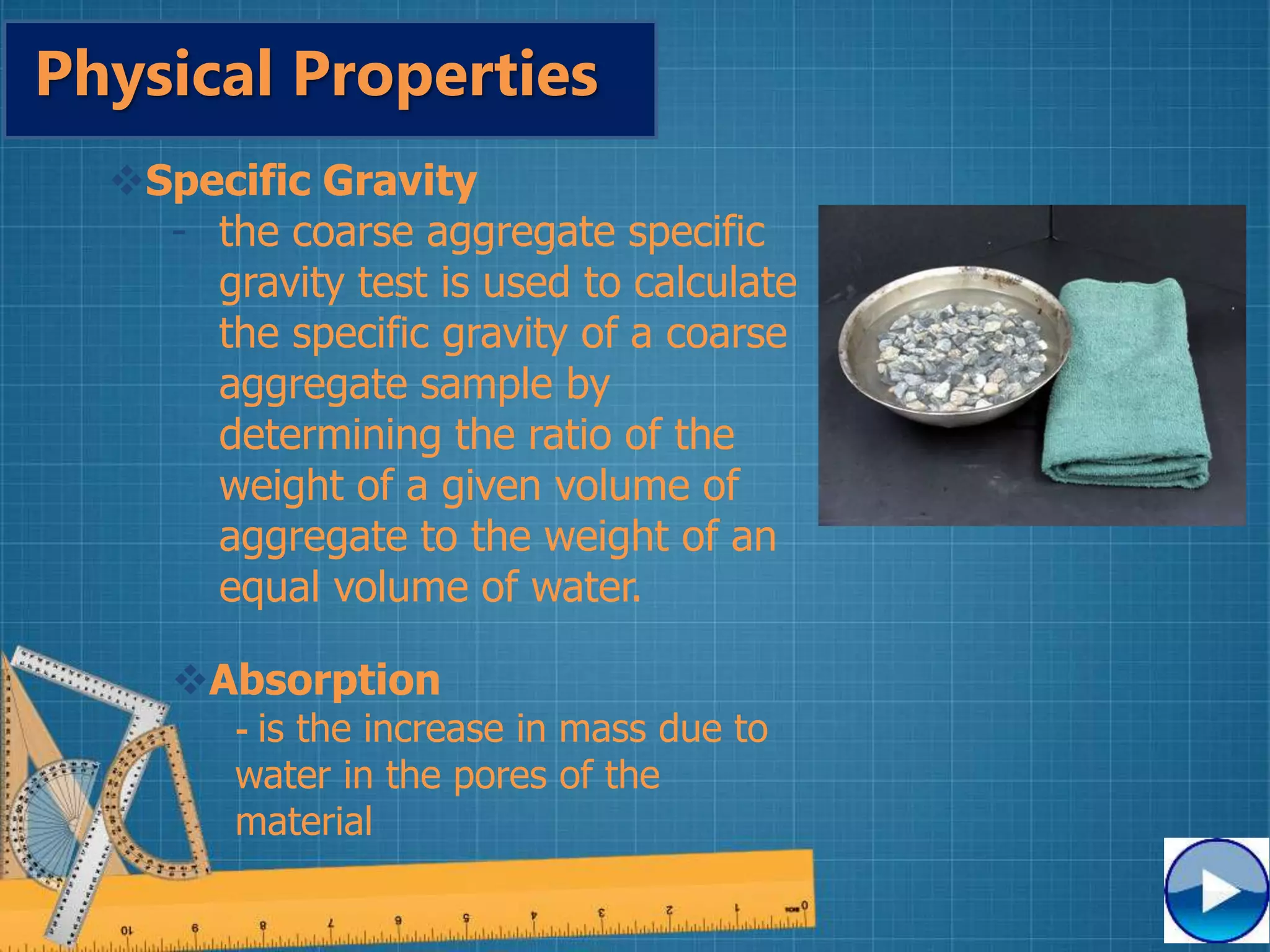
Specific Gravity
- the coarse aggregate specific
gravity test is used to calculate
the specific gravity of a coarse
aggregate sample by
determining the ratio of the
weight of a given volume of
aggregate to the weight of an
equal volume of water.
Absorption
- is the increase in mass due to
water in the pores of the
material
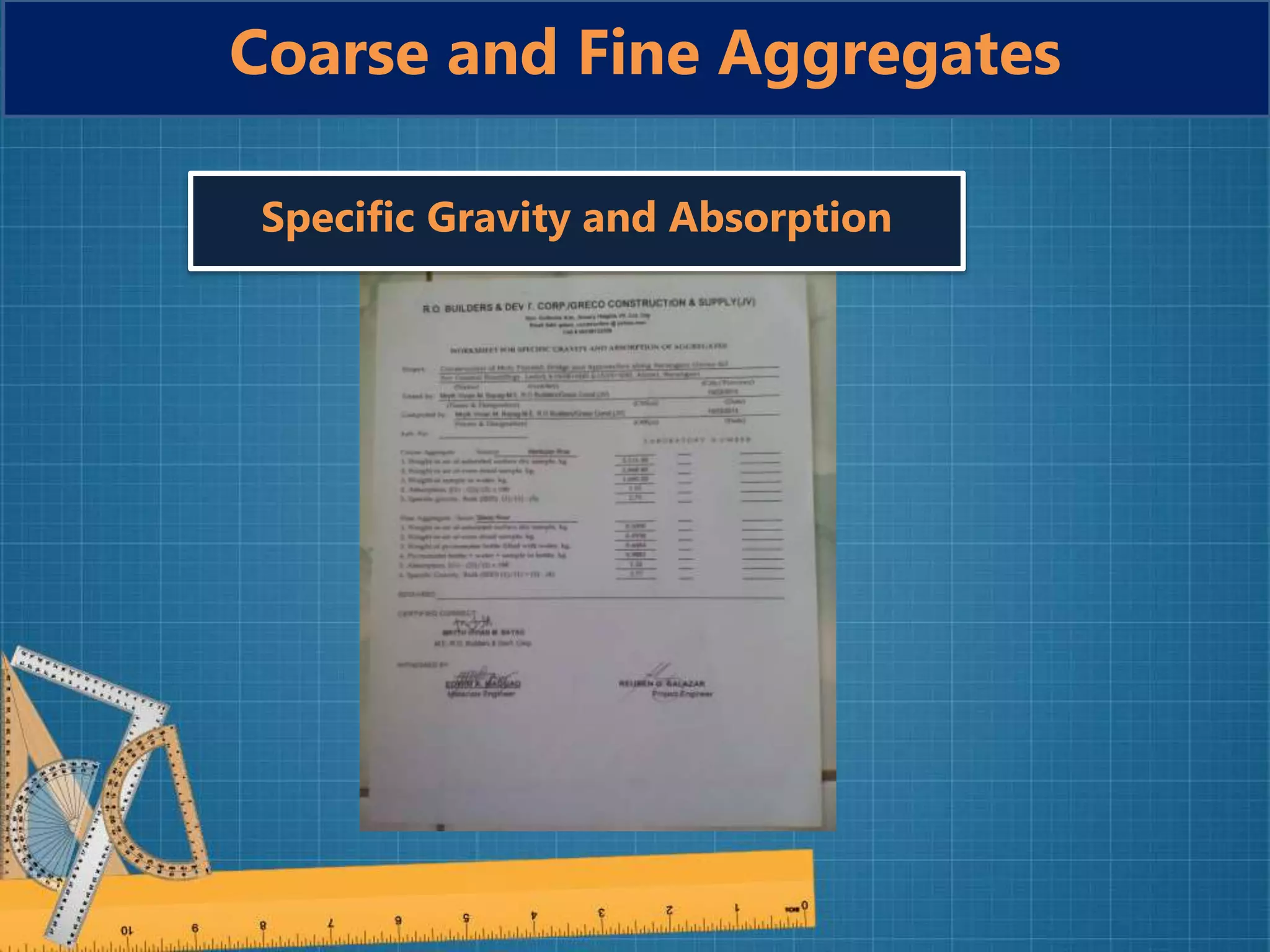
Coarse and Fine Aggregates
Specific Gravity and Absorption
Physical Properties
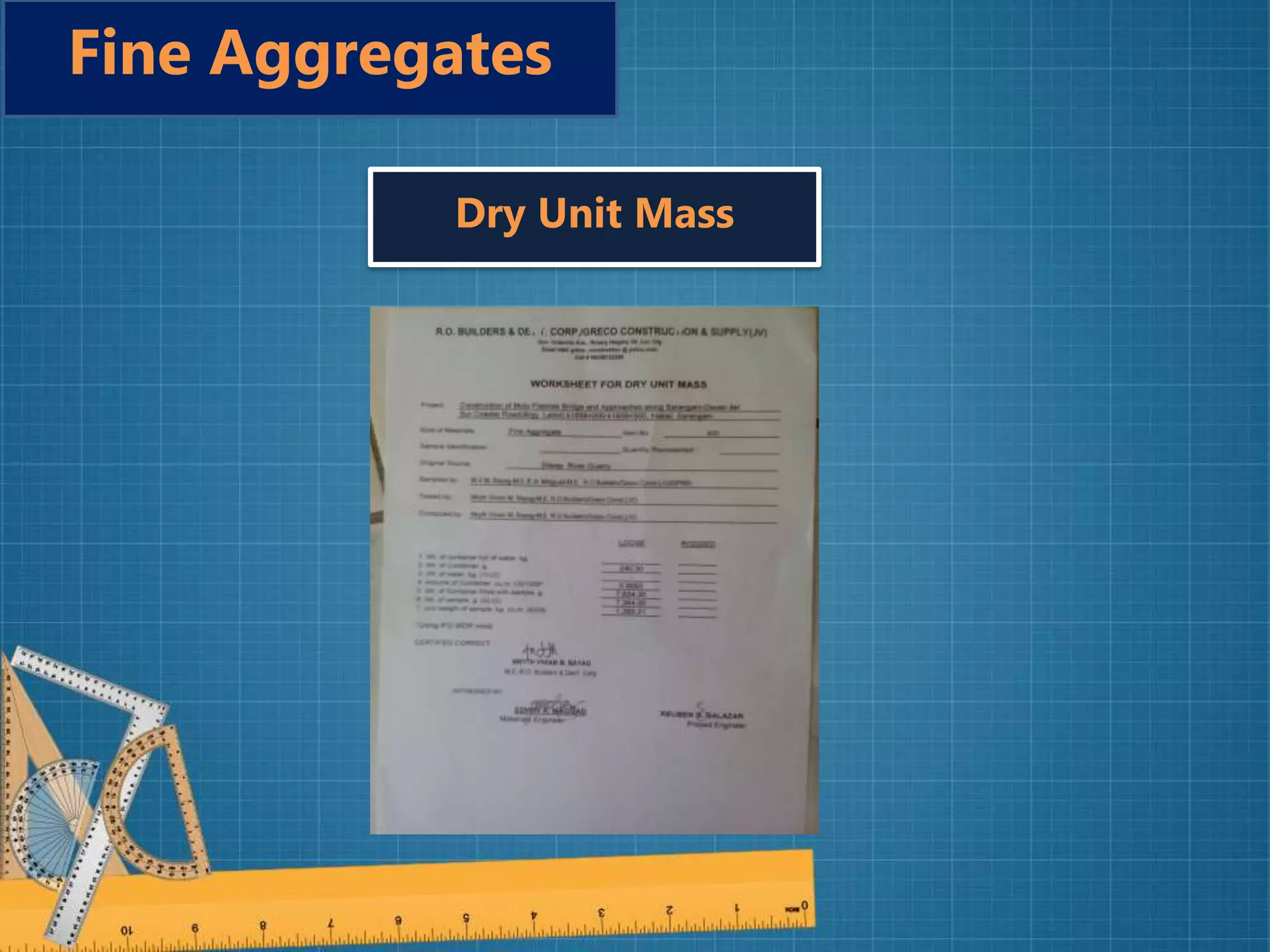
Unit Weight
- The bulk unit weight of
aggregate is needed for the
proportioning of portland
cement concrete mixtures.
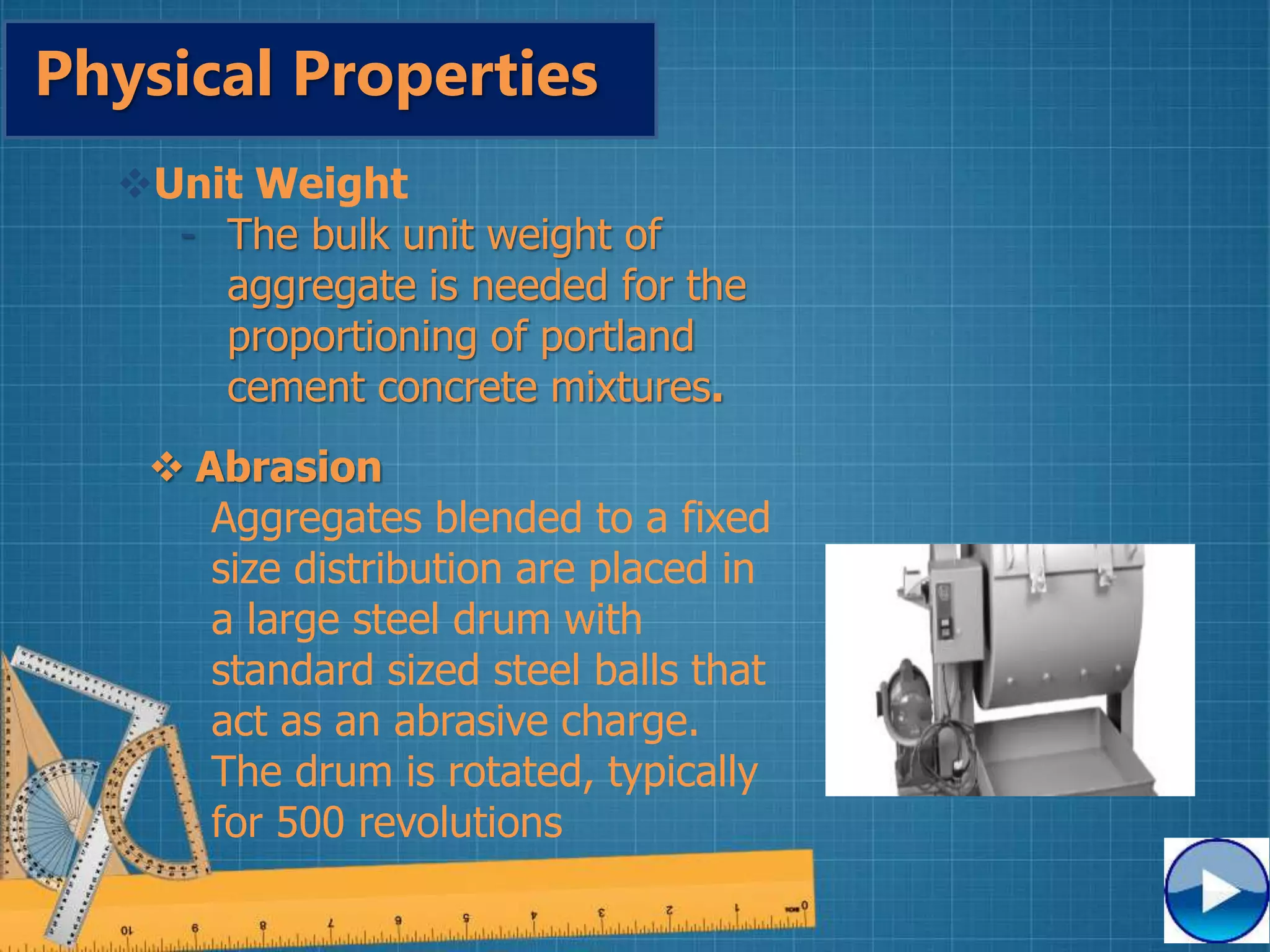
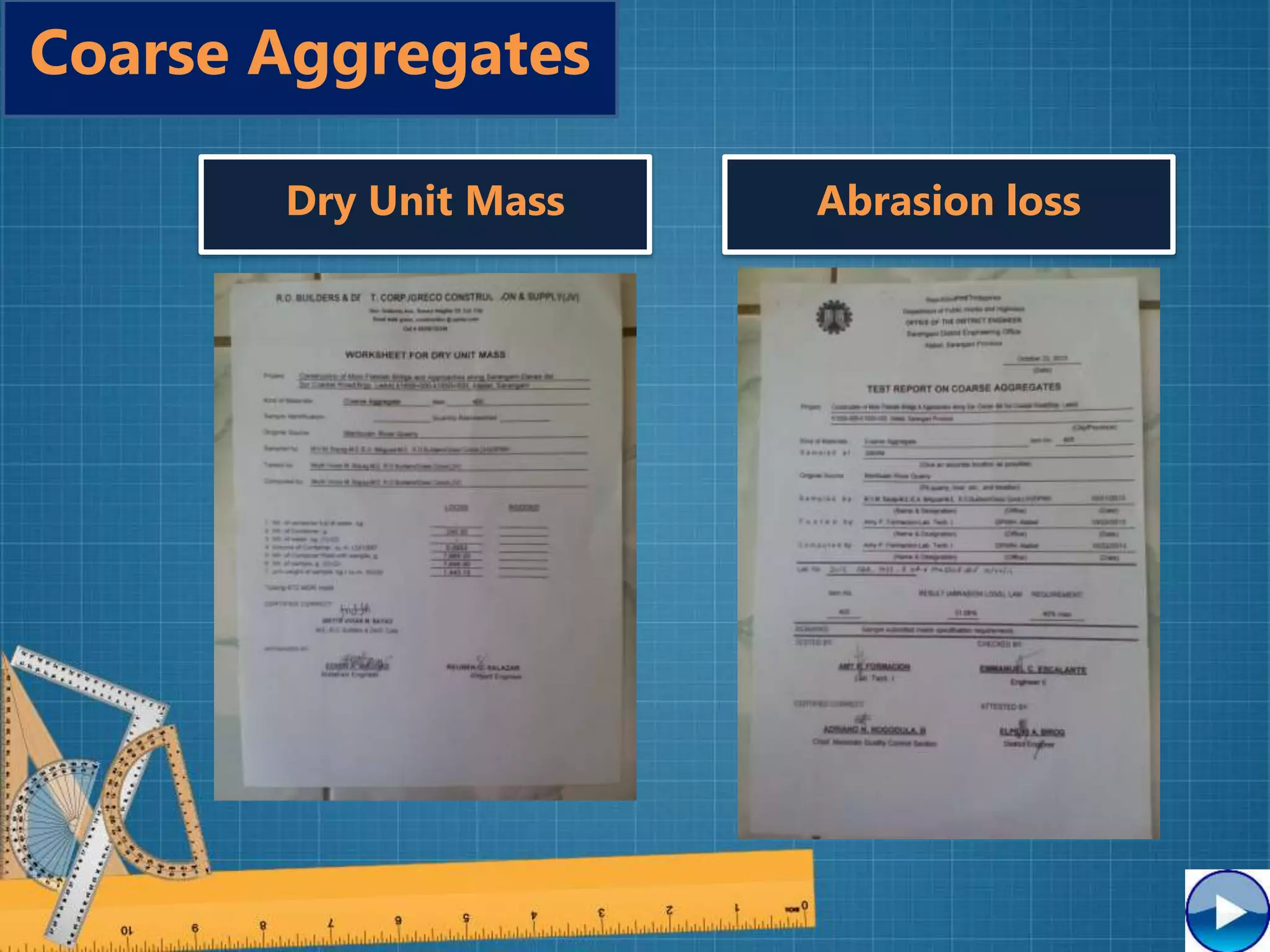
 Abrasion
Aggregates blended to a fixed
size distribution are placed in
a large steel drum with
standard sized steel balls that
act as an abrasive charge.
The drum is rotated, typically
for 500 revolutions
Abrasion loss
Coarse Aggregates
Dry Unit Mass
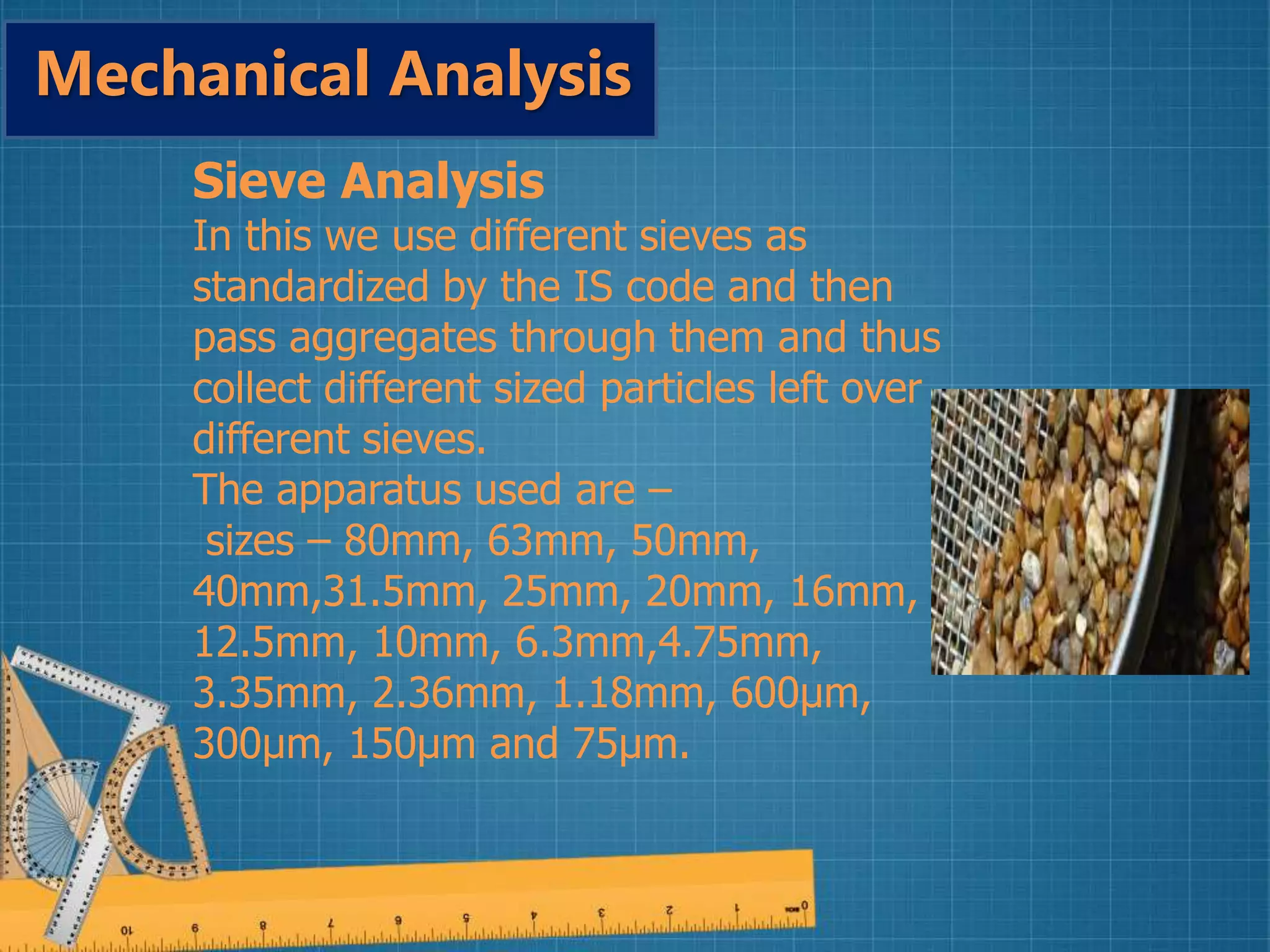
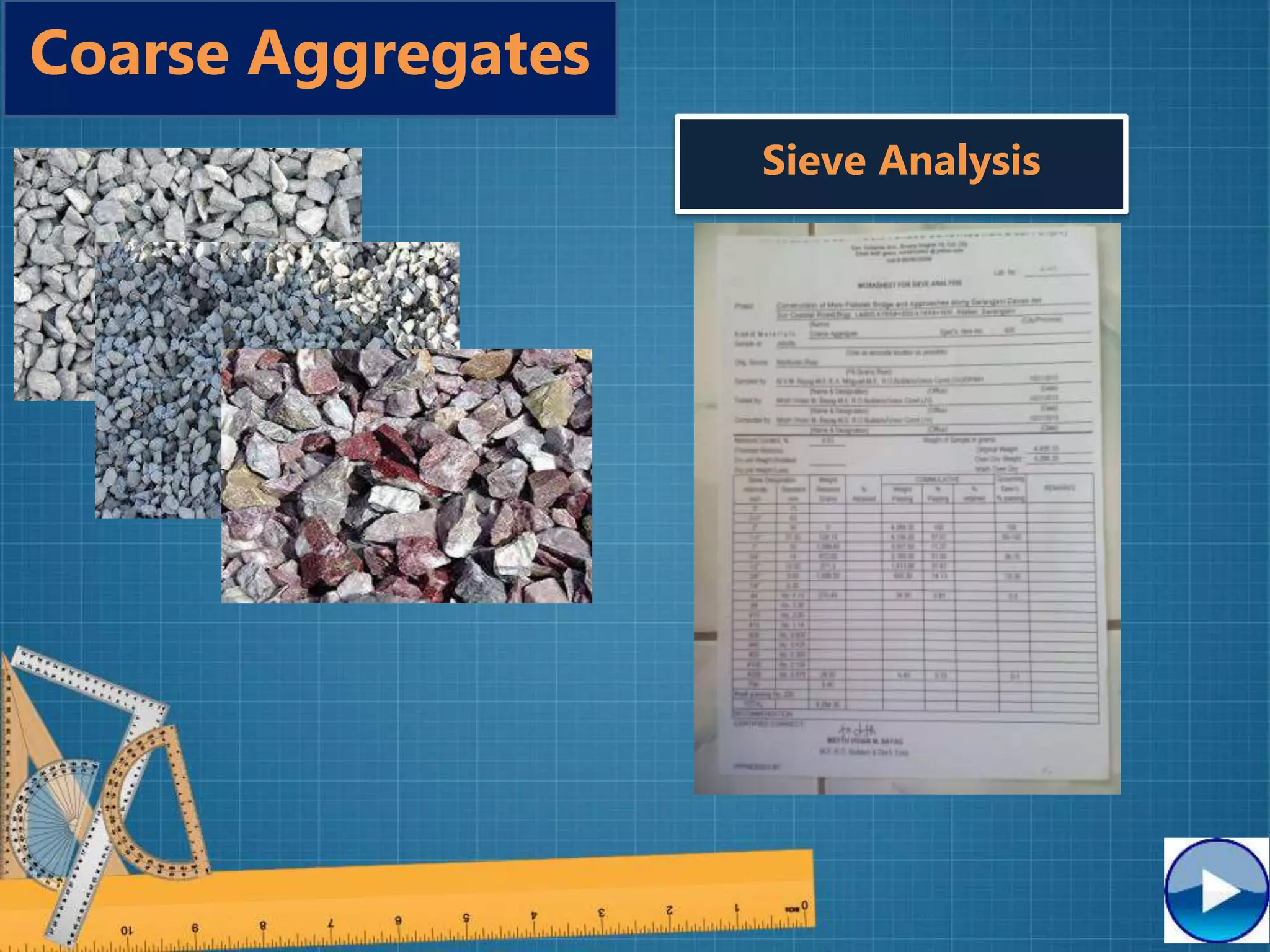
Sieve Analysis
In this we use different sieves as
standardized by the IS code and then
pass aggregates through them and thus
collect different sized particles left over
different sieves.
The apparatus used are –
sizes – 80mm, 63mm, 50mm,
40mm,31.5mm, 25mm, 20mm, 16mm,
12.5mm, 10mm, 6.3mm,4.75mm,
3.35mm, 2.36mm, 1.18mm, 600µm,
300µm, 150µm and 75µm.
Mechanical Analysis
Coarse Aggregates
Sieve Analysis
Fine Aggregates
Dry Unit Mass
Fine Aggregates
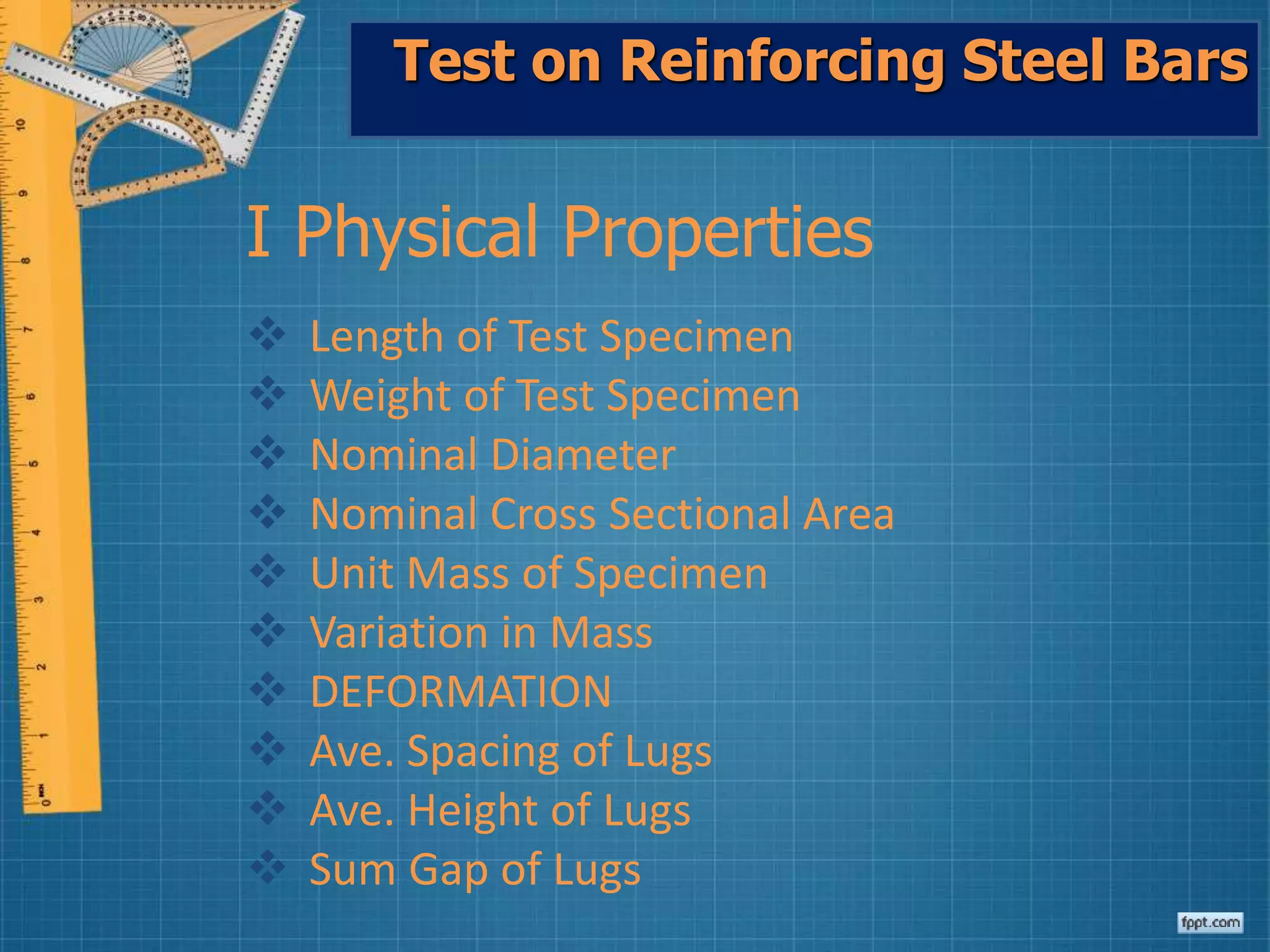
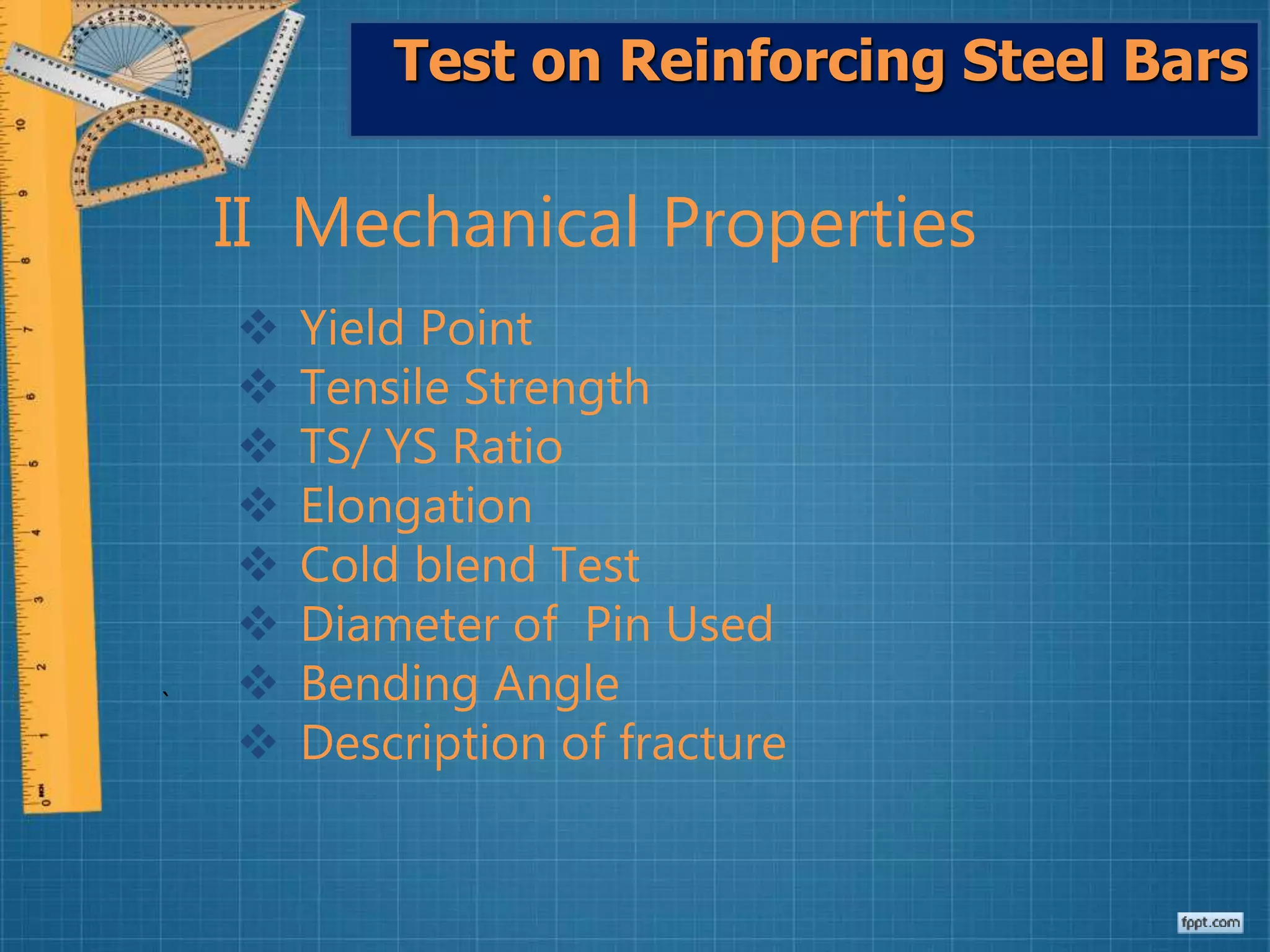
Test on Reinforcing Steel Bars
I Physical Properties
 Length of Test Specimen
 Weight of Test Specimen
 Nominal Diameter
 Nominal Cross Sectional Area
 Unit Mass of Specimen
 Variation in Mass
 DEFORMATION
 Ave. Spacing of Lugs
 Ave. Height of Lugs
 Sum Gap of Lugs
Test on Reinforcing Steel Bars
II Mechanical Properties
 Yield Point
 Tensile Strength
 TS/ YS Ratio
 Elongation
 Cold blend Test
 Diameter of Pin Used
 Bending Angle
 Description of fracture
`
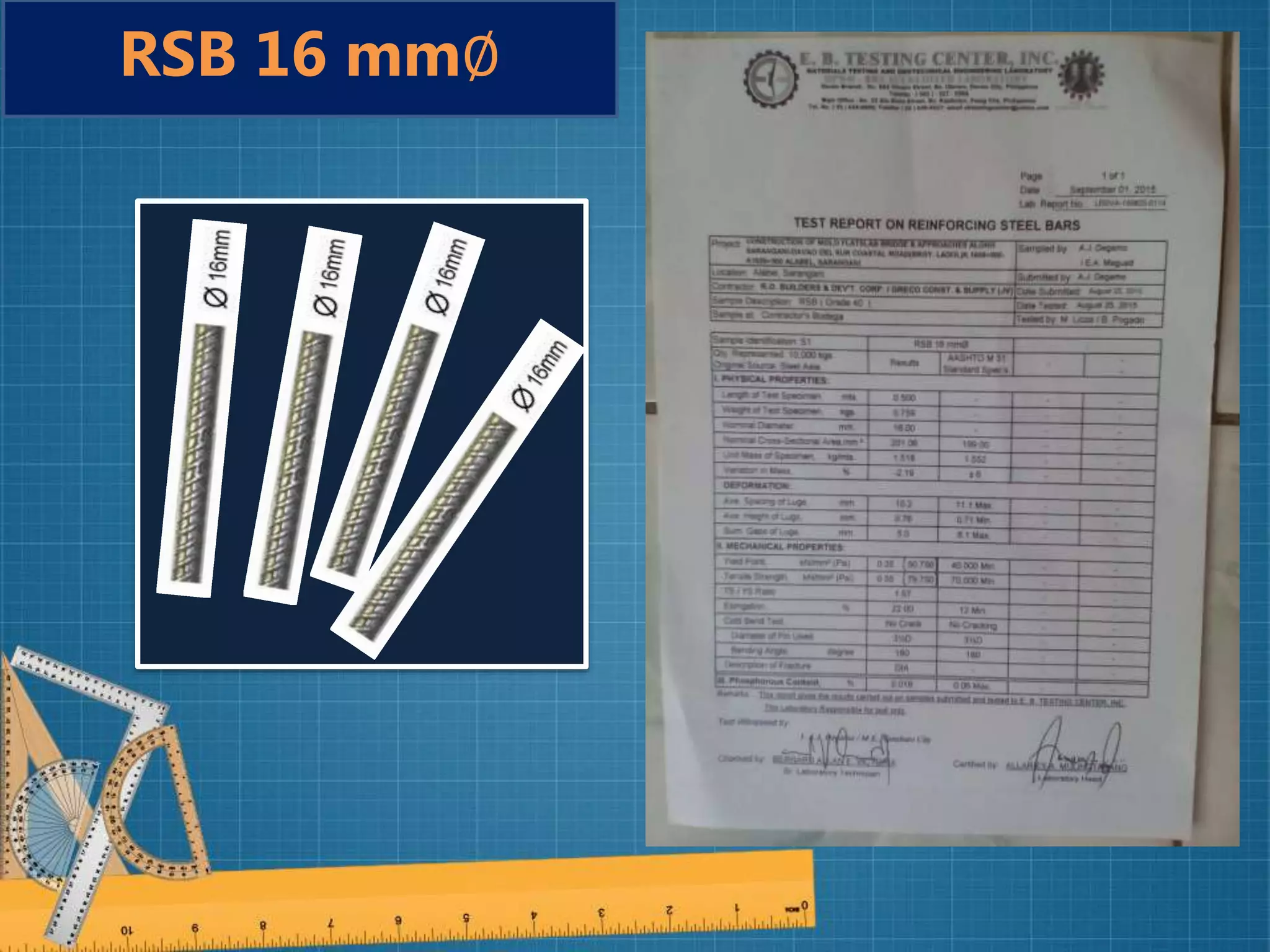
RSB 16 mm∅
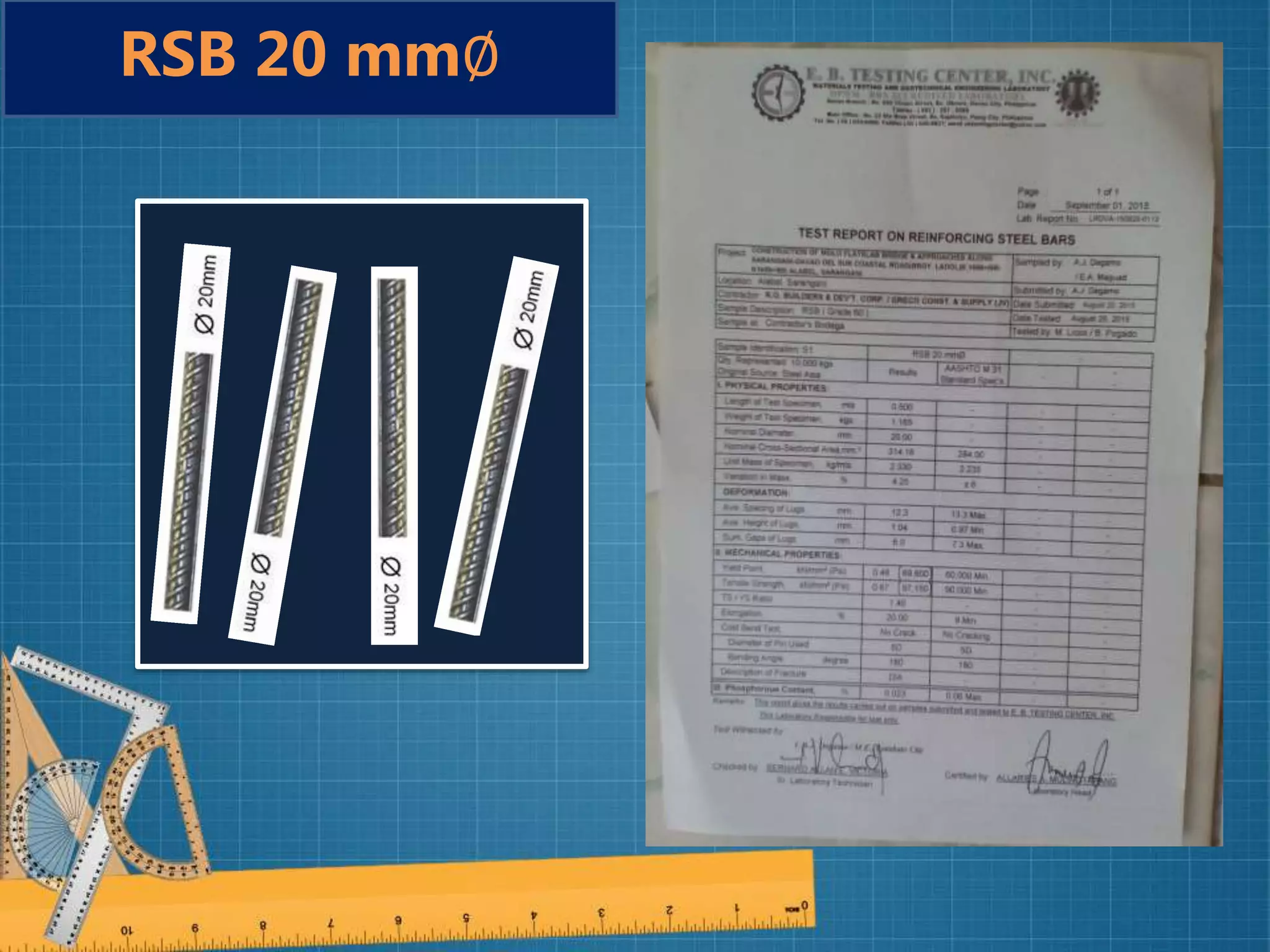
RSB 20 mm∅
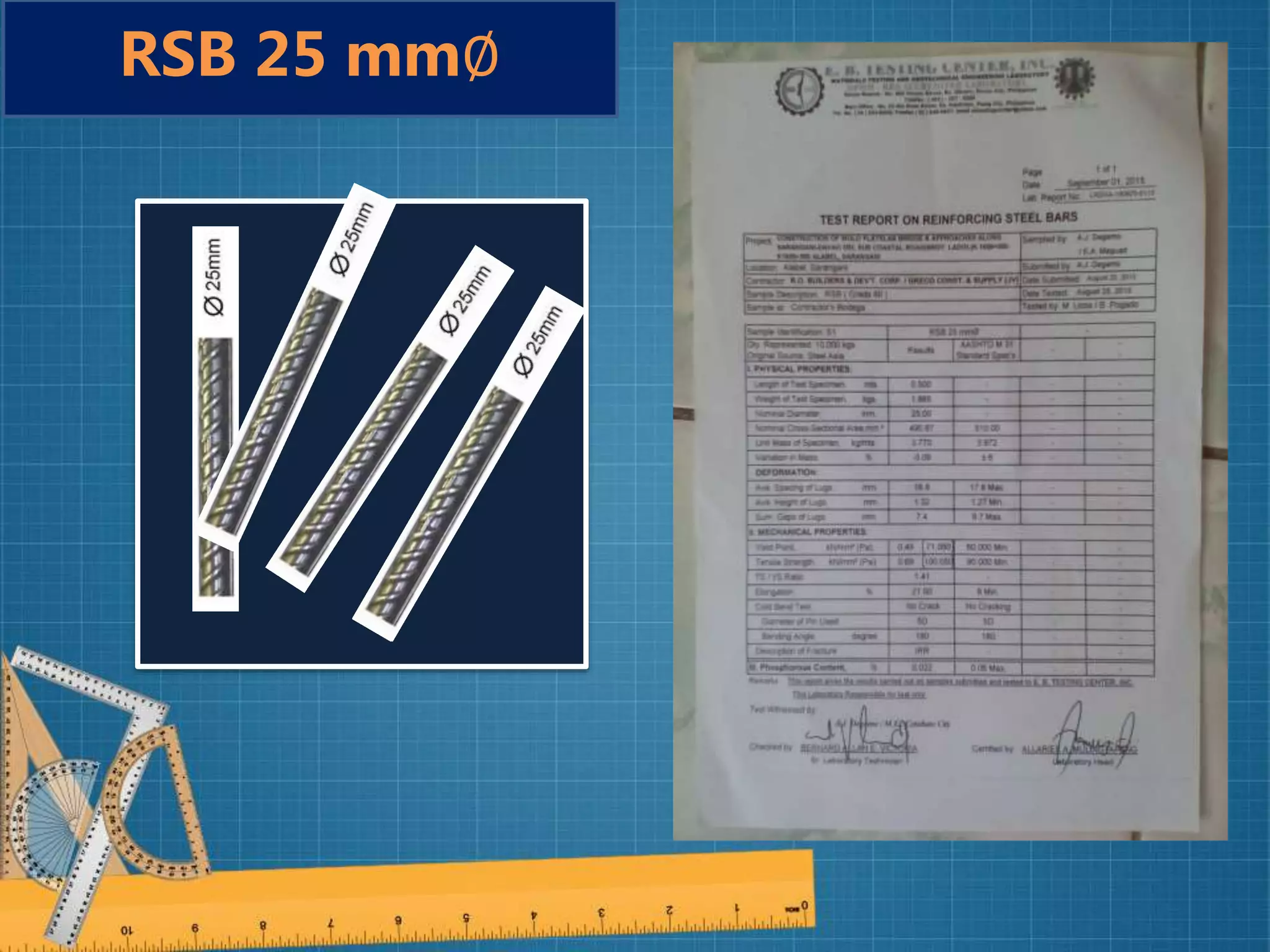
RSB 25 mm∅
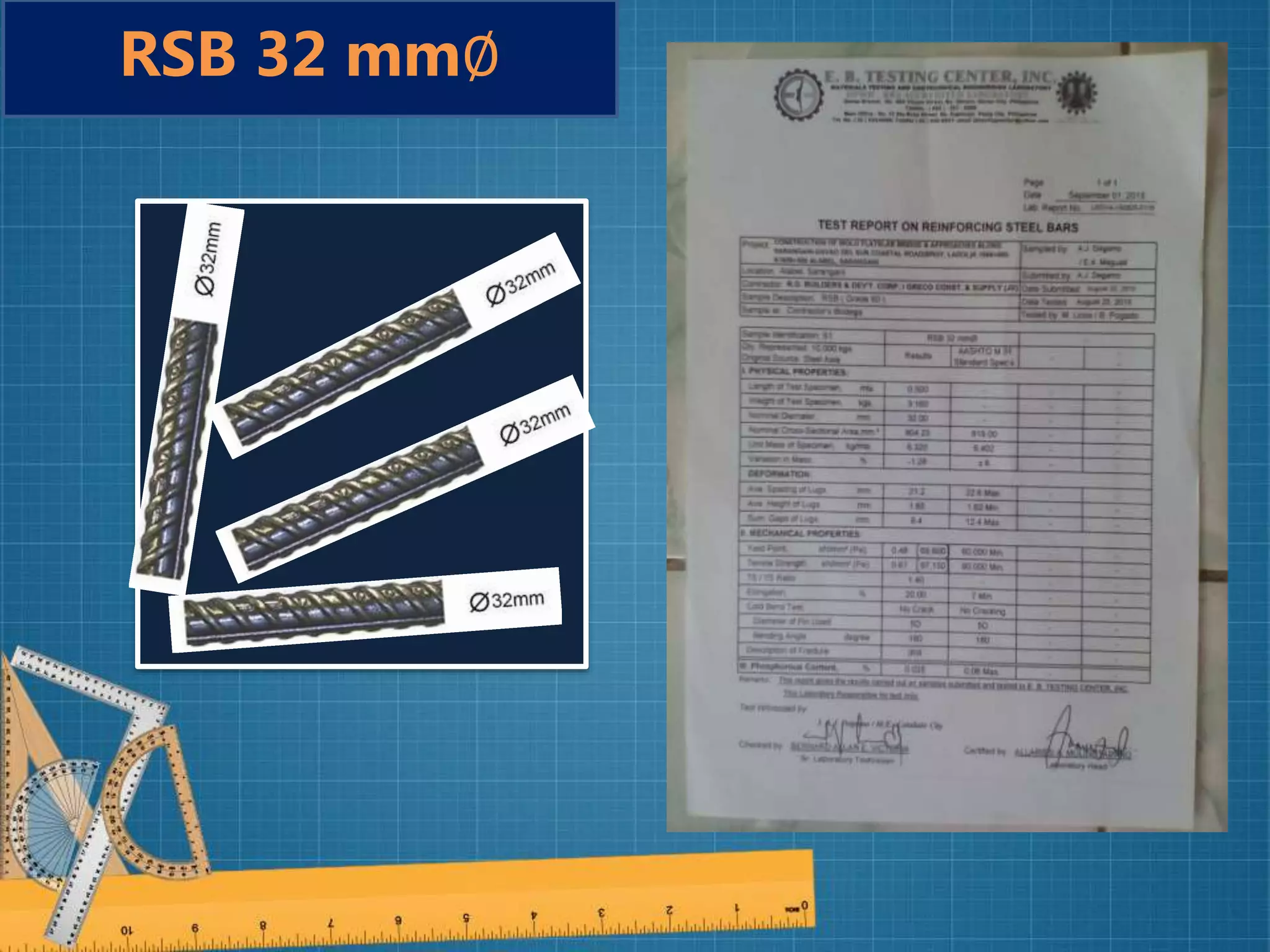
RSB 32 mm∅
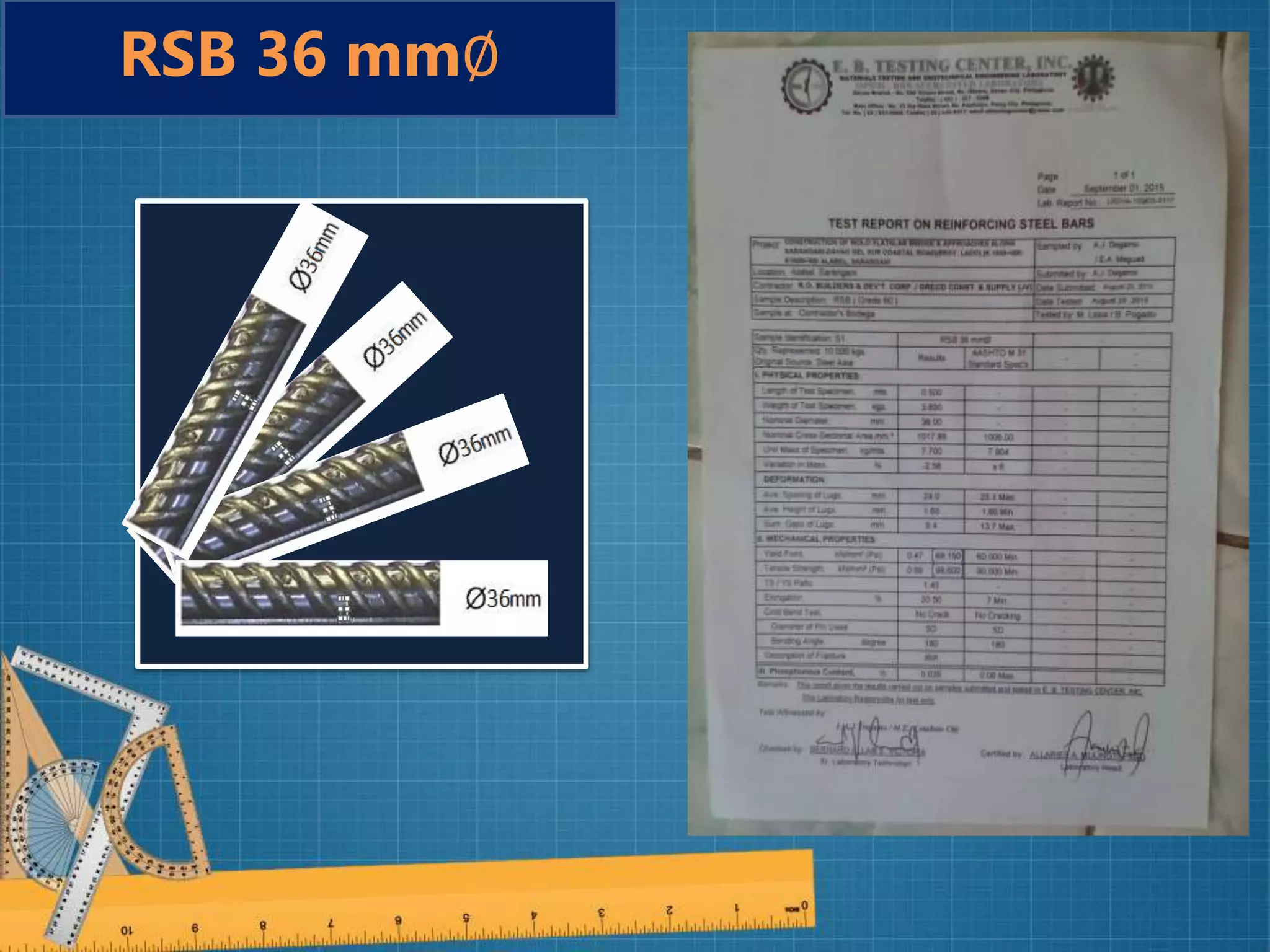
RSB 36 mm∅
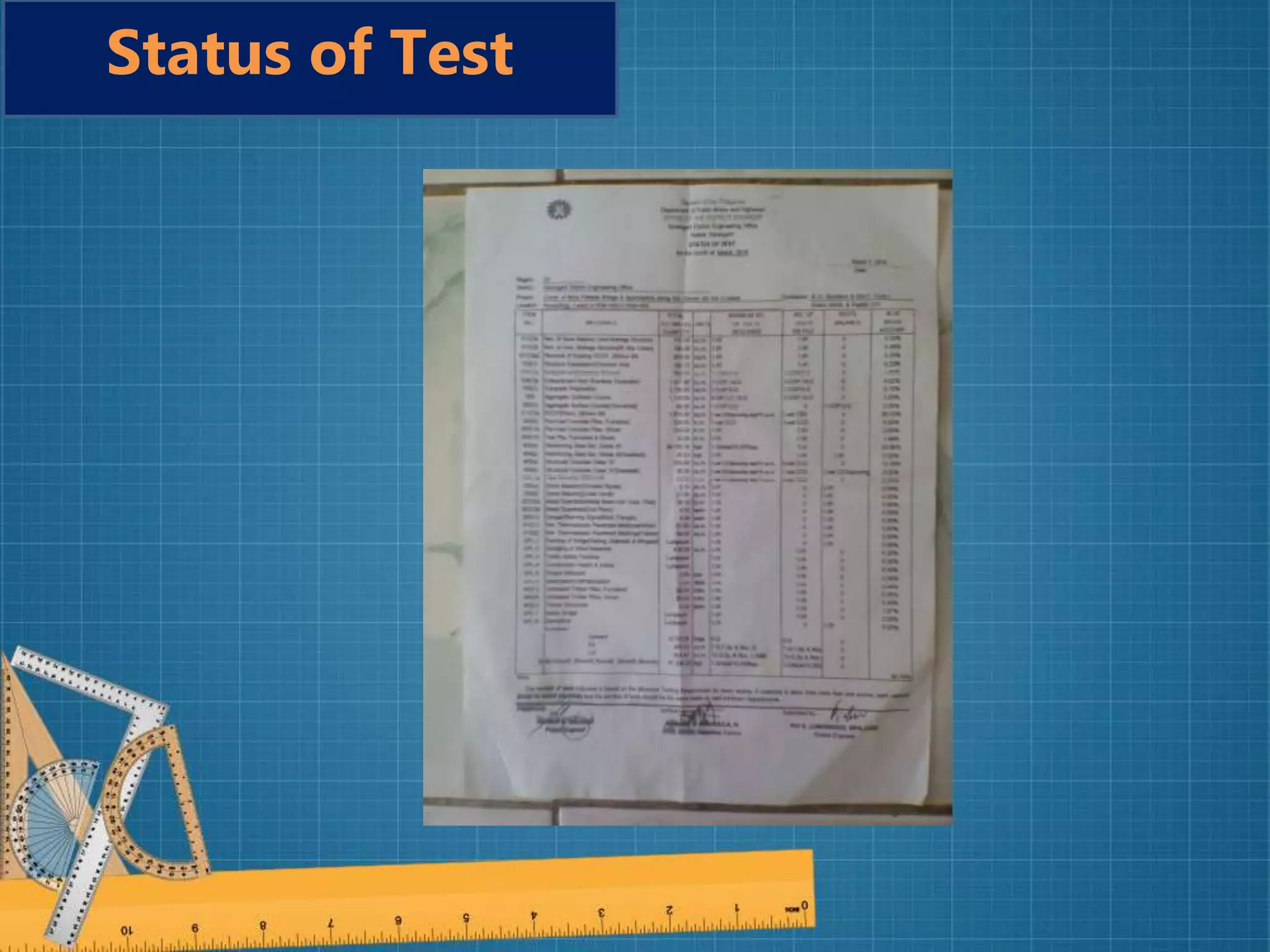
Status of Test
Material testing by. keith

Material testing by. keith

  • 1.
  • 2.
    • (QC) isa procedure or set of procedures intended to ensure that a manufactured product or performed service adheres to a defined set of quality criteria or meets the requirements of the client or customer. • Controls include product inspection emphasizes testing of products to uncover defects and reporting to management who make the decision to allow or deny product release Quality Control
  • 3.
    • The basicgoal of this process is to ensure that the products or services that are provided meet specific requirements and characteristics, such as being dependable, satisfactory, safe and fiscally sound Objective
  • 4.
    • Materials testingis the process of pulling bending, twisting, turning, hitting, and squeezing materials or components to make sure they withstand the intense stresses, strains and impact forces they are likely to experience in use and application. In other words, materials’ testing examines the overall strength, toughness, flexibility, suitability and fitness for purpose. Materials Testing
  • 5.
  • 6.
    tests on cementsare carried to know the quality of cement supplied at site. It gives some idea about cement quality based on color, touch and feel and other tests. Cement Test
  • 7.
    Physical Test Fineness Test Initialsetting time and Final setting time Soundness test Consistency test Compressive strength Chemical Analysis SiO2, Al2O3, Fe2O3, CaO, and MgO Loss on Ignition Insoluble Residue Sulphur Trioxide Cement Test
  • 8.
    • Fineness Test ismeasured by sieving it on standard sieve(90µm IS sieve ) to determine the proportion of cement whose grain size is larger than specified mesh size Physical Test
  • 9.
    • Initial SettingTime Place the test block under the rod bearing the needle. Lower the needle gently in order to make contact with the surface of the cement paste and release quickly, allowing it to penetrate the test block Physical Test
  • 10.
    • Final SettingTime The period elapsing between the time, water is added to the cement and the time, the needle makes an impression on the surface of the test block, while the attachment fails to do so. Physical Test
  • 11.
    Soundness Test a specimenof hardened cement paste is boiled for a fixed time so that any tendency to expand is speeded up and can be detected. Soundness means the ability to resist volume expansion. Le-Chatelier Physical Test
  • 12.
    Consistency The basic aimis to find out the water content required to produce a cement paste of standard consistency Le-Chatelier Physical Test
  • 13.
    Compressive Strength of cementis determined by compressive strength test on mortar cubes compacted by means of a standard vibration machine. Standard sand (IS:650) is used for the preparation of cement mortar. The specimen is in the form of cubes 70.6mm*70.6mm*70.6mm. Physical Test
  • 14.
    Loss on ignitionis calculated by heating up a cement sample to 900 – 1000°C (1650 – 1830°F) until a constant weight is obtained. The weight loss of the sample due to heating is then determined. A high loss on ignition can indicate rehydration and carbonation, which may be caused by improper and prolonged storage or adulteration during transport or transfer. Chemical Analysis
  • 15.
  • 16.
  • 17.
  • 18.
  • 19.
  • 20.
  • 21.
  • 22.
  • 23.
  • 24.
  • 25.
  • 26.
    This test methodis used to determine the grading of aggregates extracted from bituminous mixtures. The results are used to determine compliance of the particle size distribution with applicable specifications requirements, and to provide necessary data for control of the production of various aggregates to be used in bituminous mixtures. Aggregates Test
  • 27.
    Aggregates Test Specific Gravity Absorption UnitWeight Fineness Modulus Soundness  Organic Impurities  Abrasion Loss  % Wash Loss  Mortar Strength  Clay Lumps Physical Properties Mechanical Analysis Sieve Analysis
  • 28.
    Physical Properties Specific Gravity -the coarse aggregate specific gravity test is used to calculate the specific gravity of a coarse aggregate sample by determining the ratio of the weight of a given volume of aggregate to the weight of an equal volume of water. Absorption - is the increase in mass due to water in the pores of the material
  • 29.
    Coarse and FineAggregates Specific Gravity and Absorption
  • 30.
    Physical Properties Unit Weight -The bulk unit weight of aggregate is needed for the proportioning of portland cement concrete mixtures.  Abrasion Aggregates blended to a fixed size distribution are placed in a large steel drum with standard sized steel balls that act as an abrasive charge. The drum is rotated, typically for 500 revolutions
  • 31.
  • 32.
    Sieve Analysis In thiswe use different sieves as standardized by the IS code and then pass aggregates through them and thus collect different sized particles left over different sieves. The apparatus used are – sizes – 80mm, 63mm, 50mm, 40mm,31.5mm, 25mm, 20mm, 16mm, 12.5mm, 10mm, 6.3mm,4.75mm, 3.35mm, 2.36mm, 1.18mm, 600µm, 300µm, 150µm and 75µm. Mechanical Analysis
  • 33.
  • 34.
  • 35.
  • 36.
  • 37.
    Test on ReinforcingSteel Bars I Physical Properties  Length of Test Specimen  Weight of Test Specimen  Nominal Diameter  Nominal Cross Sectional Area  Unit Mass of Specimen  Variation in Mass  DEFORMATION  Ave. Spacing of Lugs  Ave. Height of Lugs  Sum Gap of Lugs
  • 38.
    Test on ReinforcingSteel Bars II Mechanical Properties  Yield Point  Tensile Strength  TS/ YS Ratio  Elongation  Cold blend Test  Diameter of Pin Used  Bending Angle  Description of fracture `
  • 39.
  • 40.
  • 41.
  • 42.
  • 43.
  • 44.