NEW YORK STATE
COUNTY HIGHWAY SUPERINTENDENTS
          ASSOCIATION


 Stretching Your Dollars with Bridge Maintenance


                August, 2011
           Alexandria Bay, New York
Understand how the taxes we pay are returned to us for local
projects.
   Understand how Federal HBRRP funds can be captured for local
bridge maintenance activities.
  Not everyone uses Federal funds for bridge maintenance.
  Understand the difference between cyclical maintenance
activities and corrective maintenance/repair projects.

  Compare and contrast Federally funded and Locally funded
Bridge Maintenance programs.
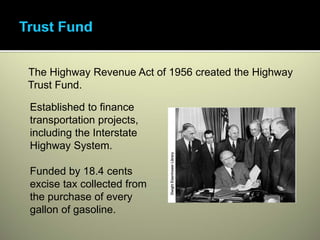
The Highway Revenue Act of 1956 created the Highway
Trust Fund.

Established to finance
transportation projects,
including the Interstate
Highway System.

Funded by 18.4 cents
excise tax collected from
the purchase of every
gallon of gasoline.
The Trust Fund pays for multi-year programs for highways,
highway safety, and transit through a funding and authorization
bill that governs surface transportation expenditures.

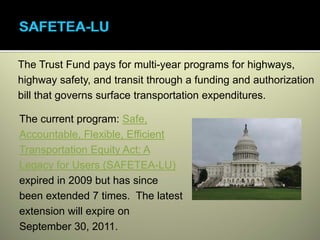
The current program: Safe,
Accountable, Flexible, Efficient
Transportation Equity Act: A
Legacy for Users (SAFETEA-LU)
expired in 2009 but has since
been extended 7 times. The latest
extension will expire on
September 30, 2011.
There could be another extension to SAFETEA-LU, an
entirely new program, or States could be left to fend for
themselves until there is a new authorization bill.

A new $339 billion surface transportation bill has received
the unanimous support of the U.S. Senate Environment
and Public Works Committee as of July 21, 2011.

The name of the Senate Bill is “Moving Ahead for
Progress in the 21st Century” or “MAP21”.
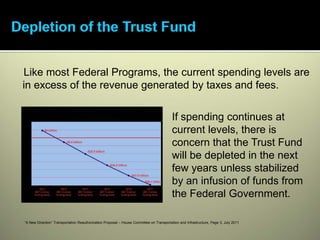
Like most Federal Programs, the current spending levels are
in excess of the revenue generated by taxes and fees.

                                                                                          If spending continues at
                                                                                          current levels, there is
                                                                                          concern that the Trust Fund
                                                                                          will be depleted in the next
                                                                                          few years unless stabilized
                                                                                          by an infusion of funds from
                                                                                          the Federal Government.

“A New Direction” Transportation Reauthorization Proposal – House Committee on Transportation and Infrastructure, Page 3, July 2011
For years, Federal funding given to local municipalities
from the Highway Bridge Replacement and
Rehabilitation Program (HBRRP) had been limited to
bridge replacement or major rehabilitation.

On January 11, 2002 the Federal Highway
Administration opened the door for HBRRP funding to
be used for preventive maintenance activities on
Federal-aid highway bridges.1
1. January 11, 2002 Memo King W. Gee, Program Manager to Division Administrators
On October 8, 2004 the Federal Highway Administration
clarified its position on HBRRP funding for preventive
maintenance activities on Federal-aid highway bridges.2

“...Timely preventive maintenance and preservation activities are
necessary to ensure proper performance of the transportation
infrastructure...”

“...Preventive maintenance offers State DOT's a way of increasing
the return on their infrastructure investment...”

2. October 8, 2004 Memo King W. Gee, Program Manager to Division Administrators
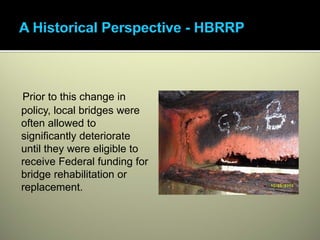
Prior to this change in
policy, local bridges were
often allowed to
significantly deteriorate
until they were eligible to
receive Federal funding for
bridge rehabilitation or
replacement.
Metropolitan Planning Organizations (MPOs) were created for
urbanized areas with a population greater than 50,000 to assure
that Federal funds are expended using a comprehensive planning
process.

For rural or non-urban areas, NYSDOT
is responsible for programming
Federally funded projects.

MPOs develop the Statewide
Transportation Improvement Program
(STIP) which is a list of all transportation
projects in New York proposed for
Federal funding.
Owners are required to develop a Bridge
Maintenance Program to access HBRRP funds.

Approved Bridge Maintenance Programs are
eligible for 80% Federal Funding.

There is still a 20 % Local Match required.

Unfortunately, Marchiselli funds are not available for
this program to assist with the local share.
A strategy for preventative bridge maintenance
activities that describes:

 Cyclical Maintenance Activities that will be planned on
 an annual basis;
 Corrective Maintenance Activities that will be planned
 assuming a cyclical maintenance program has been
 developed and implemented;
 Approximate unit costs per bridge per activity based
 on material and type of bridge;
 Proposed frequencies of each activity; and,
 Approximate Total Annual Cost of the program.
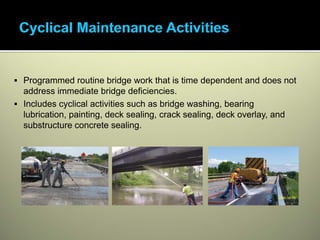
Programmed routine bridge work that is time dependent and does not
address immediate bridge deficiencies.
Includes cyclical activities such as bridge washing, bearing
lubrication, painting, deck sealing, crack sealing, deck overlay, and
substructure concrete sealing.
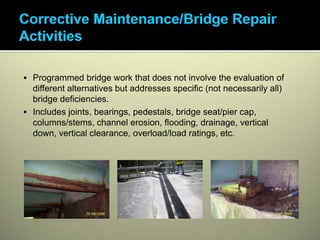
Programmed bridge work that does not involve the evaluation of
different alternatives but addresses specific (not necessarily all)
bridge deficiencies.
Includes joints, bearings, pedestals, bridge seat/pier cap,
columns/stems, channel erosion, flooding, drainage, vertical
down, vertical clearance, overload/load ratings, etc.
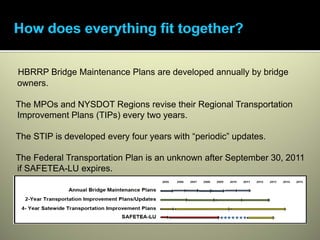
HBRRP Bridge Maintenance Plans are developed annually by bridge
owners.

The MPOs and NYSDOT Regions revise their Regional Transportation
Improvement Plans (TIPs) every two years.

The STIP is developed every four years with “periodic” updates.

The Federal Transportation Plan is an unknown after September 30, 2011
if SAFETEA-LU expires.
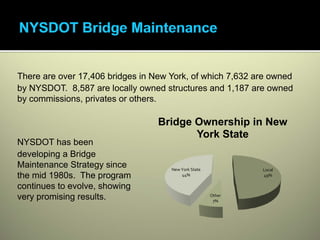
There are over 17,406 bridges in New York, of which 7,632 are owned
by NYSDOT. 8,587 are locally owned structures and 1,187 are owned
by commissions, privates or others.

                                  Bridge Ownership in New
                                         York State
NYSDOT has been
developing a Bridge
Maintenance Strategy since           New York State           Local
the mid 1980s. The program               44%                  49%

continues to evolve, showing
very promising results.                               Other
                                                       7%
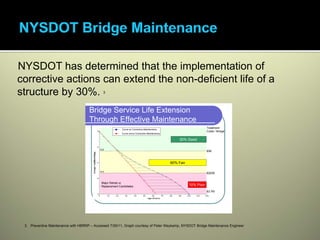
NYSDOT has determined that the implementation of
corrective actions can extend the non-deficient life of a
structure by 30%.                            3


                                     Bridge Service Life Extension
                                     Through Effective Maintenance
                                                                                                                     Treatment
                                                          Curve w/ Corrective Maintenance
                                                                                                                     Costs / Bridge
                                                          Curve w/out Corrective Maintenance

                                                                                                    30% Good

                                           5.8
                                                                                                                     $5K


                                                                                               60% Fair

                                           4.4
                                                                                                                     $250K


                                            Major Rehab or
                                            Replacement Candidates                                        10% Poor
                                                                                                                     $3.7M


 3. Preventive Maintenance with HBRRP – Accessed 7/29/11, Graph courtesy of Peter Weykamp, NYSDOT Bridge Maintenance Engineer
Niagara County is located in NYSDOT Region 5 and is a part
of the Greater Buffalo-Niagara Regional Transportation
Commission (MPO).

Niagara County’s Bridge Maintenance Program is funded with
80% Federal money.

Niagara County tax payers fund 20% the Niagara County
Bridge Maintenance Program.
Federally Funded
bridge Maintenance:
Niagara County
together with others
worked through our
MPO to allow federal
funds to be used for
80% of the cost for
bridge preventive and
corrective maintenance.
The Niagara County Inventory of Bridges

 We believe we have 88 bridges. NYSDOT
 believes we have 90 bridges.

 88 bridges represent 124 bridge spans and
 an average bridge length of 69’.
PROGRAM DEVELOPMENT HISTORY

 Maintenance saves money

 “No washee no checkee!”

 The Color of Money

 Federally Funded Bridge
 Maintenance

 Bridge maintenance is not a
 capital expense
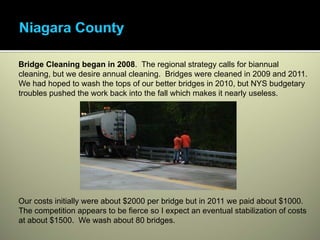
Bridge Cleaning began in 2008. The regional strategy calls for biannual
cleaning, but we desire annual cleaning. Bridges were cleaned in 2009 and 2011.
We had hoped to wash the tops of our better bridges in 2010, but NYS budgetary
troubles pushed the work back into the fall which makes it nearly useless.


Our costs initially were about $2000 per bridge but in 2011 we paid about $1000.
The competition appears to be fierce so I expect an eventual stabilization of costs
at about $1500. We wash about 80 bridges.
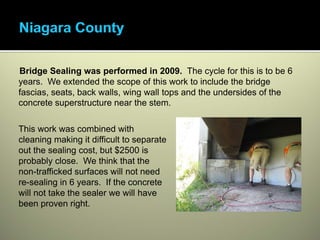
Bridge Sealing was performed in 2009. The cycle for this is to be 6
years. We extended the scope of this work to include the bridge
fascias, seats, back walls, wing wall tops and the undersides of the
concrete superstructure near the stem.

This work was combined with
cleaning making it difficult to separate
out the sealing cost, but $2500 is
probably close. We think that the
non-trafficked surfaces will not need
re-sealing in 6 years. If the concrete
will not take the sealer we will have
been proven right.
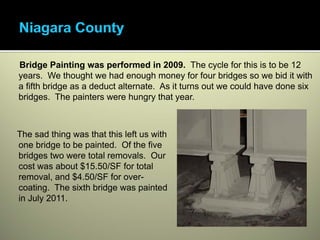
Bridge Painting was performed in 2009. The cycle for this is to be 12
years. We thought we had enough money for four bridges so we bid it with
a fifth bridge as a deduct alternate. As it turns out we could have done six
bridges. The painters were hungry that year.


The sad thing was that this left us with
one bridge to be painted. Of the five
bridges two were total removals. Our
cost was about $15.50/SF for total
removal, and $4.50/SF for over-
coating. The sixth bridge was painted
in July 2011.
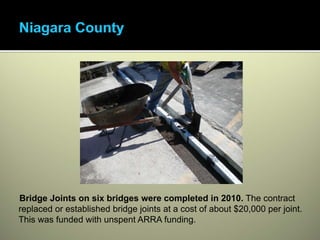
Bridge Joints on six bridges were completed in 2010. The contract
replaced or established bridge joints at a cost of about $20,000 per joint.
This was funded with unspent ARRA funding.
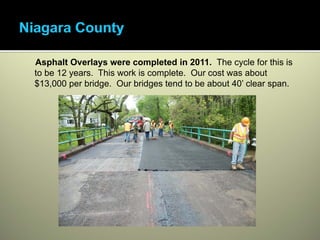
Asphalt Overlays were completed in 2011. The cycle for this is
to be 12 years. This work is complete. Our cost was about
$13,000 per bridge. Our bridges tend to be about 40’ clear span.
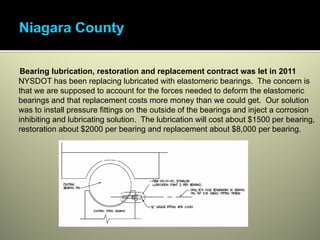
Bearing lubrication, restoration and replacement contract was let in 2011
NYSDOT has been replacing lubricated with elastomeric bearings. The concern is
that we are supposed to account for the forces needed to deform the elastomeric
bearings and that replacement costs more money than we could get. Our solution
was to install pressure fittings on the outside of the bearings and inject a corrosion
inhibiting and lubricating solution. The lubrication will cost about $1500 per bearing,
restoration about $2000 per bearing and replacement about $8,000 per bearing.
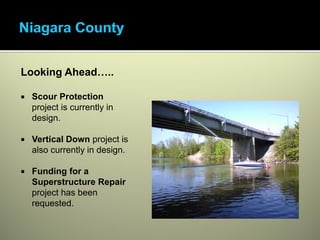
Looking Ahead…..

 Scour Protection
 project is currently in
 design.

 Vertical Down project is
 also currently in design.

 Funding for a
 Superstructure Repair
 project has been
 requested.
Selecting our maintenance project candidates:
  A bridge programmed for replacement does not receive any
  maintenance work. We will however perform preventive
  maintenance on bridge programmed for rehabilitation.

  The County Bridge Spreadsheet: Starting about 2000 we began
  keeping some of our bridge data (entered by hand) in one
  spreadsheet for all bridges, and for various purposes.

  Now we copy and paste the latest WinBolts, selected data only,
  into the County Bridge Spreadsheet.
Selecting our maintenance project candidates:
  The County Bridge Spreadsheet we developed uses a series of
  logical tests such as condition ratings and program status to
  generate numbers for the bridge categories for the annual Bridge
  Maintenance Strategy.

  The spreadsheet also uses logical tests such as element condition
  ratings, type of construction, year of latest maintenance etc. to flag
  qualifying bridges for each maintenance program, and to create a
  list of BINs.

  The Region reviews the Bridge Maintenance Strategies submitted
  by the locals, contacts us with questions, discusses our priorities, and
  later notifies of us which programs will be funded and to what
  extent.
Lessons Learned:

 You can develop your program to suit your needs.

 The application of eligibility rules is not completely rigid. This is
 particularly noteworthy if you have erroneous ratings.

 Within limits the funding can be adjusted.

 You might be allowed to create a new program such as annual
 bridge washing rather than biannual.

 Group bridges for cyclical work.
Lessons Learned:
 Group similar work into one contract.

 Give the entire scope of work needed some serious thought
 before submitting an estimate. Where experience is lacking
 forethought must be multiplied.

 Keep track of your list of BINs.

 Since these projects are difficult to estimate the first time, consider
 using deduct alternates so you can fit the contract based on the
 bids received to the funding available.
Lessons Learned:
 The candidates for any of the paving work will be a moving target
 particularly if your towns pave over your bridges without telling you
 before or after.

 Be careful with Inter-municipal agreements for preventive
 maintenance projects!!! The Agreement process is onerous.

 It makes the most sense to clean the bridges as soon as possible
 after the last likely application of salt.

 Washing and sealing contractors are not familiar with NYSDOT
 specs and process or federal laws. You have to walk them
 through it all.
•Access will be a large part of the cost.


      Lessons Learned:
           Access will be a large part of the cost.

          Give thought to whether multiple contractors will have to work on
          the same bridge at the same time.

          The inspection effort has to be planned and re-planned.

          The Bridge Maintenance Strategy is a living document that is
          revised rather than rewritten every year.

           Funding is limited so NYSDOT will ask you to prioritize the
          programs.
•Access will be a large part of the cost.


      Lessons Learned:
          Maintain new bridge immediately. This means sealing the concrete as
          part of the construction contract.

          Selective repairs of key bridges could give you a “like new” bridge.

          Crawl then walk then run.
Allegany County is located in NYSDOT Region 6 and is not
represented by an MPO.

No Federal money is used in our Bridge Maintenance
Program.

Allegany County tax payers fund the Allegany County Bridge
Maintenance Program.
The Allegany County Inventory of Bridges

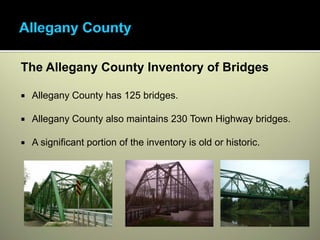
 Allegany County has 125 bridges.

 Allegany County also maintains 230 Town Highway bridges.

 A significant portion of the inventory is old or historic.
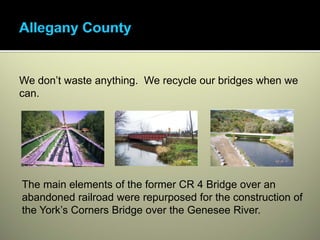
We don’t waste anything. We recycle our bridges when we
can.


The main elements of the former CR 4 Bridge over an
abandoned railroad were repurposed for the construction of
the York’s Corners Bridge over the Genesee River.
Each February, Allegany County contacts each of the Town
and Village Highway Superintendents to identify their bridge
maintenance needs.

A list of candidate bridges are reviewed by the Public Works
Committee.

Bridge maintenance projects are selected based on need
feasibility and budget.
A key component of the Allegany County Bridge Maintenance
Program is shared services with the Towns and Villages.

The County works closely with the Allegany County Town and
Village Superintendent of Highways Association to execute
Shared Services Agreements with the Association Members.

Allegany County shares engineering, labor and equipment
with the Towns and Villages.

The Towns and Villages provide all of the materials for their
Bridge Maintenance activities.
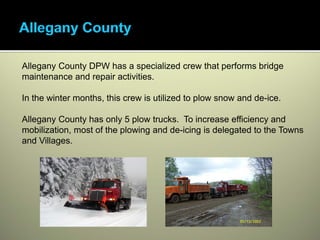
Allegany County DPW has a specialized crew that performs bridge
maintenance and repair activities.

In the winter months, this crew is utilized to plow snow and de-ice.

Allegany County has only 5 plow trucks. To increase efficiency and
mobilization, most of the plowing and de-icing is delegated to the Towns
and Villages.
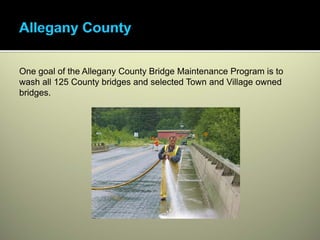
One goal of the Allegany County Bridge Maintenance Program is to
wash all 125 County bridges and selected Town and Village owned
bridges.
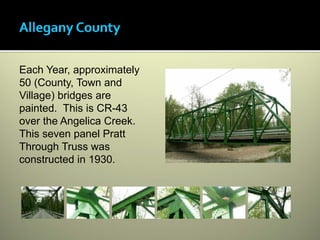
Each Year, approximately
50 (County, Town and
Village) bridges are
painted. This is CR-43
over the Angelica Creek.
This seven panel Pratt
Through Truss was
constructed in 1930.
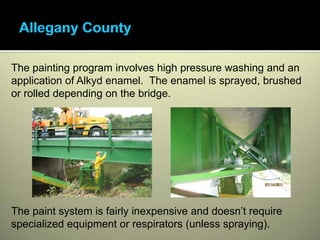
The painting program involves high pressure washing and an
application of Alkyd enamel. The enamel is sprayed, brushed
or rolled depending on the bridge.


The paint system is fairly inexpensive and doesn’t require
specialized equipment or respirators (unless spraying).
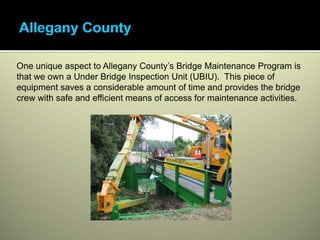
One unique aspect to Allegany County’s Bridge Maintenance Program is
that we own a Under Bridge Inspection Unit (UBIU). This piece of
equipment saves a considerable amount of time and provides the bridge
crew with safe and efficient means of access for maintenance activities.
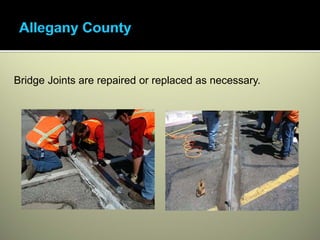
Bridge Joints are repaired or replaced as necessary.
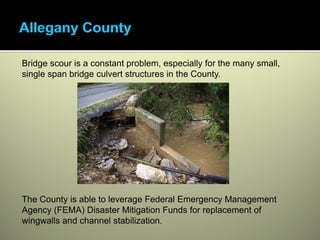
Bridge scour is a constant problem, especially for the many small,
single span bridge culvert structures in the County.


The County is able to leverage Federal Emergency Management
Agency (FEMA) Disaster Mitigation Funds for replacement of
wingwalls and channel stabilization.
The advantages of the Allegany County Bridge
Maintenance Program include:

 The budget is clearly defined – no uncertainty concerning
the MPO’s TIP, the NYSDOT STIP or the Federal
Transportation Bill.

 Low administrative costs – more money for bridge
maintenance activities.

 There is no waiting for reimbursement.
HBRRP is an acronym for.


Highway Bridge Replacement and Rehabilitation Program.
What is the Local Share for Federal HBRRP funds?


HBRRP provides 80% funding for eligible costs, while 20%
comes from local funds.
What is the name of the current funding and authorization
bill that governs Federal spending for surface
transportation?


The Safe, Accountable, Flexible, Efficient Transportation Equity
Act: A Legacy For Users or SAFETEA-LU.
How much Federal tax is collected from the sale of every
gallon of gasoline?

Since 1993 the federal tax on gasoline has been18.4 cents
per gallon.
Name 3 Federal aid eligible Cyclical Maintenance Activities.


There are seven:

Joints
Bearing lubrication
Painting
Deck sealing
Crack sealing
Deck overlay
Substructure concrete sealing.
Name 3 Federal aid eligible Corrective Maintenance/Bridge
Repair Activities.

There are many:

Bridge washing
Bearings
Pedestals
Bridge seat/pier cap
Columns/stems
Channel erosion
Vertical down
Vertical clearance
Overload/load ratings
There are an estimated 17,406 bridges in New York State.
How many are locally owned?


Approximately 44% or 8,587 bridges are locally owned.
What is an MPO?


MPOs are Metropolitan Planning Organizations. MPOs are
responsible for transportation planning activities in
metropolitan areas with populations greater than 50,000.
True of False? The NYSDOT has determined that the
implementation of corrective actions can extend the non-
deficient life of a structure by 30%.

True
Where does the money for Bridge Maintenance come from?


It really doesn’t matter if its Federal, State or Local money,
the money comes from the taxpayers - you and I.

Stretching Dollars with Bridge Maintenance

  • 1.
    NEW YORK STATE COUNTYHIGHWAY SUPERINTENDENTS ASSOCIATION Stretching Your Dollars with Bridge Maintenance August, 2011 Alexandria Bay, New York
  • 2.
    Understand how thetaxes we pay are returned to us for local projects. Understand how Federal HBRRP funds can be captured for local bridge maintenance activities. Not everyone uses Federal funds for bridge maintenance. Understand the difference between cyclical maintenance activities and corrective maintenance/repair projects. Compare and contrast Federally funded and Locally funded Bridge Maintenance programs.
  • 3.
    The Highway RevenueAct of 1956 created the Highway Trust Fund. Established to finance transportation projects, including the Interstate Highway System. Funded by 18.4 cents excise tax collected from the purchase of every gallon of gasoline.
  • 4.
    The Trust Fundpays for multi-year programs for highways, highway safety, and transit through a funding and authorization bill that governs surface transportation expenditures. The current program: Safe, Accountable, Flexible, Efficient Transportation Equity Act: A Legacy for Users (SAFETEA-LU) expired in 2009 but has since been extended 7 times. The latest extension will expire on September 30, 2011.
  • 5.
    There could beanother extension to SAFETEA-LU, an entirely new program, or States could be left to fend for themselves until there is a new authorization bill. A new $339 billion surface transportation bill has received the unanimous support of the U.S. Senate Environment and Public Works Committee as of July 21, 2011. The name of the Senate Bill is “Moving Ahead for Progress in the 21st Century” or “MAP21”.
  • 6.
    Like most FederalPrograms, the current spending levels are in excess of the revenue generated by taxes and fees. If spending continues at current levels, there is concern that the Trust Fund will be depleted in the next few years unless stabilized by an infusion of funds from the Federal Government. “A New Direction” Transportation Reauthorization Proposal – House Committee on Transportation and Infrastructure, Page 3, July 2011
  • 7.
    For years, Federalfunding given to local municipalities from the Highway Bridge Replacement and Rehabilitation Program (HBRRP) had been limited to bridge replacement or major rehabilitation. On January 11, 2002 the Federal Highway Administration opened the door for HBRRP funding to be used for preventive maintenance activities on Federal-aid highway bridges.1 1. January 11, 2002 Memo King W. Gee, Program Manager to Division Administrators
  • 8.
    On October 8,2004 the Federal Highway Administration clarified its position on HBRRP funding for preventive maintenance activities on Federal-aid highway bridges.2 “...Timely preventive maintenance and preservation activities are necessary to ensure proper performance of the transportation infrastructure...” “...Preventive maintenance offers State DOT's a way of increasing the return on their infrastructure investment...” 2. October 8, 2004 Memo King W. Gee, Program Manager to Division Administrators
  • 9.
    Prior to thischange in policy, local bridges were often allowed to significantly deteriorate until they were eligible to receive Federal funding for bridge rehabilitation or replacement.
  • 10.
    Metropolitan Planning Organizations(MPOs) were created for urbanized areas with a population greater than 50,000 to assure that Federal funds are expended using a comprehensive planning process. For rural or non-urban areas, NYSDOT is responsible for programming Federally funded projects. MPOs develop the Statewide Transportation Improvement Program (STIP) which is a list of all transportation projects in New York proposed for Federal funding.
  • 11.
    Owners are requiredto develop a Bridge Maintenance Program to access HBRRP funds. Approved Bridge Maintenance Programs are eligible for 80% Federal Funding. There is still a 20 % Local Match required. Unfortunately, Marchiselli funds are not available for this program to assist with the local share.
  • 12.
    A strategy forpreventative bridge maintenance activities that describes: Cyclical Maintenance Activities that will be planned on an annual basis; Corrective Maintenance Activities that will be planned assuming a cyclical maintenance program has been developed and implemented; Approximate unit costs per bridge per activity based on material and type of bridge; Proposed frequencies of each activity; and, Approximate Total Annual Cost of the program.
  • 13.
    Programmed routine bridgework that is time dependent and does not address immediate bridge deficiencies. Includes cyclical activities such as bridge washing, bearing lubrication, painting, deck sealing, crack sealing, deck overlay, and substructure concrete sealing.
  • 14.
    Programmed bridge workthat does not involve the evaluation of different alternatives but addresses specific (not necessarily all) bridge deficiencies. Includes joints, bearings, pedestals, bridge seat/pier cap, columns/stems, channel erosion, flooding, drainage, vertical down, vertical clearance, overload/load ratings, etc.
  • 15.
    HBRRP Bridge MaintenancePlans are developed annually by bridge owners. The MPOs and NYSDOT Regions revise their Regional Transportation Improvement Plans (TIPs) every two years. The STIP is developed every four years with “periodic” updates. The Federal Transportation Plan is an unknown after September 30, 2011 if SAFETEA-LU expires.
  • 16.
    There are over17,406 bridges in New York, of which 7,632 are owned by NYSDOT. 8,587 are locally owned structures and 1,187 are owned by commissions, privates or others. Bridge Ownership in New York State NYSDOT has been developing a Bridge Maintenance Strategy since New York State Local the mid 1980s. The program 44% 49% continues to evolve, showing very promising results. Other 7%
  • 17.
    NYSDOT has determinedthat the implementation of corrective actions can extend the non-deficient life of a structure by 30%. 3 Bridge Service Life Extension Through Effective Maintenance Treatment Curve w/ Corrective Maintenance Costs / Bridge Curve w/out Corrective Maintenance 30% Good 5.8 $5K 60% Fair 4.4 $250K Major Rehab or Replacement Candidates 10% Poor $3.7M 3. Preventive Maintenance with HBRRP – Accessed 7/29/11, Graph courtesy of Peter Weykamp, NYSDOT Bridge Maintenance Engineer
  • 18.
    Niagara County islocated in NYSDOT Region 5 and is a part of the Greater Buffalo-Niagara Regional Transportation Commission (MPO). Niagara County’s Bridge Maintenance Program is funded with 80% Federal money. Niagara County tax payers fund 20% the Niagara County Bridge Maintenance Program.
  • 19.
    Federally Funded bridge Maintenance: NiagaraCounty together with others worked through our MPO to allow federal funds to be used for 80% of the cost for bridge preventive and corrective maintenance.
  • 20.
    The Niagara CountyInventory of Bridges We believe we have 88 bridges. NYSDOT believes we have 90 bridges. 88 bridges represent 124 bridge spans and an average bridge length of 69’.
  • 21.
    PROGRAM DEVELOPMENT HISTORY Maintenance saves money “No washee no checkee!” The Color of Money Federally Funded Bridge Maintenance Bridge maintenance is not a capital expense
  • 22.
    Bridge Cleaning beganin 2008. The regional strategy calls for biannual cleaning, but we desire annual cleaning. Bridges were cleaned in 2009 and 2011. We had hoped to wash the tops of our better bridges in 2010, but NYS budgetary troubles pushed the work back into the fall which makes it nearly useless. Our costs initially were about $2000 per bridge but in 2011 we paid about $1000. The competition appears to be fierce so I expect an eventual stabilization of costs at about $1500. We wash about 80 bridges.
  • 23.
    Bridge Sealing wasperformed in 2009. The cycle for this is to be 6 years. We extended the scope of this work to include the bridge fascias, seats, back walls, wing wall tops and the undersides of the concrete superstructure near the stem. This work was combined with cleaning making it difficult to separate out the sealing cost, but $2500 is probably close. We think that the non-trafficked surfaces will not need re-sealing in 6 years. If the concrete will not take the sealer we will have been proven right.
  • 24.
    Bridge Painting wasperformed in 2009. The cycle for this is to be 12 years. We thought we had enough money for four bridges so we bid it with a fifth bridge as a deduct alternate. As it turns out we could have done six bridges. The painters were hungry that year. The sad thing was that this left us with one bridge to be painted. Of the five bridges two were total removals. Our cost was about $15.50/SF for total removal, and $4.50/SF for over- coating. The sixth bridge was painted in July 2011.
  • 25.
    Bridge Joints onsix bridges were completed in 2010. The contract replaced or established bridge joints at a cost of about $20,000 per joint. This was funded with unspent ARRA funding.
  • 26.
    Asphalt Overlays werecompleted in 2011. The cycle for this is to be 12 years. This work is complete. Our cost was about $13,000 per bridge. Our bridges tend to be about 40’ clear span.
  • 27.
    Bearing lubrication, restorationand replacement contract was let in 2011 NYSDOT has been replacing lubricated with elastomeric bearings. The concern is that we are supposed to account for the forces needed to deform the elastomeric bearings and that replacement costs more money than we could get. Our solution was to install pressure fittings on the outside of the bearings and inject a corrosion inhibiting and lubricating solution. The lubrication will cost about $1500 per bearing, restoration about $2000 per bearing and replacement about $8,000 per bearing.
  • 28.
    Looking Ahead….. ScourProtection project is currently in design. Vertical Down project is also currently in design. Funding for a Superstructure Repair project has been requested.
  • 29.
    Selecting our maintenanceproject candidates: A bridge programmed for replacement does not receive any maintenance work. We will however perform preventive maintenance on bridge programmed for rehabilitation. The County Bridge Spreadsheet: Starting about 2000 we began keeping some of our bridge data (entered by hand) in one spreadsheet for all bridges, and for various purposes. Now we copy and paste the latest WinBolts, selected data only, into the County Bridge Spreadsheet.
  • 30.
    Selecting our maintenanceproject candidates: The County Bridge Spreadsheet we developed uses a series of logical tests such as condition ratings and program status to generate numbers for the bridge categories for the annual Bridge Maintenance Strategy. The spreadsheet also uses logical tests such as element condition ratings, type of construction, year of latest maintenance etc. to flag qualifying bridges for each maintenance program, and to create a list of BINs. The Region reviews the Bridge Maintenance Strategies submitted by the locals, contacts us with questions, discusses our priorities, and later notifies of us which programs will be funded and to what extent.
  • 31.
    Lessons Learned: Youcan develop your program to suit your needs. The application of eligibility rules is not completely rigid. This is particularly noteworthy if you have erroneous ratings. Within limits the funding can be adjusted. You might be allowed to create a new program such as annual bridge washing rather than biannual. Group bridges for cyclical work.
  • 32.
    Lessons Learned: Groupsimilar work into one contract. Give the entire scope of work needed some serious thought before submitting an estimate. Where experience is lacking forethought must be multiplied. Keep track of your list of BINs. Since these projects are difficult to estimate the first time, consider using deduct alternates so you can fit the contract based on the bids received to the funding available.
  • 33.
    Lessons Learned: Thecandidates for any of the paving work will be a moving target particularly if your towns pave over your bridges without telling you before or after. Be careful with Inter-municipal agreements for preventive maintenance projects!!! The Agreement process is onerous. It makes the most sense to clean the bridges as soon as possible after the last likely application of salt. Washing and sealing contractors are not familiar with NYSDOT specs and process or federal laws. You have to walk them through it all.
  • 34.
    •Access will bea large part of the cost. Lessons Learned: Access will be a large part of the cost. Give thought to whether multiple contractors will have to work on the same bridge at the same time. The inspection effort has to be planned and re-planned. The Bridge Maintenance Strategy is a living document that is revised rather than rewritten every year. Funding is limited so NYSDOT will ask you to prioritize the programs.
  • 35.
    •Access will bea large part of the cost. Lessons Learned: Maintain new bridge immediately. This means sealing the concrete as part of the construction contract. Selective repairs of key bridges could give you a “like new” bridge. Crawl then walk then run.
  • 36.
    Allegany County islocated in NYSDOT Region 6 and is not represented by an MPO. No Federal money is used in our Bridge Maintenance Program. Allegany County tax payers fund the Allegany County Bridge Maintenance Program.
  • 37.
    The Allegany CountyInventory of Bridges Allegany County has 125 bridges. Allegany County also maintains 230 Town Highway bridges. A significant portion of the inventory is old or historic.
  • 38.
    We don’t wasteanything. We recycle our bridges when we can. The main elements of the former CR 4 Bridge over an abandoned railroad were repurposed for the construction of the York’s Corners Bridge over the Genesee River.
  • 39.
    Each February, AlleganyCounty contacts each of the Town and Village Highway Superintendents to identify their bridge maintenance needs. A list of candidate bridges are reviewed by the Public Works Committee. Bridge maintenance projects are selected based on need feasibility and budget.
  • 40.
    A key componentof the Allegany County Bridge Maintenance Program is shared services with the Towns and Villages. The County works closely with the Allegany County Town and Village Superintendent of Highways Association to execute Shared Services Agreements with the Association Members. Allegany County shares engineering, labor and equipment with the Towns and Villages. The Towns and Villages provide all of the materials for their Bridge Maintenance activities.
  • 41.
    Allegany County DPWhas a specialized crew that performs bridge maintenance and repair activities. In the winter months, this crew is utilized to plow snow and de-ice. Allegany County has only 5 plow trucks. To increase efficiency and mobilization, most of the plowing and de-icing is delegated to the Towns and Villages.
  • 42.
    One goal ofthe Allegany County Bridge Maintenance Program is to wash all 125 County bridges and selected Town and Village owned bridges.
  • 43.
    Each Year, approximately 50(County, Town and Village) bridges are painted. This is CR-43 over the Angelica Creek. This seven panel Pratt Through Truss was constructed in 1930.
  • 44.
    The painting programinvolves high pressure washing and an application of Alkyd enamel. The enamel is sprayed, brushed or rolled depending on the bridge. The paint system is fairly inexpensive and doesn’t require specialized equipment or respirators (unless spraying).
  • 45.
    One unique aspectto Allegany County’s Bridge Maintenance Program is that we own a Under Bridge Inspection Unit (UBIU). This piece of equipment saves a considerable amount of time and provides the bridge crew with safe and efficient means of access for maintenance activities.
  • 46.
    Bridge Joints arerepaired or replaced as necessary.
  • 47.
    Bridge scour isa constant problem, especially for the many small, single span bridge culvert structures in the County. The County is able to leverage Federal Emergency Management Agency (FEMA) Disaster Mitigation Funds for replacement of wingwalls and channel stabilization.
  • 48.
    The advantages ofthe Allegany County Bridge Maintenance Program include: The budget is clearly defined – no uncertainty concerning the MPO’s TIP, the NYSDOT STIP or the Federal Transportation Bill. Low administrative costs – more money for bridge maintenance activities. There is no waiting for reimbursement.
  • 49.
    HBRRP is anacronym for. Highway Bridge Replacement and Rehabilitation Program.
  • 50.
    What is theLocal Share for Federal HBRRP funds? HBRRP provides 80% funding for eligible costs, while 20% comes from local funds.
  • 51.
    What is thename of the current funding and authorization bill that governs Federal spending for surface transportation? The Safe, Accountable, Flexible, Efficient Transportation Equity Act: A Legacy For Users or SAFETEA-LU.
  • 52.
    How much Federaltax is collected from the sale of every gallon of gasoline? Since 1993 the federal tax on gasoline has been18.4 cents per gallon.
  • 53.
    Name 3 Federalaid eligible Cyclical Maintenance Activities. There are seven: Joints Bearing lubrication Painting Deck sealing Crack sealing Deck overlay Substructure concrete sealing.
  • 54.
    Name 3 Federalaid eligible Corrective Maintenance/Bridge Repair Activities. There are many: Bridge washing Bearings Pedestals Bridge seat/pier cap Columns/stems Channel erosion Vertical down Vertical clearance Overload/load ratings
  • 55.
    There are anestimated 17,406 bridges in New York State. How many are locally owned? Approximately 44% or 8,587 bridges are locally owned.
  • 56.
    What is anMPO? MPOs are Metropolitan Planning Organizations. MPOs are responsible for transportation planning activities in metropolitan areas with populations greater than 50,000.
  • 57.
    True of False?The NYSDOT has determined that the implementation of corrective actions can extend the non- deficient life of a structure by 30%. True
  • 58.
    Where does themoney for Bridge Maintenance come from? It really doesn’t matter if its Federal, State or Local money, the money comes from the taxpayers - you and I.