
GROUP MEMBERS:
INTRODUCTION…
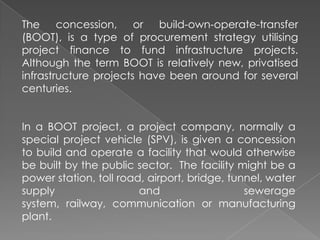
The concession, or build-own-operate-transfer
(BOOT), is a type of procurement strategy utilising
project finance to fund infrastructure projects.
Although the term BOOT is relatively new, privatised
infrastructure projects have been around for several
centuries.


In a BOOT project, a project company, normally a
special project vehicle (SPV), is given a concession
to build and operate a facility that would otherwise
be built by the public sector. The facility might be a
power station, toll road, airport, bridge, tunnel, water
supply                  and                   sewerage
system, railway, communication or manufacturing
plant.
STRUCTURE OF BOOT
PROJECTS…
PRINCIPLE


                        CONSESSION
                        AGREEMENT


                                        OFF-TAKE
                                       CONTRACT
                                                       USERS
             SUPPLY
SUPPLIER    CONTRACT


                                       OPERATION
LENDERS       LOAN      PROMOTER       CONTRACT     OPERATOR
            AGREEMENT


              LOAN
INVESTORS   AGREEMENT                CONSTRUCTION   CONSTRUCTOR
                                      CONTRACT
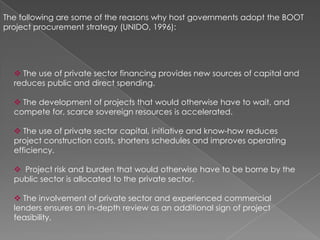
The following are some of the reasons why host governments adopt the BOOT
project procurement strategy (UNIDO, 1996):


   The use of private sector financing provides new sources of capital and
  reduces public and direct spending.

   The development of projects that would otherwise have to wait, and
  compete for, scarce sovereign resources is accelerated.

   The use of private sector capital, initiative and know-how reduces
  project construction costs, shortens schedules and improves operating
  efficiency.

   Project risk and burden that would otherwise have to be borne by the
  public sector is allocated to the private sector.

   The involvement of private sector and experienced commercial
  lenders ensures an in-depth review as an additional sign of project
  feasibility.
CONDITIONS FOR SUCCESSFUL
IMPLEMENTATION OF BOOT
PROJECTS
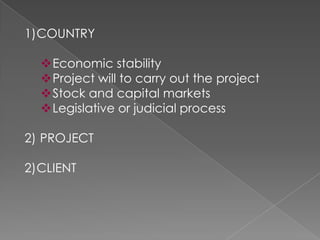
1)COUNTRY

  Economic stability
  Project will to carry out the project
  Stock and capital markets
  Legislative or judicial process

2) PROJECT

2)CLIENT
CASE STUDY!!!
INTRODUCTION…
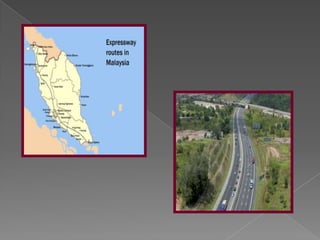
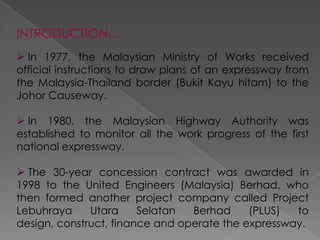
 In 1977, the Malaysian Ministry of Works received
official instructions to draw plans of an expressway from
the Malaysia-Thailand border (Bukit Kayu hitam) to the
Johor Causeway.

 In 1980, the Malaysian Highway Authority was
established to monitor all the work progress of the first
national expressway.

 The 30-year concession contract was awarded in
1998 to the United Engineers (Malaysia) Berhad, who
then formed another project company called Project
Lebuhraya     Utara     Selatan  Berhad     (PLUS)  to
design, construct, finance and operate the expressway.
BOOT STRUCTURE OF THE
PROJECT…
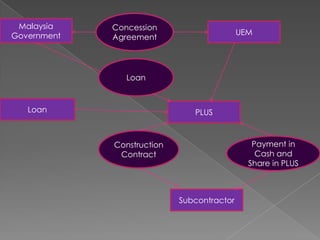
Malaysia    Concession
Government                                  UEM
             Agreement


                Loan


   Loan                        PLUS


             Construction                      Payment in
              Contract                          Cash and
                                              Share in PLUS


                            Subcontractor
a) BOOT projects offer the possibility of realising a project that would otherwise
   not be built.

b) The willingness of equity investors and lenders to accept the risk indicates
   that the project is commercially viable.

c) A BOOT project will help in a government’s policy of infrastructure
   privatisation.

d) The efficiency of the promoter and its economic interest in the
   design, construction and operation of the project will produce significant
   cost efficiencies to the principal when the concession period ends.
a) Commercial lenders and export credit guarantee agencies will be
   constrained by the same country risks.

b) There will be no credibility if the government provides too much support to
   the promoter.

c) A BOOT strategy is a highly complicated structure that requires detailed
   planning, time and money throughout the concession period. The
   promoter must have the commitment and interest to maintain the project.
The process of privatization and liberalization in Malaysia has been
motivated more by economic pragmatism than ideological
considerations. Mostly importantly, Malaysia embarked on a process of
restructuring the relationship between the public sector and the private
sector as a response to unsustainable domestic and external conditions.
The poor performance of public enterprises and the high levels of
budgetary deficits acted in concert with a reversal of the buoyant prices
for Malaysian exports to usher in an era of change.

Build,Operate,Own,Transfer (BOOT)

  • 1.
  • 2.
  • 3.
    The concession, orbuild-own-operate-transfer (BOOT), is a type of procurement strategy utilising project finance to fund infrastructure projects. Although the term BOOT is relatively new, privatised infrastructure projects have been around for several centuries. In a BOOT project, a project company, normally a special project vehicle (SPV), is given a concession to build and operate a facility that would otherwise be built by the public sector. The facility might be a power station, toll road, airport, bridge, tunnel, water supply and sewerage system, railway, communication or manufacturing plant.
  • 4.
  • 5.
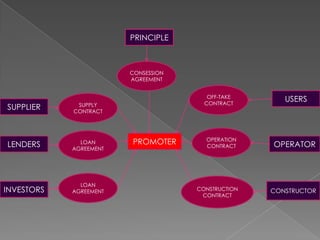
    PRINCIPLE CONSESSION AGREEMENT OFF-TAKE CONTRACT USERS SUPPLY SUPPLIER CONTRACT OPERATION LENDERS LOAN PROMOTER CONTRACT OPERATOR AGREEMENT LOAN INVESTORS AGREEMENT CONSTRUCTION CONSTRUCTOR CONTRACT
  • 6.
    The following aresome of the reasons why host governments adopt the BOOT project procurement strategy (UNIDO, 1996):  The use of private sector financing provides new sources of capital and reduces public and direct spending.  The development of projects that would otherwise have to wait, and compete for, scarce sovereign resources is accelerated.  The use of private sector capital, initiative and know-how reduces project construction costs, shortens schedules and improves operating efficiency.  Project risk and burden that would otherwise have to be borne by the public sector is allocated to the private sector.  The involvement of private sector and experienced commercial lenders ensures an in-depth review as an additional sign of project feasibility.
  • 7.
  • 8.
    1)COUNTRY Economicstability Project will to carry out the project Stock and capital markets Legislative or judicial process 2) PROJECT 2)CLIENT
  • 9.
  • 11.
    INTRODUCTION…  In 1977,the Malaysian Ministry of Works received official instructions to draw plans of an expressway from the Malaysia-Thailand border (Bukit Kayu hitam) to the Johor Causeway.  In 1980, the Malaysian Highway Authority was established to monitor all the work progress of the first national expressway.  The 30-year concession contract was awarded in 1998 to the United Engineers (Malaysia) Berhad, who then formed another project company called Project Lebuhraya Utara Selatan Berhad (PLUS) to design, construct, finance and operate the expressway.
  • 12.
    BOOT STRUCTURE OFTHE PROJECT…
  • 13.
    Malaysia Concession Government UEM Agreement Loan Loan PLUS Construction Payment in Contract Cash and Share in PLUS Subcontractor
  • 14.
    a) BOOT projectsoffer the possibility of realising a project that would otherwise not be built. b) The willingness of equity investors and lenders to accept the risk indicates that the project is commercially viable. c) A BOOT project will help in a government’s policy of infrastructure privatisation. d) The efficiency of the promoter and its economic interest in the design, construction and operation of the project will produce significant cost efficiencies to the principal when the concession period ends.
  • 15.
    a) Commercial lendersand export credit guarantee agencies will be constrained by the same country risks. b) There will be no credibility if the government provides too much support to the promoter. c) A BOOT strategy is a highly complicated structure that requires detailed planning, time and money throughout the concession period. The promoter must have the commitment and interest to maintain the project.
  • 16.
    The process ofprivatization and liberalization in Malaysia has been motivated more by economic pragmatism than ideological considerations. Mostly importantly, Malaysia embarked on a process of restructuring the relationship between the public sector and the private sector as a response to unsustainable domestic and external conditions. The poor performance of public enterprises and the high levels of budgetary deficits acted in concert with a reversal of the buoyant prices for Malaysian exports to usher in an era of change.