Scope and Sequence
for Presentations and Papers
MLA guide
Writing Guides and Parenthetical
Citations
Parenthetical Citations and
Works Cited
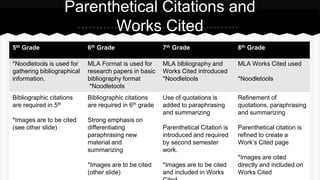
5th Grade 6th Grade 7th Grade 8th Grade
*Noodletools is used for
gathering bibliographical
information.
MLA Format is used for
research papers in basic
bibliography format
*Noodletools
MLA blbliography and
Works Cited introduced
*Noodletools
MLA Works Cited used
*Noodletools
Bibliographic citations
are required in 5th
*Images are to be cited
(see other slide)
Bibliographic citations
are required in 6th grade
Strong emphasis on
differentiating
paraphrasing new
material and
summarizing
*Images are to be cited
(other slide)
Use of quotations is
added to paraphrasing
and summarizing
Parenthetical Citation is
introduced and required
by second semester
work.
*Images are to be cited
and included in Works
Refinement of
quotations, paraphrasing
and summarizing
Parenthetical citation is
refined to create a
Work’s Cited page
*Images are cited
directly and included on
Works Cited
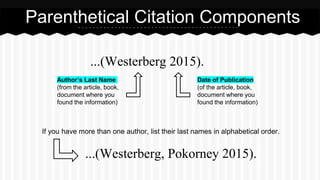
...(Westerberg 2015).
Parenthetical Citation Components
Author’s Last Name
(from the article, book,
document where you
found the information)
Date of Publication
(of the article, book,
document where you
found the information)
If you have more than one author, list their last names in alphabetical order.
...(Westerberg, Pokorney 2015).
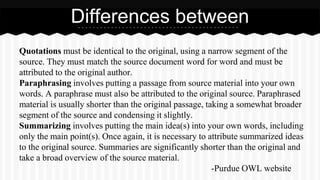
Quotations must be identical to the original, using a narrow segment of the
source. They must match the source document word for word and must be
attributed to the original author.
Paraphrasing involves putting a passage from source material into your own
words. A paraphrase must also be attributed to the original source. Paraphrased
material is usually shorter than the original passage, taking a somewhat broader
segment of the source and condensing it slightly.
Summarizing involves putting the main idea(s) into your own words, including
only the main point(s). Once again, it is necessary to attribute summarized ideas
to the original source. Summaries are significantly shorter than the original and
take a broad overview of the source material.
-Purdue OWL website
Differences between
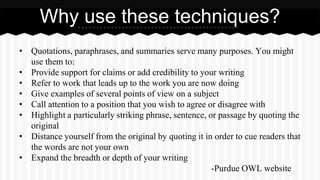
• Quotations, paraphrases, and summaries serve many purposes. You might
use them to:
• Provide support for claims or add credibility to your writing
• Refer to work that leads up to the work you are now doing
• Give examples of several points of view on a subject
• Call attention to a position that you wish to agree or disagree with
• Highlight a particularly striking phrase, sentence, or passage by quoting the
original
• Distance yourself from the original by quoting it in order to cue readers that
the words are not your own
• Expand the breadth or depth of your writing
-Purdue OWL website
Why use these techniques?
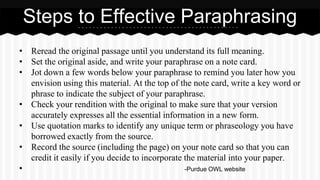
• Reread the original passage until you understand its full meaning.
• Set the original aside, and write your paraphrase on a note card.
• Jot down a few words below your paraphrase to remind you later how you
envision using this material. At the top of the note card, write a key word or
phrase to indicate the subject of your paraphrase.
• Check your rendition with the original to make sure that your version
accurately expresses all the essential information in a new form.
• Use quotation marks to identify any unique term or phraseology you have
borrowed exactly from the source.
• Record the source (including the page) on your note card so that you can
credit it easily if you decide to incorporate the material into your paper.
• -Purdue OWL website
Steps to Effective Paraphrasing
MLA Expectations and Images for
Presentations
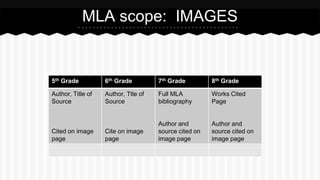
MLA scope: IMAGES
5th Grade 6th Grade 7th Grade 8th Grade
Author, Title of
Source
Cited on image
page
Author, Ttle of
Source
Cite on image
page
Full MLA
bibliography
Author and
source cited on
image page
Works Cited
Page
Author and
source cited on
image page
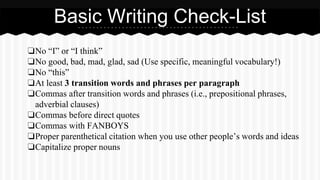
❏No “I” or “I think”
❏No good, bad, mad, glad, sad (Use specific, meaningful vocabulary!)
❏No “this”
❏At least 3 transition words and phrases per paragraph
❏Commas after transition words and phrases (i.e., prepositional phrases,
adverbial clauses)
❏Commas before direct quotes
❏Commas with FANBOYS
❏Proper parenthetical citation when you use other people’s words and ideas
❏Capitalize proper nouns
Basic Writing Check-List

Scope and Sequence MLA 2017

  • 1.
    Scope and Sequence forPresentations and Papers MLA guide
  • 2.
    Writing Guides andParenthetical Citations
  • 3.
    Parenthetical Citations and WorksCited 5th Grade 6th Grade 7th Grade 8th Grade *Noodletools is used for gathering bibliographical information. MLA Format is used for research papers in basic bibliography format *Noodletools MLA blbliography and Works Cited introduced *Noodletools MLA Works Cited used *Noodletools Bibliographic citations are required in 5th *Images are to be cited (see other slide) Bibliographic citations are required in 6th grade Strong emphasis on differentiating paraphrasing new material and summarizing *Images are to be cited (other slide) Use of quotations is added to paraphrasing and summarizing Parenthetical Citation is introduced and required by second semester work. *Images are to be cited and included in Works Refinement of quotations, paraphrasing and summarizing Parenthetical citation is refined to create a Work’s Cited page *Images are cited directly and included on Works Cited
  • 4.
    ...(Westerberg 2015). Parenthetical CitationComponents Author’s Last Name (from the article, book, document where you found the information) Date of Publication (of the article, book, document where you found the information) If you have more than one author, list their last names in alphabetical order. ...(Westerberg, Pokorney 2015).
  • 5.
    Quotations must beidentical to the original, using a narrow segment of the source. They must match the source document word for word and must be attributed to the original author. Paraphrasing involves putting a passage from source material into your own words. A paraphrase must also be attributed to the original source. Paraphrased material is usually shorter than the original passage, taking a somewhat broader segment of the source and condensing it slightly. Summarizing involves putting the main idea(s) into your own words, including only the main point(s). Once again, it is necessary to attribute summarized ideas to the original source. Summaries are significantly shorter than the original and take a broad overview of the source material. -Purdue OWL website Differences between
  • 6.
    • Quotations, paraphrases,and summaries serve many purposes. You might use them to: • Provide support for claims or add credibility to your writing • Refer to work that leads up to the work you are now doing • Give examples of several points of view on a subject • Call attention to a position that you wish to agree or disagree with • Highlight a particularly striking phrase, sentence, or passage by quoting the original • Distance yourself from the original by quoting it in order to cue readers that the words are not your own • Expand the breadth or depth of your writing -Purdue OWL website Why use these techniques?
  • 7.
    • Reread theoriginal passage until you understand its full meaning. • Set the original aside, and write your paraphrase on a note card. • Jot down a few words below your paraphrase to remind you later how you envision using this material. At the top of the note card, write a key word or phrase to indicate the subject of your paraphrase. • Check your rendition with the original to make sure that your version accurately expresses all the essential information in a new form. • Use quotation marks to identify any unique term or phraseology you have borrowed exactly from the source. • Record the source (including the page) on your note card so that you can credit it easily if you decide to incorporate the material into your paper. • -Purdue OWL website Steps to Effective Paraphrasing
  • 8.
    MLA Expectations andImages for Presentations
  • 9.
    MLA scope: IMAGES 5thGrade 6th Grade 7th Grade 8th Grade Author, Title of Source Cited on image page Author, Ttle of Source Cite on image page Full MLA bibliography Author and source cited on image page Works Cited Page Author and source cited on image page
  • 10.
    ❏No “I” or“I think” ❏No good, bad, mad, glad, sad (Use specific, meaningful vocabulary!) ❏No “this” ❏At least 3 transition words and phrases per paragraph ❏Commas after transition words and phrases (i.e., prepositional phrases, adverbial clauses) ❏Commas before direct quotes ❏Commas with FANBOYS ❏Proper parenthetical citation when you use other people’s words and ideas ❏Capitalize proper nouns Basic Writing Check-List