Dr. Mark A. McGinleyTexas Tech UniversityBIOL 5311Summer 2011Competition:MBEA Activity
CompetitionCompetition is an ecological interaction in which both participants are harmed.http://www.eoearth.org/article/CompetitionCompetition can occur between members of the same speciesIntraspecific competitionModeled in the logistic growth equationhttp://www.eoearth.org/article/Intraspecific_competitionCompetition can occur between members of different speciesIntraspecific competitionhttp://www.eoearth.org/article/Interspecific_competition?topic=58074
Competition Competition occurs when resources are limited.ResourcesFoodWaterSoil nutrientsLightSpaceshelterMates
Mechanisms of CompetitionThere are two mechanisms of competitionInterference competitionExploitative competitionhttp://www.eoearth.org/article/Exploitative_competition
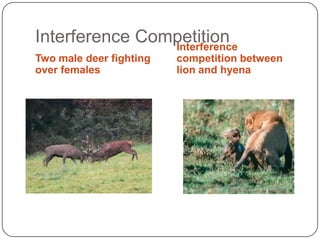
Interference CompetitionTwo male deer fighting over femalesInterference competition between lion and hyena
Exploitative CompetitionExploitative competition occurs when one individual consumes an resource so it is no longer available for consumption by another individual.Exploitative competition is the most common mechanism of competition.
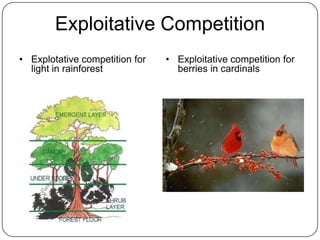
Exploitative CompetitionExplotative competition for light in rainforestExploitative competition for berries in cardinals
Effects of Intraspecific CompetitionIntraspecific competition can affectPopulation sizesPatterns of spatial dispersion
Intraspecific CompetitionIntraspecific competition for resources can be an important factor influencing population sizeModeled by the logistic growth equationAs N increases b decreases and d increases so r decreases
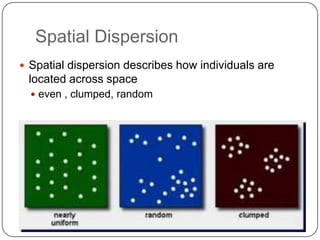
Spatial DispersionSpatial dispersion describes how individuals are located across spaceeven , clumped, random
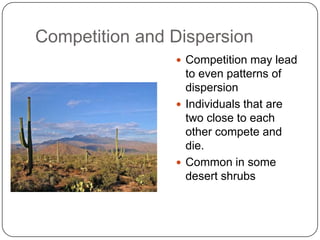
Competition and DispersionCompetition may lead to even patterns of dispersionIndividuals that are two close to each other compete and die.Common in some desert shrubs
Effects of Interspecific CompetitionInterspecific competition may affectPopulation sizeBiodiversityphenotypes
Studying CompetitionEcologists have studied competition using theoretical models, observations, and experiments
Studying Competition: ObservationsObservational studies can be used to look for evidence of competitionNegative associations between presence/absence of speciesNegative correlation between abundance of species
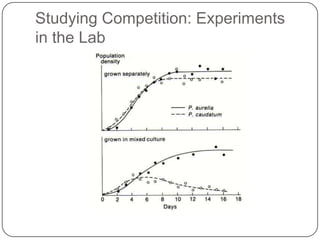
Studying Competition: Experiments in the Lab
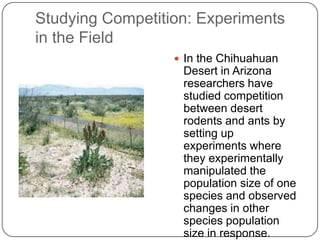
Studying Competition: Experiments in the FieldIn the Chihuahuan Desert in Arizona researchers have studied competition between desert rodents and ants by setting up experiments where they experimentally manipulated the population size of one species and observed changes in other species population size in response.
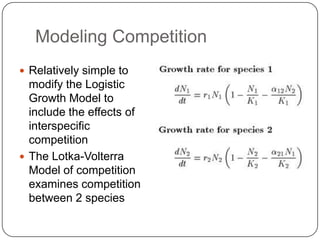
Modeling CompetitionRelatively simple to modify the Logistic Growth Model to include the effects of interspecific competitionThe Lotka-Volterra Model of competition examines competition between 2 species
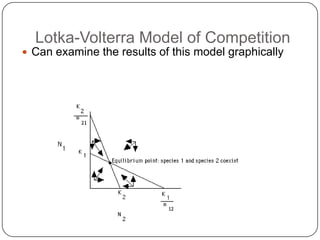
Lotka-Volterra Model of CompetitionCan examine the results of this model graphically
ResultsThree possible outcomes of competition between two speciesOne species wins and drives the other extinctCoexistence, unstableCoexistence, stableThe stable coexistence result is the one that we are most interested inTwo species can coexist only if the strength of intraspecific competition is greater than the strength of interspecifccompetition
CompetitionCompetitive Exclusion PrincipleIf two species share exactly the same niche then they will not be able to coexistOne species will win and the other will go extinctThus, species can only coexist if the have different nichesNiches differentiation.http://www.eoearth.org/article/Competitive_exclusion_principle
Niche“The Niches is a bi**c!!”There are many different definitions of niche.  In this discussion I am talking about “feeding niche” which describes what, when, and where an organism eats.
Niche DifferentiationOrganisms can differentiate their niches by Eating different foodsE.g., insects and seedsFeeding in different placesE.g., feeding on seeds found under desert shrubs or in the openE.g., feeding on bugs on the top or bottom of treesFeeding at different timesE.g., feeding on insects that are active during the day versus those that are active at night.
Niche DifferentiationOften feeding niches is influenced by the sizeEither of organismsTrophic structures (the structures used to capture food)Animals with the same sized trophic structures often eat the same foodTherefore two organisms of the same size might compete too much to be able to coexist
Law of Limiting SimilarityThere is a limit to how similar two niches can be in order to allow two species to coexist.
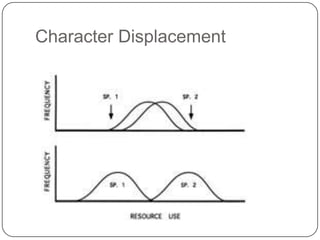
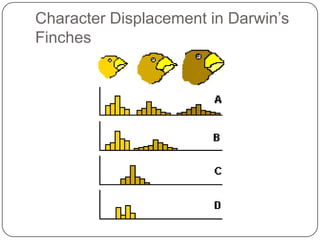
Niche DifferentiationTherefore species that are of similar sizes may not be able to coexist.If two species compete because their niches overlap then natural selection might cause their niches to vary so that they no longer overlapCharacter Displacement
Character Displacement
Character Displacement in Darwin’s Finches
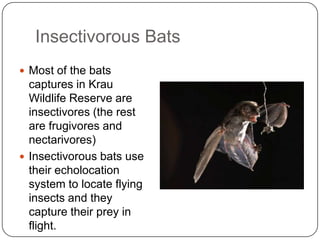
Insectivorous BatsMost of the bats captures in Krau Wildlife Reserve are insectivores (the rest are frugivores and nectarivores)Insectivorous bats use their echolocation system to locate flying insects and they capture their prey in flight.
Insectivorous Bats Insectivorous bats can reduce competition by Feeding on different sizes of insectsSize of insects that bats can eat appears to be correlated with their sizeBigger bats can eat bigger bugsFeeding in different parts of the forestE.g., feed in in the open spaces above the forest versus feeding in the canopy
Current ResearchOngoing research conducted by Dr. Kingston, her graduate students Julie Sewani and AinNural, and colleagues from Germany examines-Diet of the batsExamine fecal samplesRelationship between morphology and dietEffect of jaw size on bite forceEffects of morphology on foraging abilityRelationship between size and dietRelationship between wing shape and dietRelationship between morphology and foraging locationE.g., how close to objects can bats catch a prey?
Strength of Competition  Because a bat’s feeding strategy influenced by body size, wing shape, and echolocation system we expect members of the same species to compete most strongly (they are all similar in size).Because of similarities of members of the same genus we would expect that members of the same genus should compete more strongly than members of different genera.
Activity 1Question: Do members of the same genus compete for resources?If members of two species are competing for resources then we predictNegative association between the presence of both species in a sampleNegative correlation between the abundance of the two species
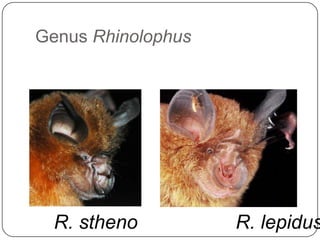
Genus RhinolophusR. stheno                  R. lepidus
Activity #1Use the data from 2009 MBEA to1. test for an association between the presence of R. sthenoand the presence of R. lepidusin a sample2. test for a correlation between the abundance of R. sthenoand R. lepidusin a sample
Results
Niche DifferentiationBecause there was no indication of a negative association between the presence/absence of the two species or a negative correlation between the abundance of the two species it appears that the species are not competing strongly for resources.Is there evidence for niche differentiation between these two species?Assume that diet is influenced by body size Is there overlap in body size between the two species.?
Activity 2Draw the frequency distribution for body size (you can use either mass or forearm length) for both speciesDo we see niche overlap or niche differentiation?
Activity 3Use the correct statistical test to test for difference between the mean size of the two species.

Competition- MBEA Activity

  • 1.
    Dr. Mark A.McGinleyTexas Tech UniversityBIOL 5311Summer 2011Competition:MBEA Activity
  • 2.
    CompetitionCompetition is anecological interaction in which both participants are harmed.http://www.eoearth.org/article/CompetitionCompetition can occur between members of the same speciesIntraspecific competitionModeled in the logistic growth equationhttp://www.eoearth.org/article/Intraspecific_competitionCompetition can occur between members of different speciesIntraspecific competitionhttp://www.eoearth.org/article/Interspecific_competition?topic=58074
  • 3.
    Competition Competition occurswhen resources are limited.ResourcesFoodWaterSoil nutrientsLightSpaceshelterMates
  • 4.
    Mechanisms of CompetitionThereare two mechanisms of competitionInterference competitionExploitative competitionhttp://www.eoearth.org/article/Exploitative_competition
  • 5.
    Interference CompetitionTwo maledeer fighting over femalesInterference competition between lion and hyena
  • 6.
    Exploitative CompetitionExploitative competitionoccurs when one individual consumes an resource so it is no longer available for consumption by another individual.Exploitative competition is the most common mechanism of competition.
  • 7.
    Exploitative CompetitionExplotative competitionfor light in rainforestExploitative competition for berries in cardinals
  • 8.
    Effects of IntraspecificCompetitionIntraspecific competition can affectPopulation sizesPatterns of spatial dispersion
  • 9.
    Intraspecific CompetitionIntraspecific competitionfor resources can be an important factor influencing population sizeModeled by the logistic growth equationAs N increases b decreases and d increases so r decreases
  • 10.
    Spatial DispersionSpatial dispersiondescribes how individuals are located across spaceeven , clumped, random
  • 11.
    Competition and DispersionCompetitionmay lead to even patterns of dispersionIndividuals that are two close to each other compete and die.Common in some desert shrubs
  • 12.
    Effects of InterspecificCompetitionInterspecific competition may affectPopulation sizeBiodiversityphenotypes
  • 13.
    Studying CompetitionEcologists havestudied competition using theoretical models, observations, and experiments
  • 14.
    Studying Competition: ObservationsObservationalstudies can be used to look for evidence of competitionNegative associations between presence/absence of speciesNegative correlation between abundance of species
  • 15.
  • 16.
    Studying Competition: Experimentsin the FieldIn the Chihuahuan Desert in Arizona researchers have studied competition between desert rodents and ants by setting up experiments where they experimentally manipulated the population size of one species and observed changes in other species population size in response.
  • 17.
    Modeling CompetitionRelatively simpleto modify the Logistic Growth Model to include the effects of interspecific competitionThe Lotka-Volterra Model of competition examines competition between 2 species
  • 18.
    Lotka-Volterra Model ofCompetitionCan examine the results of this model graphically
  • 19.
    ResultsThree possible outcomesof competition between two speciesOne species wins and drives the other extinctCoexistence, unstableCoexistence, stableThe stable coexistence result is the one that we are most interested inTwo species can coexist only if the strength of intraspecific competition is greater than the strength of interspecifccompetition
  • 20.
    CompetitionCompetitive Exclusion PrincipleIftwo species share exactly the same niche then they will not be able to coexistOne species will win and the other will go extinctThus, species can only coexist if the have different nichesNiches differentiation.http://www.eoearth.org/article/Competitive_exclusion_principle
  • 21.
    Niche“The Niches isa bi**c!!”There are many different definitions of niche. In this discussion I am talking about “feeding niche” which describes what, when, and where an organism eats.
  • 22.
    Niche DifferentiationOrganisms candifferentiate their niches by Eating different foodsE.g., insects and seedsFeeding in different placesE.g., feeding on seeds found under desert shrubs or in the openE.g., feeding on bugs on the top or bottom of treesFeeding at different timesE.g., feeding on insects that are active during the day versus those that are active at night.
  • 23.
    Niche DifferentiationOften feedingniches is influenced by the sizeEither of organismsTrophic structures (the structures used to capture food)Animals with the same sized trophic structures often eat the same foodTherefore two organisms of the same size might compete too much to be able to coexist
  • 24.
    Law of LimitingSimilarityThere is a limit to how similar two niches can be in order to allow two species to coexist.
  • 25.
    Niche DifferentiationTherefore speciesthat are of similar sizes may not be able to coexist.If two species compete because their niches overlap then natural selection might cause their niches to vary so that they no longer overlapCharacter Displacement
  • 26.
  • 27.
    Character Displacement inDarwin’s Finches
  • 28.
    Insectivorous BatsMost ofthe bats captures in Krau Wildlife Reserve are insectivores (the rest are frugivores and nectarivores)Insectivorous bats use their echolocation system to locate flying insects and they capture their prey in flight.
  • 29.
    Insectivorous Bats Insectivorousbats can reduce competition by Feeding on different sizes of insectsSize of insects that bats can eat appears to be correlated with their sizeBigger bats can eat bigger bugsFeeding in different parts of the forestE.g., feed in in the open spaces above the forest versus feeding in the canopy
  • 30.
    Current ResearchOngoing researchconducted by Dr. Kingston, her graduate students Julie Sewani and AinNural, and colleagues from Germany examines-Diet of the batsExamine fecal samplesRelationship between morphology and dietEffect of jaw size on bite forceEffects of morphology on foraging abilityRelationship between size and dietRelationship between wing shape and dietRelationship between morphology and foraging locationE.g., how close to objects can bats catch a prey?
  • 31.
    Strength of Competition Because a bat’s feeding strategy influenced by body size, wing shape, and echolocation system we expect members of the same species to compete most strongly (they are all similar in size).Because of similarities of members of the same genus we would expect that members of the same genus should compete more strongly than members of different genera.
  • 32.
    Activity 1Question: Domembers of the same genus compete for resources?If members of two species are competing for resources then we predictNegative association between the presence of both species in a sampleNegative correlation between the abundance of the two species
  • 33.
  • 34.
    Activity #1Use thedata from 2009 MBEA to1. test for an association between the presence of R. sthenoand the presence of R. lepidusin a sample2. test for a correlation between the abundance of R. sthenoand R. lepidusin a sample
  • 35.
  • 36.
    Niche DifferentiationBecause therewas no indication of a negative association between the presence/absence of the two species or a negative correlation between the abundance of the two species it appears that the species are not competing strongly for resources.Is there evidence for niche differentiation between these two species?Assume that diet is influenced by body size Is there overlap in body size between the two species.?
  • 37.
    Activity 2Draw thefrequency distribution for body size (you can use either mass or forearm length) for both speciesDo we see niche overlap or niche differentiation?
  • 38.
    Activity 3Use thecorrect statistical test to test for difference between the mean size of the two species.