CONNECTIVE TISSUE:BLOOD
DR. KINGSLEY OKON
• Blood is a specialized fluid connective tissue
consisting of some cells suspended in a liquid
intercellular substance known as plasma
• Blood is composed of mainly two parts
• i. plasma
• ii. Blood cells
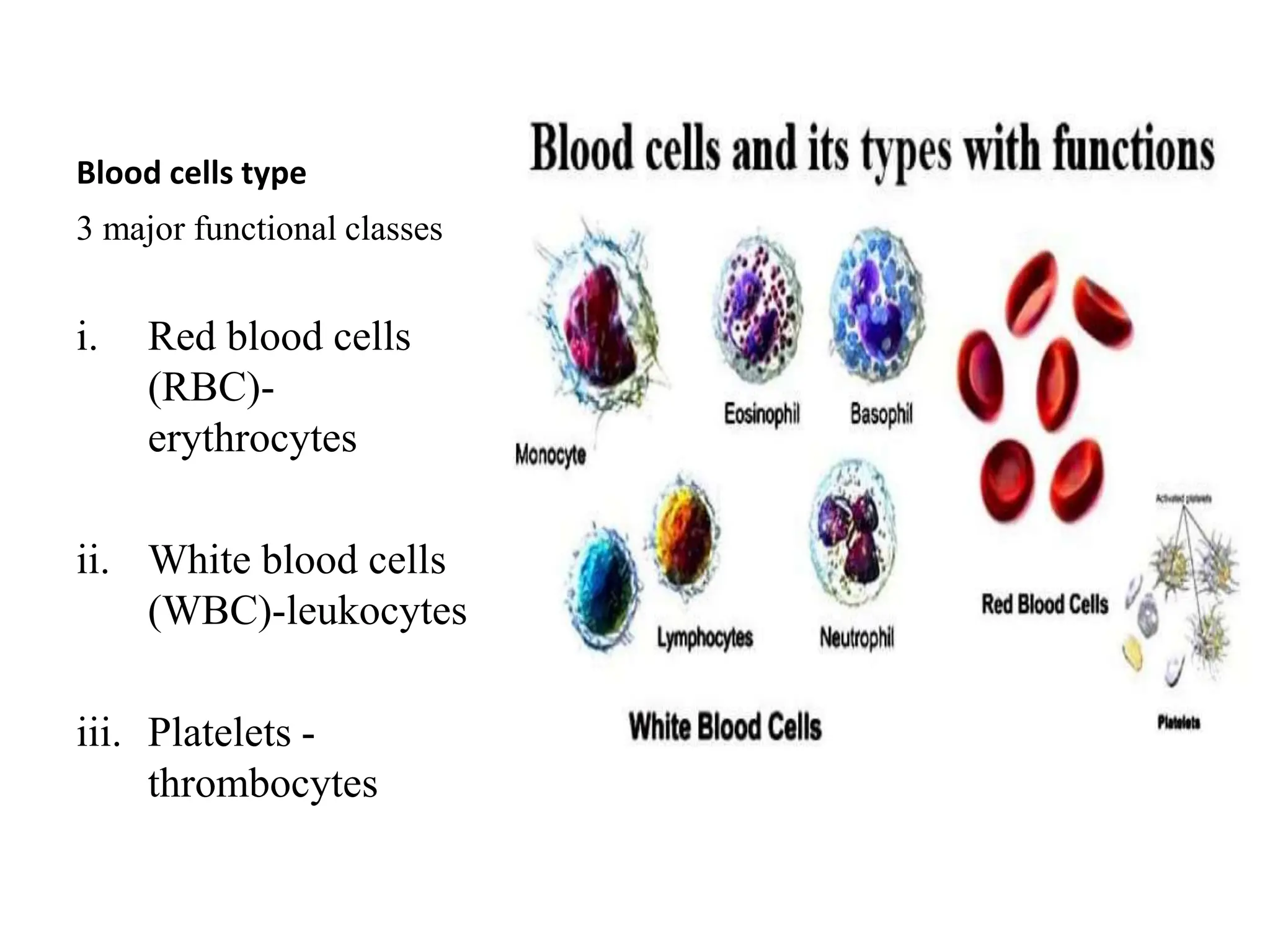
Blood cells type
3 major functional classes
i. Red blood cells
(RBC)-
erythrocytes
ii. White blood cells
(WBC)-leukocytes
iii. Platelets -
thrombocytes
• Erythrocytes contain large amounts of oxygen-
carrying haemoglobin
• Involved in transport of oxygen and carbon
dioxide
• Leukocytes constitutes an important part of the
defense and immune system
• Platelets plays a vital role in the controlling of
bleeding (haemostasis)-i.e activation of blood-
clothing cascade
Erythrocytes
Life span-120
days
Non-nucleated
Consist of
plasma
membrane
enclosing
haemoglobin and
some organelles
White blood cells (leukocytes)
• The leukocytes are the mobile units of the
body’s protective system
• They are form partially in the bone marrow
(granulocytes & monocytes) and a few
lymphocytes
• Partially in the lymph tissue (lymphocytes &
plasma)
• After formation, they are transported in the
blood to diff. parts of the body
• All WBCs have nucleus and no haemoglobin
• Protects body against microorganism and
remove dead cells & debris
• Their average total number is 6000-8000 per
mm3
• Granular or agranular classification based on
presence of cytoplasmic granules made visible
by staining
Types and Functions
• Granulocytes
Neutrophils: small phagocytic cells
Eosinophils: reduce inflammation
Basophils: release histamine & ↑se inflammatory
response
• Agranulocytes
Lymphocytes: immunity
Monocytes: becomes magrophages
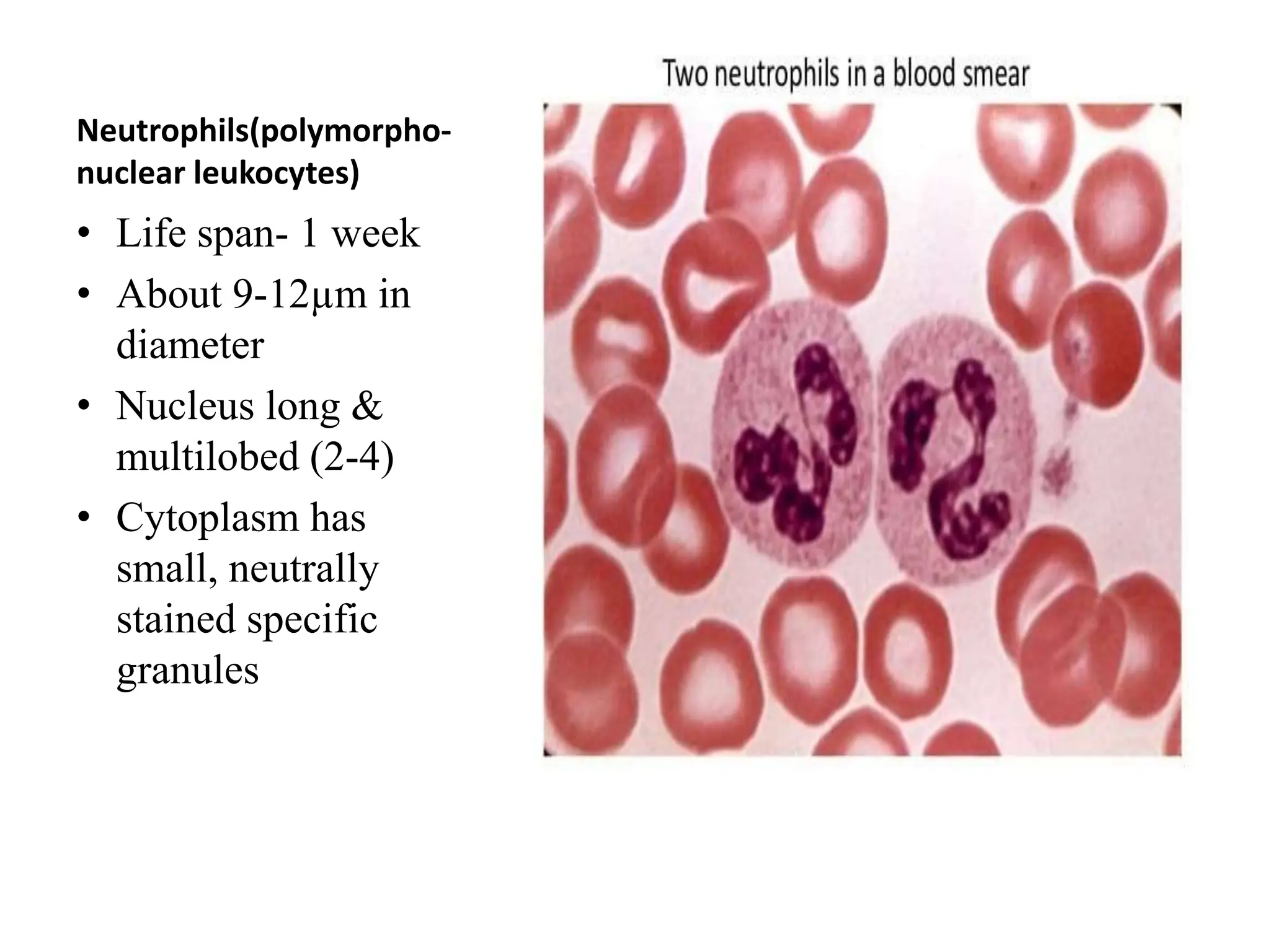
Neutrophils(polymorpho-
nuclear leukocytes)
• Life span- 1 week
• About 9-12µm in
diameter
• Nucleus long &
multilobed (2-4)
• Cytoplasm has
small, neutrally
stained specific
granules
Functions
• Primarily antibacterial
• Gives fastest response of all WBCs to
bacterials and paracytes
• Leave the blood & folloe chemotaxic signals
to sites of wounding or other inflammations
• Phagocytise foreign agents such as bacteria
• Pus is composed largely of dead neutrophils
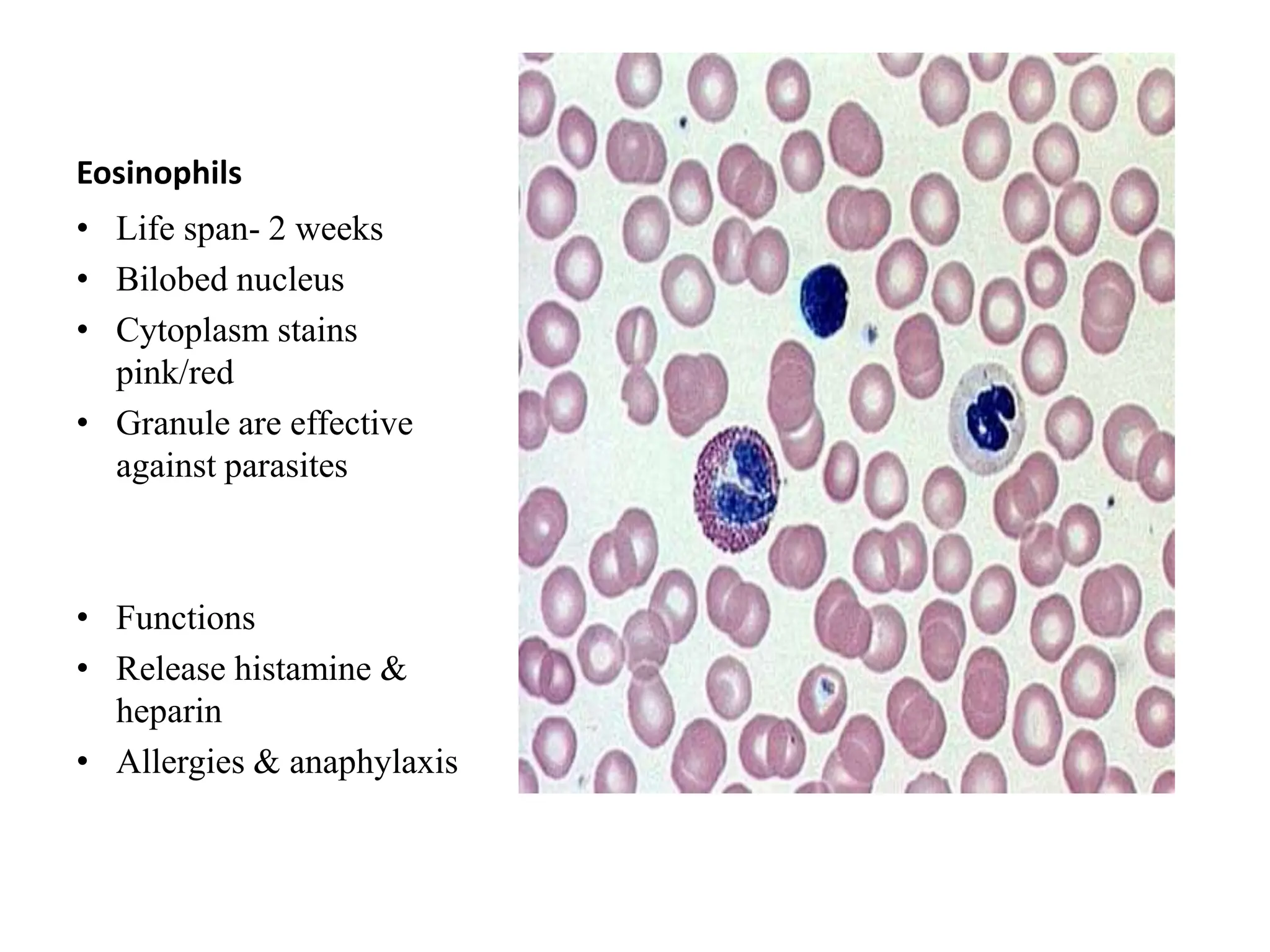
Eosinophils
• Life span- 2 weeks
• Bilobed nucleus
• Cytoplasm stains
pink/red
• Granule are effective
against parasites
• Functions
• Release histamine &
heparin
• Allergies & anaphylaxis
Lymphocytes
• Life san- varies (few
days to several years)
• Less than 8µm (small
lymphocytes)/(15µm
large)
• Round dense nucleus
• Cytoplasm is a narrow
rim round the nucleus
• Functions
• T-lymphocytes
• B-lymphocytes
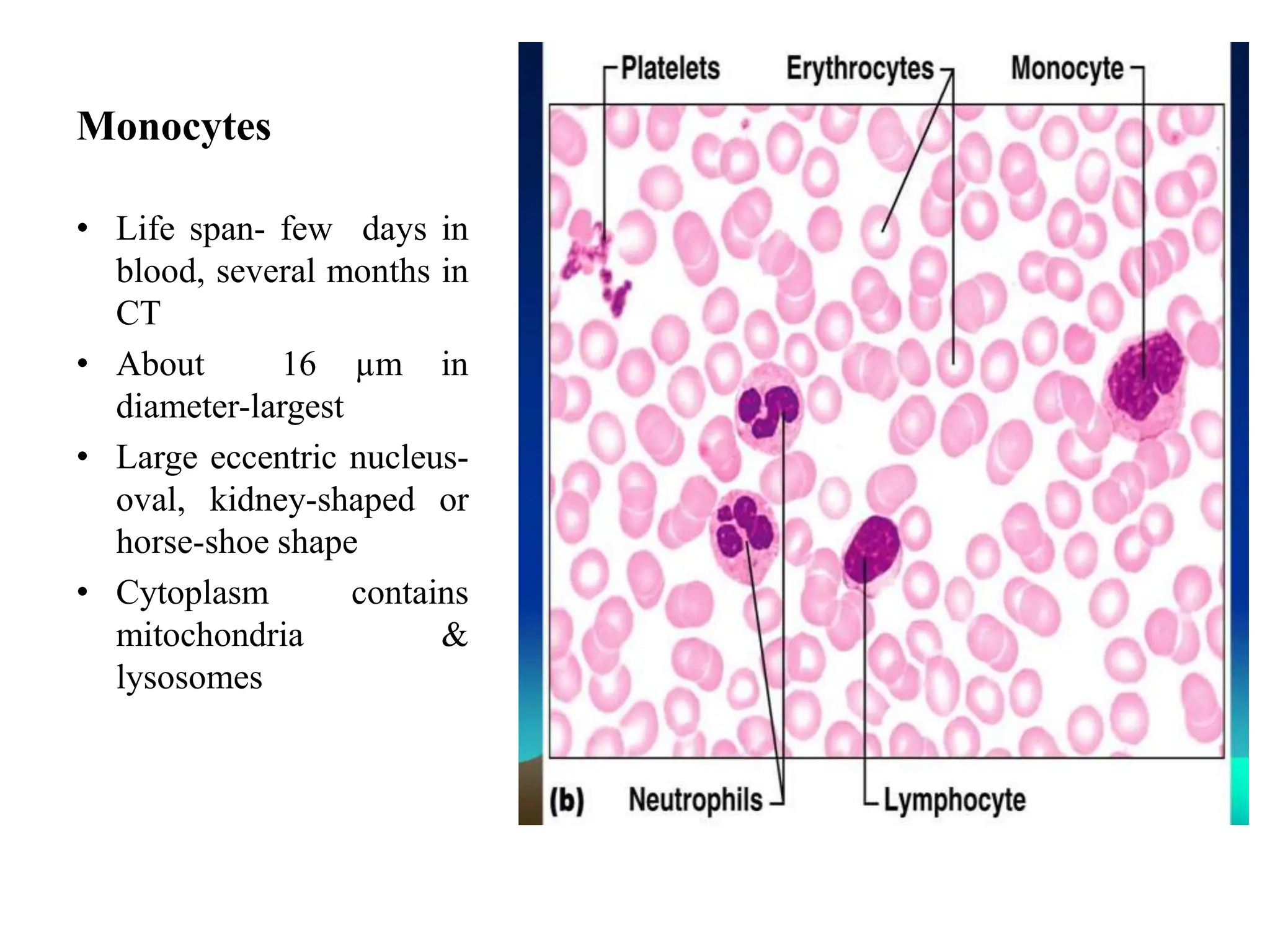
Monocytes
• Life span- few days in
blood, several months in
CT
• About 16 µm in
diameter-largest
• Large eccentric nucleus-
oval, kidney-shaped or
horse-shoe shape
• Cytoplasm contains
mitochondria &
lysosomes
Functions
• Mononuclear phagocytic system
i. tissue macrophages
– Kupffer cells (liver)
– Osteoclast cells (bone)
– Dust cells (lungs)
– Microglia (brain)
ii. Mediate inflammatory response
iii. Antigen presenting cells
Platelets
• Small, non-nucleated cells form in bone
marrow by megakaryoctes
• Round/oval biconvex disc
• 1.5-3.5µm in diameter
Functions
• i. Form plug to occludes sites of vascular damage
by adhering to collagenous tissue at the margin of
wound--- later the plug is reinforced by fibrin
• ii. Promote clot formation by producing a surface
for assembly of coagulation protein complex
• iii. Secretes factors that modulate coagulation &
vascular repair
Major functions of WBCs
• Defense action
• Phagocytosis: the neutrophils & monophils
engulf foreign particles & microorganisms
• Antibody formation: lymphocytes produce
antibodies (gamma globulin) and play an
important role in defensive mechanism of the
body
• Secretion of heparin: The basophils secretes
heparin which helps in the prevention of
intravascular clot.
• Manufacture of trephones: Leukocytes
produces some special protein like substance
known as ‘trephones’ which have great
influence on nutrition, growth & tissue repair

CONNECTIVE TISSUE Of the blood tissues.pptx

  • 1.
  • 2.
    • Blood isa specialized fluid connective tissue consisting of some cells suspended in a liquid intercellular substance known as plasma • Blood is composed of mainly two parts • i. plasma • ii. Blood cells
  • 3.
    Blood cells type 3major functional classes i. Red blood cells (RBC)- erythrocytes ii. White blood cells (WBC)-leukocytes iii. Platelets - thrombocytes
  • 4.
    • Erythrocytes containlarge amounts of oxygen- carrying haemoglobin • Involved in transport of oxygen and carbon dioxide • Leukocytes constitutes an important part of the defense and immune system • Platelets plays a vital role in the controlling of bleeding (haemostasis)-i.e activation of blood- clothing cascade
  • 5.
  • 6.
    White blood cells(leukocytes) • The leukocytes are the mobile units of the body’s protective system • They are form partially in the bone marrow (granulocytes & monocytes) and a few lymphocytes • Partially in the lymph tissue (lymphocytes & plasma) • After formation, they are transported in the blood to diff. parts of the body
  • 7.
    • All WBCshave nucleus and no haemoglobin • Protects body against microorganism and remove dead cells & debris • Their average total number is 6000-8000 per mm3 • Granular or agranular classification based on presence of cytoplasmic granules made visible by staining
  • 8.
    Types and Functions •Granulocytes Neutrophils: small phagocytic cells Eosinophils: reduce inflammation Basophils: release histamine & ↑se inflammatory response • Agranulocytes Lymphocytes: immunity Monocytes: becomes magrophages
  • 9.
    Neutrophils(polymorpho- nuclear leukocytes) • Lifespan- 1 week • About 9-12µm in diameter • Nucleus long & multilobed (2-4) • Cytoplasm has small, neutrally stained specific granules
  • 10.
    Functions • Primarily antibacterial •Gives fastest response of all WBCs to bacterials and paracytes • Leave the blood & folloe chemotaxic signals to sites of wounding or other inflammations • Phagocytise foreign agents such as bacteria • Pus is composed largely of dead neutrophils
  • 11.
    Eosinophils • Life span-2 weeks • Bilobed nucleus • Cytoplasm stains pink/red • Granule are effective against parasites • Functions • Release histamine & heparin • Allergies & anaphylaxis
  • 12.
    Lymphocytes • Life san-varies (few days to several years) • Less than 8µm (small lymphocytes)/(15µm large) • Round dense nucleus • Cytoplasm is a narrow rim round the nucleus • Functions • T-lymphocytes • B-lymphocytes
  • 13.
    Monocytes • Life span-few days in blood, several months in CT • About 16 µm in diameter-largest • Large eccentric nucleus- oval, kidney-shaped or horse-shoe shape • Cytoplasm contains mitochondria & lysosomes
  • 14.
    Functions • Mononuclear phagocyticsystem i. tissue macrophages – Kupffer cells (liver) – Osteoclast cells (bone) – Dust cells (lungs) – Microglia (brain) ii. Mediate inflammatory response iii. Antigen presenting cells
  • 15.
    Platelets • Small, non-nucleatedcells form in bone marrow by megakaryoctes • Round/oval biconvex disc • 1.5-3.5µm in diameter
  • 16.
    Functions • i. Formplug to occludes sites of vascular damage by adhering to collagenous tissue at the margin of wound--- later the plug is reinforced by fibrin • ii. Promote clot formation by producing a surface for assembly of coagulation protein complex • iii. Secretes factors that modulate coagulation & vascular repair
  • 17.
    Major functions ofWBCs • Defense action • Phagocytosis: the neutrophils & monophils engulf foreign particles & microorganisms • Antibody formation: lymphocytes produce antibodies (gamma globulin) and play an important role in defensive mechanism of the body
  • 18.
    • Secretion ofheparin: The basophils secretes heparin which helps in the prevention of intravascular clot. • Manufacture of trephones: Leukocytes produces some special protein like substance known as ‘trephones’ which have great influence on nutrition, growth & tissue repair