Prepared by
Name University Roll no.
Bindu Kundu 29
2nd sem of B.PHARMCY
WHITE BLOOD CORPUSCLES
Outline of The Topic :-
 Introduction ,
 Formation of WBC ,
 Types of WBC ,
 Discuss about Types & their functions ,
 Diseases related with Leucocytes .
WHITE BLOOD CORPUSCLES
or ,
LEUCOCYTES
 White Blood Corpuscles are also known as
Leucocytes , as they are colourless due to lack of
Haemoglobin .
 There are about 6,000-8,000 mm of WBC for 1ml of
blood .
Formation of WBC :-
 Leucocytes are formed in the Red
Bone Marrow of many bones .
 They can also be formed in
lymphatic tissue .
 They live for about 13-20 days .
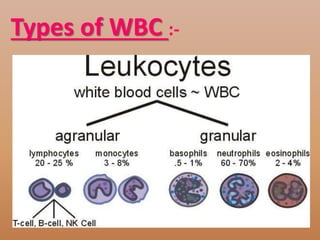
Types of WBC :-
Agranular or Agranulocyte :-
LYMPHOCYTES :
• Smallest WBC .
• Small amt. Of Cytoplasm .
• Two types ,-
1) T Lymphocytes ,
2) B Lymphocytes ,
3) NK Cells .
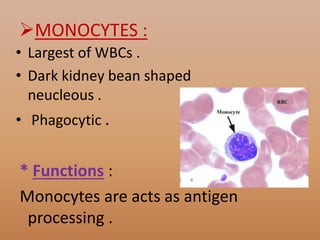
MONOCYTES :
• Largest of WBCs .
• Dark kidney bean shaped
neucleous .
• Phagocytic .
* Functions :
Monocytes are acts as antigen
processing .
Granular or Granulocyte :-
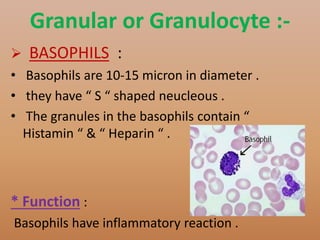
 BASOPHILS :
• Basophils are 10-15 micron in diameter .
• they have “ S “ shaped neucleous .
• The granules in the basophils contain “
Histamin “ & “ Heparin “ .
* Function :
Basophils have inflammatory reaction .
EOSINOPHIL :
• Large , numerous granules .
• 2-6 % of WBC count .
• Eosinophils are 10-15 micron in diameter .
* Function :
Eosinophils primarily deals with Parasitic
infectious and allergic reactions .
NEUTROPHIL :
• Granules are small and numerous .
• Highly active .
• 65 % of WBC count .
* Function :-
Neutrophils defend against bacterial or fungal
infection .
Diseases Related to Leucocytes :-
 LEUKOPENIA ,
 LEUKEMIA ,
 LEUCOCYTOSIS .
References :
The informations are collected from; the
book
“ Ross and Wilson Anatomy and
Physiology “ .
11th Editon .
* ------ * ------ * ------ *

White blood

  • 1.
    Prepared by Name UniversityRoll no. Bindu Kundu 29 2nd sem of B.PHARMCY
  • 2.
  • 3.
    Outline of TheTopic :-  Introduction ,  Formation of WBC ,  Types of WBC ,  Discuss about Types & their functions ,  Diseases related with Leucocytes .
  • 4.
    WHITE BLOOD CORPUSCLES or, LEUCOCYTES  White Blood Corpuscles are also known as Leucocytes , as they are colourless due to lack of Haemoglobin .  There are about 6,000-8,000 mm of WBC for 1ml of blood .
  • 5.
    Formation of WBC:-  Leucocytes are formed in the Red Bone Marrow of many bones .  They can also be formed in lymphatic tissue .  They live for about 13-20 days .
  • 6.
  • 7.
    Agranular or Agranulocyte:- LYMPHOCYTES : • Smallest WBC . • Small amt. Of Cytoplasm . • Two types ,- 1) T Lymphocytes , 2) B Lymphocytes , 3) NK Cells .
  • 8.
    MONOCYTES : • Largestof WBCs . • Dark kidney bean shaped neucleous . • Phagocytic . * Functions : Monocytes are acts as antigen processing .
  • 9.
    Granular or Granulocyte:-  BASOPHILS : • Basophils are 10-15 micron in diameter . • they have “ S “ shaped neucleous . • The granules in the basophils contain “ Histamin “ & “ Heparin “ . * Function : Basophils have inflammatory reaction .
  • 10.
    EOSINOPHIL : • Large, numerous granules . • 2-6 % of WBC count . • Eosinophils are 10-15 micron in diameter . * Function : Eosinophils primarily deals with Parasitic infectious and allergic reactions .
  • 11.
    NEUTROPHIL : • Granulesare small and numerous . • Highly active . • 65 % of WBC count . * Function :- Neutrophils defend against bacterial or fungal infection .
  • 12.
    Diseases Related toLeucocytes :-  LEUKOPENIA ,  LEUKEMIA ,  LEUCOCYTOSIS .
  • 13.
    References : The informationsare collected from; the book “ Ross and Wilson Anatomy and Physiology “ . 11th Editon . * ------ * ------ * ------ *