Presentation Pro


               Magruder’s
           American Government
                                C H A P T E R 12
                                Congress in Action


© 2001 by Prentice Hall, Inc.
C H A P T E R 12

The Federal Court System

        SECTION 1               Congress Organizes

        SECTION 2               Committees in Congress

        SECTION 3               How a Bill Becomes a Law: The
             House

        SECTION 4               The Bill in the Senate


                     Go To
                   Section:   1 2 3 4              Chapter 12
SECTION 1

Congress Organizes

• How and when does Congress convene?
• What are the roles of the presiding officers in
  the Senate and the House?

• What are the duties of party officers in
  Congress?

• How are committee chairmen chosen, and
  what is their role in the legislative process?

              Go To
            Section:   1 2 3 4   Chapter 12, Section 1
Congress Convenes
•   Congress convenes every two years—on January 3 of
    every odd-numbered year.

•   The House has formal organizational meetings at the
    beginning of each term to determine committee
    membership and standing officers.

•   The Senate, because it is a continuous body, has fewer
    organizational issues to address at the start of each term.

•   When Congress is organized, the President presents a
    State of the Union message to a joint session of Congress.
    This message, in which the President reports on the state
    of the nation as he sees it, is given annually.
             Go To
           Section:   1 2 3 4             Chapter 12, Section 1
The Presiding Officers
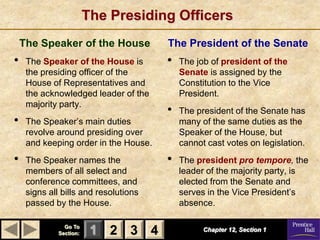
    The Speaker of the House           The President of the Senate
•    The Speaker of the House is       •   The job of president of the
     the presiding officer of the          Senate is assigned by the
     House of Representatives and          Constitution to the Vice
     the acknowledged leader of the        President.
     majority party.
                                       •   The president of the Senate has
•    The Speaker’s main duties             many of the same duties as the
     revolve around presiding over         Speaker of the House, but
     and keeping order in the House.       cannot cast votes on legislation.
•    The Speaker names the             •   The president pro tempore, the
     members of all select and             leader of the majority party, is
     conference committees, and            elected from the Senate and
     signs all bills and resolutions       serves in the Vice President’s
     passed by the House.                  absence.

               Go To
             Section:    1 2 3 4                 Chapter 12, Section 1
Party Officers

                       The Party Caucus
•   The party caucus is a closed meeting of the members of
    each party in each house which deals with matters of party
    organization.
                       The Floor Leaders
•   The floor leaders are party officers picked for their posts
    by their party colleagues.
•   The party whips assist the floor leaders and serve as a
    liaison between the party’s leadership and its rank-and-file
    members.


             Go To
           Section:   1 2 3 4             Chapter 12, Section 1
Committee Chairmen and Seniority Rule
    Committee Chairmen                  Seniority Rule
•   The committee chairmen      •   The seniority rule, an
    are the members who             unwritten custom, holds that
    head the standing               the most important posts will
    committees in each              be held by those party
    chamber of Congress.            members with the longest
                                    records of service in
•   The chairman of each of         Congress.
    these permanent
    committees is chosen from   •   The head of each committee
    the majority party by the       is often the longest-serving
    majority party caucus.          member of the committee
                                    from the majority party.

             Go To
           Section:   1 2 3 4            Chapter 12, Section 1
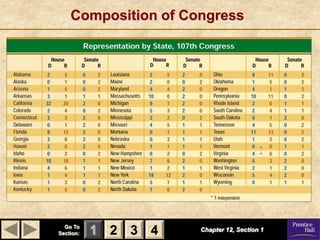
Composition of Congress


  Go To
Section:   1 2 3 4   Chapter 12, Section 1
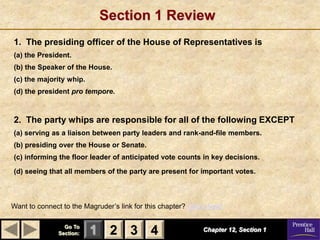
Section 1 Review
1. The presiding officer of the House of Representatives is
(a) the President.
(b) the Speaker of the House.
(c) the majority whip.
(d) the president pro tempore.


2. The party whips are responsible for all of the following EXCEPT
(a) serving as a liaison between party leaders and rank-and-file members.
(b) presiding over the House or Senate.
(c) informing the floor leader of anticipated vote counts in key decisions.

(d) seeing that all members of the party are present for important votes.


Want to connect to the Magruder’s link for this chapter? Click Here!

                 Go To
               Section:   1 2 3 4                            Chapter 12, Section 1
SECTION 2

Committees in Congress

• How do the standing committees function?
• What are the duties and responsibilities of
  the House Rules Committee?

• What are the functions of joint and
  conference committees?


              Go To
            Section:   1 2 3 4   Chapter 12, Section 2
Standing Committees
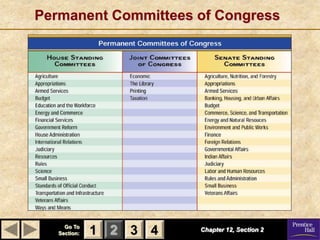
• Standing committees are permanent panels in
  Congress to which bills of similar nature could be
  sent.
• Most of the standing committees handle bills
  dealing with particular policy matters, such as
  veterans’ affairs or foreign relations.
• The majority party always holds a majority of the
  seats on each committee (the lone exception being
  the House Committee on Standards of Official
  Conduct).

          Go To
        Section:   1 2 3 4        Chapter 12, Section 2
Permanent Committees of Congress


     Go To
   Section:   1 2 3 4   Chapter 12, Section 2
The House Rules Committee and Select
                  Committees
      The House Rules            The Select Committees
        Committee
                                 •   Select committees are
•   The Rules Committee              panels established to
    decides whether and              handle a specific matter
    under what conditions            and usually exist for a
    the full House will              limited time.
    consider a measure.
                                 •   Most select committees
•   This places great power          are formed to investigate
    in the Rules Committee,          a current matter.
    as it can speed, delay, or
    even prevent House
    action on a measure.
             Go To
           Section:   1 2 3 4            Chapter 12, Section 2
Joint and Conference Committees
• A joint committee is one composed of members
  of both houses.
• Examples of joint committees include the Joint
  Economic Committee, the Joint Committee on
  Printing, and the Joint Committee on the Library of
  Congress
• A conference committee—a temporary, joint
  body—is created to iron out differences between
  bills passed by the House and Senate before they
  are sent to the President.

          Go To
        Section:   1 2 3 4        Chapter 12, Section 2
Section 2 Review
1. The House Rules Committee
(a) establishes codes of conduct.
(b) determines when and under what conditions the full House will consider a
    measure.
(c) oversees the execution of bills once they are passed into law.
(d) determines which members of the Senate may vote on a measure.


2. A conference committee is formed to
(a) iron out differences in bills passed by the House and Senate before they are sent to
     the President.
(b) hold press conferences.
(c) appoint Supreme Court justices.
(d) determine rules for debate.

Want to connect to the Magruder’s link for this section? Click Here!

                 Go To
               Section:   1 2 3 4                            Chapter 12, Section 2
SECTION 3

How a Bill Becomes a Law: The House
• What are the first steps in introducing a new
  bill to the House?
• What happens to a bill once it enters a
  committee?
• How do House leaders schedule debate
  on a bill?
• What happens to a bill on the House floor?
• What is the final step in passing a bill in the
  House?
              Go To
            Section:   1 2 3 4   Chapter 12, Section 3
The First Steps

• A bill is a proposed law presented to the House or
  Senate for consideration.

• A bill or resolution usually deals with a single
  matter, but sometimes a rider dealing with an
  unrelated matter is included.

• The clerk of the House numbers each bill, gives it a
  short title, and enters it into the House Journal and
  the Congressional Record for the day. With these
  actions the bill has received its first reading.

          Go To
        Section:   1 2 3 4          Chapter 12, Section 3
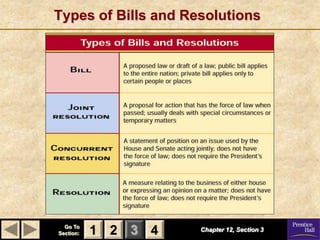
Types of Bills and Resolutions


  Go To
Section:   1 2 3 4   Chapter 12, Section 3
The Bill in Committee
    Discharge Petitions             Gathering Information
•   Most bills die in committee,    •   Most committees do their
    pigeonholed, or put away,           work through several
    never to be acted upon.             subcommittees—
                                        divisions of existing
•   If a committee pigeonholes          committees formed to
    a bill that a majority of the       address specific issues.
    House wishes to consider,
    it can be brought out of        •   Committees and
    committee via a discharge           subcommittees often hold
    petition.                           public hearings or make a
                                        junket (trip) to gather
                                        information relating to a
                                        measure.
             Go To
           Section:   1 2 3 4               Chapter 12, Section 3
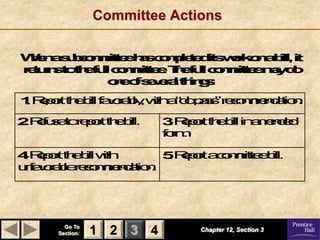
Committee Actions

W n sbo me hs o p t dt w k n bl i
 h a ucmit e a cme is o o a i , t
   e          t       l e    r  l
r t r soh f l cmit eTeu cmit e a d
e n t t eu o me. h f l o me m o
  u         l    t        l  t y
             oe fsvr lt i g:
              n o ee h s
                    a n
1R o t e ilf vr b ,w ad ps”r cmedto.
. e r h b ao l
  pt     l    a y ih “ o as eo m a n
                    t           n i

2Rueoeo t e il
. e s t r pr h b.
  f        t    l         3R o t e ili a edd
                           . e r hb nm e
                              pt    l     n
                          fr .
                          o m

4R o t e ilw
. e r h b ih
   pt     l t     5R o a o me bl
                  . e r cmit e i .
                    pt      t  l
uf vr b r cmedto.
n o l eo m a n
 a ae         n i


       Go To
     Section:   1 2 3 4        Chapter 12, Section 3
Scheduling Floor Debate
• A bill is placed into one of five calendars before
  going to the floor for consideration:
1. The Calendar of the Committee of the Whole House on the State of the
   Union
2. The House Calendar
3. The Calendar of the Committee of the Whole House
4. The Consent Calendar
5. The Discharge Calendar

• Before most measures can be taken from a
  calendar, the Rules Committee must approve that
  step and set a time for its appearance on the
  floor.
            Go To
          Section:   1 2 3 4                 Chapter 12, Section 3
The Bill on the Floor
                      Committee of the Whole
•   The Committee of the Whole includes all members of the
    House, however, they sit as one large committee and not
    as the House itself.
•   When the Committee of the Whole resolves itself, the
    Speaker steps down and another member presides.
    General debate follows.

                             Debate
•   Severe limits are placed on floor debate due to the House’s
    large size.
•   Majority and minority floor leaders generally decide in
    advance how they will split the time to be spent on a bill.
             Go To
           Section:   1 2 3 4             Chapter 12, Section 3
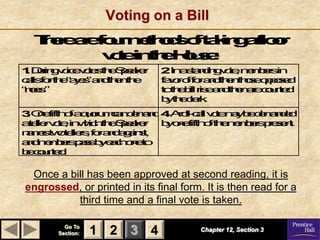
Voting on a Bill
  Te a f umhd ot k g for
  hr r or e os f ai al o
    e e     t       n
       vt i t e os:
         o nh H e
          e     u
1D i g o e o sh S ae
 . un vi vt t e p kr
    r    c   e     e          2I a t ni g o ,m br i
                               . n s d vt
                                      a n  e e e n
                                              m s
clsot eae”adhnh
 a f r h “ ys n t e t e
  l                           f vrof radhnhs opsd
                              ao f o n t e t oe poe
“ os
ne.  ”                        t t e ilrs adhn r cut d
                              oh b i e n t e a on
                                     l        e     e
                              bt el r.
                               yh c ke
3O ffh fa ur m n e ad4Ao cl vt m b dm dd
 . n it o qo c dm
     e         u a   n . r l- a o a e e a e
                           l l e y      n
ae rvt ,i wc t e pae
 t le o n h hh S kr b oeit ot e e br p sn
   l    e    i     e   y n ffh f h m e r et
                                    m s e .
nm t oe r ,f rad gi s
 a e wt le o n aa t
     s    l s       n,
ad e br ps b ec oeo
 n m e as y ah n t
      m s
b cut d
 e on .e

 Once a bill has been approved at second reading, it is
engrossed, or printed in its final form. It is then read for a
          third time and a final vote is taken.

         Go To
       Section:   1 2 3 4               Chapter 12, Section 3
Section 3 Review
1. Riders are
(a) measures attached to a bill dealing with an unrelated matter.
(b) bills dealing with transportation matters only.
(c) measures included in a bill that are unconstitutional.
(d) none of the above.


2. All of the following are options for committees to take once they
   have finished reviewing a bill EXCEPT
(a) refusing to report the bill.
(b) reporting a bill in amended form.
(c) reporting a committee bill.
(d) passing the bill into law.

Want to connect to the Magruder’s link for this section? Click Here!

                 Go To
               Section:   1 2 3 4                            Chapter 12, Section 3
SECTION 4

The Bill in the Senate
• How is a bill introduced in the Senate?
• How do the Senate’s rules for debate differ from
  those in the House?

• What is the role of conference committees in
  the legislative process?

• What actions can the President take after both
  houses have passed a bill?


              Go To
            Section:   1 2 3 4   Chapter 12, Section 4
Introducing a Bill and Rules for Debate
Introducing a Bill
  • Bills are introduced by senators, who are formally
    recognized for that purpose.
  • Proceedings are much less formal in the Senate
    compared to the House.

Rules for Debate
  • The major differences between House and Senate rules
    regard debate over measures.
  • As a general matter, senators may speak on the floor for
    as long as they wish.
  • This freedom of debate allows for the fullest possible
    discussion of matters on the floor.
          Go To
        Section:   1 2 3 4             Chapter 12, Section 4
Filibuster and Cloture
        Filibuster                  The Cloture Rule
• A filibuster is an            • Rule XXII in the
  attempt to “talk a bill to      Standing Rules of the
  death.”                         Senate deals with
                                  cloture, or limiting
• A senator may exercise          debate
  his or her right of
  holding the floor as
                                • If at least 60 senators
                                  vote for cloture, no
  long as necessary, and          more than another 30
  in essence talk until a         hours may be spent on
  measure is dropped.             debate, forcing a vote
                                  on a bill.
           Go To
         Section:   1 2 3 4           Chapter 12, Section 4
Conference Committees

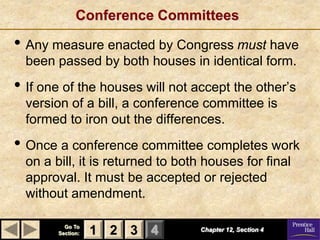
• Any measure enacted by Congress must have
  been passed by both houses in identical form.
• If one of the houses will not accept the other’s
  version of a bill, a conference committee is
  formed to iron out the differences.
• Once a conference committee completes work
  on a bill, it is returned to both houses for final
  approval. It must be accepted or rejected
  without amendment.

          Go To
        Section:   1 2 3 4        Chapter 12, Section 4
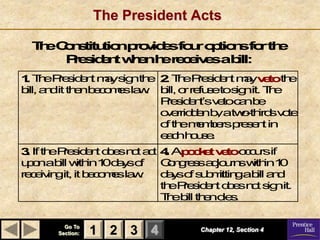
The President Acts

  T eC n t uio po id sf u o t n f rt e
   h o sit t n r v e o r pio s o h
      Pe id n w e h r c iv sab
       r s e t hn e ee e      ill:
1 T ePe id n mys nth 2 T ePe id n myv t th
 . h r s e t a ig e . h r s e t a eo e
b a dit th nb c msla . b o r fu etos nit. T e
 ill, n   e eo e w      ill, r e s   ig    h
                       Pe id n v toc nb
                         r s e t’s e a e
                       o er d nb atw - ir sv te
                        v r id e y    oth d o
                       o th mmespe e t in
                        f e e br r sn
                       e c h ue
                        ah o s .
3 If th Pe id n d e n t a t 4 Ap c e v t o c r if
 .     e r s et os o c .         o k t eo c us
u o ab w in1 d y o
 p n ill ith 0 a s f        C n r s a jo r sw in1
                             o ge s d un ith 0
r c iv git, it b c msla .
 e e in         eo e w      d y o s b ittin ab a d
                             a s f u m g ill n
                            th Pe id n d e n t s nit.
                              e r s e t o s o ig
                            T eb th nd s
                             h ill e ie .

         Go To
       Section:   1 2 3 4          Chapter 12, Section 4
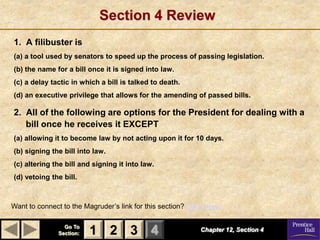
Section 4 Review
1. A filibuster is
(a) a tool used by senators to speed up the process of passing legislation.
(b) the name for a bill once it is signed into law.
(c) a delay tactic in which a bill is talked to death.
(d) an executive privilege that allows for the amending of passed bills.

2. All of the following are options for the President for dealing with a
   bill once he receives it EXCEPT
(a) allowing it to become law by not acting upon it for 10 days.
(b) signing the bill into law.
(c) altering the bill and signing it into law.
(d) vetoing the bill.


Want to connect to the Magruder’s link for this section? Click Here!

                 Go To
               Section:   1 2 3 4                            Chapter 12, Section 4

Chapter 12 government powerpoint

  • 1.
    Presentation Pro Magruder’s American Government C H A P T E R 12 Congress in Action © 2001 by Prentice Hall, Inc.
  • 2.
    C H AP T E R 12 The Federal Court System SECTION 1 Congress Organizes SECTION 2 Committees in Congress SECTION 3 How a Bill Becomes a Law: The House SECTION 4 The Bill in the Senate Go To Section: 1 2 3 4 Chapter 12
  • 3.
    SECTION 1 Congress Organizes •How and when does Congress convene? • What are the roles of the presiding officers in the Senate and the House? • What are the duties of party officers in Congress? • How are committee chairmen chosen, and what is their role in the legislative process? Go To Section: 1 2 3 4 Chapter 12, Section 1
  • 4.
    Congress Convenes • Congress convenes every two years—on January 3 of every odd-numbered year. • The House has formal organizational meetings at the beginning of each term to determine committee membership and standing officers. • The Senate, because it is a continuous body, has fewer organizational issues to address at the start of each term. • When Congress is organized, the President presents a State of the Union message to a joint session of Congress. This message, in which the President reports on the state of the nation as he sees it, is given annually. Go To Section: 1 2 3 4 Chapter 12, Section 1
  • 5.
    The Presiding Officers The Speaker of the House The President of the Senate • The Speaker of the House is • The job of president of the the presiding officer of the Senate is assigned by the House of Representatives and Constitution to the Vice the acknowledged leader of the President. majority party. • The president of the Senate has • The Speaker’s main duties many of the same duties as the revolve around presiding over Speaker of the House, but and keeping order in the House. cannot cast votes on legislation. • The Speaker names the • The president pro tempore, the members of all select and leader of the majority party, is conference committees, and elected from the Senate and signs all bills and resolutions serves in the Vice President’s passed by the House. absence. Go To Section: 1 2 3 4 Chapter 12, Section 1
  • 6.
    Party Officers The Party Caucus • The party caucus is a closed meeting of the members of each party in each house which deals with matters of party organization. The Floor Leaders • The floor leaders are party officers picked for their posts by their party colleagues. • The party whips assist the floor leaders and serve as a liaison between the party’s leadership and its rank-and-file members. Go To Section: 1 2 3 4 Chapter 12, Section 1
  • 7.
    Committee Chairmen andSeniority Rule Committee Chairmen Seniority Rule • The committee chairmen • The seniority rule, an are the members who unwritten custom, holds that head the standing the most important posts will committees in each be held by those party chamber of Congress. members with the longest records of service in • The chairman of each of Congress. these permanent committees is chosen from • The head of each committee the majority party by the is often the longest-serving majority party caucus. member of the committee from the majority party. Go To Section: 1 2 3 4 Chapter 12, Section 1
  • 8.
    Composition of Congress Go To Section: 1 2 3 4 Chapter 12, Section 1
  • 9.
    Section 1 Review 1.The presiding officer of the House of Representatives is (a) the President. (b) the Speaker of the House. (c) the majority whip. (d) the president pro tempore. 2. The party whips are responsible for all of the following EXCEPT (a) serving as a liaison between party leaders and rank-and-file members. (b) presiding over the House or Senate. (c) informing the floor leader of anticipated vote counts in key decisions. (d) seeing that all members of the party are present for important votes. Want to connect to the Magruder’s link for this chapter? Click Here! Go To Section: 1 2 3 4 Chapter 12, Section 1
  • 10.
    SECTION 2 Committees inCongress • How do the standing committees function? • What are the duties and responsibilities of the House Rules Committee? • What are the functions of joint and conference committees? Go To Section: 1 2 3 4 Chapter 12, Section 2
  • 11.
    Standing Committees • Standingcommittees are permanent panels in Congress to which bills of similar nature could be sent. • Most of the standing committees handle bills dealing with particular policy matters, such as veterans’ affairs or foreign relations. • The majority party always holds a majority of the seats on each committee (the lone exception being the House Committee on Standards of Official Conduct). Go To Section: 1 2 3 4 Chapter 12, Section 2
  • 12.
    Permanent Committees ofCongress Go To Section: 1 2 3 4 Chapter 12, Section 2
  • 13.
    The House RulesCommittee and Select Committees The House Rules The Select Committees Committee • Select committees are • The Rules Committee panels established to decides whether and handle a specific matter under what conditions and usually exist for a the full House will limited time. consider a measure. • Most select committees • This places great power are formed to investigate in the Rules Committee, a current matter. as it can speed, delay, or even prevent House action on a measure. Go To Section: 1 2 3 4 Chapter 12, Section 2
  • 14.
    Joint and ConferenceCommittees • A joint committee is one composed of members of both houses. • Examples of joint committees include the Joint Economic Committee, the Joint Committee on Printing, and the Joint Committee on the Library of Congress • A conference committee—a temporary, joint body—is created to iron out differences between bills passed by the House and Senate before they are sent to the President. Go To Section: 1 2 3 4 Chapter 12, Section 2
  • 15.
    Section 2 Review 1.The House Rules Committee (a) establishes codes of conduct. (b) determines when and under what conditions the full House will consider a measure. (c) oversees the execution of bills once they are passed into law. (d) determines which members of the Senate may vote on a measure. 2. A conference committee is formed to (a) iron out differences in bills passed by the House and Senate before they are sent to the President. (b) hold press conferences. (c) appoint Supreme Court justices. (d) determine rules for debate. Want to connect to the Magruder’s link for this section? Click Here! Go To Section: 1 2 3 4 Chapter 12, Section 2
  • 16.
    SECTION 3 How aBill Becomes a Law: The House • What are the first steps in introducing a new bill to the House? • What happens to a bill once it enters a committee? • How do House leaders schedule debate on a bill? • What happens to a bill on the House floor? • What is the final step in passing a bill in the House? Go To Section: 1 2 3 4 Chapter 12, Section 3
  • 17.
    The First Steps •A bill is a proposed law presented to the House or Senate for consideration. • A bill or resolution usually deals with a single matter, but sometimes a rider dealing with an unrelated matter is included. • The clerk of the House numbers each bill, gives it a short title, and enters it into the House Journal and the Congressional Record for the day. With these actions the bill has received its first reading. Go To Section: 1 2 3 4 Chapter 12, Section 3
  • 18.
    Types of Billsand Resolutions Go To Section: 1 2 3 4 Chapter 12, Section 3
  • 19.
    The Bill inCommittee Discharge Petitions Gathering Information • Most bills die in committee, • Most committees do their pigeonholed, or put away, work through several never to be acted upon. subcommittees— divisions of existing • If a committee pigeonholes committees formed to a bill that a majority of the address specific issues. House wishes to consider, it can be brought out of • Committees and committee via a discharge subcommittees often hold petition. public hearings or make a junket (trip) to gather information relating to a measure. Go To Section: 1 2 3 4 Chapter 12, Section 3
  • 20.
    Committee Actions W nsbo me hs o p t dt w k n bl i h a ucmit e a cme is o o a i , t e t l e r l r t r soh f l cmit eTeu cmit e a d e n t t eu o me. h f l o me m o u l t l t y oe fsvr lt i g: n o ee h s a n 1R o t e ilf vr b ,w ad ps”r cmedto. . e r h b ao l pt l a y ih “ o as eo m a n t n i 2Rueoeo t e il . e s t r pr h b. f t l 3R o t e ili a edd . e r hb nm e pt l n fr . o m 4R o t e ilw . e r h b ih pt l t 5R o a o me bl . e r cmit e i . pt t l uf vr b r cmedto. n o l eo m a n a ae n i Go To Section: 1 2 3 4 Chapter 12, Section 3
  • 21.
    Scheduling Floor Debate •A bill is placed into one of five calendars before going to the floor for consideration: 1. The Calendar of the Committee of the Whole House on the State of the Union 2. The House Calendar 3. The Calendar of the Committee of the Whole House 4. The Consent Calendar 5. The Discharge Calendar • Before most measures can be taken from a calendar, the Rules Committee must approve that step and set a time for its appearance on the floor. Go To Section: 1 2 3 4 Chapter 12, Section 3
  • 22.
    The Bill onthe Floor Committee of the Whole • The Committee of the Whole includes all members of the House, however, they sit as one large committee and not as the House itself. • When the Committee of the Whole resolves itself, the Speaker steps down and another member presides. General debate follows. Debate • Severe limits are placed on floor debate due to the House’s large size. • Majority and minority floor leaders generally decide in advance how they will split the time to be spent on a bill. Go To Section: 1 2 3 4 Chapter 12, Section 3
  • 23.
    Voting on aBill Te a f umhd ot k g for hr r or e os f ai al o e e t n vt i t e os: o nh H e e u 1D i g o e o sh S ae . un vi vt t e p kr r c e e 2I a t ni g o ,m br i . n s d vt a n e e e n m s clsot eae”adhnh a f r h “ ys n t e t e l f vrof radhnhs opsd ao f o n t e t oe poe “ os ne. ” t t e ilrs adhn r cut d oh b i e n t e a on l e e bt el r. yh c ke 3O ffh fa ur m n e ad4Ao cl vt m b dm dd . n it o qo c dm e u a n . r l- a o a e e a e l l e y n ae rvt ,i wc t e pae t le o n h hh S kr b oeit ot e e br p sn l e i e y n ffh f h m e r et m s e . nm t oe r ,f rad gi s a e wt le o n aa t s l s n, ad e br ps b ec oeo n m e as y ah n t m s b cut d e on .e Once a bill has been approved at second reading, it is engrossed, or printed in its final form. It is then read for a third time and a final vote is taken. Go To Section: 1 2 3 4 Chapter 12, Section 3
  • 24.
    Section 3 Review 1.Riders are (a) measures attached to a bill dealing with an unrelated matter. (b) bills dealing with transportation matters only. (c) measures included in a bill that are unconstitutional. (d) none of the above. 2. All of the following are options for committees to take once they have finished reviewing a bill EXCEPT (a) refusing to report the bill. (b) reporting a bill in amended form. (c) reporting a committee bill. (d) passing the bill into law. Want to connect to the Magruder’s link for this section? Click Here! Go To Section: 1 2 3 4 Chapter 12, Section 3
  • 25.
    SECTION 4 The Billin the Senate • How is a bill introduced in the Senate? • How do the Senate’s rules for debate differ from those in the House? • What is the role of conference committees in the legislative process? • What actions can the President take after both houses have passed a bill? Go To Section: 1 2 3 4 Chapter 12, Section 4
  • 26.
    Introducing a Billand Rules for Debate Introducing a Bill • Bills are introduced by senators, who are formally recognized for that purpose. • Proceedings are much less formal in the Senate compared to the House. Rules for Debate • The major differences between House and Senate rules regard debate over measures. • As a general matter, senators may speak on the floor for as long as they wish. • This freedom of debate allows for the fullest possible discussion of matters on the floor. Go To Section: 1 2 3 4 Chapter 12, Section 4
  • 27.
    Filibuster and Cloture Filibuster The Cloture Rule • A filibuster is an • Rule XXII in the attempt to “talk a bill to Standing Rules of the death.” Senate deals with cloture, or limiting • A senator may exercise debate his or her right of holding the floor as • If at least 60 senators vote for cloture, no long as necessary, and more than another 30 in essence talk until a hours may be spent on measure is dropped. debate, forcing a vote on a bill. Go To Section: 1 2 3 4 Chapter 12, Section 4
  • 28.
    Conference Committees • Anymeasure enacted by Congress must have been passed by both houses in identical form. • If one of the houses will not accept the other’s version of a bill, a conference committee is formed to iron out the differences. • Once a conference committee completes work on a bill, it is returned to both houses for final approval. It must be accepted or rejected without amendment. Go To Section: 1 2 3 4 Chapter 12, Section 4
  • 29.
    The President Acts T eC n t uio po id sf u o t n f rt e h o sit t n r v e o r pio s o h Pe id n w e h r c iv sab r s e t hn e ee e ill: 1 T ePe id n mys nth 2 T ePe id n myv t th . h r s e t a ig e . h r s e t a eo e b a dit th nb c msla . b o r fu etos nit. T e ill, n e eo e w ill, r e s ig h Pe id n v toc nb r s e t’s e a e o er d nb atw - ir sv te v r id e y oth d o o th mmespe e t in f e e br r sn e c h ue ah o s . 3 If th Pe id n d e n t a t 4 Ap c e v t o c r if . e r s et os o c . o k t eo c us u o ab w in1 d y o p n ill ith 0 a s f C n r s a jo r sw in1 o ge s d un ith 0 r c iv git, it b c msla . e e in eo e w d y o s b ittin ab a d a s f u m g ill n th Pe id n d e n t s nit. e r s e t o s o ig T eb th nd s h ill e ie . Go To Section: 1 2 3 4 Chapter 12, Section 4
  • 30.
    Section 4 Review 1.A filibuster is (a) a tool used by senators to speed up the process of passing legislation. (b) the name for a bill once it is signed into law. (c) a delay tactic in which a bill is talked to death. (d) an executive privilege that allows for the amending of passed bills. 2. All of the following are options for the President for dealing with a bill once he receives it EXCEPT (a) allowing it to become law by not acting upon it for 10 days. (b) signing the bill into law. (c) altering the bill and signing it into law. (d) vetoing the bill. Want to connect to the Magruder’s link for this section? Click Here! Go To Section: 1 2 3 4 Chapter 12, Section 4