Prepared by,
Sushila Ku Hamal
BNS
 It is inability of the heart to pump sufficient
blood to meet the need of the tissues for
oxygen and nutrient
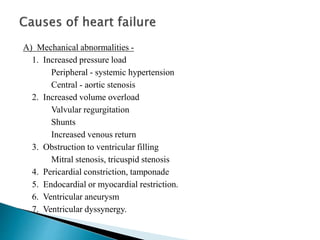
A) Mechanical abnormalities -
1. Increased pressure load
Peripheral - systemic hypertension
Central - aortic stenosis
2. Increased volume overload
Valvular regurgitation
Shunts
Increased venous return
3. Obstruction to ventricular filling
Mitral stenosis, tricuspid stenosis
4. Pericardial constriction, tamponade
5. Endocardial or myocardial restriction.
6. Ventricular aneurysm
7. Ventricular dyssynergy.
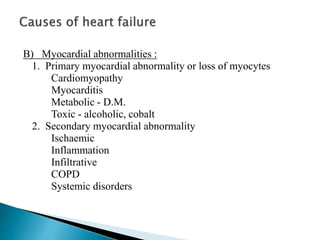
B) Myocardial abnormalities :
1. Primary myocardial abnormality or loss of myocytes
Cardiomyopathy
Myocarditis
Metabolic - D.M.
Toxic - alcoholic, cobalt
2. Secondary myocardial abnormality
Ischaemic
Inflammation
Infiltrative
COPD
Systemic disorders
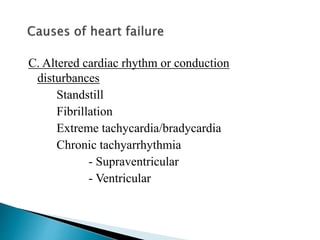
C. Altered cardiac rhythm or conduction
disturbances
Standstill
Fibrillation
Extreme tachycardia/bradycardia
Chronic tachyarrhythmia
- Supraventricular
- Ventricular
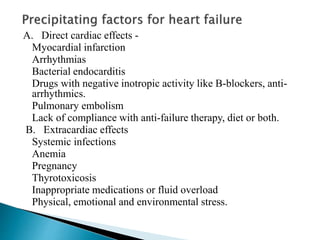
A. Direct cardiac effects -
Myocardial infarction
Arrhythmias
Bacterial endocarditis
Drugs with negative inotropic activity like B-blockers, anti-
arrhythmics.
Pulmonary embolism
Lack of compliance with anti-failure therapy, diet or both.
B. Extracardiac effects
Systemic infections
Anemia
Pregnancy
Thyrotoxicosis
Inappropriate medications or fluid overload
Physical, emotional and environmental stress.
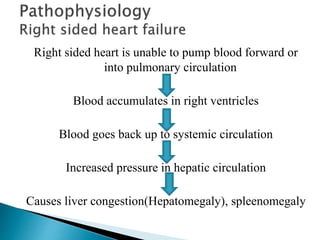
Right sided heart is unable to pump blood forward or
into pulmonary circulation
Blood accumulates in right ventricles
Blood goes back up to systemic circulation
Increased pressure in hepatic circulation
Causes liver congestion(Hepatomegaly), spleenomegaly
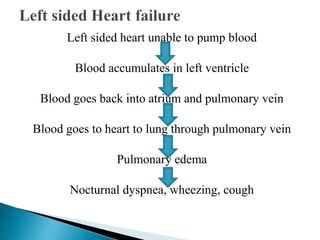
Left sided heart unable to pump blood
Blood accumulates in left ventricle
Blood goes back into atrium and pulmonary vein
Blood goes to heart to lung through pulmonary vein
Pulmonary edema
Nocturnal dyspnea, wheezing, cough
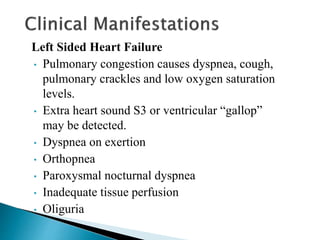
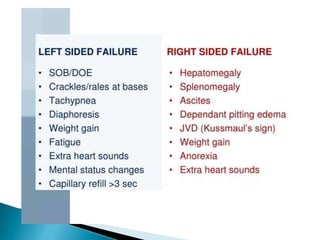
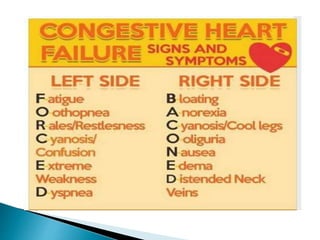
Left Sided Heart Failure
• Pulmonary congestion causes dyspnea, cough,
pulmonary crackles and low oxygen saturation
levels.
• Extra heart sound S3 or ventricular “gallop”
may be detected.
• Dyspnea on exertion
• Orthopnea
• Paroxysmal nocturnal dyspnea
• Inadequate tissue perfusion
• Oliguria
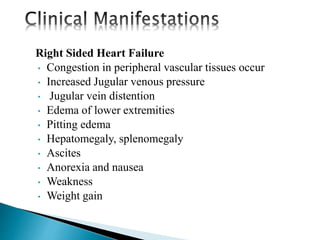
Right Sided Heart Failure
• Congestion in peripheral vascular tissues occur
• Increased Jugular venous pressure
• Jugular vein distention
• Edema of lower extremities
• Pitting edema
• Hepatomegaly, splenomegaly
• Ascites
• Anorexia and nausea
• Weakness
• Weight gain
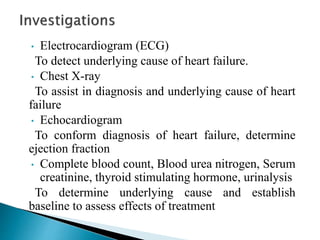
• Electrocardiogram (ECG)
To detect underlying cause of heart failure.
• Chest X-ray
To assist in diagnosis and underlying cause of heart
failure
• Echocardiogram
To conform diagnosis of heart failure, determine
ejection fraction
• Complete blood count, Blood urea nitrogen, Serum
creatinine, thyroid stimulating hormone, urinalysis
To determine underlying cause and establish
baseline to assess effects of treatment
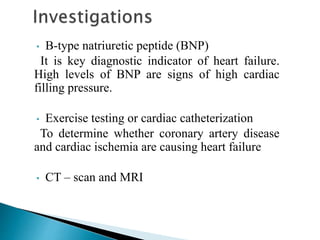
• B-type natriuretic peptide (BNP)
It is key diagnostic indicator of heart failure.
High levels of BNP are signs of high cardiac
filling pressure.
• Exercise testing or cardiac catheterization
To determine whether coronary artery disease
and cardiac ischemia are causing heart failure
• CT – scan and MRI
1. History
History reflects either systemic or pulmonary or both
congestion.
Shortness Of Breath - on effort / on lying down.
Easy fatigability
Peripheral edema
History of Hypertension, Coronary Artery Disease,
Diabetes Mellitus etc.
2. Physical examination
Tachycardia
Pulmonary rales - Pleural effusion
3rd and/or 4th heart sound
Pulsus paradoxus
Murmurs - valvular / congenital heart disease.
3. Precipitating factors
Anemia, infection, arrhythmia, MI, poor
compliance
Pulmonary embolism etc.
1. Non pharmacologic aspect :
Rest in acute heart failure
Aerobic exercise
Low salt intake (< 20 gm/day )
Weight reduction
Avoidance of smoking and other risk factor modification
Fluid restriction - 1 to 1.5 L / day
Avoid drugs - negative inotropic, cardiotoxic and salt and
water retaining alcohol
2. Pharmacologic treatment :
Directed to 3 hemodynamic endpoints
a) decrease volume overload
b) decrease preload and afterload - improve ventricular
performance
c) to improve ventricular contractility
3. Management of primary abnormalities :
Ischemic
medical
interventional
surgical
Hypertension
Valvular diseases
Secondary to systemic disorders, drugs etc.
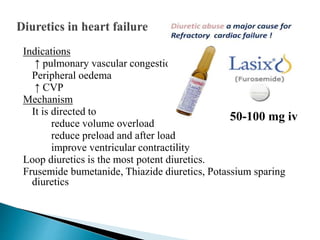
Indications
↑ pulmonary vascular congestion
Peripheral oedema
↑ CVP
Mechanism
It is directed to
reduce volume overload
reduce preload and after load
improve ventricular contractility
Loop diuretics is the most potent diuretics.
Frusemide bumetanide, Thiazide diuretics, Potassium sparing
diuretics
50-100 mg iv
ACE - inhibitors : ( Oral )
Captopril, Enalapril 2mg BD, Lisinopril 2.5mg
BD, Cilazapril, Ramipril etc.
Vasodilator drugs :
Nitrates; Oral - ( sublingual, transdermal ) IV 10-
20 mg/ml
Sodium Nitroprusside - IV
Hydralazine; Oral, IV
Digoxin: to increase myocardial contractility
Digitalis preparation to increase pumping
capability of myocardium
Newer drugs / devices
Angiotensin II receptor antagonists
Valsartan, Losartan
B- blockers
Metoprolol, Bisoprolol, Carvedilol, Atenolol
Antiarrhythmics
Amiodarone
Anticoagulant therapy :
↓Thromboemboic risk
Previous thromboembolic events
LV or intracardiac thrombus etc
 UNLOADFAT
 U: Upright position
 N: Nitrates (in low doses 10-20 mg/ml)
 L: Lasix 50-100 mg IV
 O: Oxygen, high flow and high concentration
 A: Aminophylline
 D: Digoxin, Digitalis, Diet therapy ( Salt, sodium and
high fluids restricted)
 F: Fluids decrease
 A: ACE - inhibitors Enalapril 2mg BD, Lisinopril.
 T: Test (ABG, potassium level, sodium level)
Invasive approaches for underlying disorders
PTCA with or without stent implantation
CABG
Valvular surgery
Aneurysmectomy
Left Ventricular Assist Device
Cardiomyoplasty
Heart Transplantation
• Identify and evaluate the severity of dependent
edema.
• Monitor pulse rate and blood pressure checking for
postural hypotension due to dehydration.
• Examine skin turgor and mucous membrane for
signs of dehydration
• Assess for symptoms of fluid overload (e.g.
orthopnea, post nasal drip)
• Auscultate lung sounds to detect an increase or
decrease in pulmonary crackles.
Nursing Diagnosis
• Altered cardiac output related to impaired
contractibility of heart.
• Fluid excess related to sodium and water
retention
• Activity intolerance related to oxygen demand
and supply imbalanced
• Knowledge deficit related to disease condition.
• Assess fluid balance, including intake and output
• Weigh the patient daily at the same time and on the same
scale usually in the morning after urination.
• Administer medication and assess the patient’s response
to the pharmacologic regimen
• Auscultate lung sounds to detect an increase or decrease
in pulmonary crackles.
• Determine degree of pulmonary crackles.
• To maintain head or bed with elevation at least 40-60
degree
• Elevate edematous extremities above the heart level when
in bed.
• Position should be changed 2 hourly
 Keep the patient in propped up position to reduce pulmonary
congestion.
 Give oxygen, high flow and high concentration.
 Digitalis preparation to increase pumping capability of
myocardium
 Diuretics should be given (lasix 50-100 mg IV) to decrease
fluid overload in the interstitial space.
 Nitrate IV 10-20 mg/ml.
 Pt should be kept on strict bed rest
 Continuous cardiac monitoring
 Assess vital sign and maintain I/O
 To give digoxin to increase myocardial contractility.
 If patient in severe condition medication should be given IV
route only
• Digitalis toxicity and hypokalemia
• Prolonged diuretic therapy produce hyponatremia
which results in disorientation, apprehension,
weakness, fatigue, malaise and muscle cramps.
• Pulmonary edema, Myocardial failure
• Renal failure
• Metabolic acidosis
• Cardiac arrest
• Cardiac arrhythmias
Congestive heart failure (chf) sushila

Congestive heart failure (chf) sushila

  • 1.
  • 2.
     It isinability of the heart to pump sufficient blood to meet the need of the tissues for oxygen and nutrient
  • 4.
    A) Mechanical abnormalities- 1. Increased pressure load Peripheral - systemic hypertension Central - aortic stenosis 2. Increased volume overload Valvular regurgitation Shunts Increased venous return 3. Obstruction to ventricular filling Mitral stenosis, tricuspid stenosis 4. Pericardial constriction, tamponade 5. Endocardial or myocardial restriction. 6. Ventricular aneurysm 7. Ventricular dyssynergy.
  • 5.
    B) Myocardial abnormalities: 1. Primary myocardial abnormality or loss of myocytes Cardiomyopathy Myocarditis Metabolic - D.M. Toxic - alcoholic, cobalt 2. Secondary myocardial abnormality Ischaemic Inflammation Infiltrative COPD Systemic disorders
  • 6.
    C. Altered cardiacrhythm or conduction disturbances Standstill Fibrillation Extreme tachycardia/bradycardia Chronic tachyarrhythmia - Supraventricular - Ventricular
  • 7.
    A. Direct cardiaceffects - Myocardial infarction Arrhythmias Bacterial endocarditis Drugs with negative inotropic activity like B-blockers, anti- arrhythmics. Pulmonary embolism Lack of compliance with anti-failure therapy, diet or both. B. Extracardiac effects Systemic infections Anemia Pregnancy Thyrotoxicosis Inappropriate medications or fluid overload Physical, emotional and environmental stress.
  • 8.
    Right sided heartis unable to pump blood forward or into pulmonary circulation Blood accumulates in right ventricles Blood goes back up to systemic circulation Increased pressure in hepatic circulation Causes liver congestion(Hepatomegaly), spleenomegaly
  • 9.
    Left sided heartunable to pump blood Blood accumulates in left ventricle Blood goes back into atrium and pulmonary vein Blood goes to heart to lung through pulmonary vein Pulmonary edema Nocturnal dyspnea, wheezing, cough
  • 10.
    Left Sided HeartFailure • Pulmonary congestion causes dyspnea, cough, pulmonary crackles and low oxygen saturation levels. • Extra heart sound S3 or ventricular “gallop” may be detected. • Dyspnea on exertion • Orthopnea • Paroxysmal nocturnal dyspnea • Inadequate tissue perfusion • Oliguria
  • 11.
    Right Sided HeartFailure • Congestion in peripheral vascular tissues occur • Increased Jugular venous pressure • Jugular vein distention • Edema of lower extremities • Pitting edema • Hepatomegaly, splenomegaly • Ascites • Anorexia and nausea • Weakness • Weight gain
  • 14.
    • Electrocardiogram (ECG) Todetect underlying cause of heart failure. • Chest X-ray To assist in diagnosis and underlying cause of heart failure • Echocardiogram To conform diagnosis of heart failure, determine ejection fraction • Complete blood count, Blood urea nitrogen, Serum creatinine, thyroid stimulating hormone, urinalysis To determine underlying cause and establish baseline to assess effects of treatment
  • 15.
    • B-type natriureticpeptide (BNP) It is key diagnostic indicator of heart failure. High levels of BNP are signs of high cardiac filling pressure. • Exercise testing or cardiac catheterization To determine whether coronary artery disease and cardiac ischemia are causing heart failure • CT – scan and MRI
  • 16.
    1. History History reflectseither systemic or pulmonary or both congestion. Shortness Of Breath - on effort / on lying down. Easy fatigability Peripheral edema History of Hypertension, Coronary Artery Disease, Diabetes Mellitus etc.
  • 17.
    2. Physical examination Tachycardia Pulmonaryrales - Pleural effusion 3rd and/or 4th heart sound Pulsus paradoxus Murmurs - valvular / congenital heart disease. 3. Precipitating factors Anemia, infection, arrhythmia, MI, poor compliance Pulmonary embolism etc.
  • 18.
    1. Non pharmacologicaspect : Rest in acute heart failure Aerobic exercise Low salt intake (< 20 gm/day ) Weight reduction Avoidance of smoking and other risk factor modification Fluid restriction - 1 to 1.5 L / day Avoid drugs - negative inotropic, cardiotoxic and salt and water retaining alcohol
  • 19.
    2. Pharmacologic treatment: Directed to 3 hemodynamic endpoints a) decrease volume overload b) decrease preload and afterload - improve ventricular performance c) to improve ventricular contractility 3. Management of primary abnormalities : Ischemic medical interventional surgical Hypertension Valvular diseases Secondary to systemic disorders, drugs etc.
  • 20.
    Indications ↑ pulmonary vascularcongestion Peripheral oedema ↑ CVP Mechanism It is directed to reduce volume overload reduce preload and after load improve ventricular contractility Loop diuretics is the most potent diuretics. Frusemide bumetanide, Thiazide diuretics, Potassium sparing diuretics 50-100 mg iv
  • 21.
    ACE - inhibitors: ( Oral ) Captopril, Enalapril 2mg BD, Lisinopril 2.5mg BD, Cilazapril, Ramipril etc. Vasodilator drugs : Nitrates; Oral - ( sublingual, transdermal ) IV 10- 20 mg/ml Sodium Nitroprusside - IV Hydralazine; Oral, IV Digoxin: to increase myocardial contractility Digitalis preparation to increase pumping capability of myocardium
  • 22.
    Newer drugs /devices Angiotensin II receptor antagonists Valsartan, Losartan B- blockers Metoprolol, Bisoprolol, Carvedilol, Atenolol Antiarrhythmics Amiodarone Anticoagulant therapy : ↓Thromboemboic risk Previous thromboembolic events LV or intracardiac thrombus etc
  • 23.
     UNLOADFAT  U:Upright position  N: Nitrates (in low doses 10-20 mg/ml)  L: Lasix 50-100 mg IV  O: Oxygen, high flow and high concentration  A: Aminophylline  D: Digoxin, Digitalis, Diet therapy ( Salt, sodium and high fluids restricted)  F: Fluids decrease  A: ACE - inhibitors Enalapril 2mg BD, Lisinopril.  T: Test (ABG, potassium level, sodium level)
  • 24.
    Invasive approaches forunderlying disorders PTCA with or without stent implantation CABG Valvular surgery Aneurysmectomy Left Ventricular Assist Device Cardiomyoplasty Heart Transplantation
  • 27.
    • Identify andevaluate the severity of dependent edema. • Monitor pulse rate and blood pressure checking for postural hypotension due to dehydration. • Examine skin turgor and mucous membrane for signs of dehydration • Assess for symptoms of fluid overload (e.g. orthopnea, post nasal drip) • Auscultate lung sounds to detect an increase or decrease in pulmonary crackles.
  • 28.
    Nursing Diagnosis • Alteredcardiac output related to impaired contractibility of heart. • Fluid excess related to sodium and water retention • Activity intolerance related to oxygen demand and supply imbalanced • Knowledge deficit related to disease condition.
  • 29.
    • Assess fluidbalance, including intake and output • Weigh the patient daily at the same time and on the same scale usually in the morning after urination. • Administer medication and assess the patient’s response to the pharmacologic regimen • Auscultate lung sounds to detect an increase or decrease in pulmonary crackles. • Determine degree of pulmonary crackles. • To maintain head or bed with elevation at least 40-60 degree • Elevate edematous extremities above the heart level when in bed. • Position should be changed 2 hourly
  • 30.
     Keep thepatient in propped up position to reduce pulmonary congestion.  Give oxygen, high flow and high concentration.  Digitalis preparation to increase pumping capability of myocardium  Diuretics should be given (lasix 50-100 mg IV) to decrease fluid overload in the interstitial space.  Nitrate IV 10-20 mg/ml.  Pt should be kept on strict bed rest  Continuous cardiac monitoring  Assess vital sign and maintain I/O  To give digoxin to increase myocardial contractility.  If patient in severe condition medication should be given IV route only
  • 31.
    • Digitalis toxicityand hypokalemia • Prolonged diuretic therapy produce hyponatremia which results in disorientation, apprehension, weakness, fatigue, malaise and muscle cramps. • Pulmonary edema, Myocardial failure • Renal failure • Metabolic acidosis • Cardiac arrest • Cardiac arrhythmias