KAREEM JELILAT T.
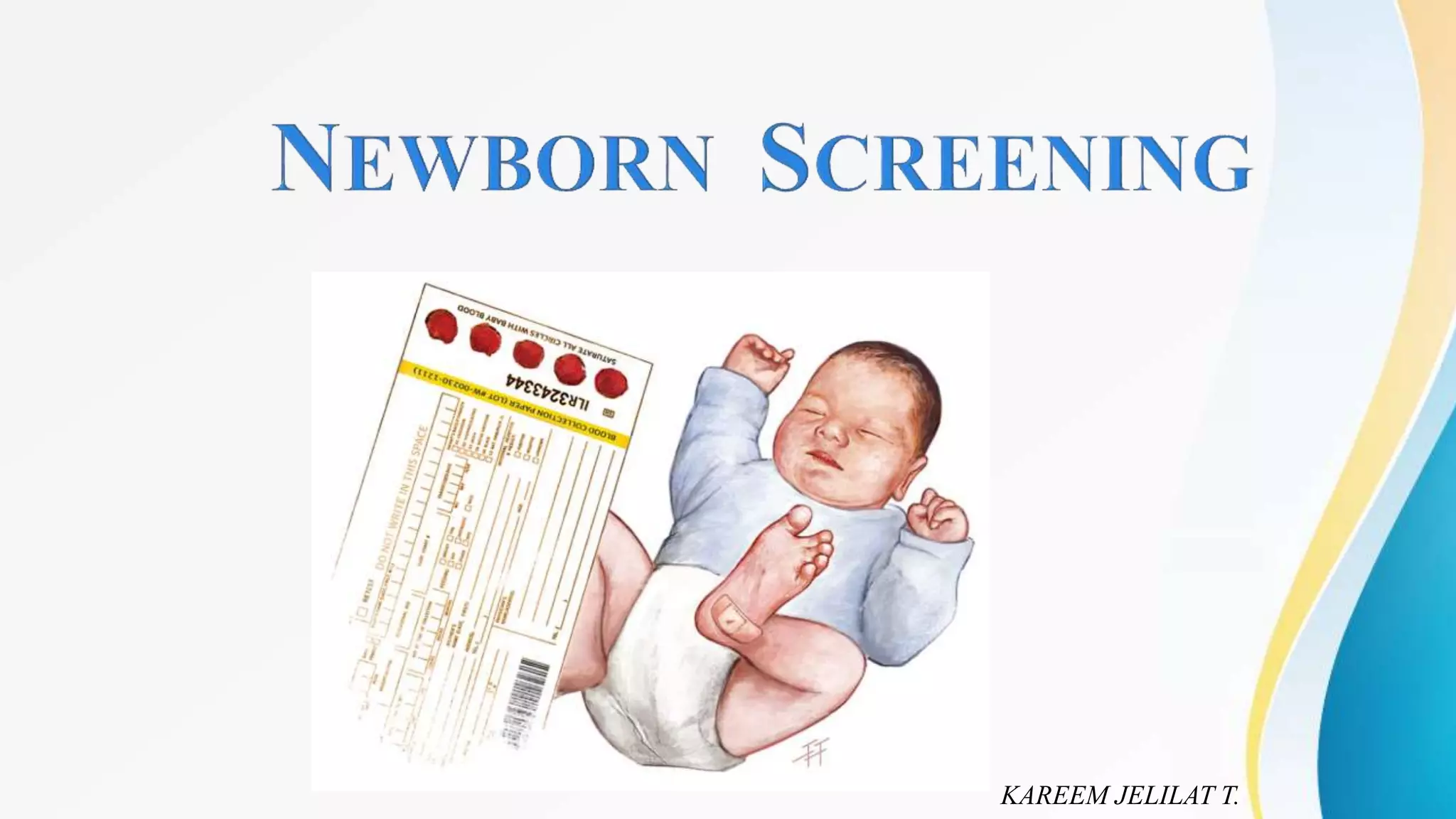
Newborn screening is a public health program of screening in
infants shortly after birth for a list of conditions that are
treatable, but not clinically evident in the newborn period.
Some of the conditions included in newborn screening
programs are only detectable after irreversible damage has been
done; in some cases sudden death is the first manifestation of a
disease.
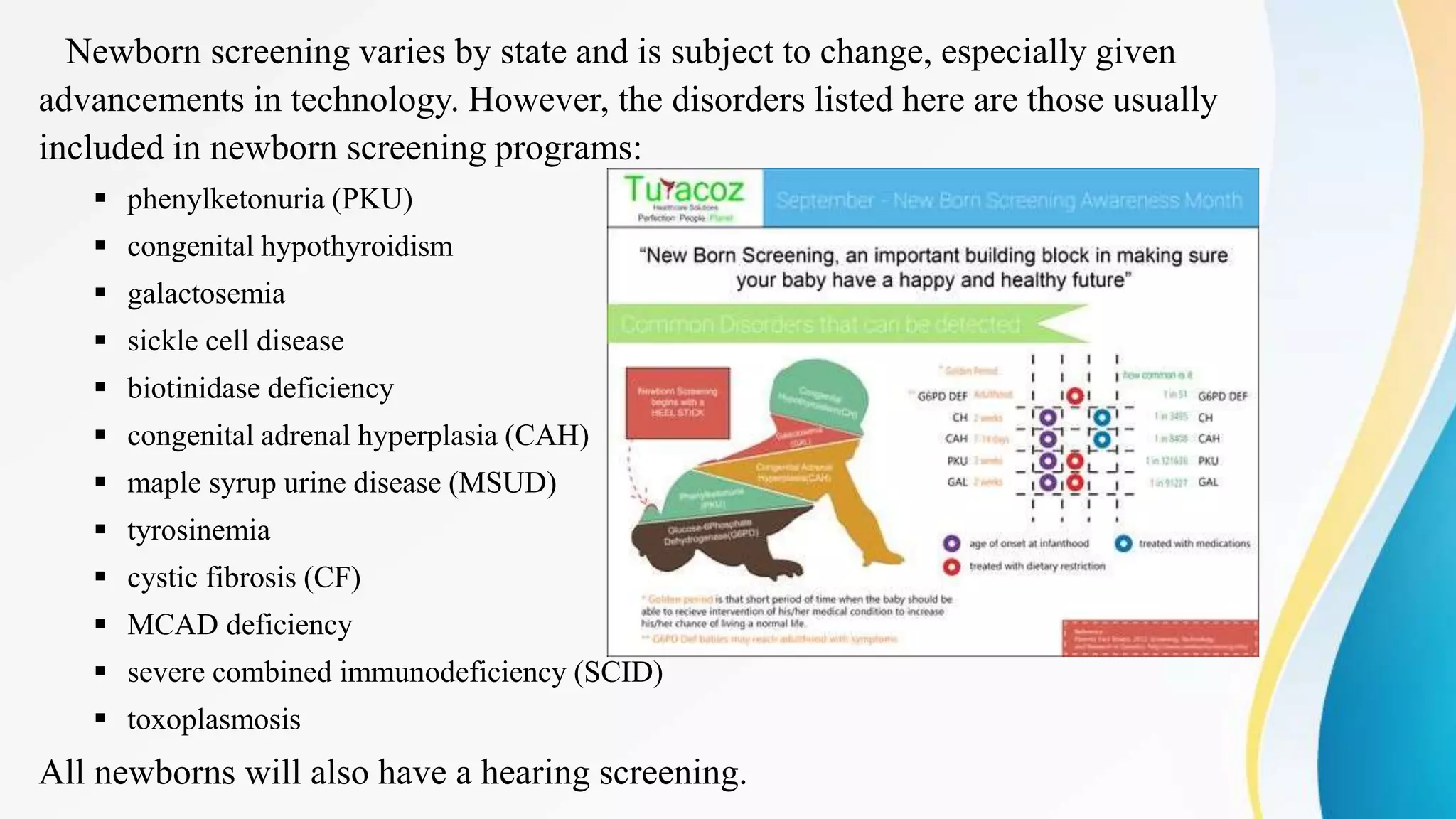
Newborn screening varies by state and is subject to change, especially given
advancements in technology. However, the disorders listed here are those usually
included in newborn screening programs:
 phenylketonuria (PKU)
 congenital hypothyroidism
 galactosemia
 sickle cell disease
 biotinidase deficiency
 congenital adrenal hyperplasia (CAH)
 maple syrup urine disease (MSUD)
 tyrosinemia
 cystic fibrosis (CF)
 MCAD deficiency
 severe combined immunodeficiency (SCID)
 toxoplasmosis
All newborns will also have a hearing screening.
Disorder Test/Method
Widely Applied
Phenylketonuria
Congenital hypothroidism
Guthrie test or automated fluorometric test
Thyroxine or thyroid- stimulating hormone
Other Inborn Errors
Biotinidase deficiency
Galactosemia
Maple syrup urine disease
Tyrosinemia
Homocystinuria
Specific enzyme assay
Modified Guthrie test
Miscellaneous
Congenital adrenal hyperplasia
Cystic fibrosis
Duchenne muscular dystrophy
Sickle cell disease
17-Hydroxyprogesterone assay
Immunoreactice trypsin and DNA analysis
Creatine kinase
Haemoglobin electrophoresis
The Guthrie test is based on reversal of bacterial growth inhibition by a high
level of phenylalanine.
• Phenylketonuria
– The screening test, which is sometimes known as the Guthrie test, is
carried out on a small sample of blood obtained by heel-prick at age 7
days.
– A low-phenylalanine diet is extremely effective in preventing learning
disabilities.
• Galactosemia
– Classic galactosemia affects approximately 1 in 50,000 newborn infants
and usually presents with vomiting, lethargy, and severe metabolic
collapse within the first 2 or 3 weeks of life. Newborn screening is based
on a modification of the Guthrie test with subsequent confirmation by
specific enzyme assay.
• Cystic Fibrosis
– Newborn screening for cystic fibrosis is based on the detection of a
raised blood level of immunoreactive trypsin, which is a
consequence of blockage of pancreatic ducts in utero,
supplemented by DNA analysis.
– The rationale for screening is that early treatment with
physiotherapy and antibiotics improve the long-term prognosis.
• Sickle Cell Disease and Thalassemia
– Newborn screening based on hemoglobin electrophoresis is
undertaken in many countries with a significant Afro-Caribbean
community.
• All 50 US states are required by law to offer neonatal screening for PKU,
galactosaemia and congenital hypothyroidism (usually nongenetic), as are
offered in most developed countries.
• In the UK consideration is currently being given also to Pompe disease,
maple syrup urine disease, tyrosinaemia, CAH, isovaleric acidaemia,
glutaric aciduria Type 1 and homocystinuria.
• Sickle cell disease (SCD) is the most common genetic disorder to affect
Blacks.
• Newborn screening needed for sickle cell anemia in Nigeria
• If neonatal screening is to be undertaken, the consultative follow-up
should be prompt and involve definitive diagnosis, prompt initiation of
management and appropriate genetic counselling.
Global Distribution of Neonatal Screening (2016)

Newborn screening

  • 1.
  • 2.
    Newborn screening isa public health program of screening in infants shortly after birth for a list of conditions that are treatable, but not clinically evident in the newborn period. Some of the conditions included in newborn screening programs are only detectable after irreversible damage has been done; in some cases sudden death is the first manifestation of a disease.
  • 3.
    Newborn screening variesby state and is subject to change, especially given advancements in technology. However, the disorders listed here are those usually included in newborn screening programs:  phenylketonuria (PKU)  congenital hypothyroidism  galactosemia  sickle cell disease  biotinidase deficiency  congenital adrenal hyperplasia (CAH)  maple syrup urine disease (MSUD)  tyrosinemia  cystic fibrosis (CF)  MCAD deficiency  severe combined immunodeficiency (SCID)  toxoplasmosis All newborns will also have a hearing screening.
  • 4.
    Disorder Test/Method Widely Applied Phenylketonuria Congenitalhypothroidism Guthrie test or automated fluorometric test Thyroxine or thyroid- stimulating hormone Other Inborn Errors Biotinidase deficiency Galactosemia Maple syrup urine disease Tyrosinemia Homocystinuria Specific enzyme assay Modified Guthrie test Modified Guthrie test Modified Guthrie test Modified Guthrie test Miscellaneous Congenital adrenal hyperplasia Cystic fibrosis Duchenne muscular dystrophy Sickle cell disease 17-Hydroxyprogesterone assay Immunoreactice trypsin and DNA analysis Creatine kinase Haemoglobin electrophoresis The Guthrie test is based on reversal of bacterial growth inhibition by a high level of phenylalanine.
  • 5.
    • Phenylketonuria – Thescreening test, which is sometimes known as the Guthrie test, is carried out on a small sample of blood obtained by heel-prick at age 7 days. – A low-phenylalanine diet is extremely effective in preventing learning disabilities. • Galactosemia – Classic galactosemia affects approximately 1 in 50,000 newborn infants and usually presents with vomiting, lethargy, and severe metabolic collapse within the first 2 or 3 weeks of life. Newborn screening is based on a modification of the Guthrie test with subsequent confirmation by specific enzyme assay.
  • 6.
    • Cystic Fibrosis –Newborn screening for cystic fibrosis is based on the detection of a raised blood level of immunoreactive trypsin, which is a consequence of blockage of pancreatic ducts in utero, supplemented by DNA analysis. – The rationale for screening is that early treatment with physiotherapy and antibiotics improve the long-term prognosis. • Sickle Cell Disease and Thalassemia – Newborn screening based on hemoglobin electrophoresis is undertaken in many countries with a significant Afro-Caribbean community.
  • 7.
    • All 50US states are required by law to offer neonatal screening for PKU, galactosaemia and congenital hypothyroidism (usually nongenetic), as are offered in most developed countries. • In the UK consideration is currently being given also to Pompe disease, maple syrup urine disease, tyrosinaemia, CAH, isovaleric acidaemia, glutaric aciduria Type 1 and homocystinuria. • Sickle cell disease (SCD) is the most common genetic disorder to affect Blacks. • Newborn screening needed for sickle cell anemia in Nigeria • If neonatal screening is to be undertaken, the consultative follow-up should be prompt and involve definitive diagnosis, prompt initiation of management and appropriate genetic counselling.
  • 8.
    Global Distribution ofNeonatal Screening (2016)