Conformational analysis
CHEM 320
Contents
• Conformation vs configuration
• Rotation around single bond
• Ring strain
• Conformation of
– Cyclohexane
– Monosubstituted cyclohexanes
– Disubstituted cyclohexanes
– Fused cyclohexanes
• Elimination reactions in cyclic compounds
• Text books:
– Bruice ‘Organic Chemistry’
– Clayden, Greevers, Warren, Wothers ‘Organic Chemistry’
• Please get a set of molecular models to use in the module
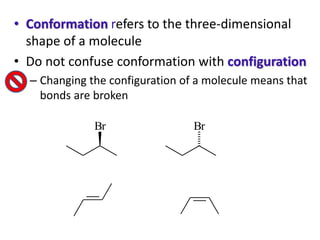
• Conformation refers to the three-dimensional
shape of a molecule
• Do not confuse conformation with configuration
– Changing the configuration of a molecule means that
bonds are broken
Br Br
Conformation / Configuration
• A different configuration is a different
molecule
• Changing the conformation of a compound
means rotating about a bond, but not
breaking it
• Conformations of a compound are readily
interconvertible and are all the same molecule
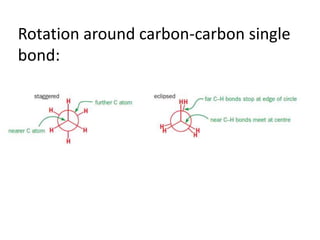
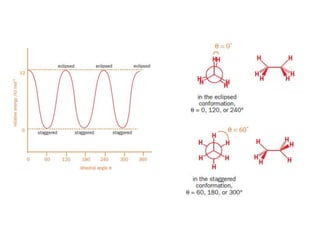
Rotation around carbon-carbon single
bond:
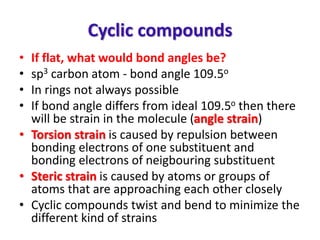
Cyclic compounds
• If flat, what would bond angles be?
• sp3 carbon atom - bond angle 109.5o
• In rings not always possible
• If bond angle differs from ideal 109.5o then there
will be strain in the molecule (angle strain)
• Torsion strain is caused by repulsion between
bonding electrons of one substituent and
bonding electrons of neigbouring substituent
• Steric strain is caused by atoms or groups of
atoms that are approaching each other closely
• Cyclic compounds twist and bend to minimize the
different kind of strains
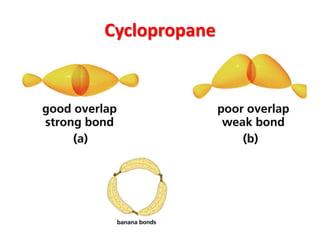
Cyclopropane
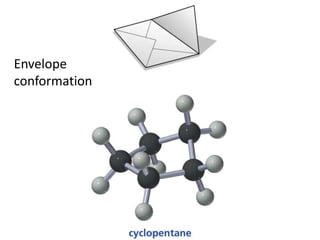
Envelope
conformation
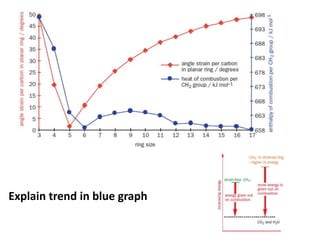
Explain trend in blue graph
Conformation of cyclohexane
Chair conformation & boat conformation
H
H
H
H
H
H
H
H
H
H
H
H
Chair conformation of cyclohexane
Newman projection
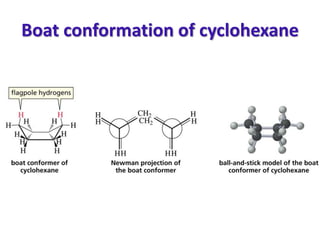
Boat conformation of cyclohexane
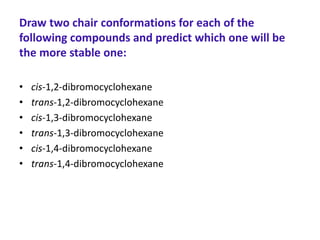
Draw two chair conformations for each of the
following compounds and predict which one will be
the more stable one:
• cis-1,2-dibromocyclohexane
• trans-1,2-dibromocyclohexane
• cis-1,3-dibromocyclohexane
• trans-1,3-dibromocyclohexane
• cis-1,4-dibromocyclohexane
• trans-1,4-dibromocyclohexane
ΔGo = -RT ln K K = e-ΔG°/RT
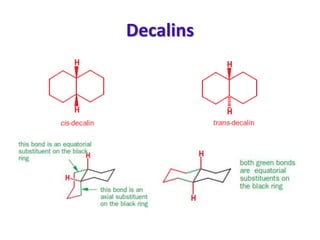
Decalins
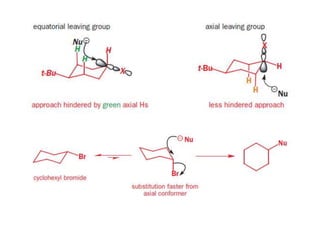
Nucleophilic substitution reactions
Conformational analysis.pptx

Conformational analysis.pptx

  • 1.
  • 2.
    Contents • Conformation vsconfiguration • Rotation around single bond • Ring strain • Conformation of – Cyclohexane – Monosubstituted cyclohexanes – Disubstituted cyclohexanes – Fused cyclohexanes • Elimination reactions in cyclic compounds • Text books: – Bruice ‘Organic Chemistry’ – Clayden, Greevers, Warren, Wothers ‘Organic Chemistry’ • Please get a set of molecular models to use in the module
  • 3.
    • Conformation refersto the three-dimensional shape of a molecule • Do not confuse conformation with configuration – Changing the configuration of a molecule means that bonds are broken Br Br
  • 4.
    Conformation / Configuration •A different configuration is a different molecule • Changing the conformation of a compound means rotating about a bond, but not breaking it • Conformations of a compound are readily interconvertible and are all the same molecule
  • 5.
  • 9.
    Cyclic compounds • Ifflat, what would bond angles be? • sp3 carbon atom - bond angle 109.5o • In rings not always possible • If bond angle differs from ideal 109.5o then there will be strain in the molecule (angle strain) • Torsion strain is caused by repulsion between bonding electrons of one substituent and bonding electrons of neigbouring substituent • Steric strain is caused by atoms or groups of atoms that are approaching each other closely • Cyclic compounds twist and bend to minimize the different kind of strains
  • 10.
  • 12.
  • 13.
    Explain trend inblue graph
  • 14.
  • 15.
    Chair conformation &boat conformation
  • 17.
    H H H H H H H H H H H H Chair conformation ofcyclohexane Newman projection
  • 18.
  • 20.
    Draw two chairconformations for each of the following compounds and predict which one will be the more stable one: • cis-1,2-dibromocyclohexane • trans-1,2-dibromocyclohexane • cis-1,3-dibromocyclohexane • trans-1,3-dibromocyclohexane • cis-1,4-dibromocyclohexane • trans-1,4-dibromocyclohexane
  • 22.
    ΔGo = -RTln K K = e-ΔG°/RT
  • 23.
  • 24.