Conflict in small groups
An overview
An overview
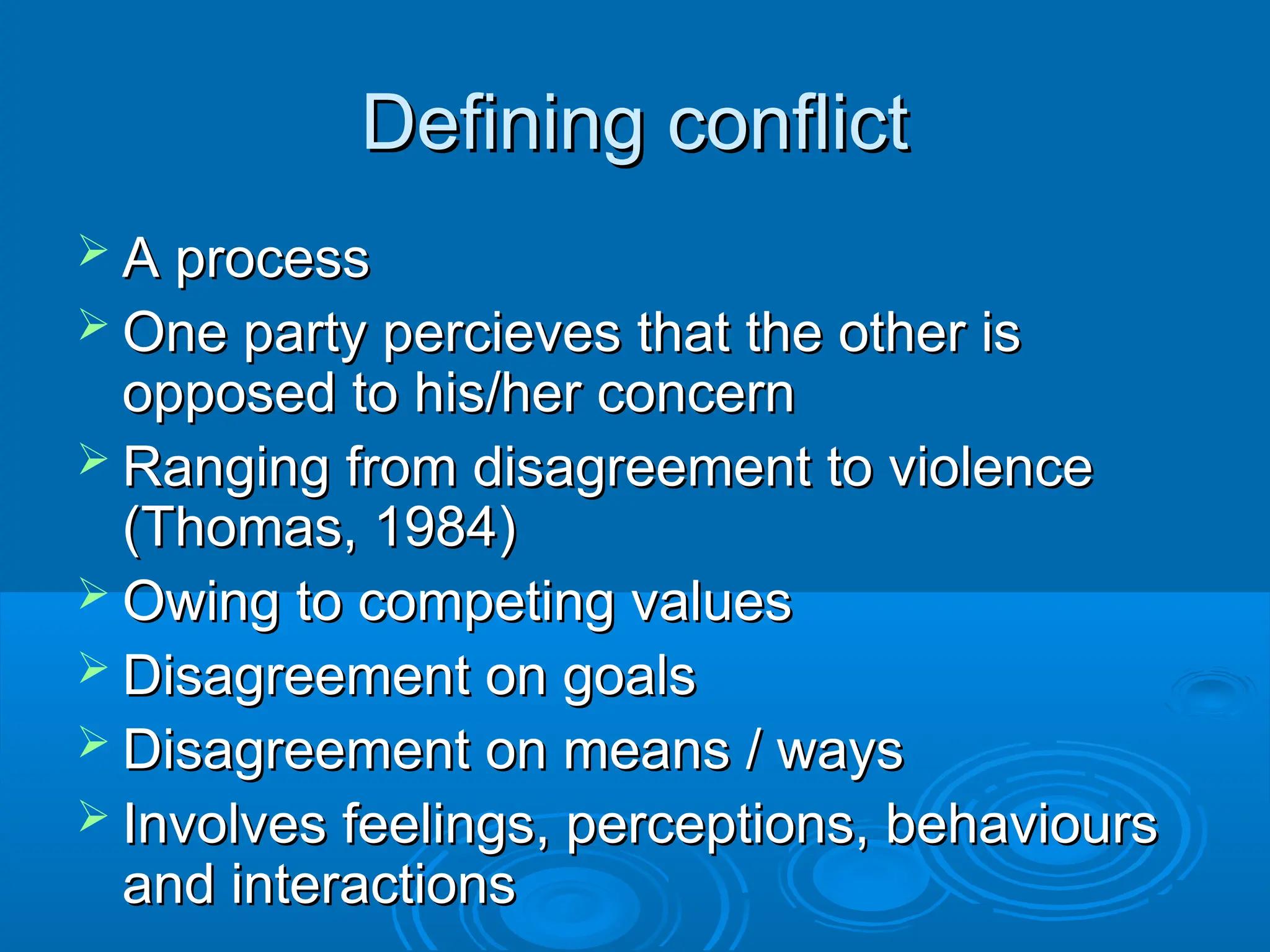
Defining conflict
Defining conflict
 A process
A process
 One party percieves that the other is
One party percieves that the other is
opposed to his/her concern
 Ranging from disagreement to violence
Ranging from disagreement to violence
(Thomas, 1984)
(Thomas, 1984)
 Owing to competing values
Owing to competing values
 Disagreement on goals
Disagreement on goals
 Disagreement on means / ways
Disagreement on means / ways
 Involves feelings, perceptions, behaviours
Involves feelings, perceptions, behaviours
and interactions
and interactions
Dimensions
Dimensions
 The perception of a situation rather than the
The perception of a situation rather than the
situation leads conflict
 Emotions connected with perceptions
Emotions connected with perceptions
 Perceptions and emotions affects behaviour
Perceptions and emotions affects behaviour
 Behaviour affects interaction
Behaviour affects interaction
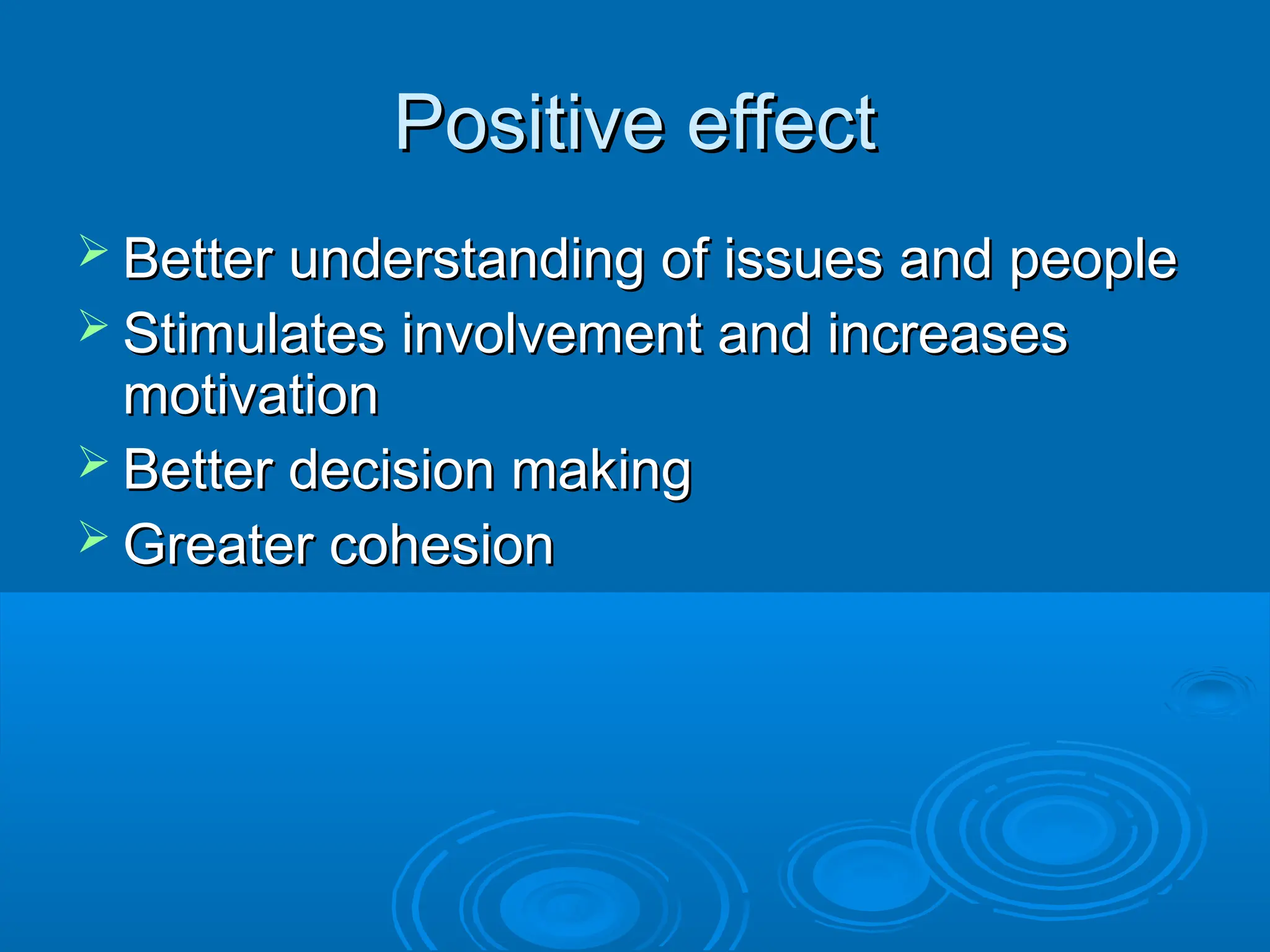
Positive effect
Positive effect
 Better understanding of issues and people
Better understanding of issues and people
 Stimulates involvement and increases
Stimulates involvement and increases
motivation
motivation
 Better decision making
Better decision making
 Greater cohesion
Greater cohesion
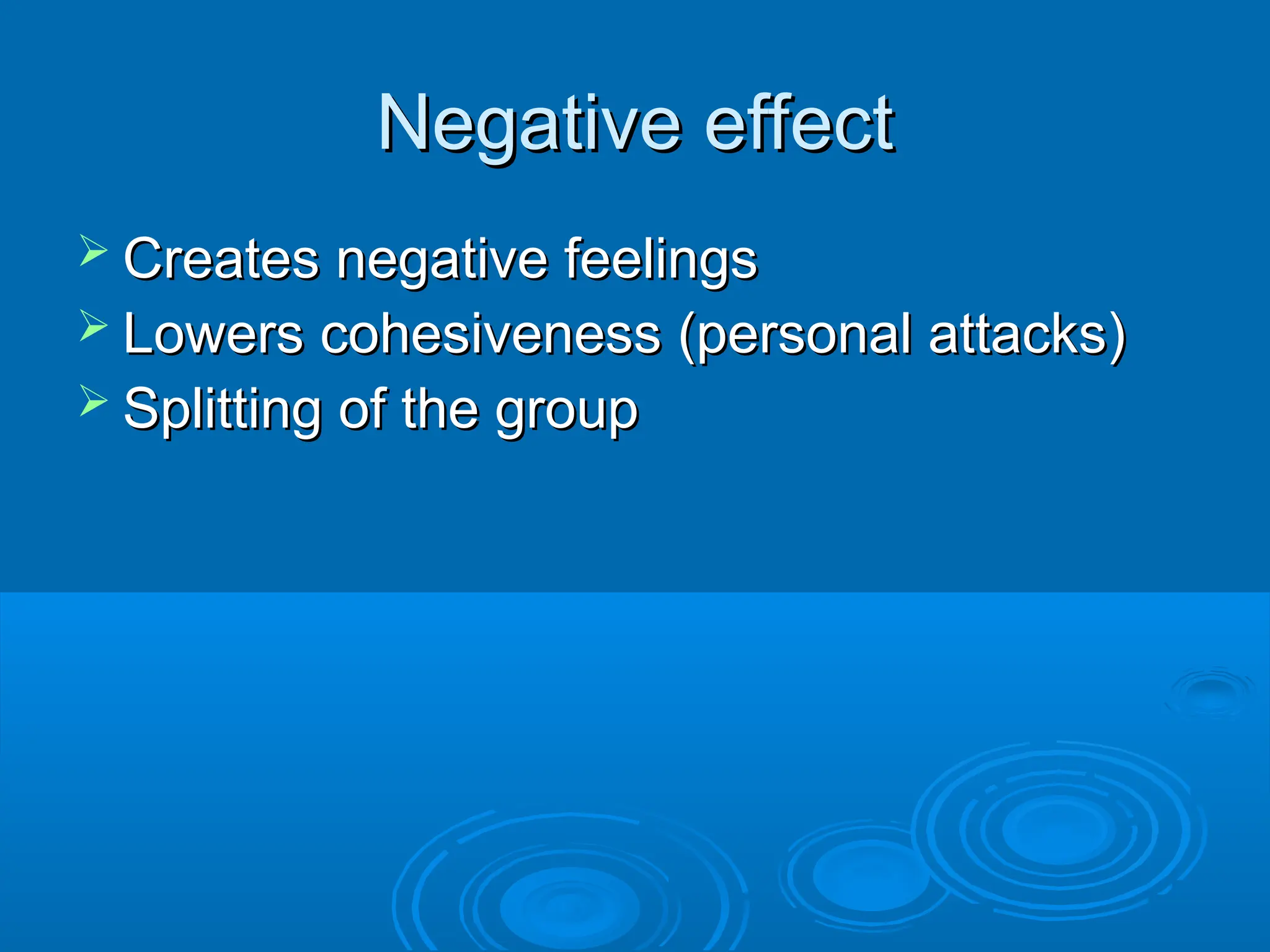
Negative effect
Negative effect
 Creates negative feelings
Creates negative feelings
 Lowers cohesiveness (personal attacks)
Lowers cohesiveness (personal attacks)
 Splitting of the group
Splitting of the group
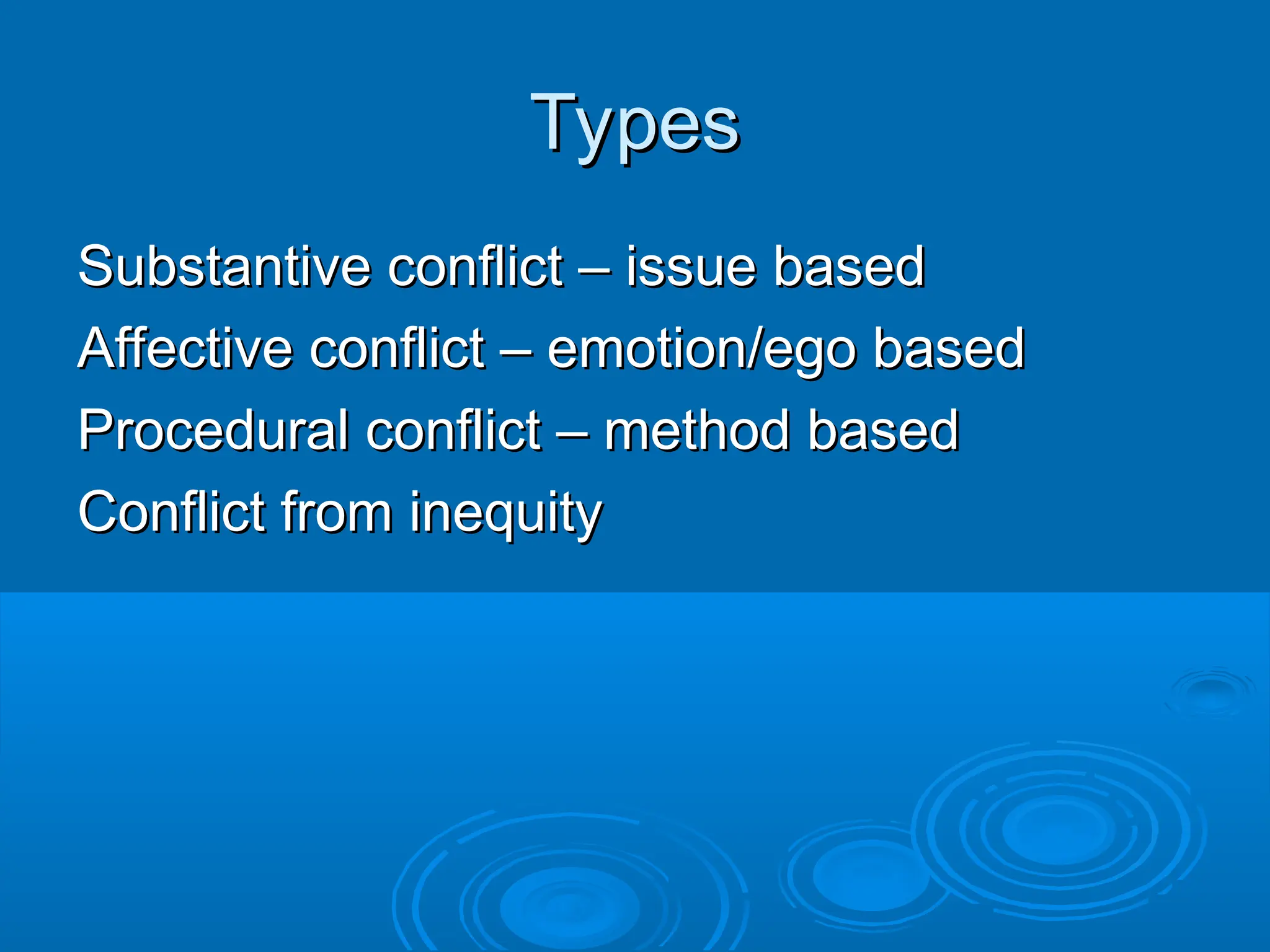
Types
Types
Substantive conflict – issue based
Affective conflict – emotion/ego based
Procedural conflict – method based
Conflict from inequity
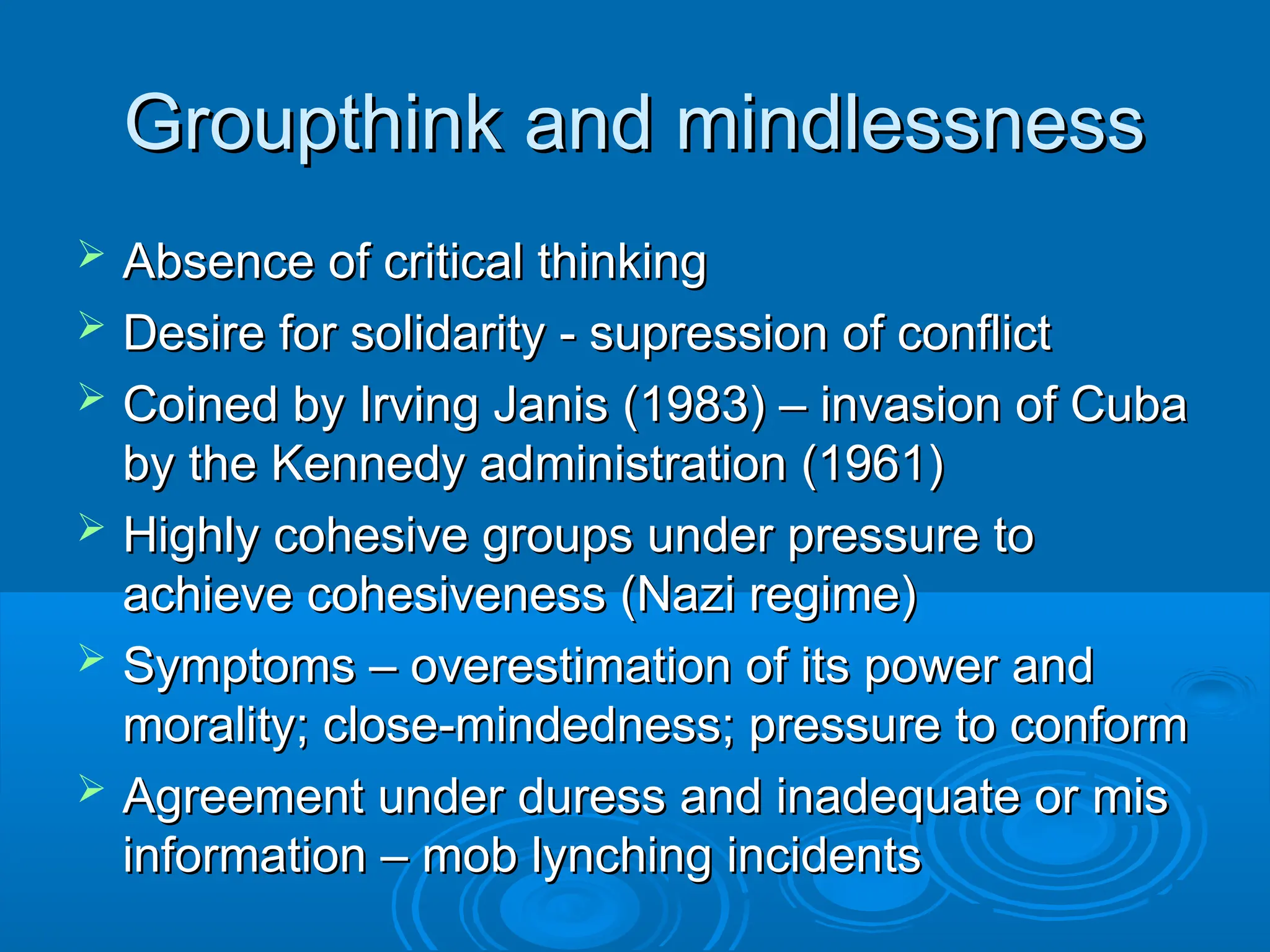
Groupthink and mindlessness
 Absence of critical thinking
Absence of critical thinking
 Desire for solidarity - supression of conflict
Desire for solidarity - supression of conflict
 Coined by Irving Janis (1983) – invasion of Cuba
Coined by Irving Janis (1983) – invasion of Cuba
by the Kennedy administration (1961)
 Highly cohesive groups under pressure to
Highly cohesive groups under pressure to
achieve cohesiveness (Nazi regime)
 Symptoms – overestimation of its power and
Symptoms – overestimation of its power and
morality; close-mindedness; pressure to conform
 Agreement under duress and inadequate or mis
Agreement under duress and inadequate or mis
information – mob lynching incidents
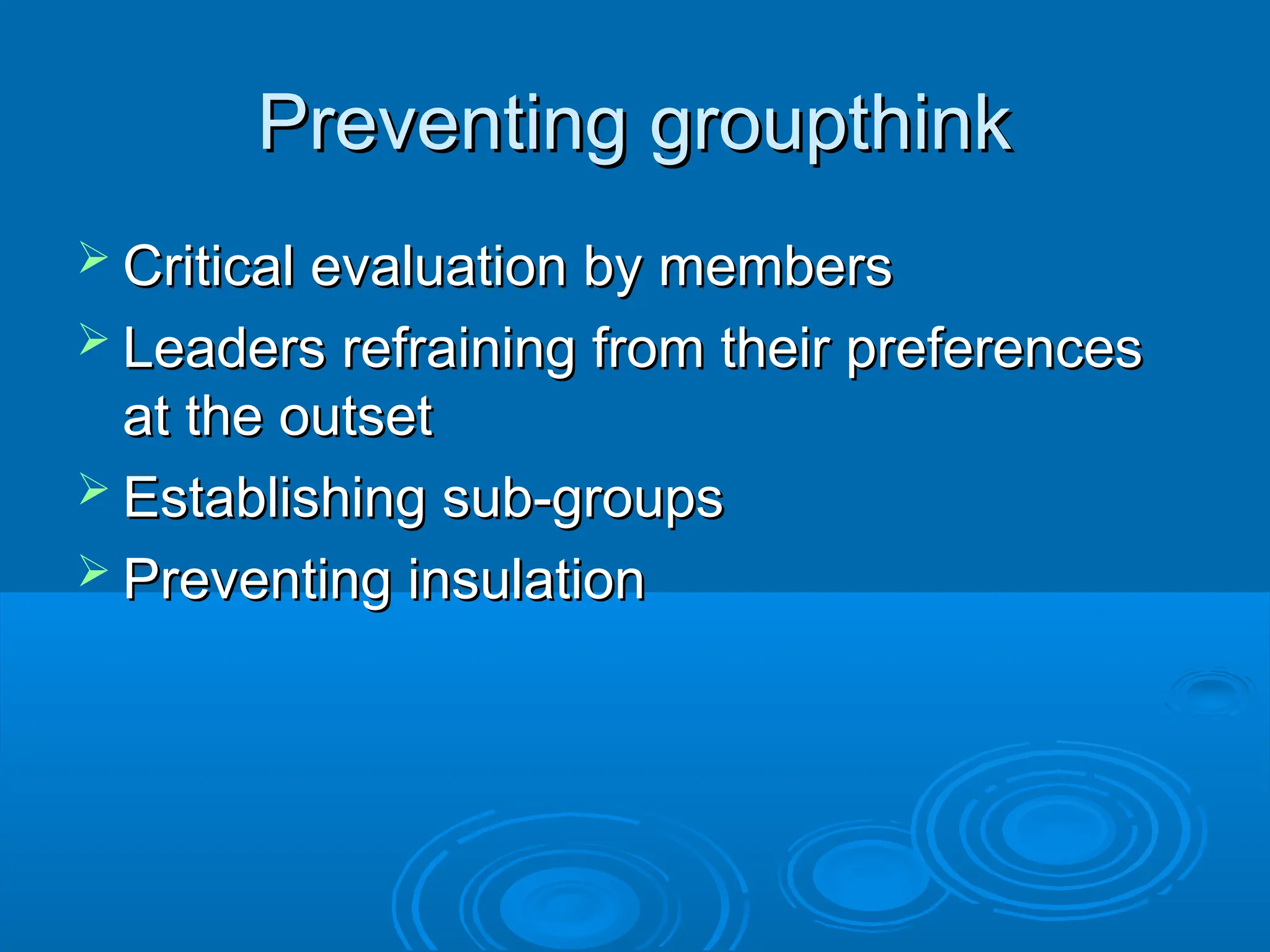
Preventing groupthink
 Critical evaluation by members
Critical evaluation by members
 Leaders refraining from their preferences
Leaders refraining from their preferences
at the outset
at the outset
 Establishing sub-groups
Establishing sub-groups
 Preventing insulation
Preventing insulation
Managing conflict
Managing conflict
 Distributive orientation – win-lose
Distributive orientation – win-lose
situations
situations
 Integrative orientation – each gets what
Integrative orientation – each gets what
they want through exploration of
alternatives
alternatives
 Approaches – Avoidance, accomodation,
Approaches – Avoidance, accomodation,
competition, collaboration, compromise
Conflict resolution
Conflict resolution
Express disagreement
Don't make personal attacks
Separate people from the problem
Focus on interests not positions
Look for options for mutual gain
Use objective criteria
Present alternatives
Third party arbitration
Negotiate and bargain for agreements

conflict management in social group work.ppt

  • 1.
    Conflict in smallgroups Conflict in small groups An overview An overview
  • 2.
    Defining conflict Defining conflict A process A process  One party percieves that the other is One party percieves that the other is opposed to his/her concern opposed to his/her concern  Ranging from disagreement to violence Ranging from disagreement to violence (Thomas, 1984) (Thomas, 1984)  Owing to competing values Owing to competing values  Disagreement on goals Disagreement on goals  Disagreement on means / ways Disagreement on means / ways  Involves feelings, perceptions, behaviours Involves feelings, perceptions, behaviours and interactions and interactions
  • 3.
    Dimensions Dimensions  The perceptionof a situation rather than the The perception of a situation rather than the situation leads conflict situation leads conflict  Emotions connected with perceptions Emotions connected with perceptions  Perceptions and emotions affects behaviour Perceptions and emotions affects behaviour  Behaviour affects interaction Behaviour affects interaction
  • 4.
    Positive effect Positive effect Better understanding of issues and people Better understanding of issues and people  Stimulates involvement and increases Stimulates involvement and increases motivation motivation  Better decision making Better decision making  Greater cohesion Greater cohesion
  • 5.
    Negative effect Negative effect Creates negative feelings Creates negative feelings  Lowers cohesiveness (personal attacks) Lowers cohesiveness (personal attacks)  Splitting of the group Splitting of the group
  • 6.
    Types Types Substantive conflict –issue based Substantive conflict – issue based Affective conflict – emotion/ego based Affective conflict – emotion/ego based Procedural conflict – method based Procedural conflict – method based Conflict from inequity Conflict from inequity
  • 7.
    Groupthink and mindlessness Groupthinkand mindlessness  Absence of critical thinking Absence of critical thinking  Desire for solidarity - supression of conflict Desire for solidarity - supression of conflict  Coined by Irving Janis (1983) – invasion of Cuba Coined by Irving Janis (1983) – invasion of Cuba by the Kennedy administration (1961) by the Kennedy administration (1961)  Highly cohesive groups under pressure to Highly cohesive groups under pressure to achieve cohesiveness (Nazi regime) achieve cohesiveness (Nazi regime)  Symptoms – overestimation of its power and Symptoms – overestimation of its power and morality; close-mindedness; pressure to conform morality; close-mindedness; pressure to conform  Agreement under duress and inadequate or mis Agreement under duress and inadequate or mis information – mob lynching incidents information – mob lynching incidents
  • 8.
    Preventing groupthink Preventing groupthink Critical evaluation by members Critical evaluation by members  Leaders refraining from their preferences Leaders refraining from their preferences at the outset at the outset  Establishing sub-groups Establishing sub-groups  Preventing insulation Preventing insulation
  • 9.
    Managing conflict Managing conflict Distributive orientation – win-lose Distributive orientation – win-lose situations situations  Integrative orientation – each gets what Integrative orientation – each gets what they want through exploration of they want through exploration of alternatives alternatives  Approaches – Avoidance, accomodation, Approaches – Avoidance, accomodation, competition, collaboration, compromise competition, collaboration, compromise
  • 10.
    Conflict resolution Conflict resolution Expressdisagreement Express disagreement Don't make personal attacks Don't make personal attacks Separate people from the problem Separate people from the problem Focus on interests not positions Focus on interests not positions Look for options for mutual gain Look for options for mutual gain Use objective criteria Use objective criteria Present alternatives Present alternatives Third party arbitration Third party arbitration Negotiate and bargain for agreements Negotiate and bargain for agreements