BETTER
BYLAWS

Bill Taylor
UW Extension Area Community Development Educator
REFERENCES
• Better Bylaws by D. Benson
Tesdahl, published by BoardSource, 2010
• The Handbook of Nonprofit Governance
by BoardSource, 2010
• Free Management Library at
http://managementhelp.org/
REFERENCES (cont.)
• Wyoming state statutes at
http://legisweb.state.wy.us/LSOWEB/wyStatutes.a
spx
– Title 6, Chapter 5, Article 1 – Offenses by Public
Officials
– Title 9, Chapter 13, Article 1 – Public
Officials, Members and Employees Ethics
– Title 16, Chapter 3 – Administrative Procedure
– Title 16, Chapter 4, Article 4 – Wyoming Public
Meetings Act
– Title 17, Chapter 19 – Wyoming Nonprofit Corporation
Act
– Title 18, Chapter 7, Article 1 - Libraries
DISCLAIMER
• No training guides or lesson plans for
public boards
• All training materials written for nonprofit
boards and organizations
– Must be converted to apply to public boards

• Wyoming statutes do not require bylaws of
a public board, just rules of operation
– Bylaws are easiest & most concise place for
those general rules
DISCLAIMER (cont.)
• Remember:
– Bylaws are for internal operating rules for the
board
• No public hearing required

– Rule-making for public policy requires the
public hearing process
• Proper governance, best practices, call for
bylaws
• Bylaws are guide for how you are
organized and operate
– Without them, there is no standard by which
to hold the board, members, or officers
accountable
WYOMING LAW
• W.S. 16-3-101(b)(ix) – “ „Rule‟ means each
agency statement of general applicability that
implements, interprets and prescribes
law, policy or ordinances of cities and
towns, or describes the
organization, procedures, or practice
requirements of any agency.”
WYOMING LAW (cont.)
• W.S. 16-4-404(a) – “In the absence of a
statutory requirement, the governing body of an
agency shall provide by
ordinance, resolution, bylaws or rule for holding
regular meetings…”
• WY Nonprofit Corporation Act good guide for
those things applicable to public boards
• Each establishing statute may be slightly
different.
– County Library Board example – W.S. 18-7103(b); 18-7-105(a)
CONSEQUENTLY
• This presentation will be mix of nonprofit
and public board practices
– Some are interchangeable
– I will attempt to delineate where there are
differences
PURPOSE
• Reflect how to fulfill mission & carry out
business in orderly, legal manner
• Define duties, authority limits, principle
operating procedures
PRECIDENCE OF AUTHORITY
• Nonprofit
– Wyoming Nonprofit Corporation Act
– Articles of Incorporation

• Public
– Wyoming statute, county resolution or city
ordinance which established board
– Wyoming statutes, county resolutions or city
ordinances, or policies which dictate
authority, governance, relation w/ other
entities, etc.
PRECIDENCE OF AUTHORITY(cont.)
• Nonprofits & public
– Bylaws – always subordinate to
statutes, county resolutions or city
ordinance, articles of incorporation
– Organizational Resolutions (properly passed
motions) – subordinate to bylaws
– Organizational recommendations, guidelines
– often nonbinding
– Organizational procedures – processes to
implement policies
CREATION
• At the organizational start-up
• Need to be in place so the organization
knows how to conduct business
• Nonprofit file copy with IRS Form 990
• There is no state agency which reviews
content or accuracy
– Inconsistencies or improprieties usually
addressed when someone (member, public)
complains or files adverse action
• Content varies, depending on organization
• Revising requires specific, often timeconsuming process, so detailed & specific
policies often left to policy documents
CONTENTS (cont.)
Suggested for nonprofit
organization (P = Public in
parentheses):
• General
– Official name (P)
– Location of principal office
(P)
– Limitations required for tax
exemption
– Procedure for amending
bylaws (P)
– Procedure for dissolving
organization
– Disposition of assets on
dissolution

• Members (if a member
organization)
– Qualifications for
membership
– Admission procedures
– Dues obligations
– Classes of
membership, their rights &
privileges
– Notice required for
membership meetings (P)
– Quorum requirements
– Frequency of meetings and
meeting procedures
– Voting procedures (P)
CONTENTS (cont.)
• Board of Directors
– Size of board (P)
– Qualifications for
membership
– Terms of office & term
limits (P)
– Selection process (P)
– Process for filling
vacancies (P)
– Frequency of meetings
(P)
– Quorum and voting
requirements (P)

– Meeting procedures (P)
– Powers of the executive
committee
– Other standing
committees or statement
that allows their
formation (P)
– Compensation of board
members
– Circumstances under
which board members
may be removed (P)
– Conflict-of-interest
procedures (P)
CONTENTS (cont.)
• Officers
– Qualifications for holding
office (P)
– Duties of officers or
reference to job description
(P)
– Process for selecting or
appointing officers (P)
– Terms & term limits (P)
– Provision for chief
executive on the board (P)
– Circumstance under which
officers may be removed
(P)

• Fiscal Matters
– Audit committee & audits
(P)
– Fiscal year of the
corporation
– Indemnification and
insurance for officers &
directors
MISSION
• Broad statement of purpose in Articles of
Incorporation for nonprofit organization
(NP)
• Further refined and clarified mission in
bylaws
MEMBERSHIP
• NP w/o membership controlled and
administered by board of directors
– Makes bylaws and procedures simpler, more
efficient
– Places control in hands of a few

• The more types and levels of
membership, the more complicated bylaws
and procedures become
– Members accorded rights by state law
BOARD OF DIRECTORS
• NP board of directors/public board –
similar in many ways
• Size - best to provide range rather than
specific number
– Providing range does not require bylaw
amendment to adjust
• i.e. – County library board statute – 3 to 5
BOARD OF DIRECTORS (cont.)
• NP
– Can easily become too big to be efficient
• Establish advisory body, honorary council for those
prominent individuals who will not be able to be a
working member of board

– State whether or not compensated
• Compensation (excluding reimbursement of
expenses) is rare and legally risky
• Excessive compensation may trigger IRS
sanctions
BOARD OF DIRECTORS (cont.)
• Selection
– Nonprofit
• Normally elected by members, if member
organization
• WY law allows other methods of designation or
appointment if specified in bylaws
• May be elected by board in non-member
organization, or as specified in bylaws

– Public
• Selection process dictated by
statute, resolution, ordinance
BOARD OF DIRECTORS (cont.)
• Terms
– Term limits
• Advantages
–
–
–
–

Ensure variety of perspectives
Expand base of contacts
Prevent concentration of power
Easy way to eliminate undesirable members

• Disadvantages
– Loss of expertise & institutional memory
– Cost of more orientation & training
BOARD OF DIRECTORS (cont.)
• Terms (cont.)
– Term limits (cont.)
• Advantages & disadvantages balanced by allowing
return after break in service of 1-2 years or terms

– Length
• Commonly 1-5 years

– NP average – 3-year terms w/ 2 term limit
– Usually staggered, especially w/ larger board
QUORUM
• Minimum number present to conduct
business
• WY law – according to bylaws
– Cannot be lower than greater of 1/3 of board
members or 2 directors
– 10% of membership, unless stated differently
in bylaws of membership organization

• Should you allow board to act w/o majority
of board present?
QUORUM (cont.)
• May require higher number for certain
actions – i.e. amending bylaws, dismissing
a director, etc.
• Typically majority of board members – 1
over 50%
MAKING DECISIONS
• Determine methods of acceptable decision
making
– Typical to state all business must be
conducted by Robert’s Rules of Order
• Too restrictive – what about consensus, other
parliamentary law systems, etc.?
• Suggest – “…or other methods as agreed upon by the
(members)(directors)(board).”
– As long as recorded in minutes as decision of group, a
vote is not required unless stated for certain decisions in
the bylaws, statute, resolution, or ordinance
MAKING DECISIONS (cont.)
• Voting
– Majority – one over 50% of those voting
• Most common requirement

– Super-majority – higher level for certain
decisions
• Amending bylaws often requires 2/3 or ¾

– Unanimous – may be required for most critical
decisions
MAKING DECISIONS (cont.)
• Voting (cont.)
– Proxy – appointing someone else to vote for
you
• Allowed via signing proxy form in general
membership voting (WY Nonprofit Corporation Act)
• Not listed as proper form of director voting in
nonprofit act
• No provision for proxy voting on public boards
MEETINGS
• Membership organizations required to hold
annual meeting of membership
– Board may meet as outlined in bylaws

• Public boards – see establishing
statute, resolution, ordinance
– Some monthly, some quarterly, some as
needed
– Should publish time & place for regular
meeting schedule (see WY Open Meetings
Act)
MEETINGS (cont.)
• Public boards (cont.)
– 3 possible types of meetings (Open Meetings
Act)
• Regular, Special, Emergency
• Outline process for
calling, advertising, holding, recording of each in
bylaws

• Executive sessions
– Outline process for calling, holding, recording
– Public – only in accordance w/ Open
Meetings Act
MEETINGS (cont.)
• Virtual meetings
– Public Meetings Act
• “ „Meeting‟ means an assembly of at least a quorum…”
• “ „Assembly‟ means communicating in person, by
means of telephone or electronic communication, or in
any other manner such that all participating members
are able to communicate with each other
contemporaneously.”
– Must provide method for public to hear
– DOES NOT include email decisions or discussion
MEETINGS (cont.)
• Virtual meetings (cont.)
– Establish acceptable methods in bylaws
– Nonprofit Act does not mention any electronic
means for meetings
OFFICERS
• NP – President, Secretary, Treasurer
required unless otherwise stated in bylaws
– One person may serve multiple offices

• P – see establishing
statute, resolution, ordinance
– i.e. – County library board – chair is required
OFFICERS (cont.)
• Provide general outline of duties –
minimum expectations
– Can refer to detailed job description as
additional document
– Broad & flexible enough so bylaws do not
require amending with every adjustment of
duties
OFFICERS (cont.)
• NP – carefully consider whether officers:
– Chosen from among directors
– Directors by virtue of being officers
– Chosen from general public or
membership, but not part of board of directors
• Non-directors have no voting power on board

– Most common – elect officers from among
directors
COMMITTEES
• Appointed to focus on specific issues,
programs, activities, etc.
– Specify who may appoint (commonly board or
chair or both)
– Usually a subset of board, could include
others as needed for expertise
• WY NP law – committee of board can only consist
of board members

– Duties and authority should be defined
COMMITTEES (cont.)
• Keep bylaws broad enough so
amendment not needed for every
committee appointment or change
– May list names of standing committees, w/
authority to appoint ad hoc committees
– May provide general statement of authority to
appoint committees & refer to policy
documents for composition, duty
description, make-up, length of existence, etc.
COMMITTEES (cont.)
• Suggested clause: “The board shall have the right to
appoint and determine the composition and authority of
such standing committees and other committees and
task forces as it deems necessary from time to time.
Such committees and task forces may be described in
separate administrative regulations or in resolutions of
the board.” – Better Bylaws by D. Benson Tesdahl
COMMITTEES (cont.)
• Task force, work group – temporary, less
formal group assembled to deal w/ specific
task
• Some organizations write a “charter” for
each committee or task force, outlining
composition, organization, duties, authority
, duration, etc.
COMMITTEES (cont.)
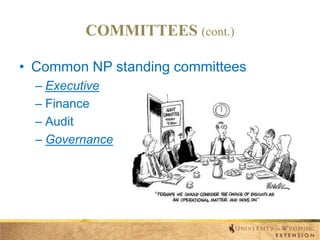
• Common NP standing committees
– Executive
– Finance
– Audit
– Governance
• “A situation in which a director or officer has
divided loyalty.” – Better Bylaws by D. Benson
Tesdahl

• Duty to act in best interests of board or
organization
– Becomes of special concern when you, your
family, your business, or another organization
you represent will benefit from a board
decision

• Not illegal, sometimes unavoidable
(cont.)

• IRS: “…purpose of a conflict-of-interest
policy is to protect the nonprofit organization‟s
interest when it is contemplating entering into
a transaction or arrangement that might benefit
the private interest of one or more of its
officers or directors.” - Better Bylaws by D. Benson
Tesdahl
(cont.)

• Policy set forth in bylaws defining conflict
of interest and outlining process when it
occurs
– Or reference conflict of interest policy
document
• For easier & more efficient changes and
adjustments
(cont.)

• Minimum policy should:
– Define in general terms what a conflict is
– Require disclosure to full board of actual or
potential conflict
– Have board decide (w/ counsel, if needed) if
conflict exists
– Preclude director from participating in
discussion or voting on any conflicting
transaction
(cont.)

• Wyoming Law
– Director not to engage in any discussion
concerning the matter, influence any of the
parties, or vote on the matter (W.S. 6-5106(b))
– Best not to even be present during that
agenda item – leave the room
CODE OF ETHICS
• Expectations for ethical conduct of officers
& directors
• Bylaws may include a statement or
reference a separate document
– May include disciplinary code of action
– May include nondiscrimination statement

• Federal & state laws prohibit certain
unethical or discriminatory actions whether
included in bylaws or not
INDEMNIFICATION
• NP – required to indemnify (pay) officers
and directors for expenses incurred in
defending any proper action of board
• P – indemnification covered by
governmental entity
• Even though required, many organizations
place indemnification statement in bylaws
for clarity
INSURANCE
• NP – should strongly consider directors
and officers (D&O) insurance
– Covers liability unless convicted of criminal
action
• Review carefully – usually contains several
exemptions

– Also covered by WY NP volunteer immunity
statute (W.S. 1-1-125)
– Policy statement in bylaws
INSURANCE (cont.)
• P – covered by governmental liability
umbrella
– As long as performing assigned duties in
good faith
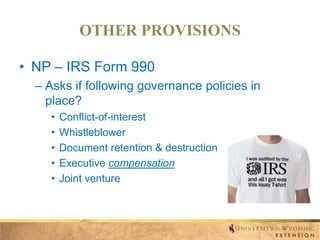
OTHER PROVISIONS
• NP – IRS Form 990
– Asks if following governance policies in
place?
•
•
•
•
•

Conflict-of-interest
Whistleblower
Document retention & destruction
Executive compensation
Joint venture
OTHER PROVISIONS (cont.)
• Vacancies on board
– NP – outline procedure for filling vacancies
occurring before end of term
– P – outlined in
statutes, resolutions, ordinances, procedures

• Removal of board members & officers
– NP – outline conditions necessary for removal &
procedure
– P – outlined in
statutes, resolutions, ordinances, procedures
OTHER PROVISIONS (cont.)
• W.S.9-2-410. – “All public records are the
property of the state. They shall be delivered by
outgoing officials and employees to their
successors and shall be
preserved, stored, transferred, destroyed or
disposed of, and otherwise managed, only in
accordance with W.S. 9-2-405 through 9-2-413.”
– Reference WY Dept of State Parks & Cultural
Resources, or County or City Clerk for details

• Provide bylaw statement of how records are
to be handled
AMENDMENTS
• Bylaws must change as operations
change
– Operations in violation of bylaws are illegal
– Cannot ignore bylaws because they are
inconvenient, incomplete, outdated
– Actions of boards & organizations have been
voided by courts because they did not follow
their own bylaws
AMENDMENTS (cont.)
• Review regularly
– Recommended every other year
– Whenever governance problems or changes
arise
– Committee, legal counsel, committee-of-thewhole
AMENDMENTS (cont.)
• Include clause in bylaws detailing exactly
how they may be changed
– Whether amendments can be made by board or
members (NP)
– How changes are developed & reviewed
– Is advance notice required before vote for
approval? How long?
– Whether changes can be approved at meeting or
with mail ballot (NP)
• All business must be at public meeting if public board

– Vote required for approval
• Majority? Supermajority?
AMENDMENTS (cont.)
• Each revision dated upon approval of
organization
– Date of amendment recorded in minutes

• NP – file amended copy w/ IRS Form 990
Better Bylaws

Better Bylaws

  • 1.
    BETTER BYLAWS Bill Taylor UW ExtensionArea Community Development Educator
  • 2.
    REFERENCES • Better Bylawsby D. Benson Tesdahl, published by BoardSource, 2010 • The Handbook of Nonprofit Governance by BoardSource, 2010 • Free Management Library at http://managementhelp.org/
  • 3.
    REFERENCES (cont.) • Wyomingstate statutes at http://legisweb.state.wy.us/LSOWEB/wyStatutes.a spx – Title 6, Chapter 5, Article 1 – Offenses by Public Officials – Title 9, Chapter 13, Article 1 – Public Officials, Members and Employees Ethics – Title 16, Chapter 3 – Administrative Procedure – Title 16, Chapter 4, Article 4 – Wyoming Public Meetings Act – Title 17, Chapter 19 – Wyoming Nonprofit Corporation Act – Title 18, Chapter 7, Article 1 - Libraries
  • 4.
    DISCLAIMER • No trainingguides or lesson plans for public boards • All training materials written for nonprofit boards and organizations – Must be converted to apply to public boards • Wyoming statutes do not require bylaws of a public board, just rules of operation – Bylaws are easiest & most concise place for those general rules
  • 5.
    DISCLAIMER (cont.) • Remember: –Bylaws are for internal operating rules for the board • No public hearing required – Rule-making for public policy requires the public hearing process
  • 6.
    • Proper governance,best practices, call for bylaws • Bylaws are guide for how you are organized and operate – Without them, there is no standard by which to hold the board, members, or officers accountable
  • 7.
    WYOMING LAW • W.S.16-3-101(b)(ix) – “ „Rule‟ means each agency statement of general applicability that implements, interprets and prescribes law, policy or ordinances of cities and towns, or describes the organization, procedures, or practice requirements of any agency.”
  • 8.
    WYOMING LAW (cont.) •W.S. 16-4-404(a) – “In the absence of a statutory requirement, the governing body of an agency shall provide by ordinance, resolution, bylaws or rule for holding regular meetings…” • WY Nonprofit Corporation Act good guide for those things applicable to public boards • Each establishing statute may be slightly different. – County Library Board example – W.S. 18-7103(b); 18-7-105(a)
  • 9.
    CONSEQUENTLY • This presentationwill be mix of nonprofit and public board practices – Some are interchangeable – I will attempt to delineate where there are differences
  • 10.
    PURPOSE • Reflect howto fulfill mission & carry out business in orderly, legal manner • Define duties, authority limits, principle operating procedures
  • 11.
    PRECIDENCE OF AUTHORITY •Nonprofit – Wyoming Nonprofit Corporation Act – Articles of Incorporation • Public – Wyoming statute, county resolution or city ordinance which established board – Wyoming statutes, county resolutions or city ordinances, or policies which dictate authority, governance, relation w/ other entities, etc.
  • 12.
    PRECIDENCE OF AUTHORITY(cont.) •Nonprofits & public – Bylaws – always subordinate to statutes, county resolutions or city ordinance, articles of incorporation – Organizational Resolutions (properly passed motions) – subordinate to bylaws – Organizational recommendations, guidelines – often nonbinding – Organizational procedures – processes to implement policies
  • 13.
    CREATION • At theorganizational start-up • Need to be in place so the organization knows how to conduct business • Nonprofit file copy with IRS Form 990 • There is no state agency which reviews content or accuracy – Inconsistencies or improprieties usually addressed when someone (member, public) complains or files adverse action
  • 14.
    • Content varies,depending on organization • Revising requires specific, often timeconsuming process, so detailed & specific policies often left to policy documents
  • 15.
    CONTENTS (cont.) Suggested fornonprofit organization (P = Public in parentheses): • General – Official name (P) – Location of principal office (P) – Limitations required for tax exemption – Procedure for amending bylaws (P) – Procedure for dissolving organization – Disposition of assets on dissolution • Members (if a member organization) – Qualifications for membership – Admission procedures – Dues obligations – Classes of membership, their rights & privileges – Notice required for membership meetings (P) – Quorum requirements – Frequency of meetings and meeting procedures – Voting procedures (P)
  • 16.
    CONTENTS (cont.) • Boardof Directors – Size of board (P) – Qualifications for membership – Terms of office & term limits (P) – Selection process (P) – Process for filling vacancies (P) – Frequency of meetings (P) – Quorum and voting requirements (P) – Meeting procedures (P) – Powers of the executive committee – Other standing committees or statement that allows their formation (P) – Compensation of board members – Circumstances under which board members may be removed (P) – Conflict-of-interest procedures (P)
  • 17.
    CONTENTS (cont.) • Officers –Qualifications for holding office (P) – Duties of officers or reference to job description (P) – Process for selecting or appointing officers (P) – Terms & term limits (P) – Provision for chief executive on the board (P) – Circumstance under which officers may be removed (P) • Fiscal Matters – Audit committee & audits (P) – Fiscal year of the corporation – Indemnification and insurance for officers & directors
  • 18.
    MISSION • Broad statementof purpose in Articles of Incorporation for nonprofit organization (NP) • Further refined and clarified mission in bylaws
  • 19.
    MEMBERSHIP • NP w/omembership controlled and administered by board of directors – Makes bylaws and procedures simpler, more efficient – Places control in hands of a few • The more types and levels of membership, the more complicated bylaws and procedures become – Members accorded rights by state law
  • 20.
    BOARD OF DIRECTORS •NP board of directors/public board – similar in many ways • Size - best to provide range rather than specific number – Providing range does not require bylaw amendment to adjust • i.e. – County library board statute – 3 to 5
  • 21.
    BOARD OF DIRECTORS(cont.) • NP – Can easily become too big to be efficient • Establish advisory body, honorary council for those prominent individuals who will not be able to be a working member of board – State whether or not compensated • Compensation (excluding reimbursement of expenses) is rare and legally risky • Excessive compensation may trigger IRS sanctions
  • 22.
    BOARD OF DIRECTORS(cont.) • Selection – Nonprofit • Normally elected by members, if member organization • WY law allows other methods of designation or appointment if specified in bylaws • May be elected by board in non-member organization, or as specified in bylaws – Public • Selection process dictated by statute, resolution, ordinance
  • 23.
    BOARD OF DIRECTORS(cont.) • Terms – Term limits • Advantages – – – – Ensure variety of perspectives Expand base of contacts Prevent concentration of power Easy way to eliminate undesirable members • Disadvantages – Loss of expertise & institutional memory – Cost of more orientation & training
  • 24.
    BOARD OF DIRECTORS(cont.) • Terms (cont.) – Term limits (cont.) • Advantages & disadvantages balanced by allowing return after break in service of 1-2 years or terms – Length • Commonly 1-5 years – NP average – 3-year terms w/ 2 term limit – Usually staggered, especially w/ larger board
  • 25.
    QUORUM • Minimum numberpresent to conduct business • WY law – according to bylaws – Cannot be lower than greater of 1/3 of board members or 2 directors – 10% of membership, unless stated differently in bylaws of membership organization • Should you allow board to act w/o majority of board present?
  • 26.
    QUORUM (cont.) • Mayrequire higher number for certain actions – i.e. amending bylaws, dismissing a director, etc. • Typically majority of board members – 1 over 50%
  • 27.
    MAKING DECISIONS • Determinemethods of acceptable decision making – Typical to state all business must be conducted by Robert’s Rules of Order • Too restrictive – what about consensus, other parliamentary law systems, etc.? • Suggest – “…or other methods as agreed upon by the (members)(directors)(board).” – As long as recorded in minutes as decision of group, a vote is not required unless stated for certain decisions in the bylaws, statute, resolution, or ordinance
  • 28.
    MAKING DECISIONS (cont.) •Voting – Majority – one over 50% of those voting • Most common requirement – Super-majority – higher level for certain decisions • Amending bylaws often requires 2/3 or ¾ – Unanimous – may be required for most critical decisions
  • 29.
    MAKING DECISIONS (cont.) •Voting (cont.) – Proxy – appointing someone else to vote for you • Allowed via signing proxy form in general membership voting (WY Nonprofit Corporation Act) • Not listed as proper form of director voting in nonprofit act • No provision for proxy voting on public boards
  • 30.
    MEETINGS • Membership organizationsrequired to hold annual meeting of membership – Board may meet as outlined in bylaws • Public boards – see establishing statute, resolution, ordinance – Some monthly, some quarterly, some as needed – Should publish time & place for regular meeting schedule (see WY Open Meetings Act)
  • 31.
    MEETINGS (cont.) • Publicboards (cont.) – 3 possible types of meetings (Open Meetings Act) • Regular, Special, Emergency • Outline process for calling, advertising, holding, recording of each in bylaws • Executive sessions – Outline process for calling, holding, recording – Public – only in accordance w/ Open Meetings Act
  • 32.
    MEETINGS (cont.) • Virtualmeetings – Public Meetings Act • “ „Meeting‟ means an assembly of at least a quorum…” • “ „Assembly‟ means communicating in person, by means of telephone or electronic communication, or in any other manner such that all participating members are able to communicate with each other contemporaneously.” – Must provide method for public to hear – DOES NOT include email decisions or discussion
  • 33.
    MEETINGS (cont.) • Virtualmeetings (cont.) – Establish acceptable methods in bylaws – Nonprofit Act does not mention any electronic means for meetings
  • 34.
    OFFICERS • NP –President, Secretary, Treasurer required unless otherwise stated in bylaws – One person may serve multiple offices • P – see establishing statute, resolution, ordinance – i.e. – County library board – chair is required
  • 35.
    OFFICERS (cont.) • Providegeneral outline of duties – minimum expectations – Can refer to detailed job description as additional document – Broad & flexible enough so bylaws do not require amending with every adjustment of duties
  • 36.
    OFFICERS (cont.) • NP– carefully consider whether officers: – Chosen from among directors – Directors by virtue of being officers – Chosen from general public or membership, but not part of board of directors • Non-directors have no voting power on board – Most common – elect officers from among directors
  • 37.
    COMMITTEES • Appointed tofocus on specific issues, programs, activities, etc. – Specify who may appoint (commonly board or chair or both) – Usually a subset of board, could include others as needed for expertise • WY NP law – committee of board can only consist of board members – Duties and authority should be defined
  • 38.
    COMMITTEES (cont.) • Keepbylaws broad enough so amendment not needed for every committee appointment or change – May list names of standing committees, w/ authority to appoint ad hoc committees – May provide general statement of authority to appoint committees & refer to policy documents for composition, duty description, make-up, length of existence, etc.
  • 39.
    COMMITTEES (cont.) • Suggestedclause: “The board shall have the right to appoint and determine the composition and authority of such standing committees and other committees and task forces as it deems necessary from time to time. Such committees and task forces may be described in separate administrative regulations or in resolutions of the board.” – Better Bylaws by D. Benson Tesdahl
  • 40.
    COMMITTEES (cont.) • Taskforce, work group – temporary, less formal group assembled to deal w/ specific task • Some organizations write a “charter” for each committee or task force, outlining composition, organization, duties, authority , duration, etc.
  • 41.
    COMMITTEES (cont.) • CommonNP standing committees – Executive – Finance – Audit – Governance
  • 42.
    • “A situationin which a director or officer has divided loyalty.” – Better Bylaws by D. Benson Tesdahl • Duty to act in best interests of board or organization – Becomes of special concern when you, your family, your business, or another organization you represent will benefit from a board decision • Not illegal, sometimes unavoidable
  • 43.
    (cont.) • IRS: “…purposeof a conflict-of-interest policy is to protect the nonprofit organization‟s interest when it is contemplating entering into a transaction or arrangement that might benefit the private interest of one or more of its officers or directors.” - Better Bylaws by D. Benson Tesdahl
  • 44.
    (cont.) • Policy setforth in bylaws defining conflict of interest and outlining process when it occurs – Or reference conflict of interest policy document • For easier & more efficient changes and adjustments
  • 45.
    (cont.) • Minimum policyshould: – Define in general terms what a conflict is – Require disclosure to full board of actual or potential conflict – Have board decide (w/ counsel, if needed) if conflict exists – Preclude director from participating in discussion or voting on any conflicting transaction
  • 46.
    (cont.) • Wyoming Law –Director not to engage in any discussion concerning the matter, influence any of the parties, or vote on the matter (W.S. 6-5106(b)) – Best not to even be present during that agenda item – leave the room
  • 47.
    CODE OF ETHICS •Expectations for ethical conduct of officers & directors • Bylaws may include a statement or reference a separate document – May include disciplinary code of action – May include nondiscrimination statement • Federal & state laws prohibit certain unethical or discriminatory actions whether included in bylaws or not
  • 48.
    INDEMNIFICATION • NP –required to indemnify (pay) officers and directors for expenses incurred in defending any proper action of board • P – indemnification covered by governmental entity • Even though required, many organizations place indemnification statement in bylaws for clarity
  • 49.
    INSURANCE • NP –should strongly consider directors and officers (D&O) insurance – Covers liability unless convicted of criminal action • Review carefully – usually contains several exemptions – Also covered by WY NP volunteer immunity statute (W.S. 1-1-125) – Policy statement in bylaws
  • 50.
    INSURANCE (cont.) • P– covered by governmental liability umbrella – As long as performing assigned duties in good faith
  • 51.
    OTHER PROVISIONS • NP– IRS Form 990 – Asks if following governance policies in place? • • • • • Conflict-of-interest Whistleblower Document retention & destruction Executive compensation Joint venture
  • 52.
    OTHER PROVISIONS (cont.) •Vacancies on board – NP – outline procedure for filling vacancies occurring before end of term – P – outlined in statutes, resolutions, ordinances, procedures • Removal of board members & officers – NP – outline conditions necessary for removal & procedure – P – outlined in statutes, resolutions, ordinances, procedures
  • 53.
    OTHER PROVISIONS (cont.) •W.S.9-2-410. – “All public records are the property of the state. They shall be delivered by outgoing officials and employees to their successors and shall be preserved, stored, transferred, destroyed or disposed of, and otherwise managed, only in accordance with W.S. 9-2-405 through 9-2-413.” – Reference WY Dept of State Parks & Cultural Resources, or County or City Clerk for details • Provide bylaw statement of how records are to be handled
  • 54.
    AMENDMENTS • Bylaws mustchange as operations change – Operations in violation of bylaws are illegal – Cannot ignore bylaws because they are inconvenient, incomplete, outdated – Actions of boards & organizations have been voided by courts because they did not follow their own bylaws
  • 55.
    AMENDMENTS (cont.) • Reviewregularly – Recommended every other year – Whenever governance problems or changes arise – Committee, legal counsel, committee-of-thewhole
  • 56.
    AMENDMENTS (cont.) • Includeclause in bylaws detailing exactly how they may be changed – Whether amendments can be made by board or members (NP) – How changes are developed & reviewed – Is advance notice required before vote for approval? How long? – Whether changes can be approved at meeting or with mail ballot (NP) • All business must be at public meeting if public board – Vote required for approval • Majority? Supermajority?
  • 57.
    AMENDMENTS (cont.) • Eachrevision dated upon approval of organization – Date of amendment recorded in minutes • NP – file amended copy w/ IRS Form 990