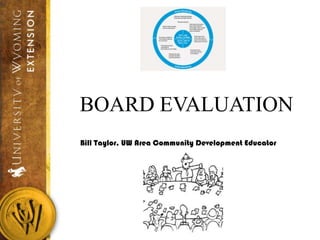
BOARD EVALUATION
Bill Taylor, UW Area Community Development Educator
References
• The Handbook of Nonprofit Governance by
BoardSource, published by Jossey-Bass, 2010
• The Board Chair Handbook, Second Edition by Mindy
R. Wertheimer, published by BoardSource, 2008
• The Nonprofit Board’s Role in Mission, Planning and
Evaluation, Second Edition by Kay Sprinkel
Grace, MA; Amy McClellan, MNO; John A.
Yankey, Ph.D., 2009
• The Board Building Cycle: Nine Steps to
Finding, Recruiting, and Engaging Nonprofit Board
Members, Second Edition by Berit M. Lakey, published
by BoardSource, 2007
References (cont.)
• Evaluating Board Performance by Bob
Cropp, Director, University of Wisconsin Center for
Cooperatives, January 1966 at
http://www.uwcc.wisc.edu/issues/Governance/board.ht
ml
• Board Performance Evaluation; Private Sector
Opinion, Issue 9 by the International Finance
Corporation at http://www.gcgf.org
• Corporate Governance: A Primer on Board Member
Evaluation by Bill Capps and Rob Steinberg of
Jeffer, Mangels, Butler & Mitchell LP at
http://about.bloomberglaw.com/practitionercontributions/corporate-governance-a-primer-onboard-member-evaluation/
“Exceptional boards embrace
the qualities of a continuous
learning
organization, evaluating their
own performance and
assessing the value they add
to the organization.”
The Source: Twelve Principles of Governance That Power
Exceptional Boards
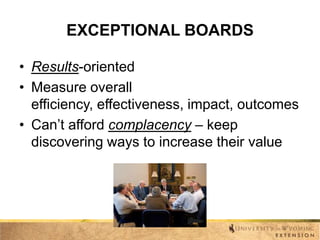
EXCEPTIONAL BOARDS
• Results-oriented
• Measure overall
efficiency, effectiveness, impact, outcomes
• Can’t afford complacency – keep
discovering ways to increase their value
EVALUATION
“Figuring out something’s worth by looking at it
carefully.”
• Assessing the effectiveness and
performance of the organization, its
programs and its services
POTENTIAL
• Identify issues pushed aside during normal
business
• Identify strengths & weaknesses affecting
optimal performance
• Keep the board focused, on track
• Allow board chair, members, & chief exec.
to assess growth & progress in their roles
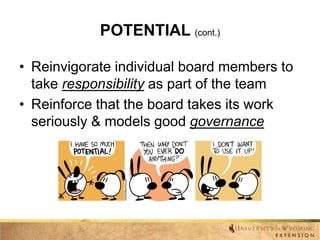
POTENTIAL (cont.)
• Reinvigorate individual board members to
take responsibility as part of the team
• Reinforce that the board takes its work
seriously & models good governance
WHEN
• Varies with organization
• Suggested:
– Brief evaluation annually
– Extensive every 2-4 years
WHO
•
•
•
•

Governance committee
Ad hoc committee
Outside consultant
Board chair and the membership in
partnership
LEVELS
• Organizational – extent to which the
organization has met its stated goals &
objectives & how well it performed in the
process
• Programmatic – efficiency and outcomes
of various or individual programs
• Board – how well the board as a whole is
functioning and understanding its role
LEVELS (cont.)
• Individual Board Member – how well each
member is fulfilling his job description
• Board Chair – is the chair a good leader
and facilitator?
• Chief Executive – how well is the chief
executive fulfilling their job description and
assisting the organization to their annual
goals?
LEVELS (cont.)
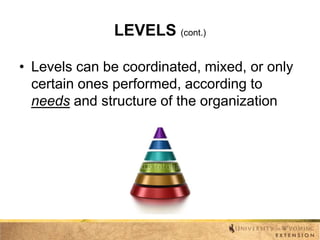
• Levels can be coordinated, mixed, or only
certain ones performed, according to
needs and structure of the organization
ORGANIZATIONAL EVALUATION
• One method – dashboard reporting
– Attached to meeting agenda
– 1-2 pages –
graphs, charts, tables, columns, limited text
• Showing progress toward goals & objectives

– Indicators to monitor:
•
•
•
•

Finances
Programs
Quality control
Human resources
ORGANIZATIONAL EVALUATION (cont.)
– Benefits of dashboard reports:
•
•
•
•
•

Supports planning
Identifies performance drivers
Prioritizes information
Identifies problems early
Increases efficiency

*ORGANIZATIONAL
EVALUATION EXERCISE
– 15 minutes
PROGRAM EVALUATION
• Provides accountability to funders
• Takes subjectivity out of justifying the
organization’s existence
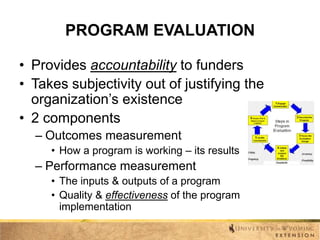
• 2 components
– Outcomes measurement
• How a program is working – its results

– Performance measurement
• The inputs & outputs of a program
• Quality & effectiveness of the program
implementation
PROGRAM EVALUATION (cont.)
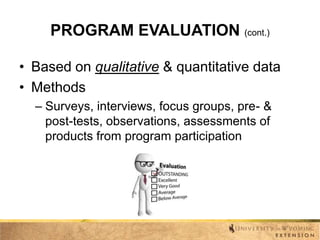
• Based on qualitative & quantitative data
• Methods
– Surveys, interviews, focus groups, pre- &
post-tests, observations, assessments of
products from program participation
BOARD SELF-ASSESSMENT
• How well is the board meeting its
responsibilities?
– Examine:
•
•
•
•
•
•

Composition
Identification & recruiting of new members
Relationship w/ constituents/stakeholders
Relationship w/ chief executive
Does committee structure work?
Are meetings well run?
BOARD SELF-ASSESSMENT (cont.)
• Questions:
– Is board clear about its roles &
responsibilities?
– Members familiar and in support of mission?
Is mission appropriate for organization in 2-4
years?
– Has board engaged in setting a strategic
direction? Is there a vision of the strategic
evolvement of the organization over the next
3-5 years?
BOARD SELF-ASSESSMENT (cont.)
• Questions (cont.)
– Is board knowledgeable about the programs? Is
there effective processes for tracking program
performance?
– Does board understand the finances & resource
strategy? Do all members participate in any
fundraising?
– Does budget reflect priorities of strategic or
annual plan? Are financial controls in place? Are
there established investment & risk management
policies?
BOARD SELF-ASSESSMENT (cont.)
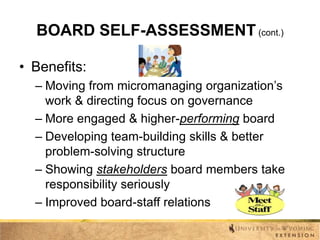
• Benefits:
– Moving from micromanaging organization’s
work & directing focus on governance
– More engaged & higher-performing board
– Developing team-building skills & better
problem-solving structure
– Showing stakeholders board members take
responsibility seriously
– Improved board-staff relations
BOARD SELF-ASSESSMENT (cont.)
• Benefits (cont.):
– Clarification of division of labor
– Identification of board structures needing
improvement
– Development of an action plan
BOARD SELF-ASSESSMENT (cont.)
• When:
– Every 2-3 years
– Exploring roles & responsibilities
– Identifying gaps in performance
– Discovering problems
– Developing plans for the future
BOARD SELF-ASSESSMENT (cont.)
• When (cont.):
– Critical points:
• In early stages of the organization’s life, especially
when hiring the 1st staff
• There is confusion about which responsibilities
belong to the board and which to the staff
• During changes of leadership on the board or of
chief executive
• When doing strategic planning
BOARD SELF-ASSESSMENT (cont.)
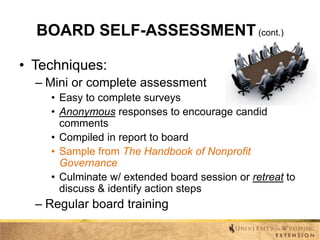
• Techniques:
– Mini or complete assessment
• Easy to complete surveys
• Anonymous responses to encourage candid
comments
• Compiled in report to board
• Sample from The Handbook of Nonprofit
Governance
• Culminate w/ extended board session or retreat to
discuss & identify action steps

– Regular board training
BOARD SELF-ASSESSMENT (cont.)
• Techniques (cont.):
– External Audit
• Engage expert in governance
• Review articles of incorporation or establishing
resolution, bylaws, observe board & committee
meetings; interview officers, board
members, former board members, & chief
executive
• Written/oral report to board and chief executive
• BoardSource provides online and custom
evaluations
– www.boardsource.org
BOARD SELF-ASSESSMENT (cont.)
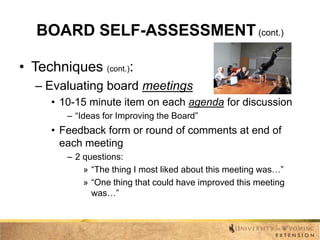
• Techniques (cont.):
– Evaluating board meetings
• 10-15 minute item on each agenda for discussion
– “Ideas for Improving the Board”

• Feedback form or round of comments at end of
each meeting
– 2 questions:
» “The thing I most liked about this meeting was…”
» “One thing that could have improved this meeting
was…”
BOARD SELF-ASSESSMENT (cont.)
• Techniques (cont.):
– Evaluating board meetings (cont.)
• Items to address:
–
–
–
–
–
–
–
–
–

Dealt w/ issues of substance & strategic importance?
Run efficiently?
Used board member’s time wisely?
Well organized?
Background materials available in advance?
Begin & end on time?
Everyone’s voice heard or did a few dominate?
Issues were discussed & debated?
Was something achieved? *Board Meeting Evaluation Exercise
– 2 minutes
BOARD SELF-ASSESSMENT (cont.)
• Outcomes of a good board assessment:
– Measure progress
– Identify areas needing improvement
– Establish goals for the future
– Remind members of their responsibilities
– Reshape operations
– Build trust, facilitate communication
– Identify strategic planning initiatives
BOARD SELF-ASSESSMENT (cont.)
• Outcomes of a good board assessment (cont.):
– Improvements in monitoring program
effectiveness
– Enhanced board meetings & more effective use
of committees
– Improvements in process of reviewing chief
executive’s performance
– Strategies for more intentional board recruitment
– Establishment of a governance committee & and
a more thoughtful nomination process
*Full Board Evaluation
Exercise – 8 minutes
BOARD MEMBER EVALUATION
• Two methods
– Self-assessment
• Based on the board member job description or the
individual section of a board assessment
instrument
• Sample from The Handbook of Nonprofit
Governance
BOARD MEMBER EVALUATION (cont.)
• Two methods (cont.)
– Peer evaluation
• A brief anonymous survey – each board member
rates others on items such as:
–
–
–
–
–
–

Attendance
Preparation
Follow-through on assignments
Quality of participation in discussion
Interactions w/ other board members
Interactions w/ staff

• Results tallied & shared privately w/ each board
member
* Board Member Self-Evaluation Exercise – 15 minutes
BOARD CHAIR EVALUATION
• Benefits:
– Clearer view of the position & its requirements
– Clarifies the work of the chair & where
improvement is desired
– Helps prevent informal mumbling & private
discussions about the chair
BOARD CHAIR EVALUATION (cont.)
• Focus:
– Facilitation skills
– Relationships & interactions w/ board
members
– Use of board work structures
– Use of governance practices
BOARD CHAIR EVALUATION (cont.)
• Handled by fellow board members (never
the chief executive)
• Anonymous survey
• Communicated directly to chair in private
discussion
CHIEF EXECUTIVE EVALUATION
• Job description
– Must be clear, unambiguous
– Basis for evaluation and measurement

• Expectations
– Annual expectations should be listed to
identify priorities and projected
accomplishments
CHIEF EXECUTIVE EVALUATION (cont.)
• When
– End of fiscal year

• What to evaluate
–
–
–
–
–
–

Success in meeting organization’s overall goals
Strategic alignment w/ board’s directives
Accomplishment of management objectives
Programmatic & fundraising achievements
Fiscal management
Relationship w/ board, staff, community
CHIEF EXECUTIVE EVALUATION (cont.)
• Process
– Organized by board chair
– Should fit the culture of the organization
– Should enhance working relationship between
board & chief executive
– Determine which instruments to use, who should
be involved, how results will be communicated
– 2 components
• Self-evaluation
• Board member questionnaire
– Comments compiled, tabulated
CHIEF EXECUTIVE EVALUATION (cont.)
• Written report
– Shared privately with chief executive
• Placed in personnel file

– Provided to entire board
Board Evaluation

Board Evaluation

  • 1.
    BOARD EVALUATION Bill Taylor,UW Area Community Development Educator
  • 2.
    References • The Handbookof Nonprofit Governance by BoardSource, published by Jossey-Bass, 2010 • The Board Chair Handbook, Second Edition by Mindy R. Wertheimer, published by BoardSource, 2008 • The Nonprofit Board’s Role in Mission, Planning and Evaluation, Second Edition by Kay Sprinkel Grace, MA; Amy McClellan, MNO; John A. Yankey, Ph.D., 2009 • The Board Building Cycle: Nine Steps to Finding, Recruiting, and Engaging Nonprofit Board Members, Second Edition by Berit M. Lakey, published by BoardSource, 2007
  • 3.
    References (cont.) • EvaluatingBoard Performance by Bob Cropp, Director, University of Wisconsin Center for Cooperatives, January 1966 at http://www.uwcc.wisc.edu/issues/Governance/board.ht ml • Board Performance Evaluation; Private Sector Opinion, Issue 9 by the International Finance Corporation at http://www.gcgf.org • Corporate Governance: A Primer on Board Member Evaluation by Bill Capps and Rob Steinberg of Jeffer, Mangels, Butler & Mitchell LP at http://about.bloomberglaw.com/practitionercontributions/corporate-governance-a-primer-onboard-member-evaluation/
  • 4.
    “Exceptional boards embrace thequalities of a continuous learning organization, evaluating their own performance and assessing the value they add to the organization.” The Source: Twelve Principles of Governance That Power Exceptional Boards
  • 5.
    EXCEPTIONAL BOARDS • Results-oriented •Measure overall efficiency, effectiveness, impact, outcomes • Can’t afford complacency – keep discovering ways to increase their value
  • 6.
    EVALUATION “Figuring out something’sworth by looking at it carefully.” • Assessing the effectiveness and performance of the organization, its programs and its services
  • 7.
    POTENTIAL • Identify issuespushed aside during normal business • Identify strengths & weaknesses affecting optimal performance • Keep the board focused, on track • Allow board chair, members, & chief exec. to assess growth & progress in their roles
  • 8.
    POTENTIAL (cont.) • Reinvigorateindividual board members to take responsibility as part of the team • Reinforce that the board takes its work seriously & models good governance
  • 9.
    WHEN • Varies withorganization • Suggested: – Brief evaluation annually – Extensive every 2-4 years
  • 10.
    WHO • • • • Governance committee Ad hoccommittee Outside consultant Board chair and the membership in partnership
  • 11.
    LEVELS • Organizational –extent to which the organization has met its stated goals & objectives & how well it performed in the process • Programmatic – efficiency and outcomes of various or individual programs • Board – how well the board as a whole is functioning and understanding its role
  • 12.
    LEVELS (cont.) • IndividualBoard Member – how well each member is fulfilling his job description • Board Chair – is the chair a good leader and facilitator? • Chief Executive – how well is the chief executive fulfilling their job description and assisting the organization to their annual goals?
  • 13.
    LEVELS (cont.) • Levelscan be coordinated, mixed, or only certain ones performed, according to needs and structure of the organization
  • 14.
    ORGANIZATIONAL EVALUATION • Onemethod – dashboard reporting – Attached to meeting agenda – 1-2 pages – graphs, charts, tables, columns, limited text • Showing progress toward goals & objectives – Indicators to monitor: • • • • Finances Programs Quality control Human resources
  • 15.
    ORGANIZATIONAL EVALUATION (cont.) –Benefits of dashboard reports: • • • • • Supports planning Identifies performance drivers Prioritizes information Identifies problems early Increases efficiency *ORGANIZATIONAL EVALUATION EXERCISE – 15 minutes
  • 16.
    PROGRAM EVALUATION • Providesaccountability to funders • Takes subjectivity out of justifying the organization’s existence • 2 components – Outcomes measurement • How a program is working – its results – Performance measurement • The inputs & outputs of a program • Quality & effectiveness of the program implementation
  • 17.
    PROGRAM EVALUATION (cont.) •Based on qualitative & quantitative data • Methods – Surveys, interviews, focus groups, pre- & post-tests, observations, assessments of products from program participation
  • 18.
    BOARD SELF-ASSESSMENT • Howwell is the board meeting its responsibilities? – Examine: • • • • • • Composition Identification & recruiting of new members Relationship w/ constituents/stakeholders Relationship w/ chief executive Does committee structure work? Are meetings well run?
  • 19.
    BOARD SELF-ASSESSMENT (cont.) •Questions: – Is board clear about its roles & responsibilities? – Members familiar and in support of mission? Is mission appropriate for organization in 2-4 years? – Has board engaged in setting a strategic direction? Is there a vision of the strategic evolvement of the organization over the next 3-5 years?
  • 20.
    BOARD SELF-ASSESSMENT (cont.) •Questions (cont.) – Is board knowledgeable about the programs? Is there effective processes for tracking program performance? – Does board understand the finances & resource strategy? Do all members participate in any fundraising? – Does budget reflect priorities of strategic or annual plan? Are financial controls in place? Are there established investment & risk management policies?
  • 21.
    BOARD SELF-ASSESSMENT (cont.) •Benefits: – Moving from micromanaging organization’s work & directing focus on governance – More engaged & higher-performing board – Developing team-building skills & better problem-solving structure – Showing stakeholders board members take responsibility seriously – Improved board-staff relations
  • 22.
    BOARD SELF-ASSESSMENT (cont.) •Benefits (cont.): – Clarification of division of labor – Identification of board structures needing improvement – Development of an action plan
  • 23.
    BOARD SELF-ASSESSMENT (cont.) •When: – Every 2-3 years – Exploring roles & responsibilities – Identifying gaps in performance – Discovering problems – Developing plans for the future
  • 24.
    BOARD SELF-ASSESSMENT (cont.) •When (cont.): – Critical points: • In early stages of the organization’s life, especially when hiring the 1st staff • There is confusion about which responsibilities belong to the board and which to the staff • During changes of leadership on the board or of chief executive • When doing strategic planning
  • 25.
    BOARD SELF-ASSESSMENT (cont.) •Techniques: – Mini or complete assessment • Easy to complete surveys • Anonymous responses to encourage candid comments • Compiled in report to board • Sample from The Handbook of Nonprofit Governance • Culminate w/ extended board session or retreat to discuss & identify action steps – Regular board training
  • 26.
    BOARD SELF-ASSESSMENT (cont.) •Techniques (cont.): – External Audit • Engage expert in governance • Review articles of incorporation or establishing resolution, bylaws, observe board & committee meetings; interview officers, board members, former board members, & chief executive • Written/oral report to board and chief executive • BoardSource provides online and custom evaluations – www.boardsource.org
  • 27.
    BOARD SELF-ASSESSMENT (cont.) •Techniques (cont.): – Evaluating board meetings • 10-15 minute item on each agenda for discussion – “Ideas for Improving the Board” • Feedback form or round of comments at end of each meeting – 2 questions: » “The thing I most liked about this meeting was…” » “One thing that could have improved this meeting was…”
  • 28.
    BOARD SELF-ASSESSMENT (cont.) •Techniques (cont.): – Evaluating board meetings (cont.) • Items to address: – – – – – – – – – Dealt w/ issues of substance & strategic importance? Run efficiently? Used board member’s time wisely? Well organized? Background materials available in advance? Begin & end on time? Everyone’s voice heard or did a few dominate? Issues were discussed & debated? Was something achieved? *Board Meeting Evaluation Exercise – 2 minutes
  • 29.
    BOARD SELF-ASSESSMENT (cont.) •Outcomes of a good board assessment: – Measure progress – Identify areas needing improvement – Establish goals for the future – Remind members of their responsibilities – Reshape operations – Build trust, facilitate communication – Identify strategic planning initiatives
  • 30.
    BOARD SELF-ASSESSMENT (cont.) •Outcomes of a good board assessment (cont.): – Improvements in monitoring program effectiveness – Enhanced board meetings & more effective use of committees – Improvements in process of reviewing chief executive’s performance – Strategies for more intentional board recruitment – Establishment of a governance committee & and a more thoughtful nomination process *Full Board Evaluation Exercise – 8 minutes
  • 31.
    BOARD MEMBER EVALUATION •Two methods – Self-assessment • Based on the board member job description or the individual section of a board assessment instrument • Sample from The Handbook of Nonprofit Governance
  • 32.
    BOARD MEMBER EVALUATION(cont.) • Two methods (cont.) – Peer evaluation • A brief anonymous survey – each board member rates others on items such as: – – – – – – Attendance Preparation Follow-through on assignments Quality of participation in discussion Interactions w/ other board members Interactions w/ staff • Results tallied & shared privately w/ each board member * Board Member Self-Evaluation Exercise – 15 minutes
  • 33.
    BOARD CHAIR EVALUATION •Benefits: – Clearer view of the position & its requirements – Clarifies the work of the chair & where improvement is desired – Helps prevent informal mumbling & private discussions about the chair
  • 34.
    BOARD CHAIR EVALUATION(cont.) • Focus: – Facilitation skills – Relationships & interactions w/ board members – Use of board work structures – Use of governance practices
  • 35.
    BOARD CHAIR EVALUATION(cont.) • Handled by fellow board members (never the chief executive) • Anonymous survey • Communicated directly to chair in private discussion
  • 36.
    CHIEF EXECUTIVE EVALUATION •Job description – Must be clear, unambiguous – Basis for evaluation and measurement • Expectations – Annual expectations should be listed to identify priorities and projected accomplishments
  • 37.
    CHIEF EXECUTIVE EVALUATION(cont.) • When – End of fiscal year • What to evaluate – – – – – – Success in meeting organization’s overall goals Strategic alignment w/ board’s directives Accomplishment of management objectives Programmatic & fundraising achievements Fiscal management Relationship w/ board, staff, community
  • 38.
    CHIEF EXECUTIVE EVALUATION(cont.) • Process – Organized by board chair – Should fit the culture of the organization – Should enhance working relationship between board & chief executive – Determine which instruments to use, who should be involved, how results will be communicated – 2 components • Self-evaluation • Board member questionnaire – Comments compiled, tabulated
  • 39.
    CHIEF EXECUTIVE EVALUATION(cont.) • Written report – Shared privately with chief executive • Placed in personnel file – Provided to entire board