INTRODUCTION TO ESTATE
PLANNING
Bill Taylor
Northeast Area Community
Development Educator
?
• What is estate planning?
• How many people are legally prepared for
death?
• What keeps people from doing estate
planning?
• At what age should you start planning for
transfer of your estate?
REFERENCES
• PLANNING AHEAD; DIFFICULT
DECISIONS University of Wyoming
Extension bulletin series; September
2013; Aaron Lyttle, Cole Ehmke, Mary
Martin, Bill Taylor; available at
http://www.wyomingextension.org/publicati
ons and enter Lyttle as author
• Aaron Lyttle, attorney-at-law with
Long, Reimer, Winegar, Beppler
SIX MAJOR QUESTIONS
• Who will make my financial decisions when I
can’t make them?
• Who will make my health-care decisions
when I can’t make them?
• What will happen to my property after I die?
• What will happen to my remains?
• What is the legal procedure for transferring
my estate to my heirs?
• Who will care for my minor children?
THREE OTHER IMPORTANT QUESTIONS
• What are the Wyoming requirements for
valid wills?
• How do you revoke a will?
• What other tools are available?
FINANCIAL DECISIONS
• Delegated with a Durable Power of Attorney
• Allows agent to make financial decisions on
your behalf
• Can delegate anything you could do yourself
– From narrow (close an account) to broad (make
all decisions on your behalf
– Typical:
•
•
•
•

Opening & closing accounts
Borrowing & lending
Giving gifts
Settling lawsuits
DURABLE POWER OF ATTORNEY
• Two types:
– Immediate – goes into effect immediately
• For those:
– Presently having difficulty managing affairs
– Couple who own property jointly

– Springing – goes into effect when you are legally
determined incompetent
• Often specifies conditions necessary for incompetency
– E.g., 1 or 2 doctors make determination

(Traditional POA becomes invalid when you
become incompetent)
HEALTH-CARE DECISIONS
• Delegated via an Advance Health Care
Directive
– Modern combination of Health Care POA and
Advance Directive or Living Will
– Binding decisions regarding end-of-life
options
– Health Care POA portion like Durable
POA, but limited to health decisions
• Goes into effect when primary health-care provider
determines you can’t make decisions
HEALTH-CARE DECISIONS (cont.)
• Decisions you can make in an Advance
Health Care Directive
– Name a guardian for yourself
– Direct to what degree you want your life
prolonged
– Direct whether you want CPR
– Indicate whether you want to donate organs
or your body
– Name a primary physician(s) to determine
your capacity to make decisions
HEALTH-CARE DECISIONS (cont.)
• Advance Health Care Directive
– Must be written, signed, dated
– Notarized or signed by two witnesses
– Can be revoked or changed at any time
– Only gives power to terminate lifesupport, never to assist with suicide or
euthanize
PROPERTY
• Intestate – without a will
– According to a formula set in state statue
– Spouse & children
• Spouse – 50%
• Children (or their heirs) split remaining 50%

– Spouse only – 100%
PROPERTY (cont.)
• Intestate – without a will (cont.)
– No Spouse
1. Children & their heirs
2. Parents, siblings and their heirs
3. Grandparent, uncles, aunts, and their heirs

– No heirs
•

State of WY – 100%

– Court will appoint personal representative
•

Old term – “administrator”
PROPERTY (cont.)
• Testate – a valid will is present
– “Surviving spouse’s elective share”:
• Spouse & children
– Spouse – may take up to 50% if any of the children are
his/hers even if the will sets a lesser amount
– Spouse – may take up to 25% if none of the children are
his/hers

• Spouse only – may take up to 50% even if will sets
a lesser amount
PROPERTY (cont.)
• Testate – a valid will is present (cont.)
– Benefits:
• Name a personal representative (executor,
administrator)
• Written list of who receives specific property
• Name someone as guardian of children
• Name someone to take care of pets
• Require beneficiaries inheritance held in trust until
a specified age
• Other decisions regarding administration &
taxation of estate
VALID WILL
• Wyoming requirements:
– In writing or typed, signed, dated
– Two competent, disinterested witnesses
– Notarization not required, but significantly
eases the process
VALID WILL (cont.)
• Wyoming requirements (cont.):
– Proved
• “Self-proving” – witnesses sign notarized affidavit
stating will was executed by person signing it
– Unnecessary for witnesses to later testify to validity
– Probated without further proof

• Non “self-proving” – validity must be proven by
written or oral testimony of one of the witnesses
– If witnesses are unavailable, must be proved by
testimony of 2 disinterested witnesses
VALID WILL (cont.)
• Holographic will
– Entirely in testator’s handwriting
– Signed by testator
– Not recommended except in emergency
– Must be proven before probate
REVOCABLE?
• Will or any part revoked by:
– New will that revokes the prior will or part of it
– By inconsistency between new will and past will
– Being “burned, torn, cancelled, obliterated or
destroyed” by testator w/ intent and purpose of
revoking it

• Divorce revokes any disposition or
appointment of property, any conferring of
general or special powers, and any
nomination to executor, trustee, conservator
or guardian of former spouse, unless
specifically stated otherwise in latest will.
REMAINS
• No instructions made:
– Disposition decided by:
• Spouse; adult children; parents; siblings;
grandparents; stepchildren; guardians – in that
order

• Written instructions regarding
“entombment, burial or cremation” or
authorizing another person to make those
decisions:
– Funeral director or undertake must follow
REMAINS (cont.)
• Helpful to prepay funeral or burial
– Provides certainty & relieves family of burden

• Can prepare written document with funeral
wishes
– Not legally binding, but helpful to others

• Should discuss wishes w/ family & heirs
before death
– Estate planning documents often not found or
reviewed until after funeral
PROBATE
• Process of transferring property from dead
person to living person(s)
• Can take several months
• Personal representative & attorney entitled
to feel based on % of probate estate value
– May collect additional fees for extraordinary
services or costs

• Public and subject to mandatory court
supervision
SUMMARY PROBATE
• Process for estates of $200,000 or less
• Persons claiming to be distributees may
file application to district court after 30
days from death
• Typically less difficult, time-consuming,
costly then formal probate
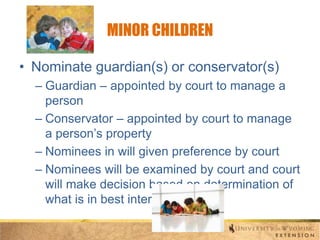
MINOR CHILDREN
• Nominate guardian(s) or conservator(s)
– Guardian – appointed by court to manage a
person
– Conservator – appointed by court to manage
a person’s property
– Nominees in will given preference by court
– Nominees will be examined by court and court
will make decision based on determination of
what is in best interest of child
TRUSTS
• Often used to avoid probate
• Establishes relationship between settlor, a
trustee, & beneficiaries
– Settlor transfers property to trustee
– Trustee manages property
– Beneficiaries benefit

• Trust never dies – probate required to
pass property from dead to living
TRUSTS (cont.)
• Typically, settlor transfers as much property
as possible during his/her life and uses pourover will to catch anything not yet transferred
at death
• Advantages:
– More expensive then wills up front, but save
probate costs
– Privacy
– Increased property control
– Minimizing transfer taxes (if estate is over
$5M/person or $10M/couple)
REVOCABLE TRUSTS
“A trust that the trustor may terminate at any point prior to
his/her death. A trust relationship in which one party, known
as the trustor, gives to a person or organization, known as the
trustee, the right to hold and invest assets or property on
behalf of a third party, known as the beneficiary. Most trusts
exist to provide for the financial future of a minor child or
mentally incompetent person, or may benefit charitable
organizations. Many trusts are exempt from taxation on
money given to the beneficiary, but because revocable trusts
may be terminated, they are considered part of the trustor's
estate and are thus subject to estate taxes.”
Farlex Financial Dictionary. © 2012 Farlex, Inc. All Rights Reserved
IRREVOCABLE TRUSTS
“A trust into which a grantor deposits assets for use by a
beneficiary where the terms of the trust cannot be modified
or abrogated without permission of the beneficiary. That
is, when a grantor sets up an irrevocable trust, he/she
completely relinquishes ownership of the assets placed in the
trust. As a result, an irrevocable trust is not usually
considered part of the grantor's estate for estate tax
purposes.”
Farlex Financial Dictionary. © 2012 Farlex, Inc. All Rights Reserved
OTHER TOOLS
• Living Trust (Revocable Trust)
– Created during life to manage property &
provide ongoing management & distribution of
property after death w/o probate
– Funded via transfers during life and pour-over
will at death

• Pour-Over Will
– Transfers property at death to previously
established trust
OTHER TOOLS (cont.)
• Joint Ownership W/ Rights of Survivorship
(Joint Tenancy)
– Whichever person survives the other receives
full ownership of property
– Used to avoid probate

• Beneficiary Designations
– Transfer benefits of life
insurance, pension, IRA, annuity, other payon-death proceeds
OTHER TOOLS (cont.)
• Testamentary Trust
– Takes effect at death
– Trustee manages property for minor or
incapacitated heir

• Bypass Trust (Credit Shelter Trust)
– Allows spouse to take advantage of lifetime
applicable exclusion
– Limit (January 1, 2013) - $5M/person,
$10M/couple
OTHER TOOLS (cont.)
• Irrevocable Life Insurance Trust (ILIT)
– Trust to hold life insurance policies
– Creator pays amount to trust equal to annual gift
tax exclusion to pay policy premiums
– Prevents life insurance proceeds from being
subjected to estate taxes

• Family Business Arrangements
– Documented business succession plan between
owners
– Type of business structure will affect what plan is
used
OTHER TOOLS (cont.)
• Charitable Gift Designations
– Intent to transfer assets to charity as
designated by will or trust

• Minor’s Trust
– Irrevocable trust which moves property from
estate to benefit minor children or
grandchildren

• TOD/POD
– Transfer-on-Death (TOD) and Payable-onDeath (POD) designations on accounts and
investments
FINAL THOUGHTS
• Discuss estate and surrounding issues w/
loved ones and trusted advisors
– Find out their interests and preferences
– Make decisions about what actions to
take, what to avoid

• See an attorney to help you through all the
alternatives and to prepare the final
documents
• Whenever circumstances or your
intentions change, change the necessary
documents
Questions? Comments?

Introduction to Estate Planning

  • 1.
    INTRODUCTION TO ESTATE PLANNING BillTaylor Northeast Area Community Development Educator
  • 2.
    ? • What isestate planning? • How many people are legally prepared for death? • What keeps people from doing estate planning? • At what age should you start planning for transfer of your estate?
  • 3.
    REFERENCES • PLANNING AHEAD;DIFFICULT DECISIONS University of Wyoming Extension bulletin series; September 2013; Aaron Lyttle, Cole Ehmke, Mary Martin, Bill Taylor; available at http://www.wyomingextension.org/publicati ons and enter Lyttle as author • Aaron Lyttle, attorney-at-law with Long, Reimer, Winegar, Beppler
  • 4.
    SIX MAJOR QUESTIONS •Who will make my financial decisions when I can’t make them? • Who will make my health-care decisions when I can’t make them? • What will happen to my property after I die? • What will happen to my remains? • What is the legal procedure for transferring my estate to my heirs? • Who will care for my minor children?
  • 5.
    THREE OTHER IMPORTANTQUESTIONS • What are the Wyoming requirements for valid wills? • How do you revoke a will? • What other tools are available?
  • 6.
    FINANCIAL DECISIONS • Delegatedwith a Durable Power of Attorney • Allows agent to make financial decisions on your behalf • Can delegate anything you could do yourself – From narrow (close an account) to broad (make all decisions on your behalf – Typical: • • • • Opening & closing accounts Borrowing & lending Giving gifts Settling lawsuits
  • 7.
    DURABLE POWER OFATTORNEY • Two types: – Immediate – goes into effect immediately • For those: – Presently having difficulty managing affairs – Couple who own property jointly – Springing – goes into effect when you are legally determined incompetent • Often specifies conditions necessary for incompetency – E.g., 1 or 2 doctors make determination (Traditional POA becomes invalid when you become incompetent)
  • 8.
    HEALTH-CARE DECISIONS • Delegatedvia an Advance Health Care Directive – Modern combination of Health Care POA and Advance Directive or Living Will – Binding decisions regarding end-of-life options – Health Care POA portion like Durable POA, but limited to health decisions • Goes into effect when primary health-care provider determines you can’t make decisions
  • 9.
    HEALTH-CARE DECISIONS (cont.) •Decisions you can make in an Advance Health Care Directive – Name a guardian for yourself – Direct to what degree you want your life prolonged – Direct whether you want CPR – Indicate whether you want to donate organs or your body – Name a primary physician(s) to determine your capacity to make decisions
  • 10.
    HEALTH-CARE DECISIONS (cont.) •Advance Health Care Directive – Must be written, signed, dated – Notarized or signed by two witnesses – Can be revoked or changed at any time – Only gives power to terminate lifesupport, never to assist with suicide or euthanize
  • 11.
    PROPERTY • Intestate –without a will – According to a formula set in state statue – Spouse & children • Spouse – 50% • Children (or their heirs) split remaining 50% – Spouse only – 100%
  • 12.
    PROPERTY (cont.) • Intestate– without a will (cont.) – No Spouse 1. Children & their heirs 2. Parents, siblings and their heirs 3. Grandparent, uncles, aunts, and their heirs – No heirs • State of WY – 100% – Court will appoint personal representative • Old term – “administrator”
  • 13.
    PROPERTY (cont.) • Testate– a valid will is present – “Surviving spouse’s elective share”: • Spouse & children – Spouse – may take up to 50% if any of the children are his/hers even if the will sets a lesser amount – Spouse – may take up to 25% if none of the children are his/hers • Spouse only – may take up to 50% even if will sets a lesser amount
  • 14.
    PROPERTY (cont.) • Testate– a valid will is present (cont.) – Benefits: • Name a personal representative (executor, administrator) • Written list of who receives specific property • Name someone as guardian of children • Name someone to take care of pets • Require beneficiaries inheritance held in trust until a specified age • Other decisions regarding administration & taxation of estate
  • 15.
    VALID WILL • Wyomingrequirements: – In writing or typed, signed, dated – Two competent, disinterested witnesses – Notarization not required, but significantly eases the process
  • 16.
    VALID WILL (cont.) •Wyoming requirements (cont.): – Proved • “Self-proving” – witnesses sign notarized affidavit stating will was executed by person signing it – Unnecessary for witnesses to later testify to validity – Probated without further proof • Non “self-proving” – validity must be proven by written or oral testimony of one of the witnesses – If witnesses are unavailable, must be proved by testimony of 2 disinterested witnesses
  • 17.
    VALID WILL (cont.) •Holographic will – Entirely in testator’s handwriting – Signed by testator – Not recommended except in emergency – Must be proven before probate
  • 18.
    REVOCABLE? • Will orany part revoked by: – New will that revokes the prior will or part of it – By inconsistency between new will and past will – Being “burned, torn, cancelled, obliterated or destroyed” by testator w/ intent and purpose of revoking it • Divorce revokes any disposition or appointment of property, any conferring of general or special powers, and any nomination to executor, trustee, conservator or guardian of former spouse, unless specifically stated otherwise in latest will.
  • 19.
    REMAINS • No instructionsmade: – Disposition decided by: • Spouse; adult children; parents; siblings; grandparents; stepchildren; guardians – in that order • Written instructions regarding “entombment, burial or cremation” or authorizing another person to make those decisions: – Funeral director or undertake must follow
  • 20.
    REMAINS (cont.) • Helpfulto prepay funeral or burial – Provides certainty & relieves family of burden • Can prepare written document with funeral wishes – Not legally binding, but helpful to others • Should discuss wishes w/ family & heirs before death – Estate planning documents often not found or reviewed until after funeral
  • 21.
    PROBATE • Process oftransferring property from dead person to living person(s) • Can take several months • Personal representative & attorney entitled to feel based on % of probate estate value – May collect additional fees for extraordinary services or costs • Public and subject to mandatory court supervision
  • 22.
    SUMMARY PROBATE • Processfor estates of $200,000 or less • Persons claiming to be distributees may file application to district court after 30 days from death • Typically less difficult, time-consuming, costly then formal probate
  • 23.
    MINOR CHILDREN • Nominateguardian(s) or conservator(s) – Guardian – appointed by court to manage a person – Conservator – appointed by court to manage a person’s property – Nominees in will given preference by court – Nominees will be examined by court and court will make decision based on determination of what is in best interest of child
  • 24.
    TRUSTS • Often usedto avoid probate • Establishes relationship between settlor, a trustee, & beneficiaries – Settlor transfers property to trustee – Trustee manages property – Beneficiaries benefit • Trust never dies – probate required to pass property from dead to living
  • 25.
    TRUSTS (cont.) • Typically,settlor transfers as much property as possible during his/her life and uses pourover will to catch anything not yet transferred at death • Advantages: – More expensive then wills up front, but save probate costs – Privacy – Increased property control – Minimizing transfer taxes (if estate is over $5M/person or $10M/couple)
  • 26.
    REVOCABLE TRUSTS “A trustthat the trustor may terminate at any point prior to his/her death. A trust relationship in which one party, known as the trustor, gives to a person or organization, known as the trustee, the right to hold and invest assets or property on behalf of a third party, known as the beneficiary. Most trusts exist to provide for the financial future of a minor child or mentally incompetent person, or may benefit charitable organizations. Many trusts are exempt from taxation on money given to the beneficiary, but because revocable trusts may be terminated, they are considered part of the trustor's estate and are thus subject to estate taxes.” Farlex Financial Dictionary. © 2012 Farlex, Inc. All Rights Reserved
  • 27.
    IRREVOCABLE TRUSTS “A trustinto which a grantor deposits assets for use by a beneficiary where the terms of the trust cannot be modified or abrogated without permission of the beneficiary. That is, when a grantor sets up an irrevocable trust, he/she completely relinquishes ownership of the assets placed in the trust. As a result, an irrevocable trust is not usually considered part of the grantor's estate for estate tax purposes.” Farlex Financial Dictionary. © 2012 Farlex, Inc. All Rights Reserved
  • 28.
    OTHER TOOLS • LivingTrust (Revocable Trust) – Created during life to manage property & provide ongoing management & distribution of property after death w/o probate – Funded via transfers during life and pour-over will at death • Pour-Over Will – Transfers property at death to previously established trust
  • 29.
    OTHER TOOLS (cont.) •Joint Ownership W/ Rights of Survivorship (Joint Tenancy) – Whichever person survives the other receives full ownership of property – Used to avoid probate • Beneficiary Designations – Transfer benefits of life insurance, pension, IRA, annuity, other payon-death proceeds
  • 30.
    OTHER TOOLS (cont.) •Testamentary Trust – Takes effect at death – Trustee manages property for minor or incapacitated heir • Bypass Trust (Credit Shelter Trust) – Allows spouse to take advantage of lifetime applicable exclusion – Limit (January 1, 2013) - $5M/person, $10M/couple
  • 31.
    OTHER TOOLS (cont.) •Irrevocable Life Insurance Trust (ILIT) – Trust to hold life insurance policies – Creator pays amount to trust equal to annual gift tax exclusion to pay policy premiums – Prevents life insurance proceeds from being subjected to estate taxes • Family Business Arrangements – Documented business succession plan between owners – Type of business structure will affect what plan is used
  • 32.
    OTHER TOOLS (cont.) •Charitable Gift Designations – Intent to transfer assets to charity as designated by will or trust • Minor’s Trust – Irrevocable trust which moves property from estate to benefit minor children or grandchildren • TOD/POD – Transfer-on-Death (TOD) and Payable-onDeath (POD) designations on accounts and investments
  • 33.
    FINAL THOUGHTS • Discussestate and surrounding issues w/ loved ones and trusted advisors – Find out their interests and preferences – Make decisions about what actions to take, what to avoid • See an attorney to help you through all the alternatives and to prepare the final documents • Whenever circumstances or your intentions change, change the necessary documents
  • 34.