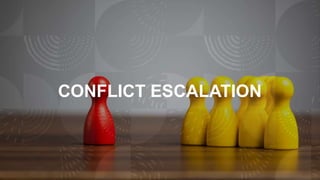
CONFLICT ESCALATION
Review of the Past Lesson
1.What are the three types of conflict?
2.Differentiate the following: Surface
Conflict, Latent Conflict, and Open
Conflict.
In other words…
• Surface Conflict is one that is episodic and not
deeply rooted, but is being directly expressed,
hopefully by non-violent means. Latent Conflict,
meanwhile, is unexpressed frustration that
continues to develop over time. Open Conflict,
on the other hand, is a deeply rooted frustration
that is currently being expressed.
Theory Input
•Conflict escalation is the
process by which Latent Conflict
grows or develops over time into
Open Conflict.
Conflict escalation
•Kriesberg (2003) described it as
involving an increase in the intensity
of a conflict and in the severity of
tactics used in pursuing the initial
goal.
Escalation Stage section
•Once a conflict is in the escalation phase,
identities, grievances, goals, and methods
often change, perpetuating the conflict in an
increasingly destructive fashion.
•Thus, each side's collective identity is
shaped as the opposite of the enemy's
identity.
Escalation Stage section
•Group loyalty is also often demonstrated by
antagonism toward the enemy.
•Additionally, good qualities are increasingly
attributed to one's own group, while bad
qualities are increasingly attributed to the
enemy, sometimes going so far as to
dehumanize the enemy.
Institutionalization Stage section
• Once a conflict begins to escalate, many
processes contribute to its institutionalization and
self-perpetuation.
• As a conflict persists, members of each side
increasingly view members of the other side as
enemies with bad qualities, and perhaps as cruel
and untrustworthy.
Institutionalization Stage section
•Such socialization contributes to a conflict's
further intractability.
•Mutual fear increases and people on each side
are concerned about their vulnerability if they
yield.
•One group may hear another group's call for
justice as a cry for revenge.
Factors that make conflict more intractable according to
Anstey, as cited by du Toit (2014, pp. 10-11), include:
•Parties do not want to lose face.
•Parties may experience tunnel vision.
•Groups cohere.
•Groups can experience a need for
revenge.
Parties do not want to lose face.
•As the conflict escalates, it becomes
increasingly difficult for leaders to argue in favor
of compromise without being seen as weak.
•During the course of a conflict, leaders will
spend a great deal of time posturing to both
their supporters and their opponents so as not
to be seen as weak and indecisive.
Parties may experience tunnel vision.
• As the conflict escalates, parties become locked
into promoting and defending their own positions
and become less open to the views of others.
• Tunnel vision prevents people from seeing
conflict from the other’s perspective and
recognizing that other parties have to satisfy their
own needs and interests.
Groups cohere.
•As conflict escalates, group cohesion tends to
become stronger.
•Groups apply pressure to their own members
to conform to conflict modes of thinking.
•Anyone advocating a moderate stance can be
discredited or branded as a traitor.
Groups can experience a need for
revenge.
•Suffering caused in conflict often leaves
people with a strong desire to see
opponents punished.
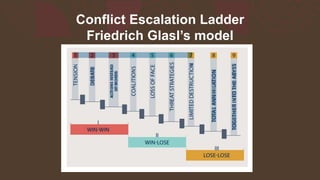
Conflict Escalation Ladder
Friedrich Glasl’s model
Structured Learning Activity:
The Kidapawan assault revisited
•Have the groups become familiar with the story.
•Designate the first group as the farmers group,
the second group as the elected officials group,
and the last group as the law enforcement group.
•Have each group map the conflict from their
assigned perspective.
Discussion
• What was the group’s need?
• What was their frustration?
• Did the need of one group result in the frustration
of another group?
• What kind of conflict was it?
• What factors contributed to the escalation of the
conflict?
•What factors would have de-
escalated the conflict?

CONFLICT ESCALATION.pptx

  • 1.
  • 2.
    Review of thePast Lesson 1.What are the three types of conflict? 2.Differentiate the following: Surface Conflict, Latent Conflict, and Open Conflict.
  • 3.
    In other words… •Surface Conflict is one that is episodic and not deeply rooted, but is being directly expressed, hopefully by non-violent means. Latent Conflict, meanwhile, is unexpressed frustration that continues to develop over time. Open Conflict, on the other hand, is a deeply rooted frustration that is currently being expressed.
  • 4.
    Theory Input •Conflict escalationis the process by which Latent Conflict grows or develops over time into Open Conflict.
  • 5.
    Conflict escalation •Kriesberg (2003)described it as involving an increase in the intensity of a conflict and in the severity of tactics used in pursuing the initial goal.
  • 6.
    Escalation Stage section •Oncea conflict is in the escalation phase, identities, grievances, goals, and methods often change, perpetuating the conflict in an increasingly destructive fashion. •Thus, each side's collective identity is shaped as the opposite of the enemy's identity.
  • 7.
    Escalation Stage section •Grouployalty is also often demonstrated by antagonism toward the enemy. •Additionally, good qualities are increasingly attributed to one's own group, while bad qualities are increasingly attributed to the enemy, sometimes going so far as to dehumanize the enemy.
  • 8.
    Institutionalization Stage section •Once a conflict begins to escalate, many processes contribute to its institutionalization and self-perpetuation. • As a conflict persists, members of each side increasingly view members of the other side as enemies with bad qualities, and perhaps as cruel and untrustworthy.
  • 9.
    Institutionalization Stage section •Suchsocialization contributes to a conflict's further intractability. •Mutual fear increases and people on each side are concerned about their vulnerability if they yield. •One group may hear another group's call for justice as a cry for revenge.
  • 10.
    Factors that makeconflict more intractable according to Anstey, as cited by du Toit (2014, pp. 10-11), include: •Parties do not want to lose face. •Parties may experience tunnel vision. •Groups cohere. •Groups can experience a need for revenge.
  • 11.
    Parties do notwant to lose face. •As the conflict escalates, it becomes increasingly difficult for leaders to argue in favor of compromise without being seen as weak. •During the course of a conflict, leaders will spend a great deal of time posturing to both their supporters and their opponents so as not to be seen as weak and indecisive.
  • 12.
    Parties may experiencetunnel vision. • As the conflict escalates, parties become locked into promoting and defending their own positions and become less open to the views of others. • Tunnel vision prevents people from seeing conflict from the other’s perspective and recognizing that other parties have to satisfy their own needs and interests.
  • 13.
    Groups cohere. •As conflictescalates, group cohesion tends to become stronger. •Groups apply pressure to their own members to conform to conflict modes of thinking. •Anyone advocating a moderate stance can be discredited or branded as a traitor.
  • 14.
    Groups can experiencea need for revenge. •Suffering caused in conflict often leaves people with a strong desire to see opponents punished.
  • 15.
  • 16.
    Structured Learning Activity: TheKidapawan assault revisited •Have the groups become familiar with the story. •Designate the first group as the farmers group, the second group as the elected officials group, and the last group as the law enforcement group. •Have each group map the conflict from their assigned perspective.
  • 17.
    Discussion • What wasthe group’s need? • What was their frustration? • Did the need of one group result in the frustration of another group? • What kind of conflict was it? • What factors contributed to the escalation of the conflict?
  • 18.
    •What factors wouldhave de- escalated the conflict?