Conflict Life Cycle
By
Prabhdeep Kaur
Abhilasha Jain
Richa Jaryal
Priyanka Chauhan
Conflict
Conflict is as old as nature, an inherent phenomenon in the
existence of mankind. This is premised on the gregarious nature of
man which often ipso facto culminates into misunderstanding or
quarrel in social relations, brought about by differences in
preferences.
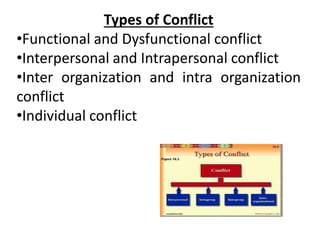
Types of Conflict
•Functional and Dysfunctional conflict
•Interpersonal and Intrapersonal conflict
•Inter organization and intra organization
conflict
•Individual conflict
Conflict life cycle
Life cycle of conflict
Stage1- Beginning
A conflict begins to take shape as the differences between the
conflicting parties become clearly defined and people begin to
take sides openly. The language of 'us and them' starts being
widely used, and the idea of a 'cause' to support emerges on
both sides. There is no violence at this point.
If a society is strong and its leaders enlightened, a conflict can be
dealt with in a constructive and positive way at this stage, and
violence and a worsening situation can be avoided.
Stage 2- Early growth
But if there are no existing ways of dealing with social tensions
and divisions, the conflict grows worse. The two sides express
open hostility, so that 'us and them' now become 'the enemy'
to each other. Each side increases its demands, and its sense of
grievance swells. Each side looks for allies from outside the
conflict area, for moral and physical support. Acts of violence
begin. If violence is not repressed, the opposing sides hit back
at one another and a destructive and deadly spiral begins.
If one of the sides has greater forces (as governments backed
by armies do, for example, when suppressing civilian
opposition) it may at this stage suppress its opponents, but the
underlying causes of conflict remain to break out another day.
Stage 3- Deadlock
Now the two sides are openly at war. Each side perceives the other as the
aggressor on whom blame for the conflict falls. Each side regards itself as having
the just cause. The lawlessness of war takes over, as inhibitions and restraints on
violence are abandoned. Three possible situations can now be reached: (a) a
stalemate with each side matching the other in violence; (b) a surge of violence
on one side; (c) exhaustion of strength and resources on both sides ( this has
been called 'a mutually-hurting stalemate').
Situation (a) continues the spiral of violence, or may halt it at a particular level
which both sides keep up.
Situation (b) can make a change: for example, one side's increased power may
cause the other side to change its tactics. The conflict may return to earlier stages
and repeat them. If a side now decides to withdraw, the conflict remains
unresolved and is likely to begin again later.
Situation (c) is the position from which the conflict can most readily move to its
next stage.
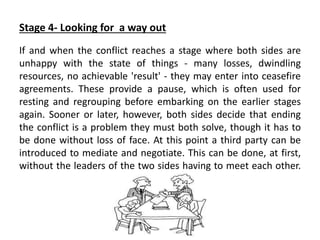
Stage 4- Looking for a way out
If and when the conflict reaches a stage where both sides are
unhappy with the state of things - many losses, dwindling
resources, no achievable 'result' - they may enter into ceasefire
agreements. These provide a pause, which is often used for
resting and regrouping before embarking on the earlier stages
again. Sooner or later, however, both sides decide that ending
the conflict is a problem they must both solve, though it has to
be done without loss of face. At this point a third party can be
introduced to mediate and negotiate. This can be done, at first,
without the leaders of the two sides having to meet each other.
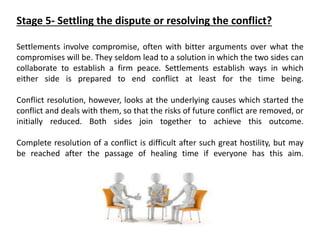
Stage 5- Settling the dispute or resolving the conflict?
Settlements involve compromise, often with bitter arguments over what the
compromises will be. They seldom lead to a solution in which the two sides can
collaborate to establish a firm peace. Settlements establish ways in which
either side is prepared to end conflict at least for the time being.
Conflict resolution, however, looks at the underlying causes which started the
conflict and deals with them, so that the risks of future conflict are removed, or
initially reduced. Both sides join together to achieve this outcome.
Complete resolution of a conflict is difficult after such great hostility, but may
be reached after the passage of healing time if everyone has this aim.
Stage 6- Working together
Now the agreement has to be put into effect. Both sides need
to create a new order together, rebuilding homes, restoring
jobs and education, establishing enlightened
management/government, disarming fighters and allowing
refugees to return home. Even more important, the two sides
have to face up to the past, share their griefs, and reconcile
their differences. This needs sensitivity, courage, and, above
all, immense patience.
Conflict life cycle

Conflict life cycle

  • 1.
    Conflict Life Cycle By PrabhdeepKaur Abhilasha Jain Richa Jaryal Priyanka Chauhan
  • 2.
    Conflict Conflict is asold as nature, an inherent phenomenon in the existence of mankind. This is premised on the gregarious nature of man which often ipso facto culminates into misunderstanding or quarrel in social relations, brought about by differences in preferences.
  • 3.
    Types of Conflict •Functionaland Dysfunctional conflict •Interpersonal and Intrapersonal conflict •Inter organization and intra organization conflict •Individual conflict
  • 4.
  • 5.
    Life cycle ofconflict Stage1- Beginning A conflict begins to take shape as the differences between the conflicting parties become clearly defined and people begin to take sides openly. The language of 'us and them' starts being widely used, and the idea of a 'cause' to support emerges on both sides. There is no violence at this point. If a society is strong and its leaders enlightened, a conflict can be dealt with in a constructive and positive way at this stage, and violence and a worsening situation can be avoided.
  • 6.
    Stage 2- Earlygrowth But if there are no existing ways of dealing with social tensions and divisions, the conflict grows worse. The two sides express open hostility, so that 'us and them' now become 'the enemy' to each other. Each side increases its demands, and its sense of grievance swells. Each side looks for allies from outside the conflict area, for moral and physical support. Acts of violence begin. If violence is not repressed, the opposing sides hit back at one another and a destructive and deadly spiral begins. If one of the sides has greater forces (as governments backed by armies do, for example, when suppressing civilian opposition) it may at this stage suppress its opponents, but the underlying causes of conflict remain to break out another day.
  • 7.
    Stage 3- Deadlock Nowthe two sides are openly at war. Each side perceives the other as the aggressor on whom blame for the conflict falls. Each side regards itself as having the just cause. The lawlessness of war takes over, as inhibitions and restraints on violence are abandoned. Three possible situations can now be reached: (a) a stalemate with each side matching the other in violence; (b) a surge of violence on one side; (c) exhaustion of strength and resources on both sides ( this has been called 'a mutually-hurting stalemate'). Situation (a) continues the spiral of violence, or may halt it at a particular level which both sides keep up. Situation (b) can make a change: for example, one side's increased power may cause the other side to change its tactics. The conflict may return to earlier stages and repeat them. If a side now decides to withdraw, the conflict remains unresolved and is likely to begin again later. Situation (c) is the position from which the conflict can most readily move to its next stage.
  • 8.
    Stage 4- Lookingfor a way out If and when the conflict reaches a stage where both sides are unhappy with the state of things - many losses, dwindling resources, no achievable 'result' - they may enter into ceasefire agreements. These provide a pause, which is often used for resting and regrouping before embarking on the earlier stages again. Sooner or later, however, both sides decide that ending the conflict is a problem they must both solve, though it has to be done without loss of face. At this point a third party can be introduced to mediate and negotiate. This can be done, at first, without the leaders of the two sides having to meet each other.
  • 9.
    Stage 5- Settlingthe dispute or resolving the conflict? Settlements involve compromise, often with bitter arguments over what the compromises will be. They seldom lead to a solution in which the two sides can collaborate to establish a firm peace. Settlements establish ways in which either side is prepared to end conflict at least for the time being. Conflict resolution, however, looks at the underlying causes which started the conflict and deals with them, so that the risks of future conflict are removed, or initially reduced. Both sides join together to achieve this outcome. Complete resolution of a conflict is difficult after such great hostility, but may be reached after the passage of healing time if everyone has this aim.
  • 10.
    Stage 6- Workingtogether Now the agreement has to be put into effect. Both sides need to create a new order together, rebuilding homes, restoring jobs and education, establishing enlightened management/government, disarming fighters and allowing refugees to return home. Even more important, the two sides have to face up to the past, share their griefs, and reconcile their differences. This needs sensitivity, courage, and, above all, immense patience.