1
Training on
Retrofitting Techniques and
Correction/exceptional Manual
29 May - 01 , June 2017, Kathmandu , Nepal
CONFINED MASONRY (CM)
Kuber Bogati
Structural Engineer
2
Objectives
As a result of this session, you should be able to:
• Understand about Confined Masonry Building : Key Concepts
• Know why Confined Masonry in Nepal
• Compare Reinforced Masonry and Confined Masonry
• Compare RC Frame with URM Infill Vs. CM,
• Know Seismic Performance of CM Buildings
• Understand How CM Resists Earthquake Effects
• Damages in Confined Masonry in Past Earthquakes
• Know General Planning and Design Aspects
• Know Guidelines for Non-engineered CM Buildings
• Introduce with Minimum Requirement & Inspection Form of CM
3
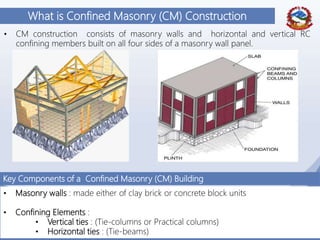
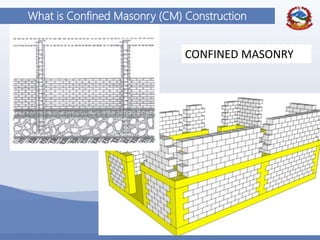
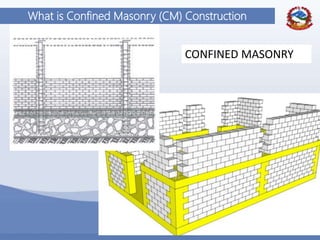
What is Confined Masonry (CM) Construction
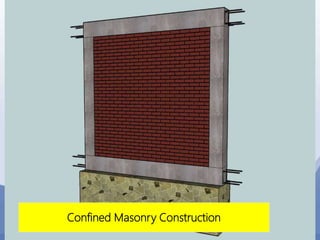
• CM construction consists of masonry walls and horizontal and vertical RC
confining members built on all four sides of a masonry wall panel.
• Masonry walls : made either of clay brick or concrete block units
• Confining Elements :
• Vertical ties : (Tie-columns or Practical columns)
• Horizontal ties : (Tie-beams)
Key Components of a Confined Masonry (CM) Building
4
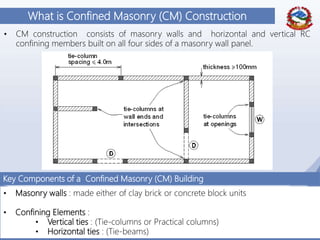
What is Confined Masonry (CM) Construction
• CM construction consists of masonry walls and horizontal and vertical RC
confining members built on all four sides of a masonry wall panel.
• Masonry walls : made either of clay brick or concrete block units
• Confining Elements :
• Vertical ties : (Tie-columns or Practical columns)
• Horizontal ties : (Tie-beams)
Key Components of a Confined Masonry (CM) Building
5
What is Confined Masonry (CM) Construction
CONFINED MASONRY
6
Confined Masonry Construction
7
What is Confined Masonry (CM) Construction
CONFINED MASONRY
8
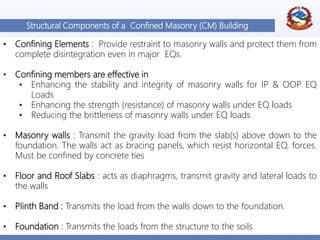
Structural Components of a Confined Masonry (CM) Building
• Confining Elements : Provide restraint to masonry walls and protect them from
complete disintegration even in major EQs.
• Confining members are effective in
• Enhancing the stability and integrity of masonry walls for IP & OOP EQ
Loads
• Enhancing the strength (resistance) of masonry walls under EQ loads
• Reducing the brittleness of masonry walls under EQ loads
• Masonry walls : Transmit the gravity load from the slab(s) above down to the
foundation. The walls act as bracing panels, which resist horizontal EQ. forces.
Must be confined by concrete ties
• Floor and Roof Slabs : acts as diaphragms, transmit gravity and lateral loads to
the walls
• Plinth Band : Transmits the load from the walls down to the foundation.
• Foundation : Transmits the loads from the structure to the soils
9
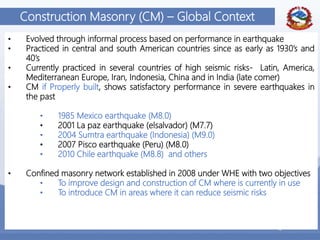
Construction Masonry (CM) – Global Context
• Evolved through informal process based on performance in earthquake
• Practiced in central and south American countries since as early as 1930’s and
40’s
• Currently practiced in several countries of high seismic risks- Latin, America,
Mediterranean Europe, Iran, Indonesia, China and in India (late comer)
• CM if Properly built, shows satisfactory performance in severe earthquakes in
the past
• 1985 Mexico earthquake (M8.0)
• 2001 La paz earthquake (elsalvador) (M7.7)
• 2004 Sumtra earthquake (Indonesia) (M9.0)
• 2007 Pisco earthquake (Peru) (M8.0)
• 2010 Chile earthquake (M8.8) and others
• Confined masonry network established in 2008 under WHE with two objectives
• To improve design and construction of CM where is currently in use
• To introduce CM in areas where it can reduce seismic risks
10
World Wide Practices
1. Chile
2. Colombia
3. Mexico
4. Peru
5. Argentina
6. Eurocode
7. Algeria
8. China
9. Iran
10.Indonesia
11.India
11
Confined Masonry in Nepal - Context
• Construction of reinforced concrete frame and masonry wall is trending in cities
and towns
• Heavy damage observed in those construction in the last earthquake even in low
PGA and spectral acceleration
• Non-ductile RC frame construction
• Unreinforced masonry walls vulnerable to lateral loading
• The presence of wall is in RC construction is not utilized as well as the
consequence of irregularity is overlooked
 Confined masonry construction provides opportunity for improved performance in
earthquake utilizing constriction from both RC and masonry components
[technologies which require similar (preferably lower) level of construction skills and
are economically viable]
 Its simple in design and analogues to conventional construction of RC frame with
walls (EXTENSIVE ENGINEERING INPUT NOT REQUIRED)
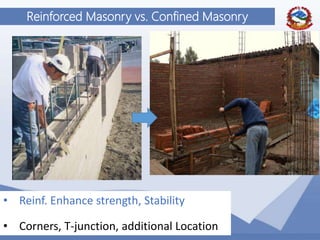
Reinforced Masonry vs. Confined Masonry
• Reinf. Enhance strength, Stability
• Corners, T-junction, additional Location
13
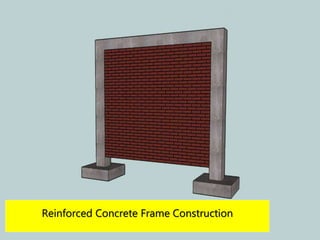
Reinforced Concrete Frame Construction
14
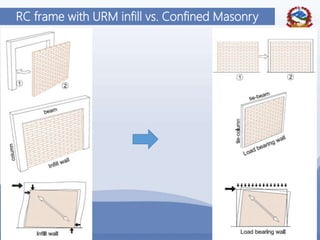
RC frame with URM infill vs. Confined Masonry
15
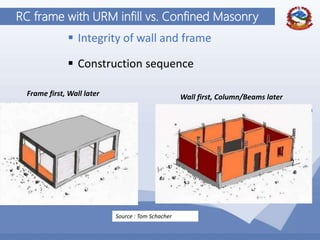
RC frame with URM infill vs. Confined Masonry
 Integrity of wall and frame
 Construction sequence
Frame first, Wall later Wall first, Column/Beams later
Source : Tom Schacher
17
Seismic Performance of CM
Confined masonry construction is found in countries/regions
with very high seismic risk,
• Latin America (Mexico, Chile, Peru, Argentina),
• Mediterranean Europe (Italy, Slovenia),
• South Asia (Indonesia), and the Far East (China).
• In some countries (e.g. Italy) for almost 100 years
• If properly built, shows satisfactory seismic performance
EXTENSIVE ENGINEERING INPUT NOT REQUIRED!
18
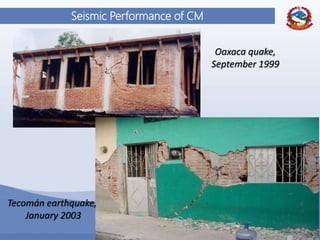
Seismic Performance of CM
Oaxaca quake,
September 1999
Tecomán earthquake,
January 2003
19
Seismic Performance of CM
Confined masonry construction has been exposed to several
destructive earthquakes:
• 1985 Lloleo, Chile (magnitude 7.8)
• 1985 Mexico City, Mexico (magnitude 8.0)
• 2001 El Salvador (magnitude 7.7)
• 2003 Tecoman, Mexico (magnitude 7.6)
• 2007 Pisco, Peru (magnitude 8.0)
• 2003 Bam, Iran (magnitude 6.6)
• 2004 The Great Sumatra Earthquake and Tsunami, Indonesia
(magnitude 9.0)
• 2007 Pisco, Peru (magnitude 8.0)
• 2010 Maule, Chile earthquake (magnitude 8.8)
• 2010 Haiti earthquake (magnitude 7.0)
Confined masonry buildings performed very well in these major
earthquakes – some buildings were damaged, but no human
losses
20
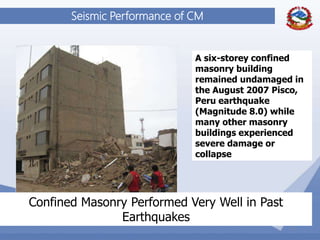
Seismic Performance of CM
A six-storey confined
masonry building
remained undamaged in
the August 2007 Pisco,
Peru earthquake
(Magnitude 8.0) while
many other masonry
buildings experienced
severe damage or
collapse
Confined Masonry Performed Very Well in Past
Earthquakes
21
How Confined Masonry Buildings Resist Earthquake Effects
22
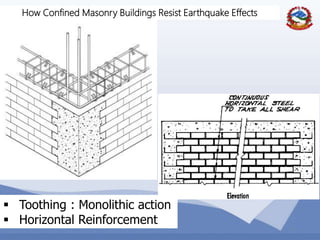
How Confined Masonry Buildings Resist Earthquake Effects
 Toothing : Monolithic action
 Horizontal Reinforcement
23
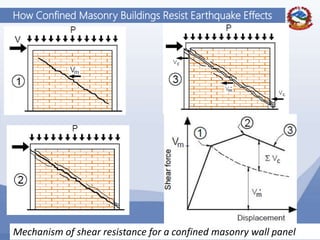
How Confined Masonry Buildings Resist Earthquake Effects
Mechanism of shear resistance for a confined masonry wall panel
24
How Confined Masonry Buildings Resist Earthquake Effects
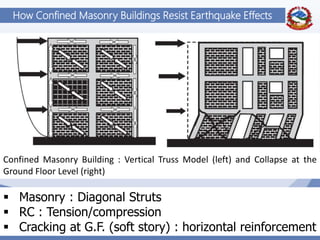
Confined Masonry Building : Vertical Truss Model (left) and Collapse at the
Ground Floor Level (right)
 Masonry : Diagonal Struts
 RC : Tension/compression
 Cracking at G.F. (soft story) : horizontal reinforcement
25
How Confined Masonry Buildings Resist Earthquake Effects
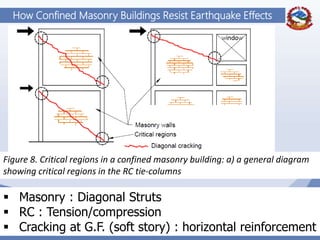
Figure 8. Critical regions in a confined masonry building: a) a general diagram
showing critical regions in the RC tie-columns
 Masonry : Diagonal Struts
 RC : Tension/compression
 Cracking at G.F. (soft story) : horizontal reinforcement
27
How Confined Masonry Buildings Resist Earthquake Effects…
Failure modes characteristic of CM Walls :
• Shear Failure Mode (due to IP Seismic Loads)
• Flexural Failure Mode (due to OOP Loads)
29
How Confined Masonry Buildings Resist Earthquake Effects…
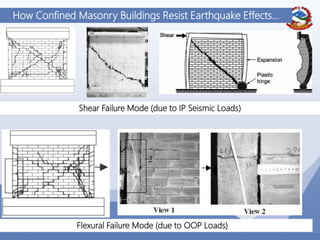
Shear Failure Mode (due to IP Seismic Loads)
Flexural Failure Mode (due to OOP Loads)
30
Key Factors Influencing Seismic Resistance of CM Structures
• Wall Density : Strength
• Masonry Units and Mortar : (Stronger)
• Tie -Columns : (Ductility & Stability)
• Horizontal Wall Reinforcement
• Openings : 10% , Load path,
33
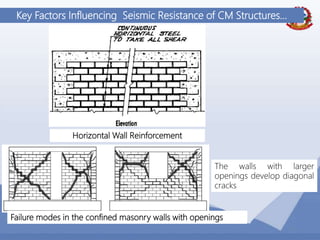
Key Factors Influencing Seismic Resistance of CM Structures…
Horizontal Wall Reinforcement
Failure modes in the confined masonry walls with openings
The walls with larger
openings develop diagonal
cracks
34
Damages in Confined Masonry in Past
Earthquakes
35
Damage Observation: Topics
1.Masonry damage (in-and out-of-plane)
2.RC tie-columns
3.Tie-beam-to-tie-column joints
4.Confining elements around openings
36
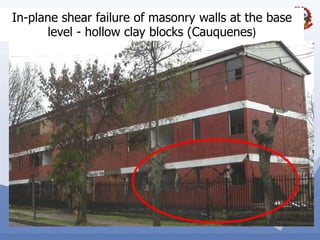
In-plane shear failure of masonry walls at the base
level - hollow clay blocks (Cauquenes)
37
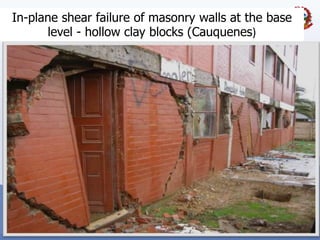
In-plane shear failure of masonry walls at the base
level - hollow clay blocks (Cauquenes)
38
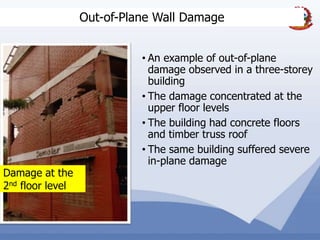
Out-of-Plane Wall Damage
Damage at the
2nd floor level
• An example of out-of-plane
damage observed in a three-storey
building
• The damage concentrated at the
upper floor levels
• The building had concrete floors
and timber truss roof
• The same building suffered severe
in-plane damage
39
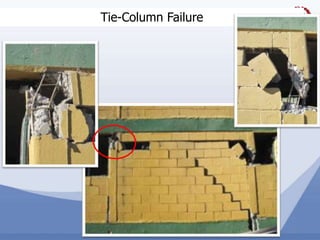
Tie-Column Failure
40
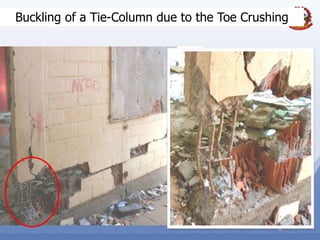
Buckling of a Tie-Column due to the Toe Crushing
41
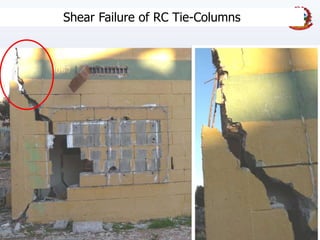
Shear Failure of RC Tie-Columns
42
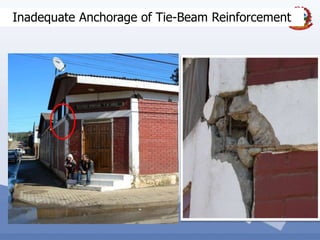
Inadequate Anchorage of Tie-Beam Reinforcement
43
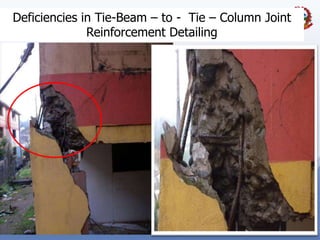
Deficiencies in Tie-Beam – to - Tie – Column Joint
Reinforcement Detailing
44
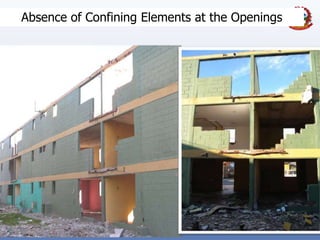
Absence of Confining Elements at the Openings
45
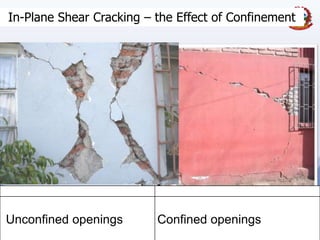
In-Plane Shear Cracking – the Effect of Confinement
Unconfined openings Confined openings
46
Key Causes of Damage in CM
1.Inadequate wall density
2.Poor quality of masonry materials and construction
3.Inadequate detailing of reinforcement in confining
elements
4.Absence of confining elements at openings
5.Geotechnical issues
47
General Planning and Design Aspects
• Architectural Guideline
• Construction Guideline
48
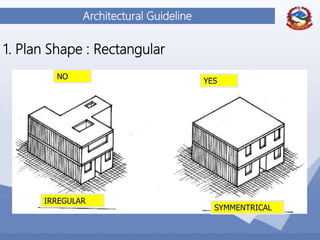
Architectural Guideline
1. Plan Shape : Rectangular
NO
YES
IRREGULAR
SYMMENTRICAL
49
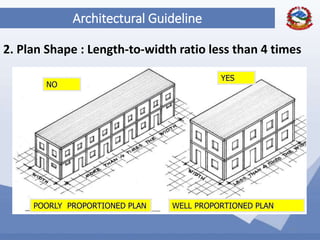
Architectural Guideline
2. Plan Shape : Length-to-width ratio less than 4 times
NO
YES
POORLY PROPORTIONED PLAN WELL PROPORTIONED PLAN
50
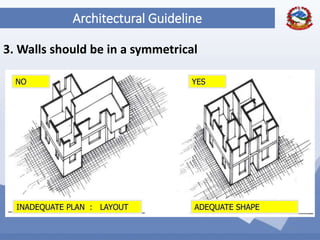
Architectural Guideline
3. Walls should be in a symmetrical
NO YES
INADEQUATE PLAN : LAYOUT ADEQUATE SHAPE
51
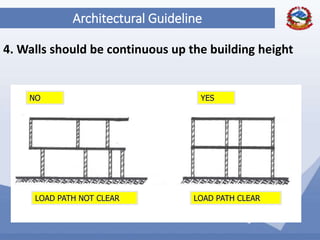
Architectural Guideline
4. Walls should be continuous up the building height
NO YES
LOAD PATH NOT CLEAR LOAD PATH CLEAR
52
Architectural Guideline
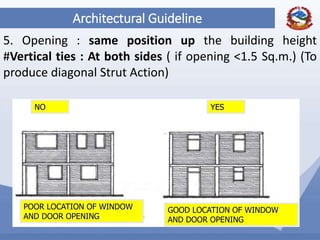
5. Opening : same position up the building height
#Vertical ties : At both sides ( if opening <1.5 Sq.m.) (To
produce diagonal Strut Action)
NO YES
POOR LOCATION OF WINDOW
AND DOOR OPENING
GOOD LOCATION OF WINDOW
AND DOOR OPENING
53
Architectural Guideline
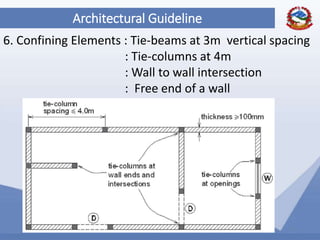
6. Confining Elements : Tie-beams at 3m vertical spacing
: Tie-columns at 4m
: Wall to wall intersection
: Free end of a wall
54
Architectural Guideline
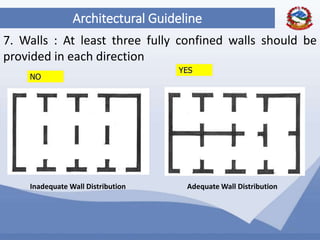
7. Walls : At least three fully confined walls should be
provided in each direction
Inadequate Wall Distribution Adequate Wall Distribution
NO
YES
55
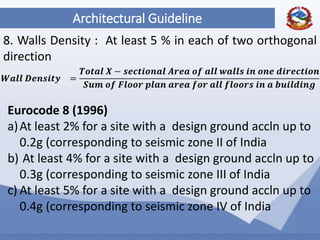
Architectural Guideline
8. Walls Density : At least 5 % in each of two orthogonal
direction
𝑾𝒂𝒍𝒍 𝑫𝒆𝒏𝒔𝒊𝒕𝒚 =
𝑻𝒐𝒕𝒂𝒍 𝑿 − 𝒔𝒆𝒄𝒕𝒊𝒐𝒏𝒂𝒍 𝑨𝒓𝒆𝒂 𝒐𝒇 𝒂𝒍𝒍 𝒘𝒂𝒍𝒍𝒔 𝒊𝒏 𝒐𝒏𝒆 𝒅𝒊𝒓𝒆𝒄𝒕𝒊𝒐𝒏
𝑺𝒖𝒎 𝒐𝒇 𝑭𝒍𝒐𝒐𝒓 𝒑𝒍𝒂𝒏 𝒂𝒓𝒆𝒂 𝒇𝒐𝒓 𝒂𝒍𝒍 𝒇𝒍𝒐𝒐𝒓𝒔 𝒊𝒏 𝒂 𝒃𝒖𝒊𝒍𝒅𝒊𝒏𝒈
Eurocode 8 (1996)
a)At least 2% for a site with a design ground accln up to
0.2g (corresponding to seismic zone II of India
b) At least 4% for a site with a design ground accln up to
0.3g (corresponding to seismic zone III of India
c) At least 5% for a site with a design ground accln up to
0.4g (corresponding to seismic zone IV of India
56
Architectural Guideline
9. Building Height : Low-to medium-rise (Eurocode 8,
1996)
Eurocode 8 (1996)
a)Up to 4-story high for a site with a design ground
accln up to 0.2g (corresponding to seismic zone II of
India
b) Up to 3-story high for a site with a design ground
accln up to 0.3g (corresponding to seismic zone III of
India
c) Up to 2-story high for a site with a design ground
accln up to 0.4g (corresponding to seismic zone IV of
India
57
Guidelines for Non-Engineered CM Buildings
𝑺𝒕𝒐𝒓𝒆𝒚 ∶ 𝑶𝒏𝒆 𝒐𝒓 𝑻𝒘𝒐
58
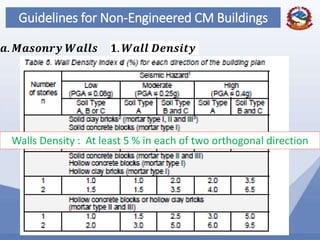
Guidelines for Non-Engineered CM Buildings
𝟏. 𝑾𝒂𝒍𝒍 𝑫𝒆𝒏𝒔𝒊𝒕𝒚𝒂. 𝑴𝒂𝒔𝒐𝒏𝒓𝒚 𝑾𝒂𝒍𝒍𝒔
Walls Density : At least 5 % in each of two orthogonal direction
59
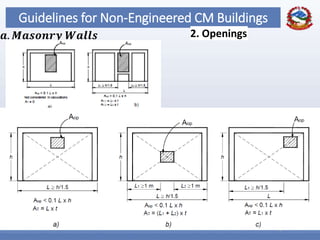
Guidelines for Non-Engineered CM Buildings
2. Openings𝒂. 𝑴𝒂𝒔𝒐𝒏𝒓𝒚 𝑾𝒂𝒍𝒍𝒔
60
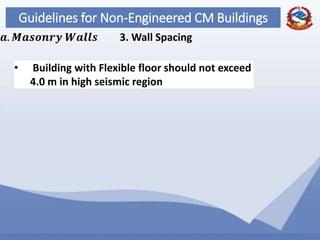
Guidelines for Non-Engineered CM Buildings
3. Wall Spacing𝒂. 𝑴𝒂𝒔𝒐𝒏𝒓𝒚 𝑾𝒂𝒍𝒍𝒔
• Building with Flexible floor should not exceed
4.0 m in high seismic region
61
Guidelines for Non-Engineered CM Buildings
4. Wall Dimensions and H/t ratios Restrictions
𝒂. 𝑴𝒂𝒔𝒐𝒏𝒓𝒚 𝑾𝒂𝒍𝒍𝒔
• Minimum wall thickness 110 mm
• H/t : less than 25, for one or two storey
• H/L : Should not less be than 0.5
• Maximum wall height : 3 m
62
Guidelines for Non-Engineered CM Buildings
5. Parapets and Gable Walls
𝒂. 𝑴𝒂𝒔𝒐𝒏𝒓𝒚 𝑾𝒂𝒍𝒍𝒔
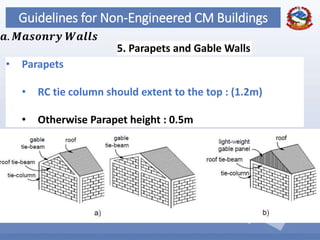
• Parapets
• RC tie column should extent to the top : (1.2m)
• Otherwise Parapet height : 0.5m
63
Guidelines for Non-Engineered CM Buildings
6. Toothing at the Wall – to – tie-column interface
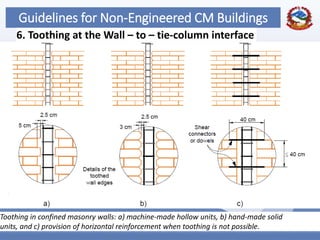
Toothing in confined masonry walls: a) machine-made hollow units, b) hand-made solid
units, and c) provision of horizontal reinforcement when toothing is not possible.
64
Guidelines for Non-Engineered CM Buildings
6. Toothing at the Wall – to – tie-column interface
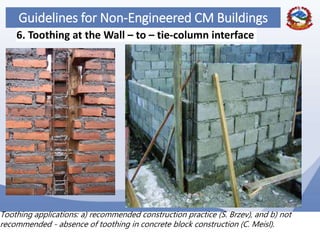
Toothing applications: a) recommended construction practice (S. Brzev), and b) not
recommended - absence of toothing in concrete block construction (C. Meisl).
65
Guidelines for Non-Engineered CM Buildings
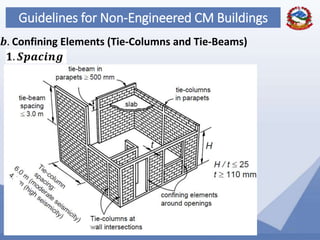
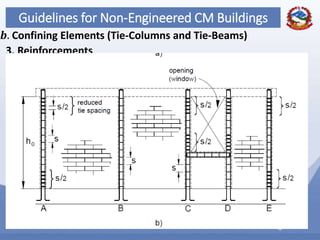
𝟏. 𝑺𝒑𝒂𝒄𝒊𝒏𝒈
𝒃. Confining Elements (Tie-Columns and Tie-Beams)
66
Guidelines for Non-Engineered CM Buildings
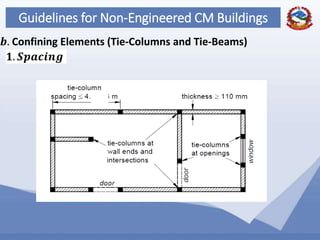
𝟏. 𝑺𝒑𝒂𝒄𝒊𝒏𝒈
𝒃. Confining Elements (Tie-Columns and Tie-Beams)
67
Guidelines for Non-Engineered CM Buildings
2. Minimum Dimensions
𝒃. Confining Elements (Tie-Columns and Tie-Beams)
• Tie – column size : (Depth x Width) : 150 mm x t
• Tie-beam Size : same as tie-column size or tx150 mm
68
Guidelines for Non-Engineered CM Buildings
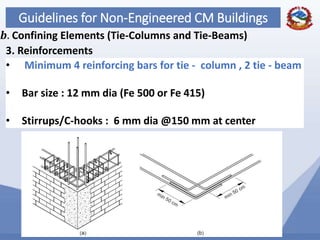
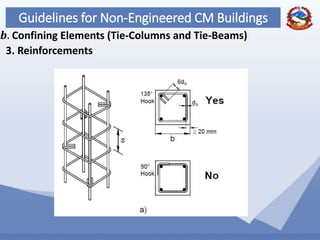
3. Reinforcements
𝒃. Confining Elements (Tie-Columns and Tie-Beams)
• Minimum 4 reinforcing bars for tie - column , 2 tie - beam
• Bar size : 12 mm dia (Fe 500 or Fe 415)
• Stirrups/C-hooks : 6 mm dia @150 mm at center
69
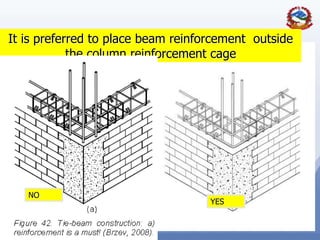
It is preferred to place beam reinforcement outside
the column reinforcement cage
YES
NO
70
Guidelines for Non-Engineered CM Buildings
3. Reinforcements
𝒃. Confining Elements (Tie-Columns and Tie-Beams)
71
Guidelines for Non-Engineered CM Buildings
3. Reinforcements
𝒃. Confining Elements (Tie-Columns and Tie-Beams)
72
Guidelines for Non-Engineered CM Buildings
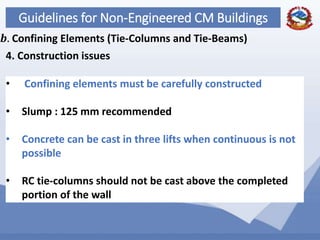
4. Construction issues
𝒃. Confining Elements (Tie-Columns and Tie-Beams)
• Confining elements must be carefully constructed
• Slump : 125 mm recommended
• Concrete can be cast in three lifts when continuous is not
possible
• RC tie-columns should not be cast above the completed
portion of the wall
73
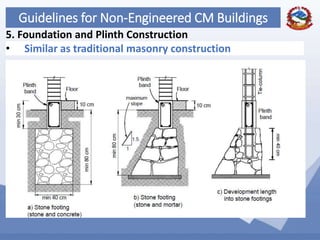
Guidelines for Non-Engineered CM Buildings
5. Foundation and Plinth Construction
• Similar as traditional masonry construction
74
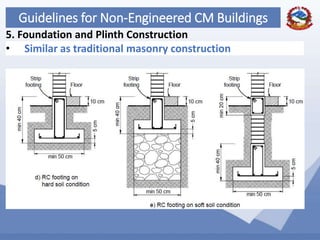
Guidelines for Non-Engineered CM Buildings
5. Foundation and Plinth Construction
• Similar as traditional masonry construction
75
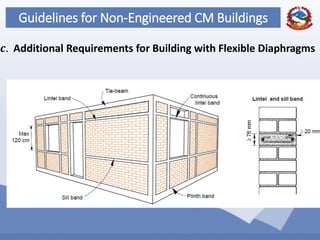
Guidelines for Non-Engineered CM Buildings
𝒄. Additional Requirements for Building with Flexible Diaphragms
76
Guidelines for Non-Engineered CM Buildings
𝒅. 𝑪𝒐𝒏𝒔𝒕𝒓𝒖𝒄𝒕𝒊𝒐𝒏 𝑸𝒖𝒂𝒍𝒊𝒕𝒚
• Construction quality has a significant bearing in seismic
performance of CM building
• Properly designed and built CM buildings performed well
in past earthquakes in most cases
• Poorly built ones experienced damage
77
An Example Illustrating Wall Density Calculation
78
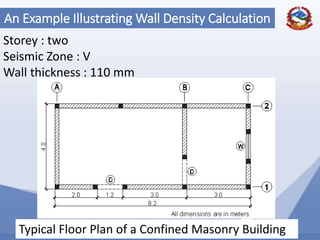
An Example Illustrating Wall Density Calculation
Storey : two
Seismic Zone : V
Wall thickness : 110 mm
Typical Floor Plan of a Confined Masonry Building
79
An Example Illustrating Wall Density Calculation
1. Floor area per floor = 4*9.2 = 36.8 m^2
Total floor area for 2 floors
TOTAL FLOOR AREA = 2*36.8 = 73.6 m^2
2. Wall density in the longitudinal direction
Wall area ( walls 1 & 2 only) :
Wall Area = [9.2+(9.2-1.2)]*(0.11) = 1.9 m^2
𝑾𝒂𝒍𝒍 𝑫𝒆𝒏𝒔𝒊𝒕𝒚 =
𝑾𝒂𝒍𝒍 𝑨𝒓𝒆𝒂
𝑻𝒐𝒕𝒂𝒍 𝑭𝒍𝒐𝒐𝒓 𝑨𝒓𝒆𝒂
=
𝟏. 𝟗
𝟕𝟑. 𝟔
= 𝟎. 𝟎𝟐𝟔 = 2.6 %
80
An Example Illustrating Wall Density Calculation
3. Wall density in the Transverse direction
Wall area ( walls A, B & C) :
Wall Area=[4.0+(4.0-1.2)+4.0-1.2]*(0.11) = 1.1 m^2
𝑾𝒂𝒍𝒍 𝑫𝒆𝒏𝒔𝒊𝒕𝒚 =
𝑾𝒂𝒍𝒍 𝑨𝒓𝒆𝒂
𝑻𝒐𝒕𝒂𝒍 𝑭𝒍𝒐𝒐𝒓 𝑨𝒓𝒆𝒂
=
𝟏. 𝟏
𝟕𝟑. 𝟔
= 𝟎. 𝟎𝟏𝟓 = 1.50 %
81
THANK YOU

Confined masonry overview

  • 1.
    1 Training on Retrofitting Techniquesand Correction/exceptional Manual 29 May - 01 , June 2017, Kathmandu , Nepal CONFINED MASONRY (CM) Kuber Bogati Structural Engineer
  • 2.
    2 Objectives As a resultof this session, you should be able to: • Understand about Confined Masonry Building : Key Concepts • Know why Confined Masonry in Nepal • Compare Reinforced Masonry and Confined Masonry • Compare RC Frame with URM Infill Vs. CM, • Know Seismic Performance of CM Buildings • Understand How CM Resists Earthquake Effects • Damages in Confined Masonry in Past Earthquakes • Know General Planning and Design Aspects • Know Guidelines for Non-engineered CM Buildings • Introduce with Minimum Requirement & Inspection Form of CM
  • 3.
    3 What is ConfinedMasonry (CM) Construction • CM construction consists of masonry walls and horizontal and vertical RC confining members built on all four sides of a masonry wall panel. • Masonry walls : made either of clay brick or concrete block units • Confining Elements : • Vertical ties : (Tie-columns or Practical columns) • Horizontal ties : (Tie-beams) Key Components of a Confined Masonry (CM) Building
  • 4.
    4 What is ConfinedMasonry (CM) Construction • CM construction consists of masonry walls and horizontal and vertical RC confining members built on all four sides of a masonry wall panel. • Masonry walls : made either of clay brick or concrete block units • Confining Elements : • Vertical ties : (Tie-columns or Practical columns) • Horizontal ties : (Tie-beams) Key Components of a Confined Masonry (CM) Building
  • 5.
    5 What is ConfinedMasonry (CM) Construction CONFINED MASONRY
  • 6.
  • 7.
    7 What is ConfinedMasonry (CM) Construction CONFINED MASONRY
  • 8.
    8 Structural Components ofa Confined Masonry (CM) Building • Confining Elements : Provide restraint to masonry walls and protect them from complete disintegration even in major EQs. • Confining members are effective in • Enhancing the stability and integrity of masonry walls for IP & OOP EQ Loads • Enhancing the strength (resistance) of masonry walls under EQ loads • Reducing the brittleness of masonry walls under EQ loads • Masonry walls : Transmit the gravity load from the slab(s) above down to the foundation. The walls act as bracing panels, which resist horizontal EQ. forces. Must be confined by concrete ties • Floor and Roof Slabs : acts as diaphragms, transmit gravity and lateral loads to the walls • Plinth Band : Transmits the load from the walls down to the foundation. • Foundation : Transmits the loads from the structure to the soils
  • 9.
    9 Construction Masonry (CM)– Global Context • Evolved through informal process based on performance in earthquake • Practiced in central and south American countries since as early as 1930’s and 40’s • Currently practiced in several countries of high seismic risks- Latin, America, Mediterranean Europe, Iran, Indonesia, China and in India (late comer) • CM if Properly built, shows satisfactory performance in severe earthquakes in the past • 1985 Mexico earthquake (M8.0) • 2001 La paz earthquake (elsalvador) (M7.7) • 2004 Sumtra earthquake (Indonesia) (M9.0) • 2007 Pisco earthquake (Peru) (M8.0) • 2010 Chile earthquake (M8.8) and others • Confined masonry network established in 2008 under WHE with two objectives • To improve design and construction of CM where is currently in use • To introduce CM in areas where it can reduce seismic risks
  • 10.
    10 World Wide Practices 1.Chile 2. Colombia 3. Mexico 4. Peru 5. Argentina 6. Eurocode 7. Algeria 8. China 9. Iran 10.Indonesia 11.India
  • 11.
    11 Confined Masonry inNepal - Context • Construction of reinforced concrete frame and masonry wall is trending in cities and towns • Heavy damage observed in those construction in the last earthquake even in low PGA and spectral acceleration • Non-ductile RC frame construction • Unreinforced masonry walls vulnerable to lateral loading • The presence of wall is in RC construction is not utilized as well as the consequence of irregularity is overlooked  Confined masonry construction provides opportunity for improved performance in earthquake utilizing constriction from both RC and masonry components [technologies which require similar (preferably lower) level of construction skills and are economically viable]  Its simple in design and analogues to conventional construction of RC frame with walls (EXTENSIVE ENGINEERING INPUT NOT REQUIRED)
  • 12.
    Reinforced Masonry vs.Confined Masonry • Reinf. Enhance strength, Stability • Corners, T-junction, additional Location
  • 13.
  • 14.
    14 RC frame withURM infill vs. Confined Masonry
  • 15.
    15 RC frame withURM infill vs. Confined Masonry  Integrity of wall and frame  Construction sequence Frame first, Wall later Wall first, Column/Beams later Source : Tom Schacher
  • 16.
    17 Seismic Performance ofCM Confined masonry construction is found in countries/regions with very high seismic risk, • Latin America (Mexico, Chile, Peru, Argentina), • Mediterranean Europe (Italy, Slovenia), • South Asia (Indonesia), and the Far East (China). • In some countries (e.g. Italy) for almost 100 years • If properly built, shows satisfactory seismic performance EXTENSIVE ENGINEERING INPUT NOT REQUIRED!
  • 17.
    18 Seismic Performance ofCM Oaxaca quake, September 1999 Tecomán earthquake, January 2003
  • 18.
    19 Seismic Performance ofCM Confined masonry construction has been exposed to several destructive earthquakes: • 1985 Lloleo, Chile (magnitude 7.8) • 1985 Mexico City, Mexico (magnitude 8.0) • 2001 El Salvador (magnitude 7.7) • 2003 Tecoman, Mexico (magnitude 7.6) • 2007 Pisco, Peru (magnitude 8.0) • 2003 Bam, Iran (magnitude 6.6) • 2004 The Great Sumatra Earthquake and Tsunami, Indonesia (magnitude 9.0) • 2007 Pisco, Peru (magnitude 8.0) • 2010 Maule, Chile earthquake (magnitude 8.8) • 2010 Haiti earthquake (magnitude 7.0) Confined masonry buildings performed very well in these major earthquakes – some buildings were damaged, but no human losses
  • 19.
    20 Seismic Performance ofCM A six-storey confined masonry building remained undamaged in the August 2007 Pisco, Peru earthquake (Magnitude 8.0) while many other masonry buildings experienced severe damage or collapse Confined Masonry Performed Very Well in Past Earthquakes
  • 20.
    21 How Confined MasonryBuildings Resist Earthquake Effects
  • 21.
    22 How Confined MasonryBuildings Resist Earthquake Effects  Toothing : Monolithic action  Horizontal Reinforcement
  • 22.
    23 How Confined MasonryBuildings Resist Earthquake Effects Mechanism of shear resistance for a confined masonry wall panel
  • 23.
    24 How Confined MasonryBuildings Resist Earthquake Effects Confined Masonry Building : Vertical Truss Model (left) and Collapse at the Ground Floor Level (right)  Masonry : Diagonal Struts  RC : Tension/compression  Cracking at G.F. (soft story) : horizontal reinforcement
  • 24.
    25 How Confined MasonryBuildings Resist Earthquake Effects Figure 8. Critical regions in a confined masonry building: a) a general diagram showing critical regions in the RC tie-columns  Masonry : Diagonal Struts  RC : Tension/compression  Cracking at G.F. (soft story) : horizontal reinforcement
  • 25.
    27 How Confined MasonryBuildings Resist Earthquake Effects… Failure modes characteristic of CM Walls : • Shear Failure Mode (due to IP Seismic Loads) • Flexural Failure Mode (due to OOP Loads)
  • 26.
    29 How Confined MasonryBuildings Resist Earthquake Effects… Shear Failure Mode (due to IP Seismic Loads) Flexural Failure Mode (due to OOP Loads)
  • 27.
    30 Key Factors InfluencingSeismic Resistance of CM Structures • Wall Density : Strength • Masonry Units and Mortar : (Stronger) • Tie -Columns : (Ductility & Stability) • Horizontal Wall Reinforcement • Openings : 10% , Load path,
  • 28.
    33 Key Factors InfluencingSeismic Resistance of CM Structures… Horizontal Wall Reinforcement Failure modes in the confined masonry walls with openings The walls with larger openings develop diagonal cracks
  • 29.
    34 Damages in ConfinedMasonry in Past Earthquakes
  • 30.
    35 Damage Observation: Topics 1.Masonrydamage (in-and out-of-plane) 2.RC tie-columns 3.Tie-beam-to-tie-column joints 4.Confining elements around openings
  • 31.
    36 In-plane shear failureof masonry walls at the base level - hollow clay blocks (Cauquenes)
  • 32.
    37 In-plane shear failureof masonry walls at the base level - hollow clay blocks (Cauquenes)
  • 33.
    38 Out-of-Plane Wall Damage Damageat the 2nd floor level • An example of out-of-plane damage observed in a three-storey building • The damage concentrated at the upper floor levels • The building had concrete floors and timber truss roof • The same building suffered severe in-plane damage
  • 34.
  • 35.
    40 Buckling of aTie-Column due to the Toe Crushing
  • 36.
    41 Shear Failure ofRC Tie-Columns
  • 37.
    42 Inadequate Anchorage ofTie-Beam Reinforcement
  • 38.
    43 Deficiencies in Tie-Beam– to - Tie – Column Joint Reinforcement Detailing
  • 39.
    44 Absence of ConfiningElements at the Openings
  • 40.
    45 In-Plane Shear Cracking– the Effect of Confinement Unconfined openings Confined openings
  • 41.
    46 Key Causes ofDamage in CM 1.Inadequate wall density 2.Poor quality of masonry materials and construction 3.Inadequate detailing of reinforcement in confining elements 4.Absence of confining elements at openings 5.Geotechnical issues
  • 42.
    47 General Planning andDesign Aspects • Architectural Guideline • Construction Guideline
  • 43.
    48 Architectural Guideline 1. PlanShape : Rectangular NO YES IRREGULAR SYMMENTRICAL
  • 44.
    49 Architectural Guideline 2. PlanShape : Length-to-width ratio less than 4 times NO YES POORLY PROPORTIONED PLAN WELL PROPORTIONED PLAN
  • 45.
    50 Architectural Guideline 3. Wallsshould be in a symmetrical NO YES INADEQUATE PLAN : LAYOUT ADEQUATE SHAPE
  • 46.
    51 Architectural Guideline 4. Wallsshould be continuous up the building height NO YES LOAD PATH NOT CLEAR LOAD PATH CLEAR
  • 47.
    52 Architectural Guideline 5. Opening: same position up the building height #Vertical ties : At both sides ( if opening <1.5 Sq.m.) (To produce diagonal Strut Action) NO YES POOR LOCATION OF WINDOW AND DOOR OPENING GOOD LOCATION OF WINDOW AND DOOR OPENING
  • 48.
    53 Architectural Guideline 6. ConfiningElements : Tie-beams at 3m vertical spacing : Tie-columns at 4m : Wall to wall intersection : Free end of a wall
  • 49.
    54 Architectural Guideline 7. Walls: At least three fully confined walls should be provided in each direction Inadequate Wall Distribution Adequate Wall Distribution NO YES
  • 50.
    55 Architectural Guideline 8. WallsDensity : At least 5 % in each of two orthogonal direction 𝑾𝒂𝒍𝒍 𝑫𝒆𝒏𝒔𝒊𝒕𝒚 = 𝑻𝒐𝒕𝒂𝒍 𝑿 − 𝒔𝒆𝒄𝒕𝒊𝒐𝒏𝒂𝒍 𝑨𝒓𝒆𝒂 𝒐𝒇 𝒂𝒍𝒍 𝒘𝒂𝒍𝒍𝒔 𝒊𝒏 𝒐𝒏𝒆 𝒅𝒊𝒓𝒆𝒄𝒕𝒊𝒐𝒏 𝑺𝒖𝒎 𝒐𝒇 𝑭𝒍𝒐𝒐𝒓 𝒑𝒍𝒂𝒏 𝒂𝒓𝒆𝒂 𝒇𝒐𝒓 𝒂𝒍𝒍 𝒇𝒍𝒐𝒐𝒓𝒔 𝒊𝒏 𝒂 𝒃𝒖𝒊𝒍𝒅𝒊𝒏𝒈 Eurocode 8 (1996) a)At least 2% for a site with a design ground accln up to 0.2g (corresponding to seismic zone II of India b) At least 4% for a site with a design ground accln up to 0.3g (corresponding to seismic zone III of India c) At least 5% for a site with a design ground accln up to 0.4g (corresponding to seismic zone IV of India
  • 51.
    56 Architectural Guideline 9. BuildingHeight : Low-to medium-rise (Eurocode 8, 1996) Eurocode 8 (1996) a)Up to 4-story high for a site with a design ground accln up to 0.2g (corresponding to seismic zone II of India b) Up to 3-story high for a site with a design ground accln up to 0.3g (corresponding to seismic zone III of India c) Up to 2-story high for a site with a design ground accln up to 0.4g (corresponding to seismic zone IV of India
  • 52.
    57 Guidelines for Non-EngineeredCM Buildings 𝑺𝒕𝒐𝒓𝒆𝒚 ∶ 𝑶𝒏𝒆 𝒐𝒓 𝑻𝒘𝒐
  • 53.
    58 Guidelines for Non-EngineeredCM Buildings 𝟏. 𝑾𝒂𝒍𝒍 𝑫𝒆𝒏𝒔𝒊𝒕𝒚𝒂. 𝑴𝒂𝒔𝒐𝒏𝒓𝒚 𝑾𝒂𝒍𝒍𝒔 Walls Density : At least 5 % in each of two orthogonal direction
  • 54.
    59 Guidelines for Non-EngineeredCM Buildings 2. Openings𝒂. 𝑴𝒂𝒔𝒐𝒏𝒓𝒚 𝑾𝒂𝒍𝒍𝒔
  • 55.
    60 Guidelines for Non-EngineeredCM Buildings 3. Wall Spacing𝒂. 𝑴𝒂𝒔𝒐𝒏𝒓𝒚 𝑾𝒂𝒍𝒍𝒔 • Building with Flexible floor should not exceed 4.0 m in high seismic region
  • 56.
    61 Guidelines for Non-EngineeredCM Buildings 4. Wall Dimensions and H/t ratios Restrictions 𝒂. 𝑴𝒂𝒔𝒐𝒏𝒓𝒚 𝑾𝒂𝒍𝒍𝒔 • Minimum wall thickness 110 mm • H/t : less than 25, for one or two storey • H/L : Should not less be than 0.5 • Maximum wall height : 3 m
  • 57.
    62 Guidelines for Non-EngineeredCM Buildings 5. Parapets and Gable Walls 𝒂. 𝑴𝒂𝒔𝒐𝒏𝒓𝒚 𝑾𝒂𝒍𝒍𝒔 • Parapets • RC tie column should extent to the top : (1.2m) • Otherwise Parapet height : 0.5m
  • 58.
    63 Guidelines for Non-EngineeredCM Buildings 6. Toothing at the Wall – to – tie-column interface Toothing in confined masonry walls: a) machine-made hollow units, b) hand-made solid units, and c) provision of horizontal reinforcement when toothing is not possible.
  • 59.
    64 Guidelines for Non-EngineeredCM Buildings 6. Toothing at the Wall – to – tie-column interface Toothing applications: a) recommended construction practice (S. Brzev), and b) not recommended - absence of toothing in concrete block construction (C. Meisl).
  • 60.
    65 Guidelines for Non-EngineeredCM Buildings 𝟏. 𝑺𝒑𝒂𝒄𝒊𝒏𝒈 𝒃. Confining Elements (Tie-Columns and Tie-Beams)
  • 61.
    66 Guidelines for Non-EngineeredCM Buildings 𝟏. 𝑺𝒑𝒂𝒄𝒊𝒏𝒈 𝒃. Confining Elements (Tie-Columns and Tie-Beams)
  • 62.
    67 Guidelines for Non-EngineeredCM Buildings 2. Minimum Dimensions 𝒃. Confining Elements (Tie-Columns and Tie-Beams) • Tie – column size : (Depth x Width) : 150 mm x t • Tie-beam Size : same as tie-column size or tx150 mm
  • 63.
    68 Guidelines for Non-EngineeredCM Buildings 3. Reinforcements 𝒃. Confining Elements (Tie-Columns and Tie-Beams) • Minimum 4 reinforcing bars for tie - column , 2 tie - beam • Bar size : 12 mm dia (Fe 500 or Fe 415) • Stirrups/C-hooks : 6 mm dia @150 mm at center
  • 64.
    69 It is preferredto place beam reinforcement outside the column reinforcement cage YES NO
  • 65.
    70 Guidelines for Non-EngineeredCM Buildings 3. Reinforcements 𝒃. Confining Elements (Tie-Columns and Tie-Beams)
  • 66.
    71 Guidelines for Non-EngineeredCM Buildings 3. Reinforcements 𝒃. Confining Elements (Tie-Columns and Tie-Beams)
  • 67.
    72 Guidelines for Non-EngineeredCM Buildings 4. Construction issues 𝒃. Confining Elements (Tie-Columns and Tie-Beams) • Confining elements must be carefully constructed • Slump : 125 mm recommended • Concrete can be cast in three lifts when continuous is not possible • RC tie-columns should not be cast above the completed portion of the wall
  • 68.
    73 Guidelines for Non-EngineeredCM Buildings 5. Foundation and Plinth Construction • Similar as traditional masonry construction
  • 69.
    74 Guidelines for Non-EngineeredCM Buildings 5. Foundation and Plinth Construction • Similar as traditional masonry construction
  • 70.
    75 Guidelines for Non-EngineeredCM Buildings 𝒄. Additional Requirements for Building with Flexible Diaphragms
  • 71.
    76 Guidelines for Non-EngineeredCM Buildings 𝒅. 𝑪𝒐𝒏𝒔𝒕𝒓𝒖𝒄𝒕𝒊𝒐𝒏 𝑸𝒖𝒂𝒍𝒊𝒕𝒚 • Construction quality has a significant bearing in seismic performance of CM building • Properly designed and built CM buildings performed well in past earthquakes in most cases • Poorly built ones experienced damage
  • 72.
    77 An Example IllustratingWall Density Calculation
  • 73.
    78 An Example IllustratingWall Density Calculation Storey : two Seismic Zone : V Wall thickness : 110 mm Typical Floor Plan of a Confined Masonry Building
  • 74.
    79 An Example IllustratingWall Density Calculation 1. Floor area per floor = 4*9.2 = 36.8 m^2 Total floor area for 2 floors TOTAL FLOOR AREA = 2*36.8 = 73.6 m^2 2. Wall density in the longitudinal direction Wall area ( walls 1 & 2 only) : Wall Area = [9.2+(9.2-1.2)]*(0.11) = 1.9 m^2 𝑾𝒂𝒍𝒍 𝑫𝒆𝒏𝒔𝒊𝒕𝒚 = 𝑾𝒂𝒍𝒍 𝑨𝒓𝒆𝒂 𝑻𝒐𝒕𝒂𝒍 𝑭𝒍𝒐𝒐𝒓 𝑨𝒓𝒆𝒂 = 𝟏. 𝟗 𝟕𝟑. 𝟔 = 𝟎. 𝟎𝟐𝟔 = 2.6 %
  • 75.
    80 An Example IllustratingWall Density Calculation 3. Wall density in the Transverse direction Wall area ( walls A, B & C) : Wall Area=[4.0+(4.0-1.2)+4.0-1.2]*(0.11) = 1.1 m^2 𝑾𝒂𝒍𝒍 𝑫𝒆𝒏𝒔𝒊𝒕𝒚 = 𝑾𝒂𝒍𝒍 𝑨𝒓𝒆𝒂 𝑻𝒐𝒕𝒂𝒍 𝑭𝒍𝒐𝒐𝒓 𝑨𝒓𝒆𝒂 = 𝟏. 𝟏 𝟕𝟑. 𝟔 = 𝟎. 𝟎𝟏𝟓 = 1.50 %
  • 76.