Jean-Marc Lepain
Construction of Expenditure Ceilings
Outline of the Presentation
I. Medium Term Expenditure Ceilings: Purpose and
Concepts
II. Methodology and Design
I. Methodology for fund allocation
II. General design and time horizon
III. Medium Term Expenditure Ceilings: Issues
I. Scope and comprehensiveness
II. Inflation Adjustments
III. Managing Uncertainty
IV. Conclusions 2
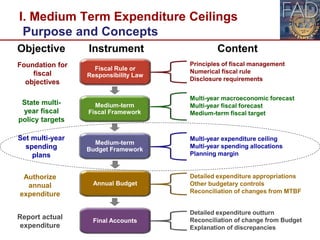
I. Medium Term Expenditure
Ceilings: Purpose and Concepts
Medium-term
Fiscal Framework
Principles of fiscal management
Numerical fiscal rule
Disclosure requirements
Multi-year macroeconomic forecast
Multi-year fiscal forecast
Medium-term fiscal target
Multi-year expenditure ceiling
Multi-year spending allocations
Planning margin
Detailed expenditure outturn
Reconciliation of change from Budget
Explanation of discrepancies
Instrument Content
Medium-term
Budget Framework
Final Accounts
Objective
Foundation for
fiscal
objectives
State multi-
year fiscal
policy targets
Set multi-year
spending
plans
Report actual
expenditure
Detailed expenditure appropriations
Other budgetary controls
Reconciliation of changes from MTBF
Fiscal Rule or
Responsibility Law
Annual Budget
Authorize
annual
expenditure
I. Medium Term Expenditure Ceilings
Purpose and Concepts
I. Medium Term Expenditure Ceilings:
Purpose and Concepts
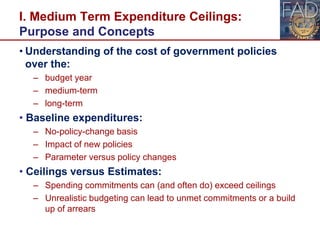
• Understanding of the cost of government policies
over the:
– budget year
– medium-term
– long-term
• Baseline expenditures:
– No-policy-change basis
– Impact of new policies
– Parameter versus policy changes
• Ceilings versus Estimates:
– Spending commitments can (and often do) exceed ceilings
– Unrealistic budgeting can lead to unmet commitments or a build
up of arrears
5
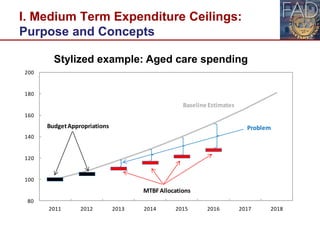
I. Medium Term Expenditure Ceilings:
Purpose and Concepts
6
80
100
120
140
160
180
200
2011 2012 2013 2014 2015 2016 2017 2018
Baseline Estimates
BudgetAppropriations
MTBFAllocations
Problem
Stylized example: Aged care spending
I. Medium Term Expenditure Ceilings:
Purpose and Concepts
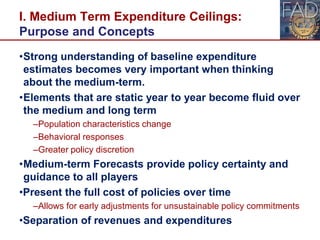
•Strong understanding of baseline expenditure
estimates becomes very important when thinking
about the medium-term.
•Elements that are static year to year become fluid over
the medium and long term
–Population characteristics change
–Behavioral responses
–Greater policy discretion
•Medium-term Forecasts provide policy certainty and
guidance to all players
•Present the full cost of policies over time
–Allows for early adjustments for unsustainable policy commitments
•Separation of revenues and expenditures
7
II. Methodology and Design
Why to move to expenditure ceilings
• To ensure that budget request are realistic and fit a
fiscal envelope;
• To allocate additional fiscal space based on strategic
priorities;
• To ensure that the budget is fully aligned with fiscal
objectives;
• To shift the responsibility of detailed allocations to
MDAs.
9
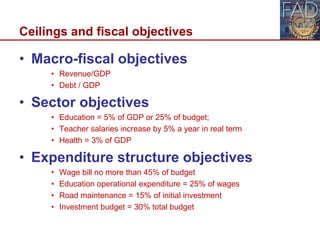
Ceilings and fiscal objectives
• Macro-fiscal objectives
• Revenue/GDP
• Debt / GDP
• Sector objectives
• Education = 5% of GDP or 25% of budget;
• Teacher salaries increase by 5% a year in real term
• Health = 3% of GDP
• Expenditure structure objectives
• Wage bill no more than 45% of budget
• Education operational expenditure = 25% of wages
• Road maintenance = 15% of initial investment
• Investment budget = 30% total budget
10
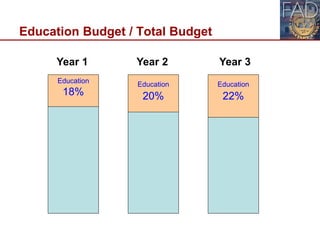
Education Budget / Total Budget
11
Education
18%
Education
22%
Education
20%
Year 1 Year 3Year 2
Budget ceiling and sector objectives
• What does it take to increase the share of education
by 2% a year?
• How should I allocate additional revenue?
• How do I use the fiscal space available?
• What is the role of development partners?
• What is the role of the other fiscal constrains?
12
Issues in Medium Term Expenditure
Ceilings
1. Design: time horizon, aggregation /
desegregation
2. Comprehensiveness
3. Inflation Adjustment
4. Managing uncertainty
13
14
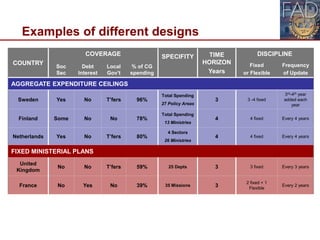
Examples of different designs
COUNTRY
COVERAGE SPECIFITY TIME
HORIZON
Years
DISCIPLINE
Soc
Sec
Debt
Interest
Local
Gov’t
% of CG
spending
Fixed
or Flexible
Frequency
of Update
AGGREGATE EXPENDITURE CEILINGS
Sweden Yes No T’fers 96%
Total Spending
27 Policy Areas
3 3 -4 fixed
3rd-4th year
added each
year
Finland Some No No 78%
Total Spending
13 Ministries
4 4 fixed Every 4 years
Netherlands Yes No T’fers 80%
4 Sectors
26 Ministries
4 4 fixed Every 4 years
FIXED MINISTERIAL PLANS
United
Kingdom
No No T’fers 59% 25 Depts 3 3 fixed Every 3 years
France No Yes No 39% 35 Missions 3
2 fixed + 1
Flexible
Every 2 years
Design issues
• How much of my budget do I allocate
by ceiling?
• Do I include intergovernmental
transfers?
• How do I deal with special purpose
funds ?
• How do I deal with entitlement?
15
II. Medium Term Expenditure Ceilings: Issues
Time horizon
• Fixed-term/multiyear ceiling:
– Depends (partly) on political set-up of the
government
– Can this government restrict the next
government’s spending decisions?
– Political commitment is the key
16
III. Medium Term Expenditure
Ceilings: Issues
II. Medium Term Expenditure Ceilings:
Comprehensiveness
• Special issues when considering
exclusions:
– Items financed by donations or foreign grants
– Cyclically sensitive expenditures – balance
between allowing for countercyclical expenditure policies
against long-term fiscal sustainability.
– Interest payments
Aggregation vs. Disaggregation
• Aggregate ceilings is what textbooks recommend.
• Benefit of aggregation: managerial flexibility
• Obstacle to aggregation: laws regulating civil service
employment, procurement law, PFM laws and
regulation
19
II. Medium Term Expenditure Ceilings:
Comprehensiveness
• Which items to be restricted by the
expenditure ceiling?
– Completeness, with clearly motivated and
unambiguously defined exceptions; but high
number of exceptions makes monitoring
complex
– Simplicity and transparency important
20
II. Medium Term Expenditure Ceilings:
Inflation Adjustments
• Ceilings can be expressed in nominal or real terms
• Issues to be considered:
– Real:
• flexible: changes in expenditure items caused by price changes do not require other
expenditure items to be cut for the spending limits to be upheld. On the other hand, if
prices fall, this does not create a surplus usable for increasing other expenditure.
• But poorer transparency in comparison with the nominal spending limits; difficult for
external parties to monitor whether the spending limits are being adhered to
• Lead more easily to a pro-cyclical fiscal policy, since when inflation is boosted by
economic growth, expenditure increases in nominal terms, and vice versa
– Nominal:
• Unambiguous and transparent: no cost adjustments need to be made during the
spending limits period
• Have a counter-cyclical effect in that if inflation were to increase beyond that which was
predicted, expenditure would automatically be restricted during the spending limits
period (and vice versa)
• On the other hand nominal limits allow the increasing of expenditure if inflation is lower
than predicted. This could lead to a permanently higher level of expenditure. Higher
inflation than predicted can lead to expenditure reductions or cost-cutting which could
be difficult to accept and might lead to the exceeding the spending limits 21
II. Medium Term Expenditure Ceilings: Issues
Managing Uncertainty
• Integrity of the framework requires that overall
commitments are not revised
• Uncertainty grows with the time-horizon
• New policy initiatives are part of the political reality
• Margins are needed
– Contingency margins
– Planning margins
• Avoid practices such as substituting expenditure for
tax expenditure, net budgeting and accounting, and
deferral of payments from one fiscal year to the next
22
II. Medium Term Expenditure Ceilings: Issues
Managing Uncertainty
• How much and what type of flexibility? Depends on the
construction of the ceiling:
– A comprehensive ceiling needs some mechanisms for
dealing with an unfavorable developments
– Nominal ceilings require more flexibility than real ceilings
in order to absorb unforeseen increases in inflation.
– The uncertainty in forecasts increases with the time
horizon,
– The further in advance the expenditure ceiling is
established, the larger the expected variations in
expenditure that must be accommodated.
• Uncertainty in medium-term expenditure development
requires that planned expenditure generally be set at a
lower level than the expenditure ceiling to ensure that the
outcome complies with the ceiling 23
II. Medium Term Expenditure Ceilings: Issues
Numerical Definition
24
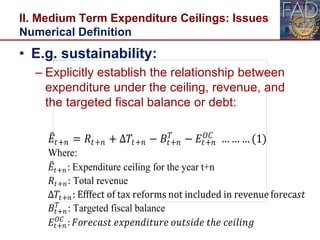
• E.g. sustainability:
– Explicitly establish the relationship between
expenditure under the ceiling, revenue, and
the targeted fiscal balance or debt:
𝐸𝑡+𝑛 = 𝑅𝑡+𝑛 + ∆𝑇𝑡+𝑛 − 𝐵𝑡+𝑛
𝑇
− 𝐸𝑡+𝑛
𝑂𝐶
… … … (1)
Where:
𝐸𝑡+𝑛: Expenditure ceiling for the year t+n
𝑅𝑡+𝑛: Total revenue
∆𝑇𝑡+𝑛: Efffect of tax reforms not included in revenue foreca𝑠𝑡
𝐵𝑡+𝑛
𝑇
: Targeted fiscal balance
𝐸𝑡+𝑛
𝑂𝐶
: 𝐹𝑜𝑟𝑒𝑐𝑎𝑠𝑡 𝑒𝑥𝑝𝑒𝑛𝑑𝑖𝑡𝑢𝑟𝑒 𝑜𝑢𝑡𝑠𝑖𝑑𝑒 𝑡ℎ𝑒 𝑐𝑒𝑖𝑙𝑖𝑛𝑔
II. Medium Term Expenditure Ceilings: Issues
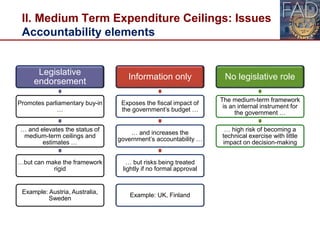
Accountability elements
Legislative
endorsement
Promotes parliamentary buy-in
…
… and elevates the status of
medium-term ceilings and
estimates …
…but can make the framework
rigid
Example: Austria, Australia,
Sweden
Information only
Exposes the fiscal impact of
the government’s budget …
… and increases the
government’s accountability …
… but risks being treated
lightly if no formal approval
Example: UK, Finland
No legislative role
The medium-term framework
is an internal instrument for
the government …
… high risk of becoming a
technical exercise with little
impact on decision-making
25
VI. Conclusions
26
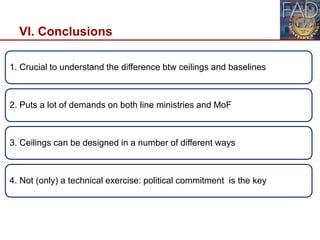
1. Crucial to understand the difference btw ceilings and baselines
2. Puts a lot of demands on both line ministries and MoF
3. Ceilings can be designed in a number of different ways
4. Not (only) a technical exercise: political commitment is the key

Construction of expenditure ceilings

  • 1.
  • 2.
    Outline of thePresentation I. Medium Term Expenditure Ceilings: Purpose and Concepts II. Methodology and Design I. Methodology for fund allocation II. General design and time horizon III. Medium Term Expenditure Ceilings: Issues I. Scope and comprehensiveness II. Inflation Adjustments III. Managing Uncertainty IV. Conclusions 2
  • 3.
    I. Medium TermExpenditure Ceilings: Purpose and Concepts
  • 4.
    Medium-term Fiscal Framework Principles offiscal management Numerical fiscal rule Disclosure requirements Multi-year macroeconomic forecast Multi-year fiscal forecast Medium-term fiscal target Multi-year expenditure ceiling Multi-year spending allocations Planning margin Detailed expenditure outturn Reconciliation of change from Budget Explanation of discrepancies Instrument Content Medium-term Budget Framework Final Accounts Objective Foundation for fiscal objectives State multi- year fiscal policy targets Set multi-year spending plans Report actual expenditure Detailed expenditure appropriations Other budgetary controls Reconciliation of changes from MTBF Fiscal Rule or Responsibility Law Annual Budget Authorize annual expenditure I. Medium Term Expenditure Ceilings Purpose and Concepts
  • 5.
    I. Medium TermExpenditure Ceilings: Purpose and Concepts • Understanding of the cost of government policies over the: – budget year – medium-term – long-term • Baseline expenditures: – No-policy-change basis – Impact of new policies – Parameter versus policy changes • Ceilings versus Estimates: – Spending commitments can (and often do) exceed ceilings – Unrealistic budgeting can lead to unmet commitments or a build up of arrears 5
  • 6.
    I. Medium TermExpenditure Ceilings: Purpose and Concepts 6 80 100 120 140 160 180 200 2011 2012 2013 2014 2015 2016 2017 2018 Baseline Estimates BudgetAppropriations MTBFAllocations Problem Stylized example: Aged care spending
  • 7.
    I. Medium TermExpenditure Ceilings: Purpose and Concepts •Strong understanding of baseline expenditure estimates becomes very important when thinking about the medium-term. •Elements that are static year to year become fluid over the medium and long term –Population characteristics change –Behavioral responses –Greater policy discretion •Medium-term Forecasts provide policy certainty and guidance to all players •Present the full cost of policies over time –Allows for early adjustments for unsustainable policy commitments •Separation of revenues and expenditures 7
  • 8.
  • 9.
    Why to moveto expenditure ceilings • To ensure that budget request are realistic and fit a fiscal envelope; • To allocate additional fiscal space based on strategic priorities; • To ensure that the budget is fully aligned with fiscal objectives; • To shift the responsibility of detailed allocations to MDAs. 9
  • 10.
    Ceilings and fiscalobjectives • Macro-fiscal objectives • Revenue/GDP • Debt / GDP • Sector objectives • Education = 5% of GDP or 25% of budget; • Teacher salaries increase by 5% a year in real term • Health = 3% of GDP • Expenditure structure objectives • Wage bill no more than 45% of budget • Education operational expenditure = 25% of wages • Road maintenance = 15% of initial investment • Investment budget = 30% total budget 10
  • 11.
    Education Budget /Total Budget 11 Education 18% Education 22% Education 20% Year 1 Year 3Year 2
  • 12.
    Budget ceiling andsector objectives • What does it take to increase the share of education by 2% a year? • How should I allocate additional revenue? • How do I use the fiscal space available? • What is the role of development partners? • What is the role of the other fiscal constrains? 12
  • 13.
    Issues in MediumTerm Expenditure Ceilings 1. Design: time horizon, aggregation / desegregation 2. Comprehensiveness 3. Inflation Adjustment 4. Managing uncertainty 13
  • 14.
    14 Examples of differentdesigns COUNTRY COVERAGE SPECIFITY TIME HORIZON Years DISCIPLINE Soc Sec Debt Interest Local Gov’t % of CG spending Fixed or Flexible Frequency of Update AGGREGATE EXPENDITURE CEILINGS Sweden Yes No T’fers 96% Total Spending 27 Policy Areas 3 3 -4 fixed 3rd-4th year added each year Finland Some No No 78% Total Spending 13 Ministries 4 4 fixed Every 4 years Netherlands Yes No T’fers 80% 4 Sectors 26 Ministries 4 4 fixed Every 4 years FIXED MINISTERIAL PLANS United Kingdom No No T’fers 59% 25 Depts 3 3 fixed Every 3 years France No Yes No 39% 35 Missions 3 2 fixed + 1 Flexible Every 2 years
  • 15.
    Design issues • Howmuch of my budget do I allocate by ceiling? • Do I include intergovernmental transfers? • How do I deal with special purpose funds ? • How do I deal with entitlement? 15
  • 16.
    II. Medium TermExpenditure Ceilings: Issues Time horizon • Fixed-term/multiyear ceiling: – Depends (partly) on political set-up of the government – Can this government restrict the next government’s spending decisions? – Political commitment is the key 16
  • 17.
    III. Medium TermExpenditure Ceilings: Issues
  • 18.
    II. Medium TermExpenditure Ceilings: Comprehensiveness • Special issues when considering exclusions: – Items financed by donations or foreign grants – Cyclically sensitive expenditures – balance between allowing for countercyclical expenditure policies against long-term fiscal sustainability. – Interest payments
  • 19.
    Aggregation vs. Disaggregation •Aggregate ceilings is what textbooks recommend. • Benefit of aggregation: managerial flexibility • Obstacle to aggregation: laws regulating civil service employment, procurement law, PFM laws and regulation 19
  • 20.
    II. Medium TermExpenditure Ceilings: Comprehensiveness • Which items to be restricted by the expenditure ceiling? – Completeness, with clearly motivated and unambiguously defined exceptions; but high number of exceptions makes monitoring complex – Simplicity and transparency important 20
  • 21.
    II. Medium TermExpenditure Ceilings: Inflation Adjustments • Ceilings can be expressed in nominal or real terms • Issues to be considered: – Real: • flexible: changes in expenditure items caused by price changes do not require other expenditure items to be cut for the spending limits to be upheld. On the other hand, if prices fall, this does not create a surplus usable for increasing other expenditure. • But poorer transparency in comparison with the nominal spending limits; difficult for external parties to monitor whether the spending limits are being adhered to • Lead more easily to a pro-cyclical fiscal policy, since when inflation is boosted by economic growth, expenditure increases in nominal terms, and vice versa – Nominal: • Unambiguous and transparent: no cost adjustments need to be made during the spending limits period • Have a counter-cyclical effect in that if inflation were to increase beyond that which was predicted, expenditure would automatically be restricted during the spending limits period (and vice versa) • On the other hand nominal limits allow the increasing of expenditure if inflation is lower than predicted. This could lead to a permanently higher level of expenditure. Higher inflation than predicted can lead to expenditure reductions or cost-cutting which could be difficult to accept and might lead to the exceeding the spending limits 21
  • 22.
    II. Medium TermExpenditure Ceilings: Issues Managing Uncertainty • Integrity of the framework requires that overall commitments are not revised • Uncertainty grows with the time-horizon • New policy initiatives are part of the political reality • Margins are needed – Contingency margins – Planning margins • Avoid practices such as substituting expenditure for tax expenditure, net budgeting and accounting, and deferral of payments from one fiscal year to the next 22
  • 23.
    II. Medium TermExpenditure Ceilings: Issues Managing Uncertainty • How much and what type of flexibility? Depends on the construction of the ceiling: – A comprehensive ceiling needs some mechanisms for dealing with an unfavorable developments – Nominal ceilings require more flexibility than real ceilings in order to absorb unforeseen increases in inflation. – The uncertainty in forecasts increases with the time horizon, – The further in advance the expenditure ceiling is established, the larger the expected variations in expenditure that must be accommodated. • Uncertainty in medium-term expenditure development requires that planned expenditure generally be set at a lower level than the expenditure ceiling to ensure that the outcome complies with the ceiling 23
  • 24.
    II. Medium TermExpenditure Ceilings: Issues Numerical Definition 24 • E.g. sustainability: – Explicitly establish the relationship between expenditure under the ceiling, revenue, and the targeted fiscal balance or debt: 𝐸𝑡+𝑛 = 𝑅𝑡+𝑛 + ∆𝑇𝑡+𝑛 − 𝐵𝑡+𝑛 𝑇 − 𝐸𝑡+𝑛 𝑂𝐶 … … … (1) Where: 𝐸𝑡+𝑛: Expenditure ceiling for the year t+n 𝑅𝑡+𝑛: Total revenue ∆𝑇𝑡+𝑛: Efffect of tax reforms not included in revenue foreca𝑠𝑡 𝐵𝑡+𝑛 𝑇 : Targeted fiscal balance 𝐸𝑡+𝑛 𝑂𝐶 : 𝐹𝑜𝑟𝑒𝑐𝑎𝑠𝑡 𝑒𝑥𝑝𝑒𝑛𝑑𝑖𝑡𝑢𝑟𝑒 𝑜𝑢𝑡𝑠𝑖𝑑𝑒 𝑡ℎ𝑒 𝑐𝑒𝑖𝑙𝑖𝑛𝑔
  • 25.
    II. Medium TermExpenditure Ceilings: Issues Accountability elements Legislative endorsement Promotes parliamentary buy-in … … and elevates the status of medium-term ceilings and estimates … …but can make the framework rigid Example: Austria, Australia, Sweden Information only Exposes the fiscal impact of the government’s budget … … and increases the government’s accountability … … but risks being treated lightly if no formal approval Example: UK, Finland No legislative role The medium-term framework is an internal instrument for the government … … high risk of becoming a technical exercise with little impact on decision-making 25
  • 26.
    VI. Conclusions 26 1. Crucialto understand the difference btw ceilings and baselines 2. Puts a lot of demands on both line ministries and MoF 3. Ceilings can be designed in a number of different ways 4. Not (only) a technical exercise: political commitment is the key

Editor's Notes

  • #15 Both Sweden and UK tried and failed to cover GG