Presented by:
Zia-Ul-Hassan Mamoon
2016-CRP-43
Abdur Raziq
2016-CRP-44
Building Construction In seismic Area
Course Instructor:
Sir Rehan Ashraf
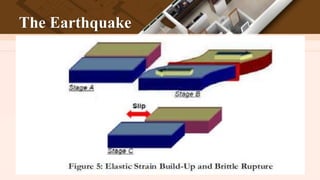
The Earthquake
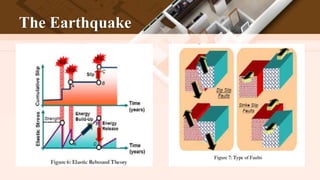
The Earthquake
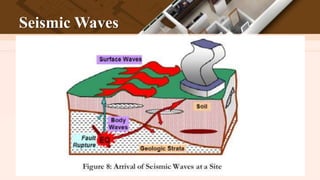
Seismic Waves
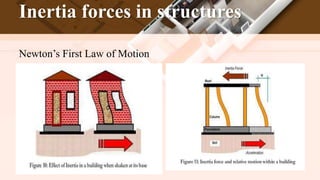
Inertia forces in structures
Newton’s First Law of Motion
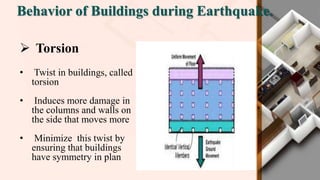
Behavior of Buildings during Earthquake.
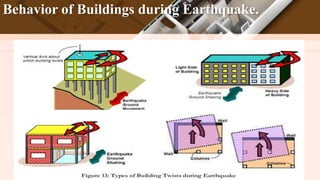
 Torsion
• Twist in buildings, called
torsion
• Induces more damage in
the columns and walls on
the side that moves more
• Minimize this twist by
ensuring that buildings
have symmetry in plan
Behavior of Buildings during Earthquake.
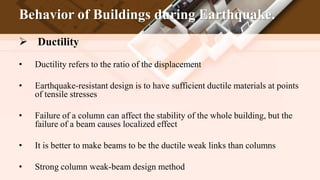
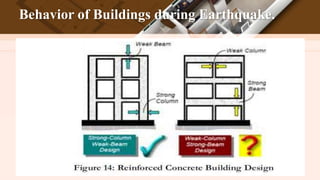
 Ductility
• Ductility refers to the ratio of the displacement
• Earthquake-resistant design is to have sufficient ductile materials at points
of tensile stresses
• Failure of a column can affect the stability of the whole building, but the
failure of a beam causes localized effect
• It is better to make beams to be the ductile weak links than columns
• Strong column weak-beam design method
Behavior of Buildings during Earthquake.
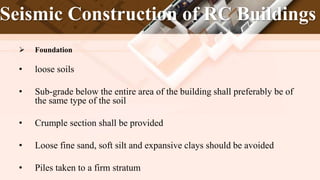
Seismic Construction of RC Buildings
 Foundation
• loose soils
• Sub-grade below the entire area of the building shall preferably be of
the same type of the soil
• Crumple section shall be provided
• Loose fine sand, soft silt and expansive clays should be avoided
• Piles taken to a firm stratum
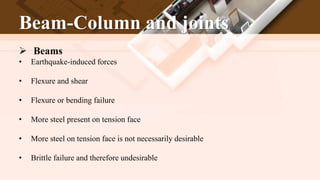
Beam-Column and joints
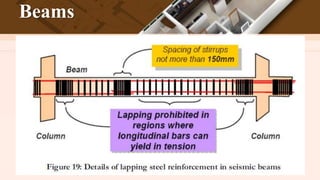
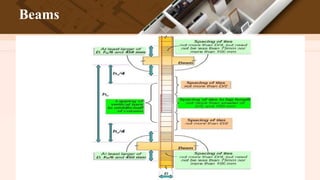
 Beams
• Earthquake-induced forces
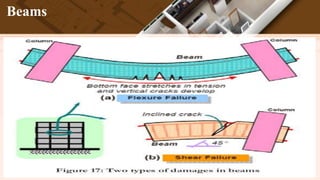
• Flexure and shear
• Flexure or bending failure
• More steel present on tension face
• More steel on tension face is not necessarily desirable
• Brittle failure and therefore undesirable
Beams
Beams
Beams
Column
• Shear failure is brittle and must be avoided in
columns by providing transverse ties at close spacing
• 300mm wide
Column
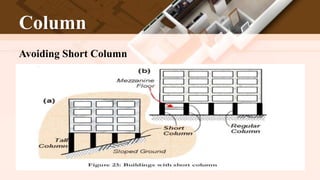
Avoiding Short Column
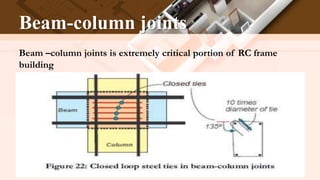
Beam-column joints
Beam –column joints is extremely critical portion of RC frame
building
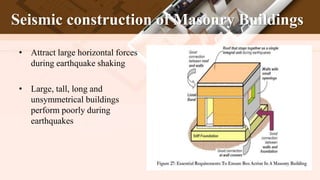
Seismic construction of Masonry Buildings
• Attract large horizontal forces
during earthquake shaking
• Large, tall, long and
unsymmetrical buildings
perform poorly during
earthquakes
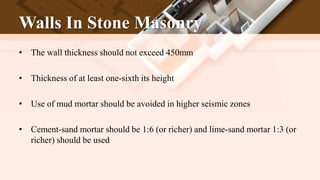
Walls In Stone Masonry
• The wall thickness should not exceed 450mm
• Thickness of at least one-sixth its height
• Use of mud mortar should be avoided in higher seismic zones
• Cement-sand mortar should be 1:6 (or richer) and lime-sand mortar 1:3 (or
richer) should be used
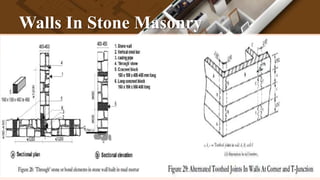
Walls In Stone Masonry
•Recent Development
of Seismic Retrofit
Methods in Japan
Opening in wall
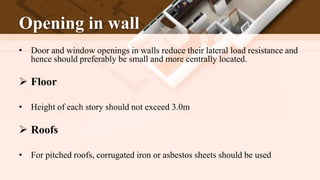
• Door and window openings in walls reduce their lateral load resistance and
hence should preferably be small and more centrally located.
 Floor
• Height of each story should not exceed 3.0m
 Roofs
• For pitched roofs, corrugated iron or asbestos sheets should be used
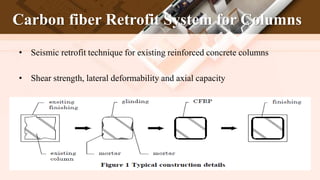
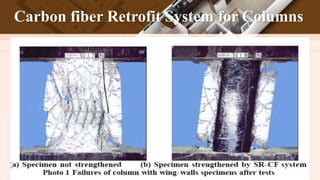
Carbon fiber Retrofit System for Columns
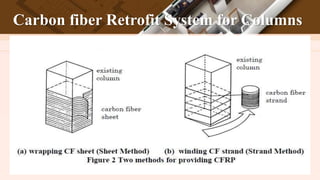
• Seismic retrofit technique for existing reinforced concrete columns
• Shear strength, lateral deformability and axial capacity
Carbon fiber Retrofit System for Columns
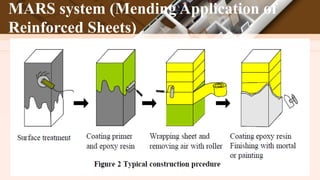
MARS system (Mending Application
of Reinforced Sheets)
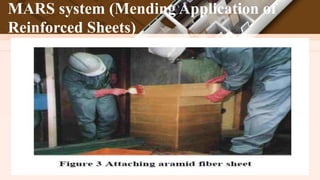
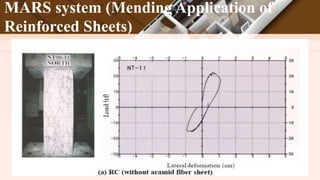
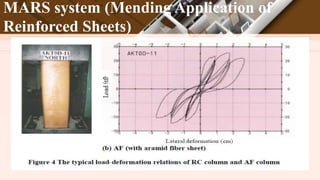
• MARS system is the method of reinforcing existing concrete
structures with FRP (fiber-reinforced plastic) sheets that are strong
• Increase the durability and the ductility of structural members
• Anti-corrosive
MARS system (Mending Application of
Reinforced Sheets)
MARS system (Mending Application of
Reinforced Sheets)
MARS system (Mending Application of
Reinforced Sheets)
MARS system (Mending Application of
Reinforced Sheets)
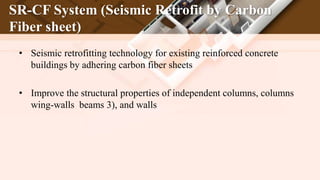
SR-CF System (Seismic Retrofit by Carbon
Fiber sheet)
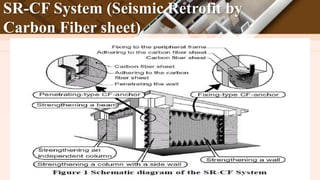
• Seismic retrofitting technology for existing reinforced concrete
buildings by adhering carbon fiber sheets
• Improve the structural properties of independent columns, columns
wing-walls beams 3), and walls
SR-CF System (Seismic Retrofit by
Carbon Fiber sheet)
Carbon fiber Retrofit System for Columns
References
• Recent Development of Seismic Retrofit Methods in
Japan
• Earthquake safety construction: from guidelines to
practice
Thanks

Building desighn in seiemic environment

  • 2.
    Presented by: Zia-Ul-Hassan Mamoon 2016-CRP-43 AbdurRaziq 2016-CRP-44 Building Construction In seismic Area Course Instructor: Sir Rehan Ashraf
  • 3.
  • 4.
  • 5.
  • 6.
    Inertia forces instructures Newton’s First Law of Motion
  • 7.
    Behavior of Buildingsduring Earthquake.  Torsion • Twist in buildings, called torsion • Induces more damage in the columns and walls on the side that moves more • Minimize this twist by ensuring that buildings have symmetry in plan
  • 8.
    Behavior of Buildingsduring Earthquake.
  • 9.
    Behavior of Buildingsduring Earthquake.  Ductility • Ductility refers to the ratio of the displacement • Earthquake-resistant design is to have sufficient ductile materials at points of tensile stresses • Failure of a column can affect the stability of the whole building, but the failure of a beam causes localized effect • It is better to make beams to be the ductile weak links than columns • Strong column weak-beam design method
  • 10.
    Behavior of Buildingsduring Earthquake.
  • 11.
    Seismic Construction ofRC Buildings  Foundation • loose soils • Sub-grade below the entire area of the building shall preferably be of the same type of the soil • Crumple section shall be provided • Loose fine sand, soft silt and expansive clays should be avoided • Piles taken to a firm stratum
  • 12.
    Beam-Column and joints Beams • Earthquake-induced forces • Flexure and shear • Flexure or bending failure • More steel present on tension face • More steel on tension face is not necessarily desirable • Brittle failure and therefore undesirable
  • 13.
  • 14.
  • 15.
  • 16.
    Column • Shear failureis brittle and must be avoided in columns by providing transverse ties at close spacing • 300mm wide
  • 17.
  • 18.
    Beam-column joints Beam –columnjoints is extremely critical portion of RC frame building
  • 19.
    Seismic construction ofMasonry Buildings • Attract large horizontal forces during earthquake shaking • Large, tall, long and unsymmetrical buildings perform poorly during earthquakes
  • 20.
    Walls In StoneMasonry • The wall thickness should not exceed 450mm • Thickness of at least one-sixth its height • Use of mud mortar should be avoided in higher seismic zones • Cement-sand mortar should be 1:6 (or richer) and lime-sand mortar 1:3 (or richer) should be used
  • 21.
  • 22.
    •Recent Development of SeismicRetrofit Methods in Japan
  • 23.
    Opening in wall •Door and window openings in walls reduce their lateral load resistance and hence should preferably be small and more centrally located.  Floor • Height of each story should not exceed 3.0m  Roofs • For pitched roofs, corrugated iron or asbestos sheets should be used
  • 24.
    Carbon fiber RetrofitSystem for Columns • Seismic retrofit technique for existing reinforced concrete columns • Shear strength, lateral deformability and axial capacity
  • 25.
    Carbon fiber RetrofitSystem for Columns
  • 26.
    MARS system (MendingApplication of Reinforced Sheets) • MARS system is the method of reinforcing existing concrete structures with FRP (fiber-reinforced plastic) sheets that are strong • Increase the durability and the ductility of structural members • Anti-corrosive
  • 27.
    MARS system (MendingApplication of Reinforced Sheets)
  • 28.
    MARS system (MendingApplication of Reinforced Sheets)
  • 29.
    MARS system (MendingApplication of Reinforced Sheets)
  • 30.
    MARS system (MendingApplication of Reinforced Sheets)
  • 31.
    SR-CF System (SeismicRetrofit by Carbon Fiber sheet) • Seismic retrofitting technology for existing reinforced concrete buildings by adhering carbon fiber sheets • Improve the structural properties of independent columns, columns wing-walls beams 3), and walls
  • 32.
    SR-CF System (SeismicRetrofit by Carbon Fiber sheet)
  • 33.
    Carbon fiber RetrofitSystem for Columns
  • 34.
    References • Recent Developmentof Seismic Retrofit Methods in Japan • Earthquake safety construction: from guidelines to practice
  • 35.