CONDITIONALS
Building Blocks of
Sentences
CONDITIONAL SENTENCES
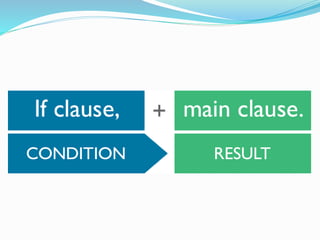
Conditional sentences are statements discussing known
factors or hypothetical situations and their consequences.
Complete conditional sentences contain a conditional
clause (often referred to as the if-clause) and the
consequence.
Consider the following sentences:
•If a certain condition is true, then a particular result happens.
•I would travel around the world if I won the lottery.
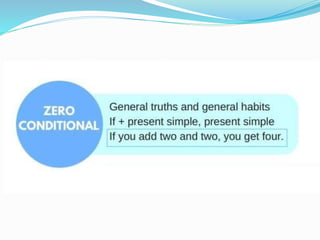
•When water reaches 100 degrees, it boils.
CONDITIONAL SENTENCES
•There are four types of conditional sentences.
•It’s important to use the correct structure for each of
these different conditional sentences because they
express varying meanings.
•Pay attention to verb tense when using different
conditional modes. Use a comma after the if-clause
when the if-clause precedes the main clause.
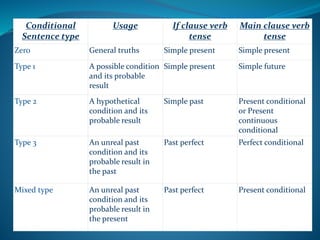
Conditional
Sentence type
Usage If clause verb
tense
Main clause verb
tense
Zero General truths Simple present Simple present
Type 1 A possible condition
and its probable
result
Simple present Simple future
Type 2 A hypothetical
condition and its
probable result
Simple past Present conditional
or Present
continuous
conditional
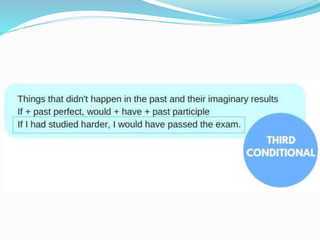
Type 3 An unreal past
condition and its
probable result in
the past
Past perfect Perfect conditional
Mixed type An unreal past
condition and its
probable result in
the present
Past perfect Present conditional
By
Shanimol B
English
Kannur University Teacher Education Centre
Dharmasala

Conditionals

  • 1.
  • 2.
    CONDITIONAL SENTENCES Conditional sentencesare statements discussing known factors or hypothetical situations and their consequences. Complete conditional sentences contain a conditional clause (often referred to as the if-clause) and the consequence. Consider the following sentences: •If a certain condition is true, then a particular result happens. •I would travel around the world if I won the lottery. •When water reaches 100 degrees, it boils.
  • 3.
    CONDITIONAL SENTENCES •There arefour types of conditional sentences. •It’s important to use the correct structure for each of these different conditional sentences because they express varying meanings. •Pay attention to verb tense when using different conditional modes. Use a comma after the if-clause when the if-clause precedes the main clause.
  • 5.
    Conditional Sentence type Usage Ifclause verb tense Main clause verb tense Zero General truths Simple present Simple present Type 1 A possible condition and its probable result Simple present Simple future Type 2 A hypothetical condition and its probable result Simple past Present conditional or Present continuous conditional Type 3 An unreal past condition and its probable result in the past Past perfect Perfect conditional Mixed type An unreal past condition and its probable result in the present Past perfect Present conditional
  • 10.
    By Shanimol B English Kannur UniversityTeacher Education Centre Dharmasala