ADDITIVES
AND
ADMIXTURES
PRESENTED BY, APURVA CHORGHE, HIMANSHI MEHTA, CHITRA VERMA
B.ARCH, BMCT-6
CONTENT
01.
02.
03.
ADDITIVES
ADMIXTURES
DIFFERENCE BETWEEN
ADDITIVES AND
ADMIXTURES
DEFINITION
TYPES
USES
EXAMPLES
ADVANTAGES
DISADAVNATGES
ADDITIVES
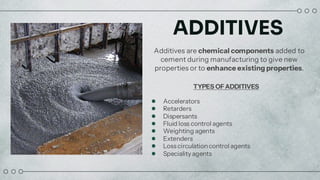
Additives are chemical components added to
cement during manufacturing to give new
properties or to enhance existing properties.
TYPES OFADDITIVES
● Accelerators
● Retarders
● Dispersants
● Fluid loss control agents
● Weighting agents
● Extenders
● Loss circulationcontrol agents
● Speciality agents
TYPES OF ADDITIVES
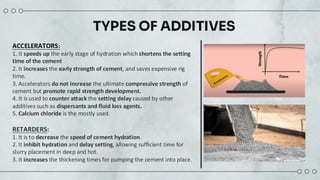
ACCELERATORS:
1. It speeds up the early stage of hydration which shortens the setting
time of the cement
2. It increases the early strength of cement, and saves expensive rig
time.
3. Accelerators do not increase the ultimate compressive strength of
cement but promote rapid strength development.
4. It is used to counter attack the setting delay caused by other
additives such as dispersants and fluid loss agents.
5. Calcium chloride is the mostly used.
RETARDERS:
1. It is to decrease the speed of cement hydration.
2. It inhibit hydration and delay setting, allowing sufficient time for
slurry placement in deep and hot.
3. It increases the thickening times for pumping the cement into place.
TYPES OF ADDITIVES
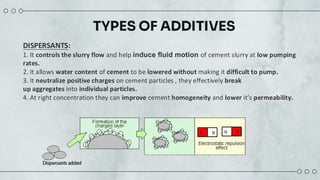
DISPERSANTS:
1. It controls the slurry flow and help induce fluid motion of cement slurry at low pumping
rates.
2. It allows water content of cement to be lowered without making it difficult to pump.
3. It neutralize positive charges on cement particles , they effectively break
up aggregates into individual particles.
4. At right concentration they can improve cement homogeneity and lower it’s permeability.
TYPES OF ADDITIVES
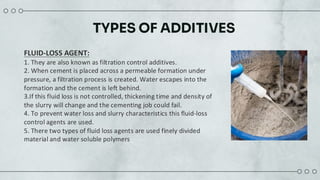
FLUID-LOSS AGENT:
1. They are also known as filtration control additives.
2. When cement is placed across a permeable formation under
pressure, a filtration process is created. Water escapes into the
formation and the cement is left behind.
3.If this fluid loss is not controlled, thickening time and density of
the slurry will change and the cementing job could fail.
4. To prevent water loss and slurry characteristics this fluid-loss
control agents are used.
5. There two types of fluid loss agents are used finely divided
material and water soluble polymers
TYPES OF ADDITIVES
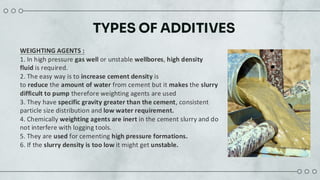
WEIGHTING AGENTS :
1. In high pressure gas well or unstable wellbores, high density
fluid is required.
2. The easy way is to increase cement density is
to reduce the amount of water from cement but it makes the slurry
difficult to pump therefore weighting agents are used
3. They have specific gravity greater than the cement, consistent
particle size distribution and low water requirement.
4. Chemically weighting agents are inert in the cement slurry and do
not interfere with logging tools.
5. They are used for cementing high pressure formations.
6. If the slurry density is too low it might get unstable.
USES
• Enhancement of Workability:
• Plasticizers and Superplasticizers are used to improve the workability of concrete without increasing the water
content. This helps in easy handling, especially in large-scale construction projects like bridges, dams, and high-
rise buildings.
• Control of Setting Time:
• Retarders (used in hot climates) and Accelerators (used in cold climates) help manage the setting time of
concrete. Retarders are especially useful in India’s warmer regions to avoid premature setting during
transportation. Accelerators are used to speed up the curing process in cooler temperatures.
• Improvement of Durability:
• Corrosion Inhibitors help protect rebars from corrosion, which is especially important in India due to the high
humidity and exposure to coastal environments, which accelerate the corrosion process.
• Air-Entraining Agents are used to improve concrete's resistance to freezing and thawing cycles, but they also
help in areas of heavy rainfall or humidity in coastal regions.
USES
• Waterproofing:
• Types: Crystalline admixtures, Hydrophobic pore-blocking agents, Densifiers
• Function: Reduce water permeability, enhance durability, and prevent corrosion in reinforcement
• Uses: Basements, water tanks, bridges, and marine structures
• Example: Xypex, Kryton, and Fosroc waterproofing admixtures
• Improvement of Strength:
• Pozzolanic Materials, such as Fly Ash, Ground Granulated Blast Furnace Slag (GGBS), and Silica Fume, are added
to increase the long-term strength and durability of concrete. These materials are often used in large
infrastructure projects like highways, bridges, and industrial buildings in India.
MANUFACTURERS OF ADDITIVES
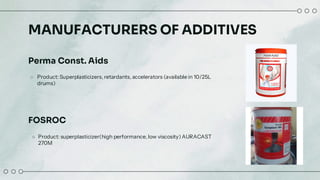
○ Product: Superplasticizers, retardants, accelerators (available in 10/25L
drums)
○ Product: superplasticizer(high performance, low viscosity) AURACAST
270M
Perma Const. Aids
FOSROC
MANUFACTURERS OF ADDITIVES
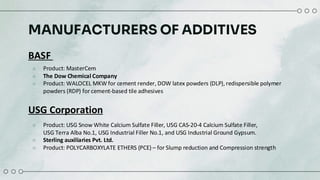
○ Product: MasterCem
○ The Dow Chemical Company
○ Product: WALOCEL MKW for cement render, DOW latex powders (DLP), redispersible polymer
powders (RDP) for cement-based tile adhesives
○ Product: USG Snow White Calcium Sulfate Filler, USG CAS-20-4 Calcium Sulfate Filler,
USG Terra Alba No.1, USG Industrial Filler No.1, and USG Industrial Ground Gypsum.
○ Sterling auxiliaries Pvt. Ltd.
○ Product: POLYCARBOXYLATE ETHERS (PCE) – for Slump reduction and Compression strength
BASF
USG Corporation
ADMIXTURES
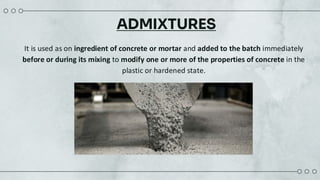
It is used as on ingredient of concrete or mortar and added to the batch immediately
before or during its mixing to modify one or more of the properties of concrete in the
plastic or hardened state.
TYPES OF ADMIXTURES
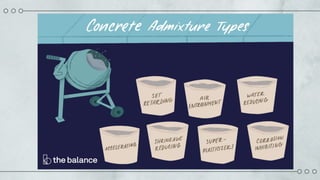
MINERAL:
• FLY ASH: A byproduct from burning coal in power plants, it enhances workability and reduces water demand.​
• SILICA FUME: A byproduct of silicon metal production, it improves strength and durability by filling voids in concrete.​
• GROUND GRANULATED BLAST FURNACE SLAG (GGBFS): A byproduct of steel manufacturing, it enhances resistance to
chemical attack and improves long-term strength.​
• RICE HUSK ASH: An agricultural waste that can enhance the pozzolanic properties of concrete.​
CHEMICAL​:
SET RETARDING:
• These admixtures are used where setting time of concrete need to be delayed hence workable for long duration.​
• It delays the hydration process but doesn’t affect the eventual process. ​
• Used in high temperature zones where concrete will set quickly.​
• Calcium sulphate, sugar, salt, cellulose, ammonium, ferrous & ferric chloride, hydro carboxylic acid and their salts are
used as retarders.
TYPES OF ADMIXTURES
AIR ENTRAINING:
• It is to increase the durability of concrete under freezing and thawing ​conditions. ​
• When added to concrete mix, It will form small stable bubbles of air to form ​
• uniformly through a concrete mix​
• also improve the workability of concrete, prevents segregation and ​bleeding, improves the
chemical resistance of concrete.​
• Most used air entrainment admixtures are vinsol resin, darex, Teepol,etc. ​
• These admixtures are actually made of Natural wood resins, alkali salts, animal and vegetable fats
and oils etc.​
TYPES OF ADMIXTURES
WATER REDUCERS:
• It minimizes the amount of water required in a concrete mix.​
• These are also known as plasticizers and these are classified into:
• Calcium and sodium are commonly used plasticizers, new generation superplasticizers are acrylic
polymer based, polycarboxylate, etc.
Water-Reducing Benefits & Required
• Water Capacity Superplasticizers reduce water by up to 30%, improving strength without sacrificing
workability Ideal water-cement ratio: 0.4 - 0.6 depending on structure requirements
ACCELERATORS:​
• It increases the rate of hydration of concrete.​
• They speed up the process of initial hardening of concrete.​
• There are useful in fast-track construction such as early removal of form work, less period of curing,
emergency repair works , for construction in low temperature region.​
1. Plasticizer - reduces the water demand upto 10%.​
2. Mid -range plasticizer - reduces the water demand up to 15%.​
3. Super - plasticizer - reduces the water demand upto 30 %. ​
USES
1. Improvement of Workability​
Plasticizers and Superplasticizers: These increase the flowability and workability of concrete, making it easier to mix, transport,
and place. They are particularly useful for complex molds or when the mix is heavily reinforced.​
Use Case: High-rise buildings, large-scale infrastructure projects, and concrete elements with dense reinforcement.​
2. Control of Setting Time​
Accelerators: Speed up the setting time of concrete, allowing for faster curing, especially in colder weather conditions.​
Retarders: Slow down the setting time, which is useful in hot climates or for projects that require longer handling and
transportation times.​
Use Case: Cold-weather concreting (accelerators) and hot-weather concreting or long-haul projects (retarders).​
3. Enhancing Durability​
Corrosion Inhibitors: These reduce the risk of steel reinforcement corrosion, making concrete more durable in aggressive
environments like marine areas or areas with high chloride content.​
Air-Entraining Agents: Improve freeze-thaw resistance by creating microscopic air bubbles in the concrete, which helps prevent
cracking due to freezing and thawing cycles.​
Waterproofing Agents: Reduce water penetration, protecting concrete from moisture-related damage.​
Use Case: Coastal structures, industrial plants, water treatment facilities, and foundations exposed to moisture.​
USES
4. Improving Strength
Pozzolanic Additives (Fly Ash, Silica Fume, GGBS): These materials enhance the long-term strength and durability of concrete
by improving its density and chemical resistance.​
Use Case: High-performance concrete used in bridges, highways, dams, and large buildings requiring high compressive
strength.​
5. Shrinkage and Cracking Control​
Shrinkage-Reducing Admixtures: These help reduce the shrinkage of concrete during the curing process, minimizing the
potential for cracks, especially in large pours.​
Use Case: Slabs, pavements, and floorings in large industrial or commercial buildings.
MANUFACTURERS OF ADMIXTURES
• FOSROC
Product: superplasticizer(high performance, low viscosity) AURACAST 270M​
• BASF
Product: MasterCem
• The Dow Chemical Company​
Product: WALOCEL MKW for cement render, DOW latex powders (DLP),redispersible polymer powders
(RDP) for cement-based tile adhesives​
• USG Corporation​
Product: USG Snow White Calcium Sulfate Filler, USG CAS-20-4 Calcium Sulfate Filler, USG Terra Alba
No.1, USG Industrial Filler No.1, and USG Industrial Ground Gypsum.​
• Sterling auxiliaries Pvt. Ltd.​
Product: POLYCARBOXYLATE ETHERS (PCE) – for Slump reduction and Compression strength
ADVANTAGES OF ADMIXTURES
• They enhance the workability of concrete. Admixtures imparts early strength in concrete.​
• Admixtures reduce the early heat of hydration and overcome thermal cracking problem in concrete. If there is
a more heat of hydration then cracks can propagate in fresh concrete.Admixtures improve the resistance
against freeze-thaw effect on concrete.​
• Concrete admixtures boost sustainability by:
1. Reducing cement: Less water needed means less cement, lowering CO2 emissions.
2. Using waste: Enables use of industrial byproducts like fly ash, cutting carbon footprint.
3. Bio-based options: Some use renewable materials, replacing oil-based components.
4. Improving lifespan: Enhances durability, reducing repairs and resource use.
• Concrete admixtures can accelerate the setting time as well as there are admixtures that decelerate concrete
setting time.​
• There are some admixtures that act as anti-bacterial agents.​
• RMC (Ready-Mix Concrete) & Its RoleFactory-made concrete ensuring uniform qualityReduces wastage,
increases efficiency, and is widely used in large-scale projects
DISADVANTAGES OF ADMIXTURES
• Increased dosage initially makes the concrete mix look workable and increases the slump, but the slump drops
very quick, thus making the mix unsuitable for working.
• Concrete for slipforming can be ruined by an excessive amount of PCE additive. Fluid occurs first, and then the
mixture becomes sticky and forms hexagon. Overdosing, temperature, cement problems, poor aggregates, or
an excess of retarders are the causes of this. Fix it with meticulous testing and oversight.​
• In case of form finished concrete the high range water reducing superplasticizer results discolouration of the
concrete and gives rise to air voids on the exposed surface.
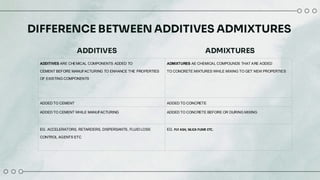
DIFFERENCE BETWEEN ADDITIVES ADMIXTURES
ADDITIVES ARE CHEMICAL COMPONENTS ADDED TO
CEMENT BEFORE MANUFACTURING TO ENHANCE THE PROPERTIES
OF EXISTING COMPONENTS​
ADMIXTURES AE CHEMICAL COMPOUNDS THAT ARE ADDED
TO CONCRETE MIXTURES WHILE MIXING TO GET NEW PROPERTIES​
ADDED TO CEMENT​ ADDED TO CONCRETE​
ADDED TO CEMENT WHILE MANUFACTURING​ ADDED TO CONCRETE BEFORE OR DURING MIXING
EG. ACCELERATORS, RETARDERS, DISPERSANTS, FLUID LOSS
CONTROL AGENTS ETC​
EG. FLY ASH, SILICA FUME ETC.
ADDITIVES ADMIXTURES
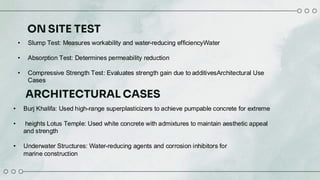
ON SITE TEST
• Slump Test: Measures workability and water-reducing efficiencyWater
• Absorption Test: Determines permeability reduction
• Compressive Strength Test: Evaluates strength gain due to additivesArchitectural Use
Cases
ARCHITECTURAL CASES
• Burj Khalifa: Used high-range superplasticizers to achieve pumpable concrete for extreme
• heights Lotus Temple: Used white concrete with admixtures to maintain aesthetic appeal
and strength
• Underwater Structures: Water-reducing agents and corrosion inhibitors for
marine construction
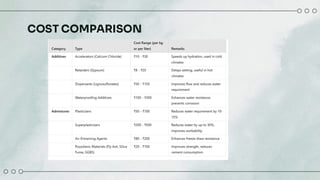
COST COMPARISON

FINAL ADDITIVES AND ADMIXTURES PRESENTATION.pdf

  • 1.
    ADDITIVES AND ADMIXTURES PRESENTED BY, APURVACHORGHE, HIMANSHI MEHTA, CHITRA VERMA B.ARCH, BMCT-6
  • 2.
  • 3.
    ADDITIVES Additives are chemicalcomponents added to cement during manufacturing to give new properties or to enhance existing properties. TYPES OFADDITIVES ● Accelerators ● Retarders ● Dispersants ● Fluid loss control agents ● Weighting agents ● Extenders ● Loss circulationcontrol agents ● Speciality agents
  • 4.
    TYPES OF ADDITIVES ACCELERATORS: 1.It speeds up the early stage of hydration which shortens the setting time of the cement 2. It increases the early strength of cement, and saves expensive rig time. 3. Accelerators do not increase the ultimate compressive strength of cement but promote rapid strength development. 4. It is used to counter attack the setting delay caused by other additives such as dispersants and fluid loss agents. 5. Calcium chloride is the mostly used. RETARDERS: 1. It is to decrease the speed of cement hydration. 2. It inhibit hydration and delay setting, allowing sufficient time for slurry placement in deep and hot. 3. It increases the thickening times for pumping the cement into place.
  • 5.
    TYPES OF ADDITIVES DISPERSANTS: 1.It controls the slurry flow and help induce fluid motion of cement slurry at low pumping rates. 2. It allows water content of cement to be lowered without making it difficult to pump. 3. It neutralize positive charges on cement particles , they effectively break up aggregates into individual particles. 4. At right concentration they can improve cement homogeneity and lower it’s permeability.
  • 6.
    TYPES OF ADDITIVES FLUID-LOSSAGENT: 1. They are also known as filtration control additives. 2. When cement is placed across a permeable formation under pressure, a filtration process is created. Water escapes into the formation and the cement is left behind. 3.If this fluid loss is not controlled, thickening time and density of the slurry will change and the cementing job could fail. 4. To prevent water loss and slurry characteristics this fluid-loss control agents are used. 5. There two types of fluid loss agents are used finely divided material and water soluble polymers
  • 7.
    TYPES OF ADDITIVES WEIGHTINGAGENTS : 1. In high pressure gas well or unstable wellbores, high density fluid is required. 2. The easy way is to increase cement density is to reduce the amount of water from cement but it makes the slurry difficult to pump therefore weighting agents are used 3. They have specific gravity greater than the cement, consistent particle size distribution and low water requirement. 4. Chemically weighting agents are inert in the cement slurry and do not interfere with logging tools. 5. They are used for cementing high pressure formations. 6. If the slurry density is too low it might get unstable.
  • 8.
    USES • Enhancement ofWorkability: • Plasticizers and Superplasticizers are used to improve the workability of concrete without increasing the water content. This helps in easy handling, especially in large-scale construction projects like bridges, dams, and high- rise buildings. • Control of Setting Time: • Retarders (used in hot climates) and Accelerators (used in cold climates) help manage the setting time of concrete. Retarders are especially useful in India’s warmer regions to avoid premature setting during transportation. Accelerators are used to speed up the curing process in cooler temperatures. • Improvement of Durability: • Corrosion Inhibitors help protect rebars from corrosion, which is especially important in India due to the high humidity and exposure to coastal environments, which accelerate the corrosion process. • Air-Entraining Agents are used to improve concrete's resistance to freezing and thawing cycles, but they also help in areas of heavy rainfall or humidity in coastal regions.
  • 9.
    USES • Waterproofing: • Types:Crystalline admixtures, Hydrophobic pore-blocking agents, Densifiers • Function: Reduce water permeability, enhance durability, and prevent corrosion in reinforcement • Uses: Basements, water tanks, bridges, and marine structures • Example: Xypex, Kryton, and Fosroc waterproofing admixtures • Improvement of Strength: • Pozzolanic Materials, such as Fly Ash, Ground Granulated Blast Furnace Slag (GGBS), and Silica Fume, are added to increase the long-term strength and durability of concrete. These materials are often used in large infrastructure projects like highways, bridges, and industrial buildings in India.
  • 10.
    MANUFACTURERS OF ADDITIVES ○Product: Superplasticizers, retardants, accelerators (available in 10/25L drums) ○ Product: superplasticizer(high performance, low viscosity) AURACAST 270M Perma Const. Aids FOSROC
  • 11.
    MANUFACTURERS OF ADDITIVES ○Product: MasterCem ○ The Dow Chemical Company ○ Product: WALOCEL MKW for cement render, DOW latex powders (DLP), redispersible polymer powders (RDP) for cement-based tile adhesives ○ Product: USG Snow White Calcium Sulfate Filler, USG CAS-20-4 Calcium Sulfate Filler, USG Terra Alba No.1, USG Industrial Filler No.1, and USG Industrial Ground Gypsum. ○ Sterling auxiliaries Pvt. Ltd. ○ Product: POLYCARBOXYLATE ETHERS (PCE) – for Slump reduction and Compression strength BASF USG Corporation
  • 12.
    ADMIXTURES It is usedas on ingredient of concrete or mortar and added to the batch immediately before or during its mixing to modify one or more of the properties of concrete in the plastic or hardened state.
  • 14.
    TYPES OF ADMIXTURES MINERAL: •FLY ASH: A byproduct from burning coal in power plants, it enhances workability and reduces water demand.​ • SILICA FUME: A byproduct of silicon metal production, it improves strength and durability by filling voids in concrete.​ • GROUND GRANULATED BLAST FURNACE SLAG (GGBFS): A byproduct of steel manufacturing, it enhances resistance to chemical attack and improves long-term strength.​ • RICE HUSK ASH: An agricultural waste that can enhance the pozzolanic properties of concrete.​ CHEMICAL​: SET RETARDING: • These admixtures are used where setting time of concrete need to be delayed hence workable for long duration.​ • It delays the hydration process but doesn’t affect the eventual process. ​ • Used in high temperature zones where concrete will set quickly.​ • Calcium sulphate, sugar, salt, cellulose, ammonium, ferrous & ferric chloride, hydro carboxylic acid and their salts are used as retarders.
  • 15.
    TYPES OF ADMIXTURES AIRENTRAINING: • It is to increase the durability of concrete under freezing and thawing ​conditions. ​ • When added to concrete mix, It will form small stable bubbles of air to form ​ • uniformly through a concrete mix​ • also improve the workability of concrete, prevents segregation and ​bleeding, improves the chemical resistance of concrete.​ • Most used air entrainment admixtures are vinsol resin, darex, Teepol,etc. ​ • These admixtures are actually made of Natural wood resins, alkali salts, animal and vegetable fats and oils etc.​
  • 16.
    TYPES OF ADMIXTURES WATERREDUCERS: • It minimizes the amount of water required in a concrete mix.​ • These are also known as plasticizers and these are classified into: • Calcium and sodium are commonly used plasticizers, new generation superplasticizers are acrylic polymer based, polycarboxylate, etc. Water-Reducing Benefits & Required • Water Capacity Superplasticizers reduce water by up to 30%, improving strength without sacrificing workability Ideal water-cement ratio: 0.4 - 0.6 depending on structure requirements ACCELERATORS:​ • It increases the rate of hydration of concrete.​ • They speed up the process of initial hardening of concrete.​ • There are useful in fast-track construction such as early removal of form work, less period of curing, emergency repair works , for construction in low temperature region.​ 1. Plasticizer - reduces the water demand upto 10%.​ 2. Mid -range plasticizer - reduces the water demand up to 15%.​ 3. Super - plasticizer - reduces the water demand upto 30 %. ​
  • 17.
    USES 1. Improvement ofWorkability​ Plasticizers and Superplasticizers: These increase the flowability and workability of concrete, making it easier to mix, transport, and place. They are particularly useful for complex molds or when the mix is heavily reinforced.​ Use Case: High-rise buildings, large-scale infrastructure projects, and concrete elements with dense reinforcement.​ 2. Control of Setting Time​ Accelerators: Speed up the setting time of concrete, allowing for faster curing, especially in colder weather conditions.​ Retarders: Slow down the setting time, which is useful in hot climates or for projects that require longer handling and transportation times.​ Use Case: Cold-weather concreting (accelerators) and hot-weather concreting or long-haul projects (retarders).​ 3. Enhancing Durability​ Corrosion Inhibitors: These reduce the risk of steel reinforcement corrosion, making concrete more durable in aggressive environments like marine areas or areas with high chloride content.​ Air-Entraining Agents: Improve freeze-thaw resistance by creating microscopic air bubbles in the concrete, which helps prevent cracking due to freezing and thawing cycles.​ Waterproofing Agents: Reduce water penetration, protecting concrete from moisture-related damage.​ Use Case: Coastal structures, industrial plants, water treatment facilities, and foundations exposed to moisture.​
  • 18.
    USES 4. Improving Strength PozzolanicAdditives (Fly Ash, Silica Fume, GGBS): These materials enhance the long-term strength and durability of concrete by improving its density and chemical resistance.​ Use Case: High-performance concrete used in bridges, highways, dams, and large buildings requiring high compressive strength.​ 5. Shrinkage and Cracking Control​ Shrinkage-Reducing Admixtures: These help reduce the shrinkage of concrete during the curing process, minimizing the potential for cracks, especially in large pours.​ Use Case: Slabs, pavements, and floorings in large industrial or commercial buildings.
  • 19.
    MANUFACTURERS OF ADMIXTURES •FOSROC Product: superplasticizer(high performance, low viscosity) AURACAST 270M​ • BASF Product: MasterCem • The Dow Chemical Company​ Product: WALOCEL MKW for cement render, DOW latex powders (DLP),redispersible polymer powders (RDP) for cement-based tile adhesives​ • USG Corporation​ Product: USG Snow White Calcium Sulfate Filler, USG CAS-20-4 Calcium Sulfate Filler, USG Terra Alba No.1, USG Industrial Filler No.1, and USG Industrial Ground Gypsum.​ • Sterling auxiliaries Pvt. Ltd.​ Product: POLYCARBOXYLATE ETHERS (PCE) – for Slump reduction and Compression strength
  • 20.
    ADVANTAGES OF ADMIXTURES •They enhance the workability of concrete. Admixtures imparts early strength in concrete.​ • Admixtures reduce the early heat of hydration and overcome thermal cracking problem in concrete. If there is a more heat of hydration then cracks can propagate in fresh concrete.Admixtures improve the resistance against freeze-thaw effect on concrete.​ • Concrete admixtures boost sustainability by: 1. Reducing cement: Less water needed means less cement, lowering CO2 emissions. 2. Using waste: Enables use of industrial byproducts like fly ash, cutting carbon footprint. 3. Bio-based options: Some use renewable materials, replacing oil-based components. 4. Improving lifespan: Enhances durability, reducing repairs and resource use. • Concrete admixtures can accelerate the setting time as well as there are admixtures that decelerate concrete setting time.​ • There are some admixtures that act as anti-bacterial agents.​ • RMC (Ready-Mix Concrete) & Its RoleFactory-made concrete ensuring uniform qualityReduces wastage, increases efficiency, and is widely used in large-scale projects
  • 21.
    DISADVANTAGES OF ADMIXTURES •Increased dosage initially makes the concrete mix look workable and increases the slump, but the slump drops very quick, thus making the mix unsuitable for working. • Concrete for slipforming can be ruined by an excessive amount of PCE additive. Fluid occurs first, and then the mixture becomes sticky and forms hexagon. Overdosing, temperature, cement problems, poor aggregates, or an excess of retarders are the causes of this. Fix it with meticulous testing and oversight.​ • In case of form finished concrete the high range water reducing superplasticizer results discolouration of the concrete and gives rise to air voids on the exposed surface.
  • 22.
    DIFFERENCE BETWEEN ADDITIVESADMIXTURES ADDITIVES ARE CHEMICAL COMPONENTS ADDED TO CEMENT BEFORE MANUFACTURING TO ENHANCE THE PROPERTIES OF EXISTING COMPONENTS​ ADMIXTURES AE CHEMICAL COMPOUNDS THAT ARE ADDED TO CONCRETE MIXTURES WHILE MIXING TO GET NEW PROPERTIES​ ADDED TO CEMENT​ ADDED TO CONCRETE​ ADDED TO CEMENT WHILE MANUFACTURING​ ADDED TO CONCRETE BEFORE OR DURING MIXING EG. ACCELERATORS, RETARDERS, DISPERSANTS, FLUID LOSS CONTROL AGENTS ETC​ EG. FLY ASH, SILICA FUME ETC. ADDITIVES ADMIXTURES
  • 23.
    ON SITE TEST •Slump Test: Measures workability and water-reducing efficiencyWater • Absorption Test: Determines permeability reduction • Compressive Strength Test: Evaluates strength gain due to additivesArchitectural Use Cases ARCHITECTURAL CASES • Burj Khalifa: Used high-range superplasticizers to achieve pumpable concrete for extreme • heights Lotus Temple: Used white concrete with admixtures to maintain aesthetic appeal and strength • Underwater Structures: Water-reducing agents and corrosion inhibitors for marine construction
  • 24.