RUDANI KRUPALI J.RUDANI KRUPALI J.
F .Y. M.Sc. Nursing student,F .Y. M.Sc. Nursing student,
I.K.D.R.C.I.K.D.R.C.
College of Nursing,College of Nursing,
AhmedabadAhmedabad
DATE :- 02-01-2017DATE :- 02-01-2017
To End Something Old,To End Something Old,
will Start Something New,will Start Something New,
Wishing You With Mighty Heart,Wishing You With Mighty Heart,
Though The Words AreThough The Words Are
Very FewVery Few……
INTRODUCTION OF HEALTH
According to WHO, “Health is a state of
complete physical, mental, and social being
and not merely an absence of diseases or
infirmity”
Health is a state of dynamic balance of
an individual ability to perform personally
valued roles and responsibilities to deal and
cope with physical biological psychological
and social stresses and challenges
throughout the life while continuing to
maintain sense of wellbeing.
Illness: It is a subjective state of the
person who feels aware of not being
well.
Sickness : It is a state of social
dysfunction.
Disease : It is a physiological /
psychological dysfunction.
Carrier: A person with subclinical
infectious disease who can transmit
the disease to others is called a
carrier.
CONCEPT OF DISEASE
CAUSATION
THEORIES OF DISEASE CAUSATION
A.Old theories
B.Germ theory of disease
C.Biomedical model
D.Theory of multifactorial causation
E.Epidemiological traid
F.Lazaru’s theories of stress response
G.Wolff’s theory of stress, organ
maladaptation and disease
H.Holmes and Rahe’s theory of life change
and onset of illness.
A. Old theories
Till the end of 18th
century,
various theories were in vogue, e.g.
supernatural theory of disease (e.g. curse
of God; an evil eye). The Ayurveda
considers that the disease is due to
imbalance of the ‘tridosha’. These are
vata(air), pitta(bile), and kapha(mucus).
The Chinese medicine believes that the
disease is caused due to imbalance of
male principle(yang)and female
principle(yin).
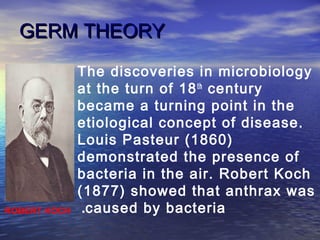
GERM THEORYGERM THEORY
The discoveries in microbiology
at the turn of 18th
century
became a turning point in the
etiological concept of disease.
Louis Pasteur (1860)
demonstrated the presence of
bacteria in the air. Robert Koch
(1877) showed that anthrax was
caused by bacteria.ROBERT KOCH
These theories of pasture and Koch
confirmed the germ theory of disease.
Thus, the emphasis has shifted from
empirical causes (like bad air as a cause in
malaria) of the old theories to microbes of
Germ theory.
But now it is recognized that a disease is
rarely caused by a single agent alone, but
depends upon a number of contributory
factors.
C. The Biomedical model
This model explains the disease as a
result of malfunctioning organs or
cells, e.g. diabetes is caused by
malfunctioning of pancreas. But the
drawback with it is focuses on cause
and effect relationships, and ends to
ignore the psychosocial component
of the disease.
D. Theory of multifactorial causation
Now it is recognized that a disease is not caused by
an organism but also predisposed by many factors
contributing to its occurrence, specially ‘modern
diseases’ of civilization like lung cancer, diabetes,
coronary heart disease, mental illness etc. These
predisposing factors are social, economic, cultural,
genetic psychological factors, etc. (including poverty,
illiteracy, ignorance and poor living conditions).
This theory of multifactorial causation was put forth
by Pettenkofer Munich (1819-1901). This theory de-
emphasizes the “Germ theory” (or single cause
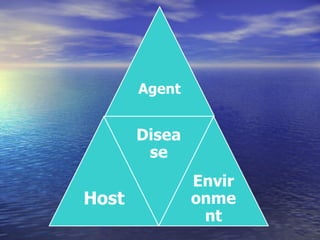
E. Epidemiological Triad :
The Germ theory of disease has many
limitations. For example, it is well known that not
everyone exposed to tuberculosis develops
tuberculosis. The same exposure, however in an
undernourished or otherwise susceptible person,
may result in clinical disease. Similarly, not everyone
to beta-hemolytic streptococci develops acute
rheumatic environment, which are equally
important to determine whether or not disease will
occur in the exposed host. This demanded a broader
concept of disease that synthesized the basic factors
F. Lazaru’s theories of stress
response
According to him, in the
process of coping, the individual
shapes as well as responds to a
demand or stress, which can have
an impact on the client’s resistance
to disease.
G. Wolff’s theory of stress, organ
maladaptation and disease
He studied people’s response to
chronic stressors, like a frustrating job
or an unhappy home life. He believed
that a person’s total life situation
profoundly affects a person’s
susceptibility to disease.
H. Holmes and rahe’s theory of life
changes and the onset of illness
They explored the relationship between
the amount of change in a person’s life
and subsequent illness. They discovered
that the higher a person’s life changes
score, the greater is the like hood that an
illness would develop.
2. PATHOGENESIS OF DISEASE
It means the evolution of a
disease process in an individual, from its early
stage to final stage of recovery or death, in the
absence of any intervention such as
prevention or treatment. This differs from
disease and from person to person.
The natural history of an
infectious disease occurs in two phases-
prepathogenesis and pathogenesis.
1. PrePathogenesis
Phase
This phase refers to the
period before the onset of
disease. During this phase,
interaction is taking place
among the three components
of epidemiological triad
namely Agent, Host, and
I.Agent Factors
A disease ‘agent’ is defined as a substance,
living or nonliving or a force, the excessive
presence or relative lack of which initiates
the disease process. The disease agents
are broadly classified into the following
groups:
• Physical agents : Heat, cold,
radiation, noise, atmospheric
pressure, humidity, etc.
• Chemical agents : Endogenous: Urea,
uric acid, bilirubin, ketones, calcium
oxalate, etc.
Exogenous : Dust, das, fumes, metals,
allergens, etc.
• Biological agents : viruses, rickettsia,
bacteria, fungi, protozoa, helminthes,
etc.
• Mechanical agents : friction, force,
injury, sprain, accidents, etc.
ii. host factors
• Age : certain disease is peculiar in certain
age-group.
• Sex : certain disease like lung cancer and
coronary heart disease are common among
men and rheumatoid arthritis, diabetes, and
obesity are common among women.
• Ethnicity : Sickle cell anemia is more
frequent among the negroes.
• Occupation : This not only determines the
income but also the health hazards arising
out of the occupation, e.g. pneumoconiosis
• Literacy level : The higher the literacy
level, the lower is the incidence of the
• Income : This is the ‘key’ factors determining the
standard of living and influences the development
of the disease. Lower socioeconomic status
predisposes for infectious disease and higher
status for non-communicable disease.
• Marital status : cancer of cervix is common among
the married women than the unmarried women.
• Nutritional status : poor nutritional status makes a
person more vulnerable to infectious disease.
• Life-style factors : Like smoking, alcoholism, drug-
abuse, lack of exercise, multiple sexual
partnership, etc. favor the development of
III. Environmental factors
These are classified into physical,
biological, and sociological environment.
•Physical environment : Air, water,
soil, food, etc.
•Biological environment : Plants,
animals, insects, rodents, microbes, etc.
•sociological environment : death,
divorce of parents, desertion, loss of
employment, birth of a handicapped child,
etc.
2. Pathogenesis Phases
The pathogenesis phase begins with the
entry of the disease ‘agent’ in the susceptible human
host. The further events in the pathogenesis phase
are clear cut in infectious disease, i.e. the disease
agent multiple and induces tissue and physiological
changes, the disease progresses through a period of
incubation and later through early and late
pathogenesis. the final outcome of disease may be
recovery, disability, or death. The pathogenesis
phase may be modified by intervention measures
such as immunization and chemotherapy.
The infection may be clinical
or sub-clinical, and when it is subclinical,
the person will not have recognizable
signs and symptoms but may spread the
disease agent to others, acting as a
‘carrier’, as in typhoid and diphtheria.
When the person develops
clinical signs and symptoms, he is called a
‘clinical case’.
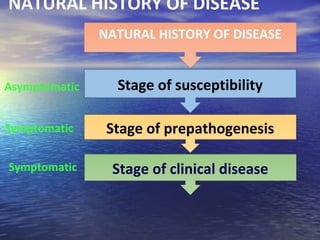
NATURAL HISTORY OF DISEASE
Stage of susceptibility
Stage of prepathogenesis
Stage of clinical disease
NATURAL HISTORY OF DISEASE
Symptomatic
Symptomatic
Asymptomatic
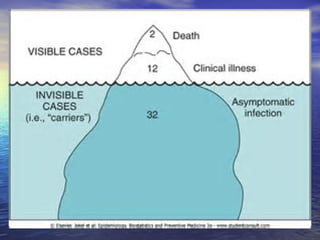
3. ICEBERG PHENOMENON OF DISEASE
According to this concept, the disease
in the community is compared to an iceberg.
When a piece of ice is allowed to float
on water, a small portion is visible and a major
portion is submerged in the water. The visible
tip of ice is compared to clinical cases, which
the physician sees in the community.
The major submerged portion of ice
corresponds to the hidden mass of
unrecognized disease such as latent cases,
in apparent, carriers, asymptomatic, and
undiagnosed cases in the community,
which are all responsible for the constant
prevalence of the disease in the
community.
THANK YOUTHANK YOU!!!!!!!!!!
THANK
YOU!!!!!

Concept of disease causation

  • 1.
    RUDANI KRUPALI J.RUDANIKRUPALI J. F .Y. M.Sc. Nursing student,F .Y. M.Sc. Nursing student, I.K.D.R.C.I.K.D.R.C. College of Nursing,College of Nursing, AhmedabadAhmedabad DATE :- 02-01-2017DATE :- 02-01-2017
  • 2.
    To End SomethingOld,To End Something Old, will Start Something New,will Start Something New, Wishing You With Mighty Heart,Wishing You With Mighty Heart, Though The Words AreThough The Words Are Very FewVery Few……
  • 3.
    INTRODUCTION OF HEALTH Accordingto WHO, “Health is a state of complete physical, mental, and social being and not merely an absence of diseases or infirmity” Health is a state of dynamic balance of an individual ability to perform personally valued roles and responsibilities to deal and cope with physical biological psychological and social stresses and challenges throughout the life while continuing to maintain sense of wellbeing.
  • 4.
    Illness: It isa subjective state of the person who feels aware of not being well. Sickness : It is a state of social dysfunction. Disease : It is a physiological / psychological dysfunction. Carrier: A person with subclinical infectious disease who can transmit the disease to others is called a carrier.
  • 5.
  • 6.
    THEORIES OF DISEASECAUSATION A.Old theories B.Germ theory of disease C.Biomedical model D.Theory of multifactorial causation E.Epidemiological traid F.Lazaru’s theories of stress response G.Wolff’s theory of stress, organ maladaptation and disease H.Holmes and Rahe’s theory of life change and onset of illness.
  • 7.
    A. Old theories Tillthe end of 18th century, various theories were in vogue, e.g. supernatural theory of disease (e.g. curse of God; an evil eye). The Ayurveda considers that the disease is due to imbalance of the ‘tridosha’. These are vata(air), pitta(bile), and kapha(mucus). The Chinese medicine believes that the disease is caused due to imbalance of male principle(yang)and female principle(yin).
  • 8.
    GERM THEORYGERM THEORY Thediscoveries in microbiology at the turn of 18th century became a turning point in the etiological concept of disease. Louis Pasteur (1860) demonstrated the presence of bacteria in the air. Robert Koch (1877) showed that anthrax was caused by bacteria.ROBERT KOCH
  • 9.
    These theories ofpasture and Koch confirmed the germ theory of disease. Thus, the emphasis has shifted from empirical causes (like bad air as a cause in malaria) of the old theories to microbes of Germ theory. But now it is recognized that a disease is rarely caused by a single agent alone, but depends upon a number of contributory factors.
  • 10.
    C. The Biomedicalmodel This model explains the disease as a result of malfunctioning organs or cells, e.g. diabetes is caused by malfunctioning of pancreas. But the drawback with it is focuses on cause and effect relationships, and ends to ignore the psychosocial component of the disease.
  • 11.
    D. Theory ofmultifactorial causation Now it is recognized that a disease is not caused by an organism but also predisposed by many factors contributing to its occurrence, specially ‘modern diseases’ of civilization like lung cancer, diabetes, coronary heart disease, mental illness etc. These predisposing factors are social, economic, cultural, genetic psychological factors, etc. (including poverty, illiteracy, ignorance and poor living conditions). This theory of multifactorial causation was put forth by Pettenkofer Munich (1819-1901). This theory de- emphasizes the “Germ theory” (or single cause
  • 12.
    E. Epidemiological Triad: The Germ theory of disease has many limitations. For example, it is well known that not everyone exposed to tuberculosis develops tuberculosis. The same exposure, however in an undernourished or otherwise susceptible person, may result in clinical disease. Similarly, not everyone to beta-hemolytic streptococci develops acute rheumatic environment, which are equally important to determine whether or not disease will occur in the exposed host. This demanded a broader concept of disease that synthesized the basic factors
  • 14.
    F. Lazaru’s theoriesof stress response According to him, in the process of coping, the individual shapes as well as responds to a demand or stress, which can have an impact on the client’s resistance to disease.
  • 15.
    G. Wolff’s theoryof stress, organ maladaptation and disease He studied people’s response to chronic stressors, like a frustrating job or an unhappy home life. He believed that a person’s total life situation profoundly affects a person’s susceptibility to disease.
  • 16.
    H. Holmes andrahe’s theory of life changes and the onset of illness They explored the relationship between the amount of change in a person’s life and subsequent illness. They discovered that the higher a person’s life changes score, the greater is the like hood that an illness would develop.
  • 17.
    2. PATHOGENESIS OFDISEASE It means the evolution of a disease process in an individual, from its early stage to final stage of recovery or death, in the absence of any intervention such as prevention or treatment. This differs from disease and from person to person. The natural history of an infectious disease occurs in two phases- prepathogenesis and pathogenesis.
  • 18.
    1. PrePathogenesis Phase This phaserefers to the period before the onset of disease. During this phase, interaction is taking place among the three components of epidemiological triad namely Agent, Host, and
  • 19.
    I.Agent Factors A disease‘agent’ is defined as a substance, living or nonliving or a force, the excessive presence or relative lack of which initiates the disease process. The disease agents are broadly classified into the following groups:
  • 20.
    • Physical agents: Heat, cold, radiation, noise, atmospheric pressure, humidity, etc. • Chemical agents : Endogenous: Urea, uric acid, bilirubin, ketones, calcium oxalate, etc. Exogenous : Dust, das, fumes, metals, allergens, etc. • Biological agents : viruses, rickettsia, bacteria, fungi, protozoa, helminthes, etc. • Mechanical agents : friction, force, injury, sprain, accidents, etc.
  • 21.
    ii. host factors •Age : certain disease is peculiar in certain age-group. • Sex : certain disease like lung cancer and coronary heart disease are common among men and rheumatoid arthritis, diabetes, and obesity are common among women. • Ethnicity : Sickle cell anemia is more frequent among the negroes. • Occupation : This not only determines the income but also the health hazards arising out of the occupation, e.g. pneumoconiosis • Literacy level : The higher the literacy level, the lower is the incidence of the
  • 22.
    • Income :This is the ‘key’ factors determining the standard of living and influences the development of the disease. Lower socioeconomic status predisposes for infectious disease and higher status for non-communicable disease. • Marital status : cancer of cervix is common among the married women than the unmarried women. • Nutritional status : poor nutritional status makes a person more vulnerable to infectious disease. • Life-style factors : Like smoking, alcoholism, drug- abuse, lack of exercise, multiple sexual partnership, etc. favor the development of
  • 23.
    III. Environmental factors Theseare classified into physical, biological, and sociological environment. •Physical environment : Air, water, soil, food, etc. •Biological environment : Plants, animals, insects, rodents, microbes, etc. •sociological environment : death, divorce of parents, desertion, loss of employment, birth of a handicapped child, etc.
  • 24.
    2. Pathogenesis Phases Thepathogenesis phase begins with the entry of the disease ‘agent’ in the susceptible human host. The further events in the pathogenesis phase are clear cut in infectious disease, i.e. the disease agent multiple and induces tissue and physiological changes, the disease progresses through a period of incubation and later through early and late pathogenesis. the final outcome of disease may be recovery, disability, or death. The pathogenesis phase may be modified by intervention measures such as immunization and chemotherapy.
  • 25.
    The infection maybe clinical or sub-clinical, and when it is subclinical, the person will not have recognizable signs and symptoms but may spread the disease agent to others, acting as a ‘carrier’, as in typhoid and diphtheria. When the person develops clinical signs and symptoms, he is called a ‘clinical case’.
  • 26.
    NATURAL HISTORY OFDISEASE Stage of susceptibility Stage of prepathogenesis Stage of clinical disease NATURAL HISTORY OF DISEASE Symptomatic Symptomatic Asymptomatic
  • 27.
    3. ICEBERG PHENOMENONOF DISEASE According to this concept, the disease in the community is compared to an iceberg. When a piece of ice is allowed to float on water, a small portion is visible and a major portion is submerged in the water. The visible tip of ice is compared to clinical cases, which the physician sees in the community.
  • 28.
    The major submergedportion of ice corresponds to the hidden mass of unrecognized disease such as latent cases, in apparent, carriers, asymptomatic, and undiagnosed cases in the community, which are all responsible for the constant prevalence of the disease in the community.
  • 31.