COMPUTING SAFETY
R&R
INDEX
Definition
Threats
Antivirus
Peer –to-peer nets
Privacy protection
Tips for protecting your
data
Internet is not safe
COMPUTING SAFETY DEFINITION
In distributed computing, safety properties
informally require that "something bad will
never happen" in a distributed
system or distributed algorithm.
Unlike liveness properties, safety properties
can be violated by a finite execution of a
distributed system. In a database system, a
promise to never return data with null fields is
an example of a safety guarantee. All
properties can be expressed as the
intersection of safety and liveness properties.
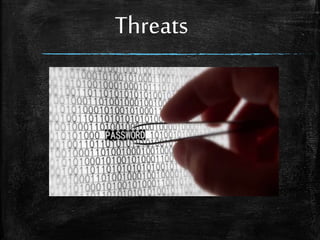
Threats
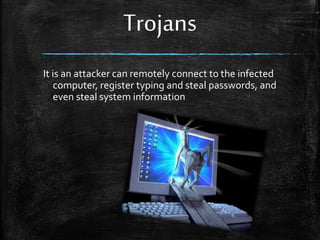
Trojans
It is an attacker can remotely connect to the infected
computer, register typing and steal passwords, and
even steal system information
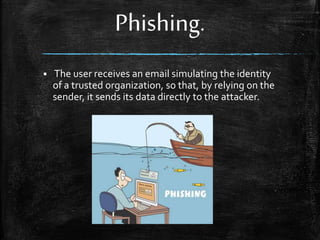
Phishing.
ď‚§ The user receives an email simulating the identity
of a trusted organization, so that, by relying on the
sender, it sends its data directly to the attacker.
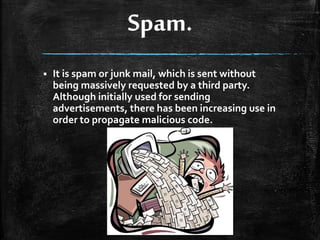
Spam.
ď‚§ It is spam or junk mail, which is sent without
being massively requested by a third party.
Although initially used for sending
advertisements, there has been increasing use in
order to propagate malicious code.
Virus
ď‚§ Viruses can infect in the traditional way of
'injecting' a portion of malicious code into a normal
file. In this way, when the user executes the file, in
addition to the normal actions of the file in
question, the virus instructions are executed.
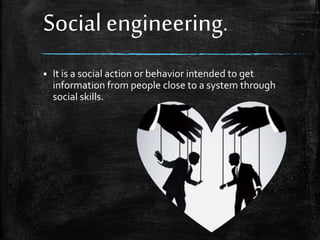
Social engineering.
ď‚§ It is a social action or behavior intended to get
information from people close to a system through
social skills.
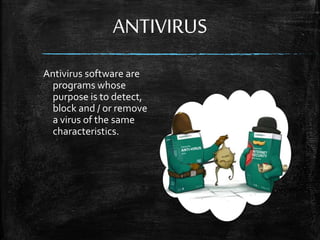
ANTIVIRUS
Antivirus software are
programs whose
purpose is to detect,
block and / or remove
a virus of the same
characteristics.
PREVENTING
ANTIVIRUS
ď‚§ As its name implies,
this type of antivirus is
characterized by
anticipating the
infection, preventing
it. In this way, they
remain in the memory
of the computer,
monitoring certain
actions and functions
of the system.
IDENTIFYING
ANTIVIRUS
ď‚§ This kind of antivirus
has the function of
identifying certain
infectious programs
that affect the system.
DESCENTAMINATOR ANTIVIRUS:
ď‚§ The purpose of this kind of antivirus is to
decontaminate a system that was infected,
through the elimination of malicious programs.
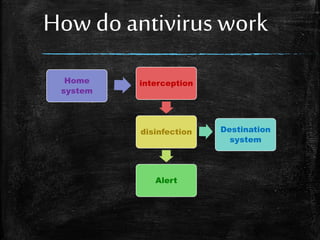
How do antivirus work
interception
disinfection
Alert
Destination
system
Home
system
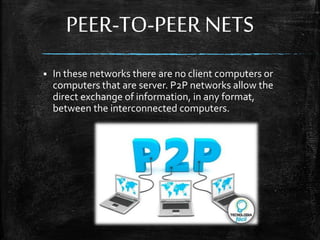
PEER-TO-PEER NETS
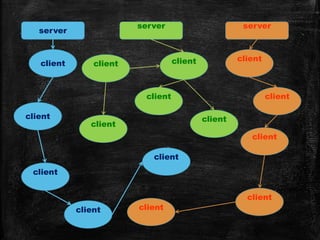
ď‚§ In these networks there are no client computers or
computers that are server. P2P networks allow the
direct exchange of information, in any format,
between the interconnected computers.
server
serverserver
client
client
client
client
client
client
client
client
client
client client
client
client
client
client
ď‚§ Peer-to-peer networks leverage, manage, and
optimize the bandwidth usage of other network
users through connectivity between peers,
obtaining more performance in connections and
transfers than with some conventional centralized
methods.
FIREWALL
These programs have the function of blocking
access to a certain system, acting as a defensive
wall.They have under their control the traffic in
and out of a computer, preventing the execution
of all dubious activity.
Firewalls clasified on:
ď‚§ Hardware:This type of
system is placed on the
devices used to enter the
Internet, the so-called
"routers".The placement
of the firewall in this case
is very complex, it is
made thanks to a browser
that has access to the
Internet.
ď‚§ Software: can be
distinguished two types
of these firewalls, the first
is free: also known under
the name of software
firewall, which can be
used with total freedom
and completely free of
charge as its name
indicates. Its purpose is to
track and not allow access
to certain data to
personal computers.
Nowadays most PCs
already have the firewall
in place.
Or in:
ď‚§ Application:These are usually used with servers
called proxy. In this case it is not possible to pass
data directly between networks, since there is a
monitoring of the data.
ď‚§ Network: in this case the decisions are made
depending on the data ports, the destination
address and the origin of the information.
Privacy protection
ď‚§ The protection of personal data is located within the field of
study of computer law. It is the guarantee or the ability to
control the information itself versus its automated
processing, that is to say, not only to that information stored
in computer systems, but in any support that allows its use:
storage, organization and access. In some countries data
protection finds constitutional recognition, as a human right
and in others simply legal.
Tips for protecting your data
ď‚§ 1.- Know and configure the privacy options in
detail.
ď‚§ 2.- Identify the functions and effects of each
action.
ď‚§ 3.- Protect personal data.
ď‚§ 4.- Protect the data personally.
ď‚§ 5.-Maintain a proactive attitude in the defense
of own data.
ď‚§ 6.- Evaluate the attitudes and privacy conditions
of the contacts.
Quid pro quo
ď‚§ Quid pro quo means "something for something".
The attacker calls random numbers in a company,
claiming to be calling back from technical support.
This person will inform someone of a legitimate
problem and will offer to help you, during the
process will get access data and launch malware..
Baiting
ď‚§ In this case a removable storage device (CD, DVD,
USB) infected with malicious software is used,
leaving it in a place where it is easy to find (eg
public restrooms, elevators, sidewalks, etc.). When
the victim finds the device and enters it on your
computer, the software will be installed and will
allow the hacker to obtain all the user's personal
data.
Vishing
ď‚§ The vishing consists of making covert telephone
calls under surveys that could also take personal
information so that the victim does not suspect.
Take care of your devices
Internet is not safe…
even though we think it is…
HACKERS
ď‚§ A hacker is someone who discovers the
weaknesses of a computer or computer network,
although the term can also be applied to someone
with advanced knowledge of computers and
computer networks. Hackers can be motivated by
a multitude of reasons, including purposes Profit,
protest or challenge.
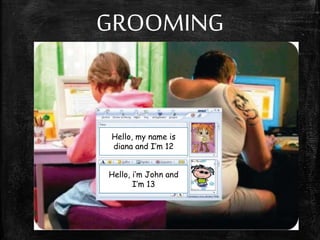
GROOMING
Hello, my name is
diana and I’m 12
Hello, i’m John and
I’m 13
CYBERBULLYING
SEXTORSION
THE END
Bibliography
ď‚§ Wikipedia
ď‚§ Different blogs
ď‚§ Google images

Computing safety ryr

  • 1.
  • 2.
    INDEX Definition Threats Antivirus Peer –to-peer nets Privacyprotection Tips for protecting your data Internet is not safe
  • 3.
    COMPUTING SAFETY DEFINITION Indistributed computing, safety properties informally require that "something bad will never happen" in a distributed system or distributed algorithm. Unlike liveness properties, safety properties can be violated by a finite execution of a distributed system. In a database system, a promise to never return data with null fields is an example of a safety guarantee. All properties can be expressed as the intersection of safety and liveness properties.
  • 4.
  • 5.
    Trojans It is anattacker can remotely connect to the infected computer, register typing and steal passwords, and even steal system information
  • 6.
    Phishing. ď‚§ The userreceives an email simulating the identity of a trusted organization, so that, by relying on the sender, it sends its data directly to the attacker.
  • 7.
    Spam. ď‚§ It isspam or junk mail, which is sent without being massively requested by a third party. Although initially used for sending advertisements, there has been increasing use in order to propagate malicious code.
  • 8.
    Virus ď‚§ Viruses caninfect in the traditional way of 'injecting' a portion of malicious code into a normal file. In this way, when the user executes the file, in addition to the normal actions of the file in question, the virus instructions are executed.
  • 9.
    Social engineering. ď‚§ Itis a social action or behavior intended to get information from people close to a system through social skills.
  • 10.
    ANTIVIRUS Antivirus software are programswhose purpose is to detect, block and / or remove a virus of the same characteristics.
  • 11.
    PREVENTING ANTIVIRUS ď‚§ As itsname implies, this type of antivirus is characterized by anticipating the infection, preventing it. In this way, they remain in the memory of the computer, monitoring certain actions and functions of the system. IDENTIFYING ANTIVIRUS ď‚§ This kind of antivirus has the function of identifying certain infectious programs that affect the system.
  • 12.
    DESCENTAMINATOR ANTIVIRUS: ď‚§ Thepurpose of this kind of antivirus is to decontaminate a system that was infected, through the elimination of malicious programs.
  • 13.
    How do antiviruswork interception disinfection Alert Destination system Home system
  • 14.
    PEER-TO-PEER NETS ď‚§ Inthese networks there are no client computers or computers that are server. P2P networks allow the direct exchange of information, in any format, between the interconnected computers.
  • 15.
  • 16.
    ď‚§ Peer-to-peer networksleverage, manage, and optimize the bandwidth usage of other network users through connectivity between peers, obtaining more performance in connections and transfers than with some conventional centralized methods.
  • 17.
    FIREWALL These programs havethe function of blocking access to a certain system, acting as a defensive wall.They have under their control the traffic in and out of a computer, preventing the execution of all dubious activity.
  • 18.
    Firewalls clasified on: ď‚§Hardware:This type of system is placed on the devices used to enter the Internet, the so-called "routers".The placement of the firewall in this case is very complex, it is made thanks to a browser that has access to the Internet. ď‚§ Software: can be distinguished two types of these firewalls, the first is free: also known under the name of software firewall, which can be used with total freedom and completely free of charge as its name indicates. Its purpose is to track and not allow access to certain data to personal computers. Nowadays most PCs already have the firewall in place.
  • 19.
    Or in: ď‚§ Application:Theseare usually used with servers called proxy. In this case it is not possible to pass data directly between networks, since there is a monitoring of the data. ď‚§ Network: in this case the decisions are made depending on the data ports, the destination address and the origin of the information.
  • 20.
    Privacy protection ď‚§ Theprotection of personal data is located within the field of study of computer law. It is the guarantee or the ability to control the information itself versus its automated processing, that is to say, not only to that information stored in computer systems, but in any support that allows its use: storage, organization and access. In some countries data protection finds constitutional recognition, as a human right and in others simply legal.
  • 21.
    Tips for protectingyour data ď‚§ 1.- Know and configure the privacy options in detail. ď‚§ 2.- Identify the functions and effects of each action. ď‚§ 3.- Protect personal data. ď‚§ 4.- Protect the data personally. ď‚§ 5.-Maintain a proactive attitude in the defense of own data. ď‚§ 6.- Evaluate the attitudes and privacy conditions of the contacts.
  • 22.
    Quid pro quo ď‚§Quid pro quo means "something for something". The attacker calls random numbers in a company, claiming to be calling back from technical support. This person will inform someone of a legitimate problem and will offer to help you, during the process will get access data and launch malware..
  • 23.
    Baiting ď‚§ In thiscase a removable storage device (CD, DVD, USB) infected with malicious software is used, leaving it in a place where it is easy to find (eg public restrooms, elevators, sidewalks, etc.). When the victim finds the device and enters it on your computer, the software will be installed and will allow the hacker to obtain all the user's personal data.
  • 24.
    Vishing ď‚§ The vishingconsists of making covert telephone calls under surveys that could also take personal information so that the victim does not suspect.
  • 25.
    Take care ofyour devices
  • 26.
    Internet is notsafe… even though we think it is…
  • 27.
    HACKERS ď‚§ A hackeris someone who discovers the weaknesses of a computer or computer network, although the term can also be applied to someone with advanced knowledge of computers and computer networks. Hackers can be motivated by a multitude of reasons, including purposes Profit, protest or challenge.
  • 28.
    GROOMING Hello, my nameis diana and I’m 12 Hello, i’m John and I’m 13
  • 29.
  • 30.
  • 32.
  • 33.

Editor's Notes

  • #5  Su nombre proviene de la leyenda del caballo de Troya
  • #26 You could be beimg hacked