(Bio)Hackathons:
What, Why, and How
Benjamin Good TSRI @bgood
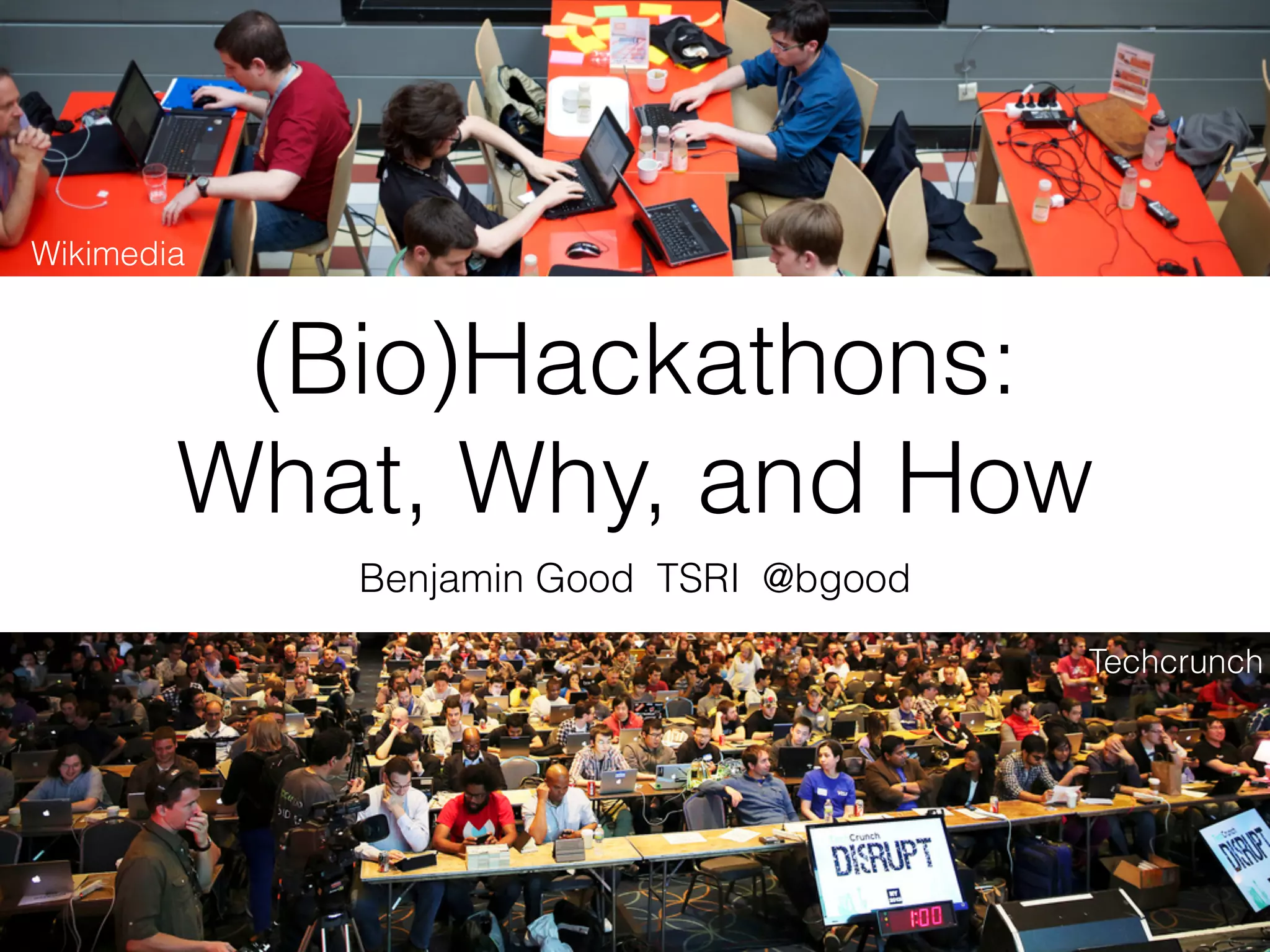
Wikimedia
Techcrunch
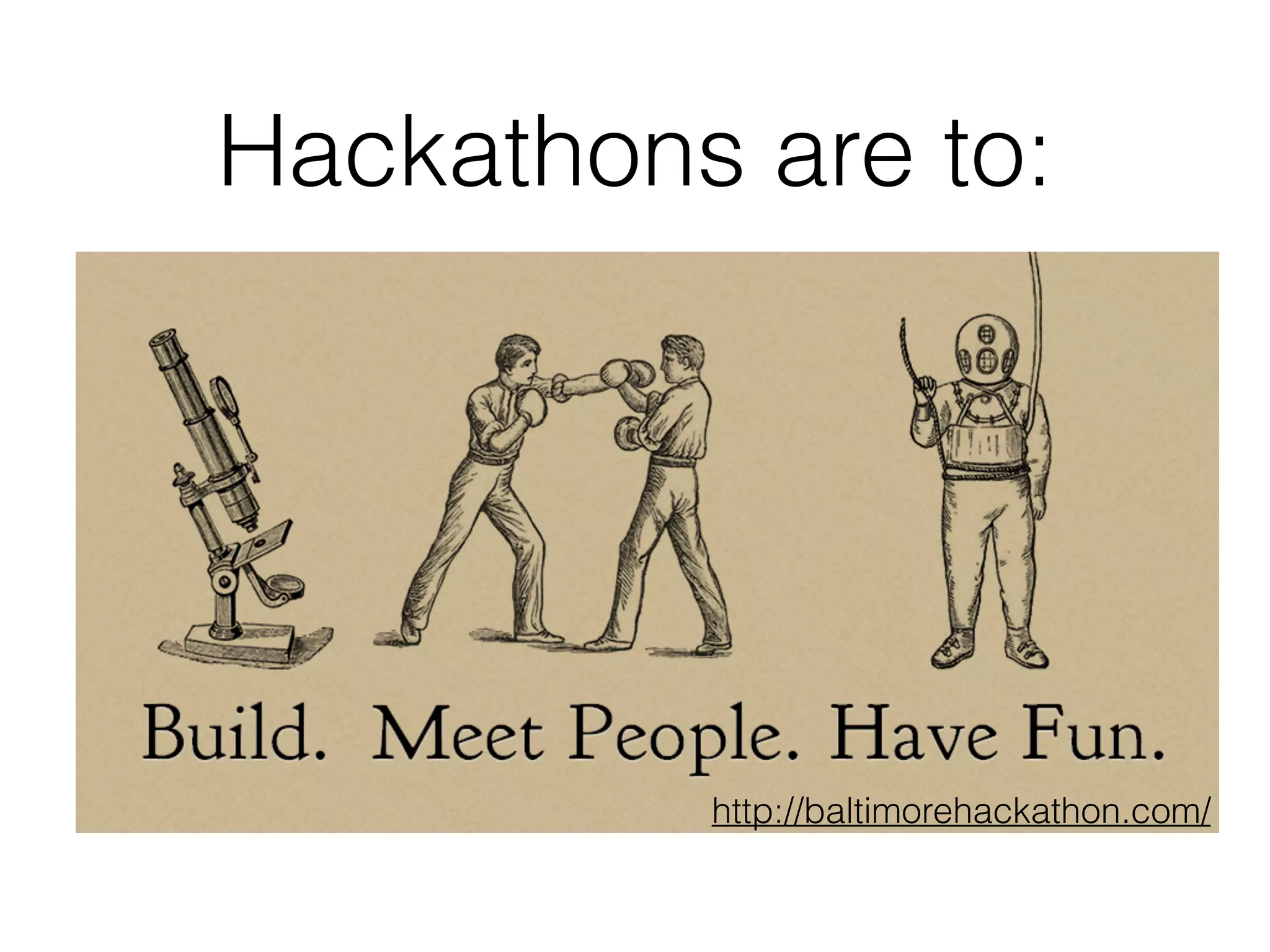
Hackathons are to:
http://baltimorehackathon.com/
Like an (un)conference
But you create something in the process
Why?
• Collaborative Creativity
• Learning (e.g. new APIs)
• Advertising.. (e.g. pushing your new API..)
• Networking
Hackathons are for:
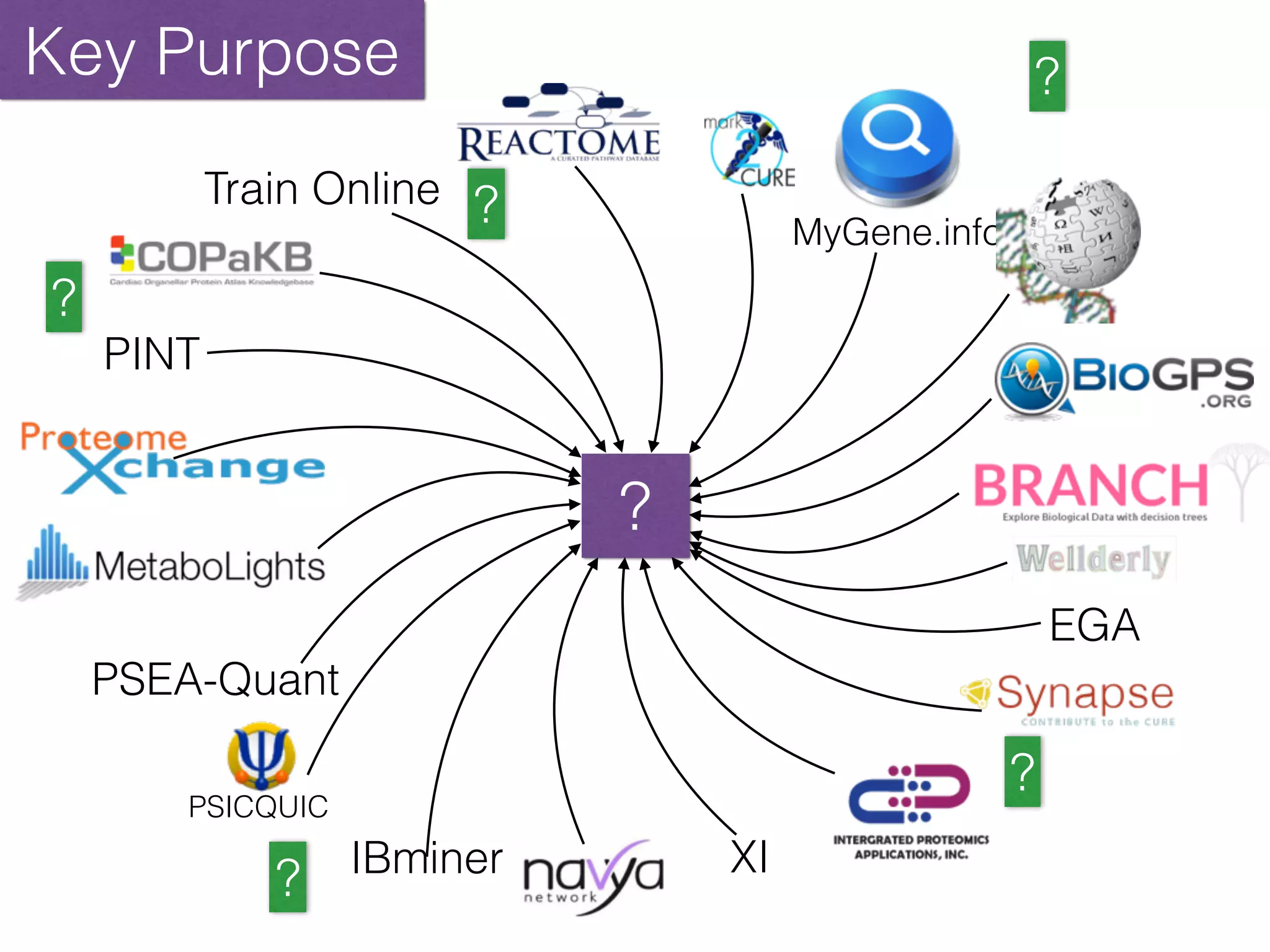
Key Purpose
PSEA-Quant
MyGene.info
XI
PSICQUIC
PINT
IBminer
EGA
Train Online
?
?
?
?
?
?
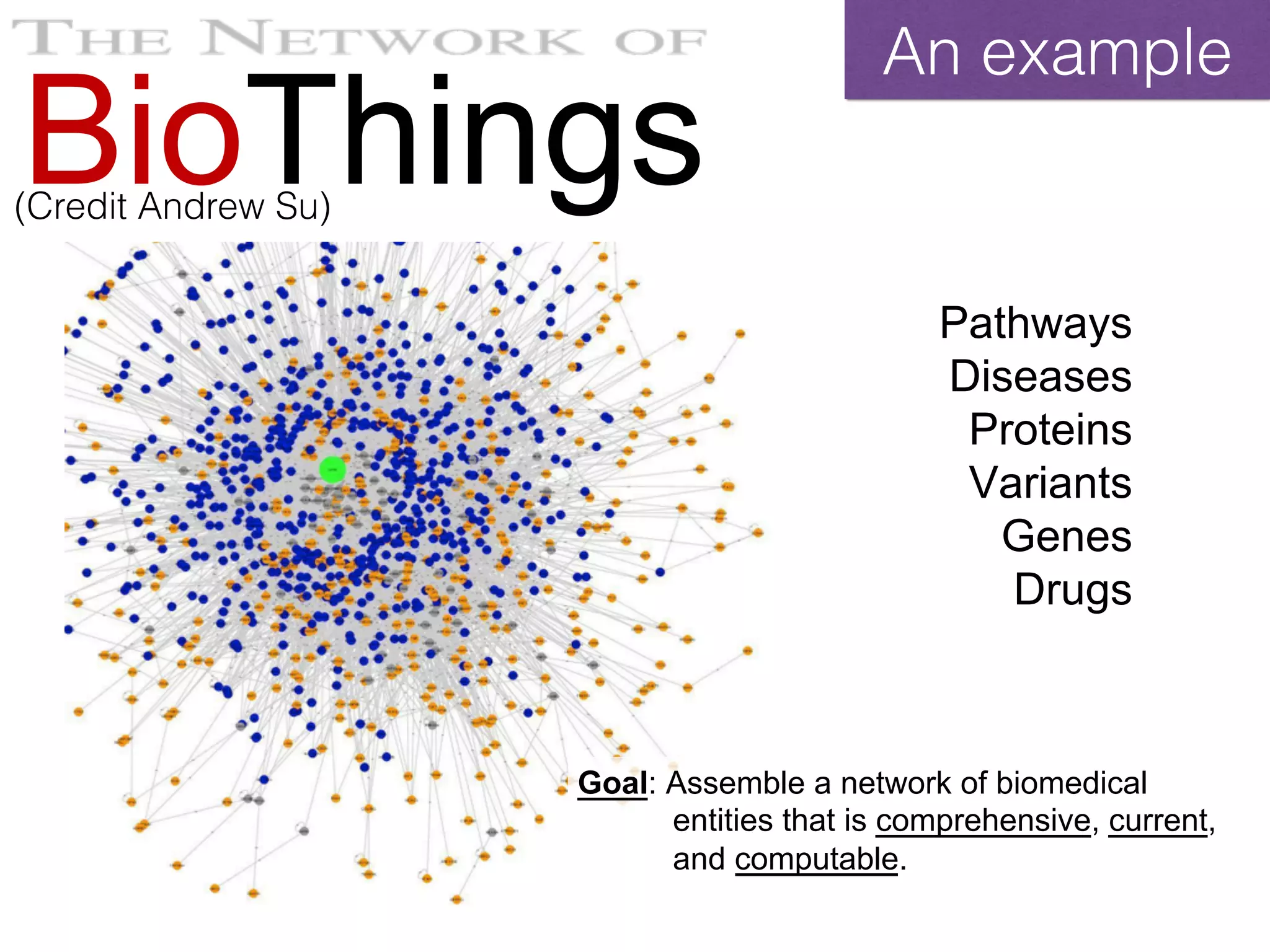
Goal: Assemble a network of biomedical
entities that is comprehensive, current,
and computable.
Pathways
Diseases
Proteins
Variants
Genes
Drugs
BioThings(Credit Andrew Su)
An example
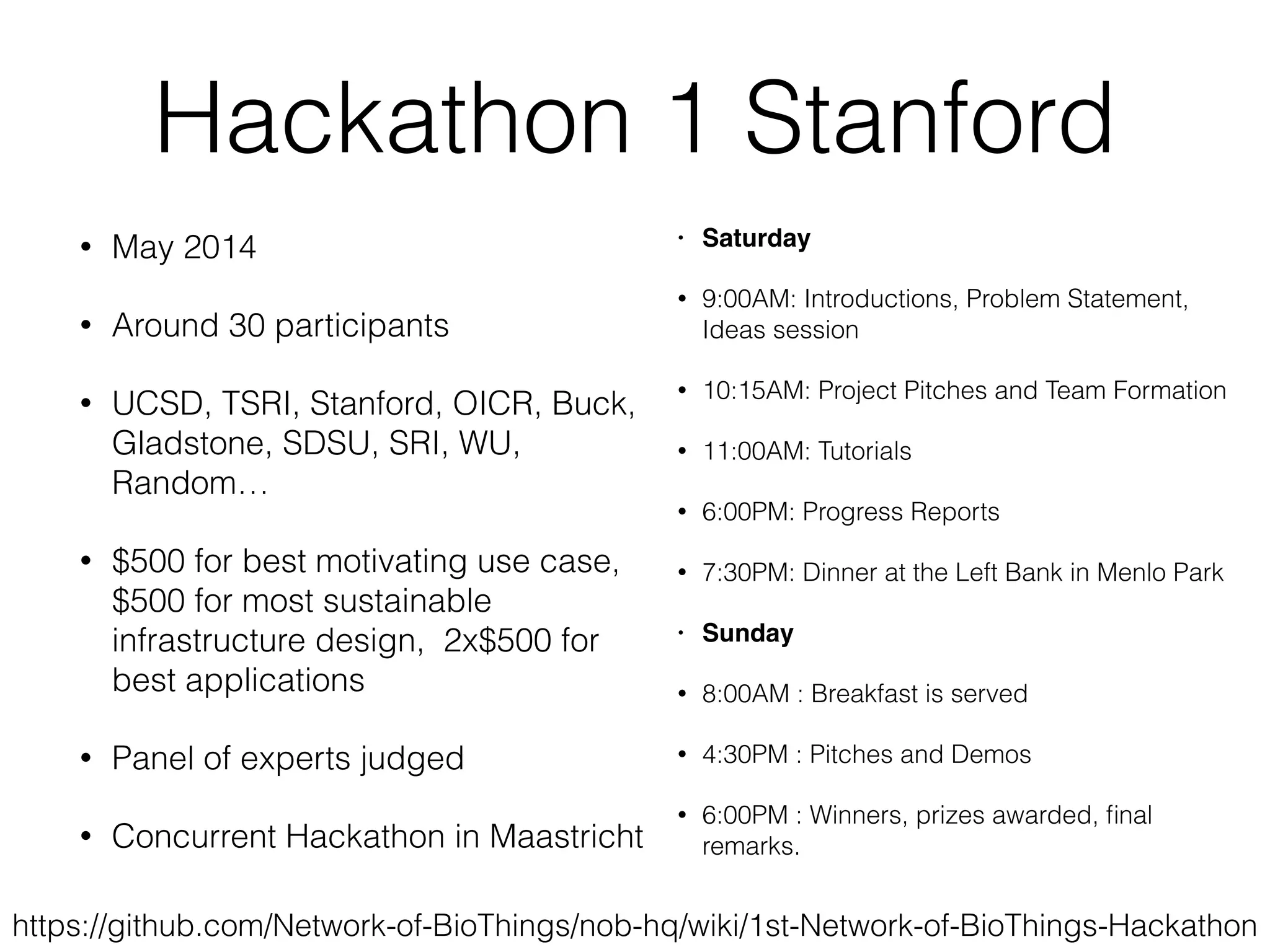
Hackathon 1 Stanford
• May 2014
• Around 30 participants
• UCSD, TSRI, Stanford, OICR, Buck,
Gladstone, SDSU, SRI, WU,
Random…
• $500 for best motivating use case,
$500 for most sustainable
infrastructure design, 2x$500 for
best applications
• Panel of experts judged
• Concurrent Hackathon in Maastricht
https://github.com/Network-of-BioThings/nob-hq/wiki/1st-Network-of-BioThings-Hackathon
• Saturday
• 9:00AM: Introductions, Problem Statement,
Ideas session
• 10:15AM: Project Pitches and Team Formation
• 11:00AM: Tutorials
• 6:00PM: Progress Reports
• 7:30PM: Dinner at the Left Bank in Menlo Park
• Sunday
• 8:00AM : Breakfast is served
• 4:30PM : Pitches and Demos
• 6:00PM : Winners, prizes awarded, final
remarks.
Results
• bioDiscoverer
• gettingCrafty
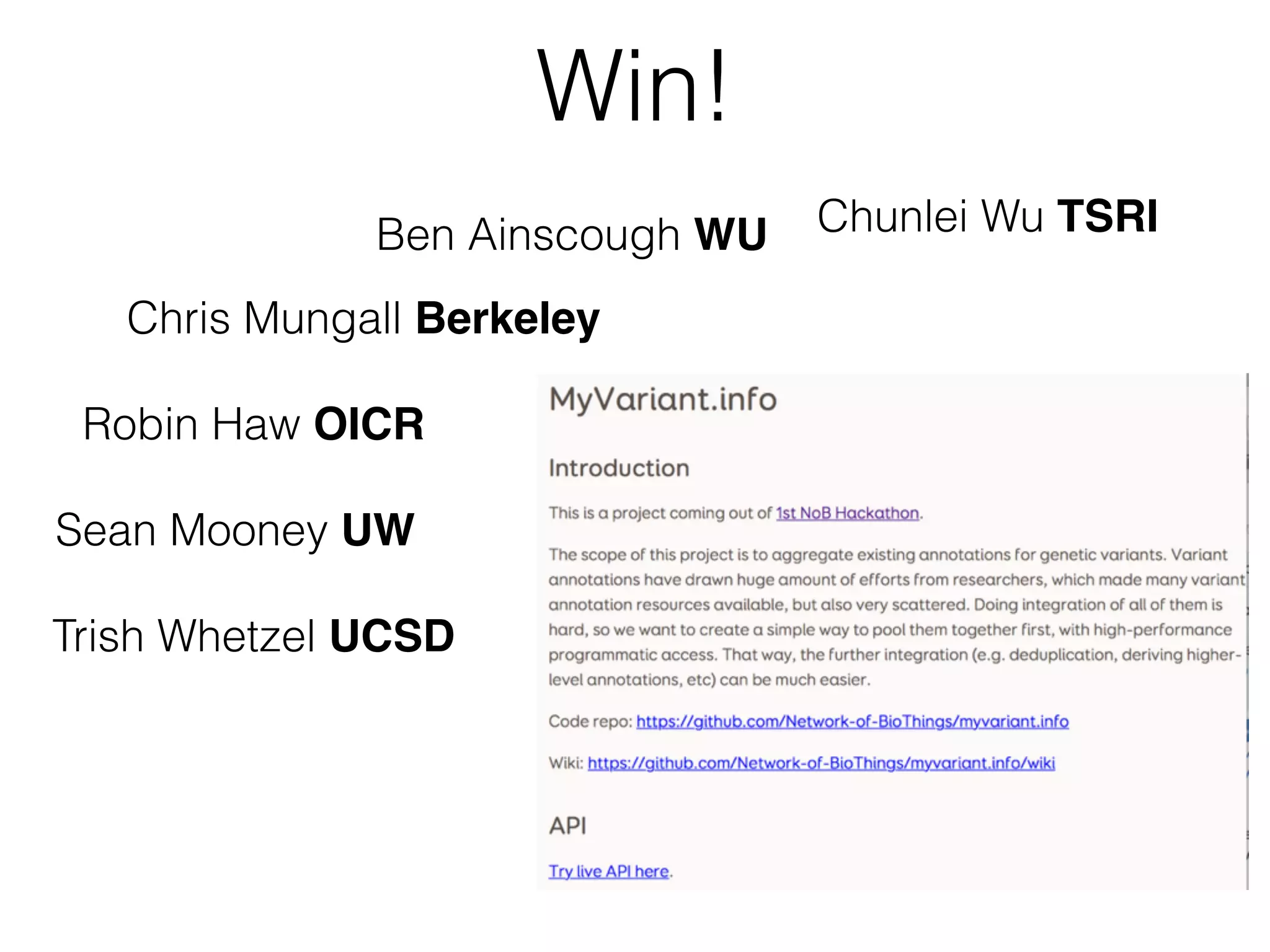
• network of variant annotations
• turned into myvariant.info
• PubMed++
• Whypothesis
• Given a hypothetical drug-disease association, propose a
mechanism using known drug-gene and disease-gene
interactions. Simplify and visualize the proposed pathway.
Win!
Trish Whetzel UCSD
Robin Haw OICR
Chunlei Wu TSRI
Chris Mungall Berkeley
Ben Ainscough WU
Sean Mooney UW
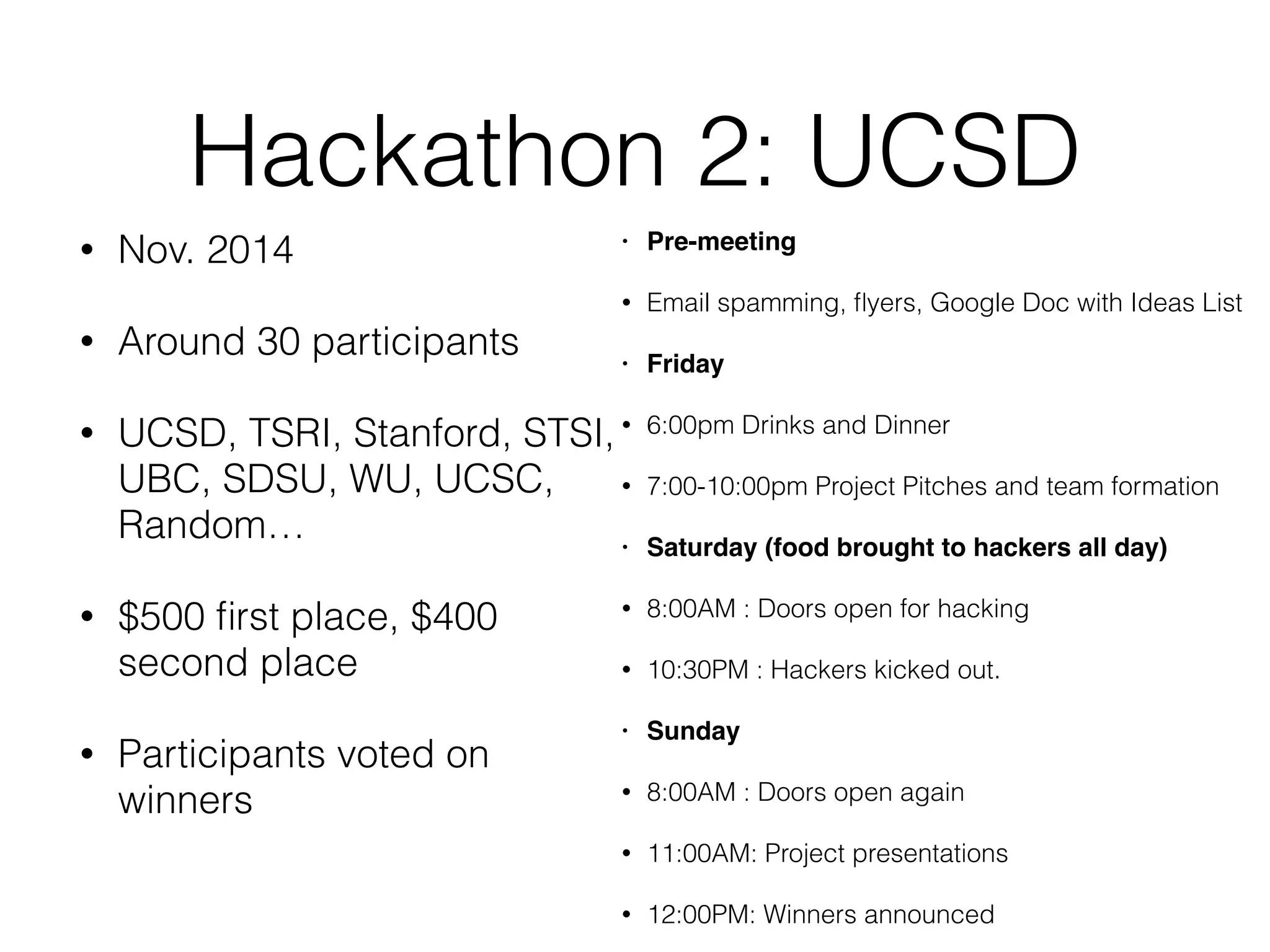
Hackathon 2: UCSD
• Nov. 2014
• Around 30 participants
• UCSD, TSRI, Stanford, STSI,
UBC, SDSU, WU, UCSC,
Random…
• $500 first place, $400
second place
• Participants voted on
winners
• Pre-meeting
• Email spamming, flyers, Google Doc with Ideas List
• Friday
• 6:00pm Drinks and Dinner
• 7:00-10:00pm Project Pitches and team formation
• Saturday (food brought to hackers all day)
• 8:00AM : Doors open for hacking
• 10:30PM : Hackers kicked out.
• Sunday
• 8:00AM : Doors open again
• 11:00AM: Project presentations
• 12:00PM: Winners announced
Projects
• BioPolymer: A set of embeddable web components to display and edit bio data. Initially data from MyGene &
MyVariant. Team: Mark Fortner, Keiichiro Ono
• SameSame: a dynamic tool for finding and visualizing the degree of similarity between any set of biomedical
concepts. Team: Benjamin Good, Maulik Kamdar, Alan Higgins, Alex Williams
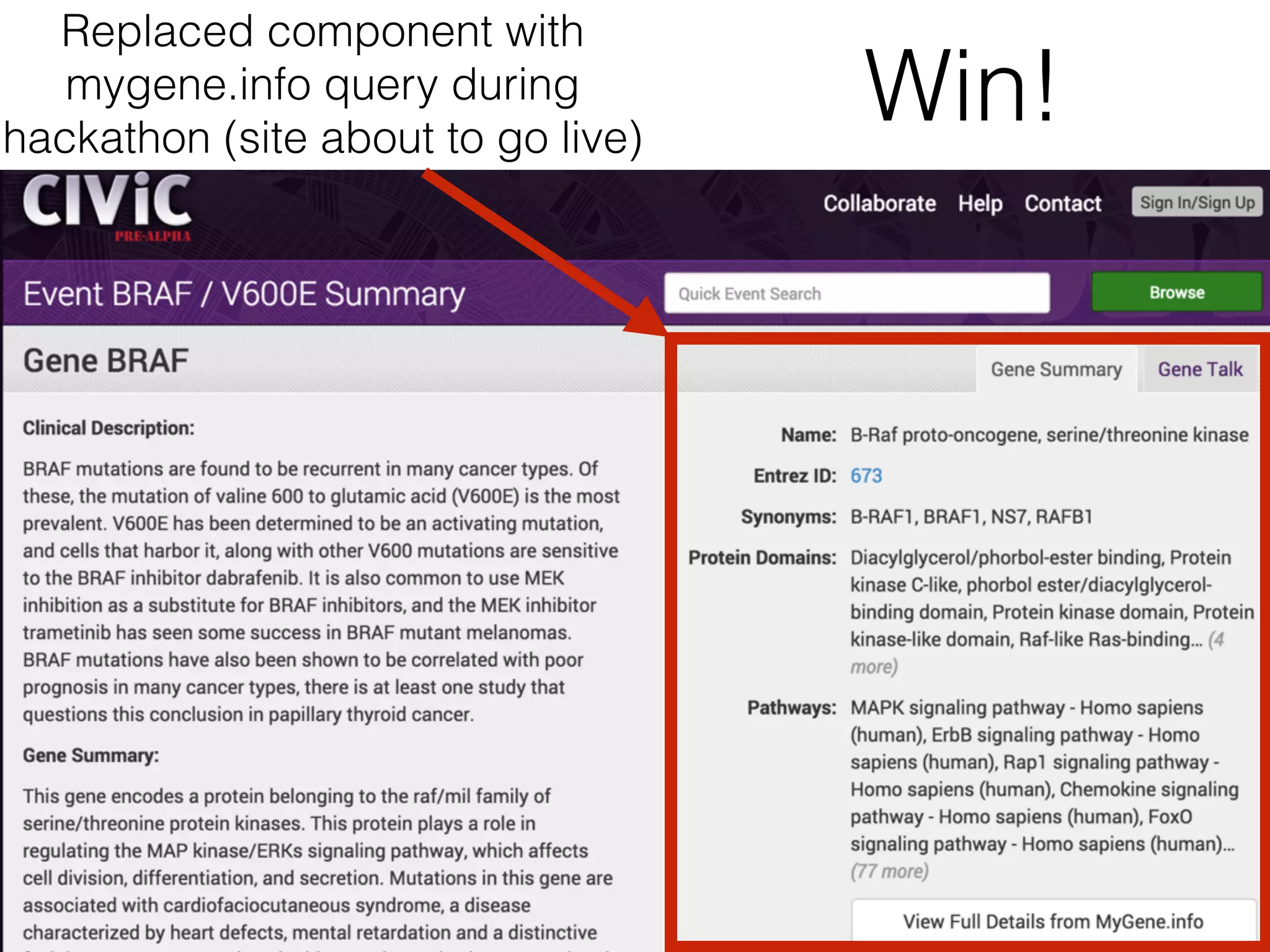
• CIViC - Clinical Interpretation of Variants in Cancer: Crowdsourcing and web interface for curation of clinically
actionable evidence in cancer. Team: Obi Griffith, Adam Coffman, Martin Jones, Karthik G, Jon Cristensen, Julianne
Schneider
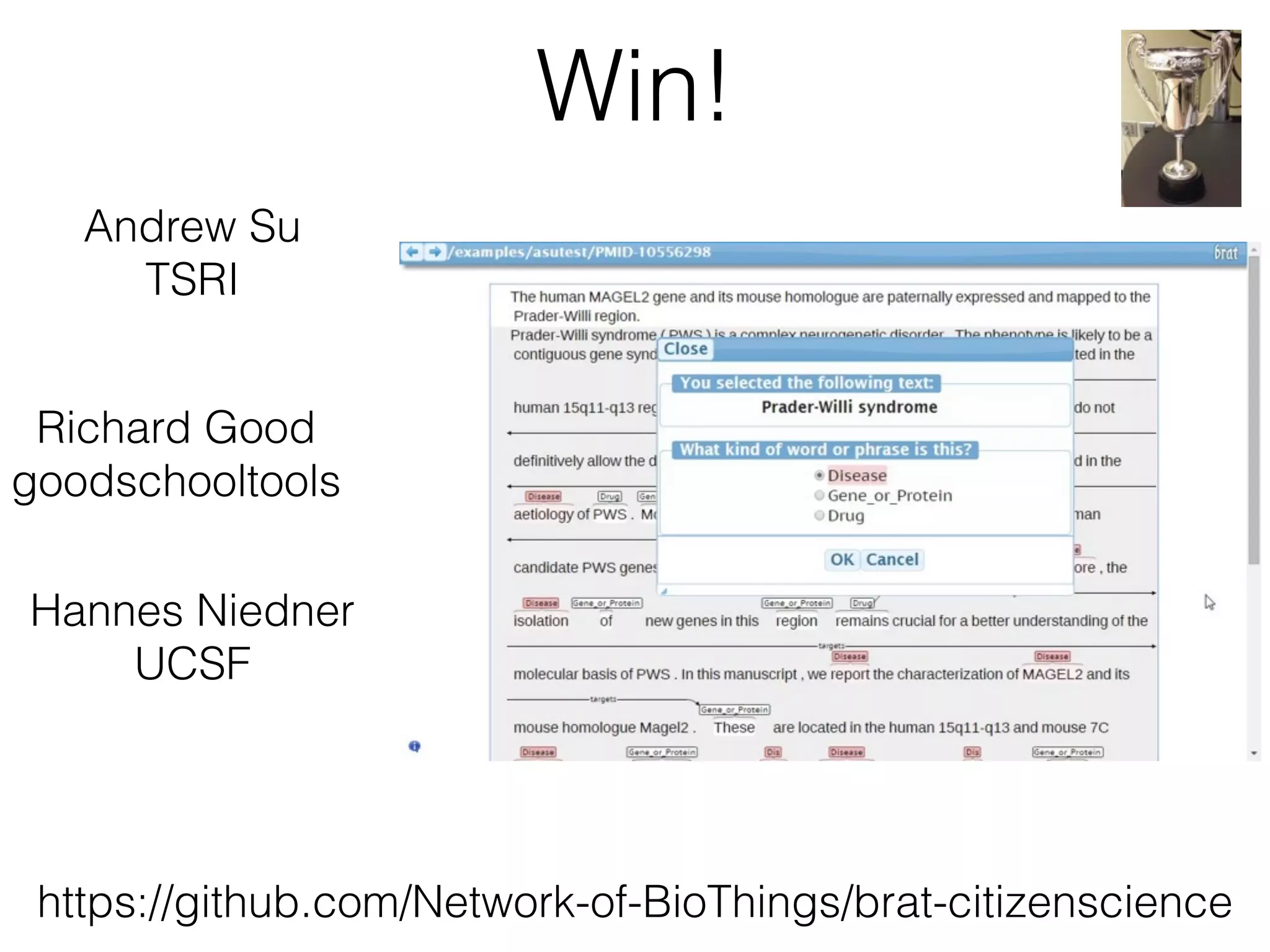
• Citizen Science: An app to enable people to extract structured ‘facts’ (subject predicate object triples) from
unstructured text. Here is the project presentation. Team: Richard Good, Hannes Niedner, Andrew Su
• SBiDer: Synthetic Biocircuit Developer: A web-app to search a database of operons [functional biochemical
pathways] to use them in new and novel ways [to make synthetic organisms such as the ones used to make this
Malaria treatment]. Team Justin Huang, Kwat Yeerna, Fernando Contreras, Joaquin Reyna, Jenhan Tao
• NDex: The NDEx project provides a public website where scientists and organizations can share, store, manipulate,
and publish biological network knowledge. Team Dexter Pratt
• fiSSEA: A framework that integrates MyGene.info and MyVariant.info to retrieve functional prediction annotations (or
any type of annotation) for knowledge discovery, specifically implement CADD scores for “functional impact SNP Set
Enrichment Analysis". Team: Adam Mark, Erick Scott, Chunlei Wu
• MyGene.Info Taxonomy Query: Added detailed taxonomy information to mygene.info. Allows queries based on
taxonomy ID and advanced queries based on hierarchies of taxonomic nodes. Team: Greg Stupp, Chunlei Wu
Win!
Andrew Su
TSRI
Richard Good
goodschooltools
https://github.com/Network-of-BioThings/brat-citizenscience
Hannes Niedner
UCSF
Win!
Replaced component with
mygene.info query during
hackathon (site about to go live)
Win of a different kind
Team of 1 (NDex project)
Clearly enjoyed weekend as
a Programmer rather than
Project Director..
How - the 6Gs of running a
hackathon
• Get people to show up
• Get them to talk to each other
• Get them to pick projects and form teams
• Get them working
• Get them to present their work
• Give out prizes to the best projects

(Bio)Hackathons

  • 1.
    (Bio)Hackathons: What, Why, andHow Benjamin Good TSRI @bgood Wikimedia Techcrunch
  • 2.
  • 3.
    Like an (un)conference Butyou create something in the process
  • 4.
    Why? • Collaborative Creativity •Learning (e.g. new APIs) • Advertising.. (e.g. pushing your new API..) • Networking Hackathons are for:
  • 5.
  • 6.
    Goal: Assemble anetwork of biomedical entities that is comprehensive, current, and computable. Pathways Diseases Proteins Variants Genes Drugs BioThings(Credit Andrew Su) An example
  • 7.
    Hackathon 1 Stanford •May 2014 • Around 30 participants • UCSD, TSRI, Stanford, OICR, Buck, Gladstone, SDSU, SRI, WU, Random… • $500 for best motivating use case, $500 for most sustainable infrastructure design, 2x$500 for best applications • Panel of experts judged • Concurrent Hackathon in Maastricht https://github.com/Network-of-BioThings/nob-hq/wiki/1st-Network-of-BioThings-Hackathon • Saturday • 9:00AM: Introductions, Problem Statement, Ideas session • 10:15AM: Project Pitches and Team Formation • 11:00AM: Tutorials • 6:00PM: Progress Reports • 7:30PM: Dinner at the Left Bank in Menlo Park • Sunday • 8:00AM : Breakfast is served • 4:30PM : Pitches and Demos • 6:00PM : Winners, prizes awarded, final remarks.
  • 8.
    Results • bioDiscoverer • gettingCrafty •network of variant annotations • turned into myvariant.info • PubMed++ • Whypothesis • Given a hypothetical drug-disease association, propose a mechanism using known drug-gene and disease-gene interactions. Simplify and visualize the proposed pathway.
  • 9.
    Win! Trish Whetzel UCSD RobinHaw OICR Chunlei Wu TSRI Chris Mungall Berkeley Ben Ainscough WU Sean Mooney UW
  • 10.
    Hackathon 2: UCSD •Nov. 2014 • Around 30 participants • UCSD, TSRI, Stanford, STSI, UBC, SDSU, WU, UCSC, Random… • $500 first place, $400 second place • Participants voted on winners • Pre-meeting • Email spamming, flyers, Google Doc with Ideas List • Friday • 6:00pm Drinks and Dinner • 7:00-10:00pm Project Pitches and team formation • Saturday (food brought to hackers all day) • 8:00AM : Doors open for hacking • 10:30PM : Hackers kicked out. • Sunday • 8:00AM : Doors open again • 11:00AM: Project presentations • 12:00PM: Winners announced
  • 11.
    Projects • BioPolymer: Aset of embeddable web components to display and edit bio data. Initially data from MyGene & MyVariant. Team: Mark Fortner, Keiichiro Ono • SameSame: a dynamic tool for finding and visualizing the degree of similarity between any set of biomedical concepts. Team: Benjamin Good, Maulik Kamdar, Alan Higgins, Alex Williams • CIViC - Clinical Interpretation of Variants in Cancer: Crowdsourcing and web interface for curation of clinically actionable evidence in cancer. Team: Obi Griffith, Adam Coffman, Martin Jones, Karthik G, Jon Cristensen, Julianne Schneider • Citizen Science: An app to enable people to extract structured ‘facts’ (subject predicate object triples) from unstructured text. Here is the project presentation. Team: Richard Good, Hannes Niedner, Andrew Su • SBiDer: Synthetic Biocircuit Developer: A web-app to search a database of operons [functional biochemical pathways] to use them in new and novel ways [to make synthetic organisms such as the ones used to make this Malaria treatment]. Team Justin Huang, Kwat Yeerna, Fernando Contreras, Joaquin Reyna, Jenhan Tao • NDex: The NDEx project provides a public website where scientists and organizations can share, store, manipulate, and publish biological network knowledge. Team Dexter Pratt • fiSSEA: A framework that integrates MyGene.info and MyVariant.info to retrieve functional prediction annotations (or any type of annotation) for knowledge discovery, specifically implement CADD scores for “functional impact SNP Set Enrichment Analysis". Team: Adam Mark, Erick Scott, Chunlei Wu • MyGene.Info Taxonomy Query: Added detailed taxonomy information to mygene.info. Allows queries based on taxonomy ID and advanced queries based on hierarchies of taxonomic nodes. Team: Greg Stupp, Chunlei Wu
  • 12.
  • 13.
    Win! Replaced component with mygene.infoquery during hackathon (site about to go live)
  • 14.
    Win of adifferent kind Team of 1 (NDex project) Clearly enjoyed weekend as a Programmer rather than Project Director..
  • 15.
    How - the6Gs of running a hackathon • Get people to show up • Get them to talk to each other • Get them to pick projects and form teams • Get them working • Get them to present their work • Give out prizes to the best projects