ANTI VIRUS PACKAGES
V I R U S
!
Introduction to Virus.
Virus Protection, Deletion & Removal Utilities
Anti-Virus Packages to Prevent, detect & Delete Virus
Viruses, worms, Trojans, and bots are all pats of a class of software
called Malware.
Malware of malicious code is short for malicious software. It is code of
software that is specifically designed to damage, disrupt, steal, or in
general inflict some other “bad” of illegitimate action on data, hosts, or
networks.
Malware cannot damage the physical hardware of systems network
equipment, but is can damage the data and software residing on the
equipment.
What is Malware ?
INTRODUCTION TO VIRUS
A computer virus is a software programwith a abilityto make copies of itself , which
attacks itself to other application or files.
A virus cannot run by itself; it requires that its host programbe run to make the virus
active.
Almost all viruses are attached to an Executablefile.
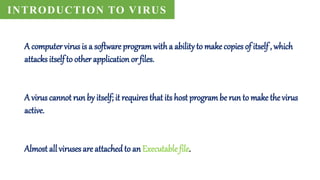
Classification
VIRUS
4. TSR ( Terminateand stayresident )
1. Boot Virus
5. File infecting viruses ( ProgramVirus)
2. Micro Virus
3. Multipartite
1. Boot Viruses
Boot viruses infects the boot records of harddisk and floppy disks.
Generally these are consideredmore dangerous than programviruses.
A Boot record infectoris a piece of malware that inserts malicious code into
the boot sector of a disk.
2. Macro Virus
These viruses infects data files.
For example, Microsoft word document and template files are susceptibleto
macro virus attacks the spread rapidlyas infecteddocuments are sharedon
networks or downloaded frominternet sites.
3. Multipartite Virus
A multipartite virus is a virus that can infest eitherboot sectors or
executable.
Sucha virus typically has two parts, one for eachtype.
* When it infects an executable, it acts 3 as an executableinfector.
*When it infects a boot sector, it works as a boot sector infector.
4. Terminate and stay resident
A TSR virus is a virus that stays active in memory after the application ( or
bootstrapping, of disk mounting ) has terminated.
TSR viruses can be boot sector infectors or executable infectors.
The brain virus is a TSR virus.
5. File Infecting Viruses
These viruses infect programfiles, which have extensions such as .com, .exe,
.sys, .dll, .ovl or .scr. Programfiles are attractive targets for computer virus
because they are widelyused and have relativity, simpleformats to which
viruses can attach themselves.
Types of Viruses
1) Worms 2) Trojan Horse 3) Bombs
1). Computer Worm
A computer Wormis a standalone malware computer programthat
replicates itself in order to spread to other computers.
Examples : Klez, Nimda, Code Redetc.
2). Trojan Horse Viruses
Trojan Horse, or Trojan, is any malicious computer programwhichis used
to hack into a computer by misleading users of its true intent.
Logic Bombs that execute a certain payloadat a pre-definedtime or when
some other condition is met. This technique can be usedby a virus or worm
to gain momentumand spreadbefore being noticed.
Logic Bombs are usually timed to do maximumdamage.
3). Logic Bombs
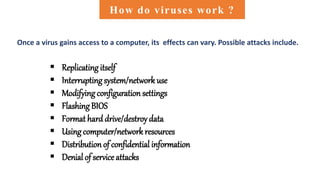
 Replicating itself
 Interrupting system/network use
 Modifying configuration settings
 FlashingBIOS
 Format hard drive/destroy data
 Using computer/network resources
 Distribution of confidential information
 Denial of service attacks
How do viruses work ?
Once a virus gains access to a computer, its effects can vary. Possible attacks include.
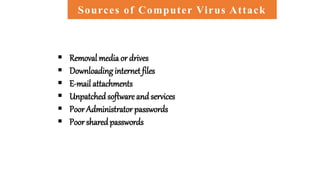
Sources of Computer Virus Attack
 Removal media or drives
 Downloading internet files
 E-mail attachments
 Unpatchedsoftware and services
 Poor Administrator passwords
 Poor shared passwords
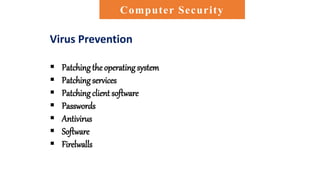
Computer Security
 Patchingthe operating system
 Patchingservices
 Patchingclient software
 Passwords
 Antivirus
 Software
 Firelwalls
Virus Prevention
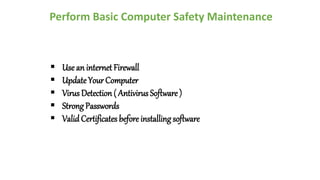
Perform Basic Computer Safety Maintenance
 Use an internet Firewall
 Update Your Computer
 Virus Detection ( Antivirus Software )
 Strong Passwords
 ValidCertificates before installing software
collezian
Click Here
Name : Md. Azad
Branch : Computer Science and Engineering
Governments Polytechnic Chapra

Computer viruses

  • 1.
    ANTI VIRUS PACKAGES VI R U S ! Introduction to Virus. Virus Protection, Deletion & Removal Utilities Anti-Virus Packages to Prevent, detect & Delete Virus
  • 2.
    Viruses, worms, Trojans,and bots are all pats of a class of software called Malware. Malware of malicious code is short for malicious software. It is code of software that is specifically designed to damage, disrupt, steal, or in general inflict some other “bad” of illegitimate action on data, hosts, or networks. Malware cannot damage the physical hardware of systems network equipment, but is can damage the data and software residing on the equipment. What is Malware ?
  • 3.
    INTRODUCTION TO VIRUS Acomputer virus is a software programwith a abilityto make copies of itself , which attacks itself to other application or files. A virus cannot run by itself; it requires that its host programbe run to make the virus active. Almost all viruses are attached to an Executablefile.
  • 4.
    Classification VIRUS 4. TSR (Terminateand stayresident ) 1. Boot Virus 5. File infecting viruses ( ProgramVirus) 2. Micro Virus 3. Multipartite
  • 5.
    1. Boot Viruses Bootviruses infects the boot records of harddisk and floppy disks. Generally these are consideredmore dangerous than programviruses. A Boot record infectoris a piece of malware that inserts malicious code into the boot sector of a disk.
  • 6.
    2. Macro Virus Theseviruses infects data files. For example, Microsoft word document and template files are susceptibleto macro virus attacks the spread rapidlyas infecteddocuments are sharedon networks or downloaded frominternet sites.
  • 7.
    3. Multipartite Virus Amultipartite virus is a virus that can infest eitherboot sectors or executable. Sucha virus typically has two parts, one for eachtype. * When it infects an executable, it acts 3 as an executableinfector. *When it infects a boot sector, it works as a boot sector infector.
  • 8.
    4. Terminate andstay resident A TSR virus is a virus that stays active in memory after the application ( or bootstrapping, of disk mounting ) has terminated. TSR viruses can be boot sector infectors or executable infectors. The brain virus is a TSR virus.
  • 9.
    5. File InfectingViruses These viruses infect programfiles, which have extensions such as .com, .exe, .sys, .dll, .ovl or .scr. Programfiles are attractive targets for computer virus because they are widelyused and have relativity, simpleformats to which viruses can attach themselves.
  • 10.
    Types of Viruses 1)Worms 2) Trojan Horse 3) Bombs
  • 11.
    1). Computer Worm Acomputer Wormis a standalone malware computer programthat replicates itself in order to spread to other computers. Examples : Klez, Nimda, Code Redetc.
  • 12.
    2). Trojan HorseViruses Trojan Horse, or Trojan, is any malicious computer programwhichis used to hack into a computer by misleading users of its true intent.
  • 13.
    Logic Bombs thatexecute a certain payloadat a pre-definedtime or when some other condition is met. This technique can be usedby a virus or worm to gain momentumand spreadbefore being noticed. Logic Bombs are usually timed to do maximumdamage. 3). Logic Bombs
  • 14.
     Replicating itself Interrupting system/network use  Modifying configuration settings  FlashingBIOS  Format hard drive/destroy data  Using computer/network resources  Distribution of confidential information  Denial of service attacks How do viruses work ? Once a virus gains access to a computer, its effects can vary. Possible attacks include.
  • 15.
    Sources of ComputerVirus Attack  Removal media or drives  Downloading internet files  E-mail attachments  Unpatchedsoftware and services  Poor Administrator passwords  Poor shared passwords
  • 16.
    Computer Security  Patchingtheoperating system  Patchingservices  Patchingclient software  Passwords  Antivirus  Software  Firelwalls Virus Prevention
  • 17.
    Perform Basic ComputerSafety Maintenance  Use an internet Firewall  Update Your Computer  Virus Detection ( Antivirus Software )  Strong Passwords  ValidCertificates before installing software
  • 18.
    collezian Click Here Name :Md. Azad Branch : Computer Science and Engineering Governments Polytechnic Chapra