Program ThreatsVirus & logic bombPrepared and presented by :Medhat Dawoud5/10/20101
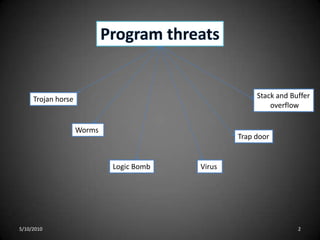
Program threatsStack and BufferoverflowTrojan horseWorms Trap doorLogic BombVirus 5/10/20102
Logic BombProgram that initiates a security incident under certain circumstances.Known by the Mentor Programmers (or any other one want to be professional in IT world).5/10/20103
VirusCode fragment embedded in legitimate program.
How do viruses work ?
Very specific to CPU architecture, operating system, applications.
Usually borne via email or as a macro.5/10/20104
Virus Con."payload" of a virus is the part of the software that actually does the damage; the rest of the virus is used to break the security.Virus dropper inserts virus onto the system.virus signature is a pattern (a series of bytes) that can be used to identify the virus .5/10/20105
Virus CategoriesMany categories of viruses, literally many thousands of viruses so that you can find a virus in two or more categories:FileBootMacroSource codePolymorphicEncryptedStealthTunnelingMultipartiteArmored5/10/20106
FileAppend itself to a file.Change the start of the program to its code.Known as parasitic viruses.usually with extensions .BIN, .COM, .EXE, .OVL, .DRV.5/10/20107
BootThe boot sector carries the Mater Boot Record (MBR) which read and load the operating system.Boot-sector viruses infect computer systems by copying code either to the boot sector on a floppy disk or the partition table on a hard disk.Executed every time the system is booting.Known as memory viruses.5/10/20108
5/10/20109
Example for :Wreak havoc5/10/201010
MacroWritten in a high-level language.macros start automatically when a document is opened or closed (word – Excel).can be spread through e-mail attachments, discs, networks, modems, and the Internet.5/10/201011
Viruses for freeAntivirus withMillions $$5/10/201012
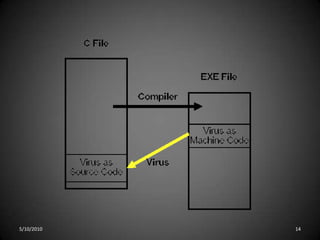
Source codeLooks for a source code and modifies it to include the virus and to help spread the virus.5/10/201013
5/10/201014
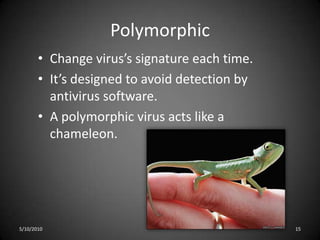
PolymorphicChange virus’s signature each time.It’s designed to avoid detection by antivirus software.A polymorphic virus acts like a chameleon.5/10/201015
EncryptedEncrypted virus to avoid detection.It has a decryption code along with the encrypted virus.5/10/201016
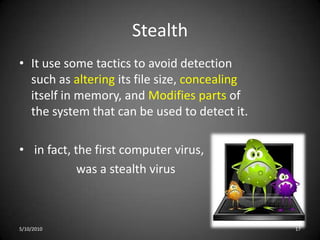
StealthIt use some tactics to avoid detection such as altering its file size, concealing itself in memory, and Modifies parts of the system that can be used to detect it. in fact, the first computer virus,                  was a stealth virus5/10/201017
TunnelingInstall itself in the interrupt-handler chain or in device drivers attempting to bypass detection.Try to  intercept the actions before the anti-virus software can detect the malicious code.5/10/201018

Program Threats

  • 1.
    Program ThreatsVirus &logic bombPrepared and presented by :Medhat Dawoud5/10/20101
  • 2.
    Program threatsStack andBufferoverflowTrojan horseWorms Trap doorLogic BombVirus 5/10/20102
  • 3.
    Logic BombProgram thatinitiates a security incident under certain circumstances.Known by the Mentor Programmers (or any other one want to be professional in IT world).5/10/20103
  • 4.
    VirusCode fragment embeddedin legitimate program.
  • 5.
  • 6.
    Very specific toCPU architecture, operating system, applications.
  • 7.
    Usually borne viaemail or as a macro.5/10/20104
  • 8.
    Virus Con."payload" ofa virus is the part of the software that actually does the damage; the rest of the virus is used to break the security.Virus dropper inserts virus onto the system.virus signature is a pattern (a series of bytes) that can be used to identify the virus .5/10/20105
  • 9.
    Virus CategoriesMany categoriesof viruses, literally many thousands of viruses so that you can find a virus in two or more categories:FileBootMacroSource codePolymorphicEncryptedStealthTunnelingMultipartiteArmored5/10/20106
  • 10.
    FileAppend itself toa file.Change the start of the program to its code.Known as parasitic viruses.usually with extensions .BIN, .COM, .EXE, .OVL, .DRV.5/10/20107
  • 11.
    BootThe boot sectorcarries the Mater Boot Record (MBR) which read and load the operating system.Boot-sector viruses infect computer systems by copying code either to the boot sector on a floppy disk or the partition table on a hard disk.Executed every time the system is booting.Known as memory viruses.5/10/20108
  • 12.
  • 13.
    Example for :Wreakhavoc5/10/201010
  • 14.
    MacroWritten in ahigh-level language.macros start automatically when a document is opened or closed (word – Excel).can be spread through e-mail attachments, discs, networks, modems, and the Internet.5/10/201011
  • 15.
    Viruses for freeAntiviruswithMillions $$5/10/201012
  • 16.
    Source codeLooks fora source code and modifies it to include the virus and to help spread the virus.5/10/201013
  • 17.
  • 18.
    PolymorphicChange virus’s signatureeach time.It’s designed to avoid detection by antivirus software.A polymorphic virus acts like a chameleon.5/10/201015
  • 19.
    EncryptedEncrypted virus toavoid detection.It has a decryption code along with the encrypted virus.5/10/201016
  • 20.
    StealthIt use sometactics to avoid detection such as altering its file size, concealing itself in memory, and Modifies parts of the system that can be used to detect it. in fact, the first computer virus, was a stealth virus5/10/201017
  • 21.
    TunnelingInstall itself inthe interrupt-handler chain or in device drivers attempting to bypass detection.Try to  intercept the actions before the anti-virus software can detect the malicious code.5/10/201018
  • 22.
    MultipartiteInfect multiple partsof the system.Including boot sector, memory, and files.So it’s difficult to be detected by the antivirus scanner.5/10/201019
  • 23.
    ArmoredThe most dangeroustype. The virus may use methods to make tracing, disassembling, and reverse engineering its code more difficult.Virus droppers and other full files which are part of a virus infestation are hidden.5/10/201020
  • 24.