THE IMPLEMENTATION OF COOPERATIVE
LEARNING BY GIVING INITIAL KNOWLEDGE IN
COLLLOID SYSTEM

BY
SUSILO SUDARMAN
8126141017
DEPARTMENT CHEMISTRY
STATE UNIVERSITYOF MEDAN
2013
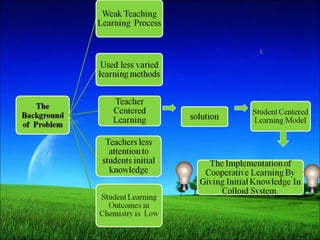
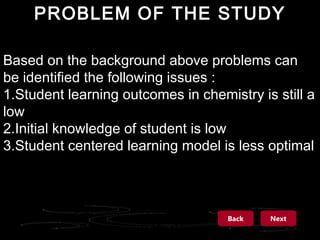
PROBLEM OF THE STUDY
Based on the background above problems can
be identified the following issues :
1.Student learning outcomes in chemistry is still a
low
2.Initial knowledge of student is low
3.Student centered learning model is less optimal

Back

Next
THE SCOPE OF THE
STUDY
As for the limitation problem in this research is
the implementation of cooperative learning by giving initial
knowledge in colloid System in class XI SMA NEGERI 3 BINJAI
academic year 2010/2011

Back

Next
PROBLEM FORMULATION
In the study the formulation of the problem is
Does the implementation of cooperative learning
model by giving initial knowledge the subject of
colloid system better than the implementation of
cooperative learning model without

giving initial

knowledge ?
Back

Next
RESEARCH OBJECTIVES
1. To know student learning outcomes in
chemistry through cooperative learning by
giving initial knowledge in colloid system
2. To know the difference student learning
outcomes in chemistry through cooperative
learning by giving initial knowledge in colloid
system.

Back

Next
THE SIGNIFICANCE OF THE STUDY
1. As an alternative learning model for teachers
to choose the model of learning chemistry
2. For student to be more critical in every
cooperative learning by initial knowledge
3. For information on cooperative material for
advanced

researchers

who

will

conduct

research in the same issue.
Back

Next
THEORETICAL FRAMEWORK
1. Learning is an active process of knowledge
construction in which learners build on initial
knowledge
and experience to shape meaning and construct new
knowledge (Walker & Lambert, 1995).
2. The learning outcomes is a change in behavior that
happens to individuals as a result of his experience.
3. Initial knowledge is a collection of information
obtained from the knowledge and experience of
someone in his life and brings with linking of
information on a new learning experience to learn
certain things that are new to the aforementioned
person.
4. Cooperative learning is an approach to teaching that
makes maximum use of cooperatives activities
involving pairs and small group of learners in the
classroom.
5. Colloid system is The compound between
homogeneous and heterogeneous solution.

Next
CONCEPTUAL FRAMEWORK
Two major components in the learning of teachers and students
interact with each other. Therefore, strategies to teacher by giving initial
knowledge through cooperative model of the material that will be discussed in
a very important lesson. For those students already can imagine the content
will learned, so that it will stimulate interest and arouse curiosity in the students
themselves. Then the teacher also needs to do recitation form of duties related
has been given to material. The teacher evaluates of students in the form of
holding exam. It can be ascertained that these students will be able to answer
is good.
RESEARCH HYPOTHESIS
NOL HYPOTHESIS (H0)

The student learning outcomes chemistry taught the
implementation of cooperative learning by giving initial
knowledge in colloid system no better or equal to the student
learning outcomes

µ1 = µ 2

ALTERNATIF HYPOTHESIS (Ha)
The student learning outcomes chemistry taught the
implementation of cooperative learning by giving
initial knowledge better than without by giving initial
knowledge in colloid system.

µ1 ≠ µ 2

Back

Next
LOCATION AND TIME RESEARCH

Research Location
Location the study in SMAN 3 Binjai

Research Time
The experiment May – June 2011

Back

Next
Population And Sample
Population Research
The population in this study are all class XI
SMA Negeri or SMA Swasta the 2nd
semester of the school year 2010/2011.
The Samples taken SMA Negeri 3 Binjai,
which consists of 2 classes and each class
consists of over 43 students
Research Sample
The sampling technique in this study
is the sampling purposif . In order to obtain
a homogeneous class only two students
from class XI SMA Negeri 3 Binjai in class
XI 1 as a control class, in class XI 2
experiments class.
Back

Next
RESEARCH VARIABLES
The independent
variables

The giving initial knowledge on
cooperative

learning

in

the

experimental class (X1)
The Control
variables

Not given initial knowledge of
cooperative learning

Bound Variables

This experiment student learning
outcomes in colloid system.

Back

Next
Research Instrument
Data collection tool was used to study the results of chemical
tests on sub-topics, in the form of multiple-choice test
consisting of 20 items with 5 options. One option is the
answer key while 4 other option is a distractor

Back

Next
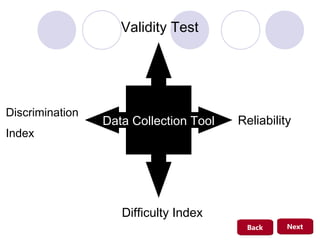
Validity Test

Discrimination
Index

Data Collection Tool

Reliability

Difficulty Index
Back

Next
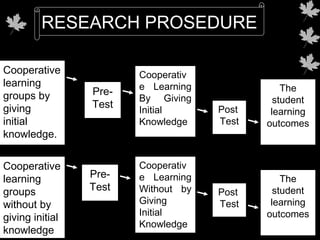
RESEARCH PROSEDURE
Cooperative
learning
groups by
giving
initial
knowledge.
Cooperative
learning
groups
without by
giving initial
knowledge

PreTest

PreTest

Cooperativ
e Learning
By Giving
Initial
Knowledge

Cooperativ
e Learning
Without by
Giving
Initial
Knowledge

Post
Test

Post
Test

The
student
learning
outcomes

The
student
learning
outcomes
Data Collection Techniques
1. Conducting Observations

2. T est Method

Data Analysis Techniques
Normality Test
Homogeneity
Test

Hypothesis Test
Data Analysis and Findings
 The Description of Data

a. The validity Test
Based on the calculation of validity test obtained of 25 valid
questions and 5 questions invalid from 30 questions test. So the
instrument test of learning outcomes is 20 valid question.
 b. The Reliability Test
Based on the calculation of reliability test obtained r11 = 0,86, rtable
= 0.312, because rcalculated > rtable it is means the reliability test is reliable
 c. The Difficulty Index

Based on the calculation Of difficulty index test obtained of 4
difficult questions, 22 medium questions and 4 easy questions
d. The Discrimination Index
Based on the calculation of discrimination index test obtained of
12 questions is good, 10 questions is enough and 8 question is bad
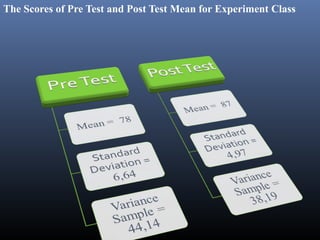
The Scores of Pre Test and Post Test Mean for Experiment Class
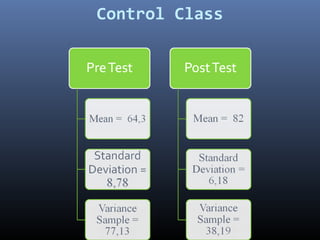
Control Class
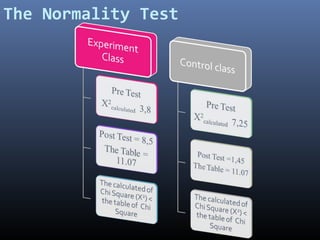
The Normality Test
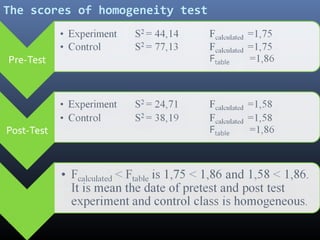
The scores of homogeneity test
The Scores of Hypothesis Test
 Based on the calculation of t-test (see appendix 21),

tcalculated 3,46 and ttable 2,57. It means that the tcalculated is higher
than ttable (tcal = 3,46 < ttable = 2,57). Therefore, it can be
concluded that the null hypothesis (Ho) is rejected and
the alternative hypothesis (Ha) is accepted.

 It is mean that learning outcomes the implementation

of cooperative learning model by giving initial
knowledge better than without by giving initial
knowledge the subject of colloid systems.
Discussion
 Based on the data analysis of the research instrument

initial to classes of samples obtained that the average
results of experiment class = 78.0 ± 6.64 and after
being given the implementation of cooperative learning
by giving initial knowledge = 87 ± 4.97.
 While for control class the average results = 64.3 ± 8.78

and after being cooperative learning without by giving
initial knowledge 82 ± 6.18.
Based on the calculation the hypothesis test of the
obtained tcalculated > ttable = 3.465 > 2.571, so Ha is accepted, it is
means there are the difference of learning outcomes between
the implementation of cooperative learning by giving initial
knowledge with the implementation of cooperative learning
without by giving initial knowledge the subject of colloid
system

At the time of the implementation of cooperative

learning to work of together that involves students
complete the task. The experimental class of each
group in construct knowledge by linking the
information or initial knowledge that has been a new
learning experience to much learning for students. So

that students who already have initial knowledge will
make it easier to follow the next lesson.
There are some constraints that occur in carrying out
this research are:
a) a lack of time given by school to carry out research,
b) a class that is less conducive atmosphere when sitting
divide the group so much time,
c) The class room which is not comparable with the number
of number of students in the classroom, so that teaching and
learning process was not optimal as expected.
Through the implementation of cooperative learning by
giving initial knowledge in colloid system not only improves
the results of students studying chemistry, but to work together
and build a social sense to the students.

Conclusion
Based on the data analysis which are presented in
the previous chapter, the conclusions are drawn as the
following:
1. The finding shows that the implementation of
cooperative learning by giving initial knowledge is
higher that the implementation of cooperative learning
without by giving initial knowledge.
2. The finding shows that the value of giving initial
knowledge is 87 higher than without by giving initial
knowledge.
Suggestions
Having considered the finding of this research, the
suggestion is:
1. The Teachers should as apply of cooperative learning
by giving initial knowledge to students as one of
alternative teaching to teach Colloid Systems.
2. Next research is necessary for research relevant to
the different subjects that as concrete steps to
improve the quality of education, especially study of
chemistry
THANK YOU……

THE IMPLEMENTATION OF COOPERATIVE LEARNING BY GIVING INITIAL KNOWLEDGE IN COLLOID SYSTEM

  • 1.
    THE IMPLEMENTATION OFCOOPERATIVE LEARNING BY GIVING INITIAL KNOWLEDGE IN COLLLOID SYSTEM BY SUSILO SUDARMAN 8126141017 DEPARTMENT CHEMISTRY STATE UNIVERSITYOF MEDAN 2013
  • 3.
    PROBLEM OF THESTUDY Based on the background above problems can be identified the following issues : 1.Student learning outcomes in chemistry is still a low 2.Initial knowledge of student is low 3.Student centered learning model is less optimal Back Next
  • 4.
    THE SCOPE OFTHE STUDY As for the limitation problem in this research is the implementation of cooperative learning by giving initial knowledge in colloid System in class XI SMA NEGERI 3 BINJAI academic year 2010/2011 Back Next
  • 5.
    PROBLEM FORMULATION In thestudy the formulation of the problem is Does the implementation of cooperative learning model by giving initial knowledge the subject of colloid system better than the implementation of cooperative learning model without giving initial knowledge ? Back Next
  • 6.
    RESEARCH OBJECTIVES 1. Toknow student learning outcomes in chemistry through cooperative learning by giving initial knowledge in colloid system 2. To know the difference student learning outcomes in chemistry through cooperative learning by giving initial knowledge in colloid system. Back Next
  • 7.
    THE SIGNIFICANCE OFTHE STUDY 1. As an alternative learning model for teachers to choose the model of learning chemistry 2. For student to be more critical in every cooperative learning by initial knowledge 3. For information on cooperative material for advanced researchers who will conduct research in the same issue. Back Next
  • 8.
    THEORETICAL FRAMEWORK 1. Learningis an active process of knowledge construction in which learners build on initial knowledge and experience to shape meaning and construct new knowledge (Walker & Lambert, 1995). 2. The learning outcomes is a change in behavior that happens to individuals as a result of his experience. 3. Initial knowledge is a collection of information obtained from the knowledge and experience of someone in his life and brings with linking of information on a new learning experience to learn certain things that are new to the aforementioned person.
  • 9.
    4. Cooperative learningis an approach to teaching that makes maximum use of cooperatives activities involving pairs and small group of learners in the classroom. 5. Colloid system is The compound between homogeneous and heterogeneous solution. Next
  • 10.
    CONCEPTUAL FRAMEWORK Two majorcomponents in the learning of teachers and students interact with each other. Therefore, strategies to teacher by giving initial knowledge through cooperative model of the material that will be discussed in a very important lesson. For those students already can imagine the content will learned, so that it will stimulate interest and arouse curiosity in the students themselves. Then the teacher also needs to do recitation form of duties related has been given to material. The teacher evaluates of students in the form of holding exam. It can be ascertained that these students will be able to answer is good.
  • 11.
    RESEARCH HYPOTHESIS NOL HYPOTHESIS(H0) The student learning outcomes chemistry taught the implementation of cooperative learning by giving initial knowledge in colloid system no better or equal to the student learning outcomes µ1 = µ 2 ALTERNATIF HYPOTHESIS (Ha) The student learning outcomes chemistry taught the implementation of cooperative learning by giving initial knowledge better than without by giving initial knowledge in colloid system. µ1 ≠ µ 2 Back Next
  • 12.
    LOCATION AND TIMERESEARCH Research Location Location the study in SMAN 3 Binjai Research Time The experiment May – June 2011 Back Next
  • 13.
    Population And Sample PopulationResearch The population in this study are all class XI SMA Negeri or SMA Swasta the 2nd semester of the school year 2010/2011. The Samples taken SMA Negeri 3 Binjai, which consists of 2 classes and each class consists of over 43 students Research Sample The sampling technique in this study is the sampling purposif . In order to obtain a homogeneous class only two students from class XI SMA Negeri 3 Binjai in class XI 1 as a control class, in class XI 2 experiments class. Back Next
  • 14.
    RESEARCH VARIABLES The independent variables Thegiving initial knowledge on cooperative learning in the experimental class (X1) The Control variables Not given initial knowledge of cooperative learning Bound Variables This experiment student learning outcomes in colloid system. Back Next
  • 15.
    Research Instrument Data collectiontool was used to study the results of chemical tests on sub-topics, in the form of multiple-choice test consisting of 20 items with 5 options. One option is the answer key while 4 other option is a distractor Back Next
  • 16.
    Validity Test Discrimination Index Data CollectionTool Reliability Difficulty Index Back Next
  • 17.
    RESEARCH PROSEDURE Cooperative learning groups by giving initial knowledge. Cooperative learning groups withoutby giving initial knowledge PreTest PreTest Cooperativ e Learning By Giving Initial Knowledge Cooperativ e Learning Without by Giving Initial Knowledge Post Test Post Test The student learning outcomes The student learning outcomes
  • 18.
    Data Collection Techniques 1.Conducting Observations 2. T est Method Data Analysis Techniques Normality Test Homogeneity Test Hypothesis Test
  • 19.
    Data Analysis andFindings  The Description of Data a. The validity Test Based on the calculation of validity test obtained of 25 valid questions and 5 questions invalid from 30 questions test. So the instrument test of learning outcomes is 20 valid question.  b. The Reliability Test Based on the calculation of reliability test obtained r11 = 0,86, rtable = 0.312, because rcalculated > rtable it is means the reliability test is reliable  c. The Difficulty Index Based on the calculation Of difficulty index test obtained of 4 difficult questions, 22 medium questions and 4 easy questions d. The Discrimination Index Based on the calculation of discrimination index test obtained of 12 questions is good, 10 questions is enough and 8 question is bad
  • 20.
    The Scores ofPre Test and Post Test Mean for Experiment Class
  • 21.
  • 22.
  • 23.
    The scores ofhomogeneity test
  • 24.
    The Scores ofHypothesis Test  Based on the calculation of t-test (see appendix 21), tcalculated 3,46 and ttable 2,57. It means that the tcalculated is higher than ttable (tcal = 3,46 < ttable = 2,57). Therefore, it can be concluded that the null hypothesis (Ho) is rejected and the alternative hypothesis (Ha) is accepted.  It is mean that learning outcomes the implementation of cooperative learning model by giving initial knowledge better than without by giving initial knowledge the subject of colloid systems.
  • 25.
    Discussion  Based onthe data analysis of the research instrument initial to classes of samples obtained that the average results of experiment class = 78.0 ± 6.64 and after being given the implementation of cooperative learning by giving initial knowledge = 87 ± 4.97.  While for control class the average results = 64.3 ± 8.78 and after being cooperative learning without by giving initial knowledge 82 ± 6.18.
  • 26.
    Based on thecalculation the hypothesis test of the obtained tcalculated > ttable = 3.465 > 2.571, so Ha is accepted, it is means there are the difference of learning outcomes between the implementation of cooperative learning by giving initial knowledge with the implementation of cooperative learning without by giving initial knowledge the subject of colloid system  At the time of the implementation of cooperative learning to work of together that involves students complete the task. The experimental class of each group in construct knowledge by linking the information or initial knowledge that has been a new learning experience to much learning for students. So that students who already have initial knowledge will make it easier to follow the next lesson.
  • 27.
    There are someconstraints that occur in carrying out this research are: a) a lack of time given by school to carry out research, b) a class that is less conducive atmosphere when sitting divide the group so much time, c) The class room which is not comparable with the number of number of students in the classroom, so that teaching and learning process was not optimal as expected. Through the implementation of cooperative learning by giving initial knowledge in colloid system not only improves the results of students studying chemistry, but to work together and build a social sense to the students.
  • 28.
    Conclusion Based on thedata analysis which are presented in the previous chapter, the conclusions are drawn as the following: 1. The finding shows that the implementation of cooperative learning by giving initial knowledge is higher that the implementation of cooperative learning without by giving initial knowledge. 2. The finding shows that the value of giving initial knowledge is 87 higher than without by giving initial knowledge.
  • 29.
    Suggestions Having considered thefinding of this research, the suggestion is: 1. The Teachers should as apply of cooperative learning by giving initial knowledge to students as one of alternative teaching to teach Colloid Systems. 2. Next research is necessary for research relevant to the different subjects that as concrete steps to improve the quality of education, especially study of chemistry
  • 30.