
C O M PUTER NETWO RKS


  Applications


   Mr. Shylesh B C
Text Book
Computer and Communication Networks
                      By Nader F. Mir
                 Pearson Edition, 2007


     Chapters 9.1 to 9.6, 18.1,18.2
Contents
– Application-layer overview
– Domain Name System (DNS)
– Remote login protocols
– Electronic mail (e-mail)
– File transfer and FTP
– World Wide Web (WWW) and HTTP
– Overview of IP telephony
– VoIP signaling protocols
Application-layer overview
• The application layer is built on the transport
  layer and provides network services to user
  applications
• The application layer defines and performs such
  applications as
  – electronic mail (e-mail), remote access to computers,
    file transfers, newsgroups, and the Web, as well as
    streaming video, Internet radio and telephony, P2P
    file sharing, multi user networked games, streaming
    stored video clips, and real-time video conferencing.
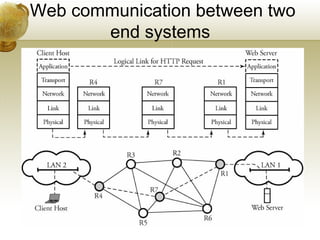
Web communication between two
       end systems
Domain Name System (DNS)
• One of the most important components of the application
  layer is the Domain Name System (DNS) server.
• DNS is a distributed hierarchical and global directory that
  translates machine or domain names to numerical IP
  addresses.
• DNS can be thought as a distributed database system
  used to map host names to IP addresses, and vice
  versa.
• DNS is an application-layer protocol, and every Internet
  service provider whether for an organization, a university
  campus, or even a residence has a DNS server.
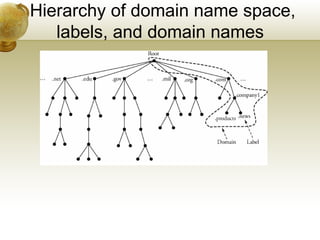
Hierarchy of domain name space,
   labels, and domain names
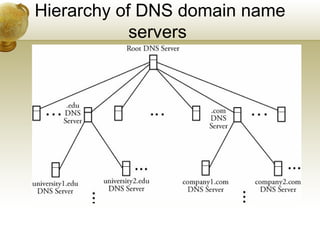
Hierarchy of DNS domain name
            servers
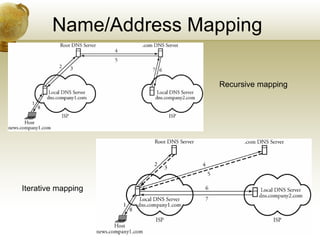
Name/Address Mapping

                       Recursive mapping


Iterative mapping
Remote login protocols
• A client/server model can create a
  mechanism that allows a user to establish
  a session on the remote machine and then
  run its applications.
• This application is known as remote login.
• Two remote login protocols are
  – TELNET
  – SSH.
TELNET Protocol
• TELNET (terminal network) is a TCP/IP
  standard for establishing a connection to a
  remote system.
• TELNET allows a user to log in to a
  remote machine across the Internet by
  first making a TCP connection and then
  pass the detail of the application from the
  user to the remote machine.
Secure Shell (SSH) Protocol
• Secure Shell (SSH), another remote login
  protocol, is based on UNIX programs.
  SSH uses TCP for communications.
• It is more powerful and flexible than
  TELNET and allows the user to more
  easily execute a single command on a
  remote client.
Electronic mail (e-mail)
• It is Simple Mail Transfer Protocol (SMTP) and
  E-mail
• The Simple Mail Transfer Protocol (SMTP) plays
  a major role in transferring Internet electronic
  mail.
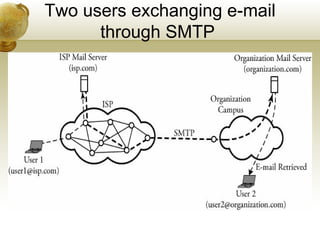
• This protocol transfers electronic mail (e-mail )
  from the mail server of a source to the mail
  servers of destinations.
• SMTP is older than the Hypertext Transfer
  Protocol (HTTP), the Web communication
  protocol, and imposes certain restrictions, such
  as limits on the size of e-mail content.
Two users exchanging e-mail
      through SMTP
File transfer and FTP
• File transfer is another computer
  networking application.
• It is always essential that files and
  information geographically distributed over
  different locations be shared among the
  members of a working group.
• Two file transfer protocols are
  – FTP
  – SCP.
File Transfer Protocol (FTP)
• File Transfer Protocol (FTP) is part of the
  TCP/IP suite and is very similar to
  TELNET.
• Both FTP and TELNET are built on the
  client/server paradigm, and both allow a
  user to establish a remote connection.
• However, TELNET provides a broader
  access to a user, whereas FTP allows
  access only to certain files.
Secure Copy Protocol (SCP)
• The Secure Copy Protocol (SCP) is similar to
  TELNET but is secure.
• Incorporated in the SCP structure are a number of
  encryption and authentication features that are
  similar to those in SSH.
• Also similar is the exchange of commands
  between local and remote hosts.
• SCP commands automatically prompt the user for
  the password information when it is time to
  access a remote machine.
• SCP cannot handle file transfer between
  machines of significantly different architectures.
World Wide Web (WWW) & HTTP
• The World Wide Web (WWW), or simply
  Web, is a global network of servers linked
  by a common protocol allowing access to
  all connected hypertext resources.
• When a client host requests an object, a
  Web server responds by sending the
  requested object through browsing tools.
• A browser is a user agent displaying the
  requested Web page.
• The Hyper Text Transfer Protocol (HTTP)
  transfers that page at the application layer.
• HTTP uses TCP rather than UDP, since
  reliability of delivery is important for Web pages
  with text.
• The TCP connection-establishment delay in
  HTTP is one of the main contributing delay
  factors associated with downloading Web
  documents.
• HTTP is based on the client/server idea, having
  a client and a server program, both of which can
  be executed on different end systems.
• The communication is carried out through an
  exchange of HTTP messages.
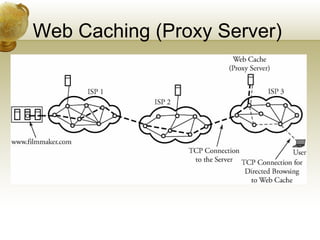
Web Caching (Proxy Server)
Overview of IP telephony
• An IP telephone can be used to make telephone calls
  over IP networks.
• Voice over IP (VoIP), or IP telephony, uses packet-
  switched networks to carry voice traffic in addition to data
  traffic.
• The basic scheme of IP telephony starts with pulse code
  modulation. The encoded data is transmitted as packets
  over packet-switched networks.
• At a receiver, the data is decoded and converted back to
  analog form.
• The packet size must be properly chosen to prevent large
  delays.
• The IP telephone system must also be able to handle the
  signaling function of the call setup, mapping of phone
  number to IP address, and proper call termination.
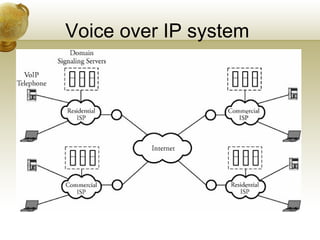
Voice over IP system
VoIP signaling protocols
• The IP telephone system must be able to handle
  signaling for call setup, conversion of phone
  number to IP address mapping, and proper call
  termination.
• Signaling is required for call setup, call
  management, and call termination.
• In the standard telephone network, signaling
  involves identifying the user's location given a
  phone number, finding a route between a calling
  and a called party, and handling the issue of call
  forwarding and other call features.
THANK YOU


 www.shylesh.freevar.com

Computer Networks

  • 1.
    C O MPUTER NETWO RKS Applications Mr. Shylesh B C
  • 2.
    Text Book Computer andCommunication Networks By Nader F. Mir Pearson Edition, 2007 Chapters 9.1 to 9.6, 18.1,18.2
  • 3.
    Contents – Application-layer overview –Domain Name System (DNS) – Remote login protocols – Electronic mail (e-mail) – File transfer and FTP – World Wide Web (WWW) and HTTP – Overview of IP telephony – VoIP signaling protocols
  • 4.
    Application-layer overview • Theapplication layer is built on the transport layer and provides network services to user applications • The application layer defines and performs such applications as – electronic mail (e-mail), remote access to computers, file transfers, newsgroups, and the Web, as well as streaming video, Internet radio and telephony, P2P file sharing, multi user networked games, streaming stored video clips, and real-time video conferencing.
  • 5.
  • 6.
    Domain Name System(DNS) • One of the most important components of the application layer is the Domain Name System (DNS) server. • DNS is a distributed hierarchical and global directory that translates machine or domain names to numerical IP addresses. • DNS can be thought as a distributed database system used to map host names to IP addresses, and vice versa. • DNS is an application-layer protocol, and every Internet service provider whether for an organization, a university campus, or even a residence has a DNS server.
  • 7.
    Hierarchy of domainname space, labels, and domain names
  • 8.
    Hierarchy of DNSdomain name servers
  • 9.
    Name/Address Mapping Recursive mapping Iterative mapping
  • 10.
    Remote login protocols •A client/server model can create a mechanism that allows a user to establish a session on the remote machine and then run its applications. • This application is known as remote login. • Two remote login protocols are – TELNET – SSH.
  • 11.
    TELNET Protocol • TELNET(terminal network) is a TCP/IP standard for establishing a connection to a remote system. • TELNET allows a user to log in to a remote machine across the Internet by first making a TCP connection and then pass the detail of the application from the user to the remote machine.
  • 12.
    Secure Shell (SSH)Protocol • Secure Shell (SSH), another remote login protocol, is based on UNIX programs. SSH uses TCP for communications. • It is more powerful and flexible than TELNET and allows the user to more easily execute a single command on a remote client.
  • 13.
    Electronic mail (e-mail) •It is Simple Mail Transfer Protocol (SMTP) and E-mail • The Simple Mail Transfer Protocol (SMTP) plays a major role in transferring Internet electronic mail. • This protocol transfers electronic mail (e-mail ) from the mail server of a source to the mail servers of destinations. • SMTP is older than the Hypertext Transfer Protocol (HTTP), the Web communication protocol, and imposes certain restrictions, such as limits on the size of e-mail content.
  • 14.
    Two users exchanginge-mail through SMTP
  • 15.
    File transfer andFTP • File transfer is another computer networking application. • It is always essential that files and information geographically distributed over different locations be shared among the members of a working group. • Two file transfer protocols are – FTP – SCP.
  • 16.
    File Transfer Protocol(FTP) • File Transfer Protocol (FTP) is part of the TCP/IP suite and is very similar to TELNET. • Both FTP and TELNET are built on the client/server paradigm, and both allow a user to establish a remote connection. • However, TELNET provides a broader access to a user, whereas FTP allows access only to certain files.
  • 17.
    Secure Copy Protocol(SCP) • The Secure Copy Protocol (SCP) is similar to TELNET but is secure. • Incorporated in the SCP structure are a number of encryption and authentication features that are similar to those in SSH. • Also similar is the exchange of commands between local and remote hosts. • SCP commands automatically prompt the user for the password information when it is time to access a remote machine. • SCP cannot handle file transfer between machines of significantly different architectures.
  • 18.
    World Wide Web(WWW) & HTTP • The World Wide Web (WWW), or simply Web, is a global network of servers linked by a common protocol allowing access to all connected hypertext resources. • When a client host requests an object, a Web server responds by sending the requested object through browsing tools. • A browser is a user agent displaying the requested Web page. • The Hyper Text Transfer Protocol (HTTP) transfers that page at the application layer.
  • 19.
    • HTTP usesTCP rather than UDP, since reliability of delivery is important for Web pages with text. • The TCP connection-establishment delay in HTTP is one of the main contributing delay factors associated with downloading Web documents. • HTTP is based on the client/server idea, having a client and a server program, both of which can be executed on different end systems. • The communication is carried out through an exchange of HTTP messages.
  • 20.
  • 21.
    Overview of IPtelephony • An IP telephone can be used to make telephone calls over IP networks. • Voice over IP (VoIP), or IP telephony, uses packet- switched networks to carry voice traffic in addition to data traffic. • The basic scheme of IP telephony starts with pulse code modulation. The encoded data is transmitted as packets over packet-switched networks. • At a receiver, the data is decoded and converted back to analog form. • The packet size must be properly chosen to prevent large delays. • The IP telephone system must also be able to handle the signaling function of the call setup, mapping of phone number to IP address, and proper call termination.
  • 22.
  • 23.
    VoIP signaling protocols •The IP telephone system must be able to handle signaling for call setup, conversion of phone number to IP address mapping, and proper call termination. • Signaling is required for call setup, call management, and call termination. • In the standard telephone network, signaling involves identifying the user's location given a phone number, finding a route between a calling and a called party, and handling the issue of call forwarding and other call features.
  • 24.