Internet is a global communication system
that links together thousands of individual
networks. It allows exchange of information
between two or more computers on a network.
Thus internet helps in transfer of messages
through mail, chat, video & audio conference,
etc.
The Internet is a vast network that
connects computers all over the world.
Through the Internet, people can share
information and communicate from
anywhere with an Internet connection
Personal Area Network (PAN)
Local Area Network (LAN)
Wireless Local Area Network (WLAN)
Campus Area Network (CAN)
Metropolitan Area Network (MAN)
Wide Area Network (WAN)
Storage-Area Network (SAN)
System-Area Network (also known as SAN)
Network topology describes the physical and logical
relationship of nodes in a network, the schematic arrangement
of the links and nodes, or some hybrid combination thereof.
Communication media refer to the ways, means or channels of
transmitting message from sender to the receiver.
Communication media indicate the use of verbal or non-verbal
language in the process of communication. Without language, none
can communicate. Whenever communication takes place, media
are used there.
The Internet is a vast network that
connects computers all over the
world. Through the Internet, people
can share information and
communicate from anywhere with an
Internet connection.
Internet was based on the idea that there would be
multiple independent networks of rather arbitrary design,
beginning with the ARPANET as the pioneering packet
switching network, but soon to include packet satellite
networks, ground-based packet radio networks and other
networks.
 It works by using a
packet routing
network that follows
Internet Protocol (IP)
and Transport Control
Protocol (TCP) [5]. ...
 TCP and IP work
together to ensure that
data transmission
across the internet is
consistent and reliable,
no matter which device
you're using or where
you're using it.
 Electronic Mail (E-mail) ...
 Telenet. ...
 File Transferring. ...
 Video Conference. ...
 World Wide Web (WWW) ...
 E-commerce. ...
 Electronic Fax (E-FAX) ...
 Newsgroup.
The World Wide Web, commonly known as the
Web, is an information system where documents
and other web resources are identified by Uniform
Resource Locators, which may be interlinked by
hyperlinks, and are accessible over the Internet
 The World Wide Web is based on several
different technologies : Web browsers,
Hypertext Mark up Language (HTML) and
Hypertext Transfer Protocol (HTTP). An
Web browser is used to access web
pages. ... Hyperlinked resources on the
World Wide Web can be accessed using
software interface provided by Web
browsers
 Electronic mail (e-mail) is a computer-
based application for the exchange of
messages between users. A worldwide
e-mail network allows people to exchange
e-mail messages very quickly. E-mail is
the electronic equivalent of a letter, but
with advantages in timeliness and
flexibility.
 Usenet is collection of online discussions that
are organized into news groups. Users may
create their own discussion topics or contribute
to existing threads within a topic. Some
newsgroups provide forums for questions and
answers, while others are designed primarily for
file sharing
 TELNET stands for terminal NET work. It is a type of
protocol that enables one computer to connect to local
computer. It is a used as a standard TCP/IP protocol
for virtual terminal service which is given by ISO. ...
Local computer uses telnet client program and the
remote computers uses telnet server program.
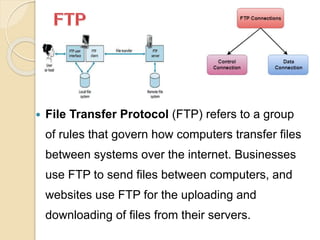
 File Transfer Protocol (FTP) refers to a group
of rules that govern how computers transfer files
between systems over the internet. Businesses
use FTP to send files between computers, and
websites use FTP for the uploading and
downloading of files from their servers.
 Intranet: An intranet is a private network that is contained
within an enterprise. Typical intranet for a business
organization consists of many interlinked local area
networks (LAN) and use any Wide Area Network
(WAN) technology for network connectivity. The main
purpose of an intranet is to share company information
and computing resources among employees. Intranet is a
private Internetwork, which is usually created and
maintained by a private organization. The content
available inside Intranet are intended only for the members
 An extranet can be viewed as part of a company's
intranet that is extended to users outside the
company like suppliers, vendors, partners,
customers, or other business associates.
 Extranet is required for normal day-to-day business
activities. For example, placing purchase order to
registered vendors, billing & invoices, payments
related activities, joint venture related activities,
product brochures for partners, discounted price
lists for partners etc.
Internet

Internet

  • 3.
    Internet is aglobal communication system that links together thousands of individual networks. It allows exchange of information between two or more computers on a network. Thus internet helps in transfer of messages through mail, chat, video & audio conference, etc.
  • 4.
    The Internet isa vast network that connects computers all over the world. Through the Internet, people can share information and communicate from anywhere with an Internet connection
  • 5.
    Personal Area Network(PAN) Local Area Network (LAN) Wireless Local Area Network (WLAN) Campus Area Network (CAN) Metropolitan Area Network (MAN) Wide Area Network (WAN) Storage-Area Network (SAN) System-Area Network (also known as SAN)
  • 7.
    Network topology describesthe physical and logical relationship of nodes in a network, the schematic arrangement of the links and nodes, or some hybrid combination thereof. Communication media refer to the ways, means or channels of transmitting message from sender to the receiver. Communication media indicate the use of verbal or non-verbal language in the process of communication. Without language, none can communicate. Whenever communication takes place, media are used there.
  • 8.
    The Internet isa vast network that connects computers all over the world. Through the Internet, people can share information and communicate from anywhere with an Internet connection. Internet was based on the idea that there would be multiple independent networks of rather arbitrary design, beginning with the ARPANET as the pioneering packet switching network, but soon to include packet satellite networks, ground-based packet radio networks and other networks.
  • 9.
     It worksby using a packet routing network that follows Internet Protocol (IP) and Transport Control Protocol (TCP) [5]. ...  TCP and IP work together to ensure that data transmission across the internet is consistent and reliable, no matter which device you're using or where you're using it.
  • 11.
     Electronic Mail(E-mail) ...  Telenet. ...  File Transferring. ...  Video Conference. ...  World Wide Web (WWW) ...  E-commerce. ...  Electronic Fax (E-FAX) ...  Newsgroup.
  • 12.
    The World WideWeb, commonly known as the Web, is an information system where documents and other web resources are identified by Uniform Resource Locators, which may be interlinked by hyperlinks, and are accessible over the Internet
  • 13.
     The WorldWide Web is based on several different technologies : Web browsers, Hypertext Mark up Language (HTML) and Hypertext Transfer Protocol (HTTP). An Web browser is used to access web pages. ... Hyperlinked resources on the World Wide Web can be accessed using software interface provided by Web browsers
  • 14.
     Electronic mail(e-mail) is a computer- based application for the exchange of messages between users. A worldwide e-mail network allows people to exchange e-mail messages very quickly. E-mail is the electronic equivalent of a letter, but with advantages in timeliness and flexibility.
  • 15.
     Usenet iscollection of online discussions that are organized into news groups. Users may create their own discussion topics or contribute to existing threads within a topic. Some newsgroups provide forums for questions and answers, while others are designed primarily for file sharing  TELNET stands for terminal NET work. It is a type of protocol that enables one computer to connect to local computer. It is a used as a standard TCP/IP protocol for virtual terminal service which is given by ISO. ... Local computer uses telnet client program and the remote computers uses telnet server program.
  • 16.
     File TransferProtocol (FTP) refers to a group of rules that govern how computers transfer files between systems over the internet. Businesses use FTP to send files between computers, and websites use FTP for the uploading and downloading of files from their servers.
  • 17.
     Intranet: Anintranet is a private network that is contained within an enterprise. Typical intranet for a business organization consists of many interlinked local area networks (LAN) and use any Wide Area Network (WAN) technology for network connectivity. The main purpose of an intranet is to share company information and computing resources among employees. Intranet is a private Internetwork, which is usually created and maintained by a private organization. The content available inside Intranet are intended only for the members
  • 18.
     An extranetcan be viewed as part of a company's intranet that is extended to users outside the company like suppliers, vendors, partners, customers, or other business associates.  Extranet is required for normal day-to-day business activities. For example, placing purchase order to registered vendors, billing & invoices, payments related activities, joint venture related activities, product brochures for partners, discounted price lists for partners etc.