Chapter 3: roadmap
 Transport-layer services
 Multiplexing and demultiplexing
 Connectionless transport: UDP
 Principles of reliable data transfer
 Connection-oriented transport: TCP
 Principles of congestion control
 TCP congestion control
 Evolution of transport-layer
functionality
Transport Layer: 3-1
UDP: User Datagram Protocol
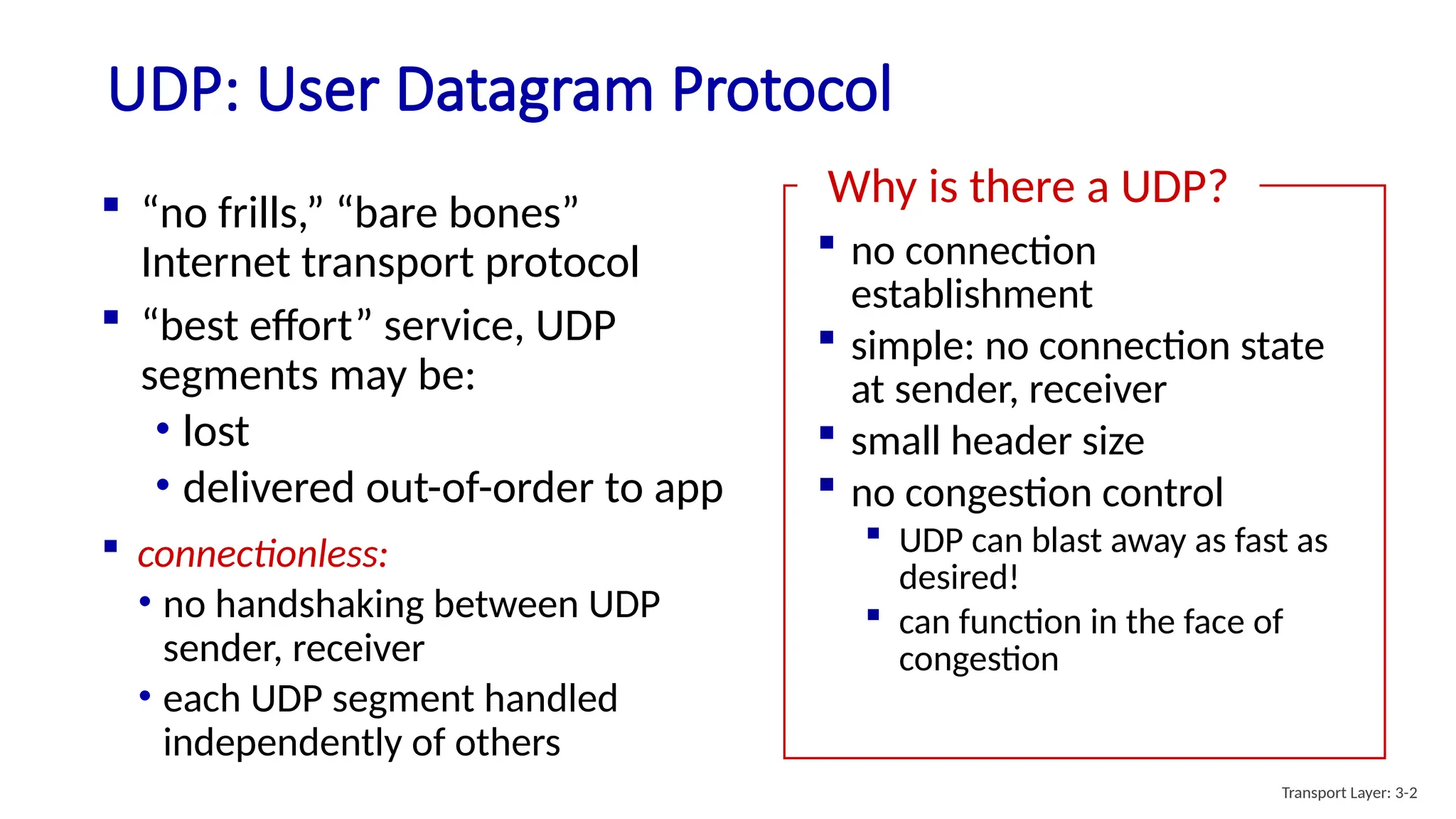
 “no frills,” “bare bones”
Internet transport protocol
 “best effort” service, UDP
segments may be:
• lost
• delivered out-of-order to app
 no connection
establishment
 simple: no connection state
at sender, receiver
 small header size
 no congestion control
 UDP can blast away as fast as
desired!
 can function in the face of
congestion
Why is there a UDP?
 connectionless:
• no handshaking between UDP
sender, receiver
• each UDP segment handled
independently of others
Transport Layer: 3-2
UDP: User Datagram Protocol
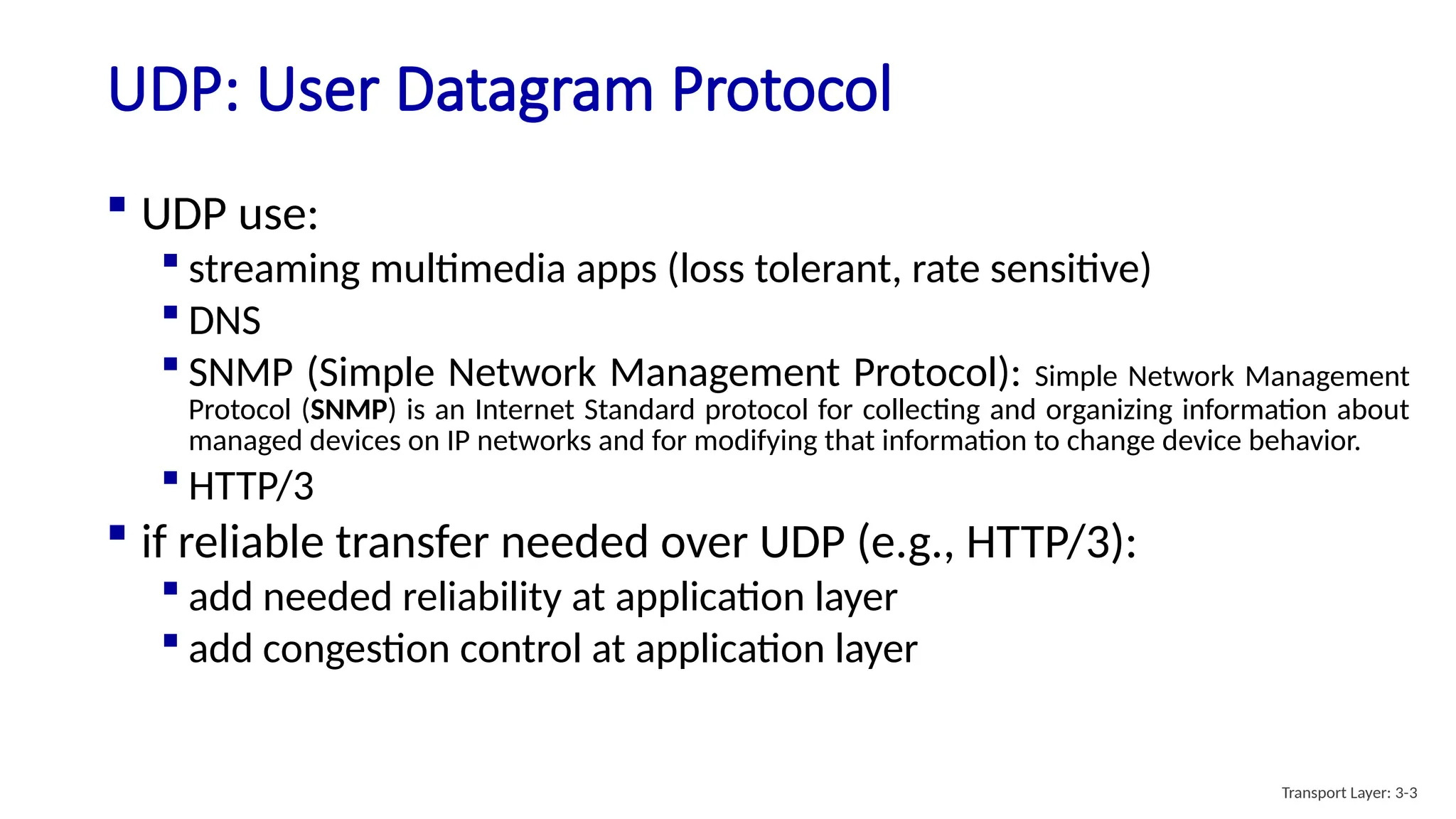
 UDP use:
 streaming multimedia apps (loss tolerant, rate sensitive)
 DNS
 SNMP (Simple Network Management Protocol): Simple Network Management
Protocol (SNMP) is an Internet Standard protocol for collecting and organizing information about
managed devices on IP networks and for modifying that information to change device behavior.
 HTTP/3
 if reliable transfer needed over UDP (e.g., HTTP/3):
 add needed reliability at application layer
 add congestion control at application layer
Transport Layer: 3-3
UDP: User Datagram Protocol [RFC 768]
Transport Layer: 3-4
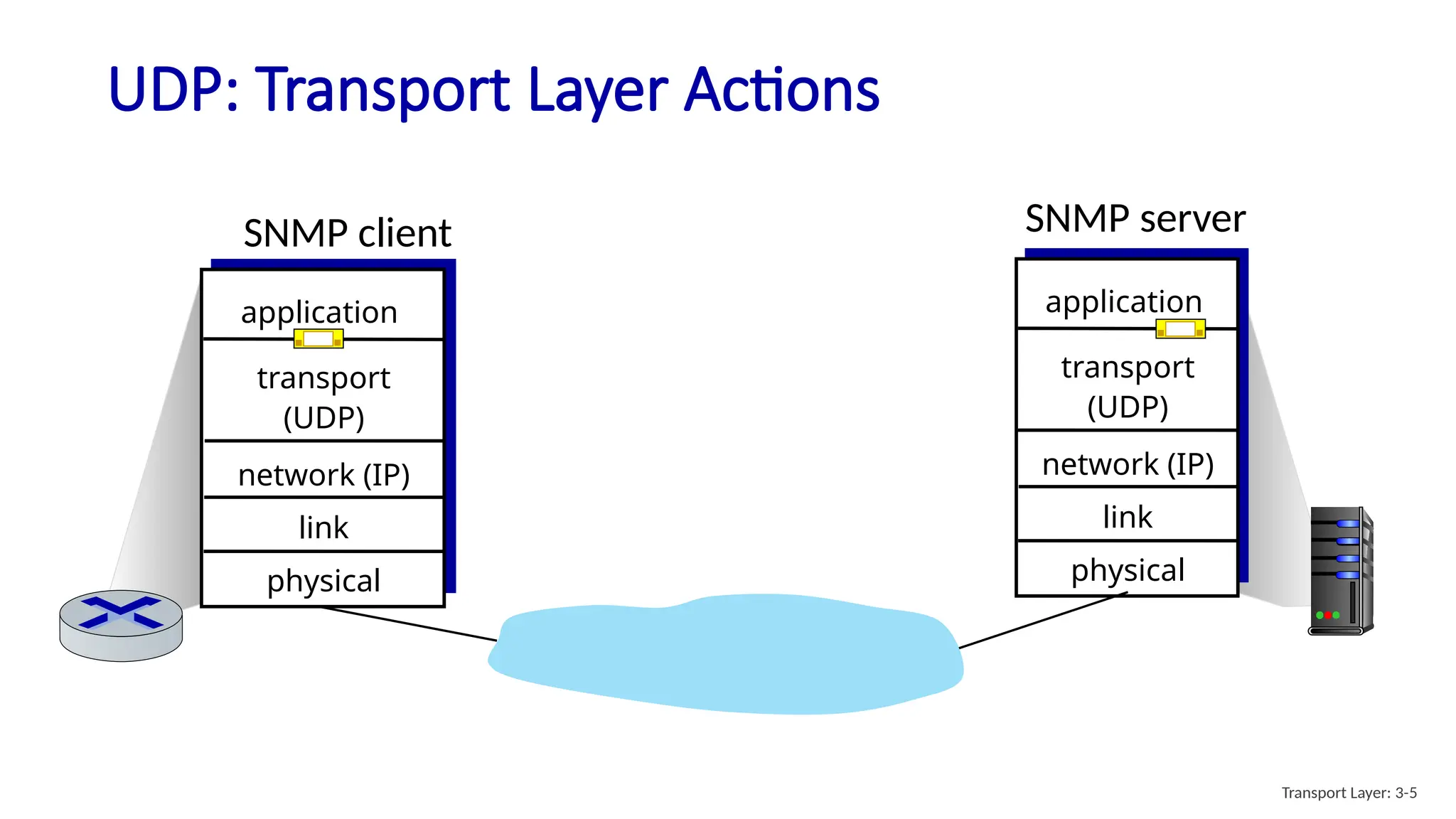
SNMP server
SNMP client
transport
(UDP)
physical
link
network (IP)
application
UDP: Transport Layer Actions
transport
(UDP)
physical
link
network (IP)
application
Transport Layer: 3-5
SNMP server
SNMP client
transport
(UDP)
physical
link
network (IP)
application
transport
(UDP)
physical
link
network (IP)
application
UDP: Transport Layer Actions
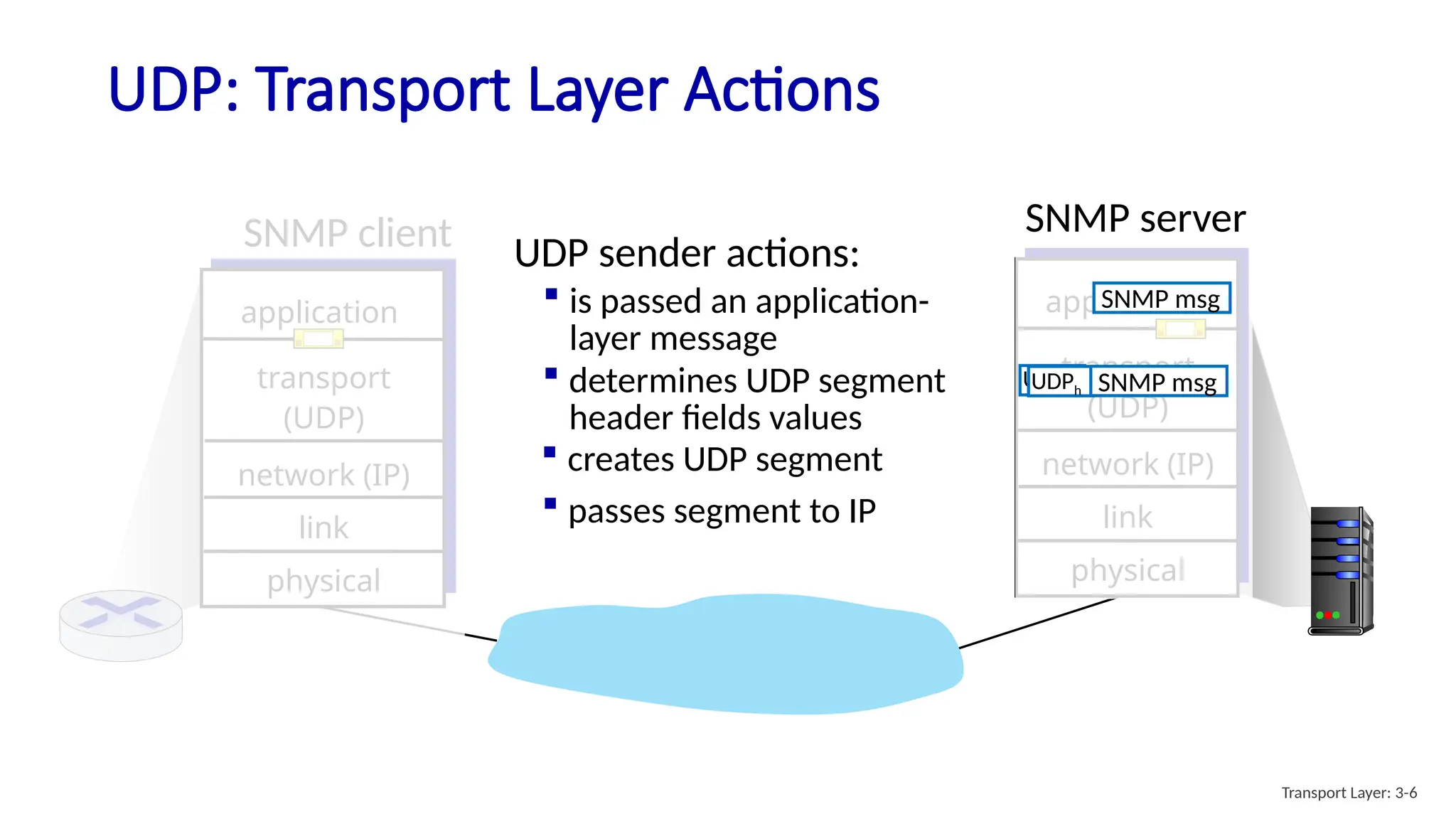
UDP sender actions:
SNMP msg
 is passed an application-
layer message
 determines UDP segment
header fields values
 creates UDP segment
 passes segment to IP
UDPh
UDPh SNMP msg
Transport Layer: 3-6
SNMP server
SNMP client
transport
(UDP)
physical
link
network (IP)
application
transport
(UDP)
physical
link
network (IP)
application
UDP: Transport Layer Actions
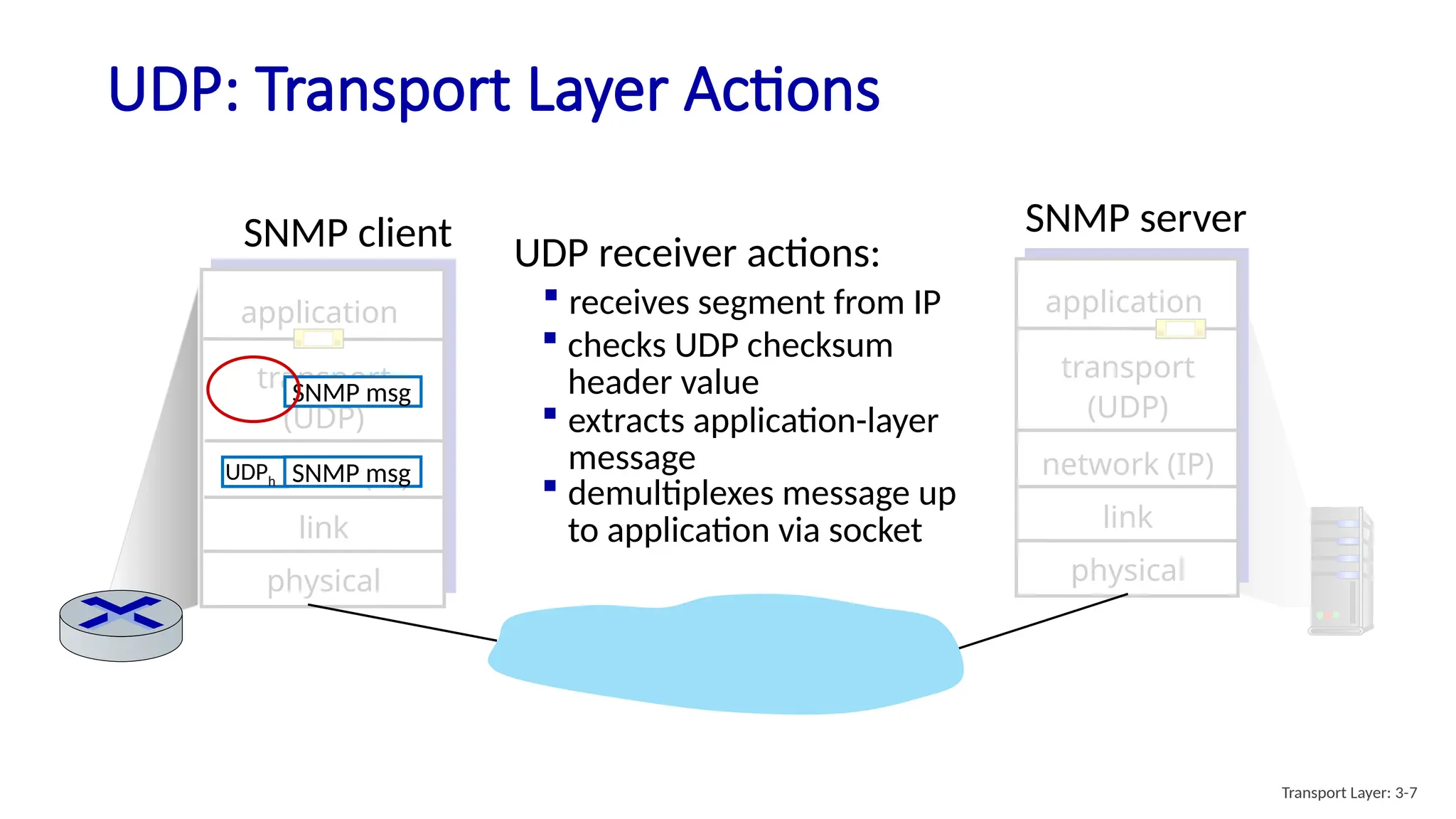
UDP receiver actions:
SNMP msg
 extracts application-layer
message
 checks UDP checksum
header value
 receives segment from IP
UDPh SNMP msg
 demultiplexes message up
to application via socket
Transport Layer: 3-7
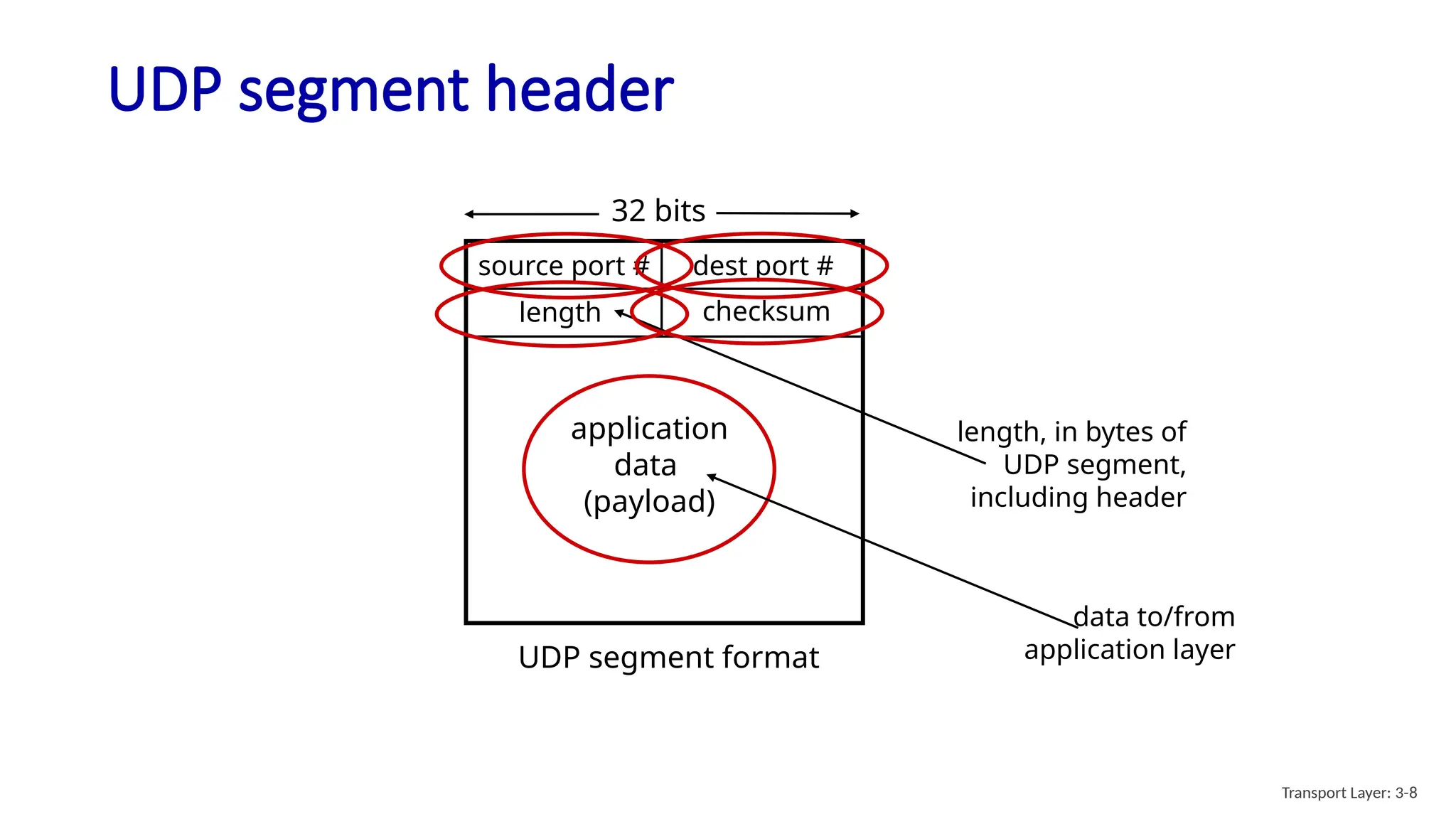
UDP segment header
source port # dest port #
32 bits
application
data
(payload)
UDP segment format
length checksum
length, in bytes of
UDP segment,
including header
data to/from
application layer
Transport Layer: 3-8
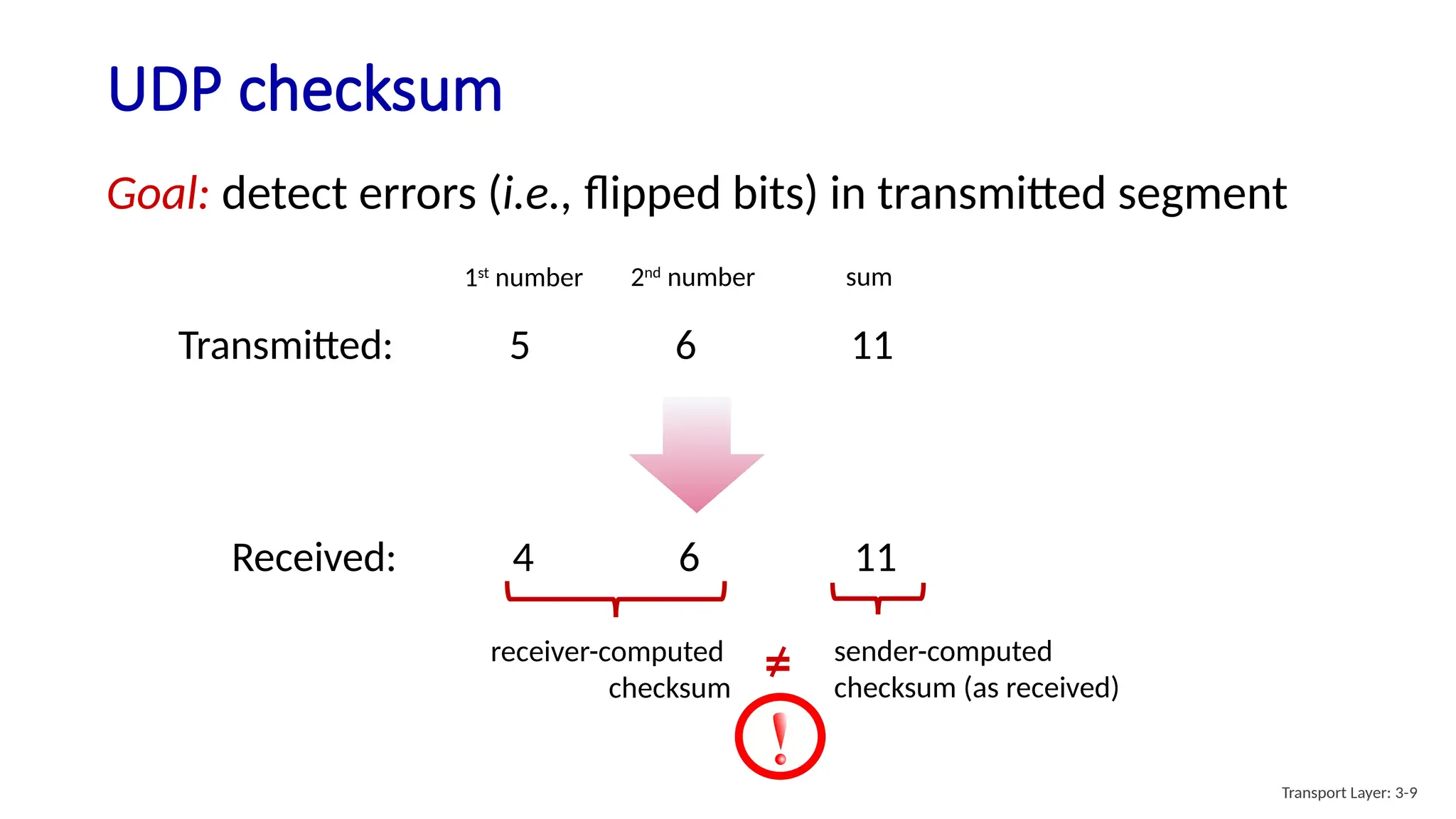
UDP checksum
Transmitted: 5 6 11
Goal: detect errors (i.e., flipped bits) in transmitted segment
Received: 4 6 11
1st
number 2nd
number sum
receiver-computed
checksum
sender-computed
checksum (as received)
=
Transport Layer: 3-9
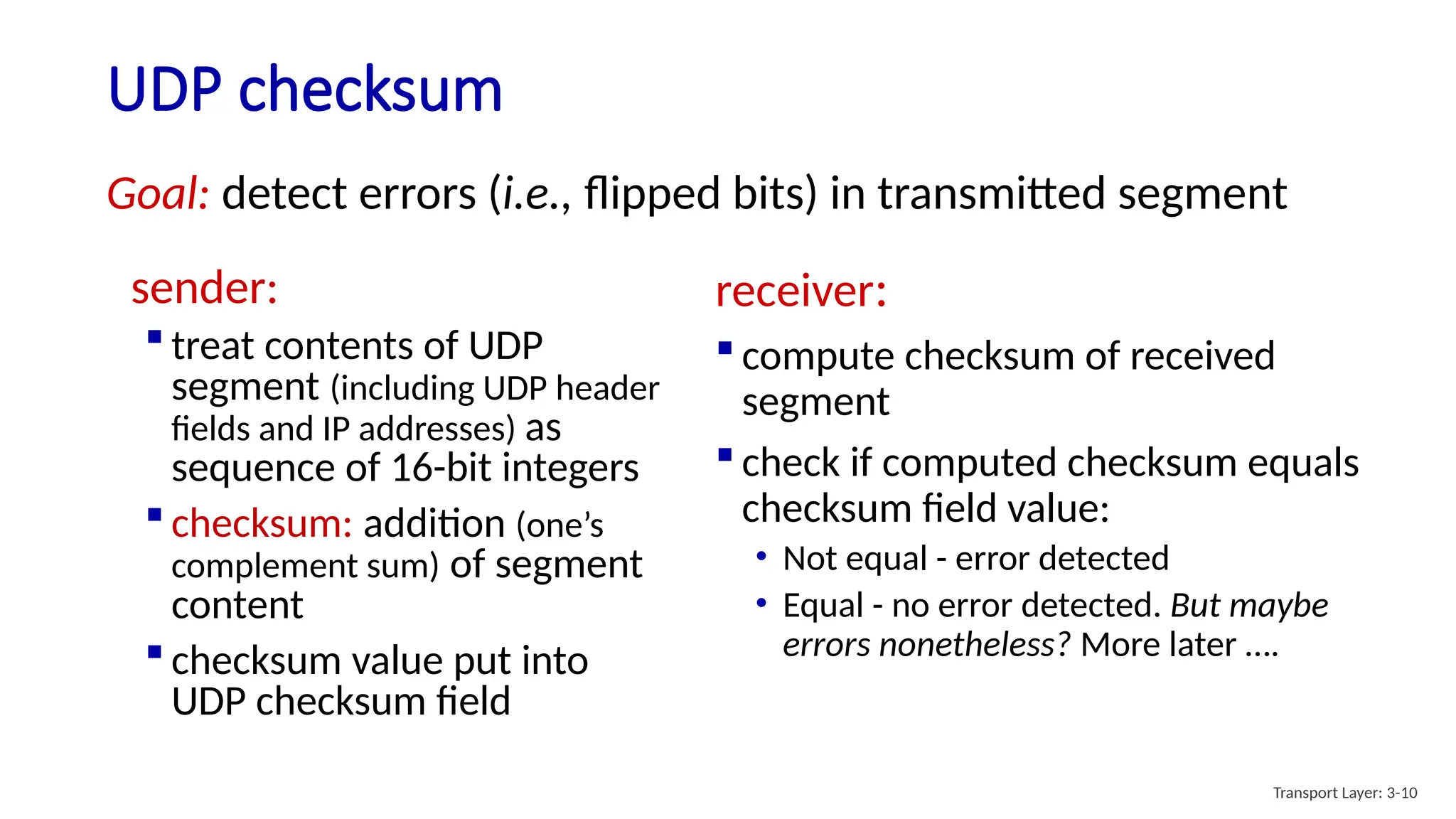
UDP checksum
sender:
 treat contents of UDP
segment (including UDP header
fields and IP addresses) as
sequence of 16-bit integers
 checksum: addition (one’s
complement sum) of segment
content
 checksum value put into
UDP checksum field
receiver:
 compute checksum of received
segment
 check if computed checksum equals
checksum field value:
• Not equal - error detected
• Equal - no error detected. But maybe
errors nonetheless? More later ….
Goal: detect errors (i.e., flipped bits) in transmitted segment
Transport Layer: 3-10
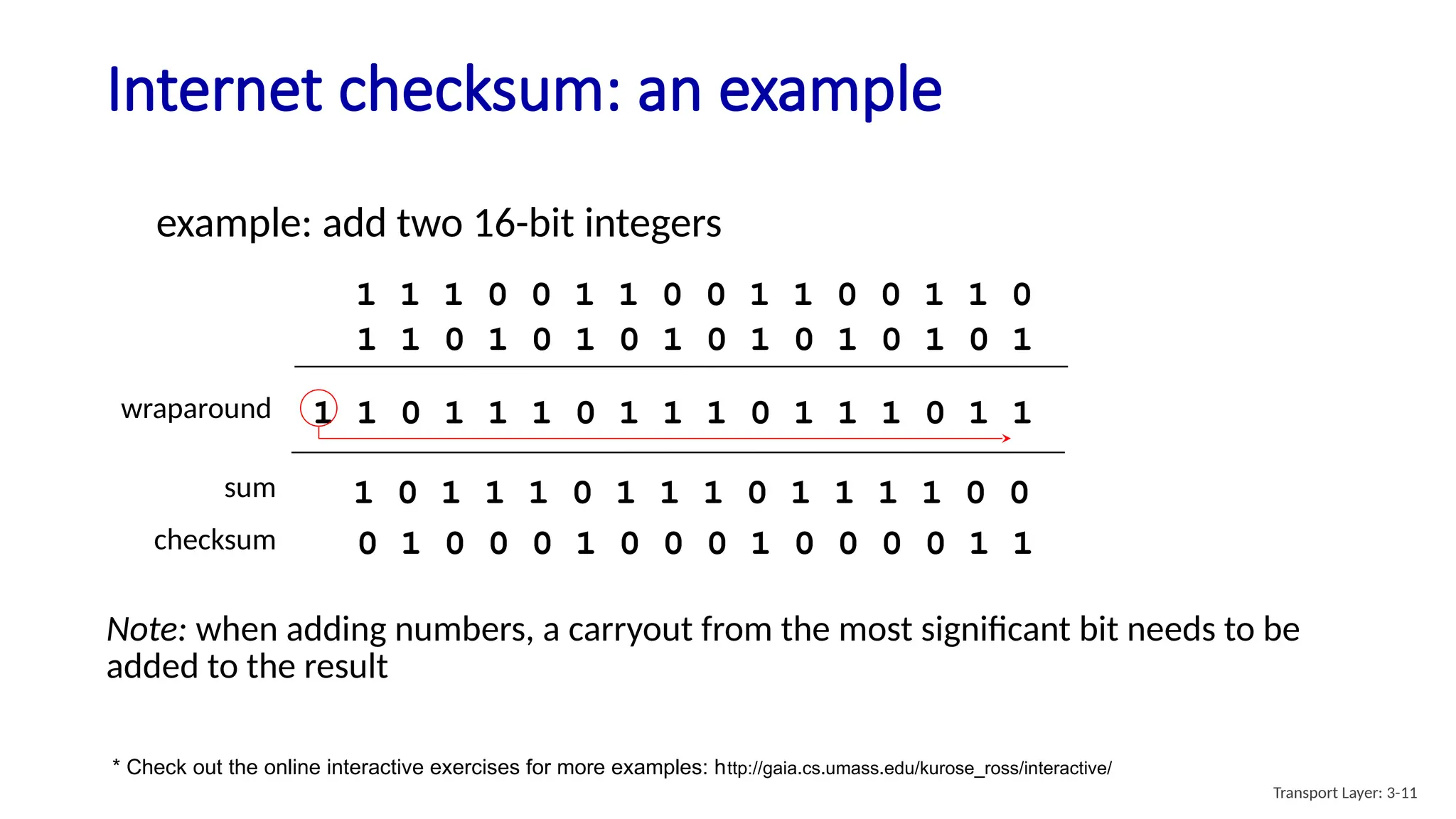
Internet checksum: an example
example: add two 16-bit integers
sum
checksum
Note: when adding numbers, a carryout from the most significant bit needs to be
added to the result
* Check out the online interactive exercises for more examples: http://gaia.cs.umass.edu/kurose_ross/interactive/
1 1 1 0 0 1 1 0 0 1 1 0 0 1 1 0
1 1 0 1 0 1 0 1 0 1 0 1 0 1 0 1
1 1 0 1 1 1 0 1 1 1 0 1 1 1 0 1 1
wraparound
1 0 1 1 1 0 1 1 1 0 1 1 1 1 0 0
0 1 0 0 0 1 0 0 0 1 0 0 0 0 1 1
Transport Layer: 3-11
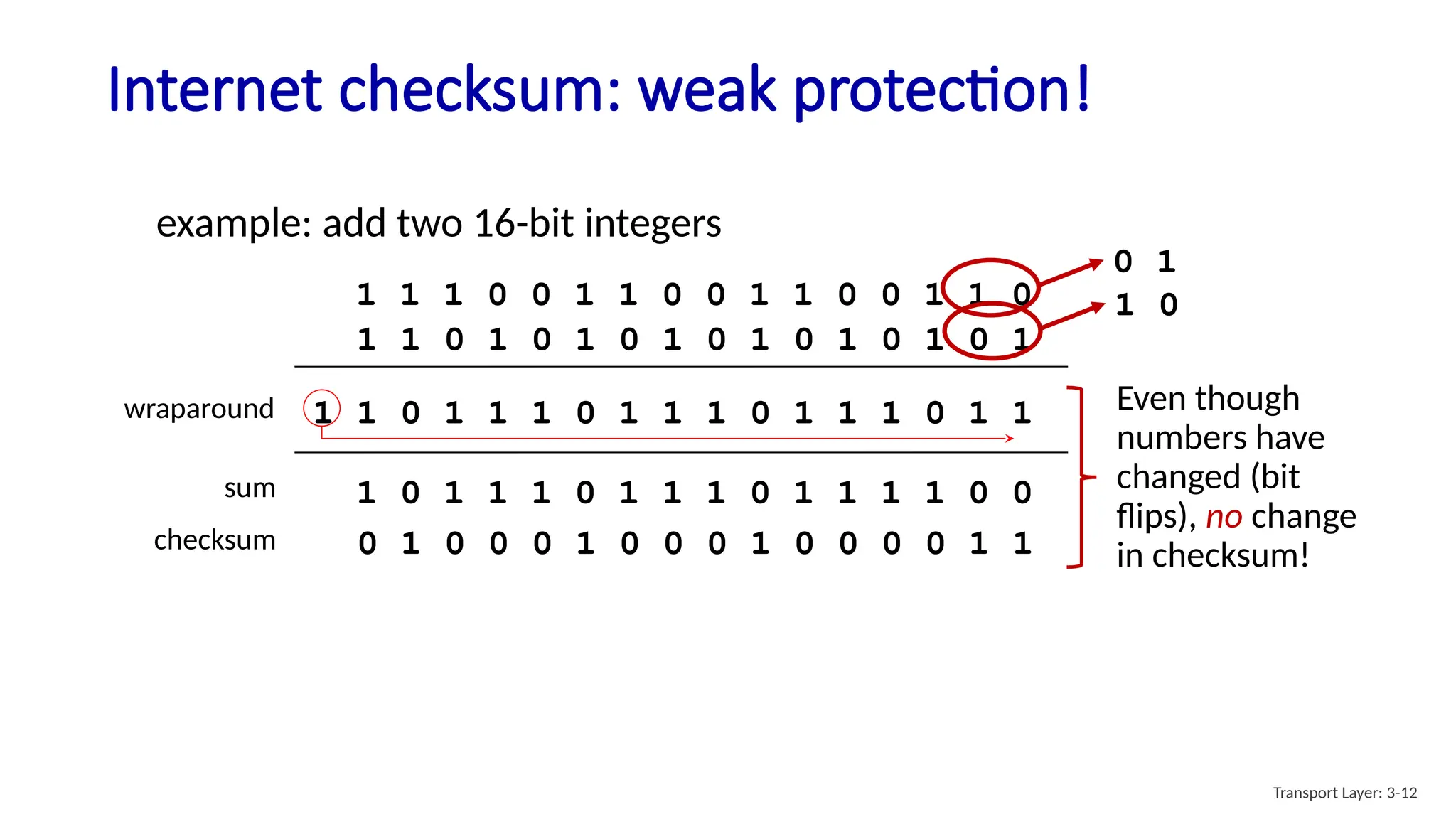
Internet checksum: weak protection!
example: add two 16-bit integers
sum
checksum
1 1 1 0 0 1 1 0 0 1 1 0 0 1 1 0
1 1 0 1 0 1 0 1 0 1 0 1 0 1 0 1
1 1 0 1 1 1 0 1 1 1 0 1 1 1 0 1 1
wraparound
1 0 1 1 1 0 1 1 1 0 1 1 1 1 0 0
0 1 0 0 0 1 0 0 0 1 0 0 0 0 1 1
0 1
1 0
Even though
numbers have
changed (bit
flips), no change
in checksum!
Transport Layer: 3-12
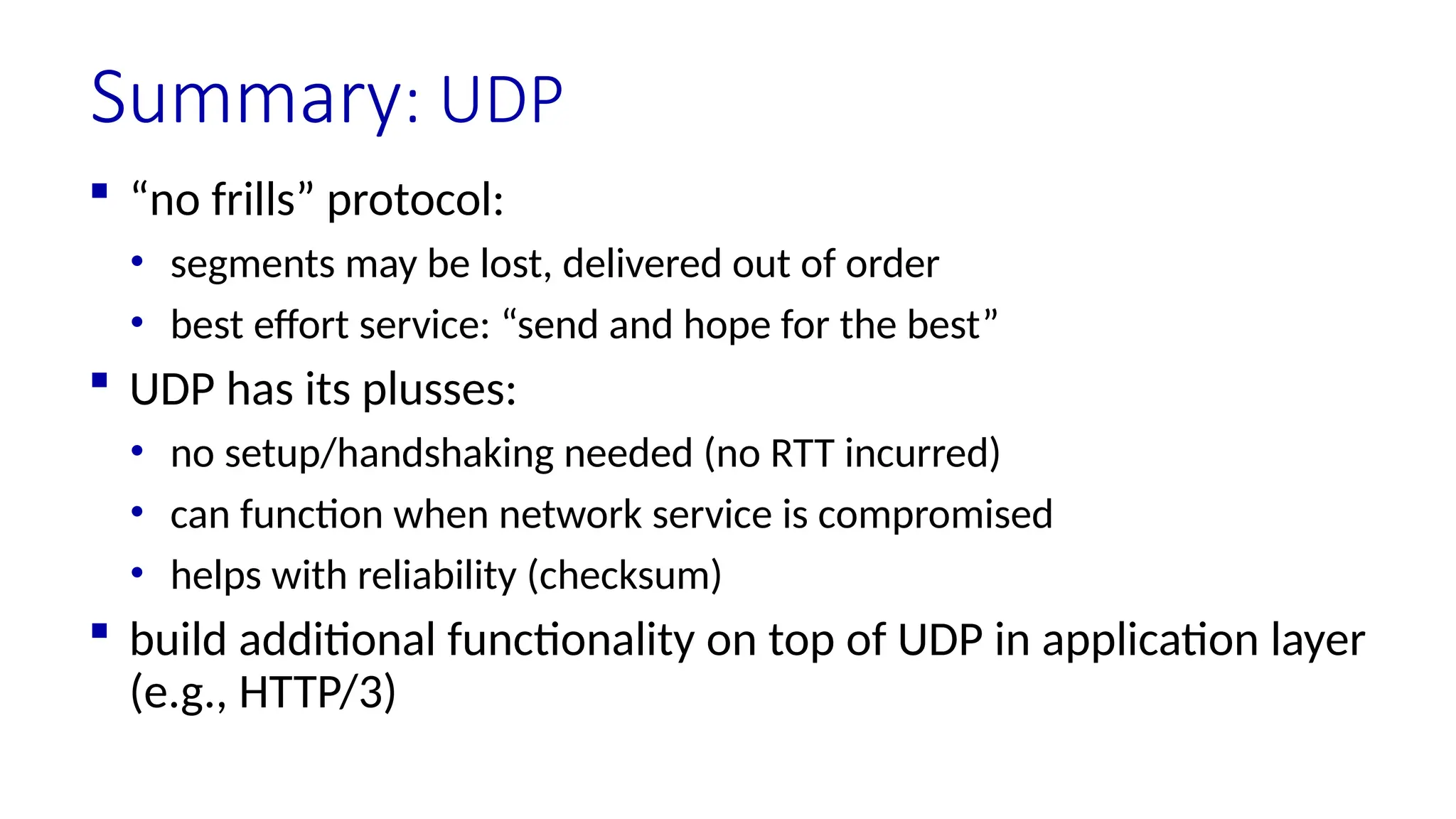
Summary: UDP
 “no frills” protocol:
• segments may be lost, delivered out of order
• best effort service: “send and hope for the best”
 UDP has its plusses:
• no setup/handshaking needed (no RTT incurred)
• can function when network service is compromised
• helps with reliability (checksum)
 build additional functionality on top of UDP in application layer
(e.g., HTTP/3)
Chapter 3: roadmap
 Transport-layer services
 Multiplexing and demultiplexing
 Connectionless transport: UDP
 Principles of reliable data transfer
 Connection-oriented transport: TCP
 Principles of congestion control
 TCP congestion control
 Evolution of transport-layer
functionality
Transport Layer: 3-14
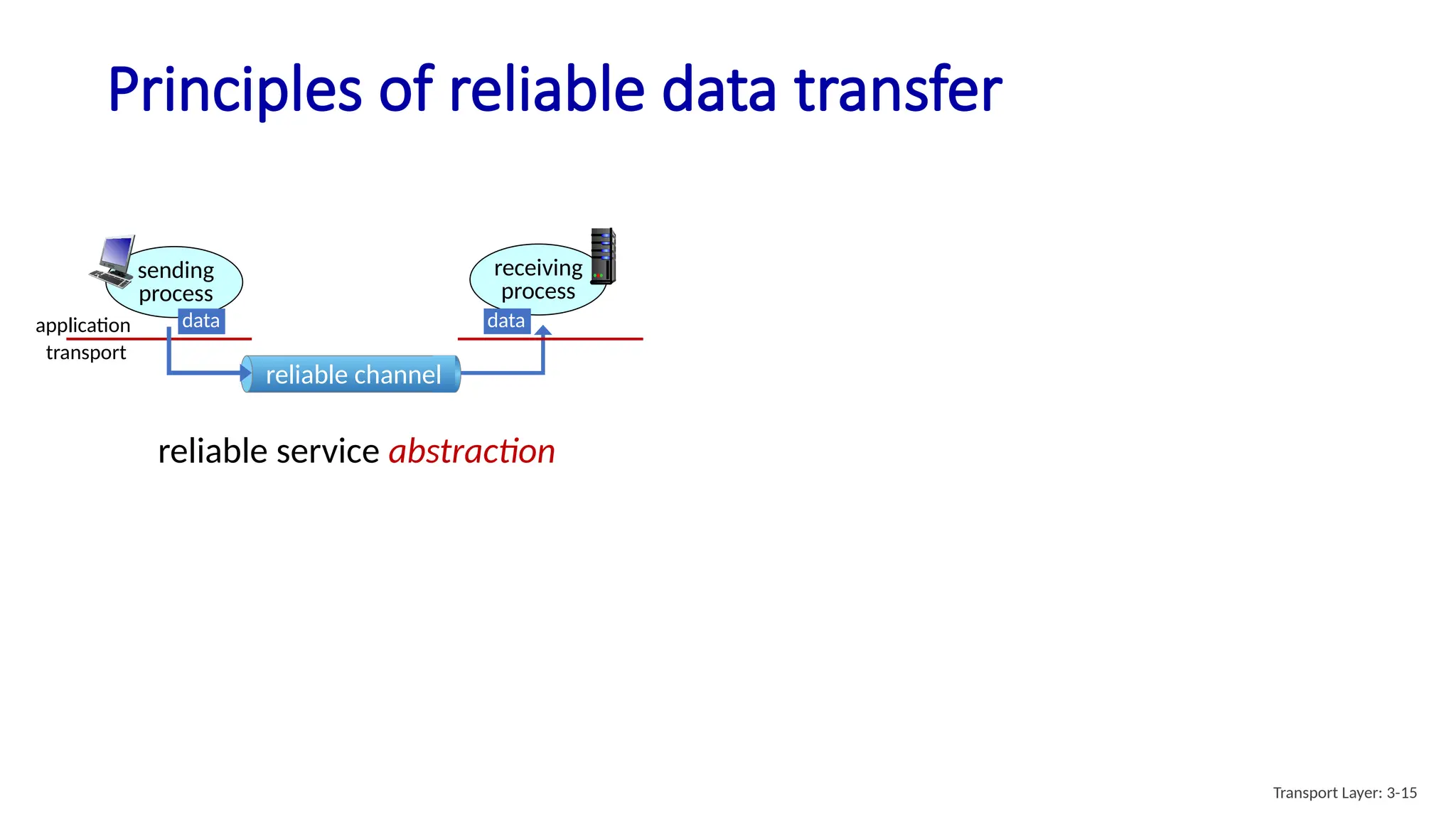
Principles of reliable data transfer
sending
process
data
receiving
process
data
reliable channel
application
transport
reliable service abstraction
Transport Layer: 3-15
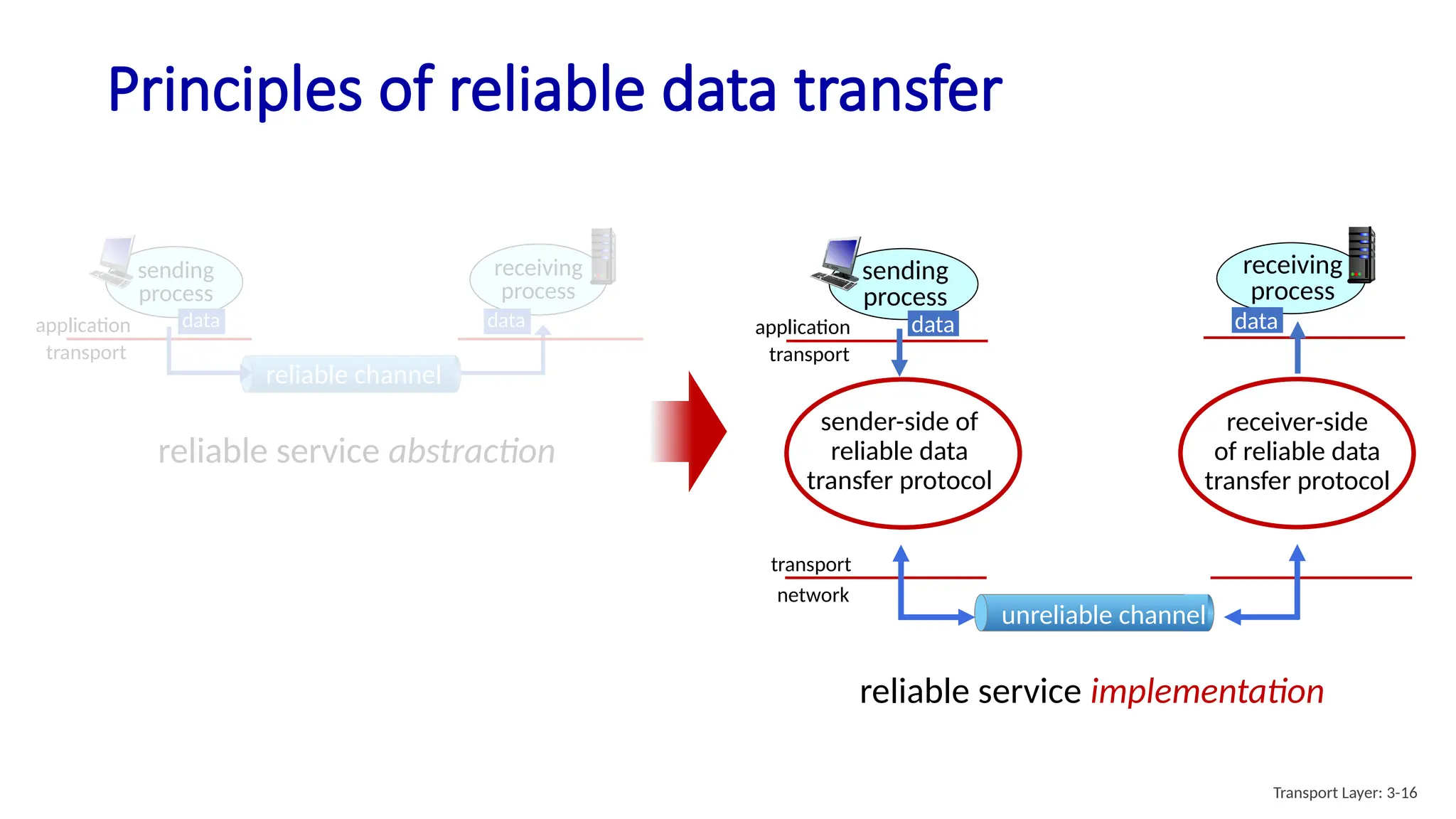
Principles of reliable data transfer
sending
process
data
receiving
process
data
application
transport
reliable service implementation
unreliable channel
network
transport
sender-side of
reliable data
transfer protocol
receiver-side
of reliable data
transfer protocol
sending
process
data
receiving
process
data
reliable channel
application
transport
reliable service abstraction
Transport Layer: 3-16
Principles of reliable data transfer
sending
process
data
receiving
process
data
application
transport
reliable service implementation
unreliable channel
network
transport
sender-side of
reliable data
transfer protocol
receiver-side
of reliable data
transfer protocol
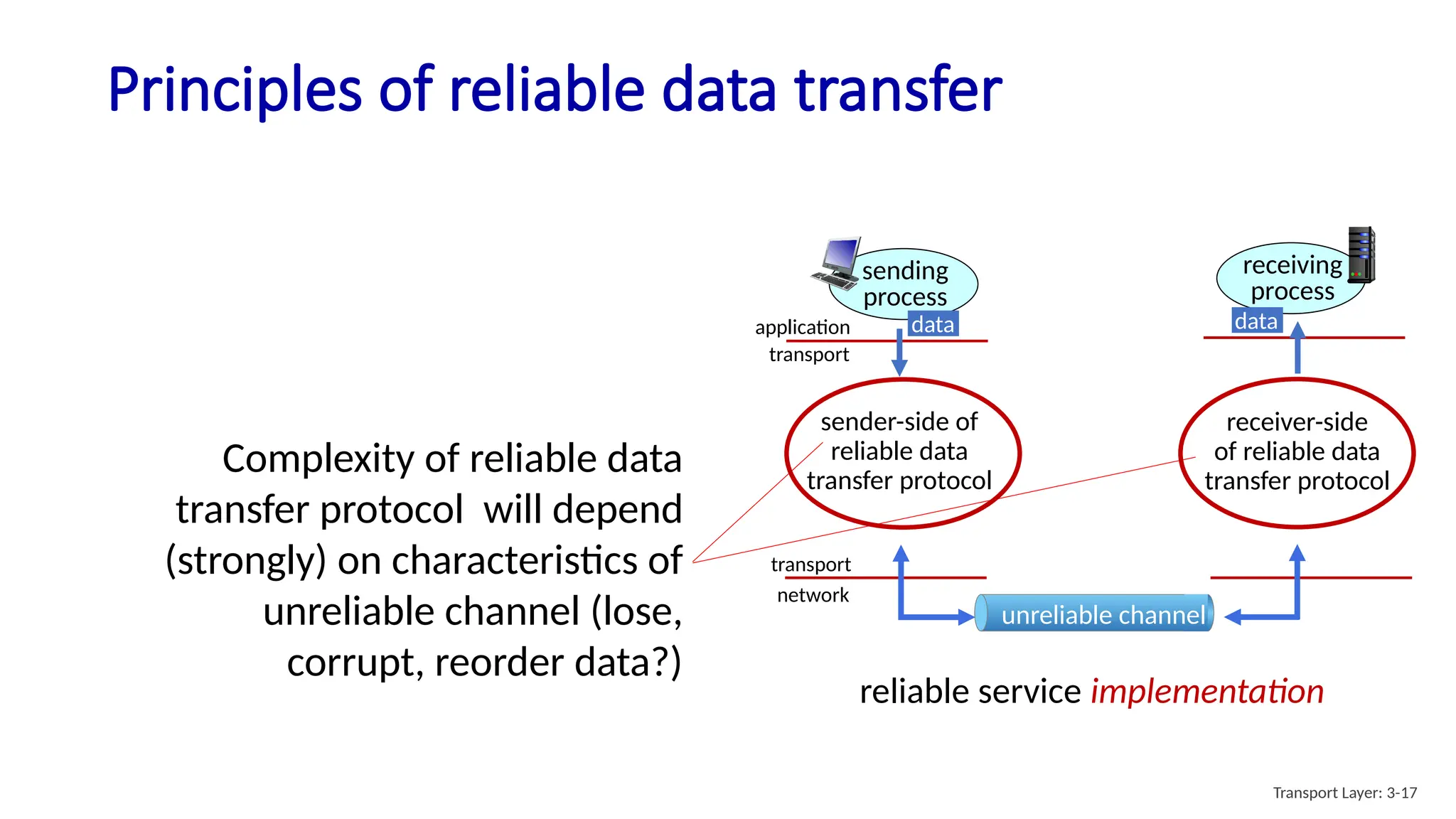
Complexity of reliable data
transfer protocol will depend
(strongly) on characteristics of
unreliable channel (lose,
corrupt, reorder data?)
Transport Layer: 3-17
Principles of reliable data transfer
sending
process
data
receiving
process
data
application
transport
reliable service implementation
unreliable channel
network
transport
sender-side of
reliable data
transfer protocol
receiver-side
of reliable data
transfer protocol
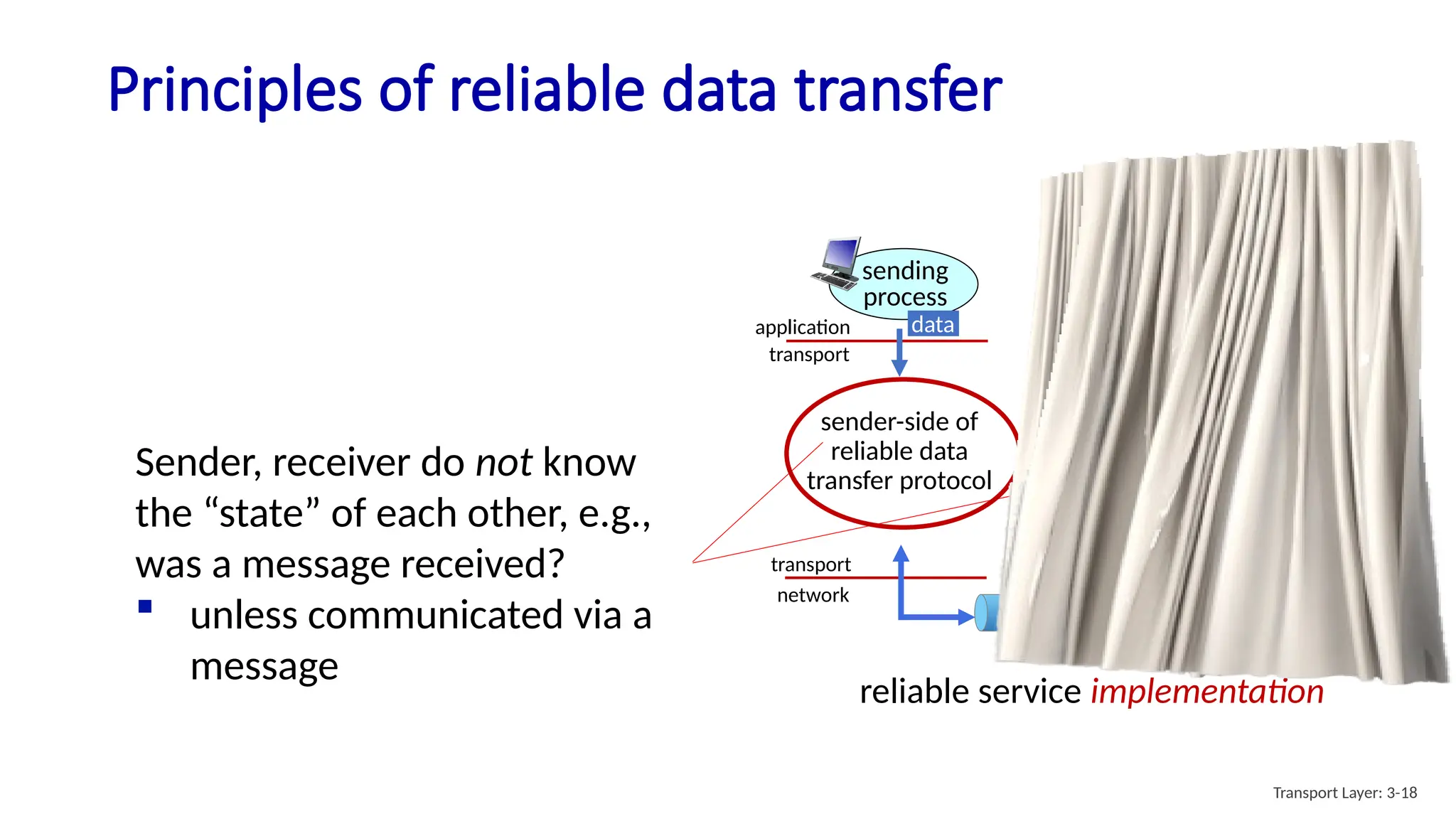
Sender, receiver do not know
the “state” of each other, e.g.,
was a message received?
 unless communicated via a
message
Transport Layer: 3-18
Reliable data transfer protocol (rdt): interfaces
sending
process
data
receiving
process
data
unreliable channel
sender-side
implementation of
rdt reliable data
transfer protocol
receiver-side
implementation of
rdt reliable data
transfer protocol
rdt_send()
udt_send() rdt_rcv()
deliver_data()
data
Header data
Header
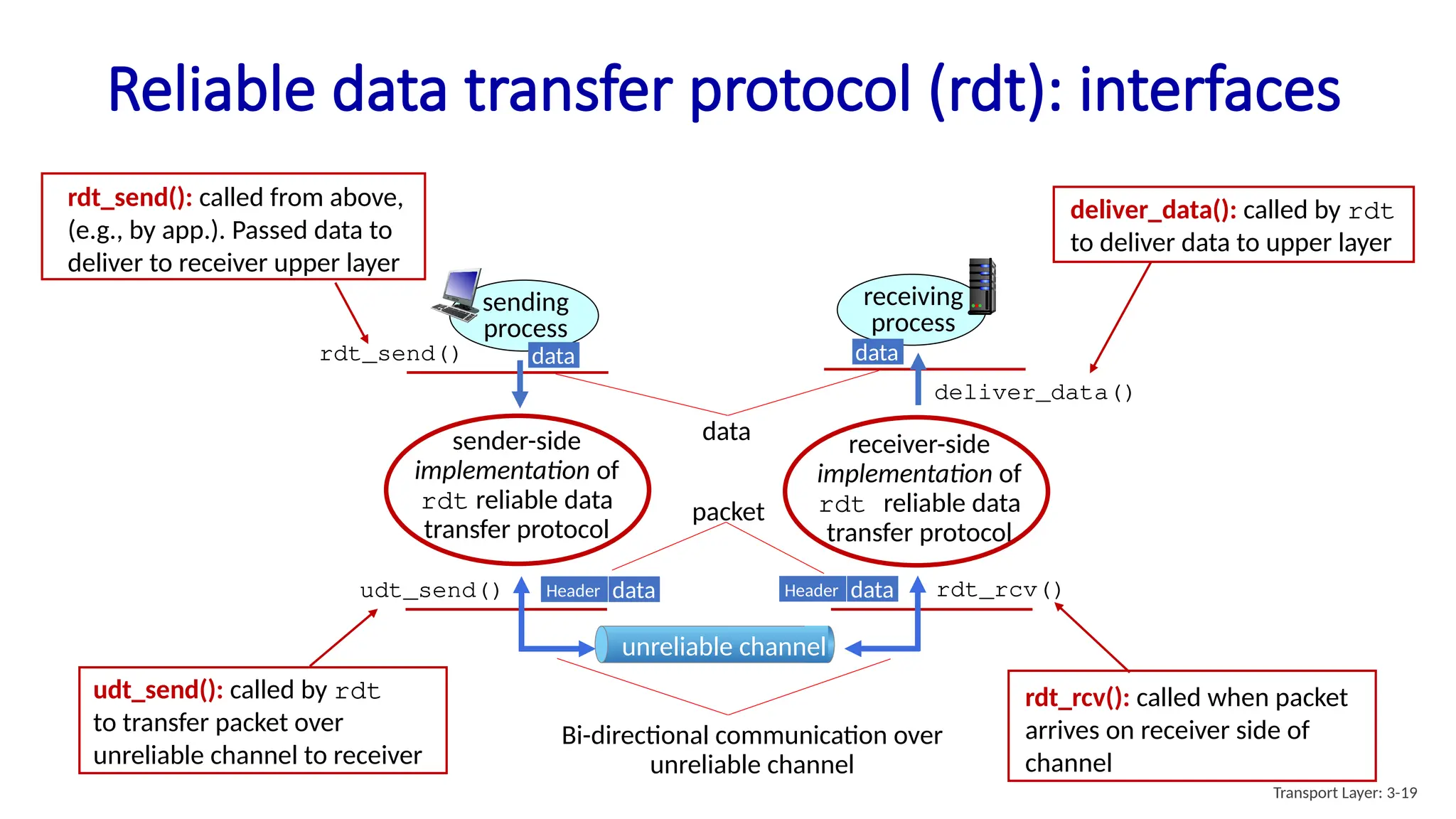
rdt_send(): called from above,
(e.g., by app.). Passed data to
deliver to receiver upper layer
udt_send(): called by rdt
to transfer packet over
unreliable channel to receiver
rdt_rcv(): called when packet
arrives on receiver side of
channel
deliver_data(): called by rdt
to deliver data to upper layer
Bi-directional communication over
unreliable channel
data
packet
Transport Layer: 3-19
Reliable data transfer: getting started
We will:
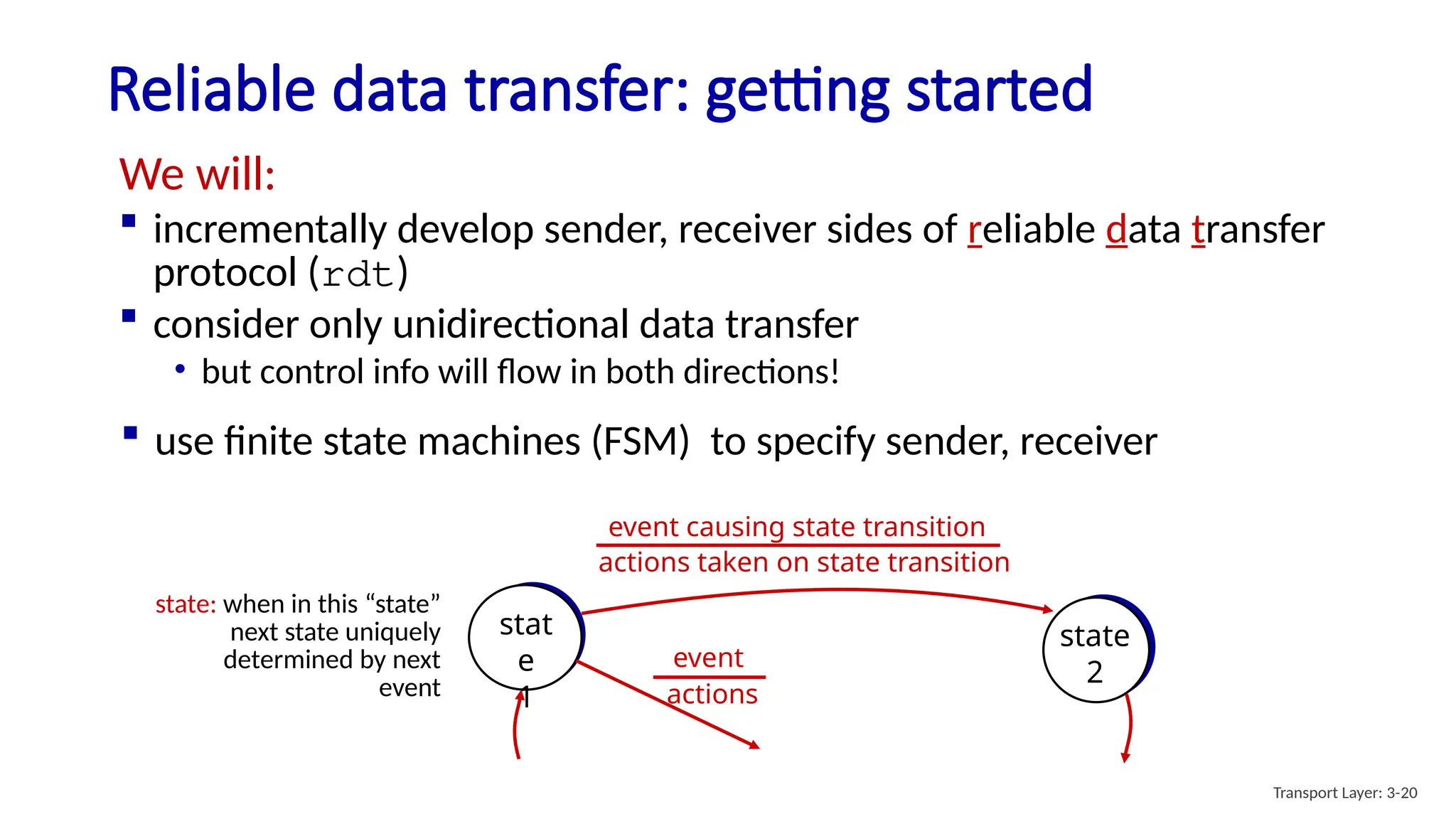
 incrementally develop sender, receiver sides of reliable data transfer
protocol (rdt)
 consider only unidirectional data transfer
• but control info will flow in both directions!
stat
e
1
state
2
event causing state transition
actions taken on state transition
state: when in this “state”
next state uniquely
determined by next
event
event
actions
 use finite state machines (FSM) to specify sender, receiver
Transport Layer: 3-20
rdt1.0: reliable transfer over a reliable channel
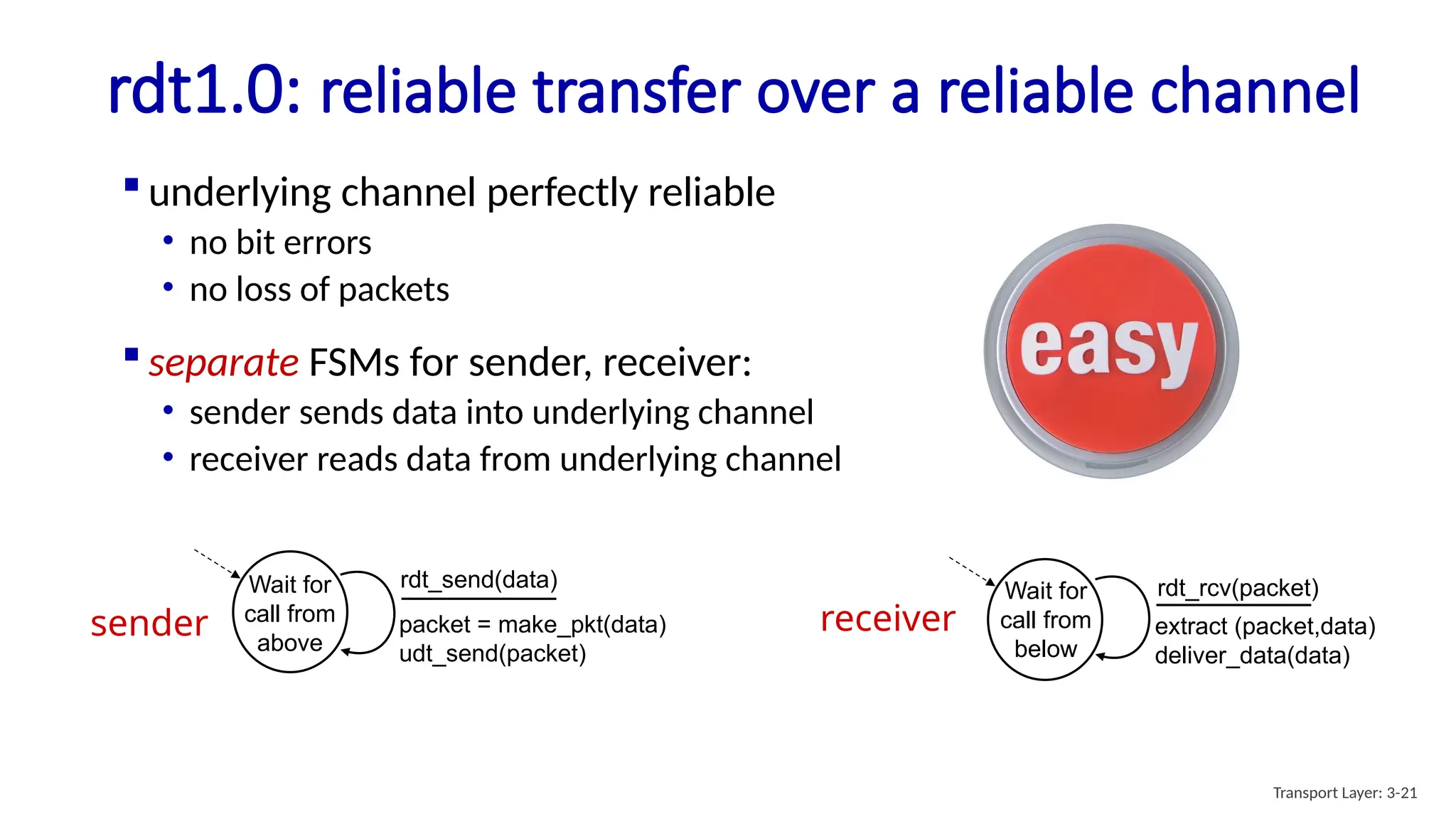
 underlying channel perfectly reliable
• no bit errors
• no loss of packets
packet = make_pkt(data)
udt_send(packet)
rdt_send(data)
extract (packet,data)
deliver_data(data)
rdt_rcv(packet)
Wait for
call from
below
receiver
 separate FSMs for sender, receiver:
• sender sends data into underlying channel
• receiver reads data from underlying channel
sender
Wait for
call from
above
Transport Layer: 3-21
rdt2.0: channel with bit errors
 underlying channel may flip bits in packet
• checksum (e.g., Internet checksum) to detect bit errors
 the question: how to recover from errors?
How do humans recover from “errors” during conversation?
Transport Layer: 3-22
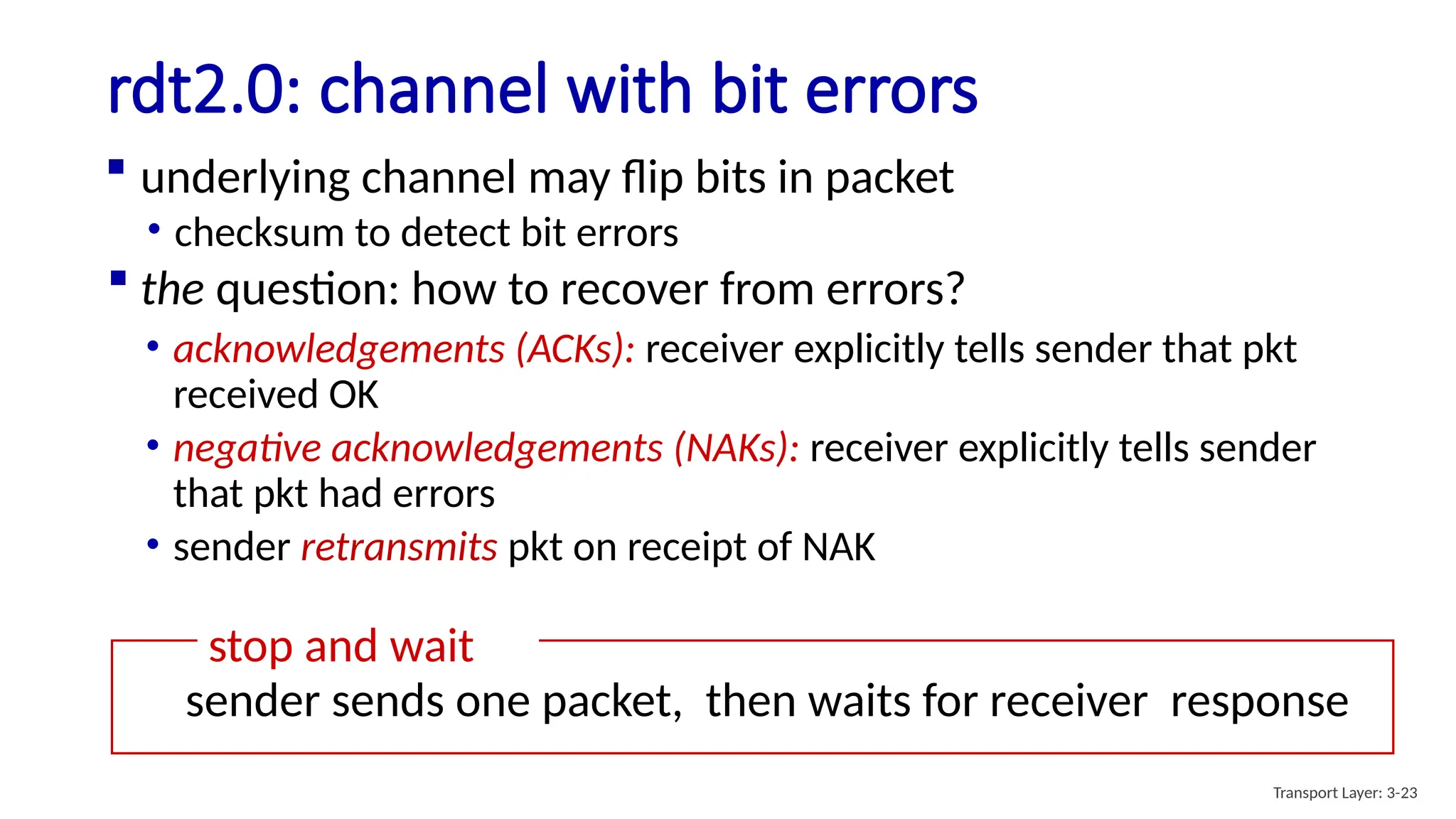
rdt2.0: channel with bit errors
 underlying channel may flip bits in packet
• checksum to detect bit errors
 the question: how to recover from errors?
• acknowledgements (ACKs): receiver explicitly tells sender that pkt
received OK
• negative acknowledgements (NAKs): receiver explicitly tells sender
that pkt had errors
• sender retransmits pkt on receipt of NAK
stop and wait
sender sends one packet, then waits for receiver response
Transport Layer: 3-23
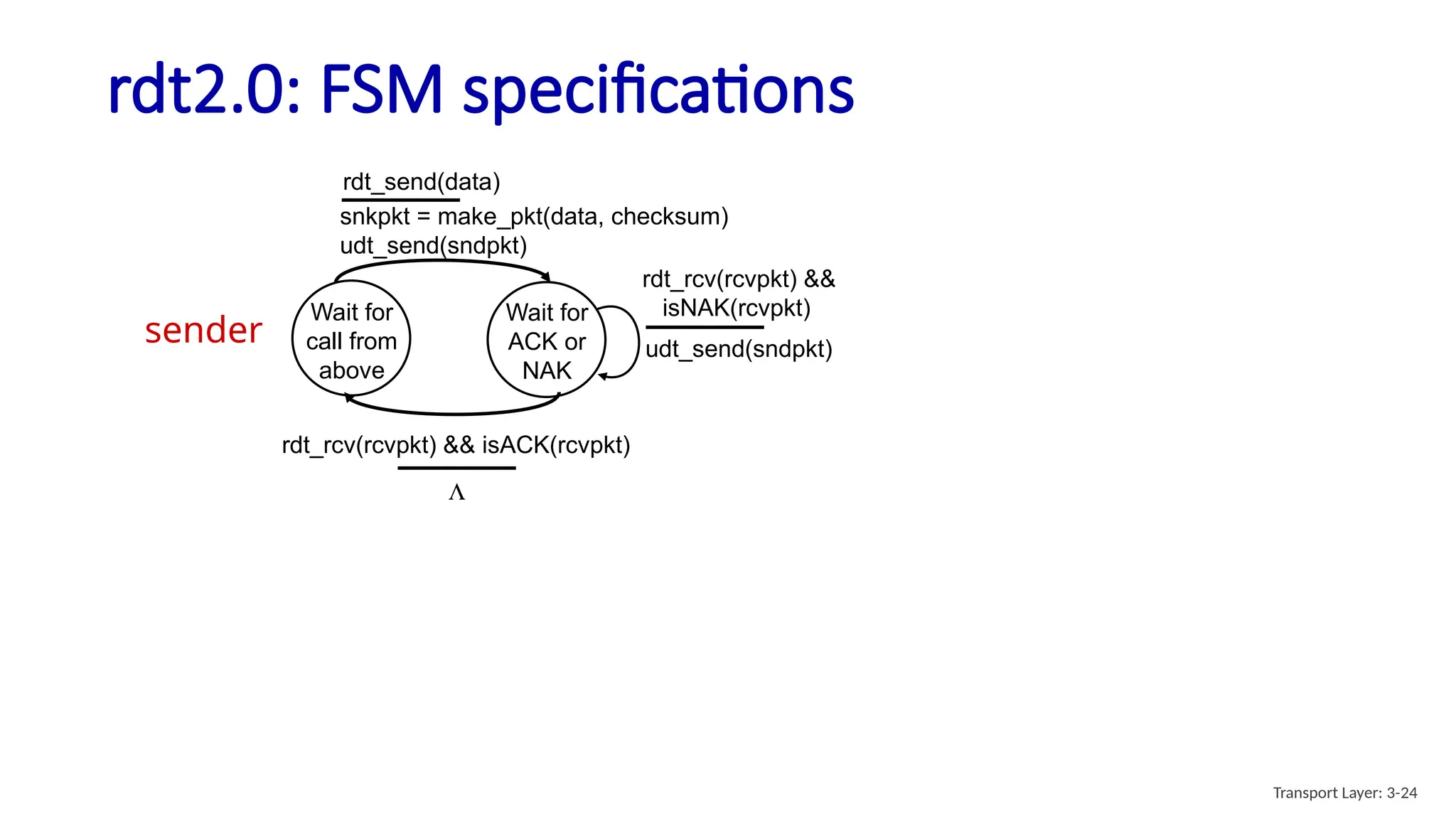
rdt2.0: FSM specifications
Wait for
call from
above
udt_send(sndpkt)
Wait for
ACK or
NAK
udt_send(NAK)
rdt_rcv(rcvpkt) && corrupt(rcvpkt)
Wait for
call from
below
extract(rcvpkt,data)
deliver_data(data)
udt_send(ACK)
rdt_rcv(rcvpkt) && notcorrupt(rcvpkt)
snkpkt = make_pkt(data, checksum)
udt_send(sndpkt)
rdt_send(data)
rdt_rcv(rcvpkt) && isACK(rcvpkt)
L
sender
receiver
rdt_rcv(rcvpkt) &&
isNAK(rcvpkt)
Transport Layer: 3-24
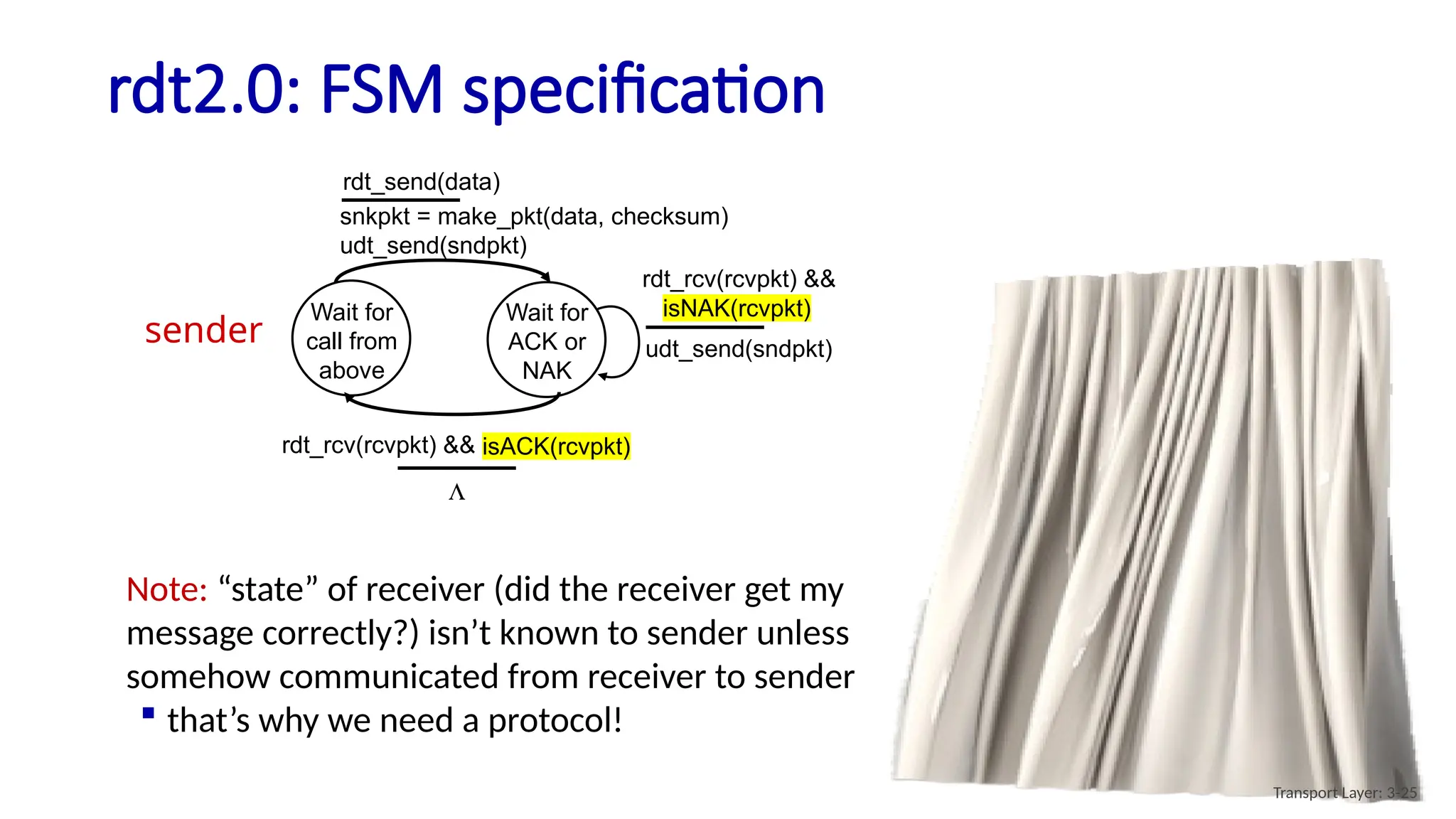
rdt2.0: FSM specification
Wait for
call from
above
udt_send(sndpkt)
Wait for
ACK or
NAK
udt_send(NAK)
rdt_rcv(rcvpkt) && corrupt(rcvpkt)
Wait for
call from
below
extract(rcvpkt,data)
deliver_data(data)
udt_send(ACK)
rdt_rcv(rcvpkt) && notcorrupt(rcvpkt)
snkpkt = make_pkt(data, checksum)
udt_send(sndpkt)
rdt_send(data)
rdt_rcv(rcvpkt) && isACK(rcvpkt)
L
sender
receiver
Note: “state” of receiver (did the receiver get my
message correctly?) isn’t known to sender unless
somehow communicated from receiver to sender
 that’s why we need a protocol!
rdt_rcv(rcvpkt) &&
isNAK(rcvpkt)
isNAK(rcvpkt)
isACK(rcvpkt)
Transport Layer: 3-25
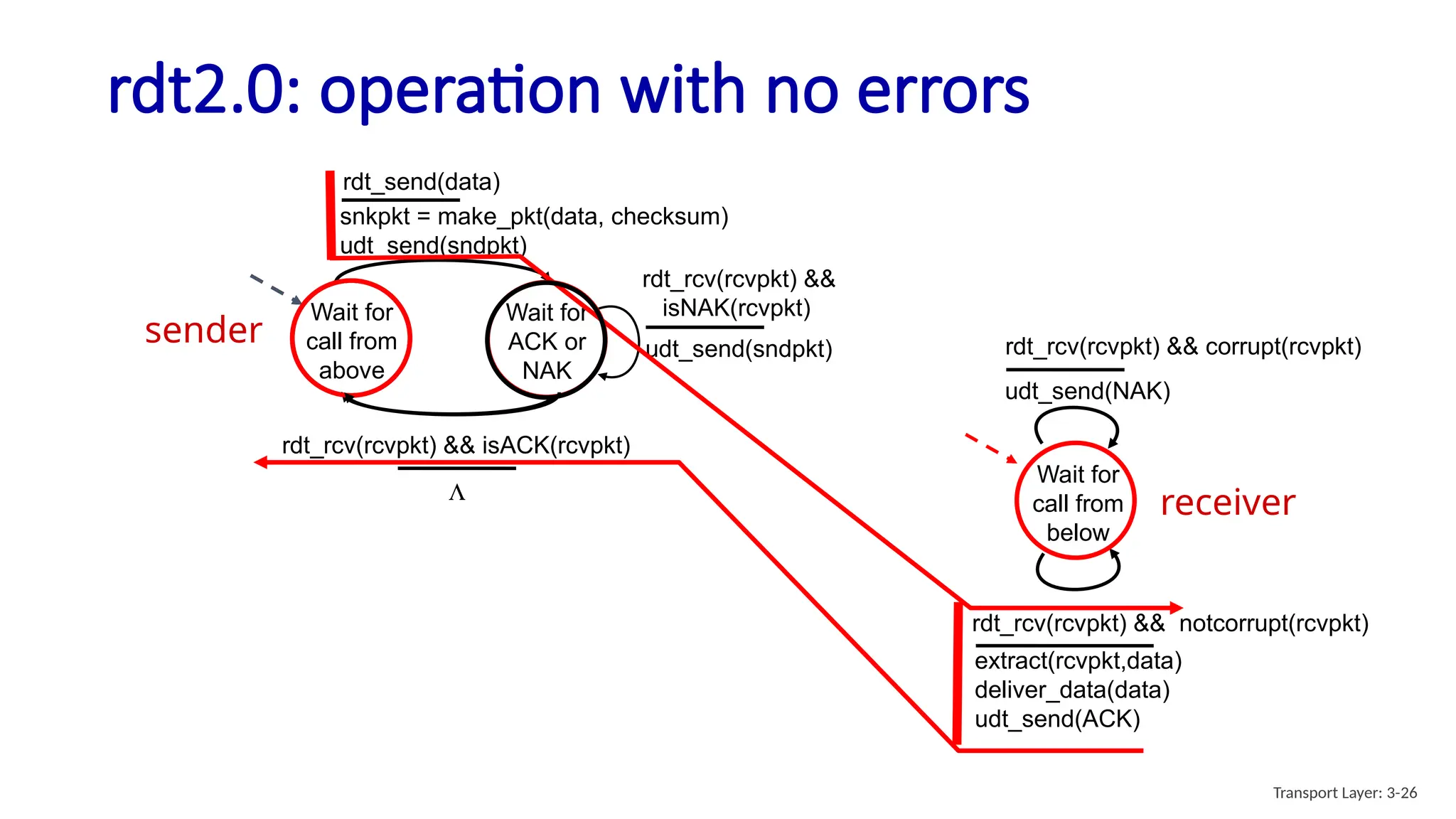
rdt2.0: operation with no errors
Wait for
call from
above
snkpkt = make_pkt(data, checksum)
udt_send(sndpkt)
udt_send(sndpkt)
udt_send(NAK)
Wait for
ACK or
NAK
Wait for
call from
below
rdt_send(data)
rdt_rcv(rcvpkt) && corrupt(rcvpkt)
rdt_rcv(rcvpkt) && isACK(rcvpkt)
L
extract(rcvpkt,data)
deliver_data(data)
udt_send(ACK)
rdt_rcv(rcvpkt) && notcorrupt(rcvpkt)
sender
receiver
rdt_rcv(rcvpkt) &&
isNAK(rcvpkt)
Transport Layer: 3-26
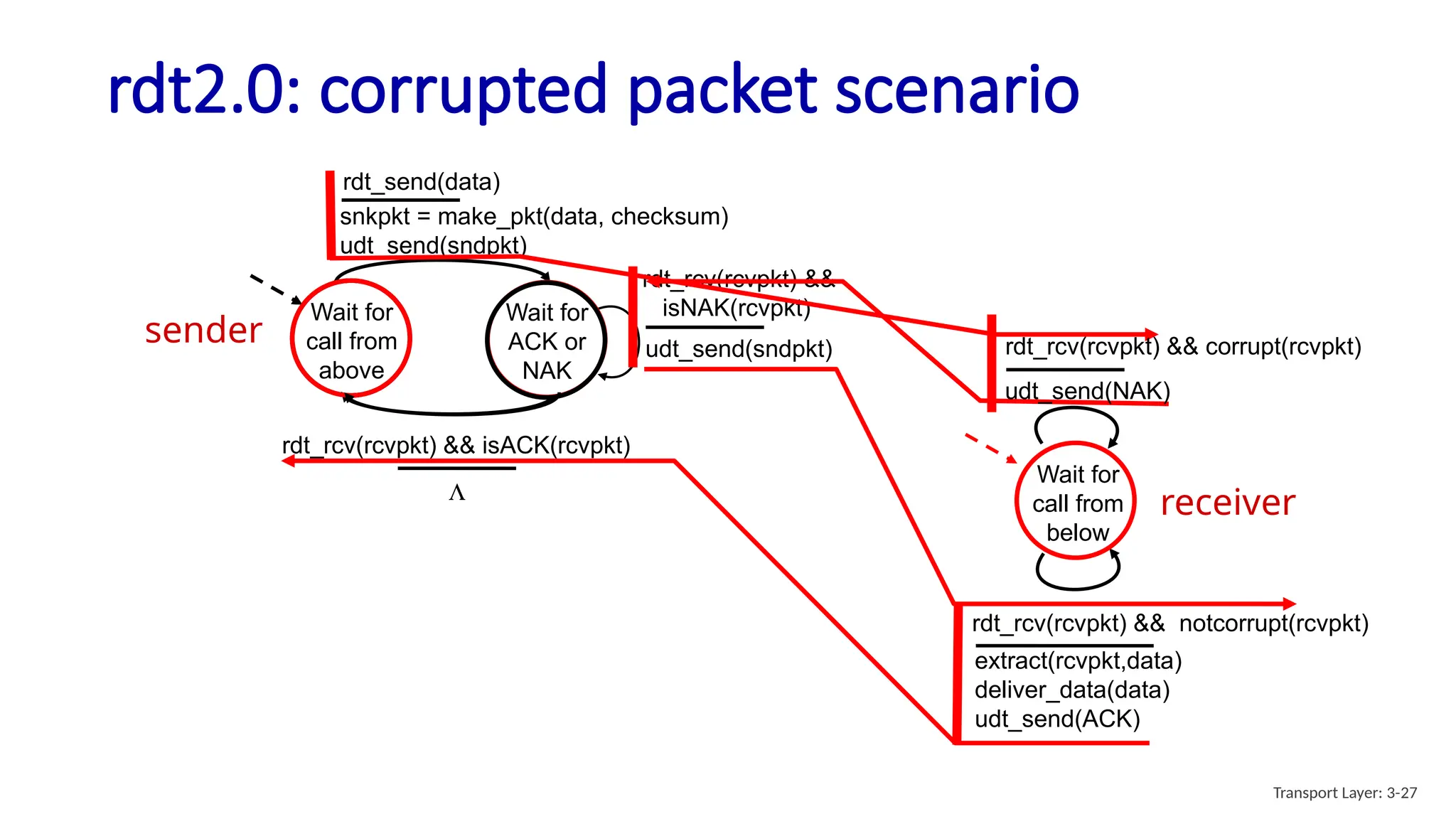
rdt2.0: corrupted packet scenario
Wait for
call from
above
snkpkt = make_pkt(data, checksum)
udt_send(sndpkt)
udt_send(sndpkt)
rdt_rcv(rcvpkt) &&
isNAK(rcvpkt)
Wait for
ACK or
NAK
Wait for
call from
below
rdt_send(data)
udt_send(NAK)
rdt_rcv(rcvpkt) && corrupt(rcvpkt)
extract(rcvpkt,data)
deliver_data(data)
udt_send(ACK)
rdt_rcv(rcvpkt) && notcorrupt(rcvpkt)
rdt_rcv(rcvpkt) && isACK(rcvpkt)
L
sender
receiver
Transport Layer: 3-27
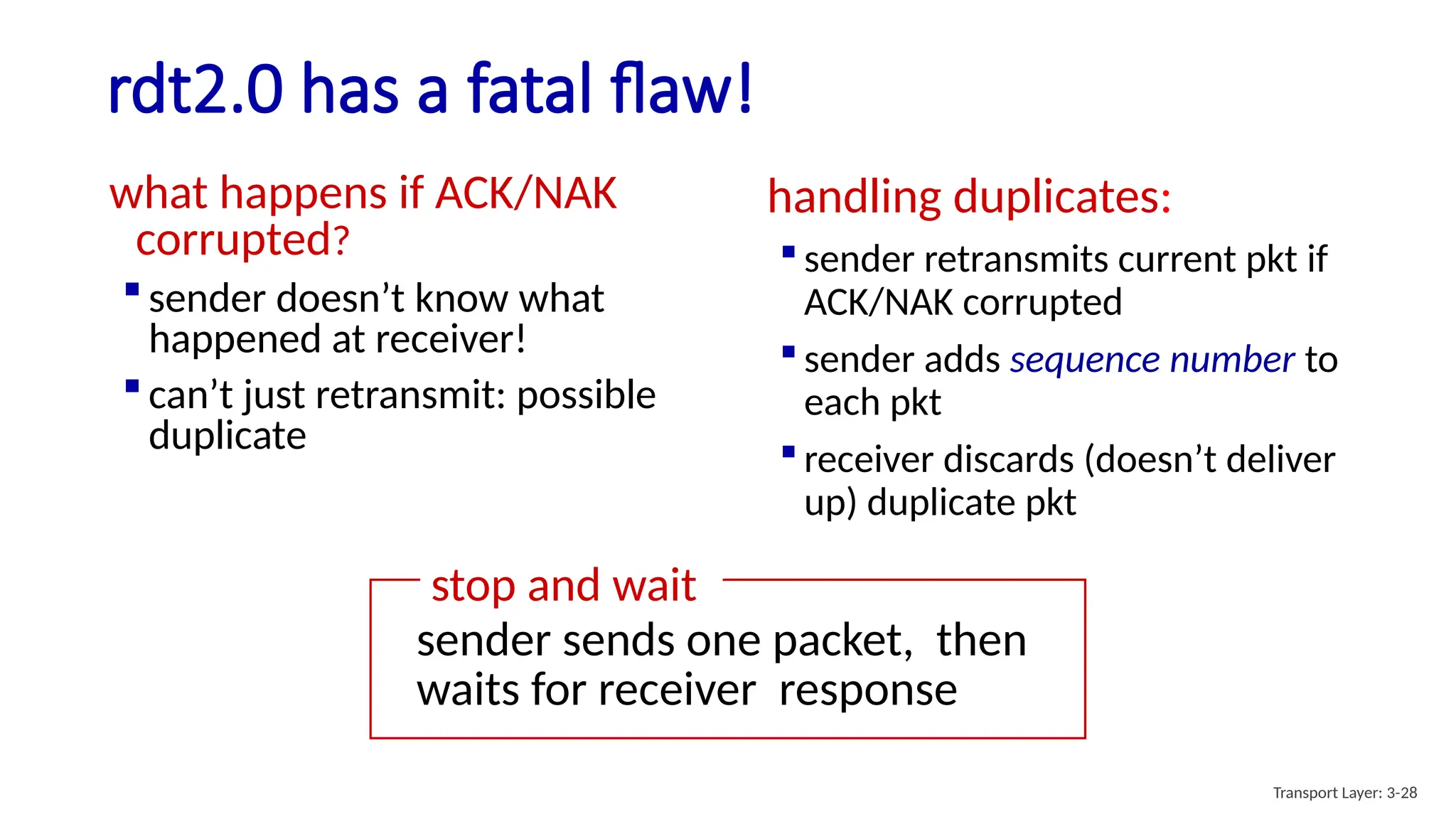
rdt2.0 has a fatal flaw!
what happens if ACK/NAK
corrupted?
 sender doesn’t know what
happened at receiver!
 can’t just retransmit: possible
duplicate
handling duplicates:
 sender retransmits current pkt if
ACK/NAK corrupted
 sender adds sequence number to
each pkt
 receiver discards (doesn’t deliver
up) duplicate pkt
stop and wait
sender sends one packet, then
waits for receiver response
Transport Layer: 3-28

Lecture 15 Transport Layer Part02 (1).pptx

  • 1.
    Chapter 3: roadmap Transport-layer services  Multiplexing and demultiplexing  Connectionless transport: UDP  Principles of reliable data transfer  Connection-oriented transport: TCP  Principles of congestion control  TCP congestion control  Evolution of transport-layer functionality Transport Layer: 3-1
  • 2.
    UDP: User DatagramProtocol  “no frills,” “bare bones” Internet transport protocol  “best effort” service, UDP segments may be: • lost • delivered out-of-order to app  no connection establishment  simple: no connection state at sender, receiver  small header size  no congestion control  UDP can blast away as fast as desired!  can function in the face of congestion Why is there a UDP?  connectionless: • no handshaking between UDP sender, receiver • each UDP segment handled independently of others Transport Layer: 3-2
  • 3.
    UDP: User DatagramProtocol  UDP use:  streaming multimedia apps (loss tolerant, rate sensitive)  DNS  SNMP (Simple Network Management Protocol): Simple Network Management Protocol (SNMP) is an Internet Standard protocol for collecting and organizing information about managed devices on IP networks and for modifying that information to change device behavior.  HTTP/3  if reliable transfer needed over UDP (e.g., HTTP/3):  add needed reliability at application layer  add congestion control at application layer Transport Layer: 3-3
  • 4.
    UDP: User DatagramProtocol [RFC 768] Transport Layer: 3-4
  • 5.
    SNMP server SNMP client transport (UDP) physical link network(IP) application UDP: Transport Layer Actions transport (UDP) physical link network (IP) application Transport Layer: 3-5
  • 6.
    SNMP server SNMP client transport (UDP) physical link network(IP) application transport (UDP) physical link network (IP) application UDP: Transport Layer Actions UDP sender actions: SNMP msg  is passed an application- layer message  determines UDP segment header fields values  creates UDP segment  passes segment to IP UDPh UDPh SNMP msg Transport Layer: 3-6
  • 7.
    SNMP server SNMP client transport (UDP) physical link network(IP) application transport (UDP) physical link network (IP) application UDP: Transport Layer Actions UDP receiver actions: SNMP msg  extracts application-layer message  checks UDP checksum header value  receives segment from IP UDPh SNMP msg  demultiplexes message up to application via socket Transport Layer: 3-7
  • 8.
    UDP segment header sourceport # dest port # 32 bits application data (payload) UDP segment format length checksum length, in bytes of UDP segment, including header data to/from application layer Transport Layer: 3-8
  • 9.
    UDP checksum Transmitted: 56 11 Goal: detect errors (i.e., flipped bits) in transmitted segment Received: 4 6 11 1st number 2nd number sum receiver-computed checksum sender-computed checksum (as received) = Transport Layer: 3-9
  • 10.
    UDP checksum sender:  treatcontents of UDP segment (including UDP header fields and IP addresses) as sequence of 16-bit integers  checksum: addition (one’s complement sum) of segment content  checksum value put into UDP checksum field receiver:  compute checksum of received segment  check if computed checksum equals checksum field value: • Not equal - error detected • Equal - no error detected. But maybe errors nonetheless? More later …. Goal: detect errors (i.e., flipped bits) in transmitted segment Transport Layer: 3-10
  • 11.
    Internet checksum: anexample example: add two 16-bit integers sum checksum Note: when adding numbers, a carryout from the most significant bit needs to be added to the result * Check out the online interactive exercises for more examples: http://gaia.cs.umass.edu/kurose_ross/interactive/ 1 1 1 0 0 1 1 0 0 1 1 0 0 1 1 0 1 1 0 1 0 1 0 1 0 1 0 1 0 1 0 1 1 1 0 1 1 1 0 1 1 1 0 1 1 1 0 1 1 wraparound 1 0 1 1 1 0 1 1 1 0 1 1 1 1 0 0 0 1 0 0 0 1 0 0 0 1 0 0 0 0 1 1 Transport Layer: 3-11
  • 12.
    Internet checksum: weakprotection! example: add two 16-bit integers sum checksum 1 1 1 0 0 1 1 0 0 1 1 0 0 1 1 0 1 1 0 1 0 1 0 1 0 1 0 1 0 1 0 1 1 1 0 1 1 1 0 1 1 1 0 1 1 1 0 1 1 wraparound 1 0 1 1 1 0 1 1 1 0 1 1 1 1 0 0 0 1 0 0 0 1 0 0 0 1 0 0 0 0 1 1 0 1 1 0 Even though numbers have changed (bit flips), no change in checksum! Transport Layer: 3-12
  • 13.
    Summary: UDP  “nofrills” protocol: • segments may be lost, delivered out of order • best effort service: “send and hope for the best”  UDP has its plusses: • no setup/handshaking needed (no RTT incurred) • can function when network service is compromised • helps with reliability (checksum)  build additional functionality on top of UDP in application layer (e.g., HTTP/3)
  • 14.
    Chapter 3: roadmap Transport-layer services  Multiplexing and demultiplexing  Connectionless transport: UDP  Principles of reliable data transfer  Connection-oriented transport: TCP  Principles of congestion control  TCP congestion control  Evolution of transport-layer functionality Transport Layer: 3-14
  • 15.
    Principles of reliabledata transfer sending process data receiving process data reliable channel application transport reliable service abstraction Transport Layer: 3-15
  • 16.
    Principles of reliabledata transfer sending process data receiving process data application transport reliable service implementation unreliable channel network transport sender-side of reliable data transfer protocol receiver-side of reliable data transfer protocol sending process data receiving process data reliable channel application transport reliable service abstraction Transport Layer: 3-16
  • 17.
    Principles of reliabledata transfer sending process data receiving process data application transport reliable service implementation unreliable channel network transport sender-side of reliable data transfer protocol receiver-side of reliable data transfer protocol Complexity of reliable data transfer protocol will depend (strongly) on characteristics of unreliable channel (lose, corrupt, reorder data?) Transport Layer: 3-17
  • 18.
    Principles of reliabledata transfer sending process data receiving process data application transport reliable service implementation unreliable channel network transport sender-side of reliable data transfer protocol receiver-side of reliable data transfer protocol Sender, receiver do not know the “state” of each other, e.g., was a message received?  unless communicated via a message Transport Layer: 3-18
  • 19.
    Reliable data transferprotocol (rdt): interfaces sending process data receiving process data unreliable channel sender-side implementation of rdt reliable data transfer protocol receiver-side implementation of rdt reliable data transfer protocol rdt_send() udt_send() rdt_rcv() deliver_data() data Header data Header rdt_send(): called from above, (e.g., by app.). Passed data to deliver to receiver upper layer udt_send(): called by rdt to transfer packet over unreliable channel to receiver rdt_rcv(): called when packet arrives on receiver side of channel deliver_data(): called by rdt to deliver data to upper layer Bi-directional communication over unreliable channel data packet Transport Layer: 3-19
  • 20.
    Reliable data transfer:getting started We will:  incrementally develop sender, receiver sides of reliable data transfer protocol (rdt)  consider only unidirectional data transfer • but control info will flow in both directions! stat e 1 state 2 event causing state transition actions taken on state transition state: when in this “state” next state uniquely determined by next event event actions  use finite state machines (FSM) to specify sender, receiver Transport Layer: 3-20
  • 21.
    rdt1.0: reliable transferover a reliable channel  underlying channel perfectly reliable • no bit errors • no loss of packets packet = make_pkt(data) udt_send(packet) rdt_send(data) extract (packet,data) deliver_data(data) rdt_rcv(packet) Wait for call from below receiver  separate FSMs for sender, receiver: • sender sends data into underlying channel • receiver reads data from underlying channel sender Wait for call from above Transport Layer: 3-21
  • 22.
    rdt2.0: channel withbit errors  underlying channel may flip bits in packet • checksum (e.g., Internet checksum) to detect bit errors  the question: how to recover from errors? How do humans recover from “errors” during conversation? Transport Layer: 3-22
  • 23.
    rdt2.0: channel withbit errors  underlying channel may flip bits in packet • checksum to detect bit errors  the question: how to recover from errors? • acknowledgements (ACKs): receiver explicitly tells sender that pkt received OK • negative acknowledgements (NAKs): receiver explicitly tells sender that pkt had errors • sender retransmits pkt on receipt of NAK stop and wait sender sends one packet, then waits for receiver response Transport Layer: 3-23
  • 24.
    rdt2.0: FSM specifications Waitfor call from above udt_send(sndpkt) Wait for ACK or NAK udt_send(NAK) rdt_rcv(rcvpkt) && corrupt(rcvpkt) Wait for call from below extract(rcvpkt,data) deliver_data(data) udt_send(ACK) rdt_rcv(rcvpkt) && notcorrupt(rcvpkt) snkpkt = make_pkt(data, checksum) udt_send(sndpkt) rdt_send(data) rdt_rcv(rcvpkt) && isACK(rcvpkt) L sender receiver rdt_rcv(rcvpkt) && isNAK(rcvpkt) Transport Layer: 3-24
  • 25.
    rdt2.0: FSM specification Waitfor call from above udt_send(sndpkt) Wait for ACK or NAK udt_send(NAK) rdt_rcv(rcvpkt) && corrupt(rcvpkt) Wait for call from below extract(rcvpkt,data) deliver_data(data) udt_send(ACK) rdt_rcv(rcvpkt) && notcorrupt(rcvpkt) snkpkt = make_pkt(data, checksum) udt_send(sndpkt) rdt_send(data) rdt_rcv(rcvpkt) && isACK(rcvpkt) L sender receiver Note: “state” of receiver (did the receiver get my message correctly?) isn’t known to sender unless somehow communicated from receiver to sender  that’s why we need a protocol! rdt_rcv(rcvpkt) && isNAK(rcvpkt) isNAK(rcvpkt) isACK(rcvpkt) Transport Layer: 3-25
  • 26.
    rdt2.0: operation withno errors Wait for call from above snkpkt = make_pkt(data, checksum) udt_send(sndpkt) udt_send(sndpkt) udt_send(NAK) Wait for ACK or NAK Wait for call from below rdt_send(data) rdt_rcv(rcvpkt) && corrupt(rcvpkt) rdt_rcv(rcvpkt) && isACK(rcvpkt) L extract(rcvpkt,data) deliver_data(data) udt_send(ACK) rdt_rcv(rcvpkt) && notcorrupt(rcvpkt) sender receiver rdt_rcv(rcvpkt) && isNAK(rcvpkt) Transport Layer: 3-26
  • 27.
    rdt2.0: corrupted packetscenario Wait for call from above snkpkt = make_pkt(data, checksum) udt_send(sndpkt) udt_send(sndpkt) rdt_rcv(rcvpkt) && isNAK(rcvpkt) Wait for ACK or NAK Wait for call from below rdt_send(data) udt_send(NAK) rdt_rcv(rcvpkt) && corrupt(rcvpkt) extract(rcvpkt,data) deliver_data(data) udt_send(ACK) rdt_rcv(rcvpkt) && notcorrupt(rcvpkt) rdt_rcv(rcvpkt) && isACK(rcvpkt) L sender receiver Transport Layer: 3-27
  • 28.
    rdt2.0 has afatal flaw! what happens if ACK/NAK corrupted?  sender doesn’t know what happened at receiver!  can’t just retransmit: possible duplicate handling duplicates:  sender retransmits current pkt if ACK/NAK corrupted  sender adds sequence number to each pkt  receiver discards (doesn’t deliver up) duplicate pkt stop and wait sender sends one packet, then waits for receiver response Transport Layer: 3-28

Editor's Notes

  • #2 Best-effort delivery describes a network service in which the network does not provide any guarantee that data is delivered or that delivery meets any quality of service the round-trip delay (RTD) or round-trip time (RTT) is the amount of time it takes for a signal to be sent plus the amount of time it takes for an acknowledgement of that signal to be received. This time delay includes the propagation times for the paths between the two communication endpoints.
  • #3 Simple Network Management Protocol (SNMP) is an Internet Standard protocol for collecting and organizing information about managed devices on IP networks and for modifying that information to change device behavior.
  • #4 read this RFC – it’s only 2.5 pages!
  • #15 note arrows through reliable data transfer channel is just one way – reliably send from sender to receiver
  • #16 Spend some time talking about how its to the sender and receiver side protocol that IMPLEMENTS reliable data transfer Communication over unreliable channel is TWO-way: sender and receiver will exchange messages back and forth to IMPLEMENT one-way reliable data transfer
  • #17  So we have a sender side and a receiver side. How much work they’ll have to do depends on the IMPAIRMENTS introduced by channel – if the channel is perfect – no problem!
  • #18 Here’s a point of view to keep in mind – it’s easy for US to look at sender and receiver together and see what is happening. OH – that message sent was lost. But think about it say from senders POV How does the sender know if its transmitted message over the unreliable channel got though?? ONLY if receiver somehow signals to the sender that it was received. The key point here is that one side does NOT know what is going on at the other side – it’s as if there’s a curtain between them. Everything they know about the other can ONLY be learned by sending/receiving messages. Sender process wants to make sure a segment got through. But it can just somehow magically look through curtain to see if receiver got it. It will be up to the receiver to let the sender KNOW that it (the receiver) has correctly received the segment. How will the sender and receiver do that – that’s the PROTOCOL. Before starting to develop a protocol, let’s look more closely at the interface (the API if you will)
  • #20  SO let’s get started in developing our reliable data transfer protocol, which we’ll call rdt (need a good acronym for protocol – like HTTP, TCP, UDP, IP) Bullet points 1 and 2 NOW if we are going to develop a protocol, so we’ll need some way to SPECIFY a protocol. How do we do that? We could write text, but as all know, that’s prone to misinterpretation, and might be incomplete. You might write a specification, and then think “oh yeah – I forgot about that case” What we need is more formal way to specify a protocol. In fact, with a formal specification there may be ways to PROVE PROPERTIES about a specification. But that’s an advanced topic we won’t get into here. We’ll start here by adopting a fairly simple protocol specification technique known as finite state machines (FSM) And as the name might suggest, a central notion of finite state machines is the notion of STATE <talk about state>
  • #21  We’ll start with the simplest case possible - an unreliable channel that is, in fact perfect – no segments are lost, corrupted, dupplicated or reordered. The sender just sends and it pops out the other side(perhaps after some delay) perfectly.