Definition of Aliasing
Aliasing refers to the effect produced when a signal is imperfectly
reconstructed from the original signal.
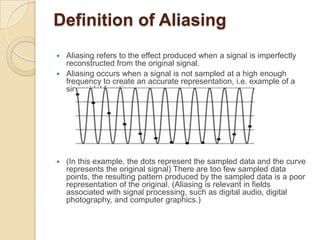
 Aliasing occurs when a signal is not sampled at a high enough
frequency to create an accurate representation, i.e. example of a
sinusoidal function:




(In this example, the dots represent the sampled data and the curve
represents the original signal) There are too few sampled data
points, the resulting pattern produced by the sampled data is a poor
representation of the original. (Aliasing is relevant in fields
associated with signal processing, such as digital audio, digital
photography, and computer graphics.)
Mean









Aliasing is an effect that causes different signals to
become indistinguishable from each other during
sampling.
Aliasing is characterized by the altering of output
compared to the original signal because resembling or
interpolation resulted in a lower resolution in images, a
slower frame rate in terms of video or a lower wave
resolution in audio.
(Anti-aliasing filters can be used to correct this
problem.)
Aliasing is a phenomenon that occurs when sampling a
continuous function with insufficient resolution
Overlap between replicated copies in frequency
spectrum
High frequency components from the replicated copies
are treated like low frequencies during the
reconstruction process
Aliasing comes in several forms:

SPATIAL ALIASING, IN PICTURES
moiré patterns arise in image warping & texture mapping
Jaggie arise in rendering
TEMPORAL ALIASING, IN AUDIO
when resembling an audio signal at a lower sampling
frequency,
e.g. 50KHz (50,000 samples per second) to 10KHz
TEMPORAL ALIASING, IN FILM/VIDEO
storming and the “wagon wheel effect
Aliasing is Bad
In a still picture, these artifacts look poor,
unrealistic.
• In audio, they sound bizarre(very strange and
unusual).
• In animation, they are very distracting, particularly
in training
simulations, such as flight simulators.
So we want to eliminate aliasing. But how?
First, let’s figure out what causes
aliasing...Suppose we wanted to make a picture
of a long, white picket fence against a dark
background, receding into the distance.
It will alias in the distance.
Along a horizontal scan line of this picture, the
intensity rises and falls.
Anti-aliasing


In digital signal processing, spatial
anti-aliasing is the technique of
minimizing the distortion artefacts
known as aliasing when representing
a high-resolution image at a lower
resolution. Anti-aliasing is used in
digital photography, computer
graphics, digital audio, and many
other applications.


Anti-aliasing means removing signal
components that have a higher
frequency than is able to be properly
resolved by the recording (or
sampling) device. This removal is
done before (re)sampling at a lower
resolution. When sampling is
performed without removing this part
of the signal, it causes undesirable
artefacts such as the black-and-white
noise near the top of figure 1-a below.


In signal acquisition and audio, anti-aliasing
is often done using an analog anti-aliasing
filter to remove the out-of-band component of
the input signal prior to sampling with an
analog-to-digital converter. In digital
photography, optical anti-aliasing filters are
made of birefringent materials, and smooth
the signal in the spatial optical domain. The
anti-aliasing filter essentially blurs the image
slightly in order to reduce the resolution to or
below that achievable by the digital sensor
(the larger the pixel pitch, the lower the
achievable resolution at the sensor level).



Example
In computer graphics, anti aliasing
improves the appearance of polygon
edges, so they are not "jagged" but are
smoothed out on the screen. However, it
incurs a performance cost for the
graphics card and uses more video
memory. The level of anti-aliasing
determines how smooth polygon edges
are (and how much video memory it
consumes).


Figure 1-a illustrates the visual distortion that
occurs when anti-aliasing is not used. Near
the top of the image, where the checkerboard
is very small, the image is both difficult to
recognize and not aesthetically appealing. In
contrast, Figure 1-b shows an anti-aliased
version of the scene. The checkerboard near
the top blends into gray, which is usually the
desired effect when the resolution is
insufficient to show the detail. Even near the
bottom of the image, the edges appear much
smoother in the anti-aliased image. Figure 1c shows another anti-aliasing algorithm,
based on the sinc filter, which is considered
better than the algorithm used in 1-b.[1]
antialising supersampling.


The term generally refers to a special
case of supersampling. Initial
implementations of full-scene antialiasing (FSAA) worked conceptually
by simply rendering a scene at a
higher resolution, and then
downsampling to a lower-resolution
output


Figure 2 shows magnified portions
(interpolated using the nearest neighbor
algorithm) of Figure 1-a (left) and 1-c
(right) for comparison. In Figure 1-c, antialiasing has interpolated the brightness
of the pixels at the boundaries to
produce gray pixels since the space is
occupied by both black and white tiles.
These help make Figure 1-c appear
much smoother than Figure 1-a at the
original magnification.


In Figure 3, anti-aliasing was used to
blend the boundary pixels of a sample
graphic; this reduced the aesthetically
jarring effect of the sharp, step-like
boundaries that appear in the aliased
graphic at the left. Anti-aliasing is often
applied in rendering text on a
computer screen, to suggest smooth
contours that better emulate the
appearance of text produced by
conventional ink-and-paper printing.

Computer graphics

  • 1.
    Definition of Aliasing Aliasingrefers to the effect produced when a signal is imperfectly reconstructed from the original signal.  Aliasing occurs when a signal is not sampled at a high enough frequency to create an accurate representation, i.e. example of a sinusoidal function:   (In this example, the dots represent the sampled data and the curve represents the original signal) There are too few sampled data points, the resulting pattern produced by the sampled data is a poor representation of the original. (Aliasing is relevant in fields associated with signal processing, such as digital audio, digital photography, and computer graphics.)
  • 2.
    Mean       Aliasing is aneffect that causes different signals to become indistinguishable from each other during sampling. Aliasing is characterized by the altering of output compared to the original signal because resembling or interpolation resulted in a lower resolution in images, a slower frame rate in terms of video or a lower wave resolution in audio. (Anti-aliasing filters can be used to correct this problem.) Aliasing is a phenomenon that occurs when sampling a continuous function with insufficient resolution Overlap between replicated copies in frequency spectrum High frequency components from the replicated copies are treated like low frequencies during the reconstruction process
  • 3.
    Aliasing comes inseveral forms: SPATIAL ALIASING, IN PICTURES moiré patterns arise in image warping & texture mapping Jaggie arise in rendering TEMPORAL ALIASING, IN AUDIO when resembling an audio signal at a lower sampling frequency, e.g. 50KHz (50,000 samples per second) to 10KHz TEMPORAL ALIASING, IN FILM/VIDEO storming and the “wagon wheel effect
  • 4.
    Aliasing is Bad Ina still picture, these artifacts look poor, unrealistic. • In audio, they sound bizarre(very strange and unusual). • In animation, they are very distracting, particularly in training simulations, such as flight simulators. So we want to eliminate aliasing. But how? First, let’s figure out what causes aliasing...Suppose we wanted to make a picture of a long, white picket fence against a dark background, receding into the distance. It will alias in the distance. Along a horizontal scan line of this picture, the intensity rises and falls.
  • 5.
    Anti-aliasing  In digital signalprocessing, spatial anti-aliasing is the technique of minimizing the distortion artefacts known as aliasing when representing a high-resolution image at a lower resolution. Anti-aliasing is used in digital photography, computer graphics, digital audio, and many other applications.
  • 6.
     Anti-aliasing means removingsignal components that have a higher frequency than is able to be properly resolved by the recording (or sampling) device. This removal is done before (re)sampling at a lower resolution. When sampling is performed without removing this part of the signal, it causes undesirable artefacts such as the black-and-white noise near the top of figure 1-a below.
  • 7.
     In signal acquisitionand audio, anti-aliasing is often done using an analog anti-aliasing filter to remove the out-of-band component of the input signal prior to sampling with an analog-to-digital converter. In digital photography, optical anti-aliasing filters are made of birefringent materials, and smooth the signal in the spatial optical domain. The anti-aliasing filter essentially blurs the image slightly in order to reduce the resolution to or below that achievable by the digital sensor (the larger the pixel pitch, the lower the achievable resolution at the sensor level).
  • 8.
      Example In computer graphics,anti aliasing improves the appearance of polygon edges, so they are not "jagged" but are smoothed out on the screen. However, it incurs a performance cost for the graphics card and uses more video memory. The level of anti-aliasing determines how smooth polygon edges are (and how much video memory it consumes).
  • 9.
     Figure 1-a illustratesthe visual distortion that occurs when anti-aliasing is not used. Near the top of the image, where the checkerboard is very small, the image is both difficult to recognize and not aesthetically appealing. In contrast, Figure 1-b shows an anti-aliased version of the scene. The checkerboard near the top blends into gray, which is usually the desired effect when the resolution is insufficient to show the detail. Even near the bottom of the image, the edges appear much smoother in the anti-aliased image. Figure 1c shows another anti-aliasing algorithm, based on the sinc filter, which is considered better than the algorithm used in 1-b.[1]
  • 10.
    antialising supersampling.  The termgenerally refers to a special case of supersampling. Initial implementations of full-scene antialiasing (FSAA) worked conceptually by simply rendering a scene at a higher resolution, and then downsampling to a lower-resolution output
  • 11.
     Figure 2 showsmagnified portions (interpolated using the nearest neighbor algorithm) of Figure 1-a (left) and 1-c (right) for comparison. In Figure 1-c, antialiasing has interpolated the brightness of the pixels at the boundaries to produce gray pixels since the space is occupied by both black and white tiles. These help make Figure 1-c appear much smoother than Figure 1-a at the original magnification.
  • 12.
     In Figure 3,anti-aliasing was used to blend the boundary pixels of a sample graphic; this reduced the aesthetically jarring effect of the sharp, step-like boundaries that appear in the aliased graphic at the left. Anti-aliasing is often applied in rendering text on a computer screen, to suggest smooth contours that better emulate the appearance of text produced by conventional ink-and-paper printing.