PRESENTED BY:-
SURESH MOHTA
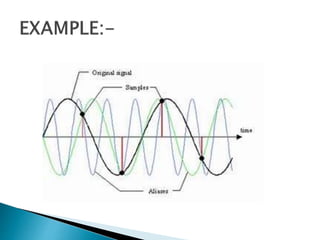
 Aliasing is termed as appearance of high
frequency signals as low frequency signal that
distracts the desired signal.
 Aliasing can occur in signals sampled in time,
for instance digital audio, and is referred to
as temporal aliasing. Aliasing can also occur
in spatially sampled signals, for instance
patterns in digital images. Aliasing in
spatially sampled signals is called spatial
aliasing.
•Aliasing is basically a low pass filter with a
cut off frequency equal to one-half the
sampling frequency used by the sampler
while sampling.
Thus
fo>=2fc
Where,
fo- Sampling Frequency
fc- Cut-off Frequency
This relationship is also
known as Nyquist Sampling Criterion.
 An anti-aliasing filter (AAF) is a filter used before a
signal sampler to restrict the bandwidth of a signal to
approximately or completely satisfy the sampling
theorem over the band of interest. Since the theorem
states that unambiguous reconstruction of the signal
from its samples is possible when the power of
frequencies above the Nyquist frequency is zero, a
real anti-aliasing filter trades off between bandwidth
and aliasing. A realizable anti-aliasing filter will
typically either permit some aliasing to occur or else
attenuate some in-band frequencies close to the
Nyquist limit. For this reason, many practical systems
sample higher than required to ensure that all
frequencies of interest can be reconstructed, a
practice called oversampling.
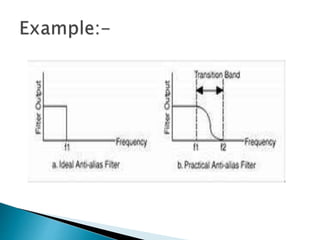
 An ideal anti-alias filter passes all the
appropriate input frequencies (below f1)and
cuts off all the undesired frequencies(above
f2). However ,such a filter is not physically
realizable. The filter passes all the frequ-
encies<f1, and cuts-off all frequencies >f2.
The region between f1 and f2 is known as
Transition Band, where signals are attenuated
gradually. The signals in the transition band
can still cause aliasing.
Aliasing and Antialiasing filter

Aliasing and Antialiasing filter

  • 1.
  • 2.
     Aliasing istermed as appearance of high frequency signals as low frequency signal that distracts the desired signal.  Aliasing can occur in signals sampled in time, for instance digital audio, and is referred to as temporal aliasing. Aliasing can also occur in spatially sampled signals, for instance patterns in digital images. Aliasing in spatially sampled signals is called spatial aliasing.
  • 3.
    •Aliasing is basicallya low pass filter with a cut off frequency equal to one-half the sampling frequency used by the sampler while sampling. Thus fo>=2fc Where, fo- Sampling Frequency fc- Cut-off Frequency This relationship is also known as Nyquist Sampling Criterion.
  • 5.
     An anti-aliasingfilter (AAF) is a filter used before a signal sampler to restrict the bandwidth of a signal to approximately or completely satisfy the sampling theorem over the band of interest. Since the theorem states that unambiguous reconstruction of the signal from its samples is possible when the power of frequencies above the Nyquist frequency is zero, a real anti-aliasing filter trades off between bandwidth and aliasing. A realizable anti-aliasing filter will typically either permit some aliasing to occur or else attenuate some in-band frequencies close to the Nyquist limit. For this reason, many practical systems sample higher than required to ensure that all frequencies of interest can be reconstructed, a practice called oversampling.
  • 7.
     An idealanti-alias filter passes all the appropriate input frequencies (below f1)and cuts off all the undesired frequencies(above f2). However ,such a filter is not physically realizable. The filter passes all the frequ- encies<f1, and cuts-off all frequencies >f2. The region between f1 and f2 is known as Transition Band, where signals are attenuated gradually. The signals in the transition band can still cause aliasing.