COMPONENT
 DIAGRAM
 in UML 2.0
 Veronica Carrega
PLAN OF TALK

   Introduction about components
   Components and component diagrams in uml 2.0
   Case study
   Elements of the component
   Component view: black-box view and white-box view
   Deployment diagrams
INTRODUCTION
   UML component diagrams describe software components
    and their dependencies to each others
       A component is an autonomous unit within a system
       The components can be used to define software systems of
        arbitrary size and complexity
       UML component diagrams enable to model the high-level software
        components, and the interfaces to those components
       Important for component-based development (CBD)
       Component and subsystems can be flexibly REUSED and
        REPLACED
       A dependency exists between two elements if changes to the
        definition of one element may cause changes to the other
       Component Diagrams are often referred to as “wiring diagrams”
       The wiring of components can be represented on diagrams by
        means of components and dependencies between them
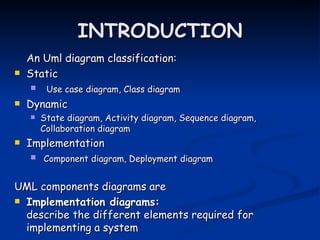
INTRODUCTION
    An Uml diagram classification:
   Static
        Use case diagram, Class diagram
   Dynamic
       State diagram, Activity diagram, Sequence diagram,
        Collaboration diagram
   Implementation
       Component diagram, Deployment diagram


UML components diagrams are
 Implementation diagrams:
  describe the different elements required for
  implementing a system
INTRODUCTION
    Another classification:
   Behavior diagrams
       A type of diagram that depicts behavior of a system
        This includes activity, state machine, and use case diagrams,
        interaction diagrams
   Interaction diagrams
       A subset of behavior diagrams which emphasize object
        interactions.  This includes collaboration, activity, sequence
        diagrams
   Structure diagrams
       A type of diagram that depicts the elements of a
        specification that are irrespective of time.  This includes
        class, composite structure, component, deployment

UML components diagrams are structure diagrams
COMPONENT in UML 2.0
   Modular unit with well-defined interfaces
    that is replaceable within its environment
   Autonomous unit within a system
      Has one or more provided and required
       interfaces
      Its internals are hidden and inaccessible

      A component is encapsulated

      Its dependencies are designed such that it
       can be treated as independently as possible
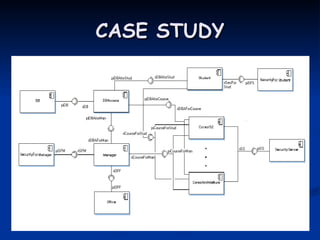
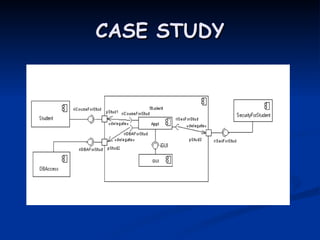
CASE STUDY
   Development of an application collecting students’ opinions
    about courses
   A student can
       Read
       Insert
       Update
       Make data permanent about the courses in its schedule
   A professor can only see statistic elaboration of the data
   The student application must be installed in pc client
    (sw1, sw2)
   The manager application must be installed in pc client (in
    the manager’s office)
   There is one or more servers with DataBase and
    components for courses management
COMPONENT NOTATION
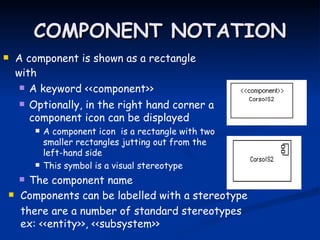
   A component is shown as a rectangle
    with
      A keyword <<component>>

       Optionally, in the right hand corner a
        component icon can be displayed
            A component icon is a rectangle with two
             smaller rectangles jutting out from the
             left-hand side
            This symbol is a visual stereotype
      The component name
    Components can be labelled with a stereotype
     there are a number of standard stereotypes
     ex: <<entity>>, <<subsystem>>
Component ELEMENTS
   A component can have
       Interfaces
         An interface represents a declaration of a set of
         operations and obligations
       Usage dependencies
         A usage dependency is relationship which one element
         requires another element for its full implementation
       Ports
         Port represents an interaction point between a component
         and its environment
       Connectors
            Connect two components
            Connect the external contract of a component to the
             internal structure
INTERFACE
   A component defines its behaviour in terms of
    provided and required interfaces
   An interface
       Is the definition of a collection of one or more
        operations
       Provides only the operations but not the implementation
       Implementation is normally provided by a class/
        component
       In complex systems, the physical implementation is
        provided by a group of classes rather than a single class
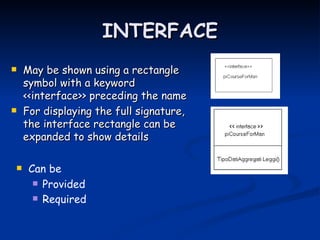
INTERFACE
   May be shown using a rectangle
    symbol with a keyword
    <<interface>> preceding the name
   For displaying the full signature,
    the interface rectangle can be
    expanded to show details

    Can be
       Provided

       Required
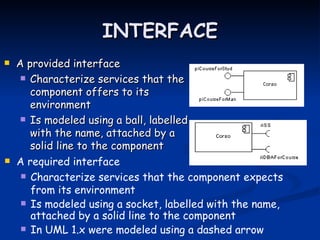
INTERFACE
   A provided interface
      Characterize services that the
       component offers to its
       environment
      Is modeled using a ball, labelled
       with the name, attached by a
       solid line to the component
   A required interface
      Characterize services that the component expects
       from its environment
      Is modeled using a socket, labelled with the name,
       attached by a solid line to the component
      In UML 1.x were modeled using a dashed arrow
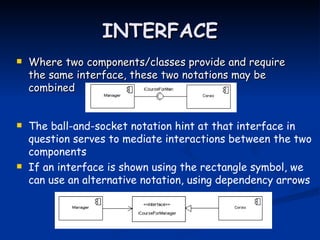
INTERFACE
   Where two components/classes provide and require
    the same interface, these two notations may be
    combined


   The ball-and-socket notation hint at that interface in
    question serves to mediate interactions between the two
    components
   If an interface is shown using the rectangle symbol, we
    can use an alternative notation, using dependency arrows
INTERFACE
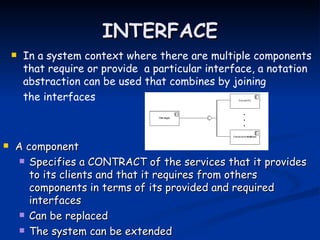
       In a system context where there are multiple components
        that require or provide a particular interface, a notation
        abstraction can be used that combines by joining
        the interfaces


   A component
      Specifies a CONTRACT of the services that it provides
       to its clients and that it requires from others
       components in terms of its provided and required
       interfaces
      Can be replaced

      The system can be extended
DEPENDENCIES
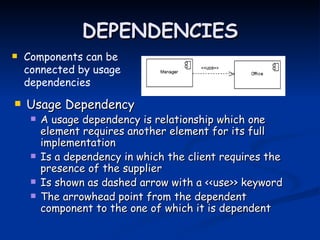
   Components can be
    connected by usage
    dependencies
   Usage Dependency
        A usage dependency is relationship which one
         element requires another element for its full
         implementation
        Is a dependency in which the client requires the
         presence of the supplier
        Is shown as dashed arrow with a <<use>> keyword
        The arrowhead point from the dependent
         component to the one of which it is dependent
PORT
   Specifies a distinct interaction point
      Between that component and its environment

      Between that component and its internal parts

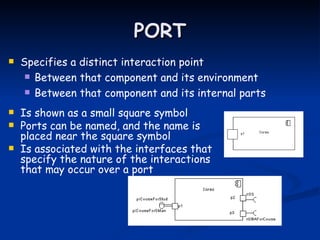
   Is shown as a small square symbol
   Ports can be named, and the name is
    placed near the square symbol
   Is associated with the interfaces that
    specify the nature of the interactions
    that may occur over a port
PORT
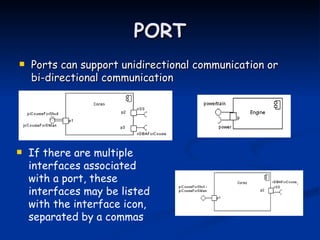
   Ports can support unidirectional communication or
    bi-directional communication


   If there are multiple
    interfaces associated
    with a port, these
    interfaces may be listed
    with the interface icon,
    separated by a commas
PORT

   All interactions of a component with its
    environment are achieved through a port
   The internals are fully isolated from the
    environment
   This allows such a component to be used in any
    context that satisfies the constraints specified by
    its ports
   Ports are not defined in UML 1.x
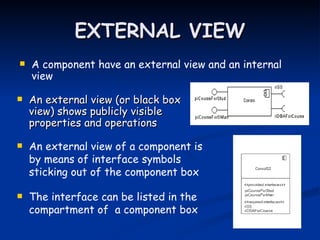
EXTERNAL VIEW
   A component have an external view and an internal
    view

   An external view (or black box
    view) shows publicly visible
    properties and operations

   An external view of a component is
    by means of interface symbols
    sticking out of the component box

   The interface can be listed in the
    compartment of a component box
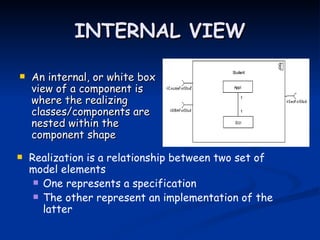
INTERNAL VIEW

   An internal, or white box
    view of a component is
    where the realizing
    classes/components are
    nested within the
    component shape

   Realization is a relationship between two set of
    model elements
      One represents a specification
      The other represent an implementation of the
       latter
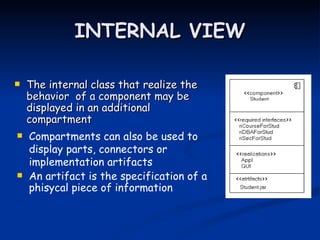
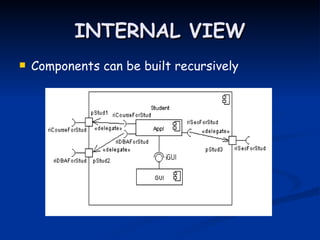
INTERNAL VIEW

   The internal class that realize the
    behavior of a component may be
    displayed in an additional
    compartment
   Compartments can also be used to
    display parts, connectors or
    implementation artifacts
   An artifact is the specification of a
    phisycal piece of information
INTERNAL VIEW
   Components can be built recursively
ASSEMBLY
   Two kinds of connectors:
      Delegation
      Assembly
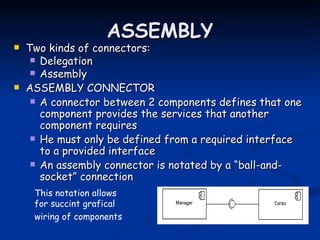
   ASSEMBLY CONNECTOR
      A connector between 2 components defines that one
       component provides the services that another
       component requires
      He must only be defined from a required interface
       to a provided interface
      An assembly connector is notated by a “ball-and-
       socket” connection
     This notation allows
     for succint grafical
     wiring of components
SEMANTICS

   The semantics for an assembly connector :
       Are that signals travel along an instance of a
        connector originating in a required port and
        delivered to a provided port
       The interfaces provided and required must be
        compatible
       The interface compatibility between provided and
        required ports that are connected enables an
        existing component in a system to be replaced
SEMANTICS
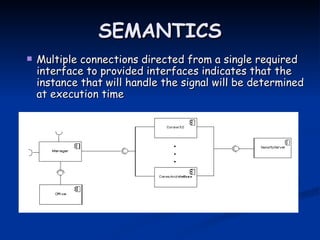
   Multiple connections directed from a single required
    interface to provided interfaces indicates that the
    instance that will handle the signal will be determined
    at execution time
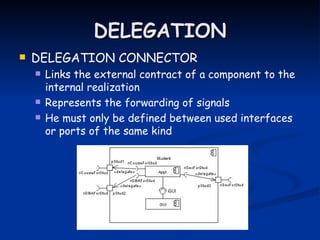
DELEGATION
   DELEGATION CONNECTOR
       Links the external contract of a component to the
        internal realization
       Represents the forwarding of signals
       He must only be defined between used interfaces
        or ports of the same kind
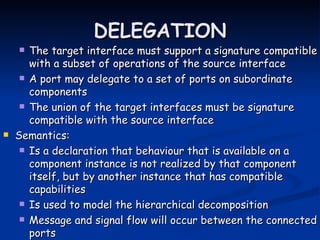
DELEGATION
      The target interface must support a signature compatible
       with a subset of operations of the source interface
      A port may delegate to a set of ports on subordinate
       components
      The union of the target interfaces must be signature
       compatible with the source interface
   Semantics:
      Is a declaration that behaviour that is available on a
       component instance is not realized by that component
       itself, but by another instance that has compatible
       capabilities
      Is used to model the hierarchical decomposition

      Message and signal flow will occur between the connected
       ports
CASE STUDY
CASE STUDY
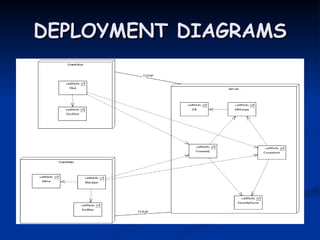
DEPLOYMENT DIAGRAMS
   There is a strong link between components diagrams and
    deployment diagrams

   Deployment diagrams
      Show the physical relationship between hardware
       and software in a system
      Hardware elements:
            Computers (clients, servers)
            Embedded processors
            Devices (sensors, peripherals)
       Are used to show the nodes where software
        components reside in the run-time system
DEPLOYMENT DIAGRAMS
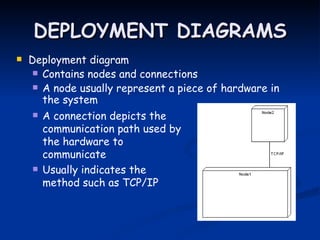
 Deployment diagram
    Contains nodes and connections
   A node usually represent a piece of hardware in
     the system
       A connection depicts the
        communication path used by
        the hardware to
        communicate
       Usually indicates the
        method such as TCP/IP
DEPLOYMENT DIAGRAMS
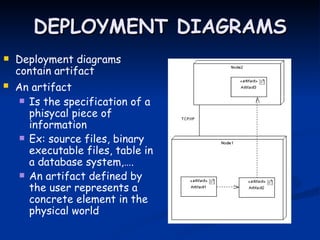
   Deployment diagrams
    contain artifact
   An artifact
      Is the specification of a
       phisycal piece of
       information
      Ex: source files, binary
       executable files, table in
       a database system,….
      An artifact defined by
       the user represents a
       concrete element in the
       physical world
DEPLOYMENT DIAGRAMS
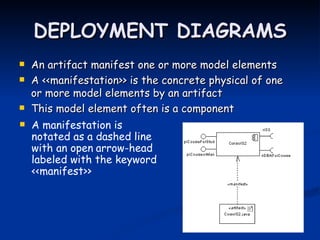
   An artifact manifest one or more model elements
   A <<manifestation>> is the concrete physical of one
    or more model elements by an artifact
   This model element often is a component
   A manifestation is
    notated as a dashed line
    with an open arrow-head
    labeled with the keyword
    <<manifest>>
DEPLOYMENT DIAGRAMS
REFERENCIES
   UML 2.0 Superstructure Specification
    August 2, 2003
    UML 2 Superstructure Final Adopted Specification
    www.omg.org/cgi-bin/doc?ptc/2003-08-02
   The Diagrams of UML 2.0
    by Scott W. Ambler, 2003-2004
    www.agilemodeling.com/essays/umlDiagrams.htm
   UML overview
    By Mandar Chitnis, Pravin Tiwari, & Lakshmi
    Ananthamurthy
    http://www.developer.com/design/article.php/1553851

Component Diagram

  • 1.
    COMPONENT DIAGRAM inUML 2.0 Veronica Carrega
  • 2.
    PLAN OF TALK  Introduction about components  Components and component diagrams in uml 2.0  Case study  Elements of the component  Component view: black-box view and white-box view  Deployment diagrams
  • 3.
    INTRODUCTION  UML component diagrams describe software components and their dependencies to each others  A component is an autonomous unit within a system  The components can be used to define software systems of arbitrary size and complexity  UML component diagrams enable to model the high-level software components, and the interfaces to those components  Important for component-based development (CBD)  Component and subsystems can be flexibly REUSED and REPLACED  A dependency exists between two elements if changes to the definition of one element may cause changes to the other  Component Diagrams are often referred to as “wiring diagrams”  The wiring of components can be represented on diagrams by means of components and dependencies between them
  • 4.
    INTRODUCTION An Uml diagram classification:  Static  Use case diagram, Class diagram  Dynamic  State diagram, Activity diagram, Sequence diagram, Collaboration diagram  Implementation  Component diagram, Deployment diagram UML components diagrams are  Implementation diagrams: describe the different elements required for implementing a system
  • 5.
    INTRODUCTION Another classification:  Behavior diagrams  A type of diagram that depicts behavior of a system This includes activity, state machine, and use case diagrams, interaction diagrams  Interaction diagrams  A subset of behavior diagrams which emphasize object interactions.  This includes collaboration, activity, sequence diagrams  Structure diagrams  A type of diagram that depicts the elements of a specification that are irrespective of time.  This includes class, composite structure, component, deployment UML components diagrams are structure diagrams
  • 6.
    COMPONENT in UML2.0  Modular unit with well-defined interfaces that is replaceable within its environment  Autonomous unit within a system  Has one or more provided and required interfaces  Its internals are hidden and inaccessible  A component is encapsulated  Its dependencies are designed such that it can be treated as independently as possible
  • 7.
    CASE STUDY  Development of an application collecting students’ opinions about courses  A student can  Read  Insert  Update  Make data permanent about the courses in its schedule  A professor can only see statistic elaboration of the data  The student application must be installed in pc client (sw1, sw2)  The manager application must be installed in pc client (in the manager’s office)  There is one or more servers with DataBase and components for courses management
  • 8.
    COMPONENT NOTATION  A component is shown as a rectangle with  A keyword <<component>>  Optionally, in the right hand corner a component icon can be displayed  A component icon is a rectangle with two smaller rectangles jutting out from the left-hand side  This symbol is a visual stereotype  The component name  Components can be labelled with a stereotype there are a number of standard stereotypes ex: <<entity>>, <<subsystem>>
  • 9.
    Component ELEMENTS  A component can have  Interfaces An interface represents a declaration of a set of operations and obligations  Usage dependencies A usage dependency is relationship which one element requires another element for its full implementation  Ports Port represents an interaction point between a component and its environment  Connectors  Connect two components  Connect the external contract of a component to the internal structure
  • 10.
    INTERFACE  A component defines its behaviour in terms of provided and required interfaces  An interface  Is the definition of a collection of one or more operations  Provides only the operations but not the implementation  Implementation is normally provided by a class/ component  In complex systems, the physical implementation is provided by a group of classes rather than a single class
  • 11.
    INTERFACE  May be shown using a rectangle symbol with a keyword <<interface>> preceding the name  For displaying the full signature, the interface rectangle can be expanded to show details  Can be  Provided  Required
  • 12.
    INTERFACE  A provided interface  Characterize services that the component offers to its environment  Is modeled using a ball, labelled with the name, attached by a solid line to the component  A required interface  Characterize services that the component expects from its environment  Is modeled using a socket, labelled with the name, attached by a solid line to the component  In UML 1.x were modeled using a dashed arrow
  • 13.
    INTERFACE  Where two components/classes provide and require the same interface, these two notations may be combined  The ball-and-socket notation hint at that interface in question serves to mediate interactions between the two components  If an interface is shown using the rectangle symbol, we can use an alternative notation, using dependency arrows
  • 14.
    INTERFACE  In a system context where there are multiple components that require or provide a particular interface, a notation abstraction can be used that combines by joining the interfaces  A component  Specifies a CONTRACT of the services that it provides to its clients and that it requires from others components in terms of its provided and required interfaces  Can be replaced  The system can be extended
  • 15.
    DEPENDENCIES  Components can be connected by usage dependencies  Usage Dependency  A usage dependency is relationship which one element requires another element for its full implementation  Is a dependency in which the client requires the presence of the supplier  Is shown as dashed arrow with a <<use>> keyword  The arrowhead point from the dependent component to the one of which it is dependent
  • 16.
    PORT  Specifies a distinct interaction point  Between that component and its environment  Between that component and its internal parts  Is shown as a small square symbol  Ports can be named, and the name is placed near the square symbol  Is associated with the interfaces that specify the nature of the interactions that may occur over a port
  • 17.
    PORT  Ports can support unidirectional communication or bi-directional communication  If there are multiple interfaces associated with a port, these interfaces may be listed with the interface icon, separated by a commas
  • 18.
    PORT  All interactions of a component with its environment are achieved through a port  The internals are fully isolated from the environment  This allows such a component to be used in any context that satisfies the constraints specified by its ports  Ports are not defined in UML 1.x
  • 19.
    EXTERNAL VIEW  A component have an external view and an internal view  An external view (or black box view) shows publicly visible properties and operations  An external view of a component is by means of interface symbols sticking out of the component box  The interface can be listed in the compartment of a component box
  • 20.
    INTERNAL VIEW  An internal, or white box view of a component is where the realizing classes/components are nested within the component shape  Realization is a relationship between two set of model elements  One represents a specification  The other represent an implementation of the latter
  • 21.
    INTERNAL VIEW  The internal class that realize the behavior of a component may be displayed in an additional compartment  Compartments can also be used to display parts, connectors or implementation artifacts  An artifact is the specification of a phisycal piece of information
  • 22.
    INTERNAL VIEW  Components can be built recursively
  • 23.
    ASSEMBLY  Two kinds of connectors:  Delegation  Assembly  ASSEMBLY CONNECTOR  A connector between 2 components defines that one component provides the services that another component requires  He must only be defined from a required interface to a provided interface  An assembly connector is notated by a “ball-and- socket” connection This notation allows for succint grafical wiring of components
  • 24.
    SEMANTICS  The semantics for an assembly connector :  Are that signals travel along an instance of a connector originating in a required port and delivered to a provided port  The interfaces provided and required must be compatible  The interface compatibility between provided and required ports that are connected enables an existing component in a system to be replaced
  • 25.
    SEMANTICS  Multiple connections directed from a single required interface to provided interfaces indicates that the instance that will handle the signal will be determined at execution time
  • 26.
    DELEGATION  DELEGATION CONNECTOR  Links the external contract of a component to the internal realization  Represents the forwarding of signals  He must only be defined between used interfaces or ports of the same kind
  • 27.
    DELEGATION  The target interface must support a signature compatible with a subset of operations of the source interface  A port may delegate to a set of ports on subordinate components  The union of the target interfaces must be signature compatible with the source interface  Semantics:  Is a declaration that behaviour that is available on a component instance is not realized by that component itself, but by another instance that has compatible capabilities  Is used to model the hierarchical decomposition  Message and signal flow will occur between the connected ports
  • 28.
  • 29.
  • 30.
    DEPLOYMENT DIAGRAMS  There is a strong link between components diagrams and deployment diagrams  Deployment diagrams  Show the physical relationship between hardware and software in a system  Hardware elements:  Computers (clients, servers)  Embedded processors  Devices (sensors, peripherals)  Are used to show the nodes where software components reside in the run-time system
  • 31.
    DEPLOYMENT DIAGRAMS  Deploymentdiagram  Contains nodes and connections    A node usually represent a piece of hardware in the system  A connection depicts the communication path used by the hardware to communicate  Usually indicates the method such as TCP/IP
  • 32.
    DEPLOYMENT DIAGRAMS  Deployment diagrams contain artifact  An artifact  Is the specification of a phisycal piece of information  Ex: source files, binary executable files, table in a database system,….  An artifact defined by the user represents a concrete element in the physical world
  • 33.
    DEPLOYMENT DIAGRAMS  An artifact manifest one or more model elements  A <<manifestation>> is the concrete physical of one or more model elements by an artifact  This model element often is a component  A manifestation is notated as a dashed line with an open arrow-head labeled with the keyword <<manifest>>
  • 34.
  • 35.
    REFERENCIES  UML 2.0 Superstructure Specification August 2, 2003 UML 2 Superstructure Final Adopted Specification www.omg.org/cgi-bin/doc?ptc/2003-08-02  The Diagrams of UML 2.0 by Scott W. Ambler, 2003-2004 www.agilemodeling.com/essays/umlDiagrams.htm  UML overview By Mandar Chitnis, Pravin Tiwari, & Lakshmi Ananthamurthy http://www.developer.com/design/article.php/1553851