
Competitor Analysis
Week 5
Competitor Analysis
Week 5
Hospitality Marketing
Nur Agustinus
Hospitality Marketing
Nur Agustinus
Hypothetical
Market Structure
Hypothetical
Market Structure
Hypothetical
Market Structure
Direct CompetitorsDirect Competitors
Indirect Competitors
“Indirect competitors offer the same stuff but have a
different goal. They don’t drive revenue the same way.”
“Indirect competitors offer the same stuff but have a
different goal. They don’t drive revenue the same way.”
Forces that drive down pricesForces that drive down prices
• Many sellers
• Stagnant or declining industry
• Firms have different costs
• Excess capacity
• Undifferentiated products
• Large/infrequent sales orders
• Strong exit barriers
• Prices/terms of sale unobservable
• Prices cannot be adjusted quickly
• Many sellers
• Stagnant or declining industry
• Firms have different costs
• Excess capacity
• Undifferentiated products
• Large/infrequent sales orders
• Strong exit barriers
• Prices/terms of sale unobservable
• Prices cannot be adjusted quickly
• Many sellers
• Stagnant or declining industry
• Firms have different costs
• Excess capacity
• Undifferentiated products
• Large/infrequent sales orders
• Strong exit barriers
• Prices/terms of sale unobservable
• Prices cannot be adjusted quickly
• Many sellers
• Stagnant or declining industry
• Firms have different costs
• Excess capacity
• Undifferentiated products
• Large/infrequent sales orders
• Strong exit barriers
• Prices/terms of sale unobservable
• Prices cannot be adjusted quickly
• Many sellers
• Stagnant or declining industry
• Firms have different costs
• Excess capacity
• Undifferentiated products
• Large/infrequent sales orders
• Strong exit barriers
• Prices/terms of sale unobservable
• Prices cannot be adjusted quickly
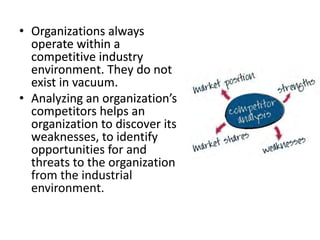
• Organizations always
operate within a
competitive industry
environment. They do not
exist in vacuum.
• Analyzing an organization’s
competitors helps an
organization to discover its
weaknesses, to identify
opportunities for and
threats to the organization
from the industrial
environment.
• Organizations always
operate within a
competitive industry
environment. They do not
exist in vacuum.
• Analyzing an organization’s
competitors helps an
organization to discover its
weaknesses, to identify
opportunities for and
threats to the organization
from the industrial
environment.
• Organizations always
operate within a
competitive industry
environment. They do not
exist in vacuum.
• Analyzing an organization’s
competitors helps an
organization to discover its
weaknesses, to identify
opportunities for and
threats to the organization
from the industrial
environment.
• Organizations always
operate within a
competitive industry
environment. They do not
exist in vacuum.
• Analyzing an organization’s
competitors helps an
organization to discover its
weaknesses, to identify
opportunities for and
threats to the organization
from the industrial
environment.
• Organizations always
operate within a
competitive industry
environment. They do not
exist in vacuum.
• Analyzing an organization’s
competitors helps an
organization to discover its
weaknesses, to identify
opportunities for and
threats to the organization
from the industrial
environment.
• Organizations always
operate within a
competitive industry
environment. They do not
exist in vacuum.
• Analyzing an organization’s
competitors helps an
organization to discover its
weaknesses, to identify
opportunities for and
threats to the organization
from the industrial
environment.
Steps of Competitor AnalysisSteps of Competitor Analysis
The following are the steps to be conducted for carrying
out a Competitor Analysis:
• Step 1: Identify Potential Competitors
• Step 2: Carry out a through Competitor Profiling
• Step 3: Understand Competitors’ Strategies
• Step 4: Analysis of Strengths and Weaknesses against
Competitors
• Step 5: Assess Market Attractiveness
• Step 6: Analyze Sources of Competitive Advantage
• Step 7: Design Competitive Strategies
The following are the steps to be conducted for carrying
out a Competitor Analysis:
• Step 1: Identify Potential Competitors
• Step 2: Carry out a through Competitor Profiling
• Step 3: Understand Competitors’ Strategies
• Step 4: Analysis of Strengths and Weaknesses against
Competitors
• Step 5: Assess Market Attractiveness
• Step 6: Analyze Sources of Competitive Advantage
• Step 7: Design Competitive Strategies
The following are the steps to be conducted for carrying
out a Competitor Analysis:
• Step 1: Identify Potential Competitors
• Step 2: Carry out a through Competitor Profiling
• Step 3: Understand Competitors’ Strategies
• Step 4: Analysis of Strengths and Weaknesses against
Competitors
• Step 5: Assess Market Attractiveness
• Step 6: Analyze Sources of Competitive Advantage
• Step 7: Design Competitive Strategies
The following are the steps to be conducted for carrying
out a Competitor Analysis:
• Step 1: Identify Potential Competitors
• Step 2: Carry out a through Competitor Profiling
• Step 3: Understand Competitors’ Strategies
• Step 4: Analysis of Strengths and Weaknesses against
Competitors
• Step 5: Assess Market Attractiveness
• Step 6: Analyze Sources of Competitive Advantage
• Step 7: Design Competitive Strategies
The following are the steps to be conducted for carrying
out a Competitor Analysis:
• Step 1: Identify Potential Competitors
• Step 2: Carry out a through Competitor Profiling
• Step 3: Understand Competitors’ Strategies
• Step 4: Analysis of Strengths and Weaknesses against
Competitors
• Step 5: Assess Market Attractiveness
• Step 6: Analyze Sources of Competitive Advantage
• Step 7: Design Competitive Strategies
The following are the steps to be conducted for carrying
out a Competitor Analysis:
• Step 1: Identify Potential Competitors
• Step 2: Carry out a through Competitor Profiling
• Step 3: Understand Competitors’ Strategies
• Step 4: Analysis of Strengths and Weaknesses against
Competitors
• Step 5: Assess Market Attractiveness
• Step 6: Analyze Sources of Competitive Advantage
• Step 7: Design Competitive Strategies
Market-based AnalysisMarket-based Analysis
• the competition faced by companies has been
classified based on the degree of product
substitution in the following categories:
• Brand Competition
• Industry Competition
• Product Competition
• Generic Competition
• the competition faced by companies has been
classified based on the degree of product
substitution in the following categories:
• Brand Competition
• Industry Competition
• Product Competition
• Generic Competition
• the competition faced by companies has been
classified based on the degree of product
substitution in the following categories:
• Brand Competition
• Industry Competition
• Product Competition
• Generic Competition
• the competition faced by companies has been
classified based on the degree of product
substitution in the following categories:
• Brand Competition
• Industry Competition
• Product Competition
• Generic Competition
• the competition faced by companies has been
classified based on the degree of product
substitution in the following categories:
• Brand Competition
• Industry Competition
• Product Competition
• Generic Competition
Bases of Competition
I. Customer-oriented
Who they are – competition for same budget
When they use it
Why they use it- benefits sought
II. Marketing-oriented: advertising and promotion
Theme/copy strategy
Media
Distribution
Price
III. Resource-oriented
Raw materials
Employees
Financial resources
IV. Geographic
I. Customer-oriented
Who they are – competition for same budget
When they use it
Why they use it- benefits sought
II. Marketing-oriented: advertising and promotion
Theme/copy strategy
Media
Distribution
Price
III. Resource-oriented
Raw materials
Employees
Financial resources
IV. Geographic
I. Customer-oriented
Who they are – competition for same budget
When they use it
Why they use it- benefits sought
II. Marketing-oriented: advertising and promotion
Theme/copy strategy
Media
Distribution
Price
III. Resource-oriented
Raw materials
Employees
Financial resources
IV. Geographic
I. Customer-oriented
Who they are – competition for same budget
When they use it
Why they use it- benefits sought
II. Marketing-oriented: advertising and promotion
Theme/copy strategy
Media
Distribution
Price
III. Resource-oriented
Raw materials
Employees
Financial resources
IV. Geographic
I. Customer-oriented
Who they are – competition for same budget
When they use it
Why they use it- benefits sought
II. Marketing-oriented: advertising and promotion
Theme/copy strategy
Media
Distribution
Price
III. Resource-oriented
Raw materials
Employees
Financial resources
IV. Geographic
I. Customer-oriented
Who they are – competition for same budget
When they use it
Why they use it- benefits sought
II. Marketing-oriented: advertising and promotion
Theme/copy strategy
Media
Distribution
Price
III. Resource-oriented
Raw materials
Employees
Financial resources
IV. Geographic
I. Customer-oriented
Who they are – competition for same budget
When they use it
Why they use it- benefits sought
II. Marketing-oriented: advertising and promotion
Theme/copy strategy
Media
Distribution
Price
III. Resource-oriented
Raw materials
Employees
Financial resources
IV. Geographic
Category Factors
• Threat of new entrants
• Bargaining power of buyers
• Bargaining power of suppliers
• Current category rivalry
• Pressure from substitutes
• Category capacity
• Threat of new entrants
• Bargaining power of buyers
• Bargaining power of suppliers
• Current category rivalry
• Pressure from substitutes
• Category capacity
• Threat of new entrants
• Bargaining power of buyers
• Bargaining power of suppliers
• Current category rivalry
• Pressure from substitutes
• Category capacity
• Threat of new entrants
• Bargaining power of buyers
• Bargaining power of suppliers
• Current category rivalry
• Pressure from substitutes
• Category capacity
• Threat of new entrants
• Bargaining power of buyers
• Bargaining power of suppliers
• Current category rivalry
• Pressure from substitutes
• Category capacity
Assessing Competitor’s Strategies
Marketing mix
Competitor Information to CollectCompetitor Information to Collect
• Ability to produce
• Ability to market
• Ability to finance
• Ability to manage
• Ability to produce
• Ability to market
• Ability to finance
• Ability to manage
• Ability to produce
• Ability to market
• Ability to finance
• Ability to manage
• Ability to produce
• Ability to market
• Ability to finance
• Ability to manage
Competitor AnalysisCompetitor Analysis
• Firms face a wide range
of competition
• Be careful to avoid
“competitor myopia”
• Methods of identifying
competitors:
– Industry point-of-view
– Market point-of-view
• Competitor maps
can help
Steps in theSteps in the
Process:Process:
• Firms face a wide range
of competition
• Be careful to avoid
“competitor myopia”
• Methods of identifying
competitors:
– Industry point-of-view
– Market point-of-view
• Competitor maps
can help
Steps in theSteps in the
Process:Process:
• Firms face a wide range
of competition
• Be careful to avoid
“competitor myopia”
• Methods of identifying
competitors:
– Industry point-of-view
– Market point-of-view
• Competitor maps
can help
IdentifyingIdentifying
CompetitorsCompetitors
AssessingAssessing
CompetitorsCompetitors
SelectingSelecting
Competitors toCompetitors to
Attack or AvoidAttack or Avoid
Steps in theSteps in the
Process:Process:
• Firms face a wide range
of competition
• Be careful to avoid
“competitor myopia”
• Methods of identifying
competitors:
– Industry point-of-view
– Market point-of-view
• Competitor maps
can help
IdentifyingIdentifying
CompetitorsCompetitors
AssessingAssessing
CompetitorsCompetitors
SelectingSelecting
Competitors toCompetitors to
Attack or AvoidAttack or Avoid
• Firms face a wide range
of competition
• Be careful to avoid
“competitor myopia”
• Methods of identifying
competitors:
– Industry point-of-view
– Market point-of-view
• Competitor maps
can help
IdentifyingIdentifying
CompetitorsCompetitors
AssessingAssessing
CompetitorsCompetitors
SelectingSelecting
Competitors toCompetitors to
Attack or AvoidAttack or Avoid
• Firms face a wide range
of competition
• Be careful to avoid
“competitor myopia”
• Methods of identifying
competitors:
– Industry point-of-view
– Market point-of-view
• Competitor maps
can help
IdentifyingIdentifying
CompetitorsCompetitors
AssessingAssessing
CompetitorsCompetitors
SelectingSelecting
Competitors toCompetitors to
Attack or AvoidAttack or Avoid
Competitor AnalysisCompetitor Analysis
• Determining competitors’
objectives
• Identifying competitors’
strategies
– Strategic groups
• Assessing competitors’
strengths and weaknesses
– Benchmarking
• Estimating competitors’
reactions
Steps in theSteps in the
Process:Process:
• Determining competitors’
objectives
• Identifying competitors’
strategies
– Strategic groups
• Assessing competitors’
strengths and weaknesses
– Benchmarking
• Estimating competitors’
reactions
Steps in theSteps in the
Process:Process:
• Determining competitors’
objectives
• Identifying competitors’
strategies
– Strategic groups
• Assessing competitors’
strengths and weaknesses
– Benchmarking
• Estimating competitors’
reactions
IdentifyingIdentifying
CompetitorsCompetitors
AssessingAssessing
CompetitorsCompetitors
SelectingSelecting
Competitors toCompetitors to
Attack or AvoidAttack or Avoid
Steps in theSteps in the
Process:Process:
• Determining competitors’
objectives
• Identifying competitors’
strategies
– Strategic groups
• Assessing competitors’
strengths and weaknesses
– Benchmarking
• Estimating competitors’
reactions
IdentifyingIdentifying
CompetitorsCompetitors
AssessingAssessing
CompetitorsCompetitors
SelectingSelecting
Competitors toCompetitors to
Attack or AvoidAttack or Avoid
• Determining competitors’
objectives
• Identifying competitors’
strategies
– Strategic groups
• Assessing competitors’
strengths and weaknesses
– Benchmarking
• Estimating competitors’
reactions
IdentifyingIdentifying
CompetitorsCompetitors
AssessingAssessing
CompetitorsCompetitors
SelectingSelecting
Competitors toCompetitors to
Attack or AvoidAttack or Avoid
• Determining competitors’
objectives
• Identifying competitors’
strategies
– Strategic groups
• Assessing competitors’
strengths and weaknesses
– Benchmarking
• Estimating competitors’
reactions
IdentifyingIdentifying
CompetitorsCompetitors
AssessingAssessing
CompetitorsCompetitors
SelectingSelecting
Competitors toCompetitors to
Attack or AvoidAttack or Avoid
Competitor AnalysisCompetitor Analysis
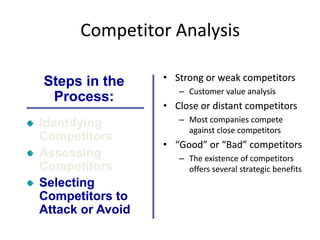
• Strong or weak competitors
– Customer value analysis
• Close or distant competitors
– Most companies compete
against close competitors
• “Good” or “Bad” competitors
– The existence of competitors
offers several strategic benefits
Steps in theSteps in the
Process:Process:
• Strong or weak competitors
– Customer value analysis
• Close or distant competitors
– Most companies compete
against close competitors
• “Good” or “Bad” competitors
– The existence of competitors
offers several strategic benefits
Steps in theSteps in the
Process:Process:
• Strong or weak competitors
– Customer value analysis
• Close or distant competitors
– Most companies compete
against close competitors
• “Good” or “Bad” competitors
– The existence of competitors
offers several strategic benefits
IdentifyingIdentifying
CompetitorsCompetitors
AssessingAssessing
CompetitorsCompetitors
SelectingSelecting
Competitors toCompetitors to
Attack or AvoidAttack or Avoid
Steps in theSteps in the
Process:Process:
• Strong or weak competitors
– Customer value analysis
• Close or distant competitors
– Most companies compete
against close competitors
• “Good” or “Bad” competitors
– The existence of competitors
offers several strategic benefits
IdentifyingIdentifying
CompetitorsCompetitors
AssessingAssessing
CompetitorsCompetitors
SelectingSelecting
Competitors toCompetitors to
Attack or AvoidAttack or Avoid
• Strong or weak competitors
– Customer value analysis
• Close or distant competitors
– Most companies compete
against close competitors
• “Good” or “Bad” competitors
– The existence of competitors
offers several strategic benefits
IdentifyingIdentifying
CompetitorsCompetitors
AssessingAssessing
CompetitorsCompetitors
SelectingSelecting
Competitors toCompetitors to
Attack or AvoidAttack or Avoid
IdentifyingIdentifying
CompetitorsCompetitors
AssessingAssessing
CompetitorsCompetitors
SelectingSelecting
Competitors toCompetitors to
Attack or AvoidAttack or Avoid
CreatingCreating
Competitive AdvantageCompetitive Advantage
CreatingCreating
Competitive AdvantageCompetitive Advantage
CreatingCreating
Competitive AdvantageCompetitive Advantage
DefinitionDefinition
• Competitive Advantage
–An advantage
over competitors
gained by offering consumers
greater
value than
competitors offer.
• Competitive Advantage
–An advantage
over competitors
gained by offering consumers
greater
value than
competitors offer.
• Competitive Advantage
–An advantage
over competitors
gained by offering consumers
greater
value than
competitors offer.
• Competitive Advantage
–An advantage
over competitors
gained by offering consumers
greater
value than
competitors offer.
18- 20
• Competitive Advantage
–An advantage
over competitors
gained by offering consumers
greater
value than
competitors offer.
Competitive StrategiesCompetitive Strategies
• Basic Winning Competitive
Strategies: Porter
– Overall cost leadership
• Lowest production and
distribution costs
– Differentiation
• Creating a highly
differentiated product line
and marketing program
– Focus
• Effort is focused on serving
a few market segments
• Basic Winning Competitive
Strategies: Porter
– Overall cost leadership
• Lowest production and
distribution costs
– Differentiation
• Creating a highly
differentiated product line
and marketing program
– Focus
• Effort is focused on serving
a few market segments
• Basic Winning Competitive
Strategies: Porter
– Overall cost leadership
• Lowest production and
distribution costs
– Differentiation
• Creating a highly
differentiated product line
and marketing program
– Focus
• Effort is focused on serving
a few market segments
• Basic Winning Competitive
Strategies: Porter
– Overall cost leadership
• Lowest production and
distribution costs
– Differentiation
• Creating a highly
differentiated product line
and marketing program
– Focus
• Effort is focused on serving
a few market segments
18- 22
• Basic Winning Competitive
Strategies: Porter
– Overall cost leadership
• Lowest production and
distribution costs
– Differentiation
• Creating a highly
differentiated product line
and marketing program
– Focus
• Effort is focused on serving
a few market segments
Competitive StrategiesCompetitive Strategies
• Basic Competitive Strategies:
Value Disciplines
– Operational excellence
• Superior value via price and convenience
– Customer intimacy
• Superior value by means of building strong
relationships with buyers and satisfying
needs
– Product leadership
• Superior value via product innovation
• Basic Competitive Strategies:
Value Disciplines
– Operational excellence
• Superior value via price and convenience
– Customer intimacy
• Superior value by means of building strong
relationships with buyers and satisfying
needs
– Product leadership
• Superior value via product innovation
• Basic Competitive Strategies:
Value Disciplines
– Operational excellence
• Superior value via price and convenience
– Customer intimacy
• Superior value by means of building strong
relationships with buyers and satisfying
needs
– Product leadership
• Superior value via product innovation
• Basic Competitive Strategies:
Value Disciplines
– Operational excellence
• Superior value via price and convenience
– Customer intimacy
• Superior value by means of building strong
relationships with buyers and satisfying
needs
– Product leadership
• Superior value via product innovation
18- 23
• Basic Competitive Strategies:
Value Disciplines
– Operational excellence
• Superior value via price and convenience
– Customer intimacy
• Superior value by means of building strong
relationships with buyers and satisfying
needs
– Product leadership
• Superior value via product innovation
Competitor Analysis

Competitor Analysis

  • 1.
    Competitor Analysis Week 5 CompetitorAnalysis Week 5 Hospitality Marketing Nur Agustinus Hospitality Marketing Nur Agustinus
  • 2.
  • 4.
  • 5.
    Indirect Competitors “Indirect competitorsoffer the same stuff but have a different goal. They don’t drive revenue the same way.” “Indirect competitors offer the same stuff but have a different goal. They don’t drive revenue the same way.”
  • 8.
    Forces that drivedown pricesForces that drive down prices • Many sellers • Stagnant or declining industry • Firms have different costs • Excess capacity • Undifferentiated products • Large/infrequent sales orders • Strong exit barriers • Prices/terms of sale unobservable • Prices cannot be adjusted quickly • Many sellers • Stagnant or declining industry • Firms have different costs • Excess capacity • Undifferentiated products • Large/infrequent sales orders • Strong exit barriers • Prices/terms of sale unobservable • Prices cannot be adjusted quickly • Many sellers • Stagnant or declining industry • Firms have different costs • Excess capacity • Undifferentiated products • Large/infrequent sales orders • Strong exit barriers • Prices/terms of sale unobservable • Prices cannot be adjusted quickly • Many sellers • Stagnant or declining industry • Firms have different costs • Excess capacity • Undifferentiated products • Large/infrequent sales orders • Strong exit barriers • Prices/terms of sale unobservable • Prices cannot be adjusted quickly • Many sellers • Stagnant or declining industry • Firms have different costs • Excess capacity • Undifferentiated products • Large/infrequent sales orders • Strong exit barriers • Prices/terms of sale unobservable • Prices cannot be adjusted quickly
  • 9.
    • Organizations always operatewithin a competitive industry environment. They do not exist in vacuum. • Analyzing an organization’s competitors helps an organization to discover its weaknesses, to identify opportunities for and threats to the organization from the industrial environment. • Organizations always operate within a competitive industry environment. They do not exist in vacuum. • Analyzing an organization’s competitors helps an organization to discover its weaknesses, to identify opportunities for and threats to the organization from the industrial environment. • Organizations always operate within a competitive industry environment. They do not exist in vacuum. • Analyzing an organization’s competitors helps an organization to discover its weaknesses, to identify opportunities for and threats to the organization from the industrial environment. • Organizations always operate within a competitive industry environment. They do not exist in vacuum. • Analyzing an organization’s competitors helps an organization to discover its weaknesses, to identify opportunities for and threats to the organization from the industrial environment. • Organizations always operate within a competitive industry environment. They do not exist in vacuum. • Analyzing an organization’s competitors helps an organization to discover its weaknesses, to identify opportunities for and threats to the organization from the industrial environment. • Organizations always operate within a competitive industry environment. They do not exist in vacuum. • Analyzing an organization’s competitors helps an organization to discover its weaknesses, to identify opportunities for and threats to the organization from the industrial environment.
  • 10.
    Steps of CompetitorAnalysisSteps of Competitor Analysis The following are the steps to be conducted for carrying out a Competitor Analysis: • Step 1: Identify Potential Competitors • Step 2: Carry out a through Competitor Profiling • Step 3: Understand Competitors’ Strategies • Step 4: Analysis of Strengths and Weaknesses against Competitors • Step 5: Assess Market Attractiveness • Step 6: Analyze Sources of Competitive Advantage • Step 7: Design Competitive Strategies The following are the steps to be conducted for carrying out a Competitor Analysis: • Step 1: Identify Potential Competitors • Step 2: Carry out a through Competitor Profiling • Step 3: Understand Competitors’ Strategies • Step 4: Analysis of Strengths and Weaknesses against Competitors • Step 5: Assess Market Attractiveness • Step 6: Analyze Sources of Competitive Advantage • Step 7: Design Competitive Strategies The following are the steps to be conducted for carrying out a Competitor Analysis: • Step 1: Identify Potential Competitors • Step 2: Carry out a through Competitor Profiling • Step 3: Understand Competitors’ Strategies • Step 4: Analysis of Strengths and Weaknesses against Competitors • Step 5: Assess Market Attractiveness • Step 6: Analyze Sources of Competitive Advantage • Step 7: Design Competitive Strategies The following are the steps to be conducted for carrying out a Competitor Analysis: • Step 1: Identify Potential Competitors • Step 2: Carry out a through Competitor Profiling • Step 3: Understand Competitors’ Strategies • Step 4: Analysis of Strengths and Weaknesses against Competitors • Step 5: Assess Market Attractiveness • Step 6: Analyze Sources of Competitive Advantage • Step 7: Design Competitive Strategies The following are the steps to be conducted for carrying out a Competitor Analysis: • Step 1: Identify Potential Competitors • Step 2: Carry out a through Competitor Profiling • Step 3: Understand Competitors’ Strategies • Step 4: Analysis of Strengths and Weaknesses against Competitors • Step 5: Assess Market Attractiveness • Step 6: Analyze Sources of Competitive Advantage • Step 7: Design Competitive Strategies The following are the steps to be conducted for carrying out a Competitor Analysis: • Step 1: Identify Potential Competitors • Step 2: Carry out a through Competitor Profiling • Step 3: Understand Competitors’ Strategies • Step 4: Analysis of Strengths and Weaknesses against Competitors • Step 5: Assess Market Attractiveness • Step 6: Analyze Sources of Competitive Advantage • Step 7: Design Competitive Strategies
  • 11.
    Market-based AnalysisMarket-based Analysis •the competition faced by companies has been classified based on the degree of product substitution in the following categories: • Brand Competition • Industry Competition • Product Competition • Generic Competition • the competition faced by companies has been classified based on the degree of product substitution in the following categories: • Brand Competition • Industry Competition • Product Competition • Generic Competition • the competition faced by companies has been classified based on the degree of product substitution in the following categories: • Brand Competition • Industry Competition • Product Competition • Generic Competition • the competition faced by companies has been classified based on the degree of product substitution in the following categories: • Brand Competition • Industry Competition • Product Competition • Generic Competition • the competition faced by companies has been classified based on the degree of product substitution in the following categories: • Brand Competition • Industry Competition • Product Competition • Generic Competition
  • 12.
    Bases of Competition I.Customer-oriented Who they are – competition for same budget When they use it Why they use it- benefits sought II. Marketing-oriented: advertising and promotion Theme/copy strategy Media Distribution Price III. Resource-oriented Raw materials Employees Financial resources IV. Geographic I. Customer-oriented Who they are – competition for same budget When they use it Why they use it- benefits sought II. Marketing-oriented: advertising and promotion Theme/copy strategy Media Distribution Price III. Resource-oriented Raw materials Employees Financial resources IV. Geographic I. Customer-oriented Who they are – competition for same budget When they use it Why they use it- benefits sought II. Marketing-oriented: advertising and promotion Theme/copy strategy Media Distribution Price III. Resource-oriented Raw materials Employees Financial resources IV. Geographic I. Customer-oriented Who they are – competition for same budget When they use it Why they use it- benefits sought II. Marketing-oriented: advertising and promotion Theme/copy strategy Media Distribution Price III. Resource-oriented Raw materials Employees Financial resources IV. Geographic I. Customer-oriented Who they are – competition for same budget When they use it Why they use it- benefits sought II. Marketing-oriented: advertising and promotion Theme/copy strategy Media Distribution Price III. Resource-oriented Raw materials Employees Financial resources IV. Geographic I. Customer-oriented Who they are – competition for same budget When they use it Why they use it- benefits sought II. Marketing-oriented: advertising and promotion Theme/copy strategy Media Distribution Price III. Resource-oriented Raw materials Employees Financial resources IV. Geographic I. Customer-oriented Who they are – competition for same budget When they use it Why they use it- benefits sought II. Marketing-oriented: advertising and promotion Theme/copy strategy Media Distribution Price III. Resource-oriented Raw materials Employees Financial resources IV. Geographic
  • 13.
    Category Factors • Threatof new entrants • Bargaining power of buyers • Bargaining power of suppliers • Current category rivalry • Pressure from substitutes • Category capacity • Threat of new entrants • Bargaining power of buyers • Bargaining power of suppliers • Current category rivalry • Pressure from substitutes • Category capacity • Threat of new entrants • Bargaining power of buyers • Bargaining power of suppliers • Current category rivalry • Pressure from substitutes • Category capacity • Threat of new entrants • Bargaining power of buyers • Bargaining power of suppliers • Current category rivalry • Pressure from substitutes • Category capacity • Threat of new entrants • Bargaining power of buyers • Bargaining power of suppliers • Current category rivalry • Pressure from substitutes • Category capacity
  • 14.
  • 15.
    Competitor Information toCollectCompetitor Information to Collect • Ability to produce • Ability to market • Ability to finance • Ability to manage • Ability to produce • Ability to market • Ability to finance • Ability to manage • Ability to produce • Ability to market • Ability to finance • Ability to manage • Ability to produce • Ability to market • Ability to finance • Ability to manage
  • 16.
    Competitor AnalysisCompetitor Analysis •Firms face a wide range of competition • Be careful to avoid “competitor myopia” • Methods of identifying competitors: – Industry point-of-view – Market point-of-view • Competitor maps can help Steps in theSteps in the Process:Process: • Firms face a wide range of competition • Be careful to avoid “competitor myopia” • Methods of identifying competitors: – Industry point-of-view – Market point-of-view • Competitor maps can help Steps in theSteps in the Process:Process: • Firms face a wide range of competition • Be careful to avoid “competitor myopia” • Methods of identifying competitors: – Industry point-of-view – Market point-of-view • Competitor maps can help IdentifyingIdentifying CompetitorsCompetitors AssessingAssessing CompetitorsCompetitors SelectingSelecting Competitors toCompetitors to Attack or AvoidAttack or Avoid Steps in theSteps in the Process:Process: • Firms face a wide range of competition • Be careful to avoid “competitor myopia” • Methods of identifying competitors: – Industry point-of-view – Market point-of-view • Competitor maps can help IdentifyingIdentifying CompetitorsCompetitors AssessingAssessing CompetitorsCompetitors SelectingSelecting Competitors toCompetitors to Attack or AvoidAttack or Avoid • Firms face a wide range of competition • Be careful to avoid “competitor myopia” • Methods of identifying competitors: – Industry point-of-view – Market point-of-view • Competitor maps can help IdentifyingIdentifying CompetitorsCompetitors AssessingAssessing CompetitorsCompetitors SelectingSelecting Competitors toCompetitors to Attack or AvoidAttack or Avoid • Firms face a wide range of competition • Be careful to avoid “competitor myopia” • Methods of identifying competitors: – Industry point-of-view – Market point-of-view • Competitor maps can help IdentifyingIdentifying CompetitorsCompetitors AssessingAssessing CompetitorsCompetitors SelectingSelecting Competitors toCompetitors to Attack or AvoidAttack or Avoid
  • 17.
    Competitor AnalysisCompetitor Analysis •Determining competitors’ objectives • Identifying competitors’ strategies – Strategic groups • Assessing competitors’ strengths and weaknesses – Benchmarking • Estimating competitors’ reactions Steps in theSteps in the Process:Process: • Determining competitors’ objectives • Identifying competitors’ strategies – Strategic groups • Assessing competitors’ strengths and weaknesses – Benchmarking • Estimating competitors’ reactions Steps in theSteps in the Process:Process: • Determining competitors’ objectives • Identifying competitors’ strategies – Strategic groups • Assessing competitors’ strengths and weaknesses – Benchmarking • Estimating competitors’ reactions IdentifyingIdentifying CompetitorsCompetitors AssessingAssessing CompetitorsCompetitors SelectingSelecting Competitors toCompetitors to Attack or AvoidAttack or Avoid Steps in theSteps in the Process:Process: • Determining competitors’ objectives • Identifying competitors’ strategies – Strategic groups • Assessing competitors’ strengths and weaknesses – Benchmarking • Estimating competitors’ reactions IdentifyingIdentifying CompetitorsCompetitors AssessingAssessing CompetitorsCompetitors SelectingSelecting Competitors toCompetitors to Attack or AvoidAttack or Avoid • Determining competitors’ objectives • Identifying competitors’ strategies – Strategic groups • Assessing competitors’ strengths and weaknesses – Benchmarking • Estimating competitors’ reactions IdentifyingIdentifying CompetitorsCompetitors AssessingAssessing CompetitorsCompetitors SelectingSelecting Competitors toCompetitors to Attack or AvoidAttack or Avoid • Determining competitors’ objectives • Identifying competitors’ strategies – Strategic groups • Assessing competitors’ strengths and weaknesses – Benchmarking • Estimating competitors’ reactions IdentifyingIdentifying CompetitorsCompetitors AssessingAssessing CompetitorsCompetitors SelectingSelecting Competitors toCompetitors to Attack or AvoidAttack or Avoid
  • 18.
    Competitor AnalysisCompetitor Analysis •Strong or weak competitors – Customer value analysis • Close or distant competitors – Most companies compete against close competitors • “Good” or “Bad” competitors – The existence of competitors offers several strategic benefits Steps in theSteps in the Process:Process: • Strong or weak competitors – Customer value analysis • Close or distant competitors – Most companies compete against close competitors • “Good” or “Bad” competitors – The existence of competitors offers several strategic benefits Steps in theSteps in the Process:Process: • Strong or weak competitors – Customer value analysis • Close or distant competitors – Most companies compete against close competitors • “Good” or “Bad” competitors – The existence of competitors offers several strategic benefits IdentifyingIdentifying CompetitorsCompetitors AssessingAssessing CompetitorsCompetitors SelectingSelecting Competitors toCompetitors to Attack or AvoidAttack or Avoid Steps in theSteps in the Process:Process: • Strong or weak competitors – Customer value analysis • Close or distant competitors – Most companies compete against close competitors • “Good” or “Bad” competitors – The existence of competitors offers several strategic benefits IdentifyingIdentifying CompetitorsCompetitors AssessingAssessing CompetitorsCompetitors SelectingSelecting Competitors toCompetitors to Attack or AvoidAttack or Avoid • Strong or weak competitors – Customer value analysis • Close or distant competitors – Most companies compete against close competitors • “Good” or “Bad” competitors – The existence of competitors offers several strategic benefits IdentifyingIdentifying CompetitorsCompetitors AssessingAssessing CompetitorsCompetitors SelectingSelecting Competitors toCompetitors to Attack or AvoidAttack or Avoid IdentifyingIdentifying CompetitorsCompetitors AssessingAssessing CompetitorsCompetitors SelectingSelecting Competitors toCompetitors to Attack or AvoidAttack or Avoid
  • 19.
    CreatingCreating Competitive AdvantageCompetitive Advantage CreatingCreating CompetitiveAdvantageCompetitive Advantage CreatingCreating Competitive AdvantageCompetitive Advantage
  • 20.
    DefinitionDefinition • Competitive Advantage –Anadvantage over competitors gained by offering consumers greater value than competitors offer. • Competitive Advantage –An advantage over competitors gained by offering consumers greater value than competitors offer. • Competitive Advantage –An advantage over competitors gained by offering consumers greater value than competitors offer. • Competitive Advantage –An advantage over competitors gained by offering consumers greater value than competitors offer. 18- 20 • Competitive Advantage –An advantage over competitors gained by offering consumers greater value than competitors offer.
  • 22.
    Competitive StrategiesCompetitive Strategies •Basic Winning Competitive Strategies: Porter – Overall cost leadership • Lowest production and distribution costs – Differentiation • Creating a highly differentiated product line and marketing program – Focus • Effort is focused on serving a few market segments • Basic Winning Competitive Strategies: Porter – Overall cost leadership • Lowest production and distribution costs – Differentiation • Creating a highly differentiated product line and marketing program – Focus • Effort is focused on serving a few market segments • Basic Winning Competitive Strategies: Porter – Overall cost leadership • Lowest production and distribution costs – Differentiation • Creating a highly differentiated product line and marketing program – Focus • Effort is focused on serving a few market segments • Basic Winning Competitive Strategies: Porter – Overall cost leadership • Lowest production and distribution costs – Differentiation • Creating a highly differentiated product line and marketing program – Focus • Effort is focused on serving a few market segments 18- 22 • Basic Winning Competitive Strategies: Porter – Overall cost leadership • Lowest production and distribution costs – Differentiation • Creating a highly differentiated product line and marketing program – Focus • Effort is focused on serving a few market segments
  • 23.
    Competitive StrategiesCompetitive Strategies •Basic Competitive Strategies: Value Disciplines – Operational excellence • Superior value via price and convenience – Customer intimacy • Superior value by means of building strong relationships with buyers and satisfying needs – Product leadership • Superior value via product innovation • Basic Competitive Strategies: Value Disciplines – Operational excellence • Superior value via price and convenience – Customer intimacy • Superior value by means of building strong relationships with buyers and satisfying needs – Product leadership • Superior value via product innovation • Basic Competitive Strategies: Value Disciplines – Operational excellence • Superior value via price and convenience – Customer intimacy • Superior value by means of building strong relationships with buyers and satisfying needs – Product leadership • Superior value via product innovation • Basic Competitive Strategies: Value Disciplines – Operational excellence • Superior value via price and convenience – Customer intimacy • Superior value by means of building strong relationships with buyers and satisfying needs – Product leadership • Superior value via product innovation 18- 23 • Basic Competitive Strategies: Value Disciplines – Operational excellence • Superior value via price and convenience – Customer intimacy • Superior value by means of building strong relationships with buyers and satisfying needs – Product leadership • Superior value via product innovation