COMPARISON-TREE
METHOD OF SELECTION
ALEX. K. GEORGE
2014-17-115
SELECTION
 First step in any tree breeding/ improvement programs.
 Choose most desirable individuals for use as parents in breeding
and production programs.
 Enables to attain significant amount of genetic gain as quickly and
inexpensively as possible, at the same time maintaining a broad
genetic base to ensure future gains.
 Selection methods depends on
 Type of genetic variation in the population
 Availability of pedigree information
 Degree of urgency in establishing production seed orchards
 Type of stand (plantations) and species characters
 Condition of the forest
Selection of traits
1. Stem: height, diameter, forking, straightness, taper,
bark thickness
2. Branches: number, diameter, angle, distribution
3. Crown: length, width, symmetry, foliage
4. Wood: density, fibre dimensions, gain, workability
5. Phytochemicals: yield, composition, quality
6. Adaptation: effect of drought or other environmental factors,
tolerance to pest and pathogen attack
Selection criteria
 Straight, cylindrical, non forking, non twisting bole
 Fast growth
 Narrow crown
 Thin branches with wide branch angles
 High wood density and long fibre
 Resistance to pest and diseases
DEFINITIONS
 Candidate tree
 A tree that has been selected for grading because of its desirable
phenotypic qualities but that has not yet been graded or tested.
 marked with yellow band of 5cm width, 5cm above breast height.
 Select, Superior or Plus tree
 A tree that has been recommended for production or breeding orchard
use following grading.
 It has a superior phenotype and appears to be adaptable
 it not been tested for its genetic worth, although the chances of its
having a good genotype are high for characteristics with a reasonable
heritability.
 Marked by another yellow band (2) of 5 cm with, 5cm below breast
height.
 Elite tree
 Selected trees that have proven to be genetically superior by means of
progeny testing.
 Tree is most suited for desired for use in mass production of seeds or
vegetative propagules.
 Comparison or Check tree
 Trees that are located in the same stand , are of nearly the same age,
are growing on the same or better site as the select tree and against
which the select tree is graded
Comparison/ check-tree method
 Suitable for plantations and even aged natural stands
 First selection of candidate tree – screened for traits in relation to
few surrounding trees
 Comparison tree should be selected from dominant or co-dominant
crown with similar age and site conditions, approximately within
100m range from the candidate tree.
 Superiority of the candidate tree over the average of the
comparison tree is worked out for each trait
 Candidate tree is designated as plus tree if it proves superior to the
comparison trees; otherwise rejected.
 Objective is to adjust or correct the phenotypic value of the
candidate tree for environmental effects common to that particular
stand.
 Comparison tree may be related to the candidate tree – will
become with in family selection –result in reduction in genetic gain
 Not bad trees are chosen but the good trees are discarded
 Improved by increasing the number of comparison trees and by
using comparison trees not immediately adjacent to the candidate
tree
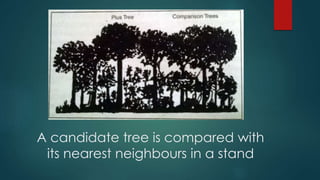
A candidate tree is compared with
its nearest neighbours in a stand
Guidelines for selecting candidate
trees
1. Search should be concentrated on stands and plantations that are
average or better in growth and other characters of interest.
2. Stands in which candidate trees are sought should be located on
the same variety of sites where plantations from improved seed will
ultimately be established.
3. When selection are made from plantations, information about the
suitability of the seed source used in the planting should be
obtained.
4. In older stands, the search effort should be confined to trees that
have an age range of no more than 10 to 15 years younger or
older than the projected rotation age of the plantation that are to
be established.
5. Selection should be made from stands that are pure in species
composition as possible.
6. Stands must be avoided that have been logged for poles or pilings or
that have been high graded or thinned from above.
7. The minimum size of a stand or plantation in which a candidate can
be located is immaterial.
8. Preferably only one select tree should be accepted from any one
small natural stand to reduce the possibility of obtaining candidate
tree that are close relatives. Not apply to plantations.
9. Highly desirable for candidate tree to exhibit a heavy flower or cone
crop
10. Once decision has been made to look over an area for candidate
trees, a through systematic search should be made.
11. Comparison or check tree selection should be used when feasible.
General precautions for candidate
tree selection
1. A systematic search for plus tree selection must concentrate on
average or good stand.
2. Selection should be done from uniform age and site conditions, similar
to where the plantation will be established.
3. Isolated trees or border trees in a stand should be excluded.
4. Age of tree should be more than half of the rotation age but less than
the rotation age of the species.
5. No more than 3 to 4 selections per hectare should be preferred.
6. Candidate tree should be selected from upper crown in a stand.
7. Comparison tree should be selected from the near vicinity of the
candidate tree.
8. The candidate tree should be 5% superior in height and 20% in dbh.
9. The candidate tree must be free from apparent pest and disease
damage.
10. Stem should not have crooked bole.
11. Trees should have good seed production capacity.
12. Select few trees (30-40) from large part of species-distribution range
with utmost care to avoid the extra environmental advantage.
13. Traits of economic significance should be determined by the
objective of plus tree selection.
14. Traits for selection should be arranged according to economic
priority in descending order.
15. Record the ownership, geographical information and map of the
area of plus tree selection.
Reference
 Zobel, B. and Talbert, J. 1984. Applied Forest Tree Improvement. The
Blackburn Press, USA, 505p.
 Surendran, C., Sehgal, R. N. and Paramathma, M. 2003. Textbook of
Forest Tree Breeding. ICAR, New Delhi, 247p.
 Manadal, A. K. and Gibson, G. L. 1998. Forest Genetics and Tree
Breeding. CBS Publishers, New Delhi, 268p.
Comparison tree method of selection

Comparison tree method of selection

  • 1.
  • 2.
    SELECTION  First stepin any tree breeding/ improvement programs.  Choose most desirable individuals for use as parents in breeding and production programs.  Enables to attain significant amount of genetic gain as quickly and inexpensively as possible, at the same time maintaining a broad genetic base to ensure future gains.  Selection methods depends on  Type of genetic variation in the population  Availability of pedigree information  Degree of urgency in establishing production seed orchards  Type of stand (plantations) and species characters  Condition of the forest
  • 3.
    Selection of traits 1.Stem: height, diameter, forking, straightness, taper, bark thickness 2. Branches: number, diameter, angle, distribution 3. Crown: length, width, symmetry, foliage 4. Wood: density, fibre dimensions, gain, workability 5. Phytochemicals: yield, composition, quality 6. Adaptation: effect of drought or other environmental factors, tolerance to pest and pathogen attack
  • 4.
    Selection criteria  Straight,cylindrical, non forking, non twisting bole  Fast growth  Narrow crown  Thin branches with wide branch angles  High wood density and long fibre  Resistance to pest and diseases
  • 5.
    DEFINITIONS  Candidate tree A tree that has been selected for grading because of its desirable phenotypic qualities but that has not yet been graded or tested.  marked with yellow band of 5cm width, 5cm above breast height.  Select, Superior or Plus tree  A tree that has been recommended for production or breeding orchard use following grading.  It has a superior phenotype and appears to be adaptable  it not been tested for its genetic worth, although the chances of its having a good genotype are high for characteristics with a reasonable heritability.  Marked by another yellow band (2) of 5 cm with, 5cm below breast height.
  • 6.
     Elite tree Selected trees that have proven to be genetically superior by means of progeny testing.  Tree is most suited for desired for use in mass production of seeds or vegetative propagules.  Comparison or Check tree  Trees that are located in the same stand , are of nearly the same age, are growing on the same or better site as the select tree and against which the select tree is graded
  • 7.
    Comparison/ check-tree method Suitable for plantations and even aged natural stands  First selection of candidate tree – screened for traits in relation to few surrounding trees  Comparison tree should be selected from dominant or co-dominant crown with similar age and site conditions, approximately within 100m range from the candidate tree.  Superiority of the candidate tree over the average of the comparison tree is worked out for each trait  Candidate tree is designated as plus tree if it proves superior to the comparison trees; otherwise rejected.  Objective is to adjust or correct the phenotypic value of the candidate tree for environmental effects common to that particular stand.
  • 8.
     Comparison treemay be related to the candidate tree – will become with in family selection –result in reduction in genetic gain  Not bad trees are chosen but the good trees are discarded  Improved by increasing the number of comparison trees and by using comparison trees not immediately adjacent to the candidate tree
  • 9.
    A candidate treeis compared with its nearest neighbours in a stand
  • 11.
    Guidelines for selectingcandidate trees 1. Search should be concentrated on stands and plantations that are average or better in growth and other characters of interest. 2. Stands in which candidate trees are sought should be located on the same variety of sites where plantations from improved seed will ultimately be established. 3. When selection are made from plantations, information about the suitability of the seed source used in the planting should be obtained. 4. In older stands, the search effort should be confined to trees that have an age range of no more than 10 to 15 years younger or older than the projected rotation age of the plantation that are to be established.
  • 12.
    5. Selection shouldbe made from stands that are pure in species composition as possible. 6. Stands must be avoided that have been logged for poles or pilings or that have been high graded or thinned from above. 7. The minimum size of a stand or plantation in which a candidate can be located is immaterial. 8. Preferably only one select tree should be accepted from any one small natural stand to reduce the possibility of obtaining candidate tree that are close relatives. Not apply to plantations. 9. Highly desirable for candidate tree to exhibit a heavy flower or cone crop 10. Once decision has been made to look over an area for candidate trees, a through systematic search should be made. 11. Comparison or check tree selection should be used when feasible.
  • 13.
    General precautions forcandidate tree selection 1. A systematic search for plus tree selection must concentrate on average or good stand. 2. Selection should be done from uniform age and site conditions, similar to where the plantation will be established. 3. Isolated trees or border trees in a stand should be excluded. 4. Age of tree should be more than half of the rotation age but less than the rotation age of the species. 5. No more than 3 to 4 selections per hectare should be preferred. 6. Candidate tree should be selected from upper crown in a stand. 7. Comparison tree should be selected from the near vicinity of the candidate tree. 8. The candidate tree should be 5% superior in height and 20% in dbh.
  • 14.
    9. The candidatetree must be free from apparent pest and disease damage. 10. Stem should not have crooked bole. 11. Trees should have good seed production capacity. 12. Select few trees (30-40) from large part of species-distribution range with utmost care to avoid the extra environmental advantage. 13. Traits of economic significance should be determined by the objective of plus tree selection. 14. Traits for selection should be arranged according to economic priority in descending order. 15. Record the ownership, geographical information and map of the area of plus tree selection.
  • 15.
    Reference  Zobel, B.and Talbert, J. 1984. Applied Forest Tree Improvement. The Blackburn Press, USA, 505p.  Surendran, C., Sehgal, R. N. and Paramathma, M. 2003. Textbook of Forest Tree Breeding. ICAR, New Delhi, 247p.  Manadal, A. K. and Gibson, G. L. 1998. Forest Genetics and Tree Breeding. CBS Publishers, New Delhi, 268p.

Editor's Notes

  • #3 Instance: difference in one or two age will made younger ones being suppressed
  • #5 Ideal plus tree has
  • #8 Most common method, Teak, sandal, bombax ceiba
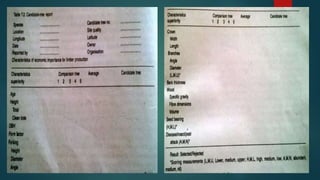
  • #11 Observations are recorded on the character of economic importance on the candidate tree report for the selection of candidate tree and the adjacent 4-5 comparison/ check trees.
  • #13 Truly silvicultural and mechanically thinned can be selected